Tag: Penélope Cruz

Pain & Glory (2019)

Antonio Banderas excels as a version of the director in Almodóvar’s Pain & Glory

Director: Pedro Almodóvar

Cast: Antonio Banderas (Salvador Mallo), Penélope Cruz (Jacinta Mallo), Nora Nacas (Mercedes), Asier Etxeandia (Alberto Crespo), Leonardo Sbaraglia (Federico), César Vicente (Eduardo), Cecilia Roth (Zulema), Julieta Serrano (Older Jacinta Mallo), Raúl Arévalo (Salvador’s father)
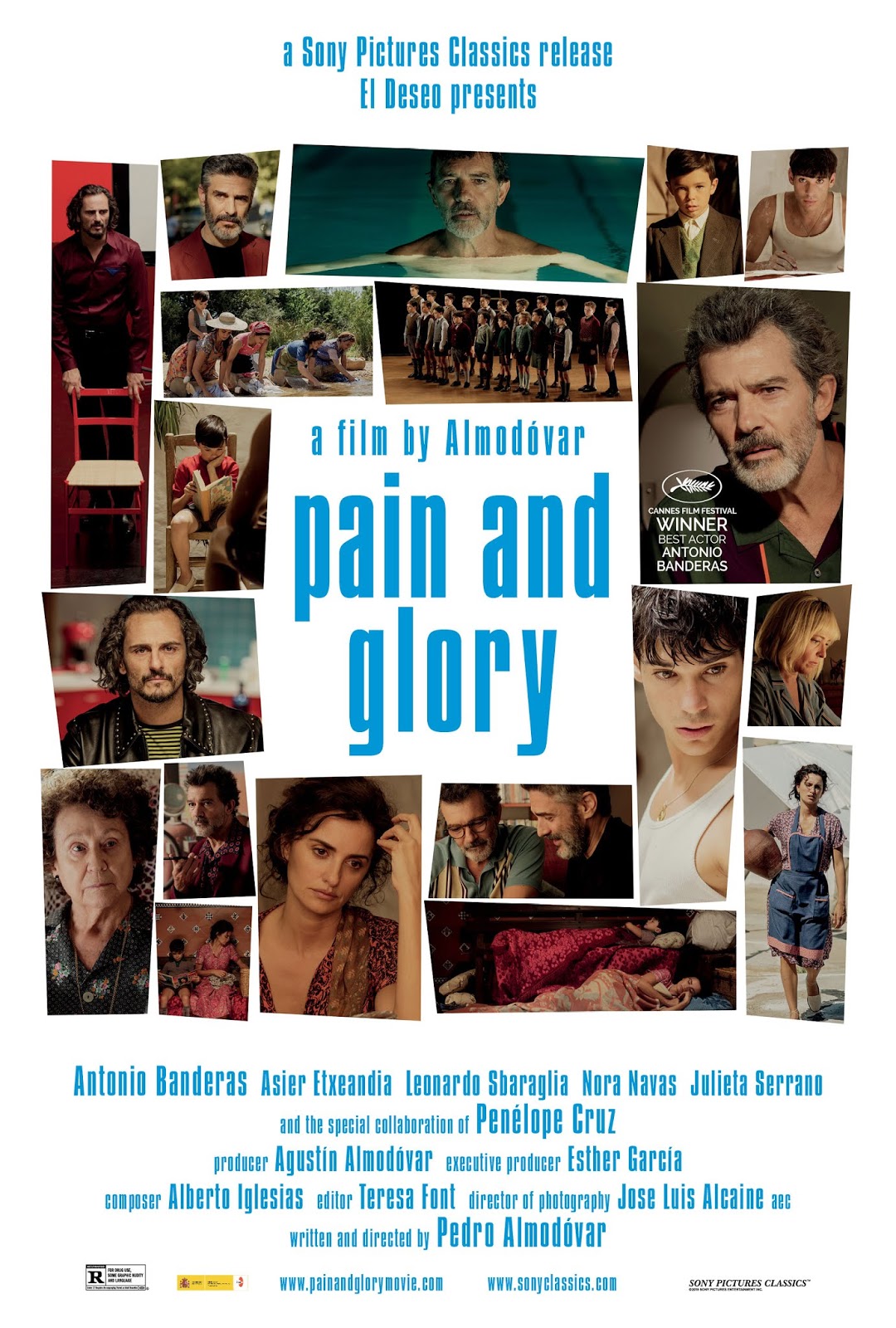
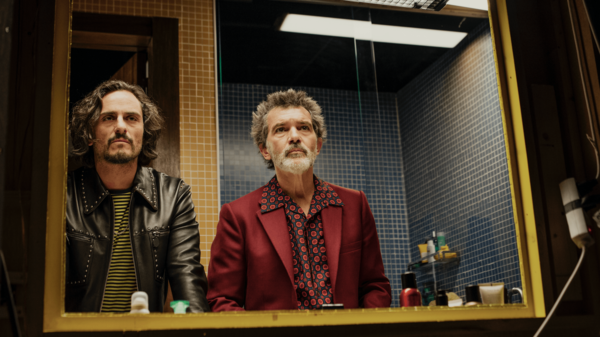
Every artist in time reflects on his roots, and many explore these reflections in their medium of choice. The master of this in the world of cinema was Fellini, and any film that riffs upon the biography of auteur directors is destined to be described as Fellini-esque. That’s an appropriate title for Pedro Almodóvar’s Pain & Glory, which explores Almodóvar’s childhood spiced with a fictionalised version of himself in the present day, struggling with lack of drive and against a series of crippling illnesses. It makes for a gently structured, quietly moving picture shot with a classic simplicity but filled with genuine emotional feeling.

Salvador Mallo (Antonio Banderas) is our Almodóvar substitute, his body falling apart from a range of illnesses and diseases that have prevented him from directing a film for years. Asked to present a screening of a classic film of his from almost thirty years ago, he contacts the lead actor of the film Alberto Crespo (Asier Etxeandia) who he has not spoken to since making the film. The two quickly re-bond – helped by Mallo’s curiosity about trying the heroin of which Crespo is a habitual user. Mallo finds the drugs not only help to ease his pain, but also bring back a flood of memories about growing up with his mother Jacinta (Penélope Cruz) as a poor peasant boy, educated in a convent school and teaching a young labourer Eduardo (César Vicente) to read and write.

Almodóvar is best known for a electric, dynamically assembled films but he is also a patient and intelligent craftsman and sensitive director with an eye for pace, and Pain & Glory is a far more meditative piece, as befitting the sense that both Almodóvar and Mallo are reflecting on their entire lives. The general structure fits in to a well-worn template of such films, with Mallo dealing with dissatisfaction and frustration in the present day but, through memories, finding a sense of peace and an ability to move on and reconnect with his life and work. But familiar as it is, it is a template that works exceptionally well – and I felt a real sadness and frustration that Mallo is drawn towards the superficial, short-term, comfort that drugs bring him when he is unable to write and direct films.

While I find some of the films attitudes towards drugs a little unsettling (Crespo seems willing to kick them at will, which I find rather hard to believe and even a bit irresponsible), it does show that this is a false nirvana for Mallo and that the more time he spends (as he eventually recognises) wallowing in this rather than finding avenues for artistic creation, is time wasted. Crespo (very well played by Asier Etxeandia, despite the character being a bit of a cliché) may well be a great actor – his performance of a Mallo short story memoir carries real emotional weight – but he is a lightweight human being, the very opposite of the far more deeper feeling (and thinking) Mallo. 

It’s that exploration of Mallo’s personality, art and how the two relate to his memories of his past that really powers the movie. Mallo is of course played by Almodóvar’s muse Antonio Banderas – and this might well be the greatest performance of Banderas’ career. I’m sure he has never been as sensitive, gentle, soft, tender and vulnerable as is here. Looking thinner and more delicate than ever before, Banderas keeps emotion carefully in check but playing constantly in the eyes. He’s fabulous, a wonderfully humane and beautiful performance.

Matching this quality, the sequences that really kick into gear in the modern storyline are those that carry real emotional meaning for Mallo/Almodóvar. The first is a meeting between Mallo and former lover Federico (Leonardo Sbaraglia, quite excellent – tender, heartbreaking and real) , which is an intensely personal, gently played, sad but also affectionate and hopeful conversation about a relationship loved and lost, which belongs in the past but which can bring a certain contentment in the future. It’s also a scene that demonstrates how the past sometimes stays better in the past, and that quieter reflections on lost relationships can be better and richer than restarting them. 

This also mixes in well with Mallo’s yearning to be free to continue his creative output, unburdened by disease and illness, mixed with a loving guilt for his mother who sacrificed so much to give him chances in life and whom he feels he failed in her final years (despite spending them caring for her in his home). The later sequences showing Mallo looking after his mother (a wonderful performance by Julieta Serrano) hum with an intimacy and emotional honesty that work all the better for the film’s careful interweaving of past and present.

Extended flashbacks – driven perhaps by Mallo’s exploration of his past fuelled by drugs – chronicle his childhood with his mother, marvellously played by Penélope Cruz, Almodóvar’s other muse. Cruz’s maternal, caring but strong-willed embodiment of Mallo’s mother is exquisite, from singing while washing laundry at the lake to sadly encouraging her son to believe convent school is his best chance of a full education. It’s clear that Mallo’s mother believes she knows what is best for her son – and, as a late sting shows, sometimes mean she takes drastic decisions without her son’s knowledge. The flashbacks cover everything from Mallo’s education to his first infatuation (and realisation of his sexuality) with a young married labourer who he teaches to read and write.

Pain & Glory explores all these memories with a touching intimacy but also a clear-eyed reality, and Almodóvar’s honesty in these scenes and with his own feelings about his past and how it has powered his art have a real emotional force to them. With superb performances throughout the cast, the film is a testament to the restraint and careful lack of flash, of a director willing to explore his life without flash or bangs. At one point Mallo opines “a great actor is not the one who cried, but the one who knows how to contain the tears”. It could be a strapline for the whole movie.
Murder on the Orient Express (2017)


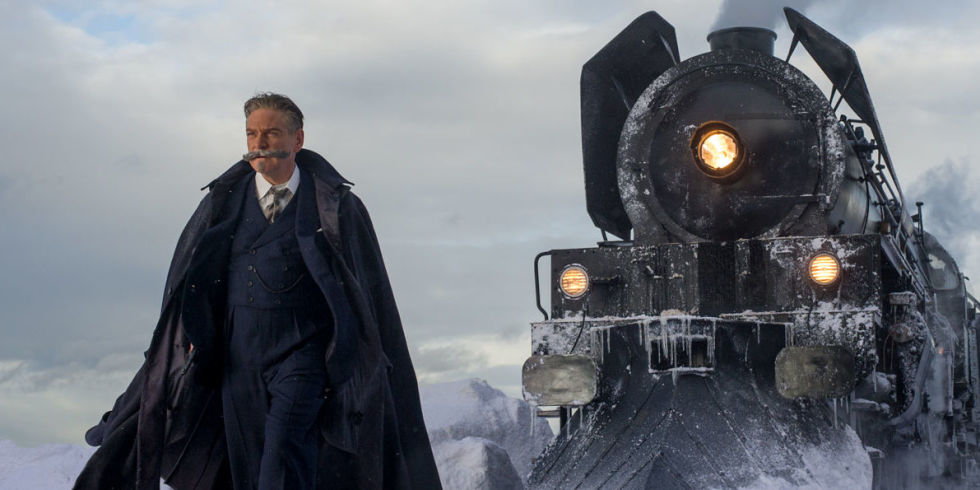
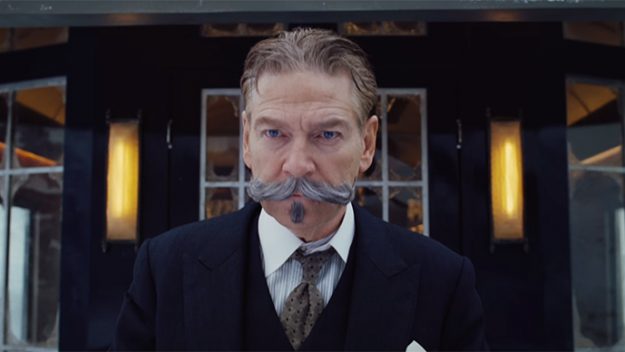
A dishevelled Kenneth Branagh (and tache) investigates a Murder on the Orient Express

Director: Kenneth Branagh

Cast: Kenneth Branagh (Hercule Poirot), Tom Bateman (Bouc), Penélope Cruz (Pilar Estravados), Willem Dafoe (Gerhard Hardman), Judi Dench (Princess Dragomiroff), Johnny Depp (Samuel Ratchett), Josh Gad (Hector MacQueen), Derek Jacobi (Edward Masterman), Leslie Odom Jnr (Dr Arbuthnot), Michelle Pfeiffer (Caroline Hubbard), Daisy Ridley (Mary Debenham), Marwan Kenzari (Pierre Michel), Olivia Colman (Hildegarde Schmidt), Lucy Boynton (Countess Elena Andrenyi), Manuel Garcia-Rulfo (Biniamino Marquez), Sergei Polunin (Count Rudolph Andrenyi), Miranda Raison (Sonia Armstrong)

Is there a murder mystery with a more widely known resolution than Murder on the Orient Express? Possibly not – if for no other reason that film and television versions of this story are as numerous as the suspects in the actual mystery. If that wasn’t a big enough challenge for Branagh to take on, he also joins a list of umpteen actors to play Poirot himself: following in the (very precise) footsteps of the big guns: Finney, Ustinov and of course, above all, David Suchet. How does his version of this most famous detective in his most famous adventure measure up? Well, with mixed results.

For those who don’t know, Hercule Poirot (Kenneth Branagh) is “possibly the world’s greatest detective”. Here, he is travelling back from Istanbul  on the Orient Express, a berth having being secured at the last minute by his friend Bouc (Tom Bateman) the director of the line. En route he is approached by the sinister Ratchett (Johnny Depp), who asks if he can serve as his bodyguard. Poirot refuses – only for Ratchett to be murdered that night. Bouc asks Poirot to investigate – and it soon becomes clear that the dozen other passengers in Ratchett’s carriage could all have had motives to kill him. But who is the killer?

Murder on the Orient Express is on the cusp of being a very good film. But, like the train itself, it gets bogged down too often in changes from the source material that add nothing, action scenes that feel toe-curlingly out of place, and bombastic filming that goes a little bit too far. In many ways it captures some of the faults of its director, my much-loved hero Kenneth Branagh – and I do love him, but as a director he has a tendency to make things too big, to wear his love of the complex shot on his sleeve; to basically try too hard. As a director, that’s what it feels like he’s doing here.

It’s filmed with a luscious, chocolate box, old-school Hollywood grandeur. The camera swoops and zooms over some gorgeous landscape as the train puffs through snowy mountain scenery. There are some loving travelogue tracking shots of Istanbul and Jerusalem. The film lingers with a loving eye on the luxury and class of the Orient Express itself (including some egregiously clunky product placement). The costumes look lovely.  But the end result of all this lavish filming is that it sometimes goes too far towards the reassuring, Boxing-Day-afternoon treat. 

Everything is a little too technicolour at points. It also means that some of Branagh’s more self-consciously tricksy camera work stands out a little too much. A “birds-eye” view of the discovery of the body (the camera above the heads of the actors looking straight down) is oddly disconnecting – it works a lot better when Poirot and Bouc examine the crime scene, giving the audience a god like view of the scene. Some overly complicated shots swoop up along the aqueduct where the train is stuck, past Poirot speaking to characters, then over the top of the train. It’s a rather too overblown and clumsy attempt to make a conversation seem cinematic – it feels a little forced.

It’s one of many points where the film feels like it is trying too hard to make the story edgier or more overtly cinematic. Not the least of these are sequences that up the action quotient. I feel very confident this is the first Poirot film you’ll ever see where the hero is involved in not one but two dynamic fights. One of these is a bizarre chase down the aqueduct with Poirot and another character. The second involves gunfire (an effective shock to be fair) and Poirot using his cane as a weapon in hand-to-hand combat. 

There is nothing wrong with making Poirot more active – Branagh’s character is very much the ex-soldier and policeman, busting open the door to Ratchett’s berth to investigate, walking over the train’s roof, brow-beating the odd suspect (at one point at gun point). It’s just all too much – what audience is this playing to? Who really goes to a Poirot film expecting a goddamn fight scene? Even Count Andrenyi is introduced ninja-kickboxing photographers (I’m not joking here) – is this really what Agatha Christie would have wanted?

There are some odd choices made to deepen Poirot’s character. He is given some sort of lost romantic interest – no less than four times in the film he is given scenes where he holds a photo and bemoans “mon cher Kat-a-rean”. In the opening sequence, Poirot’s love of symmetry is introduced by him accidentally stepping in a cow pat and then stepping in it with his other foot to make each equal. Not only does a “stepping in shit” joke seem wildly out of place, but I don’t believe someone as fastidious and observant as Poirot would even step in it in the first place, let alone choose to step into it twice.

The train doesn’t just stop, it’s nearly taken out by an avalanche. A knife isn’t just discovered, it’s literally found stabbed into a character’s back. Characters have been changed to allow a more diverse cast – which I applaud – but making Arbuthnot a soldier turned doctor is a change that makes very little sense. The claustrophobia of the original is lost by having workers turn up almost immediately to dig the train out. Several scenes are filmed outside, with workers surrounding the train digging it out. Some of these undermine the original or are a little silly.

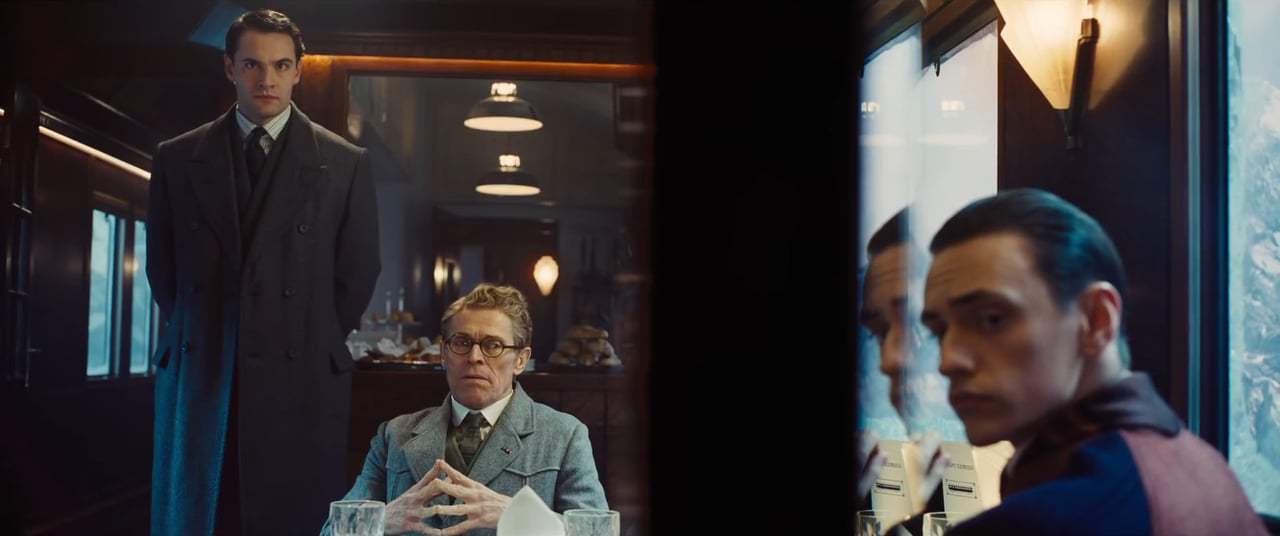
The suspect assemble

But I’m being really hard on this film because there are major flashes of promise here. Not least in Branagh’s performance as Poirot. I’m very confident in saying that, after David Suchet of course, this is the second best Poirot committed to film. The first thing anyone will notice is of course the moustache. Yes it looks absurd, but you attune to it quickly. It’s also a plot point: Poirot uses it, and his eccentricities, to lure people (Columbo style) into a false sense of security. When the film relaxes into just letting Poirot investigate (and hues closer to the original), Branagh gives Poirot a warm humanity and gentleness. His eyes are a wonder – intense disks of sadness. 

Branagh gives Poirot a love of order and justice that defines his world view – and the film introduces a moral conundrum for Poirot in the solution of the crime. I would say David Suchet’s TV version did this better – stressing Poirot’s Catholicism and belief in the rule of law as major factors that conflict him when confronted with the solution. But Branagh captures a real sense of Poirot’s conflict (even if the solution reveal is overplayed and overshot – right down to a “last supper” style tableaux in a railway tunnel) and his sadness, confusion and decency are really lovely – there is even a very neat touch with him forgetting to straight and smarten his appearance, as he deals with the ramifications of his solution to the murder. He looks like cartoon character, but he makes Poirot a real man. I would definitely like to see him do the role again.

The rest of the all-star cast rather struggle for crumbs, as the focus remains solidly on Poirot (largely because the film is intended as the possible first in a series). Tom Bateman is excellent as Bouc, charming and endearing but also given a character arc that sees him develop and change. Of the stars, Depp is suitably grimy as Ratchett, Pfeiffer imperiously stylish and skittish as Hubbard and Odum Jnr affecting as Arbuthnot. I was very taken with Daisy Ridley’s Mary Debenham, a young charm hiding steel underneath. Dafoe, Dench, Colman, Jacobi and the rest are given little to do but are reliably excellent when they are. Others like Cruz feel wasted. 

When the film focuses on Poirot simply investigating, it is very good. Each interrogation of the passengers is brilliantly played by Branagh – Poirot subtly adjusting his methods and approach depending on the person he is talking to. Poirot’s introduction sequence in Jerusalem has a playful Sherlock feel to it: Poirot solving a crime in seconds (having been dragged from his hotel, where he pickily demands eggs that are perfectly equal), including accurately predicting how the criminal will try and escape. There are lots of lovely moments – but just when you settle down to enjoy it, something wildly over-the-top or silly happens.

Murder on the Orient Express is by no stretch of the imagination a bad movie. In some places, it’s charming and a lot of fun. If it’s designed for watching on a bank holiday afternoon it works very well. But it’s, at best, the third best version of this story on film (after the 1974 Lumet film and the Suchet TV version). Do we really need to watch the third best version of an already familiar story? If we could transplant Branagh’s performance into Lumet’s film, now that would be something. But as it is, we’ve got a decent if flawed film that just tries too hard to do too much.