Tag: Peter Dinklage

Transformers: Rise of the Beasts (2023)

Transformers: Rise of the Beasts (2023)

Transformers serves away from the charm of Bumblebee back to the tedious machismo of Bay

Director: Steven Caple Jnr

Cast: Anthony Ramos (Noah Diaz), Dominique Fishback (Elena Wallace), Dean Scott Vazquez (Kris Diaz), Luna Lauren Velez (Breanna Diaz), Peter Cullen (Optimus Prime), Ron Perlman (Optimus Primal), Peter Dinklage (Scourge), Michelle Yeoh (Airazor), Pete Davidson (Mirage), Liza Koshy (Arcee), Colman Domingo (Unicron)

Somehow the Transformers franchise lucked out and managed to make a film I actually wouldn’t feel awkward showing to a child. Bumblebee avoided the crude sexualisation and graphic violence (hidden by the fact you are watching CGI engine oil and bits of metal flying around, rather than blood and bits of human flesh) of Michael Bay’s films. I really enjoyed it. I can’t really say the same about this follow-up. I’d at least let a child watch it – although it’s the cinematic equivalent of letting them have a Big Mac for dinner.

Transformers: Rise of the Beasts could have continued in the tone of Bumblebee, a delightful mix of cartoon and Buster Keaton/Laurel and Hardy. Instead, it takes tiny elements of that, then mashes them up with the throw-it-all-at-the-screen style of Bay. It’s not a happy marriage, and Rise of the Beasts is tired and overly familiar, crammed with crude banter and the sort of mass smackdown we’ve seen done time-and-time again. Give me strength. Rise of the Beasts isn’t really a sequel to Bumblebee – the events of that film are referred to only in a blink-and-you’ll-miss-it reference. The boyish charm of Bumblebee is drenched in audio clip quotes from Scarface and the like. Instead, it’s another “end of the world seconds away from a giant robot monster” flick.

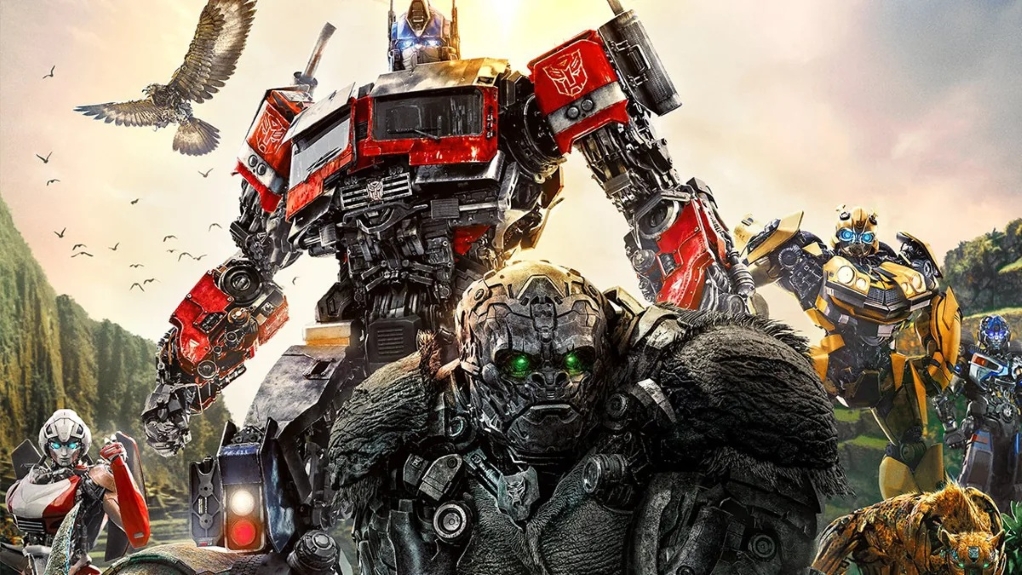
Far in the future Unicorn (voiced with regal indifference by Colman Domingo), the planet eating robot from the 1985 film (when he was voiced by a final pay-cheque collecting Orson Welles) is trapped in another dimension, but wants to break into ours. He sends his minion Scourge (Peter Dinklage, dialling it in big time) to 1990s Earth to hunt down the MacGuffin that will do it. Only Optimus Prime (Peter Cullen) and his Autobots can stop him, allied with an ex-soldier desperately trying to help his kid brother Noah Diaz (Anthony Ramos) and Elena Wallace (Dominique Fishback) a junior archaeologist who can unearth the MacGuffin from where it has been hidden centuries ago by the Maximals, a group of transformers descended from our Autobots who transform into giant mechanical animals (their leader Optimus Primal is a Kong style ape).

It all seems a million miles away from the charm of the first film, with a teenage girl bonding with her first car who just happens to be a clumsy robot. There is precious little charm at all Rise of the Beasts. The human characters are either faintly forgettable, loud and brash or serve only as plot points. Anthony Ramos has to do a lot of digging to find any depth in a character given only a cursory plotline of desperation to provide for his mum and brother. Dominique Fishback’s archaeologist has the faintest of backstories about being cheated out of the credit for her work, before she’s fiddling with MacGuffins with handwave lines. The action zips across two universes and two continents, but never seems to really find firm grounding for itself.

There’s also something rather sad about the film swopping out the fairy tale elements of Bumblebee with a far more conventional Bro-romance. Ramos’ street-wise ex-soldier is paired up with Peter Davidson’s Mirage, a loud-mouthed Autobot who, despite a few witty lines, basically comes across as a street-wise bro with a hot streak of immaturity. There is a streak of laddish banter throughout the film – none of it, thank God, as appallingly sexist or racist as what passes for this sort of chat in Bay’s films – that essentially doubles down on restoring the franchise to something that appeals only to teenage boys and adults who wish they still were teenage boys.

After the broadening out of Bumblebee with a female lead given actual agency, this feels like a retrograde step. Rise of the Beasts does manage to pay this Bros plotline off with a surprisingly effective scene of self-sacrifice – but does so while not shirking on red-blooded (or red-oiled) young men whooping and cheering as they blast stuff out of the sky. It’s a step firmly back towards a territory that places male relationships at a premium – be it bros or actual brothers – and the bonds between men a world that leaves women on the outside looking in.

Not to mention the plot continually readjusts its stakes and characters depending on the requirements from scene to scene. Scourge is an unstoppable killing machine… until the plot requires him not to be. Characters are killed off… until the plot needs them to come back to life. Characters are fixated on their own needs… until the plot needs them to be altruistic. It combines that up with a final battle sequence that feels painfully derivative of the end of Avengers: Endgame, with Scourge mustering an army of rent-a-baddies to slow down the heroes while he slowly plugs a thingamee into a do-hickey.

Even Optimus Prime takes a backward step. While Bumblebee salvaged some likeability out of this hero, Rise of the Beasts very much returns him to Bay form: a deeply flawed leader with anger-management issues, who slices and dices foes with reckless abandon, rips off heads and uses neat kiss-off lines like “Then DIE”. I suppose he doesn’t execute at point-blank range a surrendering foe begging for mercy (Bay did this twice!) but he still hardly feels like an admirable hero. Rise of the Beasts vaguely acknowledges this by having Prime go on a loose arc of learning to put the needs of humans on a level with the Autobots (yup he’s also a proto-racist at the start) but it’s a very loose peg to hang a hero on.

Rise of the Beasts gives up on any pretensions of doing something fresh, engaging or different with the series. Even the beasts, for all their animalistic looks, are basically barely characters, more different looking toys imported into a flagging cinematic universe (Ron Perlman and Michelle Yeoh lazily yawn their way through terminal dialogue). While Bumblebee took the starting principles of the franchise and found the joy in them, Rise of the Beasts is a teenage wet dream of toys hitting each other to no great purpose, that places male relationships at its heart and leaves you with nothing to really care about. It’s a callback to everything bad about this franchise.
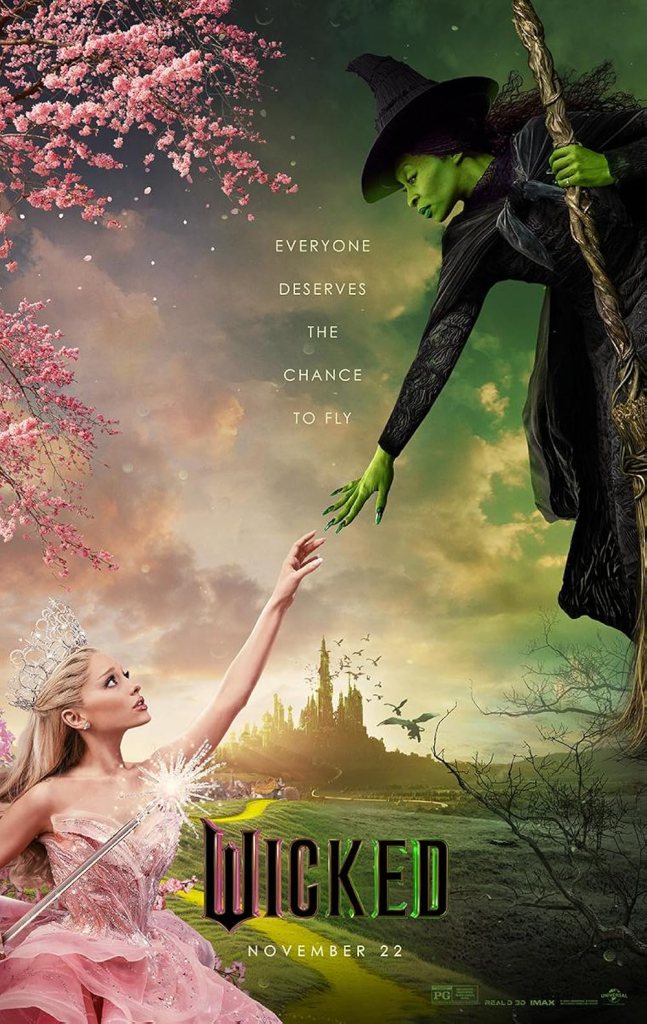
Wicked (2024)

Wicked (2024)

Hugely enjoyable and electrically filmed (sung and danced) adaptation of the classic stage musical

Director: John M. Chu

Cast: Cynthia Erivo (Elphaba Thropp), Ariana Grande (Galinda Upland), Jonathan Bailey (Fiyero Tigellar), Michelle Yeoh (Madame Morrible), Jeff Goldblum (Wizard of Oz), Ethan Slater (Boq Woodsman), Bowen Young (Pfannee), Marissa Bode (Nessarose Thropp), Peter Dinklage (Dr Dillamond), Bronwyn James (Shenshen), Andy Nyman (Governor Thropp)

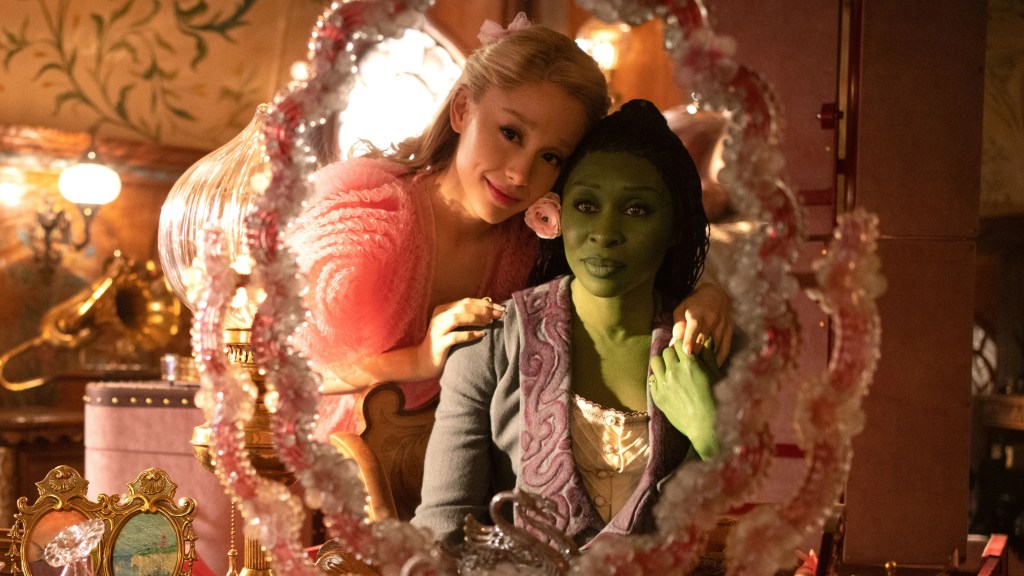
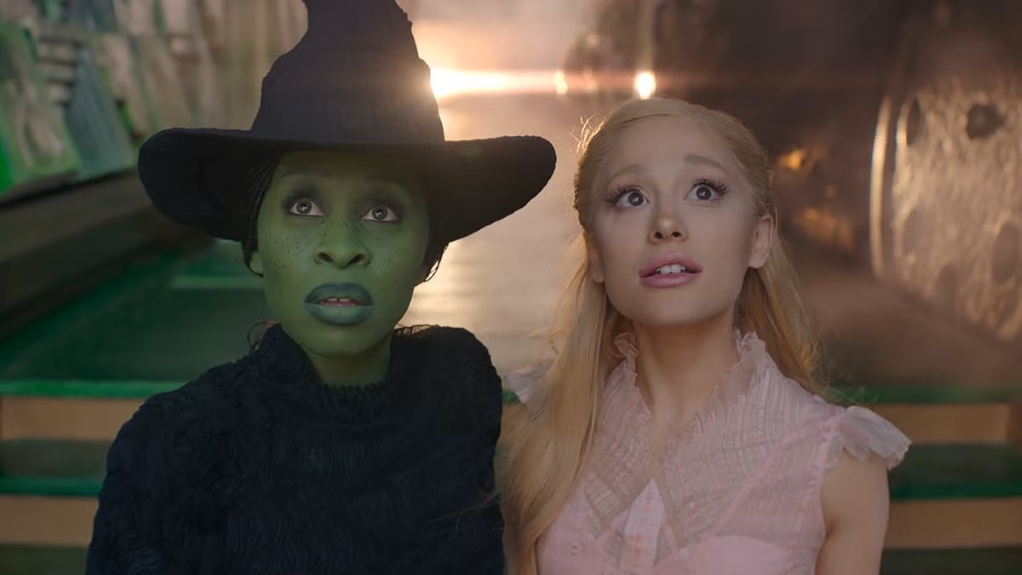
I might be the only person who missed the phenomenon of Wicked, a smash-hit musical that filled in the back story of The Wizard of Oz. Set long before the arrival of Dorothy and her march down that yellow brick road, it covers the meeting and eventual friendship of Elphaba (Cynthia Erivo) future Wicked Witch of the West and Galinda (Ariana Grande) future Glinda the Good, at Shiz University (a sort of Ozian Hogwarts). Wicked is a grand, visual spectacular crammed with memorable tunes and show-stopping dance numbers and it’s bought to cinematic life in vibrant, dynamic and highly enjoyable style by John M. Chu.

At Shiz, Elphaba is snubbed by all and sundry who can’t see past her green skin. Despised by her father (Andy Nyman) – who we know isn’t her true father (I wonder who it could be?) – she’s lived a life of defensive self-sufficiency. Galinda, in contrast, is effortlessly popular and has never found herself in any situation where she can’t get what she wants. But Elphaba has something Galinda wants – a natural talent for magic that makes her the protégé of Madame Morrible (Michelle Yeoh) – and circumstances end up with the two of them sharing rooms. Surprisingly, a friendship forms when these two opposites find common ground. But will this be challenged when Elphaba is called to the Emerald City to meet with the Wonderful Wizard of Oz (Jeff Goldblum)?

Wicked Part One covers (in almost two and half hours!) only the first act of Wicked, meaning the film culminates with the musical’s most famous number ’Defying Gravity’. The producers proudly stated this was to not compromise on character development by rushing – the more cynical might say they were motivated by double-dipping into mountains of box-office moolah. Despite this, Wicked Part 1 (despite taking pretty much as long to cover Act 1 as it takes theatres to stage the entire musical) feels surprisingly well-paced and the film itself is so energetic, charming and fun you quickly forget the fundamental financial cynicism behind it.

Wicked is directed with real verve and energy by John M. Chu – it’s easily the most purely enjoyable Hollywood musical since West Side Story and one of the most entertaining Broadway adaptations of this century. Wicked is expertly shot and very well edited, its camerawork making the many dance sequences both high-tempo and also easy to follow (Wicked avoids many musicals’ high-cutting failures that make choreography almost impossible to see). And it looks fabulous, the design embracing the bold colours and steam-punk magic of Oz.

It also perfectly casts its two leads, both of whom are gifted performers bringing passion and commitment. Cynthia Erivo’s voice is spectacular, and she taps into Elphaba’s loneliness and pain under her defensive, defiant outer core. It’s a fabulously sad-eyed performance of weary pain and Erivo beautifully conveys Elphaba’s moral outrage at the lies that underpin Oz. Just as fantastic is Ariana Grande. Grande says she had dreamed about playing Galinda since she was a kid (yup, that’s how old this musical is) – and it shows. It’s an electric, hilarious performance that embraces Galinda’s studied sweet physicality, her little bobs and flicks and blithe unawareness of her aching privilege and self-entitlement, but what Grande does stunningly well is really make you like Galinda no matter how misguidedly self-centred she is.

And she really is. Part of Wicked’s appeal is mixing Oz with Mean Girls with more than a dash of racial prejudice. Elphaba is immediately snubbed because she literally doesn’t look right (anti-green prejudice is an unspoken constant) compared to Galinda’s pink-coated, blond-haired perfectness. Galinda is Shiz’s queen bee, followed everywhere by two sycophantic acolytes (delightfully slappable performances from Bowen Young and Bronwyn James) who cheer everything she does and push Galinda to maximise her subtle hazing of the green-skinned outsider. After all, they see popularity as a zero-sum game: the more Elphaba might have, the less there must be to go around for them.

It’s not really a surprise that Elphaba has had a tough time. Oz is dripping with prejudice, racist assumptions and strict hierarchies. From the film’s opening number – ‘No one mourns the wicked’, where Munchkins wildly celebrate Elphaba’s future death – we are left in little doubt there is a culture of blaming those who are different for misfortunes. This sits alongside a purge of unwanted citizens: namely talking animals. Goat professor Dr Dillamond (a lovely vocal performance from Peter Dinklage) is subtly belittled for his goat-accent then dragged in disgrace from the school. A new professor extols the virtues of keeping frightened animals in cages. The casting of Jeff Goldblum helps with creating this genial but cruel world, his improvisational mumbling suggesting a man of arrogant, sociopathic distance under initial aw-shucks charm.

These secrets will impact the friendship between our leads. The extended runtime means it already takes a very long time for the ice between them to thaw (and, for me, their ballroom reconciliation doesn’t land with the cathartic force it needed for the transition from hostility to friendship to completely work), but the exceptional chemistry between Erivo and Grande helps sell it. What Wicked does very well though is show the fault-lines in this relationship. Galinda’s answer to all Elphaba’s problems is for her to be more like her, while Elphaba has clearly never had a real friend in her life and wants one more than anything. There is true kindness and love between them, but Elphaba remains an outsider with cause to be angry against the system while Galinda is the ultimate insider for whom the system has always worked. Wicked Part 1 does a very good job of never letting these facts escape your notice, for all the charm of an unexpected friendship.

Wicked Part 1 though is also a monstrously entertaining film. The song and dance numbers are spectacular – the pin-point choreography of ‘What Is This Feeling’ is superb, while the power ballad intensity if ‘The Wizard and I’ is perfectly nailed by Erivo. Jonathan Bailey comes close to stealing the limelight with a show-stopping turn as the charming, likeable but slightly rogueish Fiyero, his ‘Dancing Through Life’ routine in particular being a stunning display of athletic dancing matched with perfect vocals. Every number is given its own carefully judged tone, with wonderfully complementary photography and editing, to create a film that leaves you eagerly wanting more.

I didn’t really know the musical coming into it, but after Jon M Chu’s excellent production, I’m excited to see what happens in Part (Act) 2.

Hunger Games: The Ballad of Songbirds and Snakes (2023)

Hunger Games: The Ballad of Songbirds and Snakes (2023)

Terminally dull prequel, full of backstory you won’t care about at all

Director: Francis Lawrence

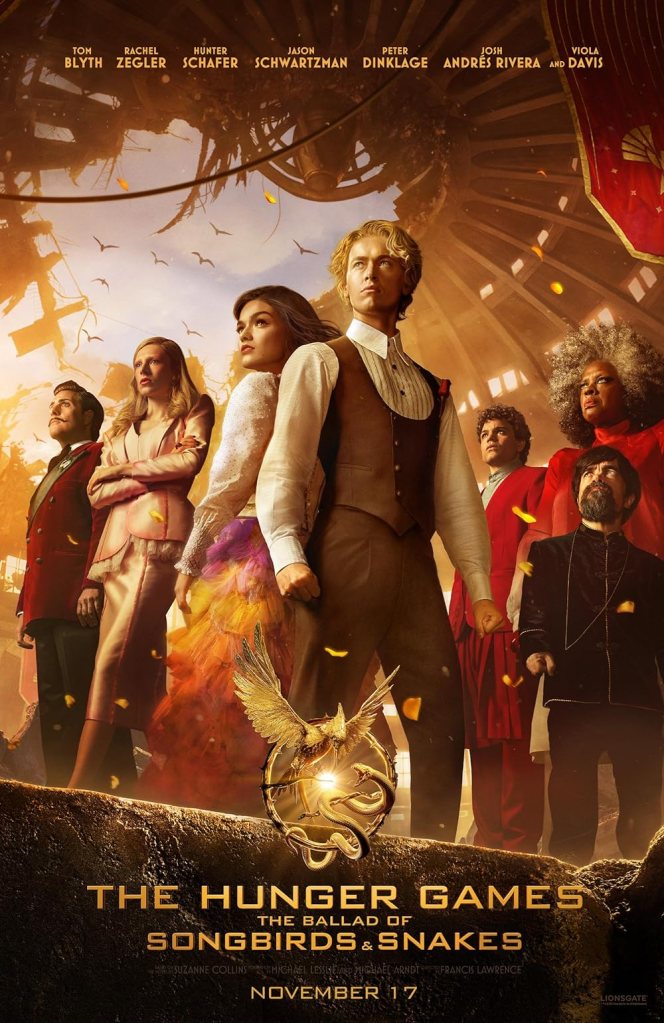
Cast: Tom Blyth (Coriolanus Snow), Rachel Zegler (Lucy Gray Baird), Josh Andrés Rivera (Sejanus Plinth), Viola Davis (Dr Volumnia Gaul), Peter Dinklage (Casca Highbottom), Jason Schwatzman (“Lucky” Flickerman), Hunter Schafer (Tigris Snow), Fionnula Flanagan (Grandma’am), Burn Gorman (Commander Hoff), Ashley Liao (Clemensia Dovecote)

Did you watch Hunger Games and wonder – ‘this is great and all but where did that guy Coriolanus Snow come from, eh’? Not sure I did. And I’m not sure I really needed to know, now that I’ve sat through all interminable 158 minutes of Hunger Games: Ballad of Songbirds and Snakes or Hitler: The Early Days. Imagine, if you will, the original Hunger Games movie – but if it was much longer, had an utterly uninteresting lead character and took itself so seriously you’d think it was offering a solution to third world debt and climate change all at once. Ballad of Songbirds and Snakes worst crime isn’t that it goes on forever, that it retreads old ground with no new ideas or that it feels like a pointlessly over-extended footnote. It’s that it is overwhelmingly, crushingly, dull.

People didn’t care about the back story: they cared about Katniss Everdean, a perfectly crafted character, hugely engaging and relatable on every viewing. I cared about her struggle to protect the people she loved not the backdrop of Panem politics. Did anyone? If I was interested in anything in Panem politics it was the way the Games both terrified the huddle masses of the districts and gave them hope. Unfortunately, this film either didn’t understand that, didn’t care or assumed we’d happily invest in the original’s villain if he was buff and had a dreamy girlfriend.

Young Coriolanus Snow (Tom Blyth, doing his best to sound like Donald Sutherland) is one of the leading students in Panem, selected to mentor a tribute through the 10th Hunger Games. Young Snow’s loins heat-up when his tribute is manic pixie dream-girl Lucy Gray (Rachel Zegler) from District Twelve. But what excites him more: a tumble with a girl from the sticks, or persuading outlandishly loopy games master Dr Volumnia Gaul (Viola Davis, the only person having fun) he knows how to turn this gladiatorial deathmatch into ratings gold? You got one guess what he picks.

Though it takes him a very, very, very long time to pick it. We watch this Proto-Hitler embrace his inner sociopath, through a weary trudge in Hunger Games lore with the origins of virtually every prop in the original movies lovingly laid out for us. Ever wondered why Snow wears that buttonhole? This is the film for you and then some. Almost every single thing in Ballad of Songbirds and Snakes is linked to something in the original movies. It’s the sort of unimaginative, world-shrinking yawn-fest where nearly every character shares a surname of a character from the original films – but of course Caesar Flickerman’s dad has exactly the same job, personae and style as he does!

You could let this go if Ballad of Songbirds and Snakes had an interesting story of its own. But it’s tedious, self-important plot makes Attack of the Clones look like Tolstoy. It chucks in a little bit of arena slaughter, but inexplicably makes it unclear how many of Coriolanus’ suggestions for improving the show are actually changing things. When the tributes perform for ‘favour’ is that something they always did (as most people behave like it is) or because Coriolanus scrawled memo suggested it (as the film implies)? The wider impact is also lost: are people bonding with Lucy Gray or having their child-killing-urges ticked in brand new ways by Coriolanus? Who knows.

It doesn’t help that Ballad seems shy about making Coriolanus himself a villain. It gives Tom Blyth a difficult act to pull off and he’s left playing his cards so close to his (inevitably) buff – his future sadism doesn’t stand in the way of a good topless scene in this film – chest that rather than wondering what will top him into sociopathy, he instead becomes a flat, boring character, with even his lust for Lucy fizzling rather than sizzling.

Rachel Zegler gets a bit more fun as this irritating mix of idealist and realist (she is pretty much whatever the plot needs from scene-to-scene – one minute angrily slapping away offerings of food, the next cowering in shocked fear when danger comes calling), with Ballad at least a good vehicle for Zegler’s vocal talents. But Lucy Gray remains too enigmatic – and, to be honest, just as dull in her unknowability – to ever become someone you care about. And never, for one minute, in her flower-crafted dress and perfect make-up do you believe she is a child of the ghetto in the way you did with Jennifer Lawrence.

Honestly the film misses a hero as complex and multi-layered as Katniss and splitting facets of her into two other characters just creates to incomplete characters. Throw in a plot that lacks any energy – it’s lackadaisical second half, with Coriolanus chucked into the wilderness as a Stormtrooper in District 12, goes on forever – and which gets bogged down in an utterly unengaging and confusing rebellion plotline with is resolved with a nonsensical narrative flourish – and it’s a recipe for disaster. It never, ever get the pulse racing as it stumbles, yawningly, to its end.

The stuff that actually is interesting gets shunted to the sidelines. A bored Peter Dinklage gets a late monologue on the creation of the Hunger Games that you desperately want to hear more about it, but don’t. Viola Davis, barrelling over-the-top under a mountain of demented hair, weird contact lenses and bizarre costumes, keeps talking about ‘the purpose of the Hunger Games’ in a portentous way that sounds like its leading somewhere but never does (so much so, I wondered if the filmmakers even understood the bread-and-circuses-as-control metaphor going on here).

Francis Lawrence directs as if this background-filling pamphlet from Suzanne Collins was a newly discovered Testament. The film is slow, stately and gives even the smallest, most inconsequential moments an unbearable level of self-important significance. It lacks pace and interest – so much so that even the slaughter of eleven scruffy, malnourished children and teenagers feels tired and ‘seen it all before’. There is no mystery, no sense of roads-not-taken, not even any peril . Just small elements of a more interesting later story being slotted dutifully in place, you realise you never wondered where Coriolanus Snow came from because it never mattered in the first place.

Cyrano (2021)

Cyrano (2021)

Slight but enjoyable musical, with the flaws of the original but some virtues of its own

Director: Joe Wright

Cast: Peter Dinklage (Cyrano de Bergerac), Haley Bennett (Roxanne), Kelvin Harrison Jr. (Christian de Neuvillette), Ben Mendelsohn (De Guiche), Monica Dolan (Marie), Bashir Salahuddin (Le Bret), Joshua James (Valvert), Anjana Vasan (Sister Claire), Ruth Sheen (Mother Marthe), Mark Benton (Montfleury), Richard McCabe (Priest), Peter Wight (Ragueneau)

Edmond Rostand’s play has been reinvented time-and-time again. After all, who can’t relate to a man convinced he’s unlovable and uses his poetic heart to write the words to help his rival woo the woman they both love. Erica Schmidt’s stage musical with songs by Aaron and Bryce Dessner from The National, pretty much keeps everything but kicks out the famous oversize nose in favour of making Cyrano a man with dwarfism. Bringing him to life – both here and on stage – is Schmidt’s husband Peter Dinklage, with his stage and screen love Roxanne portrayed by Haley Bennett, wife of Cyrano’s director Joe Wright.

It all helps create an easy-going feeling to Cyrano, a decent, at times impressive musical, that never quite turns into something really lasting but presents several fine songs in its middle act. It’s unfortunate that it’s opening section – and largely forgettable initial number – set the scene less than compellingly, dutifully repeating Rostand via a show-boating Cyrano easily besting a preening actor in a battle of wits, all while casting faintly longing looks at impressed Roxanne. What it doesn’t really do is seize the attention. In fact, what it does is really remind you what a slight story Cyrano de Bergerac really is: and that it only really starts with the Act Two introduction of Christian.

It’s certainly, it feels, where Wright’s interest begins. The romantic triangle between the three – Cyrano and Christian both in love with Roxanne, Roxanne in love with Christian and (perhaps) sub-consciously with Cyrano – introduces drama and stakes into a film that until then largely lacks either. Contrasts are drawn between Cyrano and Christian who share honour and decency, but are polar opposites in terms of confidence. Christian is physically and socially assured but crippled with inarticulate shyness when asked to speak; Cyrano can turn his feelings into poetry, but is convinced he is an unlovable imp, his confidence forever crushed by his appearance.

The concept of exchanging oversize nose for Dinklage’s dwarfism works rather well, when every single camera angle constantly reminds us of Cyrano’s otherness. It also gives a wonderful showpiece for the excellent Dinklage, who brings an intense, grungy charisma to the role. He can do the Cyrano’s performative showmanship, but also expertly demonstrates this is a front to protect his true self from being seen and potentially rejected. It becomes clear Cyrano partly embraces his titanic ghost-writing (hundreds and hundreds of pages), without Christian’s knowledge, because he genuinely feels it is the closest he can come to experiencing a relationship, just as he believes should he ever speak his true feelings they would inevitably be rejected. Dinklage does a wonderful job of balancing inner vulnerability with a mask of cocksure, arrogant confidence.

Cyrano certainly misses the subtle indicators, from the start, that Haley Bennett’s Roxanne might well have feelings for him. Aware that Cyrano de Bergerac often presents not the most flattering picture of Roxanne’s intelligence (she is a woman, after all, fooled for years into believing all those romantic words came from her husband not her lifelong friend). Bennett however let’s a – again perhaps subconscious – suspicion play just around the corner of her eyes, not to mention that her feelings for Cyrano feel a lot closer to romantic from the start. Is she as scared of rejection as Cyrano, put off by his independent front? After all she values honest feelings – and Christian, even if his words come from someone else, is clear about the way he feels in a way Cyrano never is. Kelvin Harrison Jr. is rather charming as this sweet, kind, strangely shy young man, tongue-tied and bemused by long words but with a strong sense of right and wrong.

The film – and the musical – is at its strongest when these three are interacting. Wright’s filmmaking also comes to life, with his more staid and traditional visual set-ups for the theatre-set prologue giving way (via a dynamic one-shot full of ducking and diving camerawork as Cyrano takes out ten assassins single-handed) to a series of balletic scenes. Large-scale musical numbers are accompanied by people going about every-day tasks with a wonderfully choreographed grace: be that bakers rhythmically kneading dough and stocking ovens, to a mass of soldiers fencing in perfect harmony. The songs also pick up considerably in both power and humability, culminating in the affecting Wherever I Fall, an eve-before-battle group number that sees Cyrano’s regiment preparing themselves for what could-be their final night, beautifully shot with a mist-filled coolness.

Cyrano’s slight story remains its weakness and the film can’t quite decide how to expand organically the deception plot at its heart. It’s almost a shame it bravely closes the door on the film’s most obvious protagonist, with Ben Mendelsohn’s De Guiche getting a scowling ‘villainy’ number but proving himself a man of honour. Fundamentally the long introduction to the set-up and the five-year-later coda the film wraps up with end-up feeling unsatisfying. It’s actually too faithful to Rostand, carrying across the original’s flaws. Cyrano embraces the mix of romance, comedy and sadness in its wooing-by-proxy and the odd-couple friendship between Cyrano and Christian, but feels more perfunctory as soon as it has to move beyond this section of the film.

It’s a shame as that central section is actually rather effective with Wright bringing the musical numbers in particular to life with a real delicate beauty. There are some very good performances, especially the heart-felt work from Dinklage, but it eventually strains towards an epic scale its story isn’t quite strong or engaging enough to support.

Three Billboards Outside Ebbing, Missouri (2017)


Frances McDormand is looking for justice in Martin McDonagh’s razor sharp Three Billboards Outside Ebbing, Missouri

Director: Martin McDonagh

Cast: Frances McDormand (Mildred Hayes), Woody Harrelson (Sheriff Bill Willoughby), Sam Rockwell (Officer Jason Dixon), John Hawkes (Charlie Hayes), Peter Dinklage (James), Abbie Cornish (Anne Willoughby), Lucas Hedges (Robbie Hayes), Željko Ivanek (Sergeant Cedric Connolly), Caleb Landy Jones (Red Welby), Clarke Peters (Abercrombie), Samara Weaving (Penelope), Kerry Condon (Pamela), Darrell Britt-Gibson (Jerome), Amanda Warren (Denise), Kathryn Newton (Angela Hayes)

How do we deal with grief? What might it drive us to do? How does it make us behave – and what sort of person can it make us become? Martin McDonagh’s superbly scripted and directed, brilliantly acted film explores these themes in intriguing and compelling depth, consistently surprising the audience, not only with unexpected plot developments, but also wonderfully complex characters, whose personalities and decisions feel as distanced from convention as you can get.

Mildred Hayes (Frances McDormand) is a grieving mother, who feels let-down by the police and justice system as they have failed to locate and arrest the rapist who murdered her daughter. She hires three large billboards on a quiet road out of her town in Ebbing, and places on each of them a stark message: “Raped while dying”, “And still no arrests?” and “How come, Chief Willoughby?”. The billboards lead to Sherriff Bill Willoughby (Woody Harrelson) doing what he can to re-open the case – a case with no real evidence or leads. But the local community – many of whom adore Willoughby – are increasingly angered by the billboards, not least Willoughby’s semi-protégé, controversial red-neckish officer Joe Dixon (Sam Rockwell). The billboards lead to increasingly violent disagreement in the small community – and surprising allegiances developing.

McDonagh’s black comedy-drama balances immense sadness and searing rage with jet-black humour. McDonagh’s distinctive (and often foul-mouthed) style runs through the entire film. It’s a film that not only defies real categorisation, it also defies expectations. You would expect this film to be a commentary on a heart-rending grieving mother struggling against an indifferent, incompetent, racist (or all three) legal system. Perhaps even a film that will build towards a sort of “whodunit” murder mystery. All these expectations are constantly turned upon their head. Any obvious, traditional narrative development – and lord the film plays with this throughout its runtime – is diverted. You never know where the film is going – and you would certainly never have guessed its conclusion from the opening. 

Our expectations are immediately inverted when Woody Harrelson’s Sheriff meets with Frances McDormand’s mother in the opening moments. We expect him to be indifferent, annoyed or bitter – instead he’s liberal, concerned, sympathetic and hurt, while understanding why Mildred has done what she has done. Mildred, who we expect to be moved by, whose pain we expect to empathise with – instead she’s burning with fury and resentment, is amazingly confrontational and unyielding, and her ideas for investigating the crime border on the ruthlessly right-wing. Far from the predictable drama you might expect, you are thrown into something unusual – and real.

The storyline continues throughout in this vein – McDonagh never takes the expected route, but constantly pushes towards something unexpected. His trademark spikey dialogue throws you off balance – this is surely one of the few films where you’ll see a son affectionately call his mother “an old c**t”, or a happily married, middle-class couple address each other with a stunning, loving crudity. Pay-offs to plot developments are confidently unorthodox, and devoid of the expected sentimentality. The murder mystery element of the story is played with in a unique way: even the crime itself remains unexplored and unexplained, with only a few grim photos and a few hints dropped in dialogue as to what happened.

Instead, the film focuses on how grief and upheaval affects a community. All of the characters deal with a profound personal loss over the course of the story, and the impact of this on them leads not just to anger and rage, but also in some a profound reassessment of their life and choices. It’s a film that looks at the struggle we have to control the narratives of our own lives, to not be a victim but instead to give the things that have happened to us meaning and importance. Each character wants to find a way to make the things that have happen to them have meaning, and to find a sense of closure. It asks what can and can’t we forgive, and how far do we need to take actions to find a sense of closure. The film’s open-ended conclusion both points towards suggested answers to these questions, while at the same time offering few.

Frances McDormand gives a compelling performance in the lead role, as a domineering, strong-willed woman who resolutely refuses to be a victim, but wants revenge. Burning with a simmering rage at the world, and quick to respond with aggression and even violence, McDormand never allows the character to become fully sympathetic, but constantly challenges us. It’s the sharpest-edged grieving mother you’ll see on film, as full of prejudice and judgemental behaviour as she is pain and guilt. She attacks each scene like a bull in a china shop, and Mildred Hayes is a smart, ruthless woman who takes no prisoners.

The part was written especially for McDormand, as was that of Joe Dixon for Sam Rockwell. Rockwell, one of those eminently reliable supporting actors, gives an extraordinary powder-keg performance as an on-the-surface dumb, racist bully with poor impulse control, who is barely able to hide a vulnerable mummy’s-boy complex and a strangely touching sense of loyalty. Rockwell is dynamite in each scene, but constantly gives us interesting and varied line-readings, changing our perceptions of his character with each scene. 

To briefly address a controversy that has arisen about the film.  McDonagh has explored extremes like this in the past – his work in the past has humanised murderers, child-killers, terrorists and executioners, while not excusing their actions. The film has courted controversy by refusing to condemn Dixon’s racism, or for not ‘punishing’ the character enough, but it instead asks us to understand why Dixon has done or said the things he says – and to empathise with the pain, despair and anger in his own life. Is Dixon a racist? He’s a product of his time and place, I’d say he’s really just very angry, without understanding why, and without having the emotional intelligence to deal with it. He might have done unpleasant things – in the film doesn’t dodge this – but it asks us to question why he might have done this, rather than paint him as a demon.

Equally brilliant (perhaps one of his greatest performances) is Woody Harrelson as the surprisingly liberal, good-natured, patient and humane Sherriff Willoughby. Surely no one could expect the authority figure in a film of this nature to be the most sympathetic and likeable character in the film, the one with perhaps the most moving personal story. Harrelson is simply superb in the part, and his gentle, lingering regret hangs over the film.

But the whole cast is marvellous. Hawkes is a deeply troubled and pained man hiding it under anger and mid-life crisis. Dinklage is a sad eyed, lonely man. Cornish sports a slightly unusual accent but is warmly loving and very normal as Willoughby’s wife. Hedges is impressive as Mildred’s son, whose life is made increasingly difficult by his mother’s unwillingness to compromise. Landy Jones is excellent as the empathetic billboard manager, too good for this town. Peters brings a reassuring air of authority and dignity to the film. With the dialogue a gift for actors, there isn’t a weak performance in the film.

McDonagh’s fine, simple direction adds a Western-style sweep to the action and allows the story to speak for itself, working with the actors to bring out some brilliant, unique characterisations. It’s an intelligent and thought-provoking film, that constantly pushes you in unexpected directions and asks intriguing and challenging questions about profound issues, especially grief. Despite this, it’s a laugh-out-loud black comedy, that will move you and which has the courage to leave many of its plot issues open-ended and true-to-life. It asks questions, but it also acknowledges that life doesn’t give us answers. It also reminds us that we can never judge people from our initial impressions or expectations.