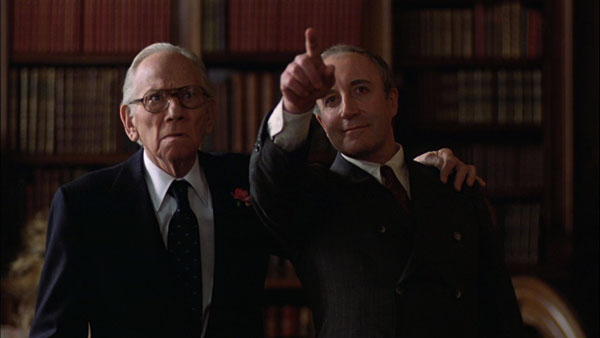
Tag: Peter Sellers

The Wrong Box (1966)

The Wrong Box (1966)

Farce, murder, mayhem and comic energy abounds in this sometimes try-hard but fun enough knockabout comedy

Director: Bryan Forbes

Cast: John Mills (Masterman Finsbury), Ralph Richardson (Joseph Finsbury), Michael Caine (Michael Finsbury), Peter Cook (Morris Finsbury), Dudley Moore (John Finsbury), Nanette Newman (Julia Finsbury), Tony Hancock (Inspector), Peter Sellers (Dr Pratt), Cicely Courtneidge (Major Martha), Wilfrid Lawson (Peacock), Thorley Walters (Patience), Irene Handl (Mrs Hackett)

Do you know what a tontine is? For those who don’t (come on, own up!) it’s basically an investment named after the Florentine banker Lorenzo di Tonti in 1653. Investors pay into a scheme which gives a regular income while accumulating interest on the initial capital. As the investors die off, the individual payouts increase until the final surviving investor claims the full ‘pot’ of cash. It’s essentially a lottery for being the last surviving investor. That’s ripe for two things: murder and farce.

We got dollops of the latter in this slap-stick, old-school farce loosely (very loosely) based on a Robert Louis Stevenson and Lloyd Osbourne novel. A Victorian tontine sees its members fall at regular intervals until there are only two survivors: estranged brothers, cantankerous Masterman (John Mills) and almost supernaturally tedious Joseph (Ralph Richardson). With Masterman pretending to be on his own deathbed to lure his brother out (to murder him), the blithely dotty Joseph is kept in health by his greedy nephews Morris (Peter Cook) and John (Dudley Finsbury). En route to see Masterman, a train accident leads to a series of farcical misunderstandings involving mis-identity, confusion and a dead body packed into a box and delivered to the wrong house.

Directed with an, at times, slightly too overtly zany bent by Bryan Forbes, The Wrong Box oscillates between being rather funny and trying too hard. It’s all too obvious to see the influence of the Oscar-winning Tom Jones in the film’s jaunty musical score and use of flowery-lined caption cards to announce events and locations. It’s also clear in the fast-paced, at times overblown, delivery of performances and dialogue, with its mix of improvisational humour and cheeky lines. Despite this though, The Wrong Box manages to be just about be fun enough (and it’s funnier than Tom Jones).

That’s probably because it’s not aspiring to be much more than a jaunt, an end-of-term treat in which a host of famous actors and comedians put on a show. Forbes might not have the inspired flair at comedy or the sort of timing this needs. But he’s got a nifty touch with dialogue and does a decent job of translating classic British theatre farce to the screen. The Wrong Box – even the title leans into this – is all about those classic farcical tropes of things being delivered to the wrong people because they have similar names, mistaken or misheard messages being passed on and people obliviously talking at cross purposes.

We get set-ups like Mills’ fake-bed-ridden old man trying multiple times to off Richardson’s bore, each attempt obliviously foiled by coincidence and accident. A body misidentified because its wearing someone else’s coat, then packed into a crate and delivered (to the wrong house) to disguise a death that hasn’t actually happened. Undertakers mistakenly taking away a man who has fainted at the foot of the stairs rather than a body in another room. All classic farce.

It’s not a surprise that experienced theatre actors emerge best. Richardson, in particular, is a delight as a man who has made such a study of trivia that he compulsively bores anyone he encounters. Fellow passengers on a train, a farmer who gives him a lift in his cart, attendees at a funeral – all of them glaze over in despair while Richardson’s Uncle Joseph, with monotonous eloquence, expounds mind-numbing trivia (including, at one point, in Swahili). He makes a fine contrast with Mills’ angry short-man, constantly fuming at a string of slights, real and imagined.

These two leads set the standard for the rest of the cast, a mix of comedians, theatre pros and star names. Peter Cook occasionally tries a little too hard as a bossy-boots determined to inherit the tontine – it’s remarkably that, even this early, Dudley Moore looks more relaxed in front of the camera (Moore’s later stardom would be inexplicable to the jealous Cook). Tony Hancock looks rather sadly like a rabbit-in-the-headlights as an inspector. Peter Sellers, not surprisingly, shows how it’s done: his two-scene cameo as a drunken doctor of loose morals, surrounded by cats and permanently sozzled is a master-class in low-key, rambling hilarity.

Michael Caine and Nanette Newman also acquit themselves very well. Throwing themselves into the spirit of things as our romantic leads – fulfilling the requirements of the genre by being both charming and sweet but also naïve and a little dim – they strike up a romance that manages to be both rather touching and also a neat parody of costume drama flirtation. Forbes shoots a rather nice scene where they breathlessly eye each other up, the camera cutting rapidly from exposed arms to facial features one after the other. Both are very funny, with Caine striking up a lovely double-act with Wilfrid Lawson as an almost incoherently drunk butler (Lawson’s finest hour since Pygmalion).

The film keeps its comic energy flowing well, with Forbes using a good mix of interiors and some attractive Bath locations (doubling for London). It’s also a film which – surprisingly since its written by a pair of Americans – really captures a sense of British eccentricity. I really enjoyed, in particular, the opening sequence that charts the deaths of the other members of the tontine – a parade of inept empire builders (soldiers, explorers, big game hunters) meting a series of surreal (often self-inflicted) deaths.

It probably does slightly outstay its welcome – 90 minutes would have been perfect. It’s a little too pleased with its semi-surreal set-up and stylistic flourishes – the floral on-screen captions definitely are far less funny than the films thinks. There is, at times, a little too much of the “isn’t this zany!” air about the film that can grate, with set-ups groaning with their desire to amuse (a late hearse chase scene falls into this) like a pub bore telling you a story in his self-proclaimed “inimical style”.

But at least The Wrong Box does make you laugh. And when that is all it is aiming to do, its hard not to have a soft spot for it.

Dr Strangelove; or How I Learned to Stop Worrying and Love the Bomb (1964)

Peter Sellers tries to stop the end of the world in the terrific satire Dr Strangelove

Director: Stanley Kubrick

Cast: Peter Sellers (Group Captain Lionel Mandrake/President Merkin Muffley/Dr Strangelove), George C. Scott (General Buck Turgidson), Sterling Hayden (Brigadier General Jack D Ripper), Keenan Wynn (Colonel Bat Guano), Slim Pickens (Major “King” Kong), Peter Bull (Russian Ambassador), Jack Creley (Mr Staines), James Earl Jones (Lt Lothar Zogg), Tracy Reed (Miss Foreign Affairs)

“Gentlemen you can’t fight in here. This is the War Room!” Kubrick’s hugely influential satire helped shape our perceptions of the Cold War and its mantra of mutually assured direction. Showing no mercy to its targets, it mixes Goonish schoolboy humour with moments of genuine tension and rising horror. Sure it features some of the faults of its director –self-importance, cold distance and much of the wit is due to Sellers and the performers rather than the not-particularly-witty-Kubrick – but there is no doubt it remains a seminal classic.

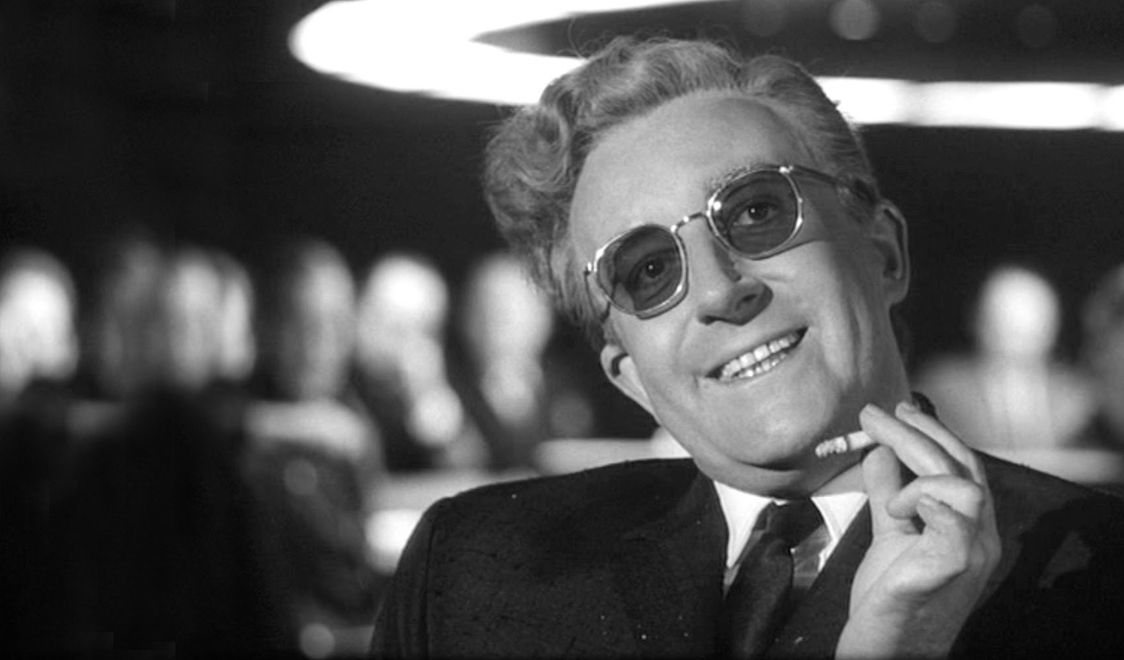
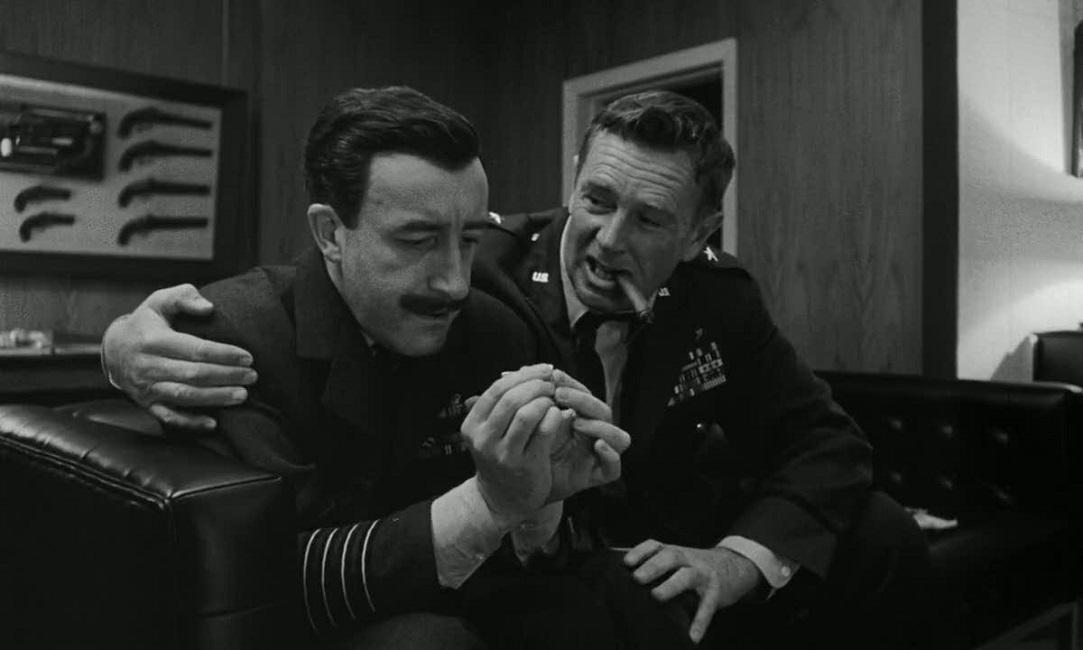
General Jack D Ripper (Sterling Hayden – excellent) orders his planes to drop their nuclear bombs on the USSR. Ripper is launching a pre-emptive strike to protect the American way of life from the Commies and, most importantly, to protect our precious bodily fluids. Yup he’s crazy, something his second-in-command RAF Group Captain Lionel Mandrake (Peter Sellers) quickly realises, but can’t do anything about. US President Merkin Muffley (Sellers again) reacts with horror at the prospect of all-out-war, negotiating with the Soviets to co-operate in shooting down the planes, while some of his advisors such as trigger-happy General Buck Turgidson (George C Scott, hilariously OTT) argue perhaps there is some merit in striking first. And sinister former-Nazi scientific consultant Dr Strangelove (Sellers one more time) spells out the impact of nuclear war.

Kubrick quickly came to the conclusion that if you were going to make a film about nuclear war, it almost couldn’t be anything buta comedy: after all the idea of two sides building a huge arsenal of weapons capable of destroying the world was so crazy, you wouldn’t believe it if you were told it. Dr Strangelove therefore ends up taking place in a world that’s one third grounded and two-thirds heightened reality. There is a great deal of college-style humour in the film (you can see it in those characters names which reference everything from the Whitechapel killer to female genitalia and excrement), but it works because its (mostly) played dead-straight.

Part of the film’s appeal was the number of sacred cows it slays. All the things that, at the time, America was meant to respect were ridiculed. The military, politicians, the Presidency, America’s moral authority, the ingenuity of American science and engineering. It’s all shown to be ineffectual, misguided, underpinned by fascist-tinged insanity, myopically obsessed with big bangs over humanity or plain ridiculous. Every single authority figure in the film is deconstructed over its course as some combination of childish, empathy-free or useless. You can’t come out of this film and every again have an unquestioning assurance our leaders know what they are doing.

This works, because it’s placed in a film that in many ways has the plot of a far more serious film (its very similar of course to Fail Safe). Chunks of it are played completely straight, or with just the merest touch of the surreal. In particular the sequences set on the bomber, commanded by Major Kong (played at short notice by Slim Pickens after injury prevented Sellers taking on that role as well) have that true sense of Kubrickian detail in their careful staging of all the procedures a bomber crew would follow (even if it still allows some fun to be poked at the expense of the survival kit, the contents of which would give a fella “a pretty good weekend in Vegas”).

Those bomber scenes sometimes outstay their welcome in their cold technicality (it’s odd to say that a film as short of this sometimes feels a little overlong), but that’s largely because in a film that is clearly demanding us to shake our heads at the madness, it struggles to get us invested in a more conventional heroic story (especially as success there is starting a nuclear conflagration).

Perhaps that’s because of the coldness in Kubrick’s style – emotion doesn’t often find its way into his greatest works, and he was often reliant on working with the right people (get a McDowell in it or a  Nicholson and things can click, get an O’Neal and you can get a different story). Humour isn’t his strong suit, but fortunately he worked with Sellers at his finest hours. Sellers takes on three roles, all of them a sharp contrast, and he’s masterful in all of them. There were fewer more gifted improvisational performers than Sellers, and each of his parts benefits hugely from the dynamism (of various sorts) he gives them. It’s also interesting that two of them are actually the “one sane man” (Muffley and Mandrake) while Strangelove is a pantomime monster of insanity (introduced late in the film, he’s the final indicator that our fates are in the hands of complete lunatics).

For Mandrake, Sellers parodied the stiff-upper lip upper class, with Mandrake a stuffed-shirt, attempting to wheedle recall codes out with Ripper with a clumsy bonhomie. Muffley is played almost dead-straight as a weak man out of his depth. But he does have a phone call monologue with the Russian premier (largely improvised with Sellers) that is one of the funniest things you’ll ever see. There’s no restraint in Strangelove, a wheel-chair bound grotesque with a phantom (hardcore fascist) hand, constantly suppressing involuntary Hitler salutes and trying to hide his mounting excitement at the prospect of worldwide annihilation (“Mein Fuhrer! I can valk!”).

Kubrick’s directorial approach – wisely – seems to have been to acknowledge that Sellers was providing so much of the madness and dark comedy the concept demands, that he could be more restrained. Interestingly, for being his most famous film, it often feels like one of his least personal ones. It stands outside much of the Kubrick cannon – it’s short, its often brisk, technically it’s unflashy and often unobtrusive – and it plays on the director’s weakest vein, comedy.

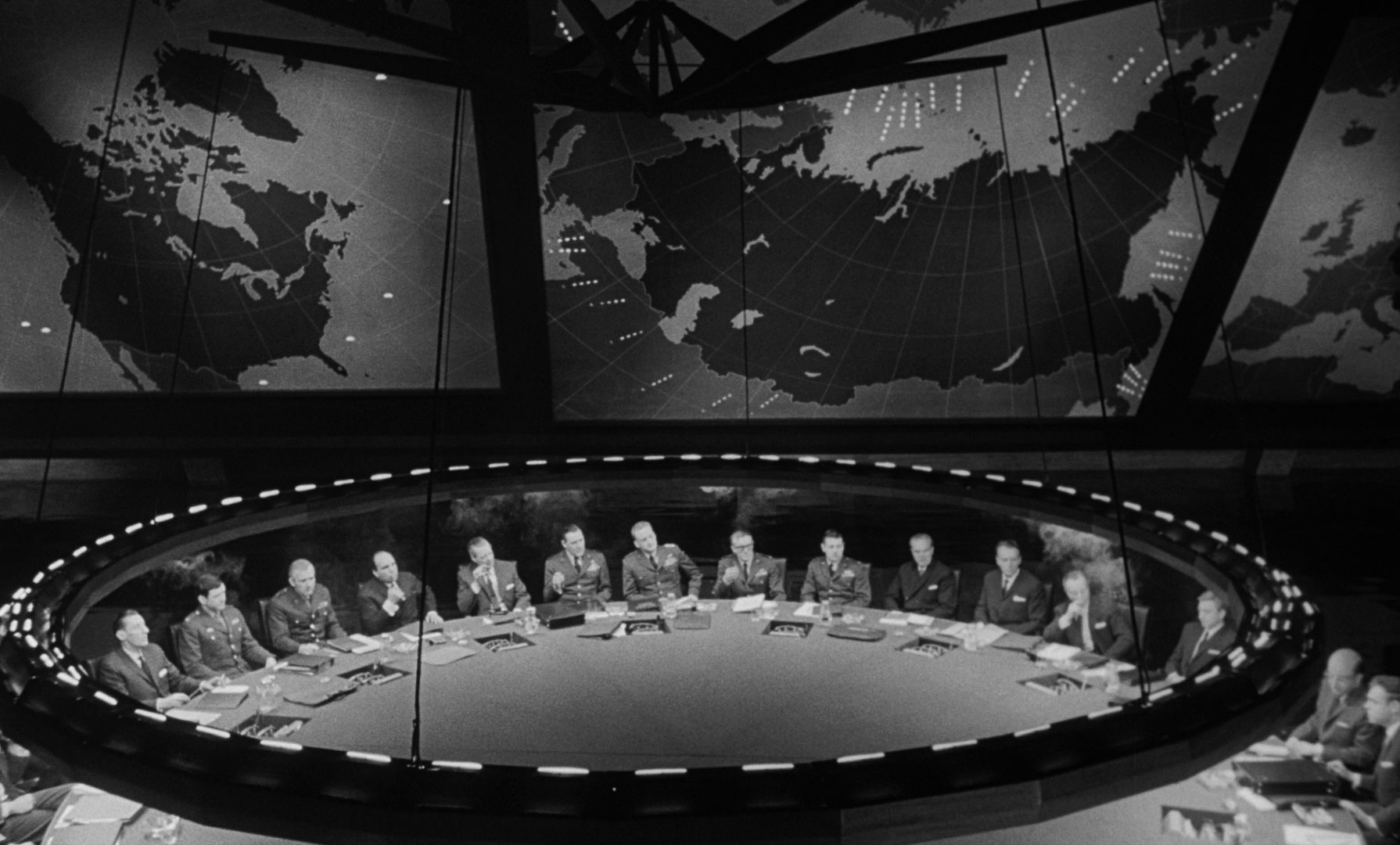
But it’s got his mastery of detail – partly also due to its faultless set design by Ken Adam. The reconstruction of the bomber interior is overwhelmingly convincing (the Air Force was amazed at how accurate it was). Ripper’s low-ceilinged office is a visual metaphor for the character’s insular insanity. Most influential of-all, the Bond villain-ish War Room, with its vast circular table and huge screens was so perfectly conceived, it cemented the idea for generations of what war planning rooms should look like (Reagan even asked where it was when he took office). The film may be darkly surreal, but its surroundings give it an authority that is essential for its success.

Authority is what the film needed to work. Perhaps that’s the greatest contribution of Kubrick, to create a structure of convincing reality, allowing the surreal and insane actions to work. From Ripper’s clear fixation on his own impotence (“I do not avoid women but I do deny them my essence”) – to Turgidson’s increasingly bombastic militarism (“I don’t say we won’t get our hair mussed, but I do say no more than 10 to 20 million killed. Tops.”), they all work because they contrast with a setting soaked in reality and detail. It also adds the important depth that gives the film impact: sure it wouldn’t happen like this, but something like this could happen.

Dr Strangelove’s humour has at times dated – there’s something undeniably schoolboyish about its tone. Stretches showing the detail of the bomber’s operation go on way too long. The film itself also takes a while to get going, and like many Kubrick films it has an air of being pleased with itself. But in Sellers it has a comic genius at the height of his game and its impact in changing the way we think about the world can’t be denied. Still a classic.

Being There (1979)

Peter Sellers is a void in the satirical Being There

Director: Hal Ashby

Cast: Peter Sellers (Chance, the gardener/Chauncey Gardiner), Shirley MacLaine (Eve Rand), Melvyn Douglas (Ben Rand), Richard Dysart (Dr Robert Allenby), Jack Warden (The President), Richard Basehart (Ambassador Vladimir Skrapinov), David Clennon (Thomas Franklin), Fran Brill (Sally Hayes), Ruth Attaway (Louise)

In movies honesty and simplicity often hide a deeper truth – a more pure view of the world, unaffected by cynicism. Being There takes these ideas and inverts them. What if we were so desperate to see a higher meaning in the words of the unaffected, that we kidded ourselves that even their blandest utterances carried deep meaning. It’s the central idea of Being There, proving again that a delusion only works when those affected are also those most invested in sustaining it.

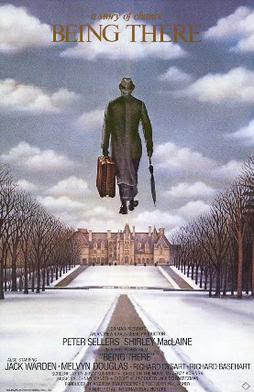
Chance (Peter Sellers) is a child-like innocent. He works in the garden of “the old man” (implied to be his father). He has never in his life left the confines of his self-contained home. He can’t read, he can’t write. His meals are prepared for him by the old man’s staff. Apart from gardening his only other interest is television – and even that is a mute, hypnotic interest with Chance meekly watching anything screened in front of him. When the old man passes away, Chance (of whom there is no record at all) is asked to leave the house by the old man’s lawyers. He finds himself in a modern 1970s world, but still dressed (and with the manners) of a 1930s gentleman.

Accidentally hit by the chauffer driven car of Eve (Shirley MacLaine), the younger wife of wealthy businessman Ben Rand (Melvyn Douglas), Chance (his name mistakenly overheard as Chancey Gardiner) finds himself in the home of Ben where his manners, dress and polite comments about gardening are interpreted as being deep, intellectual musings on society and the economy. In a few days Chance is advising the President (Jack Warden) and his opinion is being solicited by the media. Will anyone notice that Chance is a harmless but basically empty man?

Being There is not just a hilarious satire of the capacity of the rich and powerful to persuade themselves of things. It’s also a satire on the Capraesque notion of the innocent seeing a truth that the rest of us can’t see. It throws in more than enough social commentary on the edges as well – Chance is revered because he looks right: well-dressed, courtly manners, softly spoken, polite and above all white. The film gets a few pointed blows in on this that look more and more central to the film the older it gets. Seeing Chance’s earnest musings on gardening being interpreted as deeply meaningful economic commentary on the television, the woman who bought him up in the old man’s house – a black servant Louise – announces “It’s for sure a white man’s world in America. Look here: I raised that boy since he was the size of a piss-ant… Shortchanged by the Lord, and dumb as a jackass. Look at him now! Yes, sir, all you’ve gotta be is white in America, to get whatever you want.”

And she’s right. Interpreted by the rich, white, entitled men of America as one of their own, it never occurs to them that Chance might be something else. And his statements carry such bland emptiness – precisely because Chance is merely stating genuine gardening tips – that it becomes easy to invest them with whatever depth they like, because they have no depth themselves. While in Capra, Chance would stumble upon some of the corruption at the top or make these people rethink their lives, here he drifts through, barely understanding what is happening around him, allowing these powerful men to interpret him as something that reassures them about their own lives.

In the 1970s the film was seen as a satire on the television generation. But watching it today – despite Chance’s mute, unengaged smile while watching TV – this isn’t about a mindless cabbage potato being seen as a sage. He’s a completely empty vessel that can have meanings poured into him – and then can all stick because not for a single second is Chance trying to get anything out of it. He would be as happy returned to the street as he is in the palaces of the mighty.

The film works due to the success of Peter Seller’s performance. Seller’s had pitched long and hard for the role: he had always believed himself a void beneath the mad-hat comic personas he had inhabited, and believed himself uniquely placed to understand the neutrality of Chance. That’s what he brings here. It takes true skill to play a character as blank as this one. Chance never responds to the situation he is in – and seems to have no understanding at all of the situation. He’s completely genuine and honest – exactly what gives his comments weight to people, because he is not even remotely trying to add any weight to them – and meekly accepts all the things that happen to him. He is honest on every question he is asked – that his only interests are gardening and TV – and sits quietly, smiling, until finally saying or doing things he has frequently copied from TV.

Seller’s restrains himself utterly in the role and eventually his very tame, sweet blankness makes him endearing. The performance would fall apart if even for a split second there was a tip of hat or wink to the camera. There’s none of that. Compare Chance to say Forrest Gump. Gump is the quintessential example of the cliché man who really understands the world better than all of us. Chance is the reality, a simple man, harmless but incapable of really engaging with the world. In Hal Ashby’s skilled and restrained hands this becomes crucial to the awe he is treated with by the rich. He’s a mystery we get no answers to and someone we know as little about at the end as we did at the start. But yet Sellers is mesmeric.

Melvyn Douglas’ provides a superb (Oscar-winning) performance as Ben Rand. How much does Rand really believe in Chance? He’s charismatic, determined and driven – but also nearing the end of his life. Does he want to believe in his faith in Chance, because it makes him feel better? Is Chance almost a sort of advance satire of movements like scientology – faiths that make rich people feel better about themselves, because it affirms their views and place in the hierarchy? It’s possible – and why not when they can craft an idea of Chance that is far superior to their nervy (and literally impotent) President (Jack Warden in a smart little turn).

Ashby at time overplays his hand a little. The final image – a benign Chance literally walking on water on the Rand estate lake – is famous, but its meaning is unclear. Does it imply that Chance is some form of second coming? Or does the naïve and clueless Chance simply walk across water because he doesn’t understand that he can’t? I feel the latter myself – the idea of him being a Jesus figure is so out of keeping with the film, I see it as a final physical representation of his own lack of knowledge about the world. Some hated the final flourish (visually wonderfully done as it is) – although not as much as the bizarre outtake of Sellers cracking up that plays over the credit (Sellers in particular loathed this, believing it shattered the magic of his performance and cost him an Oscar).

Being There isn’t perfect – it’s too long and Shirley MacLaine gets rather a thankless part as the wife who becomes infatuated with Chance (more could perhaps have been got out of her seeing the truth of Chance, rather than being as arrogantly deluded as the rest). Moments have dated less well than others. But it’s got a sharp idea at its heart – and its satire of the rich, Hollywood sentimentality and society feels sharper every day. Rather fittingly as well the film has an autumnal quality about it in Ashby’s coldly reserved shooting: Sellers and Douglas both died shortly after its release, the book’s author Jerzy Kosinski would be plagued after its release with accusations of plagiarism and Ashby’s (after a drug fuelled but successful 1970s) career would collapse almost immediately after its release. But it’s a smart, mysterious, witty and profound film that gains greater meaning with age.