
Tag: Polish films

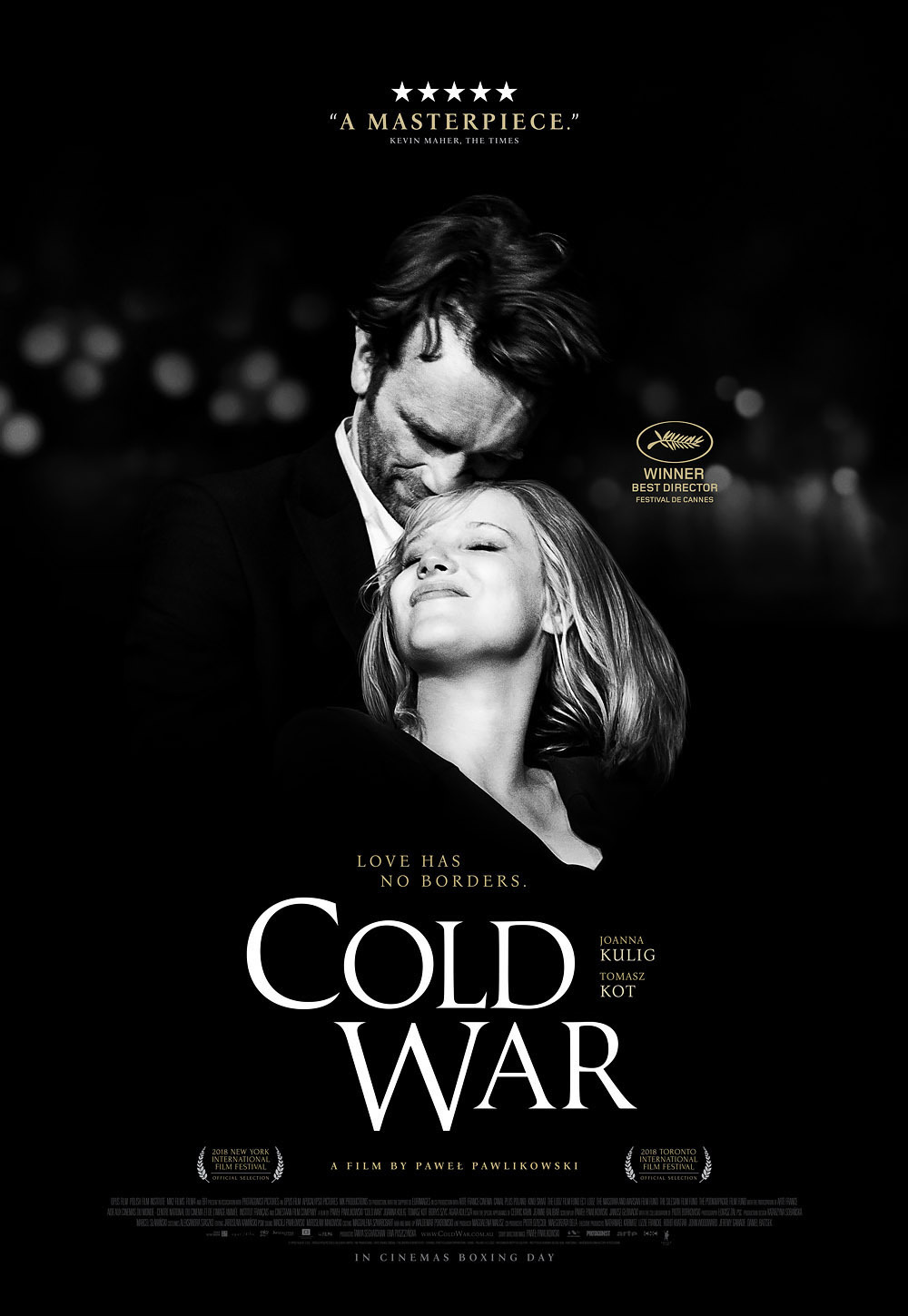
Cold War (2018)

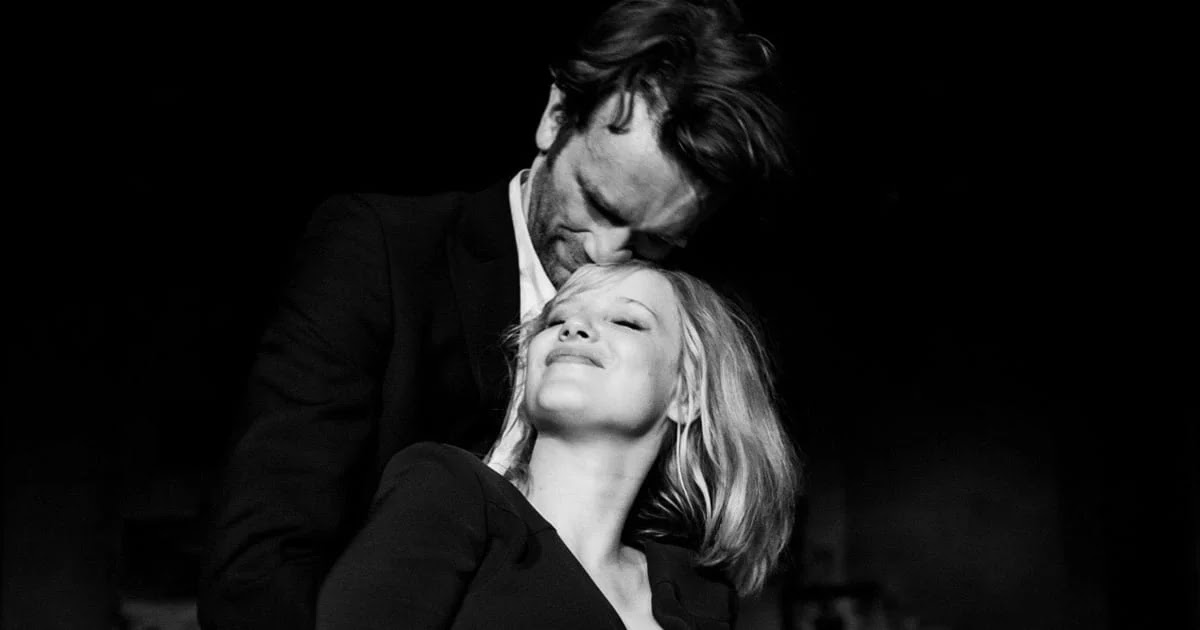
Tomasz Kot and Joanna Kulig are lovers divided in Cold War

Director: Paweł Pawlikowski

Cast: Joanna Kulig (Zula Lichon), Tomasz Kot (Wiktor Warski), Borys Szyc (Lech Kaczmarek), Agata Kulesza (Irena Bielecka), Jeanne Balibar (Juliette), Cédric Kahn (Michel)
Pawlikowski’s film is a heartfelt, heavy fictionalisation, of his own parent’s marriage. Or at least the emotions and clashes that lay at the heart of this turbulent marriage, rather than the actual events themselves.

In post-World War II Poland, the Polish government are funding the creation of a folk-music ensemble, to promote Polish culture. Wiktor (Tomasz Kot) is the lead conductor, helping to select the members. One of the applicants, Zula (Joanna Kulig) is a talented musician who has misled the committee on her background. Wiktor recruits her anyway and she swiftly becomes lead singer of the troupe – just as she and Wiktor begin a heated relationship. When the troupe journeys to perform in Berlin, Wiktor takes the opportunity to cross the border – but Zula, frightened of the risk, refuses to go with him. Over the next fifteen years the couple intermittently come together again. When apart, they long for each other. When together, it never takes long for joy to transform into envy, bitterness, anger and frustration.

The film is called “Cold War” – but it’s about the feuding relationship between these two different but very similar people, and the clashes between them caused by their hearts. Pawlikowski creates some neat commentary around how the Cold War – that division of Europe into two opposing camps – throws up even more boundaries between the two. The defection of one from Poland instantly makes it nearly impossible to meet. Both long for their Polish homes, aware that they can never lead the life they want there.

What’s a shame is that these themes don’t mix very well with the dark romance of the main storyline. It’s impossible watching the film not to think about Pawlikowski’s previous film Ida. Like Cold War, Idawas shot in gorgeous black-and-white (using the non-widescreen Academy ratio 4:3) and explored family problems in post-War Poland. But Ida managed to be both a deeply emotional investigation into the traumas historical and political events have inflicted on a family, while also giving a riveting insight into the scarred land Poland was for much of the twentieth century. Cold War misses this additional layer, focusing excessively on the personal, with two characters at its centre that it’s harder to relate to.

I always feel bad when I’m reduced to saying that the film didn’t work so well for me because I didn’t care for the lead characters. There is very little to fault in the performances. Both have an absorbing chemistry, and develop characters that are prickly, difficult, passionate, firey figures. Kot is, by turns, reserved and obsessive, prone to rash decisions he regrets at leisure. It’s something he shares with Zula. Joanna Kulig is very impressive here, carrying a defensive coldness at her heart that she only rarely allows to melt. She is a character rife with contradictions – decisive (except when she isn’t), passionate (except when she’s rational), loving (except when she hates). She’s a cocktail of confused emotions – perhaps stemming from a troubled childhood.

Both characters have striking self-destructive streaks. The film – like many of Pawlikowski’s films told in a very tight runtime, little more than 80 minutes – charts how these two characters time-and-time again find themselves in a position where they could seize happiness – only too promptly ruin it with jealousies, bitterness and narrow-mindedness. After a while, I confess, I found it wearing. Their decisions are so often – so obviously – wrong, naïve and stupid, that it gets too much. Their relationship is so fuelled by selfishness and disregard for others – partners, spouses, children – that after a while I found myself wanting to give them a shake and tell them to sort themselves out.

Essentially, for all its heartfelt passion and poetic beauty, it’s a “can’t live with, can’t live without”  tale. Its told with pace, but I felt I could actually do with a few more minutes to understand these two people better. There is probably one too many rural peasant troupe performance eating up runtime that could have been better spent getting a grasp on the characters.

The black-and-white shooting is extraordinarily beautiful, and Pawlikowski’s direction is, as always, perfectly judged, well-paced and tender. But for me this becomes a slight film about two people its’ hard to warm to, with an ending that suddenly tips into something both far more operatic and also slightly too pleased with itself. I missed the grace, beauty, wisdom and depth of Ida, which looks more and more like a perfectly judged masterpiece that balances the personal, the emotional and the social perfectly. Cold War, on the other hand, only feels like it scratches the surface of many of these themes.
Ida (2014)

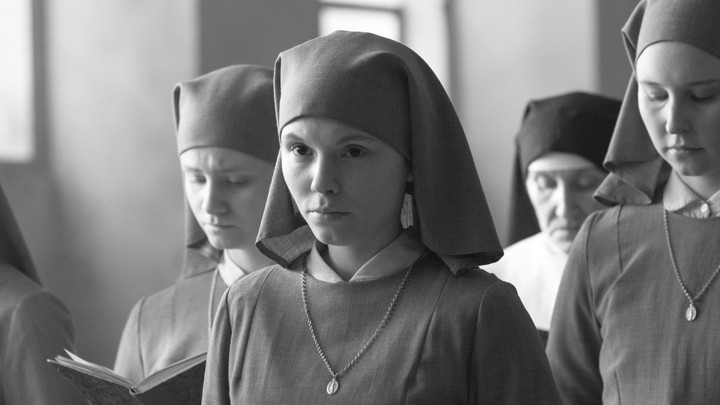
Agata Kulesza as a young Nun facing a crisis in engrossing Polish film Ida

Director: Paweł Pawlikowski

Cast: Agata Kulesza (Wanda Gruz), Agata Trzebuchowska (Anna/Ida Lebenstein), Dawid Ogrodnik (Lis), Adam Szyszkowski (Feliks Skiba), Jerzy Trela (Szymon Skiba), Joanna Kulig (Singer)

We are lucky. Growing up in a Western country, free of conquest and suppression, we don’t have the past weighing on every breath and step of our lives. But travel to other parts of Europe and you will find that the past is as unspokenly present in every moment as the present is, and that the two practically coexist side-by-side. Poland in the 1960s was such a country – a land so weighed down by the horrors it had seen throughout the century that there is no need for them to be given a name.

Anna (Agata Trzebuchowska) is a young novice nun told by her prioress that before she can take her vows she must meet with her aunt, Wanda Gruz (Agata Kulesza), a last surviving relative she had never even heard of until that day. Visiting Wanda, Anna is shocked to discover that Anna’s real name is Ida and that she is the daughter of Jewish parents murdered during the Second World War. Wanda, a resistance fighter during the war, later became a feared State Prosecutor but is now a judge struggling with unspoken guilt and succumbing frequently to alcoholism and one-night stands. Together Wanda and Ida travel to try and trace what exactly happened to Ida’s parents – discovering profound truths about themselves and their country as they travel.

Pawlikowski, a Polish director who grew up in London, directs his first Polish language film – and I think it’s fair to say he has produced a small-scale masterpiece here. Shot in beautiful black-and-white – a sublime choice for the chilling weight of the past that hangs over every shot of this film – Pawlikowski’s film is a lean, trim, perfectly weighted 78 minutes that covers more thematic depth and richness than films three times its length. It’s done with a beautifully low-key, quiet power that gives you plenty to richly mull over.

Its genius is capturing the weight of the past and the impact that it has at both a personal and a national level. So traumatic is the past of Poland that words like Holocaust and Stalinism need not be mentioned – over the course of a decade, millions of Poles (many of them Jews) were killed by Nazis, Soviet police and other Poles. This is a country lying deep in a post-traumatic haze, guilt, fear and sorrow the base below many social interactions. Pawlikowski captures all this beautifully, the oppressive gloom of sadness lying across every single frame. 

There is no demand for retribution and apology – and the one moment of guilty confession is beautifully underplayed and affecting for its relative lack of reaction from the witnesses – and the past is not expressed as an evil secret. Rather, people – good and bad – are shown as just people, many of them acting out of fear, or for what they felt was best, or ignorance. There is no easy viciousness and evil in the past, just the sad facts of life. The film’s atmosphere is coated in the horrors of the past, but lives roundly in the present. There are few – if any – dramatic moments of tears, recriminations and accusations. Instead the pressure of the past is met with sad, reflective shame and weary acceptance of the impossibility of going back.

Every shot is carefully chosen to reflect this theme. Pawlikowski frequently shoots Ida and Wanda just off centre of the frame, or even low down in the frame, allowing much of the shot to frequently be filled with the architecture and nature of Poland – much of both, rundown, crumbling, cold and bleak. The old “academy” ratio of 4:3 works perfectly for this look, old-fashioned but also boxed in. Not a single shot is wasted or overlong, and each of them serves a perfect purpose. Pawlikowski uses the structure of the road movie to serve itself as a semi-voyage into the past of Poland, as well as brilliantly allowing for the emotional expansion of its lead characters.

Both these leads are beautifully played by the two leads. Agata Trzebuchowska, a non-actor (now a journalist and film director herself) was plucked from almost nowhere in the Polish film industry to play Ida (she accepted due to her love for Pawlikowski’s film My Summer of Love) and she is perfectly suited to the role, investing Ida with a certainty from the start that slowly adapts and adjusts as she learns more and more about both her own past and her country’s. 

Agata Kulesza is extraordinarily good as Wanda, whose intense feelings of guilt at the many mistakes she feels were made in her past consume every thought, but who presents to the world a bullish confidence and freedom of expression. Her underlying vulnerability is what allows Ida in – and what will fundamentally change her outlook on the world, and both give expression to and dominate her melancholy.

Both these characters are shifted and changed forever by their joint exploration of the seemingly simple facts of their background – and the idea of continuing life in a world after this seems impossible. But Pawlikowski’s film doesn’t seem without hope. There is another generation coming to Poland – represented by a jazz band, led by Lis (Dawid Ogrodnik), a hitchhiker they pick up – and for these, the past seems just that. It’s not an everyday presence that haunts their decisions, or hangs over their life, and for this generation coming “life as usual” seems not a burden but an accepted fact. Is this a good or a bad thing? Maybe both, but it at least shows that that the country has some hope of moving on and forging a future even while the scars of the past remain.

Three Colours: White (1994)

Zbigniew Zamachowski confronts the problems of revenge in Kieślowski’s Three Colours: White

Director: Krzysztof Kieślowski

Cast: Zbigniew Zamachowski (Karol Karol), Julie Delpy (Dominique Vidal), Janusz Gajos (Mikolaj), Jerzy Stuhr (Jurek), Aleksander Bardini (Lawyer), Grzegorz Warchol (Elegant man), Cezary Harasimowicz (Inspector), Jerzy Nowak (Old farmer), Jerzy Trela (Monsieur Bronek)

The second film in Kieślowski’s ambitious thematic trilogy probably couldn’t be much more different from the first. Whereas Blue was a romantic tragedy, this is a sort of bitter comedy, a kind of anti-farce if you like. Here, the themes of equality are much more about getting even rather than all men being equal. Just as Blue looked at the negativities of liberty, this looks at the dark side of equality, and the blinkered tunnel vision we follow in order to get ourselves even.

Polish hairdresser Karol Karol (Zbigniew Zamachowski) is divorced in Paris by his French wife Dominique (Julie Delpy). In quick succession, Dominique strips him of his home, access to their bank account, his passport and his share of the business, and takes another lover. Reduced to homeless penury on the streets of Paris, Karol finally finds a way to get home to Warsaw by befriending sad-sack successful businessman Mikolaj (Janusz Gajos), a fellow Pole, on the Métro. With Mikolaj’s help, Karol finds himself back home and soon in a position to start scheming his revenge.

White is, let’s be honest, a lot less of a triumph than Blue. That was a film that combined stunning visuals, directorial invention, profound depth and emotion. It was a story that looked at universal themes from a fascinating series of new angles. White,however, is more of a shaggy dog story. It feels like it’s aiming for some sort of Chaucerian fable, but it never really goes anywhere in particular, and it never really engages as much as it should while it tries to get there. While it’s not unentertaining film, it’s at best a good one rather than a great one.

My main problem is that Dominique’s character just never clicks. Why does she do the things she does? No idea. We are never given any insight into her character – she remains a cipher, bordering on a trope of the wicked beautiful seducer. Why does she jilt Karol? Surely it can’t be because of his (rather obvious) impotence ever since he arrived in France, and felt isolated in his new home? Why does she take such a delight in persecuting him, even down to audibly having sex with her lover when he calls her (“Perfect timing” she says before getting frisky)?

It’s hard not to get the sense of a film which has a slight suspicion of women. I don’t imagine that this a suspicion Kieślowski  in any way shares – sensitive and humane portrayals of women are central to his films (not least Blue) – but when the only female character in this is the distant and unknowable Dominique it’s not good. Without any sense of why she has done the things she does, it’s hard to feel comfortable with the semi-comic destruction of her Karol plans.

But then that is part of the film’s point: Karol is obsessed (without even really knowing it) with his wife. Not even so much with revenge for that matter – just getting the chance to take on his wife in a one-sided struggle makes him feel closer to her. The only possession he takes home from Paris is a bust that reminds him of his wife (and which he painstakingly repairs after it is smashed to pieces). Much as tries to build a new life, it’s a monofocus – he only gets what he gets in order to use the resources against his ex-wife. 

So equality is in Kieślowski’s design, not a good thing. Shy, sweet Karol basically ends up entrapping himself and his wife in equally frustrating positions: she in prison, he faking his own death without a penny. What was the point for Karol? No wonder he looks up at her in prison with tears rolling down his face – he’s still in love and he’s got nothing to really show for his equality, other than their joint misery.

All of this sits alongside Kieślowski’s brilliant understanding of post-Cold-war Poland, a bustling land of opportunity to make a quick buck, where simple peasant farmers can be bamboozled out of their land by smarter guys who know businesses from the West are just dying to buy up properties. Karol shares this understanding of Poland. No wonder he’s all at sea in the rest. The instant he arrives back he’s delighted, relaxed and more confident – “I’m home!” he cries joyfully, even when his first view on arriving in Poland is a mass rubbish dump. 

Moments like that show Kieślowski’s dry comedy. There are plenty of other moments, helped by Zamachowski’s pretty lovable performance of the naïve-but-growing-in-confidence Karol. Karol and Mikolaj (an excellent Janusz Gajos) put together quite an excellent double bill of bromance laced with darker themes of depression (it’s no real surprise who Mikolaj is talking about when he tells Karol that he will help him if Karol can help his “friend” who wants to die but can’t kill himself). Karol’s hapless fate in Paris raises a few smiles, as does his surreal escape stuffed in a suitcase.

But there aren’t quite enough of them. Too much of the film either doesn’t connect or hold together. I could have certainly done without Karol’s sexual prowess returning once he is confident and rich in Poland (yawn!). Dominique’s non-character remains a serious problem, and there just isn’t enough meat on the bones here. Compared to the richness of the first entry in the series, this feels remarkably empty. It’s also a lot less visually arresting and imaginatively done than the first film: I’m already struggling to remember any of the visuals.

Kieślowski may well have wanted a sort of anti-comedy to be the pivot of his trilogy, but it doesn’t really work here. He ends up with something that feels so slight and underdeveloped that it doesn’t stick with the viewer, and doesn’t engage them either. While it has moments, as you would expect from a great director, and some very good actors, it doesn’t have nearly enough of them.