
Tag: Post 9/11

Eye in the Sky (2015)


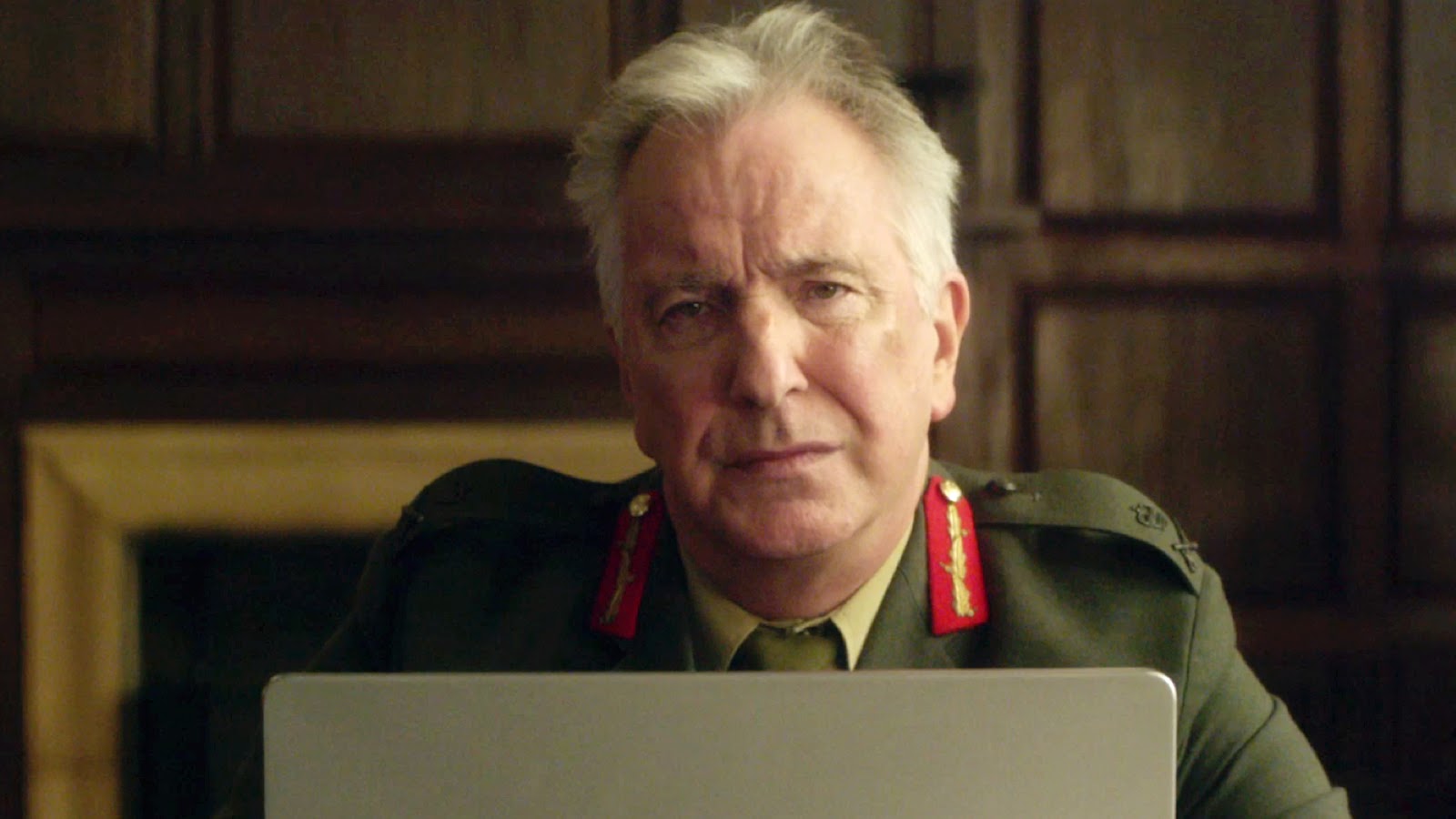
The great Alan Rickman is an exasperated General, in drone-strike moral fable Eye in the Sky

Director: Gavin Hood

Cast: Helen Mirren (Colonel Katherine Powell), Aaron Paul (Lt. Steve Watts), Alan Rickman (Lt. General Frank Benson), Barkhad Abdi (Jama Farah), Jeremy Northam (Brian Woodale), Iain Glen (Foreign Secretary), Monica Dolan (Angela Northman), Richard McCabe (George Matheson), Phoebe Fox (Carrie Gershon), Babou Ceesay (Sgt. Mushtz Saddiq), John Heffernan (Major Howard Webb)

As Shakespeare said, sometimes we are urged: “to do a great right, do a little wrong”. Eye in the Sky is a film about that dilemma. Numbers 2, 4 and 5 on the terrorist “Most Wanted” list are meeting in a house in Kenya. They are preparing suicide bombers. A series of attacks could be minutes away. A drone strike will probably save hundreds of lives. Seems obvious doesn’t it? Unfortunately, sitting in the fatality zone is an innocent young girl, just trying to sell bread. Take out the bombers and you’ll save dozens of other children – but you’ll almost certainly kill this one child.

Your initial reaction to this sort of situation would probably be “thank goodness that’s not my decision”. Problem is, you get the feeling many of our elective representatives feel the same: as the situation escalates (from capture, to kill, to controlled strike, to a certainty of civilian casualties) so does the buck-passing, from politician to politician all unwilling to make a call.

Guy Hibbert’s well researched and thought-provoking script combined with Gavin Hood’s taut direction make this a gripping conversation thriller about the impossibility of moral debates. Hibbert’s script brilliantly piles moral debate on moral debate – just as we accept the desirability of one action, the circumstances change with bewildering speed. Everything, from a change of travel plans to battery failure on a vital piece of equipment, amps up the pressure and makes the situation more morally unpalatable.

The buck-passing becomes almost a dark farce in this expert script. A put-upon civil servant is repeatedly sent to communicate with a string of senior leaders, from the Foreign Secretary to the Prime Minister. Later a crucial decision takes place over a conference call, with an ever-expanding series of international attendees. It’s like a deadly serious Yes, Minister, with Jeremy Northam’s junior minister a flummoxed and vacillating Jim Hacker.

The military seems equally divided – senior officers focus on the big picture, aware of the evil they must do but seeing it as a necessity to prevent worse acts, but the junior ranks actually executing the strikes push back with increasing distress. Mirren’s colonel pressures a sergeant into effectively falsifying a fatality prediction for the girl, to push her superiors into authorising the strike on this vital target. A shallower film would have played great play of this. But Hood and Hibbert never take that easy route.

The film also explores distance conflict. Nearly all the participants are based thousands of miles away, watching on screens and pushing buttons. Rickman’s General has a knock-out final speech about his first-hand experiences of the horror of suicide bombings – and compares this to the moral objections of the greatest opponent of military action in the film, who has watched it all play out with “coffee and biscuits”. Remote warfare is neither in itself good or bad – and those objecting to actions are not angels, just as those pushing for action have their own moral reasons for doing so, and the film demonstrates that amidst all this, the “right answer” (if there is such a thing) can be almost impossible to identify.

Conversation thrillers like this are dependent on the quality of the actors – so it’s lucky we’ve got a great cast here. A gimlet-eyed Helen Mirren is as tough as you’ve seen her as the field commander who suppresses all doubt in pursuit of the greater good. In his last on-screen role, Alan Rickman gives one of his best performances as a wry, humane general who has come to terms with the hideous moral cost soldiers have to bear. His increased exasperation at the procrastination of his political masters adds some black comedy, but he also gives the character a wonderful humanity (a prologue in which he struggles to buy his grandchild a present is not only wonderfully witty, but humanises the character immediately).

Few actors do tortured conscience under the surface better than Aaron Paul – and his drone pilot turned reluctant killer provides much of the moral force of the film. Paul’s sensitive and anguished divide between following orders and living with the knowledge he’s wilfully condemning a child to death is beautifully done. Barkhard Abdi grounds his field operative not only with much of the film’s more conventional derring-do, but also layers the character with dedication and selflessness.

Eye in the Sky is a marvellous piece of tense and layered film-making. It makes high drama out of moral quandaries, and really makes us pause to stop and think about the impact of our decisions both in a wider context, and a very painful immediate one. The professional military figures – even Mirren’s cold Colonel Powell – are motivated by a painful familiarity with acceptable loss, rather than gung-ho aggression. The politicians struggle to reach a decision not only through reluctance, but with empathy for their potential victims. It overeggs the pudding with its final shots of the young girl who has unwittingly been at the centre of a major international incident, but other than that it hardly puts a foot wrong.

Zero Dark Thirty (2012)


Zero Dark Thirty tries to raise questions and views, but dodges many of them

Director: Kathryn Bigelow

Cast: Jessica Chastain (Maya), Jason Clarke (Dan), Jennifer Ehle (Jessica), Mark Strong (George), Kyle Chandler (Joseph Bradley), James Gandolfini (CIA Director), Stephen Dillane (National Security Advisor), Harold Perrineau (Jack), Mark Duplass (Steve), John Barrowman (Jeremy), Joel Edgerton (Patrick), Chris Pratt (Justin)

Zero Dark Thirty is a deeply troubling film: a journalistic investigation into the hunt for Bin Laden, shot with an action thriller film ethos. It wears its factual accuracy and research with an ostentatious pride on its sleeve, but ducks out of making any judgement on the issues it presents, as if afraid to pollute the events it displays with editorialising. But some events demand discussion and a point of view: as one critic said, you wouldn’t make a film about slavery that focuses on the cotton output. Similarly, a film that drives us towards the killing of the vile Bin Laden should also challenge us more about the methods used to capture him, the extent to which we “became what we hunted”.

And I don’t buy that the film is challenging us to recognise this ourselves. It starts with recordings from the 9/11 flights (a moment which made me feel uneasy to say the least and many family members were also unhappy with), its lead character Maya is caught up in two bombings and an assassination attempt, her best friend (well played by Jennifer Ehle) is killed in a suicide bombing. All of this, along with the film’s omission of any exploration of the terrorists themselves, is encouraging us to look at a particular side of the argument. Cementing this is the end of the film which, despite caveats, has a “mission accomplished” feeling – it may not be flag waving, but it does want us to feel the professionalism of a job well done, reinforced by the tearful release of 12 years of tension from Maya. We are not being encouraged to question the attitudes or assumptions of the characters in front of us; we are being steered towards a particular view of these characters and events. Without an explicit endorsement, but implicit suggestions that ends may well have justified means.

Of course, 9/11 was an abomination – but setting the deck the way the film does means it makes it easier to condone the terrible things that the CIA do in this film to get the results it got. That’s the problem with the film’s “stanceless stance” – its patting itself on the back for not taking sides means it doesn’t acknowledge any depths to its facts, it gives no context. There are many, many issues and motivations, from both sides, behind the events we see here – but we don’t learn anything about any of them. Instead the film is like a Wikipedia page with brilliant photography and editing: a skilfully presented PPT deck that shows us what happens, but doesn’t feel like it tells us anything about why or how it happened.

Torture is of course the main issue here. The film opens with a gruelling extended torture sequence of almost 25 minutes. The information it yields directly is questionable, but it does eventually lead to a crucial name, which is backed up later by Maya watching videos of others undergoing “extreme interrogation” and saying the same name. Now, torture in something like 24 feels different: there at least (a) the whole world was a cartoon, (b) the danger was immediate (“a nuclear bomb will go off in thirty minutes dammit!”) and (c) there was a sense of conflict in its perpetrators. Neither is the case here.

That’s not a defence of 24, but here it’s full on psychological and physical assault over a sustained period of time with no identified imminent threat and no real sense that the torturers feel they are doing anything wrong (I guess the film is suggesting they have become deadened to it, but still would it hurt to say something along those lines?). And it actually happened, and not just to bombers and terrorist kingpins, but (in this film) to couriers and bankers. Surely that demands some sort of acknowledgement in the film that it was wrong? Instead the film fudges this and the torture of suspects is shown to contribute in some way to the successful delivery of Bin Laden; there is no real questioning of whether the value of the information it directly obtained justified its use.

Part of the problem of the film is that it was originally commissioned as a film about the hunt for Bin Laden – the US actually finding him rather screwed up the narrative. There are elements of that original film in there: a hunt for a chimera, an obsession with one man that blinds us all to the bigger picture: “You’re chasing a ghost while the whole fucking network grows all around you” Kyle Chandler’s character cries out with frustration at one point. Maya (and the film) slaps him down – it never questions whether Bin Laden was worth the focus and expense. But it hints at the repurposed nature of the film, which would have had to tackle this question head on before Bin Laden was found. Was this the best use of their efforts? Was there a benefit to the war on terror outside of the satisfaction of punishing Bin Laden? How in control was Bin Laden of the jihad by then?

It feels to me that this film is two films uneasily mixed together. One film wants to explore the nature of obsession, and wants to question if it’s worth catching one man at the cost of diverting attention from hundreds of others. The other film is a triumphant story of patience and dedication rewarded. You can’t help but feel that a film released prior to Bin Laden’s killing might have been a more interesting and profound piece of work, which could have looked at the nature and cost of obsession. Instead, history itself pushes the film into saying “well it had ups and downs but the ends justified the means eventually”.

None of this doubt about the final film is of course an apology for the appalling crimes of Bin Laden and his followers. And Zero Dark Thirty is, however you cut it, a very well made film and Bigelow is an extremely good director. Jessica Chastain invests a character almost devoid of personality, about whom we learn almost nothing, with an emblematic depth that makes her feel like a profound embodiment of American determination and will, like some sort of morally conflicted female Gary Cooper. The film also does feel like it has something to tell us about an America under siege – although again, by shying away from editorialising, it loses the chance to present a specific commentary on how 9/11 affected the country, and its sudden sense of vulnerability and unease in the world.

It’s a troubling film, a film that seems to be dodging taking a moral stand on areas. It could still have said “some of things that were done were bad but the end result was good”: that would have been fine. But by not making any statement at all, it feels like it’s dodging the issue, not challenging us.