Tag: Prison drama

Birdman of Alcatraz (1962)

Burt Lancaster excels in prison drama Birdman of Alcatraz

Director: John Frankenheimer

Cast: Burt Lancaster (Robert Stroud), Karl Malden (Harvey Shoemaker), Thelma Ritter (Elizabeth Stroud), Neville Brand (Bull Ransom), Betty Field (Stella Johnson), Telly Savalas (Feto Gomez), Edmond O’Brien (Thomas E Gaddis)

What is prison for? Is it just a cage – or should it offer reform and self-improvement? Debates like this have existed from the moment the first mass-prison opened. Birdman of Alcatraz taps into this, presenting a romanticised image of the life serving time of Robert Stroud (Burt Lancaster), a double convicted murderer (including killing a guard in prison) who narrowly escapes a death sentence, sentenced to a lifetime in solitary confinement. Stroud develops a passion for ornithology, eventually becoming one of the world’s experts on avian disease – all while confined to his cell.

Front and centre in Birdman of Alcatraz is Burt Lancaster. Made by his production company, and hand-picked director (after firing Charles Chrichton), Lancaster’s prickly persona and patrician distance is wonderfully re-directed as a man who, for much of the film, carries a strong whiff of danger and violence. Surly, bitter and unrepentant, Lancaster brilliantly captures Stroud’s monomania which blossoms into a realisation his own life has been wasted. Oscar-nominated, Lancaster makes Stroud hard-to-like, but one who we slowly relate to as his brutality into a sort of recognisable humanity, however sharp-edged and un-appealing he can be.

Frankenheimer’s well-made film – it’s strikingly less flashy than much of his early work, instead using a restrained sense of documentary realism – is one I found both entertaining and involving, but also strangely troubling. But first the positive: there is no doubt this is a great “prison” movie, perfectly capturing the monotony and boredom long-term solitary confinement brings. It reduces the world into something small and oppressive – Stroud has a cell, a corridor and an exercise yard – and Frankenheimer pours on the sympathy for prisoners who are caged in a system that removes any individuality from them to turn them into docile drones.

Stroud faces a permanent struggle to win the right to keep and study his birds – including going into business selling his bird illness remedies – in the face of a system that wants him to sit in his silently in his cell. It’s hard not to be engaged with Stroud, and the lengths he must go to sustain the new hobby that has given him a reason for living. A birdcage is fashioned out of a crate after months of work. Endless variations on cures are attempted to deal with an outbreak of disease. There is even a bureaucrat warden – well played by Karl Malden as a functionary who is all duty and no imagination – who strongly believes indulging this nonsense is letting him off lightly. And maybe he’s right.

And it’s that issue which I find troubling at a film. This is a conscious attempt to turn Stroud into a sort of Mandela of Ornithology. But, scratch the surface of researching the film, and you discover Stroud was a man repeatedly diagnosed as a psychopath, who committed acts of brutal murder. This is a film that asks us to look at a man and sympathise with him, based on his passion for his hobby – like a Herman Goering biopic that focuses on his love for art. Reflecting real life, in the film Stroud never expresses a jot of regret or remorse for his crimes. The film argues his work with birds shows he has been rehabilitated – but I would argue his utter inability to recognise any moral responsibility for his actions, shows he is in no-way suitable for release.

Let this idea trip into your head and then, no matter how well made the film is made – or how well acted or engaging the story is – you suddenly twig this is a film about a man who forms stronger relationships with birds than he does with other human beings. Stroud will slave for months to save his bird – but barely bat an eyelid at the death of a man. His closest bond seems to be his antagonistic relationship with Malden’s warden, while even his closest prisoner companion (an Oscar-nominated Telly Savalas) is someone who passes out of his life for years at a time with no reaction from Stroud, and who seems capable of more regret and reflection than Stroud.

Fitting his sociopathic profile, Stroud’s only real human contact is formed with his mother. And, like White Heat’s Cody Jarrett, they have the same all-encompassing (and damagingly facilitating) relationship. His mother – played with a skilful sense of control and emotional manipulation by Thelma Ritter – constantly excuses her son’s sins, while demanding she remain his principle (ideally only) personal contact. To her, all other people – especially women – are a dangerous corrupting influence. This is not a healthy relationship, but the film doesn’t explore it, other than positioning the mother as a beast, who furiously drops her son when he decides to marry (for convenience so she can visit him) a fellow ornithologist, played by Betty Field.

In real life, Stroud was a brutal killer – not the rogueish old man he becomes by the film’s end, charming journalists – but his personality is re-positioned to take a stance on the ethics of prison reform. The film has, not surprisingly, an optimistic 1960s feeling that free-will and independence should be prioritised and that the system only crushes those feelings. Life isn’t as simple as that, however much Birdman of Alcatraz wants it to be. However, it shows you can still hugely enjoy a film that you disagree with. I guess that’s the sort of oddity that makes us human.
The Green Mile (1999)

Tom Hanks and Michael Clarke Duncan excel in the over-long but moving The Green Mile

Director: Frank Darabont

Cast: Tom Hanks (Paul Edgecomb), David Morse (Brutus Howell), Bonnie Hunt (Jan Edgecomb), Michael Clarke Duncan (John Coffey), James Cromwell (Warden Hal Moores), Michael Jeter (Edward Delacroix), Doug Hutchison (Percy Wetmore), Sam Rockwell (William “Wild Bill” Wharton), Barry Pepper (Dean Stanton), Jeffrey DeMunn (Harry Terwilliger), Graham Greene (Arlen Bitterbuck), Patricia Clarkson (Melinda Moores), Harry Dean Stanton (Toot-Toot), Dabs Greer (Old Paul)

Stephen King’s novels are often thought of solely as horror novels – but that’s to forget that he also carries with him a profound sense of the human condition and a sharp ability to create moving and surprising human stories. That’s why his works can inspire films as diverse as The Shining and The Shawshank Redemption. The Green Mile, the second King novel bought to the screen by Frank Darabont, definitely falls into the latter camp – probably why it has continued to be met with warmth and regard decades after its making.

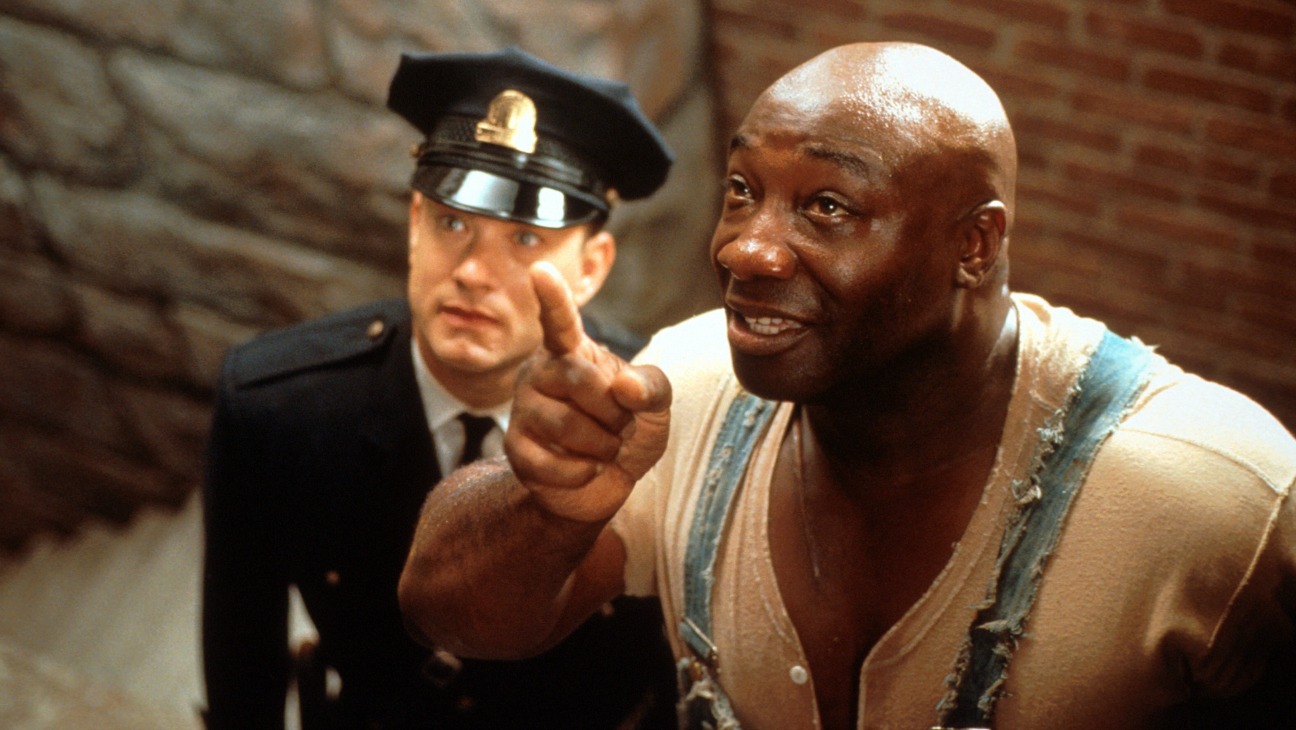
In present day Louisiana, Paul Edgecomb (Tom Hanks – played as an old man by Dabs Greer after Hanks’ make-up tests proved unconvincing) recounts his days in 1935, working as a prison guard on “the Green Mile”, the death row section of a prison. Paul’s life was changed forever with the arrival of a gentle giant, John Coffey (Michael Clarke Duncan), a seemingly simple-minded man found guilty of raping and murdering two young girls. However, John doesn’t match the personality Paul expects of a hardened criminal – and events soon prove he is far more than just an ordinary prisoner…

Frank Darabont’s adaptation of King’s novel – an adaptation King still lists as his favourite adaptation of his work – is long at almost three hours, and frequently takes its time. But it does so too carefully, and in detail, build the world it sits in – namely the prison – and the characters who live in it. Everything is carefully paced in order to create the sense of a real world, with (most of its) characters defying easy conventions or definitions. 

We know of course that the guards on this cell are largely decent, hard-working and respectful of the prisoners – not least because they are led by Tom Hanks at his most everyday, grounded and quietly moral. Darabont is very good at letting the world breathe – and, as a skilled scriptwriter, also in sketching character quickly and clearly. Both guards and prisoners are fully crafted characters, and while some of them do verge a bit more on the cartoonish villainy, their motivations and feelings feel real. 

You could criticise the film for the sentimental views built into this. All the guards are basically decent men – apart from Doug Hutchinson’s cowardly, whining bully Percy Whetmore, who owes his job to his family background, picks on the prisoners, reads porn and is motivated only by wanting to “see one cook”. While the film tries to give him some depth, a weakness of character, he’s basically easy for us to dislike. Similarly among the prisoners, all of them are polite, calm and resigned to the justice of their fate – minus an appalling, virulent racist hill-billy (played by Sam Rockwell with a manic intensity). There are very little doubts about who we are supposed to be rooting for here.

Racism as a whole gets only the barest of mentions. A few slurs are thrown at African-American John Coffey, but no real mention that in 1930s Louisiana there was little chance of a black man getting any form of justice at trial. Typically the only characters to espouse racist views fall squarely into the villain’s camp. Perhaps the intent is to show the prison as a melting pot of sorts – the final stop-off for people’s lives, where all men are basically equal, and the guards taking to heart their role as custodians for their final moments. But it’s also a bit of a cop-out.

We’re shown in detail the work Edgecomb and his team put into ensuring the prison is run smoothly and justly, and that the executions are committed as humanely as possible (frequent rehearsals – with Harry Dean Stanton rather funny as an eccentric stand-in condemned man – are called for). The good guards and good prisoners form bonds – and while this adds to the sentimentality, it perhaps makes sense in a system where the most extreme price is to be paid for their acts, and that any other judgement is unnecessary. We see three executions throughout the film, each carrying its own tone: one is a “how-it-should-be-done”, one is a horrifying, tortuous disaster, with Percy sabotaging the humane elements out of spite, the third sees Edgecomb finally questioning the role he has chosen for his life.

It’s not a film that touches a great deal on the morality – or otherwise – of legal executions, but it does use the setting to explore questions of faith and spirituality. Because what is going to put such things into your mind quicker than working in a place where life and death is literally your business? Some of this is more heavy handed than others – John Coffey’s initials should be a bit of a give-away – but the film does ask questions of what is important to us as people, and at what points should we question the decisions we take about how we live our lives.

These questions of faith don’t quite coalesce into something truly coherent, as it never quite feels if the film wants to deal with the implications of John Coffey’s gifts of healing. The possibilities of a wider world outside our understanding never really come together, and instead Coffey’s gift of healing by touch seems to be a blessed skill that he has developed rather than something more profound. There is also something troubling about the film’s sole black character (in 1930 a segregated Louisiana of all places) serving the purpose to heal white people and be sacrificed.

But when the film focuses on story and character rather than its rather unclear themes, it does well. Hanks is very good in the lead role – Darabont wrote the film specifically for him – with solid support from Morse, Pepper and DeMunn as the main “good” guard characters. Michael Jeter gives some heartfelt work as eccentric prisoner Delacroix. But the stand-out – in every way – is Michael Clarke Duncan, whose John Coffey is sweet, naïve, polite, gentle but also carries a suggestion of pain and guilt beneath his surface which is expertly sketched out.

The Green Mile may be overlong, but it’s hard to work out what you would cut as it’s a film that relies so strongly on mood, atmosphere and careful world creation. Well scripted and confidently directed by Darabont, it may be hard to work out exactly what it wants to say – but it has a richness and confidence to it, as well as an emotional force, that sometimes makes you feel that doesn’t really matter.

The Collector (1965)

Samantha Eggar is held captive by Terence Stamp in the unsettling The Collector

Director: William Wyler

Cast: Terence Stamp (Freddie Clegg), Samantha Eggar (Miranda Grey), Mona Washbourne (Aunt Annie), Maurice Dallimore (Colonel Whitman)

A lonely butterfly collector wins the pools. He’s rich, he can have everything he wants – but he’s still an outsider who can’t get a girl. Surely if a woman would just get to know him he’d find love. So the easiest way of doing that is probably kidnapping the woman you had a crush on at school, locking her in a carefully furnished basement in your Tudor mansion house and just wait for her to fall in love with you. Sounds like a perfect plan right?

William Wyler’s adaptation of John Fowles’ best-selling literary first novel sees Terence Stamp as the maladjusted loner and Samantha Eggar as his victim. It’s fascinating reading about the film today and the attitudes and perceptions towards it. Today the film is chilling in the obsessive, dangerous, self-pitying self-justifications of Freddie Clegg. But in the mid-60s a number of reviewers commented on the pity they felt for the kidnapper, and even expressed that in many ways he was acting on fantasies every healthy man has had (they haven’t). Quite rightly the film comes across differently today, a far more unsettling and disturbing portrait than it did at the time.

Wyler’s direction is intimate and a fine mixture of the theatrical – with its often single locations and two-actor scenes – and cinematic, particularly in the way he subtly builds up a Hitchcockian level of tension around the possibility of discovery and escape for Miranda. Sure visually he is a little too much in love with the crash zoom on key items (chloroform for example in Freddie’s car), and devices that seem a little too obvious (like the use of black and white for the film’s only significant flashback) but he mounts the entire film with an unsettling claustrophobia that works very well.

Further he draws out two fantastic performances from the leads. Terence Stamp was not a natural choice for the shy, timid outsider turned abductor – he’s obviously way too handsome and physically assured for the role – but he marshals very well the blinded arrogance of a man who believes the whole world would march to his tune if it only stopped and listened. His Freddie Clegg is softly-spoken, polite and controlled – so much so you almost forget how insane he is. Stamp also does a remarkable physical performance, making himself seem shorter and less dynamic than he really is, his body language having more than the hint of the schoolboy about it. Domineering, controlling, bullying and totally incapable of internal analysis of his actions. 

You realise watching the films events unfold – and Freddie’s inability to analyse the emotional truth behind them – that he is alone because he fundamentally doesn’t understand human relationships. While many of the (male) film reviewers at the time found this strangely tragic, today it’s hard to feel anything but contempt for his cruel self-pity.

The more difficult role falls to Samantha Eggar as Miranda. Wyler’s attempt to get the best performance from here seems pretty kin to the abduction the character goes through in the film – she was kept in isolation on the film set, Stamp was instructed to not talk to her outside of shooting while Wyler constantly held the threat of dismissal over her. More than a few echoes of Hitchcock in that – and Wyler’s praise on the film’s completion for Eggar’s (Oscar nominated and Cannes Award winning) performance as more than a whiff of self-praise to it. But Eggar herself is superb as a woman who oscillates between panic, desperation, ingratiating kindness, anger, contempt and fear. Miranda is a woman who tries everything she can to get out of this situation, only to constantly butt heads against the twin devils of her countryside isolation and Freddie’s own lack of emotional and intellectual intelligence.

Because the film interestingly makes clear what a tedious and not-very-bright monomaniacal man Freddie is, compared with the educated and quick-witted Miranda. When she tries to engage him on a discussion about modern art, he is utterly incapable of beginning to appreciate artists such as Picasso (‘It doesn’t look real’), completely fails to grasp any of the ideas in The Catcher in the Rye (the book she suggests he reads) or their relation to him, and is drawn only towards the blandest, most traditional drawings that she creates while whiling away the time in captivity. He fanatically collects butterflies, rooms lined with framed specimens that he can discuss in detail but with no concept of their beauty. Every time Miranda tries to scratch the surface of Freddie to connect with him she constantly discovers he has no depths at all, he’s a little boy lost in the world who can’t understand why he can’t collect people with the ease he catches and kills butterflies.

Whether the film has some sympathy for Freddie is less clear. Maurice Jarre’s luscious score certainly seems to suggest we should feel something for this misguided guy, but today it’s almost impossible to do so. The film works just as well without those feelings of implied sympathy though, which is a tribute to Wyler’s even-handed and controlled direction. Certainly Miranda’s fear and oppression are easy to connect with.

Is this a Stockholm syndrome film? Miranda – an intelligent and cunning woman – quickly realises that while she is the victim, Freddie’s desire to be seen as sort of chivalric gentleman does give her some power over his treatment of her – he wants her to fall in love for real with him. How much does she start to feel sympathy for this misguided loner? Is there any hint of real feeling at any point in her eventual attempt to seduce him (I doubt it heavily watching the film, but I may be adding a modern perspective, as I suspect Wyler wants to leave a hint there – again the score supports this feeling a bit)? I’m not sure – but the film’s eventual ending does leave little doubt that Freddie is a dangerous man, and the world is a less save place with him in it.

The Collector isn’t perfect – and perhaps its attitudes have dated – but it still has a real skill to it, some wonderful scenes – and two terrific performances from its lead actors, who I think have never been better than they are here. Wyler’s last success – and you can see his debt to the later work of Michael Powell and Alfred Hitchcock in each frame, even while he fails to match either of them – it still makes for an unsettling, troubling and fascinating watch.

Scum (1979)

Ray Winstone finds prison life a tough proposition in Scum

Director: Alan Clarke

Cast: Ray Winstone (Carlin), Mick Ford (Archer), Julian Firth (Davis), John Blundell (Banks), Phil Daniels (Richards), Alan Igborn (Meakin), Alrick Riley (Angel), Patrick Murray (Dougan), Peter Howell (Governor), John Judd (Mr Sands), Philip Jackson (Mr Greaves), John Grillo (Mr Goodyear), Bill Dean (Mr Duke)

In 1977 Alan Clarke’s searing condemnation of the borstal system in the UK, Scum, was shot as a BBC Play for Today. Outraged at its content, pressure in the press led to the film being banned. But that didn’t change what an electric bit of work it was – and when talk turned to creating a film version, having a filmed version of the script already in existence that could be used as a pitch tool was invaluable. So was born the film version of Scum, with much of the same cast, a higher budget (although still tiny by comparison to other films) and a chance for Clarke to bring his uncompromisingly harsh vision to the big screen.

Three young boys arrive at a borstal: Davis (Julian Firth) is a sensitive youngster who ran away from his previous borstal, Angel (Alrick Riley) a black kid who suffers the systemic racism at every level of the system and Carlin (Ray Winstone) a hard man with a dangerous reputation, who punched a warden at his last borstal. On arrival, the three are identified as requiring being “broken” by staff: Davis is bullied, Angel abused and Carlin is placed at the mercy of the wing’s “Daddy” Banks (John Blundell), suffering beatings with the authorities turning a blind eye. The entire system is rotten to the core and, while Carlin eventually rises up to take over the position of “Daddy”, it changes little in a young offender’s prison rife with racism, sadism, violence, abuse and rape. 

Scum is almost unbelievably grim and pessimistic for this system of incarceration, finding nothing to redeem or excuse the system across its entire running time. The borstal is a wintery hell on Earth, with justice and sympathy nowhere to be seen. While the system claims to be helping its inmates (aged from early teens to early twenties) to find new skills and purpose in life, its real function seems to be trying to beat discipline and subservience into its inmates by all means necessary. While the Governor (a silkly patrician Peter Howell) may talk faith, duty and country he oversees a system where the wardens ruthlessly beat the inmates, encourage them to ‘discipline’ each other, turn a blind eye to violence and abuse, encourage an atmosphere of racial loathing and generally show no concern or interest in any boy’s problem that can’t be solved without punching them in the mouth.

It’s a world Carlin is dropped into, and he knows it well. Played by Ray Winstone with a chippy anger that never seems that far from bursting to the surface, Carlin might want at first to keep his head down but quickly accepts the only way to survive in this dog-eat-dog world is to be the top dog. There will certainly be no justice from the wardens, who beat him on arrival as a trouble-maker, and set the Wing’s alphas on him to break his spirit. Casually beaten in the middle of the night, it’s the bruised Carlin who is sent to solitary confinement for fighting while his attackers go free. He is joined by Davis, framed for theft and Angel, for whom being black seems to be crime enough (walloped by a warden, and spilling food across his room, he is sent down for keeping his cell untidy).

What’s striking in this film though is that, as much as we are meant to think Carlin might be the hero, Clarke is smarter than that. He carefully watches Carlin – a tight-control on Winstone’s face that promises retributive violence is on the way – for almost forty minutes adjust in this system, before he takes matters into his hand. The film’s most famous sequence – shot in one dizzying tracking shot that captures the immediacy of Carlin’s putsch – sees Carlin beat Bank’s weasily sidekick Richards (Phil Daniels) with two snooker balls in a sock, before heading up to his dormitory toilet to beat Banks black-and-blue (and bloody), the cut finally coming to show us Carlin (from Banks POV) screaming at him “I’m the Daddy now”. It’s a masterclass of a sequence, electric in its execution and gives a moment of pleasing oomph (for all its extreme violence) as it shows Carlin finally getting a bit of justice.

Only Carlin’s institution as the Daddy brings largely only a change of figurehead rather than real change. Sure Carlin isn’t quite the bully Banks is, but he’s an unashamed racist, a violent thug, who ruthlessly takes over the money smuggling operation Banks was running (but taking a higher cut) and takes control of another wing by beating its “Daddy” (another black inmate) with an iron bar. Carlin is also quickly adopted by the wardens, just as Banks was, agreeing to maintain peace and control in the borstal in exchange for certain privileges like his own room. Carlin may at first seem to us the angel of retribution – but he’s really a ruthless survivor who is perfectly happy with the status quo so long as he on the top of it.

But then no one has any interest in improving things. The governor is only interested in the appearance of gentility. The wardens couldn’t care less about the rehabilitation of the inmates so long as they have a quiet life. The inmates drift through their life there, never questioning the violence around them. The matron is well-being, but hopelessly rules-bound, whose concern for the boy’s welfare never develops into seeing them as human beings. It’s a systemic failure.

There are other perspectives of course. Possibly the most fascinating character is Mick Ford (replacing David Threlfall in the original production) as Archer, a precociously intelligent inmate in his early twenties, possibly the only one who has read the rulebooks and enjoys running intellectual rings around the wardens. Causing trouble in his “own little way”, he claims to be a vegetarian (requiring a complex set of arrangements to be put in place to feed him separately) and also unable to wear leather boots (requiring his own special plastic boots to be located) and provokes the bible-bashing Governor with thoughts of converting to Islam and Sikhism. 

But he’s also a smart cookie, who recognises (in a fascinating conversation with veteran warder Dukes) that the entire system is a trap, both for the inmates and the wardens, imprisoning them in a system where criminal acts are endemic, the wardens are trapped and brutalised by the system as much as the prisoners and the whole system manifestly fails to do anything other than inoculate Darwinian violence into its inmates (Archer is of course promptly put on report for this cutting analysis). The scene – a key part of the film’s argument – is also a tribute to the skilful writing of Roy Minton, whose script bubbles with both quotable and sadly realistic dialogue.

Clarke’s entire film is the exploration of this violence and the mixture of hypocrisy and denial down to outward condonation and support it receives from the Governor down to the wardens. Any proper review of the conditions in the Borstal is impossible, as it would rock the boat and fly in the face of the positive message the Governor wishes to promote about his institution. Effort is put into putting the boys at loggerheads with each other (usually on racial grounds) as a divide and rule. The weak are happily left at the bottom of the rung, not least the tragic Davis, a sensitive boy (marvellously played by Julian Firth with a heartbreaking vulnerability) totally failed by everyone around him.

Clarke’s final act spins out of a disturbingly intense rape scene of a young inmate (an act witnessed with a sneer by sinister warden Sands, a repulsive John Judd) – the scene a mix of careful filming to show nothing too graphic, and heart-rendering intensity in its vulnerability and violence. The victim is totally ignored, leading to tragic consequences – another difficult to watch scene which hammers home both the cruel indifference of the warders and the helplessness of the victim. The eventual riot this is all leading too is, however, painfully futile: scapegoats are selected at random and beaten senseless, the status quo is reinforced by a bland platitude speech from the Governor. 

Directed with fire and passion by Alan Clarke, a virtuoso of realism and master of social conscious, Scumis a masterpiece of anger, of boiling resentment against systems that do not work and do not care that they do not work. Packed with astonishing performances and some sublime camera work and film-making skill, it’s a must-see.

The Next Three Days (2010)

Elizabeth Banks and Russell Crowe go on the run in workmanlike thriller The Next Three Days

Director:  Paul Haggis

Cast: Russell Crowe (John Brennan), Elizabeth Banks (Laura Brennan), Brian Dennehy (George Brennan), Lennie James (Lt Nabulsi), Olivia Wilde (Nicole), Ty Simpkins (Luke Brennan), Helen Carey (Grace Brennan), Liam Neeson (Damon Pennington), Daniel Stern (Meyer Fisk)

What would you do to protect the person you love? How far would you go to keep her safe? What would you sacrifice? What rules would you break? Paul Haggis’ serviceable thriller tries to answer these questions, but doesn’t really get much closer to the answers than I have here.

Russell Crowe is John Brennan, a teacher of English Literature at a mid-ranking college. One day, his wife Laura (Elizabeth Banks) is arrested for the murder of her boss. Despite her pleas of innocence, before they know it she is sentenced to spend most of the rest of her life behind bars. When desperation at the thought of her fate – and missing the upbringing of their young son – leads her to attempt suicide, John decides to take the extreme step of breaking her out of prison. But where to begin with the planning? And what will he be prepared to do?

It’s the sort of film that early-on has the lead character meet a ruthless expert (in this case an ex-con with a history of prison breaks, played with a growling enjoyment by Liam Neeson in a one-scene cameo) who outlines a list of rules and terrible things that the hero will be forced to do. The hero looks askance – but sure enough each situation arises and doncha know it the hero is forced to bend his own morality to meet the needs of his mission. What a surprise.

Only of course the film doesn’t have the courage to force Crowe’s John to actually do things that bend his morality. There is always a get-out clause. When his actions lead to him taking a petty criminal’s life (while stealing money from a drug den), it’s self-defence. When he looks like he may be forced to put innocent people in harm’s way, he backs away. When he’s asked to sacrifice something major, he refuses. The film wants to be the sort of film where we see the lead character change inexorably as he becomes harder and more ruthless to achieve his mission. But it worries about losing our sympathy, so constantly gives the audience and the character get-out clauses to excuse his behaviour.

Not that Crowe gives a bad performance – he’s actually rather convincing as a humble, slightly timid man way out of his depth at the start – but the film fails completely to show these events really changing the man. It believes that it’s turning him into a darker, more ruthless person, but it isn’t. At heart, this film isn’t really a character-study at all but a dark caper movie. Obstacles are constantly thrown in the path of our hero, many of which bamboozle him: but then when we hit the prison break itself at last, suddenly he’s pulling carefully planned rabbits and double bluffs out of his hat like Danny Ocean. It’s a film that wants to have its cake and eat it: to show a hero bewildered by his task, in danger from this ruthless world he finds himself in – but also to have him become a sort of long-game con artist thinking three moves ahead of the police.

It just doesn’t quite tie up. It’s the film adapting to whatever it feels the requirements and desires of the audience might be at a particular moment rather than something that develops naturally. Enjoyable as it is to see these sort of games play out, you can’t help but feel a little bit cheated – there has been no indication before this that the character has this level of ingenuity in him.

He doesn’t even really need to pay a price beyond that which he had accepted from the start: at points major sacrifices are dangled before him but he never needs to make any of them. He never has to really bend his personal morality significantly. It’s the cleanest conversion to criminality that you are likely to see.

The film cracks along at a decent pace – even if it is a little too long – and shows its various twists and reveals fairly well. Elizabeth Banks is pretty good as Laura, even though she hardly seems the most sympathetic character from the start (the audience has to do a bit of work for why Crowe’s character seems so devoted to her). Most of the rest of the cast are basically slightly larger cameos but no one disgraces themselves.

The main problem with the film is its lack of depth and ambition. Mentioning Don Quixote several times in the narrative doesn’t magically grant a film depth and automatically create intelligent contrasts with the novel. Instead it just sounds like straining for depth rather than actually having it.

Midnight Express (1978)

Brad Davis and John Hurt find themselves in melodramatic hell in Midnight Express

Director: Alan Parker

Cast: Brad Davis (Billy Hayes), Randy Quaid (Jimmy Booth), John Hurt (Max), Paul L Smith (Hamidou), Irene Miracle (Susan), Bo Hopkins (Tex), Paolo Bonacelli (Rifkin), Norbert Weisser (Erich), Mike Kellin (Mr Hayes), Peter Jeffrey (Ahmet), Kevork Malikyan (Prosecutor)

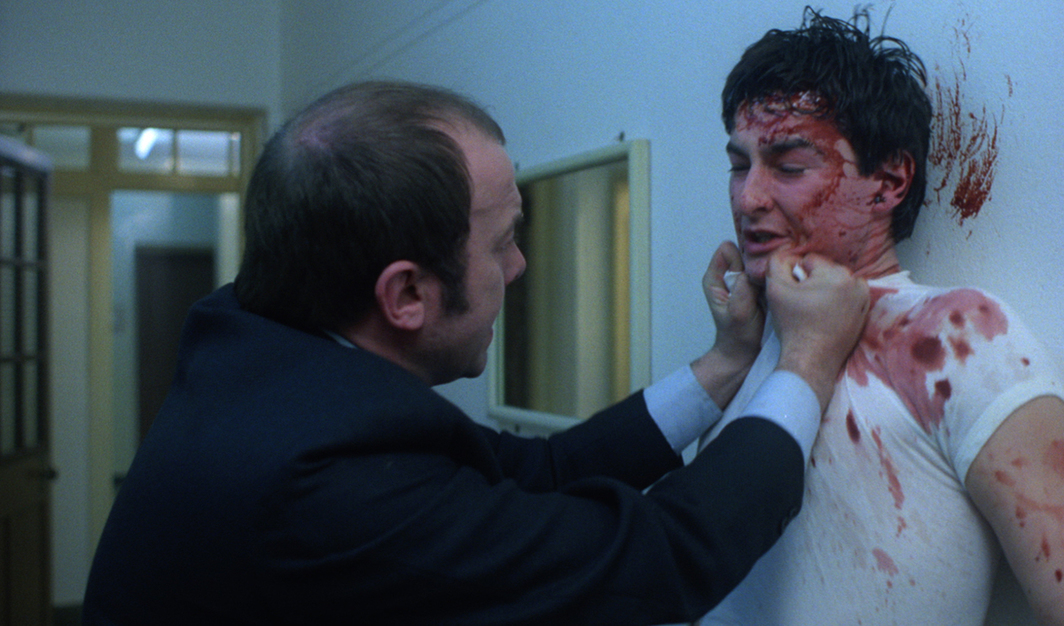
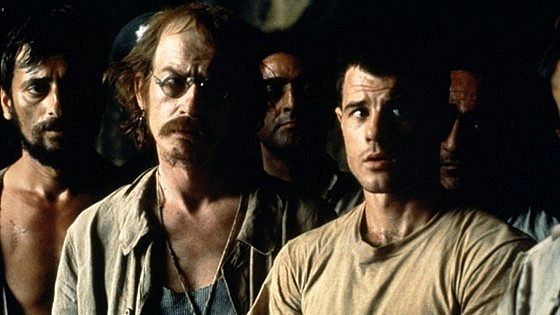
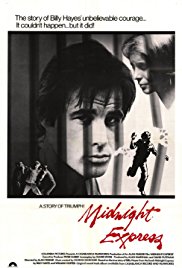
Ever wondered why “Turkish prison” was, for a long time, practically a synonym for “hell on earth”? A big reason is this film’s box-office success, a heavily fictionalised version of the experiences of Billy Hayes (Brad Davis), a young American caught smuggling hashish out of Turkey and eventually sentenced to 30 years in a prison notorious for violence, torture and rape. The film covers Hayes’ imprisonment, his alliances with fellow prisoners loud-mouthed American Jimmy (Randy Quaid) and sensitive, strung-out Englishman Max (John Hurt), and his ill-treatment at the hands of sadistic guard Hamidou (Paul L Smith). It’s not exactly a light watch.

Midnight Express was an unexpected controversial sleeper hit. Many felt the film was grossly violent, horrible, and borderline racist towards its Turkish characters. Looking back now, the violence is (with a few exceptions) no more than you might expect – but the attitude the film takes towards its Turkish characters really sticks out.

There is barely a Turk in this who isn’t crooked, sadistic, greedy, ugly or stupid (or a combination of all five). The depiction is so unsettlingly bad, the real Billy Hayes apologised at the time (he was joined years later by the film’s producers and writer, Oliver Stone). Many of the Turks are lascivious anal rapists, while the whole film has a queasy unease about homosexuality. The real Billy Hayes engaged in relationships with other men in prison – the film’s Hayes kisses a fellow prisoner in the shower but then shakes his head and leaves. A 1970s audience could cope with seeing a man flogged or tortured – but in no way could they be expected to watch two men making out.

Other than these unsettling black marks, Midnight Express is a taut, well-made, melodrama. And I say melodrama because both Stone and Parker frequently go over the top. After a friend is betrayed to a horrible fate by a Turkish prisoner, Hayes freaks out, violently beats the Turk, gouges his eyes and then (in almost laughable slow-mo) bites his tongue out and spits it across the room. Later, he is finally allowed to receive a visit from his girlfriend – she presses her breasts up against the glass while a near catatonic Hayes tearfully masturbates (“I wish I could make it better for you baby” she sighs, tearfully). Yes both those sequences are as OTT as they sound.

But when it calms down, Parker crafts a pretty affecting story. It cuts Hayes a lot of slack – I found it hard to feel sorry for a dumb, drug-smuggler who assumes his American passport will let him off with a slap on the wrist. I can’t be alone in thinking that someone who breaks the law deserves to pay some sort of price. To be fair, I think the film partly shares this view: it fast-forwards through most of Hayes’ original term, and only really hits into full misery once his sentence is arbitrarily extended by 27 years. I think Parker and Stone believe this switches the moral right to Hayes, who had served his term only to be hit with a sudden draconian change weeks before release. 

A lot of the film’s impact comes from Brad Davis’ impassioned performance as Hayes. There is something very sensitive and gentle about Davis, a real vulnerability that the film seizes upon to great effect. He looks like a bewildered lost soul, and Davis’ performance is scintillating first in its confusion, then his distress and anger. 

There are decent performances from the rest of the cast, with John Hurt standing out as the gentle Max. Garlanded with awards, Hurt is perfect as the straggled, beaten down, but still cynical and surly Max – and of course Hurt’s natural affinity for suffering works perfectly for a character who goes through the wringer. Quaid also does decent work as a thoughtless loudmouth, as does Kellin as Hayes’ impotent father. It’s also nice to see a small cameo from Peter Jeffrey as a well-spoken half-English paedophile in the prison’s psychiatric ward.

It’s a shame that Midnight Express too frequently goes too far, as it’s got an almost medieval understanding of suffering. The prison is a grim world of its own, where the prisoners largely self-police and acts of petty revenge are common. Later in the film, Hayes is sent to the film’s psychiatric ward, a hellish basement where prisoners walk in drugged-up dumbness pointlessly round and round a stone pillar.

Moments like this are far more impactful because they avoid the extremities of the rest of the film. Most of what we see isn’t true – Hayes’ story and his escape was vastly different, and the film exaggerates both his naïveté and his suffering – but it still works extremely well. Parker fought to end the film simply, rather than the all-action escape sequence filmed and this works wonderfully (it’s basically a Third Man homage, by way of Robert Altman’s The Long Goodbye) – although it still finds another moment for a threat of anal rape in the final ten minutes.

Midnight Express is a decent film, but not a pleasant one – and it leaves a slightly sour taste in the mouth, for all the competence with which it is made. Parker and Stone frequently go too far, and the reek of homophobic racism still comes off the film. However it is certainly a good piece of technical film-making and has some marvellous performances in the mix.