Tag: Psychological dramas

Séance on a Wet Afternoon (1964)

Kim Stanley and Richard Attenborough are superb in unsettling drama Seance on a Wet Afternoon

Director: Bryan Forbes

Cast: Kim Stanley (Myra Savage), Richard Attenborough (Billy Savage), Nanette Newman (Mrs Clayton), Mark Eden (Charles Clayton), Patrick Magee (Superintendent Walsh), Gerald Sim (Sergeant Beedle), Judith Donner (Amanda Clayton), Ronald Hines (Constable)

Myra (Kim Stanley) and Billy (Richard Attenborough) Savage are a middle-aged couple held together by shared grief for a lost child. Myra works as a medium with the spirit of their son, Arthur, as a spirit guide. But grief has had a damaging impact on them both – and Myra believes her work can bring some life back to their lost son. Keen to gain more recognition – and therefore for their son – she urges Billy to kidnap the daughter of a rich couple, so that she can “discover” the child through her spirit guide. However, events soon spiral increasingly out of control.

Bryan Forbes writes and directs (and produces, with Attenborough) this unsettling and often tense film, which shares DNA with ghost stories (but contains no terrors) and psychological dramas. It’s also a superbly acted chamber-piece, an acute psychological study of two deeply traumatised individuals who have responded very differently to personal tragedy and found themselves locked into cycles of behaviour that are becoming increasingly destructive.

Forbes shoots the film with a fly-on-the-wall intensity, giving the exterior scenes a cinéma verité style, concealed cameras capturing unwitting crowds walking blithely through a kidnap drama. There is a kitchen-sink realism here, and elements of psychological hammer horror, with the viewer never quite sure how far this couple will be willing to go. The eerie score by John Barry, mixes in with hauntingly dominant sound designs (especially of dripping water in the film’s opening moments) to create an oppressive, claustrophobic atmosphere that leaves you not in the least surprised that the psyche of its two lead characters have been so badly damaged.

That sense of disturbance fits perfectly with the lack of planning around the couple’s entire operation. Despite sparks of ingenuity (many of them dependent on Billy’s bland forget-ability and bank-managerish blending into the crowd), once the child has been kidnapped, they have no idea of the next step or how (or even, it seems, if they want to) exploit the situation. It becomes increasingly clear that the plan is not a grand design, but a final desperate attempt to find meaning in their own lives and (certainly in Myra’s case) to provide some sort of connection to their lost son.

That lost son hangs over the whole film, his pointedly not-real ghostly presence having contributed hugely to Myra’s mental disintegration – and also having crushed the life out of Billy. Myra has clearly never recovered from the shock and grief – more facts of which are revealed as the film plays out, culminating in a scintillating scene of emotional confrontation between the two – and Billy, in a desperate attempt to comfort his wife, has instead become the chief enabler of her fantasies.

It makes for an elegant two-hander of stirring emotion – and requires two actors at the peak of their game. As Myra, the little-known Kim Stanley is a sensation. A Broadway star (the “female Brando”) but with only one film credit prior to this (and only three more after this), Stanley brings a brilliant method technique but also a freshness and theatricality matching perfectly the film’s theatrical roots and heightened sense of reality. Stanley delivers an immersive performance that walks a fine tight-rope between calculation, delusion and psychological collapse. It’s a show-piece role, but Stanley largely avoids overplaying, instead exploring the deep emotional scars in the character with a sensitivity that makes Myra someone to pity as recoil from.

Opposite her, Attenborough delivers one of his finest performances as the complex, conflicted Billy. Seeming at first just a brow-beaten husband, it becomes clear Billy has in fact taken on a great emotional responsibility for protecting and comforting Myra, a dedication that has (step-by-step) led to him catering to her every misguided demand. It’s a generous, very subtle performance, of a fundamentally good man who performs misdeeds because he believes it is for the greater good, confusing love for his wife with refusing to make her confront reality.

These two excellent performers perform a complex dance where our perception of the power dynamics in the relationship constantly shift. At first Myra appears to hold all the aces, brow-beating the meek Billy and lecturing him on everything from the spirit world to classical music. However, it slowly becomes clear – as does Myra’s lack of grasp of reality – that Billy is the quieter but stronger character, whose dedication and strength has kept the couple going.

Séance on a Wet Afternoon is at its best when exploring the relationship between these two and provides two fine actors magnificent opportunities which their seize with relish. Its pace flags a bit over the two hours – a tighter 90 minute run time would probably have helped it – and while it’s lack of drive in the plot does reflect the confused ambling scheme at its heart, it does mean the film can drift. But this is a fine psychological study, well-made and superbly performed.
The Passenger (1975)

Maria Schneider and Jack Nicholson hit the road in Antonioni’s partly frustrating, partly masterful The Passenger

Director: Michelangelo Antonioni

Cast: Jack Nicholson (David Locke), Maria Schneider (The Girl), Ian Hendy (Martin Knight), Jenny Runacre (Rachel Locke), Charles Mulvehill (David Robertson), Steven Berkoff (Stephen)

Ever wanted to jack in your life and have a go at being someone else? It’s a temptation we’ve all felt at one time or another, that chance to make a completely fresh start free of all those burdens and expectations of our own lives. 

It’s a temptation thrown in the way of David Locke (Jack Nicholson) a British-American journalist, trying to make contact with rebel groups in the deepest Sahara deserts of Chad. Returning, after a failed excursion, to his ‘hotel’ in the tiny, beat-up village in the middle of the desert he finds that the only other resident, an Englishman, has died of a heart attack. The two man have a physical similarity, enough for Locke to decide to swop places with the dead man and leave Chad under a new identity as David Robertson. Curious to follow the details left in Robertson’s appointment diary, Locke finds that he has taken the identity of an arms dealer – making sense immediately of why Robertson was also in the hotel at the time – forcing Locke to stay one-step ahead of both the arms dealers and his wife Rachel (Jenny Runacre) and producer Martin (Ian Hendry) keen to talk to him about ‘Locke’s’ death.

If that sounds like it might be an action packed thriller – you’d be wrong, because let’s not forget that this is an Antonioni film, and if there is one thing you can expect from the revered auteur of the Art-House, it’s that his films are mysteries wrapped in enigmas. The Passenger is no exception, a slow, intriguing mood piece that only partially allows the audience even half a chance to puzzle out what it’s about, mixed with striking images and haunting sequences of fundamental unknowingness. Despite the paragraph above there is almost no plot in The Passenger, with the film instead focused on themes of alienation, existentialism, destiny, fate and identity. In other words all the big stuff.

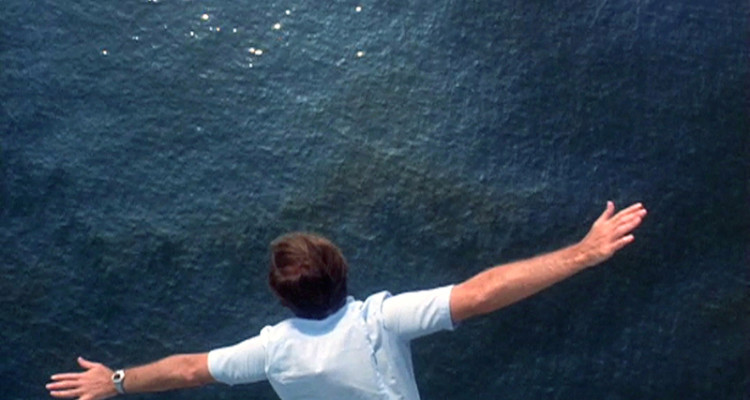
Much of this is captured in the character of Locke. Played by Jack Nicholson in a stripped-down, purged style a million miles away from the “Jack” of legend, Locke is a blank. We spend almost the entire film with him, but learn virtually nothing about him. What desires or miseries or depressions drive him to abandon his life and head out into a new life? We have only vague whispers about an unhappy marriage (with a wife having an affair with someone else) and a general listless dissatisfaction with his own life and career. Locke is a character yearning for some kind of release, some kind of higher meaning – the happiest he seems to be in the movie, is hanging over the side of a cable car, arms outstretched, pretending to fly over the waters below. It’s a freedom like that – some sort of total unshackling from the modern world altogether – that he seems to want or need.

So why doesn’t he go for it? Why doesn’t he just junk Robertson’s appointment diary and escape properly into the wide world, well beyond the reach of Chad rebels, curious wives and BBC Producers? Perhaps because he is a Passenger himself, a man who lacks the essential will and freedom of purpose to make his own destiny, to escape the structure of a world he finds so constricting? Instead, he seems bound of a wheel of fire, compelled somehow to continue following some sort of structure unable to yank himself fully free of the chains of this modern world. He wants to be a free spirit, but he remains a little man, to whom events happen, who is approached by people, who follows directions not forging his own path.

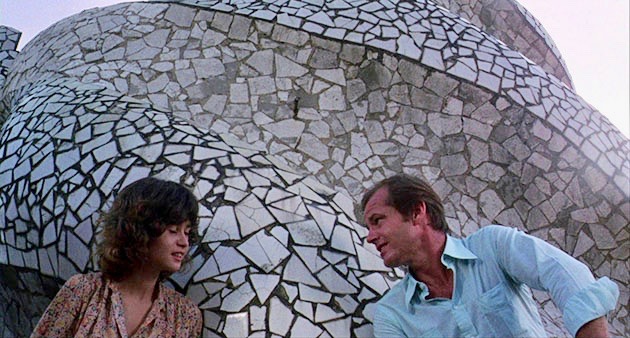
He gets as close as he can to opening up by talking to a passenger of his own, a mysterious girl (played with an unaffected naturalness by Maria Schneider that is part graceful reality, part wooden stiffness but works perfectly) he encounters while following Robertson’s trail. He first spots her sitting on a bench in London, then sees her again atop Guadi’s La Pedrera in Barcelona. Is this coincidence? Is this fate? Destiny? Or is this a curious suggestion that the girl may be more than she seems? None of these questions is answered by the film, but it fits perfectly in with the unknowing vagueness and quizzical unpredictability of its events. Hammering home the blank unknowability of Schneider’s character, she isn’t even named in the film. She joins Locke on his journey, but her motivations are as vague as his – is it escape, a bohemian lark, a curiosity that guides her? Who knows?

The film continues in this vein, showing Locke drifting from Chad to the UK to Berlin, Barcelona and Seville, never seeming to allow Locke more than a few seconds of freedom. Is the film asking if there is any such thing as true freedom, that even after swopping lives Locke still finds himself locked down into following a series of pre-arranged duties, like a train on a line? It’s not clear, but it’s beautifully filmed. Antonioni’s mastery of the camera shines throughout the film, and it’s full of haunting and immersive imagery, not least in his skilful use of locations and framing, with Locke and the Girl frequently positioned oddly or even dwarfed by the architecture and locations around them, from the plains of the desert to the towers of Gaudi.

Antonioni also saves for this film some sequences which are simply breathtaking in their cinematic mastery and beauty. His control of technique is near faultless – while his art house vagueness might have you pulling your hair out at points, these sequences will have you winding the film back just to relax in their skill and confidence again. Early in the film, we see Locke sit and fake his passport in his Chad hotel – oh for the days when identity theft was as simple as glueing a new photo into a passport – the camera smoothly moves around him, while he listens to recordings of Robertson and he meeting, until it settles onto the balcony (all this in one take) at which point Robertson walks into frame and continues the conversation, Locke following him and, there we go, Antonioni has taken us suddenly into the past. Without a single cut, the camera follows the conversation before panning back round to Locke sitting once again writing.

It’s a sequence that cineateases would be raving about, if it wasn’t dwarfed by the film’s penultimate shot, a stunning seven-minute single take that would be simplicity itself to make with CGI and Steadicam today, but was somewhere achieved without the invention of others. Starting on a single shot of Locke’s Seville hotel room, the pan slowly focuses on events outside the grilled window, the camera slowly zooming in on the outside until it passes through the grill and rotates 180 degrees back to see the room from the outside, while the Girl and other mysterious people arrive and leave outside. It’s a beautiful, brilliant, sublime, masterful piece of cinema. It’s compelling, surely one of the greatest “one-take” shots in all of cinema. Simply perfect. Directors could sit and dream of making such a shot. 

Antonioni’s masterful direction and wilfully obtuse exploration of his themes makes for a film that is at time frustratingly unreadable, but also crammed with opportunities for the viewer to insert their own views and interpretations, something that is only going to become more tempting (and rewarding) with repeated viewings. Alongside that, it’s a simply beautiful and sublimely made piece of cinema – and if for no other reason deserves your time.

Lilith (1964)

Jean Seberg lures Warren Beatty and Peter Fonda into a psychologically dangerous web in Lilith

Director: Robert Rossen

Cast: Warren Beatty (Vincent Bruce), Jean Seberg (Lilith Arthur), Peter Fonda (Stephen Evshevsky), Kim Hunter (Dr Bea Brice), Anne Meacham (Mrs Meaghan), Jessica Walter (Laura), Gene Hackman (Norman), James Patterson (De Lavrier), Robert Reilly (Bob Clayfield)

Movies have long had a fascination with mental illness – in particular the impact of mental illness on women. Lilith is an intriguing, elliptical, somewhat cold but intriguing film that looks at the impact isolation, loneliness and seclusion can have on people and how these damaged psyches can sprawl out and cause further pain and suffering for others. However, it’s also a difficult, unclear and occasionally hard to like film, that deliberately clouds so many of its points in a veil of doubt and uncertainty that it’s difficult to really embrace it.

Returning from an undisclosed war (possibly Korea), Vincent Bruce (Warren Beatty), a lonely, slightly troubled young man, drifts into a job as a counsellor at a private mental hospital, under the supervision of Dr Brice (Kim Hunter). Bruce is empathetic and keen to understand and help the patients, but he finds himself slowly drawn towards Lilith Arthur (Jean Seberg), a sensual and seductive patient at the institute. Encouraged to spend more time with Lilith – as only Vincent seems able to draw her out of a fantasy world to engage with the real one – he increasingly finds himself infatuated with her, increasingly bending any personal or professional ethics to fuel his emotional and sexual need for her.

Just in case you are in any doubt from reading that, it’s pretty clear from early on in the film that the real person in need of help is Vincent. Played with a methody introspection and brooding insecurity by Beatty (he impassively and wordlessly drifts through several scenes or merely watches, and only rarely shows any emotional engagement), Vincent is frequently framed by Rossen alone, lost in the centre and sides of frames, or walking seemingly aimlessly forward. The camera often drifts towards him, if only to stress his lack of real engagement with the things he is seeing in front of him. His obsessive qualities are there from the very start, with his fixations switching between his mother, a former girlfriend (played with a flirtatious seductiveness by Jessica Walter) and finally settling, overwhelmingly, on Lilith whom he follows with the glazed eyes of a potential killer. Beatty struggled with the part – and I can see why, as our central character is such a distant cipher that he becomes someone very hard for the audience to invest any interest in.

Lilith herself is an intriguing if, it seems, unknowable character – almost impossible to tell if she is a truly destructive force or someone who simply behaves as she feels in the moment with no understanding of the impact her actions have. She is frequently callous and cruel, and then will revert to sadness, vulnerability and insecurity. She looks for love – or at least affection and loyalty – at every turn, but then also seems unable to understand any personal relationship except through the filter of sex. Starting the film placing an erotic spell around sensitive fellow patient Steve (Peter Fonda, vulnerable and rather sweet) she quickly switches all her efforts to wrapping Vincent in a web of enchantment (as the film rather clumsily stresses to us in a scene where a doctor explicitly compares her to a spider).

Lilith is increasingly seen as an unsettling, indiscriminate figure. No sooner does Vincent become her lover, than she begins flaunting a sexual relationship she is having with another female patient. (Lesbianism was quite radical for a film at the time). Even more surprisingly the patient is a staid, rather imperious middle-aged woman (played imposingly by Anne Meacham), and the relationship seems to be partly conducted to get a rise (of one sort or another) out of Vincent. Earlier, Lilith flirts disturbingly and erotically with a very young child (who seems disturbed) – although the viewer is perhaps even more disturbed by Vincent’s blank watching of the whole scene. At every point we are reminded of Lilith’s erotic allure – and the framing of the film, and its beautiful photography by Eugene Schufftan helps to create this mystic image. Lilith is often shown behind grills and bars earlier on, before she emerges into the outside world and one enchanting image sees her kissing her reflection in a lake, the very act reducing the reflection to shimmering ripples on the surface: can anyone know her?

The part leans on being borderline sexist, the idea of the enchanting, liberated woman as somehow being a dangerous (almost evil) threat to the safety and mental security of the men around her, deliberately endangering the decent world with her sexual openness. It largely manages to avoid this due to the performance of Jean Seberg, who gives Lilith a vulnerability and suggestions of deep psychological trauma that underpin her surface sexuality, flirtation and predatory nature. It’s no surprise that she is so completely able to overwhelm the repressed, inverted Vincent, or that he becomes such a willing slave to her whims and spur-of-the-moment suggestions.

Much of this disintegration of Vincent underpins the second half of the film, as he and Lilith engage in a dance that ends up having overwhelmingly negative consequences for each of them and for many of those around them. Intriguingly, Rossen’s vision of this mental institute as a more bohemian organisation suggests that the staff all seem aware of (and even tacitly encourage) the relationship – although whether this is part of a treatment or some sort of bizarre other motive is unclear. However, all this doesn’t help to make either character one we really care about, or make the story crystallise into something that carries real impact.

That captures the central problem of the film – Rossen deliberately builds the story with an elliptical sense of mystery in which the actions and motives of characters remain deliberately unclear, and the world they live in takes on elements of the dreamlike fantasy world that Lilith herself sometimes lives in (complete with her own language). Events seems to move with little sense of time. There are surreal interludes, not least an extended sequence where Vincent takes Lilith to a jousting competition (yes you read that right). It’s perhaps all a part of understanding how the personalities of the two lead characters slowly collapse over time into themselves, but it also serves to keep a distance between the film and the viewer. The final tragic outcomes are predictable from the very start of the film, but there is still a certain power to them. As a study of what slow mental disintegration may look like, Lilith is an intriguing little picture, but basically a little too hard to invest in emotionally to carry real impact.

Ordinary People (1980)


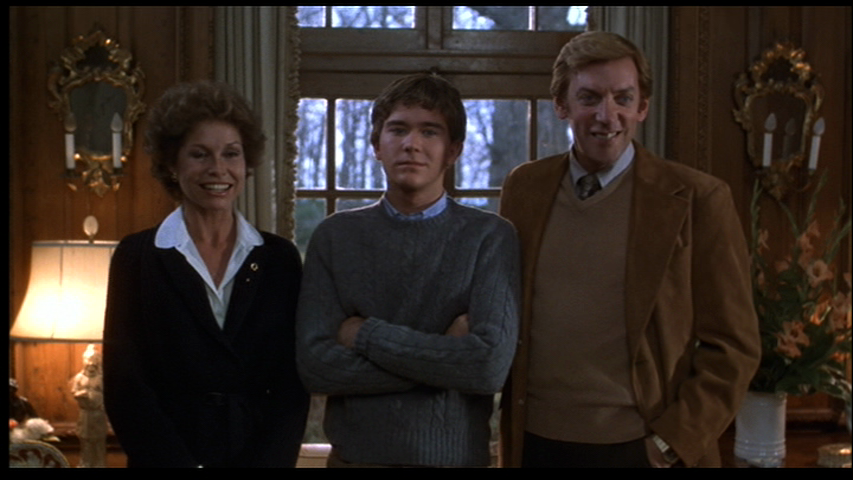
Mary Taylor Moore, Timothy Hutton and Donald Sutherland pose for an awkward picture in family troubles drama Ordinary People

Director: Robert Redford

Cast: Donald Sutherland (Calvin Jarrett), Mary Taylor Moore (Beth Jarrett), Timothy Hutton (Conrad Jarrett), Judd Hirsch (Dr Tyrone Berger), Elizabeth McGovern (Jeannine Pratt), M. Emmet Walsh (Coash Salan), Dinah Manoff (Karen Aldrich), Fredric Lehne (Joe Lazenby), James B Sikking (Roy Hanley)

In 1980, Robert Redford became the first big Hollywood stars to parlay acting success into producing and directing small scale, independent films that otherwise might never have been made. Ordinary People was the first of these – with Redford focusing on staying behind the camera – and it was a big success. It even won four Oscars – best picture, screenplay, supporting actor for Timothy Hutton (despite the fact Hutton is really the lead) and best director for Redford himself (beating out David Lynch for The Elephant Man and Martin Scorsese for Raging Bull). It was a great story for 1980 – the matinee idol turned artist. But is Ordinary People that great a film?

The film covers the emotional collapse of a wealthy middle-class American family after the eldest son Bucky is killed in a boating accident. Younger son Conrad (Timothy Hutton) has had trouble coming to terms with the accident, which he survived, and has only just left an institution after a suicide attempt. His father Calvin (Donald Sutherland) is desperate to try and relate to his son again, while his mother Beth (Mary Taylor Moore) remains emotionally distant attempting to put the accident behind them. Conrad starts seeing psychiatrist Dr Berger (Judd Hirsch), to adjust – but the after effects of Bucky’s death continue to tear the family apart.

Nobody really talks about Ordinary People any more do they? Out of all the 1980s Best Picture winners it’s perhaps the most easy to overlook (except maybe for Terms of Endearment). Why is this? Well truth be told it’s just a pretty ordinary picture. There really isn’t much to it. The story it tells of a wealthy family (only a millionaire like Redford could consider these loaded people ordinary) suffering emotional trauma and psychiatry finding the answer has been told so many times before, and since, that there isn’t anything particularly unique or interesting about it. 

In fact Ordinary People is exactly the sort of small-scale, quiet, middle-brow independent film that awards ceremonies slather over and a few years later (never mind over 30!) people struggle to see what the fuss was about. Redford directs the film with a quiet professionalism – the sort of competent craftsmanship and skill with actors that dozens of other directors could have done just as well. His Oscar for best director is especially galling when you consider the artistry and imagination of Scorsese’s direction of Raging Bull, or the unbearable sadness and tragedy Lynch gave The Elephant Man. It’s the sort of direction a non-famous director wouldn’t even have been nominated for.

This film uses shot-reverse-shot like it’s going out of fashion, most of the scenes are conversations across tables that are weighted down so heavily with meaning you start to lose interest in them. The score uses Pachelbel’s music in such an overwhelming style, it makes that sound as anodyne as much of the rest of the movie. Maybe it’s just because this is such well-trodden ground, but the revelations towards the end of the movie are so blindingly obvious you wonder why it takes so long to get to them (the son blames himself, the mother blames the son and doesn’t love him as much as the dead son, the father wants the two to kiss and make-up). 

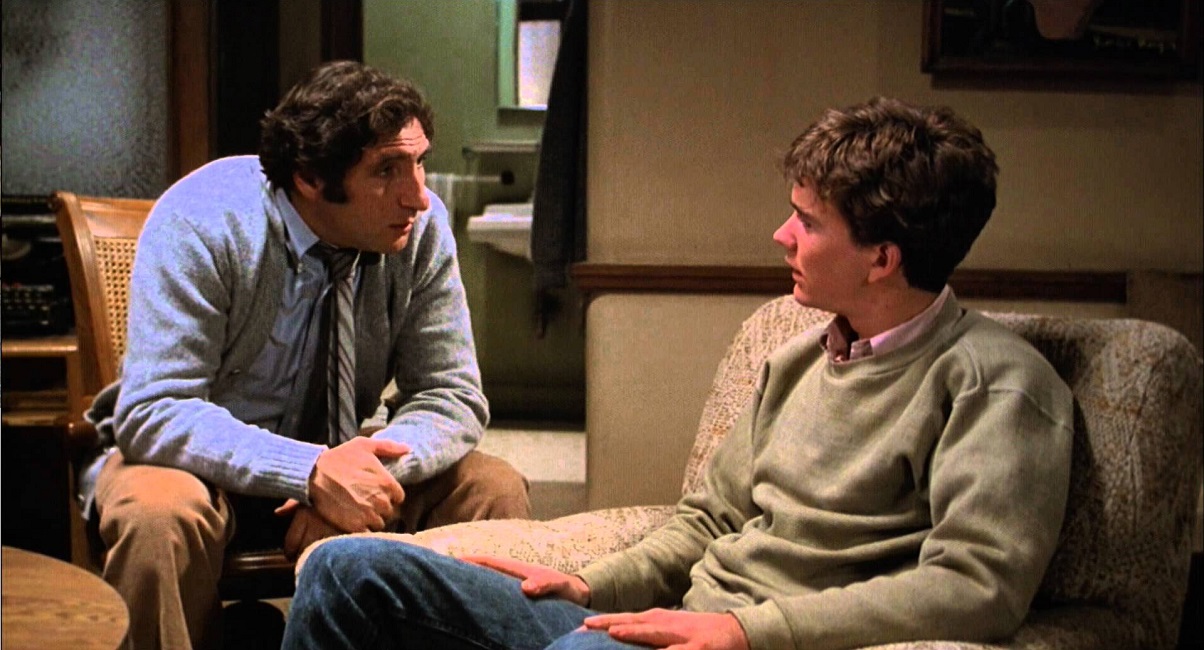
This rotates around a series of psychiatrist scenes which at least have the feeling of actual sessions, even if Judd Hirsch (good as he is here) basically plays the sort of revelation inspiring psychiatrist that only appears in movies. The film has a touching faith in the power of analysis being able to solve all problems, and spends so long luxuriating in scenes like this it virtually forgets to put actual living, breathing characters in the middle of them. With the possible exception of the father, none of these characters feel particularly real – they are just mouthpieces for the plot.

Not that it’s badly acted at all. Timothy Hutton made his film debut here and he brings a real fire and passion to the role, as well as a moving emotional vulnerability and anger directed only at himself. The supporting actor Oscar feels a bit of a cheat, as he’s clearly the lead, but he’s very good here as Conrad, struggling to express himself, bottling up his feelings and lashing out at those around him. It’s a part that feels drawn together from bits and pieces of plot requirement, but Hutton plays it to the hilt – it just doesn’t feel like a really real person, more a collection of sad traits.

Mary Taylor Moore is in a similar situation as a mother so cold and distant from her son, so repressed and controlling her distance starts damaging the entire family. She’s unable to process what has happened so almost wants to pretend nothing has (and blames her son for not doing that same), that it again feels like something from a psychiatric case-study rather than real person. Moore gained particular attention at the time as she was best known for comedy (much like Judd Hirsch, famous for the sitcom Taxi) – so the performance at the time might have looked stronger than it actually was.

The best performance might well come from Donald Sutherland in the least flashy role as the father trying to puzzle out what is going on – and trying to work out his own feelings. It’s the only character that feels less like a construct and more a genuine person, whose answers aren’t easily worked out by a bit of psychology study. Sutherland is low-key, tender, gentle and carries all his emotion on the inside – it’s a subtle and excellent performance, overlooked way too much. 

Redford essentially directed an actor’s film here (it’s all about the big moments of acting) so it’s not a surprise that it seized the attention of the Academy (largely made-up of actors) but really it’s not that far away from a well-made “movie of the week”,  with its obvious beats and not particularly surprising revelations. Perhaps it’s the point that the family’s problems seem a lot more apparent to the viewer than they do to the characters – and there is some interesting development of perceptions, not least from Sutherland’s father who starts to come to profound realisations about his wife and son. 

But Ordinary Peopleis an uninspiring and even rather tame drama, that today looks even more low-key and insubstantial. While it tries to break free from the confines of “social drama” it actually wants to tie everything up with a neat bow psychologically – and despite the fact it has an ending that suggests not everything is perfect, it really concludes with a safe full stop. There is a reason why it’s surely one of the best pictures which has been most forgotten about.

Black Swan (2010)


Natalie Portman in the intense world of ballet in Aronofsky’s crazy masterpiece Black Swan

Director:  Darren Aronofsky

Cast: Natalie Portman (Nina Sayers), Mila Kunis (Lily), Vincent Cassel (Thomas Leroy), Barbara Hershey (Erica Sayers), Winona Ryder (Beth MacIntyre), Benjamin Millepied (David Moreau), Ksenia Solo (Veronica), Kristina Anapau (Galina), Janet Montgomery (Madeline), Sebastian Stan (Andrew)

Something about ballet just makes people think of obsession. Many dancers criticised Black Swan for perpetuating myths about the dangerous psychology, the quest for perfection, the personal life imbalance connected with the all-consuming art ballet seems to be. It’s hard not to agree with them – but that doesn’t mean Black Swan isn’t unsettling, creepy and hypnotic film-making. 

Nina Sayers (Natalie Portman) is an obsessive member of the New York Ballet, focused on achieving perfection and lives a sheltered, barely adult life at home, dominated by her mother Erica (Barbara Hershey). With the forced retirement of company lead Beth McIntyre (Winona Ryder), Diagheliv-style director Thomas Leroy (Vincent Cassel) selects Nina to play the dual role lead of white and black swan in Swan Lake. Leroy feels she is perfect for the innocent white swan, but needs to work on the sensual black swan. Increasingly feeling the pressure of playing the role under the demanding Leroy – and growing increasingly preoccupied with her understudy Lily (Mila Kunis) – Nina’s fragile psyche begins to fracture.

Black Swan is a mesmerising mixture of psychological drama, melodrama, Cronenberg-style body horror, unreliable narration and immersion into a pressure-cooker world. It’s often difficult to watch, sometimes maddeningly over-blown, and overly tricksy in its intense visual style. But despite that, it’s actually compellingly watchable, an audacious tight-rope walk between style and substance that constantly feels like it’s going to get lost in its extremes but never does.

Aronofsky’s camera flies and whirls like the ballet dancers he is recording, and he creates a wonderfully dark spin on The Red Shoes. What I found particularly fascinating watching the film again after many years is how unreliable and imprecise so much of the story is. Told completely from the perspective of Nina – a woman subject to delusions, chronic social insecurity and an increasingly split psyche – it becomes clear that a lot of what we see may not be as clear-cut as we think. 

This most obviously affects our perception of Mila Kunis’ rival (or is she?) dancer Lily. How many of the interactions we see are actually happening, and how many are fantasies? With Lily becoming an alternative physical form for Nina’s projection of her own “black swan” persona (several times, Lily’s face morphs and shifts into Nina’s), we have to question virtually every appearance we see of her – and interpret her personality from the prejudiced, fearful view seen by Nina. Similarly, Barbara Hershey’s domineering mother (while undoubtedly controlling) is perhaps not the monster we see. She’s clearly 100% right in her fears for Nina’s sanity. How much of her behaviour is possessive jealousy and how much is it a protective parent who knows her daughter is a danger to herself?

Then of course we have Nina herself. Natalie Portman won every award going for her performance here, a tour de force of bravura dementedness mixed with vulnerability. Nina is a character who we only slowly realise as the film progresses is not the innocent, childlike waif she first appears, but has a much darker, more complex personality. Her “black swan” side – the darker, sexual side of her personality she is encouraged to explore – slowly expresses itself more and more as a physically. Portman clearly demonstrates the differences between the two sides of Nina’s personality. Her increasing desperation, isolation and insecurity are very effective – and the moments where she allows the “black swan” persona to control her actions are riveting.

Aronofsky explores Nina’s unbalanced mind with moments of pure body horror – although it’s grand guignol ickyness like this that probably pushed some people too far. It ties into most of the film being (quite possibly) a series of Nina’s vivid fantasies. Ballet wounds become increasingly magnified – from a broken toe nail early on, to Nina obsessively picking and scratching any wound. In one impossible to watch moment she obsessively picks off a long strip of skin from a finger wound (fortunately revealed immediately after to be fantasy). Beginning to believe she is growing wings, she obsessively scratches her back and has visions of swan flesh morphing over her body. At one point she fantasies her legs breaking into swan legs. In between this are bouts of sexual exploration – both solo and with partners – that seem increasingly unnerving. 

Aronofsky’s ballet world is one of meticulous work and back-stabbing brutality. An early sequence covers Nina’s almost ritualistic preparations of her ballet shoes. The troupe, far from supportive, seems to be ripe for bitchy debate and rivalry (although of course some of this may well be Nina’s unhinged perception). Winona Ryder has a neat cameo as a former star dancer, ruthlessly dumped for being too old. Vincent Cassel’s director is at best a domineering bully and at worst a position-abusing horndog, depending on how reliable Nina’s perspective is. It’s the setting of a melodrama, and Aronofsky has expertly mixed a Silence of the Lambs style psycho-drama and The Fly style horror.

Portman holds the film together brilliantly under Aronofsky’s distinctive direction. It’s not going to be for everyone – but Aronofsky understands ballet if nothing else, shoots it brilliantly, and when we finally see Nina fully transformed as the Black Swan dancing the final performance, the energy and controlling focus of her performance, and its beauty, really comes across (even to a ballet ignoramus like me).

Black Swan is such an off-the-wall mix of styles, and so out there in some of its visuals, story developments and characterisations, that it’s not going to please everyone. In fact, catch this on the wrong day and you’ll hate this film (and probably really, really, really hate it). But catch it at the right time and it will stick with you. But whatever your view of its gothic style and content, you’ll admire Portman’s performance, respect the craft with which it has been made, and enjoy several fine performances from Cassel, Hershey and Kunis among others. It’s weird. Very weird. But that’s not necessarily a bad thing.