
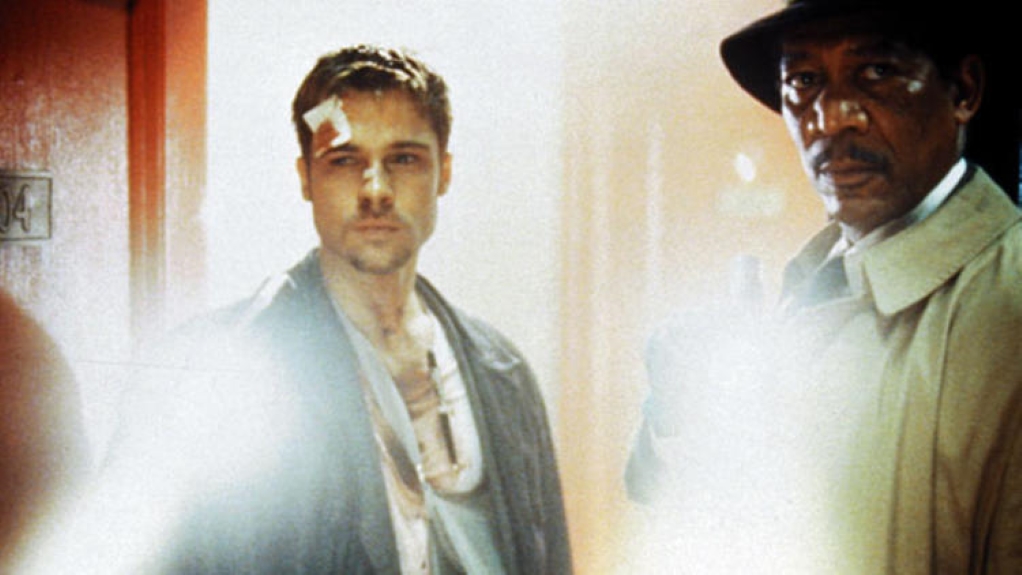
Darkly, unrelentingly unsettling, Fincher’s true-debut is an outstanding psychological thriller
Director: David Fincher
Cast: Brad Pitt (Detective David Mills), Morgan Freeman (Detective William Somerset), Gwyneth Paltrow (Tracy Mills), Richard Roundtree (DA Talbot), R. Lee Ermey (Police captain), John C McGinley (‘California’), Julie Araskog (Mrs Gould), Mark Boone Jnr (FBI man), John Cassini (Officer Davis), Reginald E. Cathey (Dr Santiago), Richard Schiff (Mark Swarr), Kevin Spacey (John Doe)

Set in a city where decency and humanity goes to die, daylight is a stranger and everything is covered with constant rainfall, Seven covers the most chilling week-in-the-life of two detectives. One, disillusioned William Somerset (Morgan Freeman), is counting down to his early retirement. The other, his cocksure replacement David Mills (Brad Pitt) thinks he’s unbeatable and indestructible. But they are going up against someone who will shake them to their core, a calculating serial killer dispatching victims he judges guilty of the seven deadly scenes, framing their bodies in grotesque rituals. Can they track him down before he completes his terrible work?
Seven is one of the finest, and most influential, of all serial killer films. Dark, haunting and relentless, it’s a perfect package of grim foreboding and nihilistic terror, expertly directed by David Fincher. Seven is very careful about what it shows you, trusting far more in the horror of suggestion and witnessing the reactions of the characters – you come out of it convinced you have seen more than you have. It never lets you relax for a moment, always dreading the worst – yet so many people never saw coming its infamous final act with its unexpected, horrifying, reveals and darkly, hope-free conclusion. Seven offers almost no comfort and never pets you at ease only a despairing look at how terrible the world can be and how desperate the struggle for goodness can be.
In a visual design that’s reminiscent of Blade Runner, the world of Seven is almost permanently dark, dingy and rain-soaked, the crime scenes filthy, terrifying haunted houses of grimness. The chaotic sounds of the city, mechanical and uncaring, are everywhere: Somerset even sleeps with a metronome ticking in an attempt to impose sone order on his world. The score uses base beats and near-industrial sound, the editing mixes smooth classic cuts and sudden shocks, the camera work is awash with tones from the green of greed to the blood red of lust. Not there there is any comfort in daylight, since the brightest, most open sequence of this claustrophobic film (even the Mills’ apartment violently shakes from passing trains, a subtle hint no where is safe) takes place in a pylon-stuffed field and it’s the most horrific, nihilistic of the lot.
Seven though is also darkly seductive: it plays on our fascination with the dark ‘genius’ of Hollywood killers, their love of patterns and the twisted purity of their quest for perfection. The film’s opening sequence, showing the killer’s preparations in a series of jagged, disorienting cuts, even places us in his perspective. When he is revealed, he mixes prissy politeness with dark, obsessive love for his work. Seven understands out fascination with the pattern killer – just as we were obsessed with Hannibal Lector and the Terminator, the guy in control is intriguing. It punishes us for this by stressing the horrific impact of his crimes and the traumatic impact on the survivors, is nihilistic ending even more effective for all the dark enjoyment the viewer has taken out of Seven’s grim momentum.

It’s also benefits hugely from its play on the conventions of the odd-couple detective pairing. Somerset and Mills are chalk-and-cheese: Somerset is calm, methodical and professionally distant, Mills is volcanic, lacks focus and becomes terribly personally invested. One of the films few touches of humanity and hope is the growing friendship between these two – slow-burning to say the least – that sees them go from butting heads to sharing jokes and supporting each other’s calls.
The performances are excellent. Brad Pitt (whose clout helped ensure producers couldn’t neuter the film’s shocking ending) is full of jittery energy masking his insecurity, doubt and fear; so worried about looking weak he resorts constantly to anger. Lacking patience (hilariously he can’t bring himself to read Dante and Chaucer, as Somerset recommends, instead resorting to hiding Cliff Notes books in his desk) he investigates the crimes with gusto, focused on the exterior not the interior. He can’t only see the killer as a lunatic, an under-estimation that makes him easy to manipulate.
The moral centre is Morgan Freeman’s Somerset, a superb performance. Somerset is completely disillusioned, convinced any trace of goodness in the world has disappeared. Despite this, events prove him wise (but not above terrible errors) and determined with a strong moral centre. He’s empathetic about crime in ways Mills isn’t (at an early crime scene, one of his first questions is if the victim’s kid has seen the body, a question dismissed as irrelevant by his colleagues) and investigates from inside the killer’s psyche, seeking to understand his motives. Perhaps no other film than Seven has given Freeman so perfect a vehicle, his expressive eyes full of sorrow and regret, his careful decency a mask of detachment that he slowly lets slip to Mills and his wife.
As that wife, Gwyneth Paltrow gives a striking, endearing and perfectly judged performance in a small but crucial role. Tracy Mills is the one unquestionably decent person in this crap-sack world, perhaps why she and Somerset are drawn together. Seven has a wonderfully quiet, humane moment in all this horror, when the two meet to discuss parenthood, a beautifully played exploration of doubt and fear from Paltrow and quiet semi-regret from Freeman. It’s a role pivotal for the film, Paltrow leaving a deeply tender impression on the viewer.

It’s vital for the film’s final act pay-off. Seven is perfectly constructed, both in its pacing of the murders and in not dragging out the mystery of the motive too long (it knows, of course, that everyone watching the film is ahead of the detectives on that score). It’s crammed with stand-out sequences: a SWAT team house storming promises drama but turns into a dark twist on the wrong-door routine; a chase sequence after a chance encounter with the unseen killer gives a perfect shot of adrenalin. It’s all unbalancing us for a shockingly unexpected move by the killer (the actor’s identity carefully kept a secret in advance, meaning his reveal is a genuine shock for the uninitiated) leading to its horrifically nihilistic ending that I defy anyone to anticipate (except its now probably as famous as the identity of Rosebud or Keyser Soze).
Seven is astonishingly brave in all its pulsating thrills and perfectly judged tension for offering very little hope. This is a film where good is essentially powerless against evil: Somerset is too detached to beat evil, Mills so invested in his own black-and-white world he’s easy prey for the coldly manipulative. The film’s conclusion is a punch to the gut, but logical in a film where we’ve seen ordinary people indifferent to the worst of humanity and evil being so devilishly determined and ingenious in its actions no one stands a chance to beat it. You can criticise Seven for its small beats of misogyny: while Tracy is pure, like a fairy-tale princess, the two female victims are a shallow, preening model while the lust victim is not the man who uses prostitutes but the prostitute herself – an attitude we shouldn’t be surprised the killer has, but is unquestioned by any of the (all-male) investigators. (I was uncomfortable with this when I first saw it in the nineties, and time hasn’t changed my mind).
But aside from that, Seven is a darkly compelling masterpiece, a brilliantly unsettling film from David Fincher, at last allowed to deliver a film that exactly matched his vision (in a way Alien 3 did not). The battle to keep its nihilistic dark and shocking ending was a battle well-won, and it makes for a film that is a chilling exploration of evil in the world as well as a compelling, darkly-bloody film noir set in a world of unrelenting hopelessness. One of the greatest serial killer films ever made.


 Movie Musings