
Tag: Rachel Ticotin

Con Air (1997)

Con Air (1997)

Big bangs and silly action abounds in Nicolas Cage’s enjoyable action epic

Director: Simon West

Cast: Nicolas Cage (Cameron Poe), John Cusack (US Marshal Vince Larkin), John Malkovich (Cyrus ‘The Virus’ Grissom), Steve Buscemi (Garland ‘The Marietta Mangler’ Greene), Ving Rhames (Nathan ‘Diamond Dog’ Jones), Colm Meaney (DEA Agent Duncan Malloy), Mykelti Williamson (Mike ‘Baby-O’ O’Dell), Rachel Ticotin (Guard Sally Bishop), Monica Potter (Tricia Poe), Dave Chappelle (Joe ‘Pinball’ Parker), MC Gainey (‘Swamp Thing’), Danny Trejo (‘Johnny 23’)

A rickety plane full of the worst of the worst and very low security. Battles to the death over the fate of a cuddly bunny. A car dragged after a flying plane. On any other day, that might all be considered strange. In Con Air it’s just grist to the mill. Made in the heart of Cage’s post-Oscar swerve from off-the-wall indie star to pumped-up, eccentric action star, Con Air is loud, brash, makes very little sense, feels like it was all made up on the spur of the moment and is rather good fun.

Cameron Poe (Nicholas Cage) is an Army Ranger who ends up in jail after he is forced to protect himself and his wife (Monica Potter), with deadly consequences, in an unprovoked bar brawl. Seven years later he is finally about to be released from prison to meet his young daughter for the first time. To get him to his release though, he’ll need to hitch a ride on a prison transfer plane that is shuttling the ‘worst of the worst’ to a high security prison. With criminal genius Cyrus ‘The Virus’ Grissom (John Malkovich) and his number two ‘Diamond Dog’ (Ving Rhames) on board, what could go wrong? Needless to say, the criminals seize the plane – can Cameron, with help on the ground from US Marshal Vince Larkin (John Cusack) protect the hostages and save the day?

There isn’t really any way of getting around this. Con Air is a very silly film. Nothing in it really bears thinking about logically. To the tune of a soft rock score and Leann Rimes (actually, How Do I Live is a damn good song, and I won’t hear a word otherwise), Simon West shoots the entire thing like it was a primary-coloured advert for action movies. It’s the sort of film that feels like the action set-pieces were written first – “The plane will crash on the in Las Vegas! Right, how do we get the plane to Las Vegas and out of fuel?” – and where the actors thrash around trying to make a plot that feels made-up on the spot full of try-hard dialogue work.

But despite this, Con Air seems to work. Whether it’s because of its brash confidence in its own ridiculousness or because it hired enough scribes to pen one-liners and character quirks to just about give the film a sense of wit and character (Poe’s ongoing effort to protect the cuddly bunny he intends to give his daughter is just one of a decent set of running gags – “Put the bunny. Back. In the box.”). You suspect watching it that there was the intention somewhere along the line to make something darker and more violent – the criminals’ seizure of the plane is surprisingly bloody – that just got forgotten about when it was decided it worked best as a dumb end-of-term panto.

A large part of its success stems from Cage’s droll performance. Turning himself into a sort of every-day action hero with just the odd trace of his famed grand guignol eccentricity here and there, Cage’s Cameron Poe makes for an intriguing lead for a balls-to-the-wall action film. Poe is softly-spoken, invariably polite, sweetly excited about seeing his daughter and pretty much encounters every unlikely event he sees with a laconic dead-pan (“On any other day that might be considered strange” he murmurs when witnessing the plane drag a sports car behind it through the air).

Cage of course looks ridiculously pumped up and spends most of the film in an obligatory Die Hard style vest. He hands out ruthless beatings of ne’er-do-wells – although only Cage could impale a serial killer on a pipe and sadly intone “Why couldn’t you just put the bunny back in the box”. Only Cage would take a part clearly intended as a Bruce Willis smirker and turn it into a sort of kick-boxing Paddington Bear. His stubborn refusal to take the film seriously means he cancels out Simon West’s ridiculously macho aesthetic that otherwise infects almost every frame. While everything else is loud, sharply cut and features actors spouting try-hard tough dialogue, the film’s central character spends the opening of the film learning Spanish and exchanging surprisingly sweet letters with his daughter and strolls around earnestly trying to do the right thing.

John Cusack similarly runs counter to the tone. Clearly counting the minutes until he can cash his cheque, Cusack turns his US Marshal into a laid-back, sandal-wearing boy scout, quietly exasperated about the wildness around him. I suspect half of Cusack’s drily low-key dialogue was written by him just to keep himself interested. Malkovich is cursed with the film’s worst try-hard tough-guy dialogue, but even he enjoys downplaying the role into softly spoken comedy. The three leads leave the blow-hard silliness to their foils Colm Meaney (as a permanently angry DEA agent) and Ving Rhames (as a violent would-be revolutionary).

With most of the people in it not taking it seriously, it generally means the ridiculousness of the plot – an aimless capture of a plane built around a series of set-pieces – and flashes of violence get watered down in favour of comic nonsense that of course ends with a rammed slot machine hitting a jackpot and the villain being stabbed, launched, electrocuted and crushed in a super-display of overkill. Whether this is what West intended who can say? But it’s certainly a lot better this way.

After all who cares if the villain’s masterplan depends on the sudden appearance of a sandstorm or that no war hero would ever go to jail for protecting his wife in a bar (Poe must have the worst lawyer in the world). It’s all about the jokes (a body at one point has a message scrawled on it and is literally posted into thin air), the bangs and, above all, the weary, half-smirking performances of the leads who can’t believe the nonsense they are sitting in the middle of.

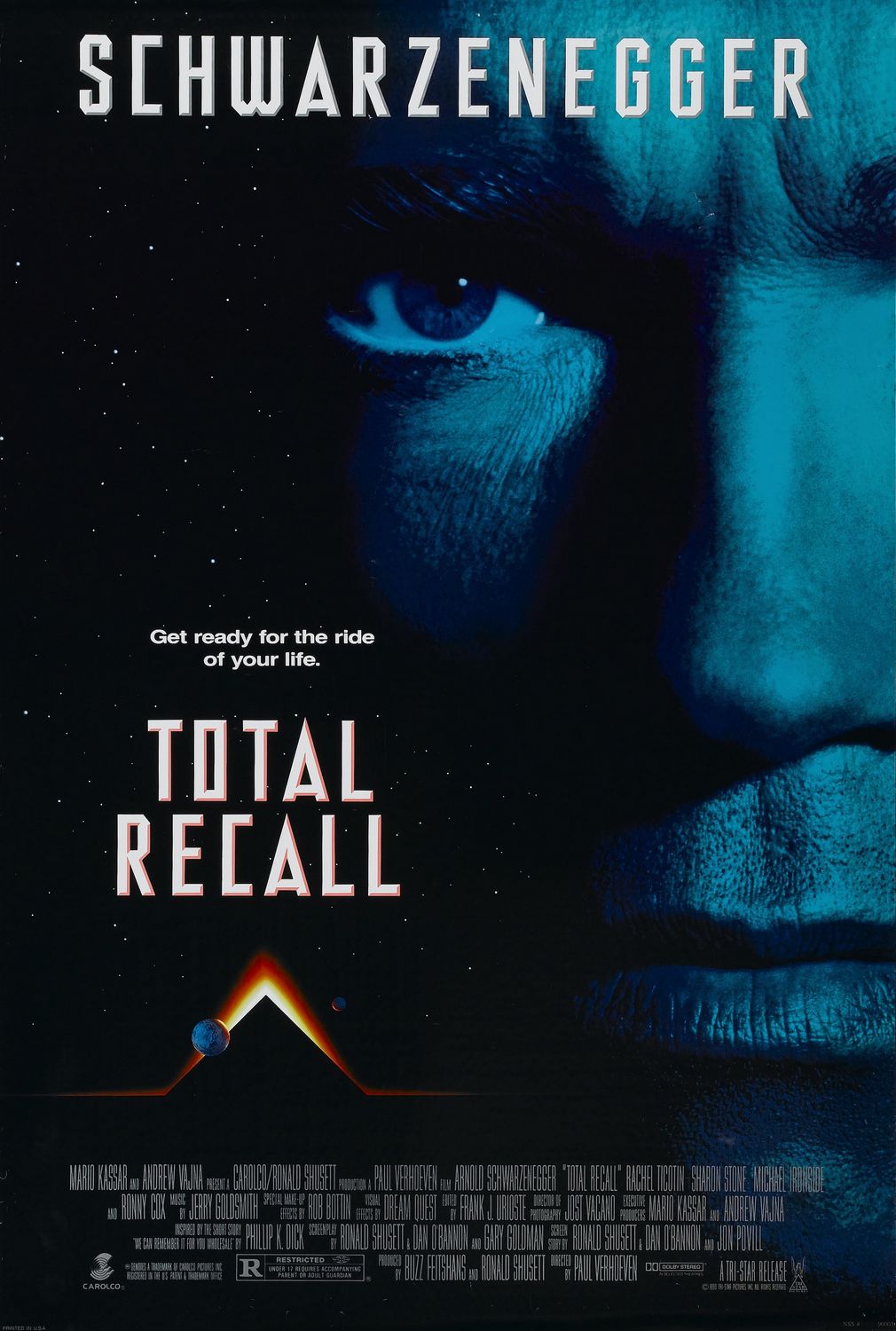
Total Recall (1990)


Arnold Schwarzenegger goes for a trip into his memories in Total Recall

Director: Paul Verhoeven

Cast: Arnold Schwarzenegger (Douglas Quaid/Carl Hauser), Rachel Ticotin (Melina), Sharon Stone (Lori Quaid), Ronny Cox (Vilos Conhaagen), Michael Ironside (Richter), Mel Johnson Jnr (Benny), Marshall Bell (George/Kuato), Roy Brocksmith (Dr Edgemar), Dean Norris (Tony)

Perhaps in 2084, they will look back on Schwarzenegger’s career and wonder what on earth we were all thinking. He was the figurehead of the 1980s fashion for muscle-bound leading men, defined more by physicality than acting ability. Since then, fashions have changed: movies are led by actors who go through hours of physical training, rather than weight lifters taking acting classes. Would Schwarzenegger be a star today? Quite possibly not: compare him to his nearest modern equivalent, Dwayne Johnson. Schwarzenegger doesn’t have an ounce of Johnson’s ability, wit or even charm. Would the world of Twitter embrace an often one-note performer with a paper thin range?

Schwarzenegger got where he was because, for all his lack of acting skill, he is a very clever man: he could spot a script and worked with people who got the best out of him. He turned himself into a brand: “Arnie” the pillar of strength, the master of the one-liner. It worked for films, it worked for politics. Which is all a long intro to say: in his best work, he put himself into decent roles in films from distinctive filmmakers, like Total Recall.

Total Recall is a semi-smart sci-fi action thriller, directed by Paul Verhoeven with his usual Dutch excess: part social satire, part wallow in extreme cartoonish violence and grotesque, Flemish-painting style imagery. Douglas Quaid (Arnie) is a construction worker in 2084, who dreams of escaping his humdrum life and visiting the Mars colony. He decides to visit Recall, a memory implantation centre which promises to give him memories of visiting Mars, with a twist: he’ll visit as a secret agent. However, the implantation reveals Quaid has hidden memories – he may in fact be rogue agent on the run, Carl Hauser. Before he knows it, everyone from his own wife (Sharon Stone) to a brutal intelligence operative (Michael Ironside) is hunting him with lethal force – and Quaid must head to Mars for answers about who he is.

Verhoeven’s sci-fi work adds a level of social satire to high concept stories. In Total Recall he mixes in his critical denunciations of big business and corporate ethics (also a major theme of Robocop) with an everyday acceptance of brutal violence that is so neck-breakingly, blood-spurtingly extreme in places it could only be social satire. Total Recall mocks our own ease with violence as entertainment, by setting itself in a world where the news broadcasts government troops machine gunning protestors (while a newsreader cheerily comments on the minimum use of violence), and the representatives of the Mars Corporation have literally no compunction or hesitation in inflicting huge numbers of civilian casualties in the crossfire.

A lot of this cartoonish violence spins out of the movie’s own playing around with the nature of reality. It leaves open the question of whether Quaid is really a spy in disguise, or if the film’s events occur only in his fractured brain suffering a terminal meltdown from an upload gone wrong. At Recall Quaid is promised his new fantasy memories will be full of action, he’ll get the girl and save the world. Needless to say he achieves all these things by the film’s end. Rachel Ticotin even appears on a screen in Recall as his “fantasy” woman. Is Quaid dreaming or not? It’s a question that is of more interest to viewers I suspect than the filmmakers (other than a few cheeky bits from Verhoeven), but it does tie in neatly with the almost dreamlike hyper violence Quaid dishes out: necks snapped, bodies spurting fountains of pinky red blood, dead bodies used as shields ripped to pieces by bullets. It’s all so extreme that it deliberately feels both not quite real and a mocking commentary on the bloodless action in other sci-fi films.

Schwarzenegger fits surprisingly well into all this. On paper, he’s completely miscast as an innocent discovering a hidden past, the future Governator anchoring a film with satirist leanings. But Verhoeven gets something out of Schwarzenegger in this film that works surprisingly well. Like James Cameron recognised, Verhoeven saw Arnie had a sort of upstanding sweetness amidst all the macho posturing. Arnie is surprisingly effective as Quaid, suddenly shocked at his capabilities for violence (as well of course or physically selling the action). Verhoeven taps into Arnie’s likeability (what other action star could sell “Consider this a divorce” as a punchline as he shoots his fake wife in the head?) and runs with it throughout the film.

As such, Schwazenegger makes a decent lead. It helps that he is willing to be a figure of fun at points. He wears a wet towel round his head to block transmissions. His face contorts ludicrously as he pulls an enormous probe from out of his nose. He infiltrates Mars dressed as an old woman. Most of this material fades away in the second half of the movie when Schwarzenegger reverts to the more typical heroic action (I suspect negotiations over the script shifted the film into a halfway house between a standard action movie and Verhoeven’s more satiric bent). But it’s all still there and helps humanise Quaid, so that we are on board with the slaughter he perpetrates later. Quaid is probably one of the best roles Arnie had – and Verhoeven does very well to fit a man so serious about himself into a world of self-parody. Saying that, the role is in some ways beyond Arnie’s reach – I’m not sure he is really plugged into or understands the dark comic tone of the movie, and he doesn’t really have the wit as a performer to do much more than deliver killer lines, certainly not to contribute to the dark satire Verhoeven is putting together.

As a whole the film doesn’t always deliver. Schwarzenegger seems at sea during scenes with his feisty, independent love interest played by Rachel Ticotin (this does her no favours, as her role hardly connects). Sharon Stone similarly has little chemistry with the Austrian Oak – although at least she has the second best role in the script as a vicious woman not afraid to use sex as a tool. The actual plot fits in nicely with the possibly dreamlike nature of what we are seeing, but the villain’s aims seem rather unclear, and the film lacks a strong enough antagonist (neither Michael Ironside or Ronny Cox have quite enough to make their thin characters come to life).

This plays into the film as being semi-smart: it’s a curious mix of smart and stupid. It’s got enough brains to poke a bit of fun at corporate America, and to make moral comments on our treatment of minorities (here represented by the mutants who inhabit Mars). On the other hand, it’s a schlocky action cartoon, that revels in ultra-violence while creating a world where, in universe, it is not considered extreme enough to comment on.

Total Recall is a fun movie that allows you to read more into it than is probably really there. Verhoeven peddles themes around the nature of reality, and introduces satiric comments on corporations and violence in the media that don’t hit home so heavily that they become wearing. I also have to say I like its empathy with the vulnerable and weak – the mutant resistance on Mars is engagingly grounded and humane, particularly in contrast to the ruthless heartlessness of Mars Corp. It’s not a masterpiece, but as a smarter piece of popcorn fun it works really well.

For Schwarzenegger himself, this was his final non­­-Terminator hit. Terminator 2 (a year later), an undoubted work of genius, was his high watermark. Three attempts since to relaunch the Terminator franchise (all with mediocre or worse directors), demonstrate Schwarzenegger’s awareness his time was fleeting and dependent on his roles rather than his skills. Total Recall was Schwarzenegger doing something completely different, to great success – but also one of his last hits-. His run of good scripts, and pulp premises, came to an end here – but it was a good end. California awaited!