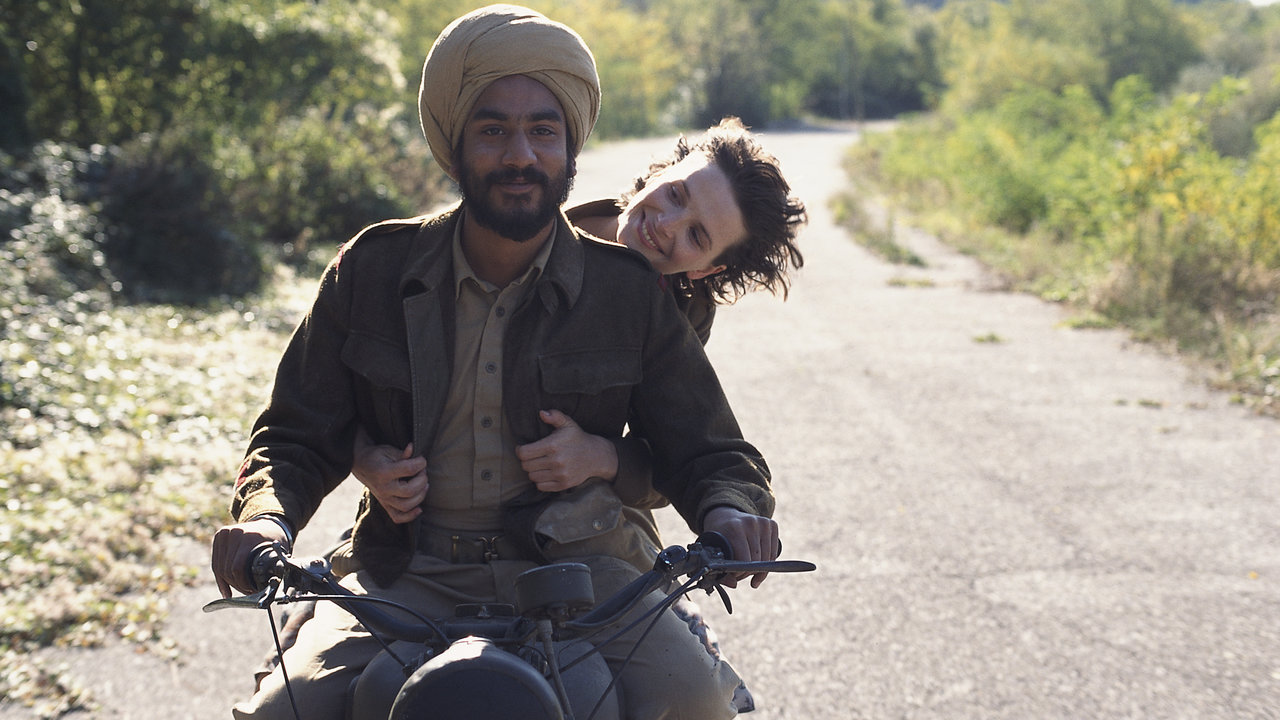
Tag: Ralph Fiennes

28 Years Later (2025)

28 Years Later (2025)

Belated sequel successfully compliments gore with thoughtfulness and surprising sensitivity

Director: Danny Boyle

Cast: Alfie Williams (Spike), Jodie Comer (Isla), Aaron Taylor-Johnson (Jamie), Ralph Fiennes (Dr Kelson), Edvin Ryding (Erik), Chi Lewis-Parry (Samson), Christopher Fulford (Sam), Amy Cameron (Rose), Stella Gonet (Jenny), Jack O’Connell (Jimmy)

Following on not quite 28 years since the original (23 Years Later wouldn’t have had the same ring to it), 28 Years Later sees Danny Boyle return to the post-apocalyptic hell-scape that is a Britain over-run by rage-infected, super-fast, permanently-furious, adrenaline-filled humans (don’t call them zombies!). But those expecting a visceral, gut-punch of blood-soaked violence may be in for a surprise. 28 Years Later is a quieter, more thoughtful film, where the battlefield is for the sort of values to embrace in a world gone to hell.

After a viciously terrifying opening set on the day of the original outbreak – in which vicar’s son Jimmy flees, terrified, from his home after a gang of infected literally rip-apart or infect his family sand terrified telly-tubby-watching friends – we flash-forward decades. Britain is now quarantined and nature has reclaimed large chunks of the land. The few remaining survivors live in protected communities, like a group on Lindisfarne, protected by a causeway flooded at high tide. In the community, 12-year-old Spike (Alfie Williams), is taken to the mainland by his father Jamie (Aaron Taylor-Johnson) to claim his first infected kill, while his confused and ill mother Isla (Jodie Comer) sits at home. But Spike will learn things about himself and his father on the mainland – enough for him to decide to risk taking his mother to meet with the mysterious Dr Kelson (a magnetically eccentric and softly-spoken Ralph Fiennes, in a performance that defies all expectations), who lives in isolation and may just know how to cure her.

Boyle’s film is kinetic and vicious at points, but also has a magnetic beauty as his camera flows across a world in some-ways unchanged from 2002 and in others utterly alien. Scavenged supplies are full of technology from the earlier noughties. The remains of things like Happy Eater restaurants are everywhere, and (proving not everything is bad) the Sycamore Gap tree remains standing. Buildings and villages are overgrown with plant-life and trees. Colossal herds of deer – enough to shake the earth – roam the countryside. In many ways the future is once more the green and pleasant land, with the Lindisfarne community sharing supplies and relearning skills like farming and archery (echoing the days of Henry V, with Boyle calling back to this with a series of shots from OIivier’s film, it’s a compulsory skill as the safest way to kill infected).

There is no chance of salvation or change here. That’s made very clear to us, with the Act Two arrival of Edvin Ryding’s scared Swedish soldier who tells us plainly that being stranded on the island is a death sentence. The world has left Britian behind and they way Erik describes it, all iPhones and Amazon deliveries, is as familiar to us as it is utterly incomprehensible to young Spike. This is not a film about fixing, averting or liberating the island. It’s a film about existing in a permanent state where mankind is no longer the apex predator.

Boyle’s film, with an excellent and thoughtful script by Alex Garland, is therefore all about defying expectation. Spike’s journey with his father is less about a terrifying chase from hordes of infected (though there is plenty of that), or him hardening himself in a brutal world. Instead, it’s about Spike’s nagging doubts about his father being confirmed. Aaron Taylor-Johnson is a very good as a man who is brave and protective, but morally weak and desperate for approval. He’s the sort of man who harangues his son into executing restrained infected (even children) and takes every opportunity in between dutiful caring for his wife, to slip off to his girlfriend. A man who brags on their return as if his son was some sort of Hercules, when Spike knew he spent most of his time missing with his arrows and in a constant state of terror.

28 Years Later captures that sinking feeling children can have when they realise beyond doubt that their parents aren’t perfect. Alfie Williams is excellent as a caring boy, who doesn’t see sensitivity and humanity as weaknesses in the way you suspect his father does. Who sees through his father’s need to promote himself and is disgusted by it. And finds himself drawn closer to his sick mother (a carefully vulnerable performance from Jodie Comer) and finding he has more affinity for a world that still has a place in it for decency, where going back to help someone is not written off as foolishness.

It’s a film that raises fascinating questions about the infected themselves. While millions of infected passed away – their rage filled minds unable to carry out basic tasks like eating or drinking – the small percentage who survived, seemed to retain enough of themselves to maintain some sort of life. They move in herds – or, as some of the obese ground-crawlers do, in a bizarre family unit – and they even have leaders. ‘Alphas’ – those who the disease caused to grow to humongous proportions (in every organ) – direct their charges. And they have intelligence: our main Alpha ‘Samson’ enraged at the death of his comrades, holds back from an attack until the moment is right, mourns the loss of a female infected and maintains a relentless pursuit for reasons we’d recognise from thousands of movies.

28 Years Later uses this to force us to ask questions about ourselves and when human life ceases to matter. To Jamie, the infected have ceased to be human and killing them a duty. But Spike is forced to start to ask: what right do we have to decide there are less human than us, these people who were like us perhaps moments before? Beyond self-defence, is killing them as noble as all that? 28 Days and Weeks Later featured the instant slaughter of anyone with even a suspicion of infection. Years questions this like never before. Everyone on this island is a victim, and the infected deserve just as much memoralizing as victims as the uninfected.

It makes for a surprisingly quiet and meditative drama – even if it is punctuated by moments of shocking blood and gore, from heads and spinal cords being ripped out to a blood-spatted TellyTubbies screening in a vicarage – and one that demands you think almost more than it demands you be thrilled. With exceptional performances, especially from Alfie Williams, it’s a different but mature sequel that redefines aspects of the series. And, based on its jaw-droppingly bizarre ending, its sequel will only take this thinking further.

The Return (2025)

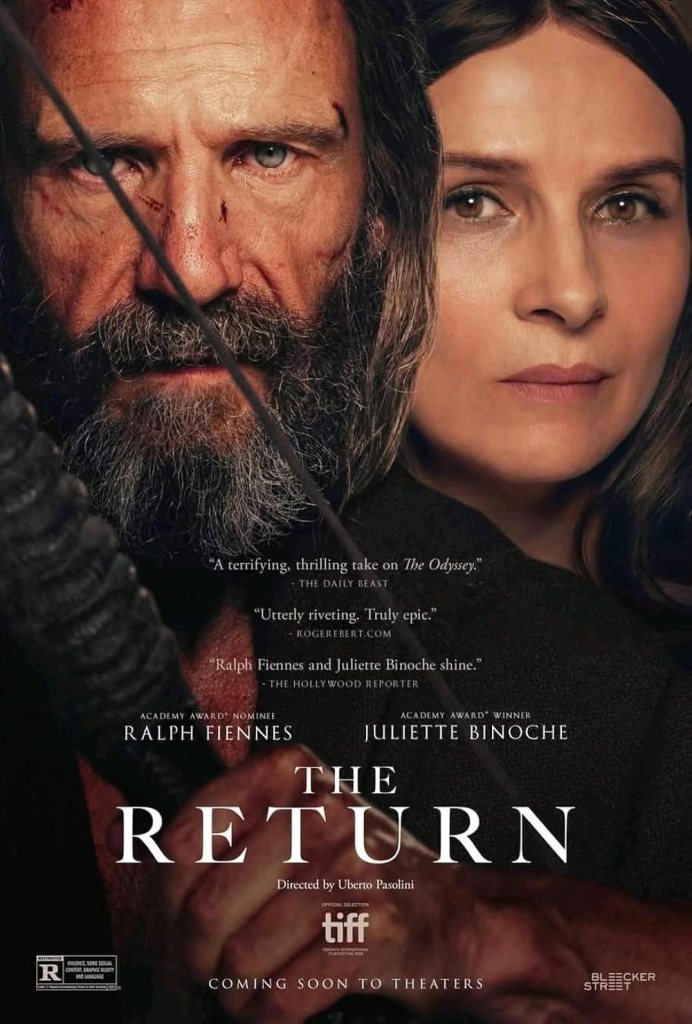
The Return (2025)

The Odyssey retold as an exploration of trauma and guilt in a rich and rewarding film

Director: Uberto Pasolini

Cast: Ralph Fiennes (Odysseus), Juliette Binoche (Penelope), Charlie Plummer (Telemachus), Tom Rhys Harries (Pisander), Marwan Kenzai (Antinous), Claudio Santamaria (Eumaeus), Ayman Al Aboud (Indius), Amir Wilson (Philoetius)

War can tear your soul apart, even if it’s become an ancient clash of legend: the memory of the deeds you did and the lives (both friend and foe) you left behind can haunt you. The pain of guilt and trauma swims behind the expressive eyes of Ralph Fiennes’ Odysseus in this unique adaptation of Homer’s famous tale of the longest journey home. A version that, as the title suggests, jettisons the journey itself (along with all those Gods) focusing instead on the spiritual journey a soul must take to come-to-terms with things seen and done and to face the consequences on those left behind. Pasolini’s film does this with expressive, melancholic beauty, bringing a unique vision to a story told many times before.

A shipwrecked Odysseus is washed, naked, up on the shore of his kingdom of Ithica – although its heavily implied this is an accident as he is clueless at first to where he is. In fact, lying naked on the beach, suggests the cunning old warrior has in many ways been born again: this time to face the pain of those he left behind. That doesn’t just include his wife Penelope (Juliette Binoche) waiting fruitlessly for years for word of his whereabouts, but also his bitter son Telemachus (Charlie Plummer) who deeply resents his absent father. It’s also the people of his kingdom, now poor and ravaged, the cream of a generation lost under his leadership, the island pillaged by a parade of cruel suitors for Penelope desperate to claim the kingdom. So great is Odysseus’ guilt he continues to conceal his identity – perhaps worried as much at confronting the truth about himself as he is the myriad people on the island with reason to hate him.

The Return replays Homer as an exploration of war trauma and PTSD. In many ways it has more in common with William Wyler’s The Best Years of Our Lives than Wolfgang Petersen’s Troy. No matter the era, it’s never easy for warriors to find a place in a world of peace they left far behind. Powered by a deeply affecting, sensitive performance from Fiennes, The Return centres a man beaten down by shame and regret, barely able to look others in the eye. This is the lasting impact of conflict. While the war at Troy is already being mythologised by the young, Odysseus’s stories focus on the ordinary citizens of Troy, who longed for peace and met their end in fire and blood. Fire and blood, what’s more, that he visited upon them.

Mix that in with the constant memory of the boatloads of Ithica’s finest young men, who have not returned with him, their souls lost in conflict and at sea. No wonder Odysseus feels solely tempted to forget himself, to become just another anonymous beggar. The Return is the tragedy of an incredibly smart, cunning man shamed that his gifts are harnessed best for death and destruction. In battle he is ruthlessly efficient, using the strengths of others against them, constantly identifying every possible advantage.

It’s a fate that he – and Penelope – fear may absorb their son. Telemachus, played with a frustrated petulance by Charlie Plummer, has watched his father’s kingdom fall apart, felt abandoned by both his parents (one to war, the other to stoic silent) and straining at the leash to do something to prove himself. If that means testing how far the parade of Penelope’s suitors will go, so be it – even if their patience with this boy becoming a man is wearing fatally thin. Tension hangs over The Return: will Telemachus follow in those footsteps Odysseus so bitterly regrets – will violence consume the next generation as much as the first?

What it will do is leave more victims behind. Juliette Binoche – with an instinctive chemistry, gives a deeply humane but fascinatingly cryptic performance – simmers with the never-ending pressure of trying to keep home and family together, very aware her own home is now awash with dangerous men she can only just control. Binoche is a tight-wound bundle of tension, suppressed fear and unacknowledged anger at her betrayal. This is a woman clinging to hope of her husband’s return, as it offers the only escape from the trap he has left her in – and if that means forcing his hand so be it.

Ithica has become a ragged island. Pasolini’s visuals for the film, influenced by Baroque artwork in its parade of barely-clothed nudes in rural settings and run-down classical wrecks, not only look gorgeously artful but successfully conveys the impression of a kingdom on its last legs. With everyone thinly clothed and living in shacks, Odysseus’ palace crumbling and lives being cheaply taken whenever the suitors fancy, it’s clear the world he left behind has disintegrated. The suitors are largely a gang of louts, increasingly fed-up with waiting (‘This fuckin’ place!’ Tom Rhys Harris’ Pisander petulantly whines at one point after getting lost in a futile chase through the maze-like woodland). They are fragilely led by Marwan Kenzai’s Antinous, whose tragedy is that he genuinely loves Penelope. In another life, indeed, you can imagine him making a considerate and kind husband if unreturned affection hadn’t made him bitter.

These ideas and concepts bring a fresh vision to The Odyssey, grounding this adaptation in a world of post-traumatic guilt and the horror of violence, devoid of gods and monsters. Fiennes, his body muscled up like a burnt and tanned roll of taut rope, is a warrior struggling against awakening. We all know eventually he will of course – but the enormous psychological burden of once again using your wit and ingenuity to efficiently slaughter other people is always palpable. It doesn’t matter if the targets ‘deserve’ it: the psychological damage remains the same.

The Return explores all the subtly, with beautifully measured performances from Fiennes and Binoche and impressive supporting turns not least from Claudio Santamaria as Odysseus’ old servant, shrewdly aware of his master’s identity earlier than he admits and determined to rouse the king to take responsibility for his actions. Sombre, wonderfully filmed and a compelling reimagination of the myth, it’s a unique view of Greek mythology that carries real emotional impact.

Conclave (2024)

Conclave (2024)

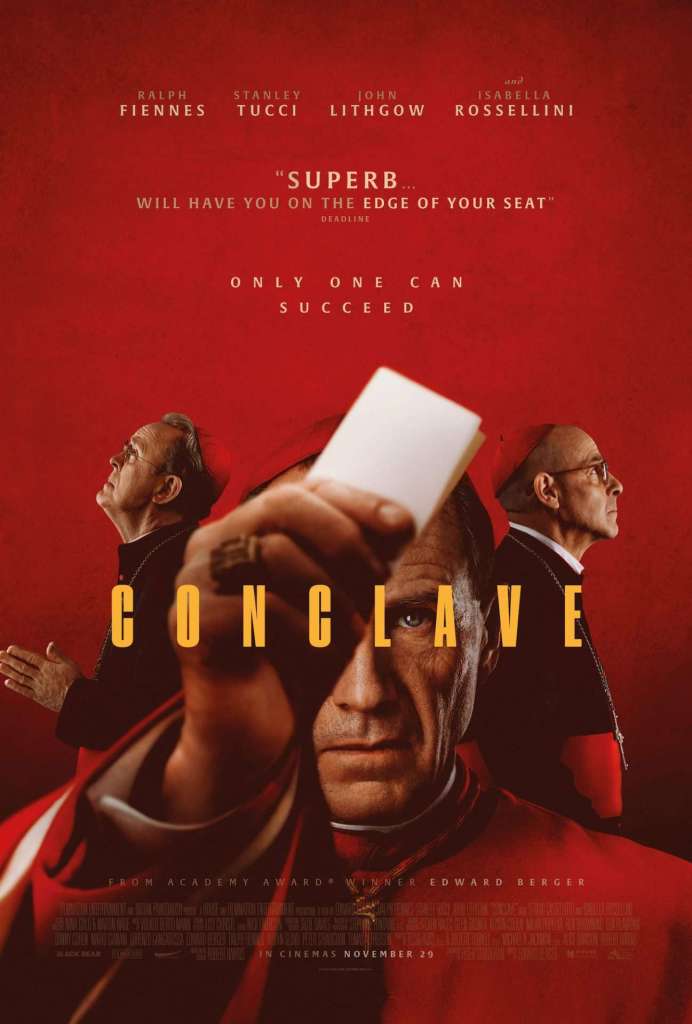
Papal boardroom politics combine with detective mystery in this engaging mix of high- and low-brow

Director: Edward Berger

Cast: Ralph Fiennes (Cardinal Thomas Lawrence), Stanley Tucci (Cardinal Aldo Bellini), John Lithgow (Cardinal Joseph Tremblay), Sergio Castellitto (Cardinal Goffredo Tedesco), Isabella Rossellini (Sister Agnes), Lucian Msamati (Cardinal Joshua Adeyemi), Carlos Diehz (Cardinal Vincent Benitez), Brian F. O’Byrne (Monsignor Raymond O’Malley), Jacek Koman (Archbishop Janusz Wozniak)

Few things have changed as little over 500 years than the election of a pope. Sure, they didn’t need to take away the phones of the Borgias and Medicis, but the idea of locking away the Princes of the Church in the Sistine Chapel until the Holy Spirit guides them towards choosing the next Heir to the Throne of St Peter hasn’t changed. But then neither (probably) has the ruthless politicking and barely concealed ambition of the cardinals (after all some were Borgias and Medicis!), many having dreamt their whole lives of moulding the Church into the shape they believe He wants it to be.

Politicking and spiritual and moral struggles with the temptations of ambition are at the heart of this excellent adaptation of Robert Harris’ novel. After the pope dies, Cardinal Thomas Lawrence (Ralph Fiennes), Dean of the College of Cardinals, is responsible for organising the new Papal Conclave. Lawrence, struggling with doubts whose request to resign was recently rejected by the Pope, is part of the moderate wing and a supporter of Cardinal Aldo Bellini (Stanley Tucci). The other major candidates are conservative Canadian Cardinal Tremblay (John Lithgow) and ultra-traditionalists Italian Cardinal Tedesco (Sergio Castellitto) and Nigerian Cardinal Adeyemi (Lucian Msamati). Lawrence slowly discovers severe reasons to doubt the suitability of all these candidates – while the number of cardinals suggesting he himself might be a suitable candidate grows.

Conclave is a very enjoyable dive into the mysterious world of papal politics. Part of its appeal is seeing that, under the mystery of centuries-old practices, elaborate robes and beautiful artworks, the struggle to elect a pope is a highly political business. Things ain’t changed that much since the Borgias, as various sexual, financial and other scandals crop up to scupper the chances of one candidate after another. As per 15th-century papal tradition, take away those flowing robes and lapses into Latin, and this is a cut-throat boardroom succession struggle that leaves more than a few reputations in ruins (and it ain’t going to be easy – even the late pope’s signet ring only comes off his finger after a rough-handed struggle).

In fact, Conclave works as well as it does because it’s a sort of Succession meets Father Brown, a brilliantly paced and staged merging of high-brow settings with pulpy page-turner thrills. At its heart is a superb performance by Ralph Fiennes as Cardinal Lawrence. Softly-spoken, Lawrence is dutiful, decent and diligent – and plagued with doubts about everything from his faith to his ambition, with permanently sad eyes, full of world-weary resignation. At one point Lawrence stares up at The Last Judgement, his eyes catching a man twisting in torment: he knows how he’s feeling. Unlike all the other cardinals, dripping with certainty, he’d rather be anywhere but there.

Lawrence becomes Father Brown, the quiet, level-headed priest going the extra mile to sniff out wrong-doing. As his concerns about many of his fellow cardinals emerge, he goes to rule-bending lengths to confirm these suspicions – and part of the delight of Conclave is how entertainingly it plays out murder mystery conventions alongside its papal shenanigans. Lawrence carries out his dogged investigation with an earnest sense of duty but what’s great about Fiennes’ performance is that he also manages to suggest the possibly of guilty ambition underneath. After all, Lawrence is a cardinal too, right? Why can’t he have a crack at being the Holy Father?

Lawrence has moments of temptation when the Holy See is dangled before him. Part of Conclave’s argument is that power is best suited to those most reluctant to carry it. Lawrence is one of the most reluctant among the papal players – but even he isn’t immune to guilty temptation. When he opens the concave with an off-the-cuff speech on moral conduct, is it subconsciously to establish his leadership? When he very publicly exposes one candidate’s misdeeds, is a side benefit demonstrating his own virtue? Conclave tracks Lawrence’s vote every time – and when he is tempted to vote for himself, an act of seemingly divine intervention takes place to almost tick him off.

It’s said at one point all cardinals have thought about their papal name. Lawrence shrugs this off, but later unhesitatingly gives an answer. Perhaps the only cardinal who hasn’t really thought about it is Cardinal Benitez (Carlos Diehz, wonderfully serene), secretly appointed Cardinal of Kabul by the late pope, a man almost alone in thinking this is a quest to find the holiest. The rest? They could probably tell their regnal names without thinking. And unlike Lawrence, they are certain about everything: from their own suitability to how pleased God will be when they land it.

Peter Straughan’s sharp and intelligent script gives an array of opportunities for excellent character actors (Conclave would make a good play). Sergio Castellitto’s scene-stealingly bombastic Tedesco, forever vaping when not growling about how chucking the Latin Mass was the end-of-days, can’t imagine he won’t win. It’s a trait he shares with Lucien Msamati’s Adeyemi, although Msamati finds a vulnerable humility that makes Adeyemi’s eventual downfall surprisingly affecting. Lithgow’s imperious Tremblay drips with arrogance (his eventual comeuppance sees Lithgow brilliantly deflate like a pricked balloon). Stanley Tucci is brilliant as the charming, morally upright Bellini who then surprises even himself with how fiercely ambitious he is.

Berger sets all this in a brilliantly oppressive setting, for all the beauty on the walls around them. Berger superbly conveys the isolation of the conclave, lit almost entirely artificially in heartless hotel rooms (that feel like monastic jails) and a fluorescent-lit canteen. The sound design is a massive part of this, the rooms devoid of ambient sound, just a crushingly deadened stillness. Frequently Lawrence’s breathing fills the soundtrack, giving the film a confessional feeling. It all means the late on surprise sound of a gust of wind carries the same impact for us as it does the cardinals.

Male voices dominate in the Vatican, so it’s telling Conclave deliberately undercuts this by giving one of its standout moments to Isabella Rossellini’s primly professional Sister Agnes. Like the other nuns staffing the conclave, she barely speaks – meaning when she does, it seizes the viewer’s attention as much as she does the crowd of cardinals. The flaws of this world return in the film’s final (slightly forced) twist, which helps question how much the alpha-male clashes between these papal academics may have shaped the atmosphere of the Church, and not for the better.

Conclave is tightly directed film, and a great adaptation of a page-turning novel with a faultless cast brilliantly led by Ralph Fiennes. It mixes pomp and ceremony with a fascinatingly tense struggle for power, made all the more gripping that in the parade of languages we hear (and all the cardinals can switch easily from English to Latin to Italian to Spanish) the language of power and ambition is constant but unspoken – and when it is explicitly stated, it has a devastating impact on those who use it. It’s a great touch in an entertaining and engaging film.

Skyfall (2012)

Skyfall (2012)

Bold, beautiful and brilliant Skyfall is probably my favourite Bond film ever – sorry folks!

Director: Sam Mendes

Cast: Daniel Craig (James Bond), Judi Dench (M), Javier Bardem (Raoul Silva), Ralph Fiennes (Gareth Mallory), Naomie Harris (Eve), Bérénice Marlohe (Sévérine), Albert Finney (Kincade), Ben Whishaw (Q), Rory Kinnear (Bill Tanner), Ola Rapace (Patrice), Helen McCrory (Clair Dowar MP)

As I watched Skyfall for the umpteenth time it suddenly occurred to me. I know I should say Goldfinger but I think this might just be both my favourite and the best James Bond film ever made. Released to coincide with the fifth anniversary of Doctor No, Skyfall manages to be an anniversary treat the celebrates Bond not with an ocean of call-backs but by telling a gripping story which plays to the star’s strengths and riffs imaginatively in both a literal and a metaphorical sense with our understanding of the legacy of the world’s best-known secret agent.

After a mission gone wrong leaves a list of undercover agents out in the open and Bond (Daniel Craig) presumed dead, MI6 comes under fire from a secret assailant seemingly determined to destroy the reputation of M (Judi Dench). With M already hanging on by a thread after that disastrous mission – Chairman of the JIC Gareth Mallory (Ralph Fiennes) is threatening her with removal – she has no choice but to lure Bond out of hiding and back into the spy game. But is the slightly out-of-shape, wounded spy ready for the challenge? The trial to find their mysterious enemy leads to Shanghai, Macau and the secretive island home of Raoul Silva (Javier Bardem), a Bond-like former British agent with a vendetta against M. Cure a battle of wits and wills between ‘these two last rats standing’.

Skyfall pretty much does everything right. Directed with verve, energy, intelligence and wit by Sam Mendes at the top of his game (Skyfall restored him to the front rank of British film directors), it mixes sensational action with well-acted, equally exciting character beats. It gets the balance exactly right – in the way that Quantum of Solace failed – between giving you the thrills but also really investing you in the drama. And it builds towards a final face-off that is, almost uniquely in the series, small-scale, intimate and personal (admittedly via a conflagration that consumes an ancestral Scottish castle and most of the Highlands). There is so much to enjoy here that you’d have to have a heart of stone not to be entertained. No wonder it’s the franchises biggest hit.

Mendes was brought on board at the suggestion (and persuasion) of Craig, eager to work with directors who would be recognise character was at least as important as fast cars and explosions, but also had the skill to deliver both. Skyfall is perfectly constructed to play to Craig’s strengths. His Bond reaches its zenith, a world-weary cynic with a strong vein of sarcasm, covering up deeply repressed unreconciled trauma. Craig is wonderful at conveying this under a naughty-boy grin.

Skyfall dials down the romance, Craig’s weakest string – it’s the only film in the franchise with no Bond girl (after QoS where, for the first time, Bond didn’t sleep with the Bond girl). Aside from a brief fling (with a character who is, perhaps a little tastelessly, all to dispensable – the fate of Sévérine being fudged with an uncomfortable flippancy) it’s Judi Dench who is the really ‘Bond Girl’ here. Judi Dench is fabulous in her swan-song, from taking the tough calls, voicing small regrets and quoting Tennyson. Skyfall acknowledges the surrogate parent relationship between M and Bond, something that was there from the day of Connery – every M has always inspired a filial loyalty from their 007. It’s a loyalty Skyfall reveals M ruthlessly exploits, extracting personal dedication from a host of agents, including both Bond and Silva – a man who (only half-jokingly) repeatedly calls her “Mummy” and has redefined his life around taking revenge on her.

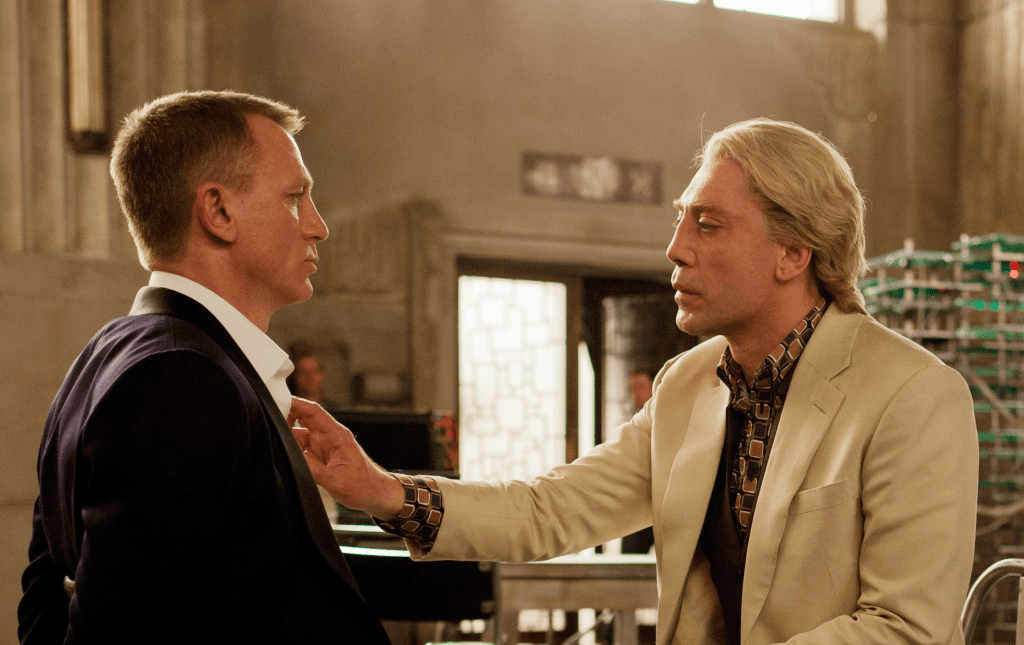
It makes a gift of a part for Javier Bardem, channelling his eccentricity into a character who often yings when he should yang. When he’s angry he laughs, when he’s overjoyed he gets quieter. Softly-spoken, almost effeminate, he’s also a ruthless killer – his studied manner of unpredictability a superb reflection of Bond’s own tightly constructed personality. Even their first meeting together is unusual and different – far from threatening Bond, Silva seems intent on seducing him, batting his eyes, stroking his bare chest with a finger and all but inviting him for a quickie (Bond’s classic response – “What makes you think this is my first time?” surely launched a thousand slash fictions).

There is a fabulously, just-below-the-line meta slice of fun going on in Skyfall. It brings Bond back from the dead (after its pulsating opening scene ends with him falling lifelessly to a watery grave), but burdens him with a host of scars. In a series of MI6 tests he completely misses a target, collapses to the floor after a workout, blows a psychological test and is repeatedly told he’s a borderline alcoholic. (In case we miss the point, Q meets him in front of Turner’s Fighting Temeraire and pointedly comments on the over-the-hill wreck being dragged back to port). Back in the field, his gunshot wounded shoulder gives out while holding onto the underside of a rising lift and Silva asks the question we’ve all asked at time or another: Mr Bond hasn’t it all gone on long enough?

While it can seem odd that two films ago Craig was introduced as a fresh-faced youngster and now embodies all fifty years of franchise ‘mileage’, it doesn’t really matter since he so triumphantly (of course!) reasserts his relevance. It’s a lovely, not too heavy-handed, piece of meta-commentary I think is both funny and human. It also means most of the call-backs to the gloried past of the franchise are metaphorical rather than literal – making a huge change from the Easter Egg stuffed nonsense you get from other franchises. It also means the one major piece of fanservice – the return of the Goldfinger car (the film is hilariously vague on whether this means Craig’s Bond and Connery’s Bond are one-and-the-same, a thing that really annoys some people who should really get a life) – really lands with a punch-the-air delight.

Skyfall is similarly astute with its characters. When Ralph Fiennes’ Gareth Mallory is introduced, we take him for an obstructive bureaucrat, flying his desk. Each scene in Fiennes’ perfectly pitched performance peels away layers to reveal a hardened professional (a decorated Army Colonel no less) and ally. It’s hard not to cheer when he takes up arms during Silva’s attack on a Parliamentary committee (with a gunshot wound no less) just as it’s hilarious to see Bond teasingly wink at Mallory before shooting out a fire extinguisher right next to him. Q returns, embodied by a perfectly cast Ben Whishaw, as a computer genius (in another gag at the franchise he’s scornful of ‘exploding pens’ and such like gadgets). Naomi Harris is very good as (it’s probably not a surprise any more to say) a Miss Moneypenny who’s a field agent in her own right. Skyfall even cheekily serves as a sort of back-door ‘origins’ story, leaving us with a very Fleming-Universal-Exports set-up.

It throws this all together with some sensational action scenes. The opening sequence is one of the best in the series, a manic chase through Istanbul that starts on foot in a darkened room (a nice reminder of M’s ruthlessness that she orders Bond to abandon to his certain death an injured agent) cars, bikes on rooftops, trains, diggers on trains and train rooftops (via a witty cufflink adjustment). There is a gorgeously shot fight-scene in a Shanghai rooftop (Roger Deakins pretty much makes Skyfall the most beautiful looking Bond film there has ever been) and a pulsating (and very witty) chase through the London Underground before that gripping Parliamentary committee gunfight. Mendes mixes excitement with plenty of neat jokes throughout and it works a treat – and the film plummets along at such speed you can forgive the little nits you can pick (like how does Silva know where to plant a bomb on the underground eh? And why did that train have no passengers?).

It culminates in a Home Alone inspired booby-trap rigged house in Scotland (wisely a Sean Connery cameo idea was nixed, with the legendary Albert Finney cast instead) and an Oedipal confrontation in a tiny Highlands church. At the end, it gave us thrills while bringing Bond home (in every sense) and was brave enough to focus on excellent actors play in a human story of regret, loss and betrayal. It’s a film which positively delighted me in the cinema and hasn’t stopped thrilling me the innumerable times I’ve seen it since then. And I can’t imagine it won’t continue to do so!

The Menu (2022)

The Menu (2022)

Dark satire is mixed with intelligent character work and a challenge to our assumptions in this intriguing film

Director: Mark Mylod

Cast: Ralph Fiennes (Julian Slowik), Anya Taylor-Joy (Margot Mills), Nicholas Hoult (Tyler Ledford), Hong Chau (Elsa), Janet McTeer (Lilian Bloom), John Leguizamo (Famous Actor), Reed Birney (Richard Liebbrandt), Judith Light (Anne Leibbrandt), Paul Adelstein (Ted), Aimee Carrero (Felicity), Arturo Castro (Soren), Rob Yang (Bryce), Mark St Cyr (Dave)

A dash of Succession. A soupcon of Hannibal Lector. Lashings of The Most Dangerous Game. All these ingredients are mixed to delightfully dark comic effect in The Menu, a sharp and tangy assault on class and modern society which leaves an unusual but satisfying taste in the mouth.

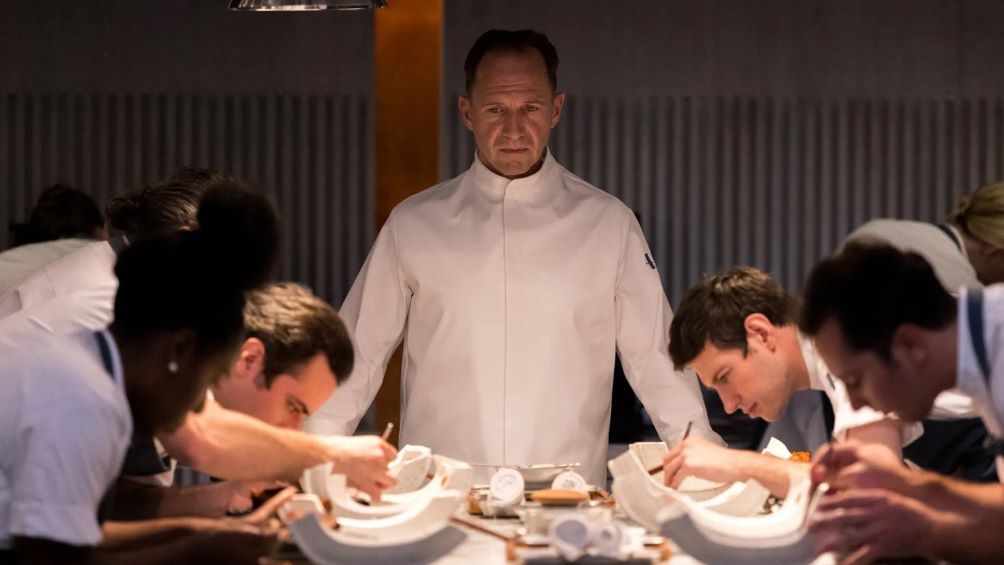
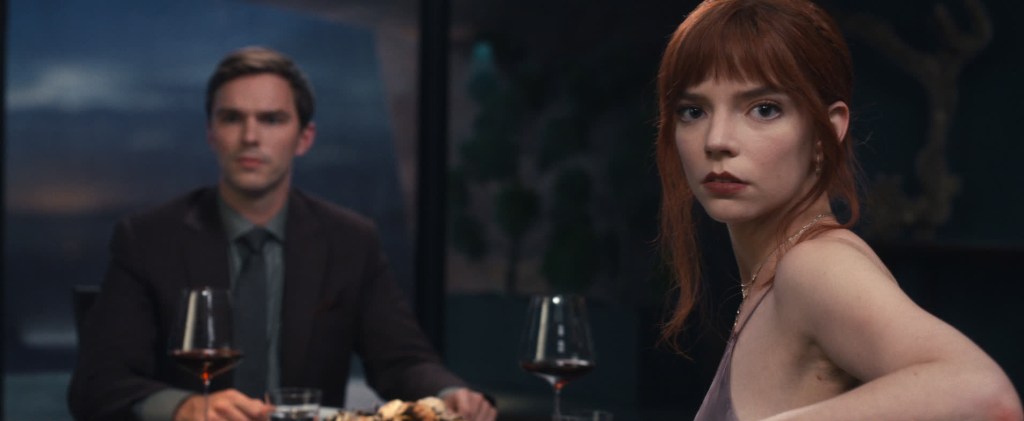
First those touches of The Most Dangerous Game. Julian Slowick (Ralph Fiennes) is a restauranteur so exclusive, his restaurant is based on a private island. Each course, of each menu is part of an overall story that forms the meal. For the story of the meal he is currently preparing, Slowick has selected an exclusive guest list of the rich and famous: businessmen, the rich, movie stars, food critics – the elite, the snobbish, the 1%. And the story he is serving up is one of increasingly grim retribution for this table-load of takers not givers. The only unexpected figure there is Margot (Anya Taylor-Joy), last-minute guest of obsessive food purist Tyler (Nicholas Hoult). How will this unexpected fly in the soup affect Slowick’s plans for the evening?

The Menu in many ways is a revenge satire. Slowick does not hold back in his increasing fury and bitterness at the people he serves without appreciation or gratitude in return. His customers are interested only in food if it costs a lot and is exclusive. They have no interest in his actual skills, in the staff (whose names they do not remember), the food itself or anything beyond their own desires. Many of the customers – most hideously a trio of “bro” investors (played with slapable smugness by Castro, Yang and St Cyr) – flash their jobs and cash expecting these to ensure their every whim is met. To them the world is like dough to be shaped into whatever bread they want it to be.

The film – with glee – exposes the hideous selfishness of the rich customers. A rich couple (Birney and Light) who have attended Slowick’s restaurants several times yet remember nothing about the food or the staff. Janet McTeer’s elite food critic, who practically scratches marks into her pen to mark the restaurants she has closed (she’s accompanied by a fawningly obsequious editor, played by Adelstein). A famous actor (John Leguizamo) who has long-since sold-out and treats his fans with contempt, joined by his spoilt rich-girl assistant/girlfriend (Aimee Carrero). Each of them is deconstructed in turns by Slowick over a series of courses parodying the snobbish bizarreness of high-class dining.

And here is where those touches of Succession make themselves known in the flavour. That series – and Mylod is a veteran (and its finest director) – also presents the ghastly shallowness and greed of the super-rich to expert comic effect. But what that show also does – and what Mylod brilliantly manages here – is make what could be two dimensional monsters sympathetic. The Menu presents these dreadful people with honesty; but, as the punishments – cruelly personal reveals, psychological torture, a finger cut off here, a man hunt there – pile up, you start to wonder if the punishment is too much?

The “bro” investors may be dreadful selfish, arrogant, dick-swinging morons: but they are also immature idiots who have never really grown up. The rich couple might treat places like this elite restaurant as a God-given right, but does that really deserve death? The food critic is harsh and arrogant, but is writing cruel words a mortal sin? The actor loathes himself for selling out his talent to make money and his girlfriend has simply been born into money and never wanted for anything. Do these people really deserve the monstrous ends Slowick has planned for them?

It’s the smartness of The Menu which could easily have invited us to just enjoy the rich and powerful being exposed, humiliated and punished. Instead, this is a smarter, more intelligent dish. The lower-class restaurant staff should be the people we are rooting for. But Slowick runs the restaurant like a cult, the staff near-robotic automatons that follow Slowick’s orders without question, intone their “Yes, Chef!” answers like a religious chant and snap to attention as one. Slowick’s number two Elsa – superbly played by Hong Chau – sums them up: all of them are desperate to become her boss and will follow Slowick to hell and back without a murmour and their heartless, personality free cruelty makes them very hard to root for.

As does Slowick himself. Here comes that sprinkling of Lector. Played with a superb, chilling intensity by Ralph Fiennes at his most coldly austere, Slowick could have been a character who swept us up in his intelligent superiority. But there is not a hint of joy in Slowick, only a vast, bubbling anger and resentment under a coldly precise exterior. Who on earth could look at this near-psychopath and think “I’d love to be him”? Slowick’s service is dryly, terrifyingly funny but you’d certainly not be left wanting to leave him a tip (unless it was your only way of getting out alive).

Instead, we gravitate towards the odd one-out. Anya Taylor-Joy is excellent as Margot, the unexpected guest who finds herself the only person unprepared for by Slowick, who is neither a member of the super-rich, but too free-spirited and independent minded to join the Slowick cult. Dragged along by Tyler – a hilarious performance of over-eagerness, snobbish elitism and stroppy self-entitlement by Nicholas Hoult – The Menu revolves more and more around the dance of death between her and Slowick. Like the audience, Margot is invited to pick a side to sympathise with.

It makes for a rich, lingering dish with an intriguing after taste, far more developed and better cooked than the sloppy revenge saga or re-heated leftovers it could have been. It left me wanting a second course.

The Grand Budapest Hotel (2014)

The Grand Budapest Hotel (2014)

Luscious visuals, hilarious gags mix with an air of sadness and regret in Wes Anderson’s masterpiece

Director: Wes Anderson

Cast: Ralph Fiennes (M. Gustav), Tony Revolori (Zero), F. Murray Abraham (Mr Moustafa), Mathieu Amalric (Serge X), Adrien Brody (Dmitri), Willem Dafoe (Jopling), Jeff Goldblum (Deputy Kovacs), Harvey Keitel (Ludwig), Jude Law (Young Writer), Bill Murray (M. Ivan), Edward Norton (Inspector Henckels), Saoirse Ronan (Agatha), Jason Schwartzman (M. Jean), Léa Seydoux (Clotilde), Tilda Swinton (Madame D), Tom Wilkinson (Author), Owen Wilson (M. Chuck)

I wrote recently I could forgive the flaws I’ve found in Kurosawa’s work, for the majesty of Seven Samurai. I can totally say the same again for Wes Anderson. He is a director I’ve sometimes found quirky, mannered and artificial – but God almighty he deserves a place in the pantheon for directing a film as near to perfection as The Grand Budapest Hotel, a delight from start to finish, as beautiful to look at as it is whipper-snap funny, as heart-warming to bathe in as it is coldly, sadly bittersweet. After three viewings I can say it is, without a doubt, a masterpiece.

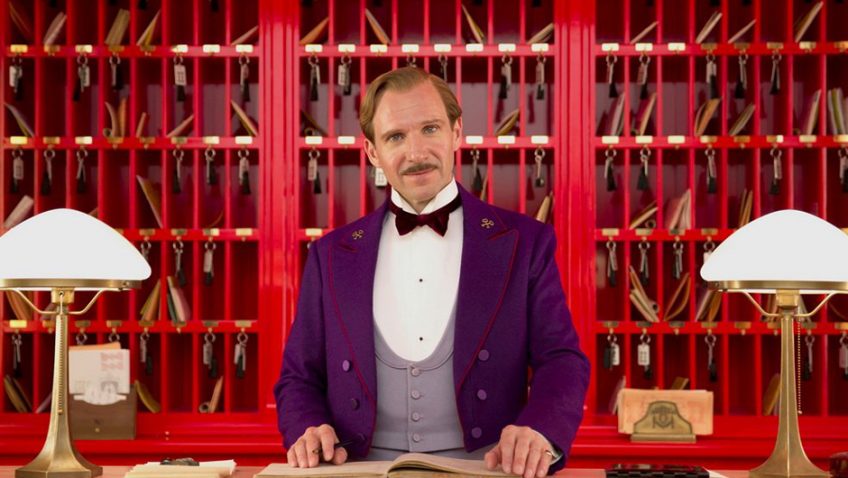
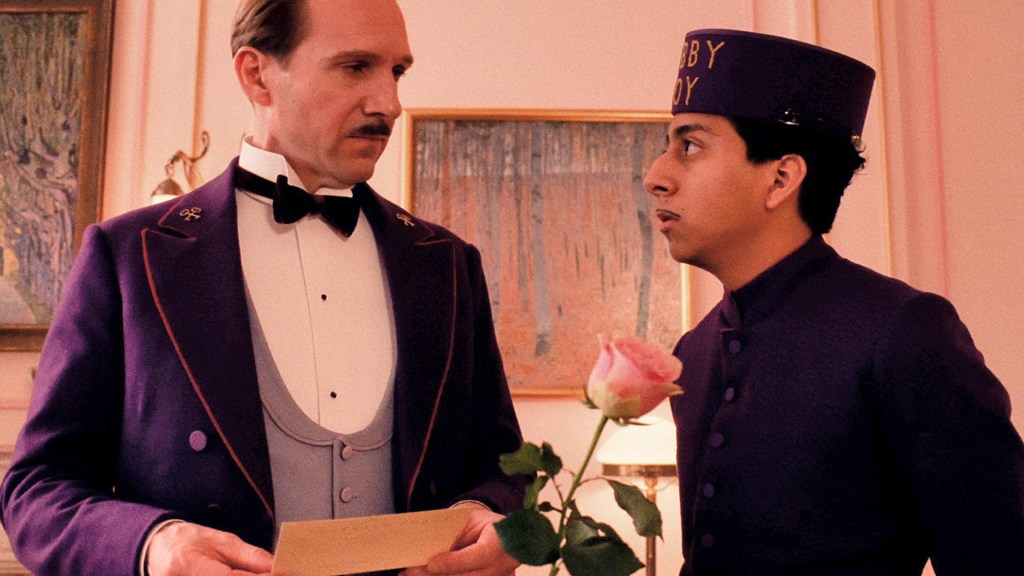
Like many Wes Anderson films, its storyline is eccentric, halfway between fantasy and absurdity. In 1932, in an opulent hotel, The Grand Budapest, concierge Monsieur Gustav (Ralph Fiennes) is the pinnacle of his trade: precise, fastidious, perfectionist, he can fix anything anywhere – opera tickets, the perfect table placement and a night of passion at any time for the elderly widows who visit his hotel. When one of them, Madame D (Tilda Swinton) dies leaving him a priceless painting, Boy with Apple he suddenly finds himself framed for her murder. Only his ingenuity, and the dedicated help of his protégé, best friend and surrogate brother/son, lobby boy Zero (Tony Revolori) will save him.

You can’t escape on the first viewing that The Grand Budapest Hotel is an extraordinarily funny film. Crammed with superb one-liners, it’s a showcase for a breathtakingly, blissfully funny performance from Ralph Fiennes whose comic timing is exquisite and whose mastery of the perfectly structured monologue of flowery language is as spot-on as his ability to deliver a crude punch-line. Anderson fills the film with clever sight-gags, bounce and a supreme sense of fun. You’ll laugh out loud (I frequently do, and I remember most of the gags) and wind back to watch them again.

But what lifts this is the wonderfully evocative, elegiac piece this beautiful film is. For all its comic zip, it unfolds in a romanticised past already a relic in 1932. We can’t escape the rise of Fascism that fills the film. Jack-booted soldiers accost and hunt Gustav and Zero. Adrien Brody’s furious heir to Madame D looks like a Gestapo officer, and his vicious heavy Jopling (Willem Dafoe so weathered, he looks like he’s been beaten by a carpet duster) has a stormtrooper menace. En route to Madame D’s funeral, Zero is nearly dragged off the train to be lynched by fascist thugs for being an immigrant and The Grand Budapest is taken over by this dreadful movement, filled with Mussolini-inspired ZZ insignia and blackshirts.

Under the jokes, the world Gustav represents has already died and been buried. We are never allowed to forget we are marching, inexorably, towards a very real-world war that will rip apart this fictional country and leave millions dead. Gustav’s gentile old-school charm ended with 1920s: and he sort of knows it. Fiennes, under the suaveness, conveys a man who falls back into potty language when he can no longer maintain his assured confidence that a straight-backed, polite assurance will solve any problem or a poetic reflection will allow them to put any unpleasantness behind them. Those days are gone and it makes for a deep, rich vein of sadness just under the surface.

It’s particularly acute because it’s made clear this is a memory piece. Anderson constructs the film like a memory box. It has no less than three framing devices. It opens and closes with a young woman in 2014 visiting a monument to a great writer, the author of the book The Grand Budapest Hotel. From there we flash back to the author (a droll Tom Wilkinson) in 1985 recounting how he met the man who inspired the novel, before heading again to a flashback to the 1960s where the young author (Jude Law) meets the man we discover is an older Zero (F Murray Abraham) who recounts the story we then watch. Each layer of the film descends deeper into Anderson’s artificial, carefully structured visual style, with its heightened sense of reality.

Old Zero – beautifully played by F. Murray Abraham – is introduced as a man of acute loneliness and sadness, who tells us early on the woman his young self loves, Agatha (a radiant Saoirse Ronan) will die and shuffles around the nearly abandoned The Grand Budapest (now a concrete nightmare of Communist architecture) with only his memories for comfort. No matter how jovial and bright the events of the 1930s are, we can’t forget that these are the reflections of a man full of regrets.

When old Zero’s narration turns to remembering Agatha, the lights around him dim: Agatha even enters the narrative almost by the side door: Gustav is arrested and imprisoned before she appears, along with a series of flashbacks-within-flashbacks to Zero and her meeting and her first meeting with Gustav, as if Zero had to steel himself to remember her (as reflected in Abraham’s tear-stained face). Later, when remembering the fates of Gustav (his best friend) and Agatha (the love of his life) he almost draws a veil over it (even their final scenes in flashback play out in monochrome). There is a deep, moving sense of humanity here, a powerful thread of grief that adds immense richness.

But don’t forget this is also a funny film! Anderson is an inventive visual and narrative director at the best of times, and here every single beat of his playful style pays off in spades. The entire 1930s section of the film (the overwhelming bulk of the narrative) plays out in 4:3 ratio, which to many other directors would be restrictive, but seems a perfect fit for a director who often composes his visuals with the skill of an expert cartoonist. The frame is frequently filled in every direction when within the grandeur of the hotel, but then feels marvellously restrictive for Gustav’s prison cell or the train compartments that seem to constantly carry Zero and him to disaster.

Anderson’s wonderfully precise camera movements also reach their zenith here. His camera is deceptively static, often placed in a series of perfectly staged compositions that places the characters at their heart, frequently looking at us. But then the camera will turn – frequently in a fluid single-plain ninety degrees to reveal a new image of character. There are Steadicam tracking shots that are a dream to watch. It’s combined with some truly astounding model shots (parts of the set are not-even-disguised animated models and miniatures, adding to the sense of fantasia) and the detail of every inch of the design (astounding work from Adam Stockhausen and Anna Pinnock) is perfection. The film is an opulent visual delight.

It’s a film of belly laughs and then moments of haunting sadness. But also, a wonderful celebration of friendship. The bond between Gustav and Zero is profound, natural and deeply moving – grounded, fittingly, in adversity from the agents of a hostile, oppressive state – and carries real emotional force. Newcomer Tony Revolori is hugely endearing as naïve but brave Zero, making his way in this new world (fitting the theme, he left his homeland after his family was destroyed by war) and sparks superbly with Fiennes and Ronan.

There is a wonderful beating heart in The Grand Budapest Hotel, amongst the farce, perfectly timed gags and cheekiness, that makes it a rich film you can luxuriate in. Anderson’s direction is faultless, Fiennes is a breathtaking revelation, both hilarious, affronted, decent and fighting the good fight. Gorgeous to look at, thought-provoking and laugh-out loud funny it’s a dream of a film.

No Time to Die (2021)

One final mission for Daniel Craig in No Time to Die

Director: Cary Joji Fukunaga

Cast: Daniel Craig (James Bond), Lea Seydoux (Dr Madeleine Swann), Rami Malek (Lyutsifer Safin), Lashana Lynch (Nomi), Ben Whishaw (Q), Naomie Harris (Eve Moneypenny), Jeffrey Wright (Felix Leiter), Christoph Waltz (Ernst Stavro Blofield), Ralph Fiennes (M), Billy Magnussen (Logan Ash), Ana de Armas (Paloma), David Dencik (Dr Valdo Obruchev), Rory Kinnear (Bill Tanner)

Remember when Daniel Craig was cast as Bond? Remember that CraigNotBond campaign, based largely on Craig being blonde? For about five minutes there was doubt about the franchise… and then Casino Royale became one of the best Bond films ever made. Craig is, clearly, one of the greatest Bonds ever, so No Time to Die, his sign-off for the role was always going to be a big movie. It’s at times exciting and gripping, but also a strange beast, partly straining at the confines of the franchise at others desperately trying to service all expectations.

It’s five years after the events of Spectre (you’d assume the less said of that the better, but unfortunately that film is absolutely at the heart of No Time to Die so we can’t dodge it). And it’s five years since James Bond (Daniel Craig) abandoned Dr Madeleine Swann (Lea Seydoux), believing she had been responsible for luring him into a Spectre ambush. Today, Spectre agents steal a biological weapon from MI6. A retired Bond, living off the grid in Jamaica, is recruited by Felix Leiter (Jeffrey Wright) to hunt it down for the CIA but MI5, and their new 007 (Lashana Lynch), are also on the trail. Plots within plots are slowly revealed and it seems all roads lead back to Madeleine and her childhood escape from a scarred killer, the mysterious Safin (Rami Malek). Just when Bond thinks he’s out, they drag him back in…

I have very mixed feelings about No Time to Die. You have to admire the skill and expertise with which it has been made. It looks absolutely gorgeous. The action set-pieces are full of ingenuity and excitement – in particular a duel between Bond and Safin’s agents in a mist-filled Norwegian forest. The opening action set-piece, in a picturesque classic Italian town, with Bond leaping off bridges and bringing out the Aston Martin for one final spin, is a doozy.

But do you remember when Bond was, y’know, escapist fun? Or even really just fun? If there is one thing I’d argue that No Time to Die isn’t, it’s fun. Yes lots of exciting things happen, but it’s also a rather maudlin film. It’s got a weary end-of-days feeling and a slight air of self-importance. Its absurd length doesn’t help puncture this. Unlike almost any other Bond film, I have a hard time imagining watching this again: it’s probably a better film than, say, The Spy Who loved Me, but honestly which one would you rather watch on a Sunday afternoon?

But Daniel Craig is superb: the ultimate expression of his wryly amused but guarded and distant Bond, a man constantly worried about lowering his defences and letting anyone in, hiding pain under an insolent grin but secretly desperate for an emotional connection. It’s clear he is one of the great Bonds. He also feels rooted Fleming. Fleming’s Bond was never a super-hero, but a flawed, lonely man, often muddling through, far more vulnerable and emotional than people remember. No Time to Die has a lot of echoes of Fleming, which is no bad thing.

No Time to Die buries itself in the emotional world of Bond. This is as close as you going to get to a character study of our super-agent. So much so that the action (and even the presence of a Bond villain) feel like only a contractual obligation. I would love it if they had made a final, indie-tinged film on a small budget where we saw Craig’s Bond wrestling with complex feelings and trying to work out what it’s all about. More of Bond playing kids’ games with Leiter in a Jamaican bar, or preparing a child’s breakfast in the morning (scenes where the film literally has its heart). It makes No Time to Die an often poorly structured and ill-focused film (factors that contribute to its length) that’s trying to be about Bond but also be BOND. It’s a circle the film can’t really square.

The Bond franchise has always slavishly followed whatever the latest big trend in cinema was so No Time to Die doubles down in following the Marvel series, by retroactively converting all of Craig’s Bonds into one single Bondverse, with No Time to Die as its Avengers Endgame. Problem is, this was all thought of far too late, feels hideously thrown-together with no thought, and means both this film and Spectre had to bend over backwards to retroactively fill out now crucial back story.

As a result, we get the bloated runtime as the film needs to set up a personal back story, explore an emotional arc, establish a new threat and thread in huge set pieces. The writing and structuring aren’t deft enough to do this as well as Marvel does. The result is something three hours long but still feels hard to follow. Craig’s best film – Skyfall – worked because it was basically a stand-alone entry. The series (and the character) works best as a mission-focused individual.

Many elements of the story introduced here make little or no sense. Safin – in a truly awful performance by a whispering Rami Malek, straining to look intimidating – is possibly the worst, most incoherent Bond villain ever. His motivation makes no sense: at first he seems focused on eliminating only those who murdered his family; his rants about collateral damage in no way squares with his plan to unleash genocide via a bio-weapon. His “we are two sides of the same coin” confrontation with Craig feels like a feeble attempt to recapture the magic of the confrontation with Bardem in Skyfall.  An opening sequence suggests a plot-defining link between him and Swann which has promise but goes almost no-where (when they finally meet again mid-film, she doesn’t even know who he is).

A braver film would have dumped this bio-hazard nonsense and placed issues of family at its heart: a hero uncertain about settling down, the villain a person desperate to find a new family. This would have placed the link between Safin and Swann at its centre, and also allowed an even more intriguing exploration of Bond’s character by contrasting him directly with a villain explicitly focused on the same preoccupations. Instead, the comparison isn’t there and Swann remains an incoherent character – alternately weak and strong as required by the plot. Craig and Seydoux also have no real chemistry and look physically mismatched (Seudoux’s youthful looks make Craig look older than he is). Compare their chemistry with that between Craig and Ana de Armas (in a knock-out guest slot, the film’s most fun moment).

Instead it feels like a film where every single idea has been thrown at the frame and all of them made to stick. Lashana Lynch has some fine charisma, but basically nothing to do as the new female 007 (the part actually feels like a bone the franchise has tossed at diversity – Bond even gets the 007 title back part-way through). There are constantly plots within plots within plots, like a dementedly rushed series of 24. Bond goes AWOL, then AWOL from AWOL, then he’s in then out then in again from MI6. A more tightly structured story would have dared to cut some of the flab, but No Time to Die is only part way towards being the brave break from tradition it needs to be.

Sure, it takes daring decisions: it has a tragic ending and shock deaths punctuate the film. But while it needed to be a smaller, intimate story with a sombre mood, it still throws in ridiculous villains, bases on islands, armies of goons and a world-ending threat. These things honestly don’t really work together and contribute to making the film too long and too sombre to be any fun. It’s a film that’s only part way to being what it wants to be, but still obsessed with being what it thinks it should be. An awkward Frankenstein that I’m not sure will have as much shelf life as its maker’s hope.

Schindler's List (1993)

Liam Neeson and Ben Kingsley excel in Spielberg’s masterpiece Schindler’s List

Director: Steven Spielberg

Cast: Liam Neeson (Oskar Schindler), Ben Kingsley (Itzhak Stern), Ralph Fiennes (Amon Goth), Caroline Goodall (Emilie Schindler), Jonathan Sagall (Poldek Pfefferberg), Embeth Davidtz (Helen Hirsch), Malgorzata Gebel (Wiktoria Klonowska), Mark Ivanir (Marcel Goldberg), Beatrice Macola (Ingrid), Andrzej Seweryn (Julian Scherner), Friedrich von Thun (Rolf Czurda)

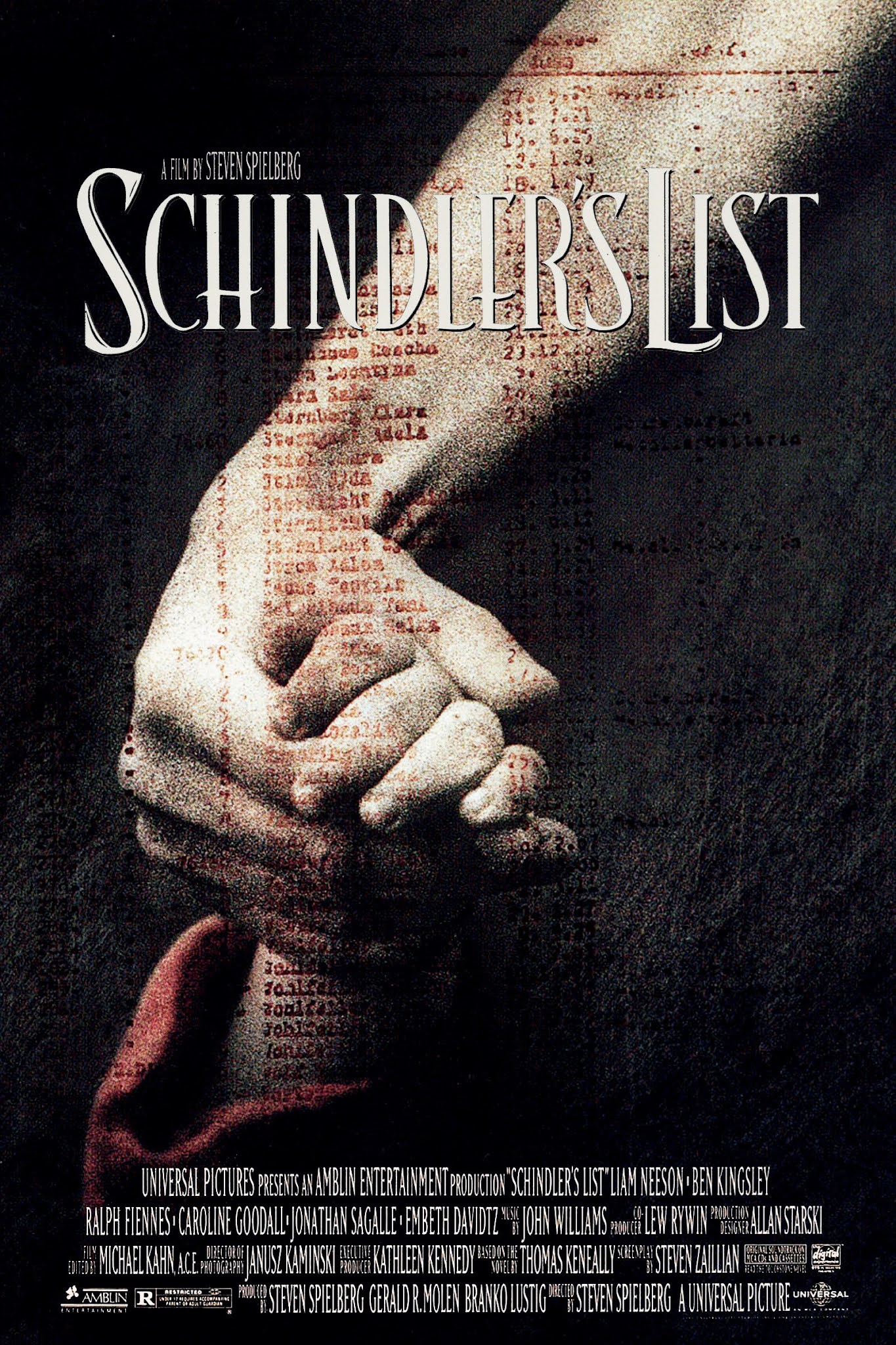
It was the film Spielberg spent over a decade building up the courage to make. Schindler’s List not only marked a new era for him as a film-maker, it also helped a wider audience directly confront the horrors of the Holocaust. At a time when Holocaust denial was starting to rise, Schindler’s List straight-forwardly but powerfully placed the reality of this crime firmly in the eyes of the world. Schindler’s List today remains one of the most emotionally powerful Holocaust movies, the standard to which all others are judged – and peerless example of committed and passionate film-making.

Based on Thomas Keneally’s Booker-prize winning “non-fiction novel” Schindler’s Ark, the film is set in Krakow during the Second World War. As the German occupying force crowds the Jews into the overcrowded Ghetto in the first step of what will become systematic extermination, Oskar Schindler (Liam Neeson) arrives in town looking to make his fortune. Charming, gregarious and quick with a bribe, Schindler soon makes friends with senior SS members. Setting up an enamelware factory to supply the Wehrmacht, it is staffed entirely by cheap Jewish labour (supplied by the SS) and run by skilled Jewish accountant Itzhak Stern (Ben Kingsley) while Schindler handles ‘public relations’ (bribes and schmoozing) with the SS. But, over time, Schindler struggles more and more to close his eyes to the murder of the Jews – a fact made even more prominent with the arrival of brutal SS commander Amon Goth (Ralph Fiennes).

Schindler’s List is chillingly, shockingly honest in its depiction of the horrors of the Holocaust. But it’s easy to forget how cunningly and gently it eases you into the nightmare you are about to watch. This is after all a film that uses Schindler as its POV character. What we are experiencing is his perception of the Holocaust, and through that trying to grasp what could potentially have made this opportunist and profiteer into a humanitarian. As such, the film is careful to give a slow build to the monstrous genocidal fury of Nazism.

In fact, much of the first thirty minutes could almost play out as a sort of triumphant against-the-odds success of a morally flexible charmer. There are a surprising number of laughs in that opening thirty minutes, at Schindler’s chutzpah and weakness for a pretty face. The opening sequence is a delightful demonstration of his confidence: we know he has nothing but the clothes he stands up in and what cash he can scrape together when he enters a nightclub frequented by the SS bigwigs we needs to impress. When he walks in no-one knows who he is: by the end of the evening a waiter is dumbfounded another guest doesn’t know who Oscar Schindler is. Much of the first act is a chronicle of Schindler playing the angles, crossing the right palms with silver and charming left right and centre to make himself a somebody from nothing.

Imagine you didn’t know what the Holocaust was. You’d think this could be a very different film. There are clues: the unspoken loathing Ben Kingsley’s Itzhak Stern clearly feels for this man who smilingly hires cheap Jewish workers from the SS (the workers get nothing) to staff his factory. The fear any Jewish character expresses when confronted with a German officer. The desperation and dirt of the Ghetto. But, like Schindler, there is enough there for you to think “yeah, it’s tough on the Jews, but it’s could be worse, it’s not my problem”.

Schindler wants to be thought of as a good man, but deep down he knows he isn’t: you can see his discomfort when he’s thanked by a one-armed man Stern has inveigled into working in the factory. He already knows he doesn’t deserve thanks – guilt that expresses itself at anger against Stern for hiring a one-armed ‘machinist’ in the first place. After all he’s running a business here.

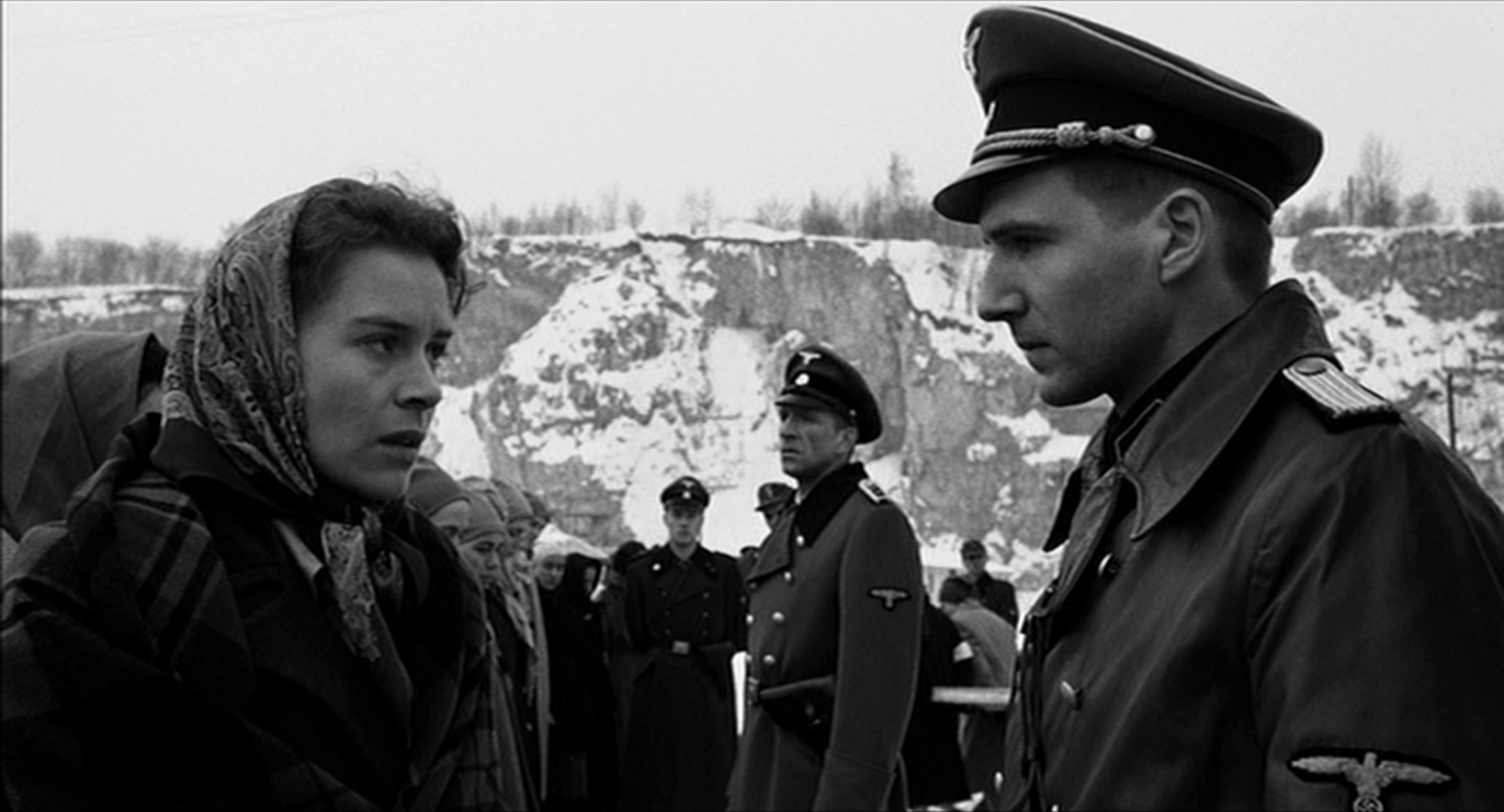
That one-armed man is the first death we see, executed at a roadside for not being able to shovel snow from the road. Any chance of turning your face away again is lost with the arrival of Amon Goth to liquidate the Krakow Ghetto and build a new concentration camp. Played with a bloated, dead-eyed sadistic sadness by Ralph Fiennes (Goth bitches constantly about his workload, drinks to excess and is as desperate to be liked as he is uncaringly brutal), Goth oversees acts of inhumanity that leave the viewer shocked and appalled.

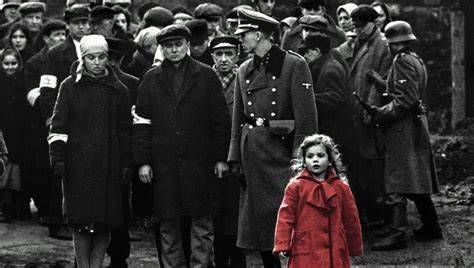
Spielberg films the liquidation of the Krakow Ghetto like a documentary observer and doesn’t flinch from the brutality: summary executions, dead bodies left in the street, the late night slaughter of any hiding in the Ghetto. Doctors euthanise their patients (who drink the poison with thanks in their eyes) before SS guards can machine gun them in their beds. Spielberg embodies this in a single red-coated girl (one of the few splashes of colour in the film), who walks through this nightmareish hell, witnessed from a hill by the horrified Schindler. Later the same red-headed girl will be wheeled on a cart of twisted, exhumed bodies to be thrown onto a bonfire of rotting corpses.

It’s but an entrée into the nightmare of Goth’s camp and the later hell of Auschwitz. In the camp, Goth snipers those not ‘working’ from the balcony of his hilltop villa. Anyone can be executed at any time. Selections see naked inhabitants of the camp running in circles, the weak pulled out to be dispatched to the death camps. Mountains of corpses are burnt, their ashes falling like snow on Krakow. Later, a misdirected train of Schindler Jews arrives in Auschwitz where human ashes form a constant mist. Terrified the women are stripped, their hair removed and herded into a shower room: the terror of this sequence alleviated only when water not gas falls from the shower heads. Spielberg shoots all this with a careful but horrific immersiveness, which never lingers on horrors but always acknowledges them while moving you onto the next terror.

You can criticise Schindler’s List for focusing on the few thousand who survived this senseless barbarism rather than the millions of dead – but the film offers a cause for hope. That, even when things are at their worst, people can decide to do good. Itzhak Stern (a beautifully judged, deeply humane performance from Ben Kingsley) calls the list “an ultimate good”, with everything around it evil. Faced with such horrors, perhaps we need to know that a man like Oscar Schindler can turn the skills he used to enrich himself towards saving lives: bribing officials, spinning stories, presenting a front to his SS partners of an uncaring businessmen while saving as many lives as he can.

Played with huge charm and authority, mixed with a fascinatingly unknowability by Liam Neeson, the film bravely never offers a definitive answer as to what turned Schindler into a man dedicated to others rather than himself. There is no single moment where he makes the conscious turn, instead the film presents the shift as a gradual but inevitable change: as the real-life Schindler himself said, in such a situation there was no other choice.

Schindler’s List isn’t perfect. Despite his best efforts, Spielberg’s sentimentality creeps in. Neeson’s final scene takes things too far, culminating in a blatantly manipulative breakdown, weeping that he did not do more – as if Spielberg is worried we didn’t get the point. Some moments lean into Hollywood convention, from Goth’s gun repeatedly misfiring when attempting to execute a worker (who survives) to Goth and Schindler cutting cards to decide the fate of Goth’s brutalised maid Helene (a sensitive and heartfelt Embeth Davidtz). But what it gets right far outweighs this.

Spielberg presents the Holocaust with unflinching emotion and a carefully controlled sense of moral outrage. Beautifully (some argued too beautifully) filmed by Janusz Kaminski in cool black-and-white with a sensitive score from John Williams, it introduced the Holocaust to an entire generation. No other director could perhaps have done that.

In a sense Spielberg’s career was building towards this, his mastery of cinematic language (this is a superbly edited film by Michael Kahn) utilised not for thrills but to illuminate one of the darkest hours of history. But with that, it also provides hope for humanity, perhaps the key to its emotional impact. The acting is sensational – Neeson has never been better, Fiennes is extraordinary, Kingsley far too easily overlooked as the film’s heart. Traumatising, horrifying but vital and essential, Schindler’s List brings to life with deep respect the worst of history.

The Reader (2008)

Kate Winslet and David Kross in the vomit-inducing The Reader

Director: Stephen Daldry

Cast: Kate Winslet (Hanna Schmitz), Ralph Fiennes (Michael Berg), David Kross (Younger Michael Berg), Bruno Ganz (Professor Rohl), Alexandra Maria Lara (Ilana Mather), Lena Olin (Rose Mather/Older Ilana Mather), Linda Bassett (Mrs Brenner)

In 1960s Germany, teenage Michael Berg (David Kross) falls in love with an older woman, Hanna Schmitz (Kate Winslet), a tram conductor who seduces him and asks him to read classic novels to her in between bouts of passionate love making. As an adult (Ralph Fiennes), Michael has never got over the effect the affair had on him. But that’s largely because, as a law student, he sat in on a trial where he discovered Hanna was a guard at Auschwitz, responsible for the gas chamber selections and later locking 300 Jewish women into a burning church.

Her co-defendants turn on Hanna – but Michael realises that Hanna is illiterate so cannot possibly be the author of the reports that her co-defendants says she wrote. Hanna is imprisoned – but years after the trial, Michael rekindles a distant contact with her, sending her recordings of books he has read, which she uses to teach herself to read. Will these embodiments of new and old Germany manage to come to terms with their shared past?

There is no way round this: The Reader is a truly dreadful film. It might be the worst film nominated for Best Picture this century (the backlash over its inclusion over The Dark Knight led to a radical change in nomination rules). It is sentimental, trite, insulting, empty, vainglorious awards-bait, shot with a heritage-stylishness. It utterly fails at almost every single thing it attempts to do: from coming-of-age drama, to questions of moral responsibility in a police state, to a country reconciling with its traumatic and criminal past. In fact, it fails so utterly and completely, you are more likely to be left open-mouthed at its crude tone-deafness than remotely moved by its emotional manipulation. It is a truly dreadful film.

Daldry’s highly average direction (Oscar-frigging-nominated!) is sickeningly twee, using a number of carefully staged moments to tweak heart-strings and point our sympathies the right way. It’s the sort of Holocaust film where the only direct engagement with the subject is a beautifully framed, poetically-scored, insultingly-genteel scene of the hero visiting Auschwitz and starring sadly at collections of shoes and the gas chambers. Presumably because, any shots of the actual Holocaust – or the crimes of Hanna, who happily confesses to selecting thousands of women and children for death – would end any chance of us feeling sorry for her.

Because this is indeed a film that feels it is challenging us to say “look again” – as if Daldry and screenwriter David Hare are sitting on our shoulder saying “Ah you think it’s all black-and-white, but see how things are more complex than that”. So we are shown a concentration camp worker whose defence really is that she was just following orders – and we are asked to sympathise! She only voluntarily signs up for the SS because, you know, it was a better job than the factories. In a crudely empty moment she asks the judges at her trial “what would you do?”. Daldry shoots like this as a “Gotcha” moment – we are clearly meant to come away from that moment feeling “ah yes, there but for the grace of God go all of us”.

Only that is, for want of a better word, bullshit. Turning your back on Jewish neighbours being taken away out of fear for your own safety would be one thing, but taking a job in a death camp, selecting people for death and then watching 300 people burn to death in front of you but doing nothing? That is quite another. And the film knows this deep down, which is why we never get a flashback, or a photo, or anything that might make us sit up and go, “hell I don’t care how much you were just a foot soldier, what you did was just wrong”. To really top it off, the film even makes it clear Hanna took this job freely (not under duress, or because she was poor and starving, or any other extenuating circumstance that might prompt complex questions about what “normal” people do under evil governments) – and she’s not sorry. Not even a little bit. Not ever at any point.

These muddied morals carry over to the vomit-inducing idea that we should feel sorry for Hanna because she is fascinated by literature but deeply ashamed of her illiteracy. So ashamed in fact that she would rather be seen as the ring-leader of a mass murder than illiterate. That very sentence alone should really give you an insight into her perverted psychology. And I love books, but I don’t think that would be much of a mitigating factor if I was also Jack the Ripper.

That’s not to mention that the film doesn’t even want to engage with the fact we are told Hanna selected sensitive, vulnerable children in the camp to read for her (and then had them killed) – and doesn’t draw a connecting line between that and her using the same tactics with Michael, seducing a vulnerable 15 year old child to control him so that he will read to her. Her behaviour is clearly not some secret shame, the product of an isolated set of circumstances that will never come again – it’s who she is, and she has made no effort to change it. Hanna is worse than a child abuser, she’s a sociopathic monster and the film’s attempt to paint her as something else is appalling.

I suppose it could have just about worked if it the film had managed to make some decent material out of its theme of Germany’s struggle with its history. But even that gets fudged. There is one decent scene, as Michael and his fellow students discuss morality with the professor (a cuddily Bruno Ganz), but other than that the idea gets lost in the cut. Instead it settles for “what would you do” confrontations and clumsy parallels between Michael’s distress about finding out the truth and his trauma and guilt leading to a struggle to emotionally connect with people.

But then he’s only matching the film which has no emotional understanding of people. It sees nothing wrong with what I am about to describe. After Hanna’s death, Michael follows the request of her will to take her life savings to the daughter of one of her victims. Not only is Michael emotionally illiterate enough to carry out this shockingly tone-deaf request, but (amazingly) the woman not only sees him in her home but keeps as a souvenir the tin Hanna kept her cash in and then puts the tin next to a her picture of her family murdered in the Holocaust. Even writing it I can hardly believe I saw it. It’s the film’s attempt to say “look there is hope” but not in any universe does any of this behaviour seem even remotely real.

The Reader instead wants to try and juggle a big theme (the Holocaust) with a cliched one (a coming-of-age for a young man) and throw in an airport-novel faux big theme (isn’t reading great!) into a syrupy, awards-winning piece of prestige cinema. It probably deserves some sort of award for getting everything about this catastrophically wrong. By the time Hanna climbs on a pile of books she has made to hang herself, you’ll be desperate to give her a shove.

Oh, Kate Winslet won an Oscar. She’s does her usual excellent job. But the film is utter dogshit.

The English Patient (1996)

Ralph Fiennes excels as the tragic The English Patient

Director: Anthony Minghella

Cast: Ralph Fiennes (Count Almasy), Juliette Binoche (Hana), Willem Dafoe (David Caravaggio), Kristin Scott Thomas (Katherine Clifton), Naveen Andrews (Kip), Colin Firth (Geoffrey Clifton), Julian Wadham (Maddox), Jurgen Prochnow (Major Muller), Kevin Whatley (Sergeant Hardy), Clive Merrison (Colonel Fenelon-Barnes), Nino Castelnuovo (D’Agostino)

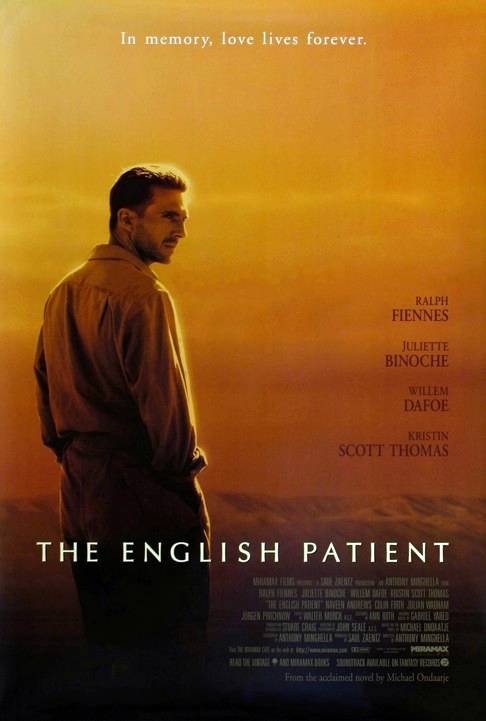
Sweeping, luscious, beautiful and an epic translation of an almost unfilmable novel into something supremely cinematic, The English Patient swept the board with nine Oscars at the 1996 Academy Awards. The English Patient has sometimes had a rocky reputation (not helped by an episode of Seinfeld where Elaine was famously non-plussed by the film). Like some of Minghella’s later work, it’s almost too well made for some to get past, looking like prime award bait. I didn’t “get it” the first time I watched it. But I – and the naysayers – were wrong: The English Patient is rich, rewarding and throbbing with a very British sense of repressed emotion and slow embracing of dangerous passions.

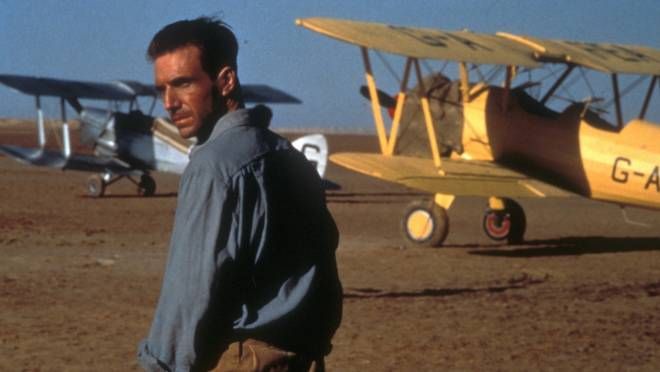
Adapted from Michael Ondatje’s multiple-award-winning novel, it unfolds across two time frames, hinging on a plane crash in the Sahara in 1942 that opens the film and leaves its pilot, Hungarian Count Almasy (Ralph Fiennes), hideously burned beyond recognition. The entire film is both an epilogue to that crash and a prologue explaining how we got there. In 1945, Almasy asserts he remembers nothing, even his own name. In what we later learn is a bitter irony, he is mistaken for an Englishman due to his perfect English. He is nursed through the final days of his life in an abandoned Italian monastery by a Canadian nurse Hana (Juliette Binoche), who has lost nearly everyone she loves in the war. Through Almasy’s memories, we see his life before the war as part of an international society of cartographers. In particular, the love affair that grows between him and Katherine Clifton (Kristin Scott-Thomas), the wife of another member of the society – an affair that will have life-shattering repercussions.

Appreciation for Minghella’s film must start with his ingenious screenplay. The English Patient, a book that moves eclectically between multiple timelines, shifting perspective frequently, and delivers its story in almost impossibly rich prose, should have been unfilmable. Minghella creates something which is both a mirror of the book’s intention, but also a cinematic text. You could use this as a teaching tool for adaptation (bizarrely one of the few Oscars it didn’t win was for Screenplay!). Working in close partnership with editor Walter Murch, Minghella’s film effortlessly cuts back and forth between at least three timelines, but never once confuses or jars. With (according to Murch) over 40 time transitions (that’s one almost every 3-4 minutes, fact fans), this could have been a jarring, impossible to follow mess. Instead, narrative clarity is its watchword.

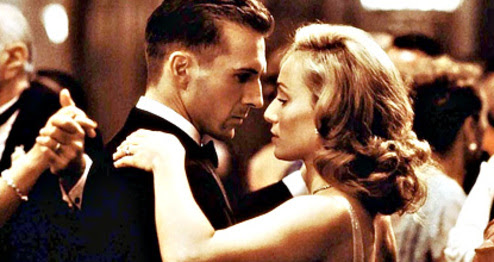
But the film also succeeds because it’s the apex of Minghella’s ability to combine luscious, poetic story-telling with acute emotion and passion. It shouldn’t be a surprise that someone who showed such understanding of grief in Truly, Madly, Deeply acutely understands how joy and pain can go hand-in-hand in love. Perhaps one of the reasons people found this a difficult film is that Almasy and Katherine are not a traditional romantic pairing. Both guarded, sometimes even cold and distant people, they are tentative, perhaps even scared, of the deep bond they immediately feel. A bond that burns all the more brightly because of the compromises and barriers in their emotional lives.

Almasy is distant, aloof, a man easy to know but impossible to understand. Katherine has a very English reserve behind a certain patrician warmth, playful at times but very aware of duty. What’s fascinating – and moving – about the film, is that these two people actually have a huge groundswell of passion between them. They are besotted with each other, but for reasons ranging from background to their own fears of emotional involvement, struggle to admit it to each other. They fling themselves at each other in romantic couplings with an almost animalistic longing. They make each other laugh. They allow themselves to speak of deep feelings, experiences and thoughts that they would not express to others. And they are also able to hurt each other through resentments, distances and shunnings in a way no one else could.

It’s a decidedly unconventional romance – compare it to, say, the next year’s Oscar winner Titanic with its far more conventional love story – but it works wonderfully. The slight air of repression also means that the confessions of deep-rooted feelings – Scott Thomas’ reveal of a gift she has never parted from, or Fiennes’ face twisted in emotional anguish – carry huge impact.

It also helps that the film is set in the sort of grand vistas that David Lean would be proud of. While you can certainly argue (with some justification) that The English Patient is a picture postcard film, its perfect visuals of the desert, the stunning beauty of so many of its shots, add to the extraordinary luscious old-fashioned 1930s romance of its setting. It could all be taking place in a world of von Sternbergesque romanticism.

Minghella’s film also interweaves skilfully the 1945 story line, revolving around Juliette Binoche’s Hana. Binoche won a deserved Oscar for a sensitive, vulnerable performance as a woman terrified of emotional commitment (sound familiar?), scared anyone she grows close to is doomed to die. Her romance with bomb disposal expert Kip (a strikingly delicate performance from Naveen Andrews, with just enough hints of anti-colonial tension mixed in) seems ready to fit this trope, but instead develops in unexpected ways. It also contributes perhaps the film’s most sweepingly romantic moment when Kip uses a pulley system, a flare and a bit of muscle to give Hana a sweeping up-close look at some Renaissance frescos. But while our flashback romance has the foreboding of doom to it, this one instead shows us the hope of a life restarting.

The English Patient also makes some striking points about the insane foolishness not just of war, but nationalism and Empire. The cartographers are a pan-European group who come together as equals, disregarding all concerns of nation. Instead they find a freedom to behave – intellectually, emotionally and sexually – in a way they never could “at home”. They represent a chance of being free to make our own choices, rather than dictated by arbitrary borders. Problems of nationhood are what will bring disaster. Colonialism is viewed equally critically: Kip gets sharp digs in at Kipling and also makes clear that his status as an Indian officer in the British Army is one of uncertainty.

Minghella’s film also works because of the mastery of the performances. Fiennes is in nearly every scene (many of them under a layer of make-up), and the role is a perfect match for the surface coldness in his performance style, which hides his wit and sensitivity. Cheated of the Oscar, Fiennes has rarely been better – his clipped romanticism mellowing in the 1945 section as a gentler but broken man. Scott-Thomas is perfectly cast – I’m not sure any other film has used her skills better – as a woman who compromised on happiness at the wrong time, and now cannot express herself.

The English Patient is a romance of slow moments, of inferred passions, which only at a few points before the end flower into something intimate. But it carries a huge emotional force, precisely because of this. Its technical work is faultless – Gabriel Yared’s score is a sumptuous mix of inspirations – and the acting superb (as well as the stars, Firth is marvellous as a decent but dull man cuckolded, Dafoe adds a layer of unpredictability as a 1945 houseguest and Whatley is the picture of working-class decency in a rare film role). The English Patient is Booker-prize film-making in its depth, richness and the work it asks you to put in, mixed with a David-Lean-meets-Mills-and-Boon pictorial loveliness, where each frame is a sun-kissed example of pictorial perfection. Mixed together, it makes for a sumptuous and deeply emotional package that I find more and more rewarding with every viewing.