Tag: Ralph Fiennes

The Invisible Woman (2013)

Ralph Fiennes and Felicity Jones excel in the thoughtful and well handled The Invisible Woman

Director: Ralph Fiennes

Cast: Ralph Fiennes (Charles Dickens), Felicity Jones (Nelly Ternan), Kristin Scott Thomas (Mrs Ternan), Tom Hollander (Wilkie Collins), Joanna Scanlan (Catherine Dickens), Michelle Fairley (Caroline Graves), Tom Burke (George Wharton Robinson), Perdita Weeks (Maria Ternan), John Kavanagh (Reverend Benham), Amanda Hale (Fanny Ternan)

In 1865 Charles Dickens was involved in a train accident. While he worked tirelessly, tending to those caught up in the accident, he was also extremely careful to hide the fact he was travelling with a young actress called Nelly Ternan. Ms Ternan was his lover, had been for several years, and the couple were returning from Paris. Dickens managed to avoid the inquest and preserve the secret of his affair. Because, while he was happy to publicly announce his separation from his wife, the idea of the public hearing that he had an affair with someone 27 years younger than him was unthinkable.

The affair is deduced from careful deduction and the small remaining correspondence (both parties destroyed large numbers of letters) by the biographer Claire Tomlin. Her book forms the basis of Fiennes’ thoughtful, careful and intelligent film, with the director playing Dickens and Felicity Jones as Nelly Ternan. The Invisible Woman is restrained and unjudgmental film-making, that largely avoids obvious moral calls and weaves a beautifully constructed tale of two people who make themselves both happy and miserable.

And that misery is partly due to the times they live in. It’s an era of Victorian morals, where all that matters is the surface appearance and any real emotions underneath can go hang. But it’s also a world where very different rules apply to men and women. Dickens can leave his wife (in a press announcement) – but of course a woman could never do the same. It’s a world of strictly defined rules, with clear roles for both genders that cannot be deviated from. And it forces Nelly Ternan to travel to Paris, because the public shame that would come with her pregnancy by Dickens would destroy her. It’s why, years after Dicken’s death, she is lying about how well she knew the man (even changing her name and age to further distance herself) so that she can conform with the expectations of being a school-master’s wife (and ensure she will not be thrown out to the streets).

The rules are so strong that both Dickens and Ternan are as much in thrall to them as anyone else. Dickens is willing to bend the rules – but only so far. He would clearly never dream of living openly with his unmarried partner and their child as his friend Wilkie Collins (a perfectly cast Tom Hollander) would do. And Nelly Ternan is as outraged at this liaison – and as desperately uncomfortable in their home – as any prim housewife would be. In fact, in many ways, Nelly is even more conservative than Dickens.

But then she has to be. After all, he would be a rogue, she would be a whore. Choices aren’t great for women – and in her chosen career of actress, Nelly is clearly far more enthusiastic than she is talented. It’s worries about the career that leads to her mother – an excellent performance of motherly love mixed with a quiet understanding of the world from Kristin Scott Thomas – all but encouraging Dickens to seduce her daughter. Because, for an independently minded woman passionate about the art, if you can’t be an actress your other option is to be a muse.

Even Dickens seems quietly ashamed at his seduction of this woman, while she half-persuades herself it isn’t happening until it is. So, what draws them together? Refreshingly this isn’t a question of an older man excited by a younger woman – or a naïve woman swept up by a powerful man. Instead, these are kindred spirits. Both of them are passionate, intelligent and questioning. They both express an emotional honesty and openness. They have shared passions for literature, theatre and stories. It’s a romance that slowly blossoms and is based on a shared feeling. It would have been easier to tell a story of seduction and abuse – but this is a more intelligent film than that. At that fatal train accident, its Dickens who yearns to stay with Nelly and its Nelly that urges him to leave to preserve his secrets.

As these two, we have two actors with beautiful chemistry. Felicity Jones is inspired as Nelly Ternan. She both idolises Dickens, but is also drawn towards him on a very human level. She is astute, but conservative and at times even remote. Her older self, over a decade later, is both prickly and defensive – and those are qualities you can trace in her younger self, and not just because of her fear of disgrace. It’s a beautifully judged performance, both older than her time and also with a vibrancy and energy that entrances.

Fiennes, a more reserved actor, seems like an odd choice for the bon vivant Dickens – but he brilliantly excels in the role, full of energy and room-filling dominance. He marvellously conveys the charm and passion of Dickens, but also his thoughtlessness. This is after all a man who drops his wife by newspaper announcement and builds a barrier between their bedrooms. Who loves Nelly, but not enough to make her anything but a secret. Who is passionate and excited about his work, but can be turn distant and cool in his personal life. It’s a fabulous performance.

And the two leads are centred in a low-key, poetic film. You get the sense that there is a danger in getting to close to genius. Dicken’s wife Catherine – a beautifully sad and lonely performance from Joanna Scanlan – even warns Nelly about it (while delivering a gift from her husband, sent to her by mistake). It’s a danger that shapes Nelly’s whole life – but also her life is enriched by having Dickens in it. It’s a film that avoids obvious moral judgments – and while there are things done which cause pain, everyone is living in an imperfect society. Fiennes direction and use of visual language is wonderful and this is an impressive film.

The Dig (2020)

THe Dig header
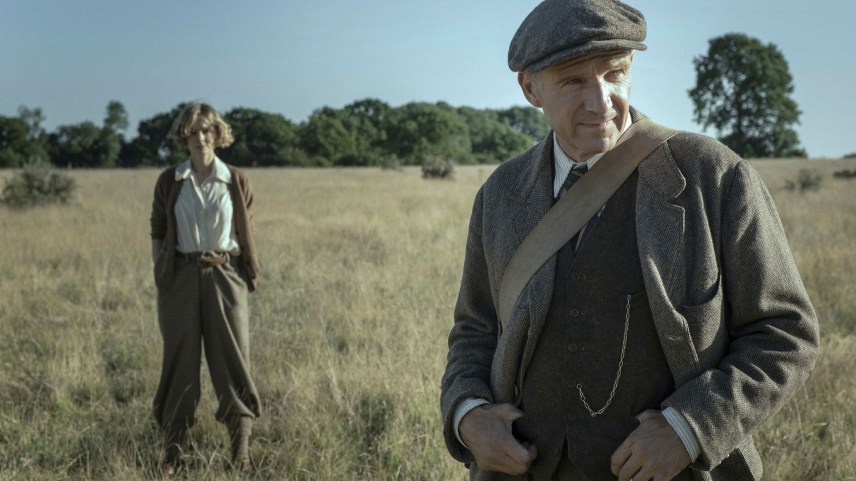
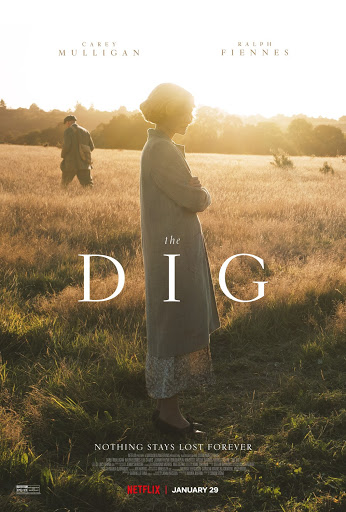
Ralph Fiennes plays an amateur digger who makes a huge discovery in the poetic The Dig

Director: Simon Stone

Cast: Carey Mulligan (Edith Pretty), Ralph Fiennes (Basil Brown), Lily James (Peggy Piggott), Johnny Flynn (Rory Lomax), Ben Chaplin (Stuart Piggott), Ken Stott (Charles Phillips), Archie Barnes (Robert Pretty), Monica Dolan (May Brown)

One of the greatest archaeological finds in British History, the Anglo-Saxon burial ship in Sutton Hoo revealed vast treasures and cultural insights that are very rarely glimpsed. Land-owner Edith Pretty (Carey Mulligan), a widow with a young son Robert (Archie Barnes), hires self-taught excavator Basil Brown (Ralph Fiennes) to investigate the curious mounds on her land. Brown discovers one of them holds the buried ship. But the dig is taken from his control by the British Museum, led by Charlie Phillips (Ken Stott): professional archaeologists who want to ensure the work is ‘done properly’. With tensions of class and profession, everyone must race against time to complete as much of the work as possible before the outbreak of the Second World War.

On the surface, The Dig is a charming, heart-felt reconstruction of a fascinating moment of archaeological history, mixed with engaging (but familiar) stories of a working-class amateurs being patronised by upper-class professionals. However, Stone’s film manages to have a richer second layer. With war approaching, and mortality constantly on the mind of most of the characters, it’s also a subtle investigation of legacy, the past and death itself.

Stone’s film develops this with its rich, poetic filming style. Beautifully shot in a series of gorgeous hazy hues, with dynamic use of low-angles and wide-angle lenses, Sutton Hoo is given an almost mystical beauty. Stone also makes extensive use of playing dialogue over images not of the conversation, but smaller moments in character’s lives, from casual meetings to cleaning shoes, that as such take on a profounder meaning. It’s a visual representation of how our legacy is often a snapshot of images and relics, moments that stay in the memory even when events (or conversation in this case) has moved on. It’s subtly done, but carries a beautiful impact.

Then of course, it’s not surprising legacy in on the mind. Each of the characters is at a tipping point in their own lives. Edith Pretty – so consumed with quiet grief over the loss of her husband that she is desperate for there to be something on the other side – is struggling with her own health, aware she will shortly leave her son an orphan. Her cousin Rory prepares for service in the RAF – service she fears will shortly leave him dead (the dangers of the airforce are clearly shown when a trainee pilot crashes and drowns near to the dig).

This connection to the briefness and intangibility of life pushes people to address their own choices. After all they are all standing in the grave of a man considered so important at that the time, a ship was dragged several miles to honour him – and today we have no idea who he was. Married archaeologist couple Stuart and Peggy Piggott confront an amiable loveless marriage (he’s gay, she’s falling in love with Rory) that shouldn’t define their lives. Basil has dealt with quiet grief at a childless marriage, and sees his work in astronomy and archaeology as his legacy.

These ideas are gently, but expertly, threaded together with a reconstruction of the key issues around the dig. Needless to say, the academics – led by Ken Stott at his most pompous – have no time for Basil’s home-spun methods. Basil’s predictions of the Anglo-Saxon tomb are constantly dismissed until he literally digs the ship up. Immediately he is benched to clearing soil (and only on Edith’s insistence is he allowed to remain at all) and later his name will be scrubbed out of the official record. It’s always the way with Britain – and a sign of how tenuous our legacies can be.

The personal stories are not always as well explored. The film has its flaws, not least the sad miscasting of Carey Mulligan as Edith. In reality, Edith was in her mid-50s when the ship was discovered. The film was developed for Nicole Kidman, but with her withdrawal Mulligan (twenty years too young) was drafted in. Sadly, nothing was changed to reflect this: meaning the characters years of spinsterhood before marriage lose impact (seriously how old can she have been when she married? She’s got a 12 year old son!). A softly underplayed romantic interest between Edith and Basil is also rather unsettling considering the vast age difference between them. (It’s better to imagine it as a platonic bond).

It’s still more engaging than the rather awkward love triangle the film introduces late on between the married Piggotts and Edith’s (fictional) cousin Rory. It’s fairly familiar stuff – the closeted gay Piggott, the growing realisation of this by Peggy and the obvious charm and gentle interest of Rory – and more or less pans out as you might expect, although at least with a dollop of human kindness.

The film’s other delight is the acting. Ralph Fiennes is superb as the taciturn Basil, a dedicated self-taught man who knows what he is worth, but struggles to gain that recognition. Fiennes not only has excellent chemistry with Mulligan and Barnes, he also suggests a quiet regret in Basil as well as a fundamental decency tinged with pride. For all that she is miscast, Mulligan does very good work as Edith while Chaplin, James and Flynn make a lot of some slightly uninspired material.

The Dig is at its best when asking quiet and gentle questions about life and when it focuses on the platonic romance between Basil and Edith. Directed with a poetic assurance by Simon Stone, it doesn’t push its points too far and gets a good balance between fascinating historic reconstruction and more profound questions of mortality.

The Constant Gardener (2005)

Rachel Weisz and Ralph Fiennes in the brilliant and moving The Constant Gardener

Director: Fernando Meirelles

Cast: Ralph Fiennes (Justin Quayle), Rachel Weisz (Tessa Quayle), Danny Huston (Sandy Woodrow), Hubert Koundé (Dr Arnold Bluhm), Archie Panjabi (Ghita Pearson), Bill Nighy (Sir Bernard Pellegrin), Gerard McSorley (Sir Kenneth Curtis), Pete Postlethwaite (Dr Lorbeer), Donald Sumpter (Tim Donohue), Richard McCabe (Arthur Hammond), Juliet Aubrey (Gloria Woodrow)

John Le Carré’s reputation as a spy novelist without peer can lead people to forget his books are often scathing condemnations of Western policy. The Constant Gardener, a superb adaptation of one of his finest novels, is no different. It’s a passionate, angry denunciation of how Western pharmaceutical companies, and their government partners, exploit the people of Africa. But it carries real force as it’s interwoven with a moving and tender study of grief and how it changes us, pushing us to see things from a different perspective. It’s that which gives the film its force.

Justin Quayle (Ralph Fiennes) is a middle-ranking career diplomat, serving in the high commission in Kenya. His wife Tessa (Rachel Weisz), an idealist determined to make a difference, is murdered. Justin determines to get to the bottom of her murder – and finds Tessa was investigating a British drugs company using the distribution of AIDS drugs to poverty-stricken Kenyans to test an experimental TB drug, covering up the harmful side effects and disposing of the dead. As flashbacks reveal Tessa’s investigation and motivations, Justin becomes ever more determined to unmask the drugs companies, and the figures in the British government protecting them.

Directed with vibrant urgency by Fernando Meirelles, The Constant Gardener is part thriller, part romance and part study of loss. Continuing his style from City of God, Meirelles’ camera work is jagged, hand-held and often unsettling, becoming ever more disjointed and edgy as the plot itself heads into darker and darker territory. The film throws us into its Kenyan setting, not shying away from the poverty of the villages. At one point, an aerial shot travels from the golf course, where the British are at play, across a train track and settles on the neighbouring slums.

This is all part of the film’s anger, which translates Le Carré’s feelings from the book. Inspired by the story of an aid worker he met in Cambodia in the 1970s (and who died in Kosovo in the 90s), the film is as furious as the novel at the heartless exploitation of Africa for the benefit of Western companies. Who counts the cost of Kenyan lives lost to experimental drugs? Certainly not the rich and powerful, who keep any consequences at a distance and rationalise them as for the greater good.

And not many have the courage to stand up to this. Most it seems are like Justin – good people who prefer not to think about, or look to deeply at, the impact we are having on the world. It takes a firebrand like Tessa to shake things up – and she pays a huge cost for it. Starting with Tessa’s death, the film feels at first like a mystery, but the culprits are all too obvious. Instead the question is why, not who, and the dark conspiracy that unfolds is really about establishing who knew what rather than who was involved (everyone, of course, was involved).

Rachel Weisz (winning the Supporting Actress Oscar for her work here) excels in a part that could have been a holier-than-thou left-wing agitator, but which she makes warm, human and real. Tessa is a woman who cares deeply, but also loves deeply, who is genuine, unaffected and speaks her mind. Weisz’ performance hits just the right notes, passionate but playful. The bond between her and Justin is real and based on a deep love on both their sides.

So warm is her performance, that you totally understand the all-consuming grief and loss Justin suffers at her death. It’s a very different sort of part for Fiennes – gentle, vulnerable, sweet, far different from his more patrician roles. He nails the part perfectly, bringing out of it a great deal of emotional force. The film is a tender exploration of the impact of grief on a person, and the mixture of shock, sorrow, anger and confusion in Fiennes’ performance feels completely real. This stillness and sombre approach to loss carries real weight.

The film becomes both a crusade – the husband taking up the cause of his slaughtered wife – but also an unusual romance. The greatest pain for Justin is discovering that his wife kept so much of her life secret from him. She did it to protect him, but he longs for the chance to prove to her that he could have been her “secret sharer”, that she could have trusted him. Effectively the film – and Justin’s quest – is to emotionally reunite with his wife, to fully understand her. The emotional heart of the film is this story, the husband effectively communing with the ghost of his wife, wanting there to be no more secrets keeping them apart.

This does mean that, at times, the conspiracy angle of the film gets slightly rushed. A late sequence effectively is four confessions from supporting characters to Justin in a row. The film gets a little bogged down in the mechanics of Justin chasing down various pieces of paper. The eventual quest to find the doctor behind the scandal (a wizened with guilt Pete Postlethwaite) offers a rather neat resolution. But it doesn’t matter too much as the film culminates in an ending that is as bizarrely bleak as it is hopeful.

Beautifully shot by Meirelles, with a raw immediacy that keeps the tension up, with a genuine sense of Kenyan life, it has a wonderful cast of character actors doing their bit (Bill Nighy as an arrogant senior diplomat and Danny Huston as a weasely coward stand out). It’s a film that is full of righteous fury at the West – but also with a tender beating heat for the pain of grief and the struggle with mourning. Emotional and political, it’s the finest Le Carré adaption on film.

The End of the Affair (1999)

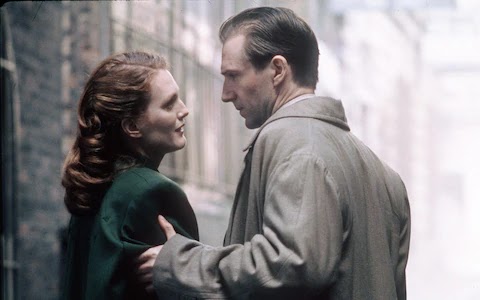
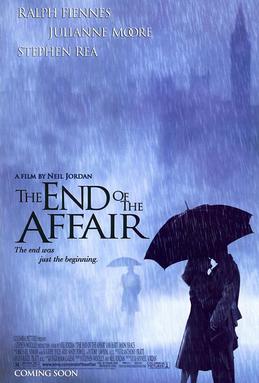
Julianne Moore and Ralph Fiennes in a doomed romance in The End of the Affair

Director: Neil Jordan

Cast: Ralph Fiennes (Maurice Bendrix), Julianne Moore (Sarah Miles), Stephen Rea (Henry Miles), Ian Hart (Mr Parkis), Jason Isaacs (Father Richard Smythe), James Bolam (Mr Savage), Sam Bould (Lance Parks), Deborah Findlay (Miss Smythe)

The End of the Affair is one of Graham Greene’s most autobiographical novels, based strongly on his relationship with Catherine Walston, wife of a friend in the civil service. Unlike the affair in the book, Greene’s continued for decades, long after the publication of the novel in 1951 (which had led to the husband demanding an end to it – a demand ignored). Greene’s novel recounts the dangerous passions of an affair, mixed with the powerful anxieties and uncertainties that the Catholic faith can have on relationships. Jordan’s film captures much of this – but in places fails to fully understand the spirit of Greene’s compelling novel.

Maurice Bendrix (Ralph Fiennes) is a moderately successful popular author, excused war service due to having injured his leg in the Spanish Civil War. In 1946, a chance meeting with Henry Miles (Stephen Rea), a staid civil servant brings back vivid memories of Maurice’s wartime affair with Henry’s wife Sarah (Julianne Moore). The affair ended abruptly for reasons Maurice cannot understand, and his love is twisting into jealous resentment. With Henry now concerned Sarah is having an affair – and seemingly unaware of Maurice and Sarah’s wartime relationship – Maurice takes it upon himself to hire Parkis (Ian Hart) a private investigator to find out more. The results though give him profound and affecting insights into both the present and the reasons for the end of his own affair with Sarah.

Jordan’s adaptation gets so much right, it’s almost more of a shame that it gets things wrong as well. The atmosphere of the film is simply perfect. It looks and feels exactly like a classic slice of Greeneland, with its dreary London, rain-soaked settings and gloomy period setting. Roger Pratt’s Oscar nominated photography is perfect for the tragic beauty of Greene’s work, and its matched with a sublime musical score from Michael Nyman that wrings every inch of emotion from the story.

Ralph Fiennes is also the perfect idea of a Greene hero – slightly imperious, bitter, arrogant with an air of prep school smugness mixed with an underlying sense of grim inferiority. It’s hard to imagine any other actor – maybe except Colin Firth – better suited to the slight air of dissolute, not obviously sympathetic world-weary struggle that a Greenian hero needs to exhibit. Fiennes barely puts a foot wrong and could have practically walked off the page.

Equally good is Julianne Moore, who nails a very English type of person, a woman determined to do her best and to set standards, but who carries just below the surface a deep well of emotional pain and sorrow that briefly is allowed to peek through. It’s a heart-rending performance of a person desperate for happiness, but hiding that longing under a veneer of acceptability, who sacrifices what she wants from life to meet the obligations of her faith. 

Because, it being Graham Greene, Faith is the big issue here – the idea of the private deals we make with God and the cost that those impose on us, the sacrifices of our own happiness in surface of something higher than ourselves. Greene’s novel intrinsically understand the eternal struggle felt in Catholicism to do the right thing, to accept the love of God into your life even if it means turning your back on more earthly loves and passions. How these journeys can be hard – unbearable even – but carry a level of reward in themselves. 

It’s that feeling for God – who Bendrix grows to believe has cheated him from happiness on earth – that powers his “diary of hate” that he is writing as the book opens. It’s an idea the film only fitfully engages with. Jordan deviates from the novel’s real intention at a key point, in particular “correcting” a dramatic error he feels Greene makes by having Sarah die “off camera” in the book, of a sudden cold, after confessing to Bendrix her reasons for ending the affair, her pact with God.

This narrative change allows a sequence in Brighton as the two reignite their affair – but it also undermines the tragedy of the book, that suddenness of loss, and also makes Sarah’s death feel like a tit-for-tat punishment for going back on her word. More to the point, the affair restarting has the air of an atheistic view of the Catholic complications here, an idea that these can be easily brushed aside because the “heart wants”. It’s to miss the point of Greene’s world thinking and undermine the small everyday tragedy in favour of something more conventional and “epic”.

It’s a major tweak that undermines the strength (otherwise) of Jordan’s work here – his directing and scripting is otherwise largely faultless. Other changes to the source clarify the message – I think changing Smythe (a gently but arrogantly certain Jason Isaacs) into a priest rather than an atheist Sarah is using to test her faith makes sense, even if it does suggest that she acts under the influence of someone else rather than on her own opinions. Making Bendrix a Spanish war veteran rather someone suffering the effects of a childhood illness adds a political and moral romanticism to the character entirely absent from any of the rest of his personality. But it’s fine.

Jordan’s film has many strengths. Its tone is excellent and it’s passion inspiring (the tender explicitness of the sex scenes landed it with a bizarre and controversial 18 certificate) and there are superb performances, not just the leads but Stephen Rea excellent as the meek but noble husband and some lovely comic work from Ian Hart as a haplessly efficient private eye. But the film slightly misses, in the end, the point of the novel – which is a real shame. If Jordan had stuck to the book, and its complex themes of guilt and grief and Catholicism we could have really had something here.

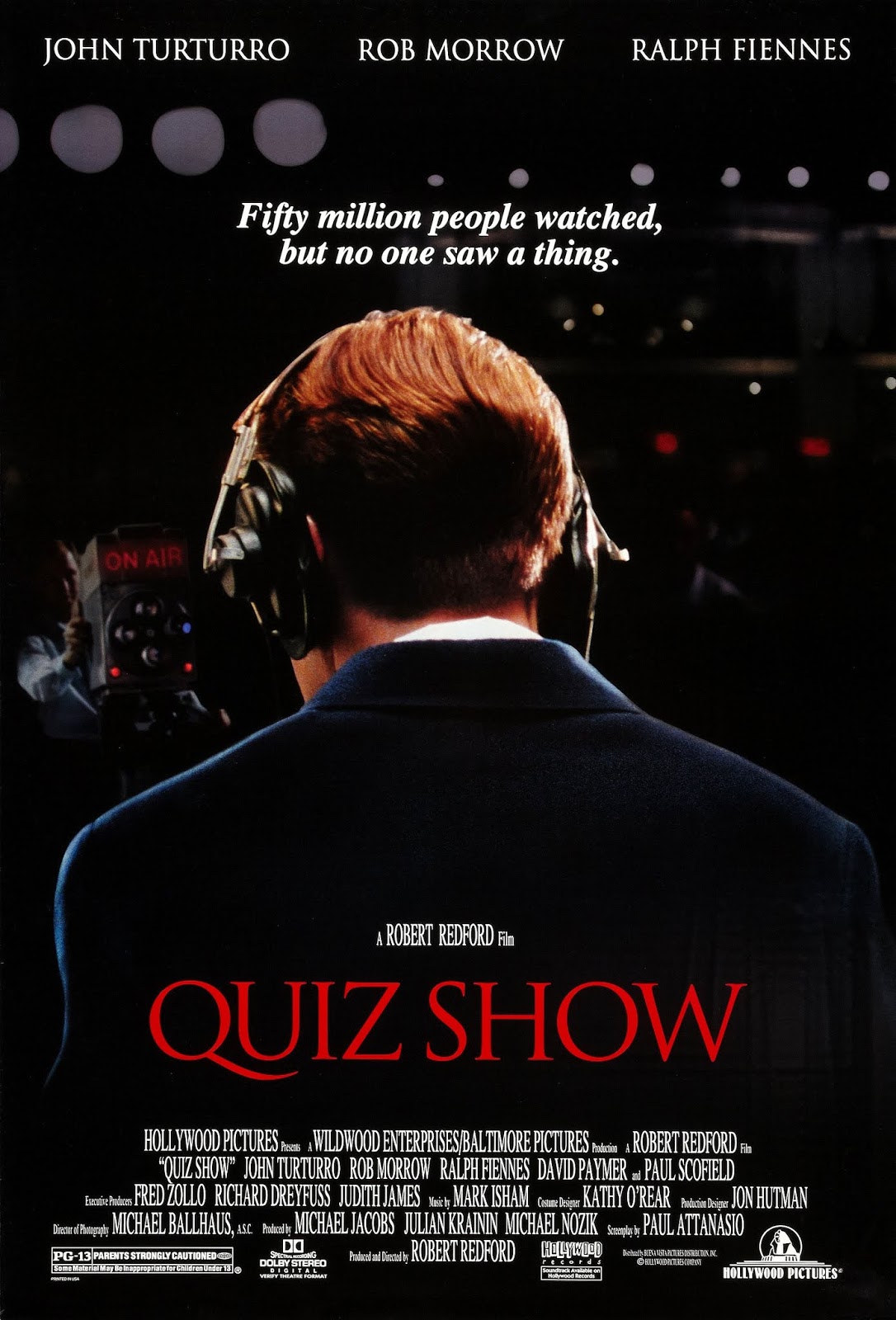
Quiz Show (1994)

Ralph Fiennes excels as the man who as the answers he shouldn’t have in Quiz Show

Director: Robert Redford

Cast: John Turturro (Herb Stempel), Rob Morrow (Richard Goodwin), Ralph Fiennes (Charles Van Doren), David Paymer (Dan Enright), Paul Scofield (Mark Van Doren), Hank Azaria (Albert Freedman), Christopher McDonald (Jack Barry), Elizabeth Wilson (Dorothy Van Doren), Mira Sorvino (Sandra Goodwin), Allan Rich (Robert Kintner), George Martin (Chairman Oren Harris), Paul Guilfoyle (Lishman), Martin Scorsese (Martin Rittenhome), Barry Levinson (Dave Garroway)

Imagine, if you can, a time when we trusted everything we saw on television. When whole nations crowded around to watch a show, and would run home to make sure they didn’t miss it. When the people appearing on the box in the corner were like members of the family invited into our home. In our cynical age of streaming and distrust, such ideas are impossible to imagine. Now we doubt anything we are shown on the box – and the first brick in that wall fell into place with the rigged quiz show scandals on American television in the 1950s.

Twenty-One is the biggest hit on NBC, with reigning champion Herb Stempel (John Turturro) correctly answering every question that comes his way. But the show’s sponsor, Geritol, is worried: Stempel’s ratings are at a plateau, and they feel the show needs a new champion. So producers Dan Enright (David Paymer) and Albert Freedman (Hank Azaria) look to recruit the sort of face of Twenty-One the sponsors want – and find him in clean-cut, Ivy league, charming Columbia League instructor (or “Professor” as they insist on calling him – and Van Doren’s move from reminding him he hasn’t qualified for that title, to happily accepting it is telling in itself) Charles Van Doren (Ralph Fiennes). 

They offer Van Doren the chance to win the show by telling him the answers in advance, while offering Stempel a career in television if he will agree to throw the next edition of the programme. Both men are plagued with indecision, but Stempel throws the game and Van Doren provides the correct answer to his final question – the exact same question he had been asked at his audition. Van Doren, seduced by the fame, quickly agrees to be given the answers in advance of the show, but the unreliable Stemple is dropped by NBC and instigates Grand Jury proceedings. The records are sealed but this piques the interest of Congressional lawyer Richard Goodwin (Rob Morrow), who begins to see the potential to “put television on trial” – while being deeply conflicted by his growing friendship with Van Doren, keen to be seen as co-operating with any investigation.

Quiz Show remains Redford’s finest directorial achievement by far, a rich, fascinating, beautifully made film with a profoundly rewarding and engrossing reflection on fame, television and the media in 20th-century America. Told at a gentle but compelling pace, probably the strongest weapon in its arsenal is a fantastically literate, well-constructed, dryly amusing and affecting script by Paul Attanasio. Scenes are beautifully assembled, crammed with well observed character beats and wonderfully quotable lines. It’s a script that would stand up extraordinarily well as a play itself, and Redford allows it plenty of room to breathe in his assured, unshowy and perfectly judged direction.

This is a film that analyses exactly how truth and entertainment are supposed to be inter-related. The rigging of quiz shows – and it was systematic across a range of shows on all channels – was a detailed lie to the American people. But, the film asks, what was the real harm of this? What are these quiz shows for? Tests of intellectual attainment or pieces of entertainment for the masses? As Scorsese’s Geritol executive says, people weren’t watching the questions, they were watching the money. 

And money is where the villainy lies in this film. For a film rich in period detail, Redford makes clear that there is a definite sense of class that underlies all the action. Decisions are made on the show based on selling things – advertising hours and Geritol products. And there are people in this show – the heads of corporations like NBC – who are making millions out of peddling rigged entertainment shows to the people. And when the chips come crashing down, it’s not these executives who are in the firing lines; it’s the little people who were the face of the enterprise – the contestants themselves – who pay the price.

It’s the exact opposite of what Goodwin wishes to achieve when he starts his investigation. He wants to add some moral force, some legislative control, to what you can and cannot present as fact and fiction on television. What he fails to understand – and what the film does – is that deep down people don’t want this. They want the excitement and the thrills – and at the end of the day wouldn’t care less if they never found out everything presented to them was carefully scripted. This lasts today: do we care that comedy sketches are not improvised but carefully scripted? Do we care if game show contestants are carefully pre-selected? Again, as Scorsese’s sponsor representative states, all any investigation will accomplish is TV shows figuring out other ways to get the high ratings: and simpler questions and less erudite competitors will be the way to go.

Because it’s all the glamour and excitement and drama we like to watch, not displays of intellectual accomplishment. It’s something the film understands – and something that comes across very clearly in Ralph Fiennes’ exquisitely well-judged performance as Charles van Doren. A genuinely intelligent, decent man, Fiennes’ performance works so well because he makes clear that under the WASPish, patrician decency of van Doren is a fundamental shallowness, a laziness and hunger for the quick buck and easy success. Constantly, Fiennes’ confident grin and easy manner hide his unease and guilt at his conduct. But he clearly can’t help himself, a Faust wrapped up in his pact.

After all what would his father – the famous poet and academic Mark van Doren, played with a beautiful ease, grace, intelligence and iron-clad honesty by Paul Scofield, a sublime actor at the top of his game – think of this all if he found out? The scenes between the two men – one the proud, loving but quietly demanding father, the other the successful, shallow, quietly desperate son – are the film’s strongest moments, consumed with the tension of the unspoken. We can see the pressure of familial expectations reflected elsewhere in Herb Stempel’s wife’s disappointment at finding that Stempel himself was a coached as much as van Doren.

John Turturro goes larger as Stempel, a bitter and frustrated man addicted to the attention and glamour TV has bought him which he has always felt has been denied him. Stempel’s desire for fame, his assumption of a persona in the public eye which is part studied, part eagerness to please his audience, gets to the heart of TV’s power. It’s the box in every room, and it can turn the ordinary into the extraordinary. It’s a box with the potential to weave magic – and it’s the tricks behind the magic that are difficult to see. For all we know the magician doesn’t saw the assistant in half (as Hank Azaria’s crude producer puts it), it makes it hard to enjoy the trick when you know it is one.

It’s ideas like this that the film gets to  so cleverly, and which turns the American quiz show into an intelligent metaphor for the corrupted ambition of America itself. The dream is to get to the top, and this was a way of offering a short cut for it – and all to help big business sell its products and make money. This is the subversive truth at the heart of Quiz Show, but it’s easy to forget as we, like the American people, have the obvious villains of the ordinary contestants be crucified by the media, rather than those who really profited. Redford’s film is smart enough to constantly remind us of this, to humanise the contestants and to show the darker elements underneath. Quiz Show is a great film.

The Hurt Locker (2009)

Danger awaits round every corner in the shocking The Hurt Locker

Director: Kathryn Bigelow

Cast: Jeremy Renner (Sgt William James), Anthony Mackie (Sgt JT Sanborn), Brian Geraghty (Specialist Owen Eldridge), Guy Pearce (Staff Sgt Matthew Thompson), Christian Camargo (Lt Colonel John Cambridge), David Morse (Colonel Reed), Ralph Fiennes (British Mercenary), Evangeline Lilly (Connie James), Sam Spruell (Contractor Charlie)

There have been few wars in history as controversial as the Iraq war. Despite this, it’s hard to think of a film that really has nailed the complex social, political and military causes behind the war – or managed to engage with the deep unease much of the Western world feels for the campaign. While there have been great films about Vietnam, that other opinion-dividing conflict of the last 50 years, there hasn’t been one about Iraq yet – perhaps because the wound is still so fresh. The Hurt Locker gets closest by far – largely because it is a film that makes war its subject, not Iraq; it could just as easily be set in the fields of France as the streets of Baghdad.

After the death of their Staff Sergeant (Guy Pearce) while defusing an IED in Baghdad, Explosive Ordnance Disposal (EOD) unit members Sgt Sanborn (Anthony Mackie) and Specialist Eldridge (Brian Geraghty) are joined by a new team leader Sgt William James (Jeremy Renner). However, they both – particularly the by-the-book Sanborn – grow increasingly concerned about James’ maverick methods and willingness to take personal risks to defuse bombs. Slowly, tensions rise in the team.

The Hurt Locker makes no comment whatsoever on the controversy behind the decision to intervene in Iraq. Instead, its focus is entirely on the psychology of those who go to war, and the sorts of personalities it can attract, from those with a keen desire to do their duty to others who get a certain “buzz” from risk and conflict that they cannot find elsewhere in their lives. As the film’s opening words say, “War is a Drug”. And there are few characters more afflicted by an addiction to that drug than Sgt William James.

Not that James is a villain. One of the film’s many strengths is that he is far from a lunatic. Played with a career-defining charisma and intensity by a then almost-unknown Jeremy Renner, James takes personal risks (defusing bombs without the huge rubber safety suits, turning off his comms to concentrate, returning to bombsites to collect trophies or lost items) but he also shows concern and empathy for his fellow soldiers and (largely) avoids putting them in danger. With the team pinned down by snipers in the desert, he calmly reassures Eldridge and talks Sanborn quietly through taking down the snipers. He develops bonds with people and later in the film shows great compassion and willingness to put himself in danger to save a man unwillingly attached to a suicide vest.

James’ struggles are to deal with the modern world and its shallow obsessions compared to the thrill of putting your life on the line (as the film brilliantly illustrates with a final vignette of James back home at the end of rotation, staring blankly at a wall of cereal boxes in a supermarket). On campaign, he talks dismissively of his child and claims to not know or understand his relationship with his wife. But this is a front – it’s clear his family life is far more settled than he suggests – and is actually more connected to his guilt at enjoying his time on military posting more than he does the neutered warmth of family life. Renner excels at all this complex psychology, crafting a man who is aware of his addiction, can’t combat it but feels a deep guilt for it.

The Hurt Locker is about how this rush of war can be more compelling and life-affirming than hearth and home. It’s also perhaps a commentary on how we ourselves get a rush from watching action and war films – that it’s only a few steps from enjoying watching the excitement of conflict, to enjoying being in the middle of that kind of action. Is James really that bad? Defusing bombs is a difficult and demanding job – and James knows (rightly) that he is one of the best at doing it. And shouldn’t a man enjoy his job? Renner’s glee at a job well done is balanced by guilty awareness that he shouldn’t be enjoying himself as much as this.

Kathryn Bigelow is in her element directing this burst of male testosterone, assembling a film that is gripping, tense and hugely exciting. It’s essentially constructed around a series of set-pieces, each of them more unsettling than the one before. Bigelow’s direction is impeccable, as each of these sequences is both unique in tone and utterly compelling. Bigelow became the first woman to win Best Director at the Oscars – and her acute understanding of men enamoured with the buzz of adrenalin is what gives the film much of its narrative force.

It also helps that the film she has assembled here is a technical marvel, brilliantly shot by Barry Ackroyd with a scintillating display of hand-held cameras, cleverly focused details and immersive story telling. The Hurt Locker is a film both drenched in sun and darkness, with burning yellows and oppressive greys. It’s a film that captures the incredibly alien, heat-stoked insanity of Iraq, and the journalistic style and camerawork make everything we watch feel even more immediate.

In the middle of this, the psychological drama between the maverick James and the cautious, procedure-led Sanborn (played by an equally impressive Anthony Mackie, whose every moment buzzes with frustration and anger at the dangers he sees James inflict on them) plays out wonderfully. Bigelow has an immediate understanding of how the adrenalin and testosterone of combat quickly bubble up into violence and aggression off the battlefield, with these two men often becoming like rutting stags, struggling to place their own supremacy on the team – with Brian Geraghty’s weaker Eldridge the pawn between the two.

The Hurt Locker does what it does so well that it’s easy to overlook its flaws. Its narrative is so pure that you regret it gives barely a second to addressing the issues in Iraq or how the behaviour and attitude of the soldiers there (mostly angry and abusive towards the local population) may be contributing to the problems. It also struggles to add much narrative originality to the story, beyond its set-pieces – in particular James’ friendship with a young Iraqi boy seems like the forced stuff of movie convention in a film that prides itself on reality. When dialogue takes over from action, many of the psychological points it raises have been seen in countless films past. You could argue that the film is largely at its weakest when it tackles any questions of plot at all, and that what Bigelow has really done here is make one of the finest boots-on-the-ground immersions you are going to see.

And if The Hurt Locker is just that then, you know what, that’s fine too. Because when it does this it’s one of the best in the game. Brilliantly assembled, shot and edited (those many Oscars were well deserved) it’s a gripping war film that relies a little too much on some of the conventions of war and combat films, while also focusing very intently on how war affects the psychology of the men at the sharp end. It gives a truly unique perspective of the dangers (in every sense) and is brought to life by a series of fine performances, with Renner and Mackie outstanding. Wonderfully directed, and smashingly tense, it’s a worthy contender in the upper echelons of any list made of great war films.

The Prince of Egypt (1998)

Animated DeMille epics in the rather brilliant The Prince of Egypt

Director: Brenda Chapman, Steve Hickner, Simon Wells

Cast: Val Kilmer (Moses), Ralph Fiennes (Ramesses II), Michelle Pfeiffer (Tzipporah), Sandra Bullock (Miriam), Jeff Goldblum (Aaron), Danny Glover (Jethro), Patrick Stewart (Pharaoh Seti), Helen Mirren (Queen Tuya), Steve Martin (Hotep), Martin Short (Huy), Ofra Haza (Yocheved)

When Dreamworks Studio was put together by three Hollywood mega hotshots (Katzenberg, Spielberg and David Geffen), Jeffrey Katzenberg, former head of Disney, finally got the chance to make his animated version of The Ten Commandments. The Prince of Egypt was the first project under the Dreamworks animation label – and it was intended to beat Disney at its own game. It succeeded – so well that many people think it actually is a Disney film. Is that a good thing?

Anyway, the story should be familiar. In Ancient Egypt, Moses (Val Kilmer), the child of Jewish slaves, is adopted by Pharaoh (Patrick Stewart) as a baby after being found in the bulrushes. Moses grows up as brother to Ramesses (Ralph Fiennes) the future Pharaoh – until the shock of finding out his heritage leads him to flee Egypt. But an encounter with the burning bush (voiced again by Kilmer) gives him a new mission – back to Egypt to demand of Ramesses “Let My People Go”. Will he succeed? Well: There Can Be Miracles (When You Believe).

It helps you to believe in miracles when a film looks as gorgeous as this one does. The animation is amazing, not just because of its quality and richness, but the imagination of its images. From the framing of Pharaoh and later Rameses around the Egyptian architecture around them, to an extraordinary dynamic shot of Moses throwing his sandals from the room when encountering the burning bush, to the haunting interpretation of the killing of the firstborn, it’s brilliant. 

It doesn’t stop there either, with the final parting of the Red Sea awe-inspiring in its scale. But the film does equally beautiful work with the smaller, more intimate moments: each character feels real and lived in, and the film perfectly captures smaller moments of affection, love and hurt with genuine emotional force. It’s a terrifically well-made film.

And of course it has a classic story – it’s literally stood the test of time. So imaginative are the visuals – and so impressive is its scope and scale – that it almost dwarfs the DeMille style it’s quietly apeing. In fact, I’d worry whether it is a film that will have greater appeal to movie-lovers and parents than perhaps it does to children. There isn’t much in the way of humour – even the film’s nominal comic characters, a pair of cynical Egyptian priests (and near con artists) voiced by Steve Martin and Martin Short, are on the side of the oppressive baddies. There are a few decent songs in there – I rather like the Les Miserables style oomph of “Deliver Us” – and the film makes great use of the beautiful voice of the late Israeli singer Ofra Haza. But there is no getting around that this is a serious piece of film-making, with nary a comic camel in sight.

But this is no bad thing at all, and I think it stands The Prince of Egypt in good stead as it’s a film you’ll like more the older and more mature you are watching it. Not least the wonderfully complex relationship it explores between Moses and Ramesses – these two wild young men start as carefree kids (the first thing we see them do is smash up a temple building site in the film’s most cartoonish sequence, a sort of Wacky Races chariot drag race), and each become dramatically changed by responsibilities. Moses ascends to a higher plane of responsibility and humanity – but Ramesses finds himself forced into defending to the death a system of government he seemed at best disinterested in as a young man.

The film actually carries a great deal of sympathy for Ramesses. It’s in many ways a tragedy of the brother relationship between these two princes of Egypt getting shattered by events. But Ramesses is a lonely, almost needy figure, who needs Moses’ affection and respect. Ralph Fiennes mines a lot of vulnerability for this man struggling to fill his father’s shoes, who just wants Moses to chuck this whole prophet business in and go back to being his only friend. Ramesses becomes a complex, vulnerable and rather sad man – unable to deal with the pressure of his role and desperate to revitalise a lost connection with Moses, the hatred he eventually feels for his former brother born almost exclusively from rejection. 

Moses isn’t quite as interesting a character – he’s more of a waster who becomes a stand-up guy – but the film successfully builds an aura about him. It struggles a bit more with those Old Testament morals: we are meant to condemn Pharaoh’s slaughter of the Jewish firstborn that opens the film, but God’s massacring of the the Egyptian firstborn (for all Moses’ discomfort with it) is presented as being primarily the fault of the Egyptians’ stubbornness.

But then that steers us into theological territory, which no animated epic for kids can really manage to set new ground with. Instead, let’s focus on the many things the film does right. First and foremost that striking visual imagery and beautiful animation, and the depth and shading it gives to the characters. The all-star cast do extremely well – even Jeff Goldblum is fairly restrained – and it’s got some great songs. It deserves to be shown as often as The Ten Commandments on the television.

In Bruges (2008)

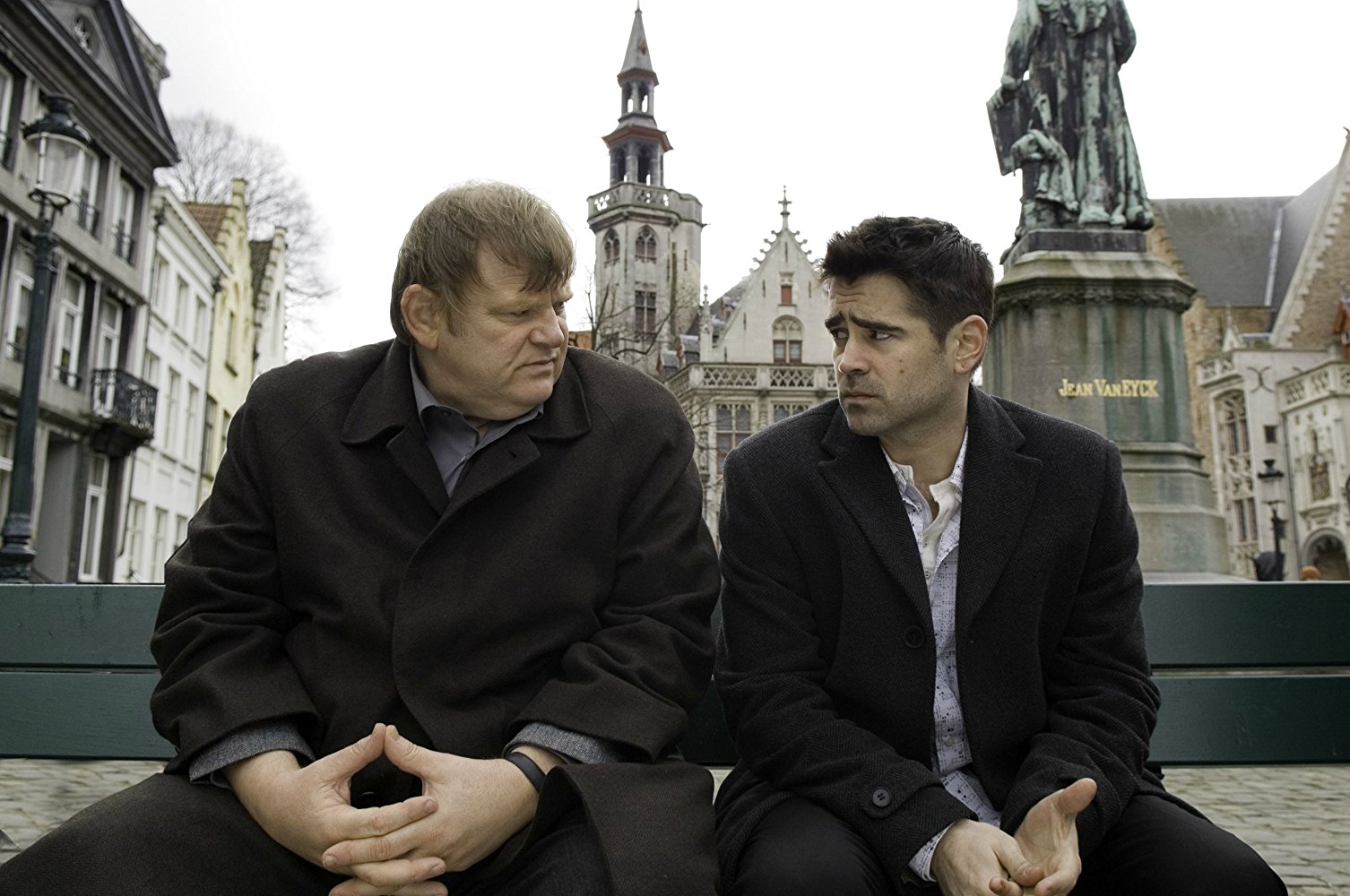
Brendan Gleeson and Colin Farell excel in hitman comedy In Bruges

Director: Martin McDonagh

Cast: Colin Farrell (Ray), Brendan Gleeson (Ken Daley), Ralph Fiennes (Harry Waters), Clémence Poésy (Chloë Villette), Jordan Prentice (Jimmy), Thekla Reuten (Marie), Jérémie Renier (Elrik), Anna Madeley (Denise), Elizabeth Berrington (Natalie Walters), Eric Godon (Yuri), Željiko Ivanek (Canadian)

Who hasn’t been dragged somewhere for sightseeing and culture, and longed to be somewhere else (anywhere else?). Most of us right? So how many of us are hitmen hiding out after a job gone wrong? Probably not that many (I hope!). It’s this mixture of the everyday and the bizarre that Martin McDonagh nails so well in his debut film, a sharp as nails, laugh-out-loud but also moving piece of work, possibly one of the sharpest written, well-made debut films you’ll find.

Ray (Colin Farrell) and Ken (Brendan Gleeson) have been sent to Bruges to hide out for a few weeks after a job gone horribly wrong in Dublin. Ken is fascinated by the city, its culture and buildings and enthusiastically buys a guide book. Ray responds like a surly, miserable kid and is desperately unimpressed with everything he sees. Their long weekend in the city becomes increasingly unusual and dangerous as they encounter angry tourists, a racist dwarf (Jordan Prentice) and a drug-dealing film assistant (Clémence Poésy), and dodge the rage of their boss Harry Waters (Ralph Fiennes).

In Bruges is a hilarious piece of film-making, with every scene featuring some moment of black humour, wry observation or un-PC laugh-out-loud comedy. It’s foul-mouthed, sometimes violent, very rude – but also deals with profound feelings of guilt and regret with a real humanity. McDonagh’s work expertly combines jet black comedy, with a warmth for its deeply flawed characters. It’s got a compelling, masterful story that packs character development, incident and intricate plot threads together with assured expertise.

McDonagh’s gift is to make you relate for all of these characters, all of whom are made to feel very real and human. It skilfully leads you to overlook their many flaws and embrace them as people. It says a lot that the most sympathetic, likeable person in the film is a multiple murderer with an (implied) cocaine habit. Everything we learn or see about the characters is designed to make us understand and relate to them more.

Ray initially seems little more than a foul-mouthed thug. But as the film progress – and thanks to Colin Farrell’s masterful performance of brashness covering deep insecurity and vulnerability – we learn he is a rather sweet, even loving man who has stumbled into a career he is deeply unsuited to. Farrell gets these switches perfectly – and his childishness is hugely endearing. From stropping around like a sulky teenager to bouncing up to a film shoot with a childish, excited shriek of joy, he defies expectations. McDonagh throws in a perfect note of tragedy once we find out the mistake Ray made – and suddenly Farrell’s performance overflows with guilt, self-loathing and an unbearable regret that makes you re-evaluate everything you’ve seen him do.

But then that is the whole film right there: it makes you laugh uproariously, then chucks you a curveball and before you know it you are hugely emotionally invested, with a huge sense of empathy for their slowly revealed depths. That goes for every character – even the nominal villains have a sadness, or a firm set of principles, or a certain dignity to them that makes you care. It’s a brilliant piece of writing and directing – and masterfully acted.

Brendan Gleeson plays the other lead in Ken: and few other actors could surely have managed to turn Ken into such a warm avuncular figure, a gentle giant who feels he has come to terms with his choice of career but experiences a subtle shift over the course of the film. Gleeson’s performance is sublime, warm and witty with a careful thread of sadness underneath it – it’s some of his best work. 

But then the whole cast is great. Prentice’s bitterness as the angry Jimmy is brilliant – and he is very funny – while Poésy’s gentle bad-girl is a terrific, radiant performance. The film also has third act dynamite with Ralph Fiennes’ Harry Waters, a foul-mouthed, furiously angry, tour-de-force character who shakes up the whole film – but who has a strange sense of nobility about him, even while he is (hilariously) effing and blinding left, right and centre.

And the film has a brilliantly anti-PC vein of humour. Jokes about drug-taking and dwarves. Foul-mouthed gags about every subject under the sun. Brilliant encounters with “large” American tourists (brilliantly paid off later in the film), jobsworth ticket sellers, angry tourists in restaurants – the film is crammed with hilarious moments. All of it is brilliantly funny because it comes naturally out of characters who feel real.

It’s also so thematically rich. As the characters stand in front of Hieronymus Bosch’s The Last Judgement, you realise that the entire film is a metaphor for purgatory, with Bruges’ medieval beauty carefully chosen to reflect this. Our heroes, laden down with sins, wait in Bruges for an unspecified length of time to discover where they will head next. Amends have to be paid, sins have to be reconciled – and all these threads come together brilliantly in a final, dream-like sequence that you suddenly realise the whole film has been carefully building towards from the start.

So the film, after a scabrous, brilliantly hilarious, darkly foul-mouthed start, slowly becomes something which (while still hilarious) is also a discussion of morality, principles and guilt. We see characters do things we might never have imagined them doing at the start, some are redeemed, others make principled decisions. And it’s really funny. I’m not sure Colin Farrell or Brendan Gleeson will ever be better than they are here. It’s a brilliant play script turned into a wonderful film. A classic.

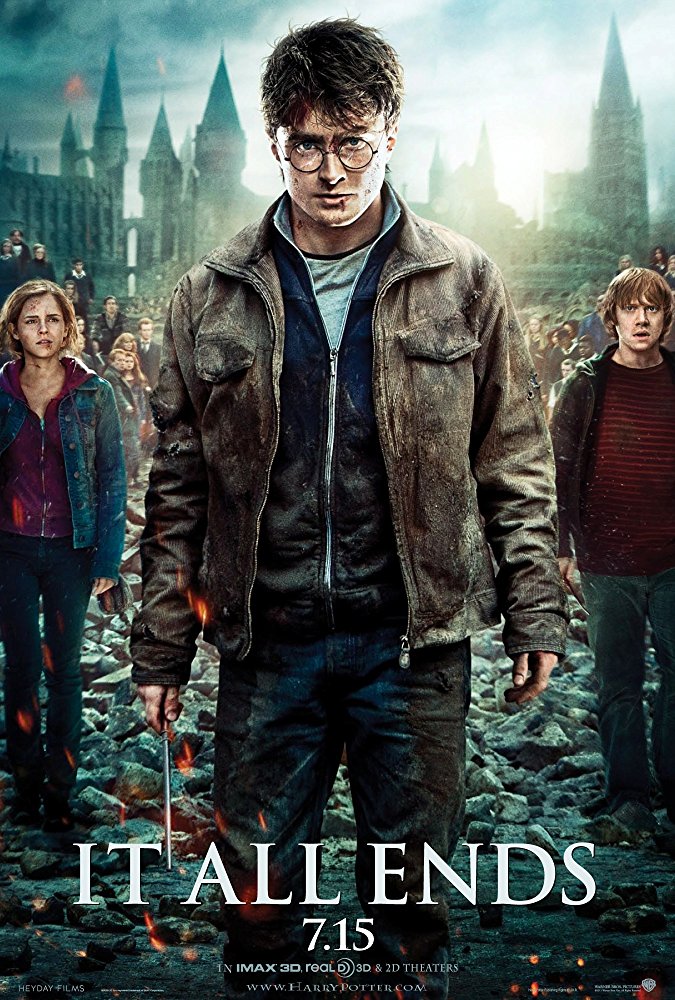
Harry Potter and the Deathly Hallows Part 2 (2011)

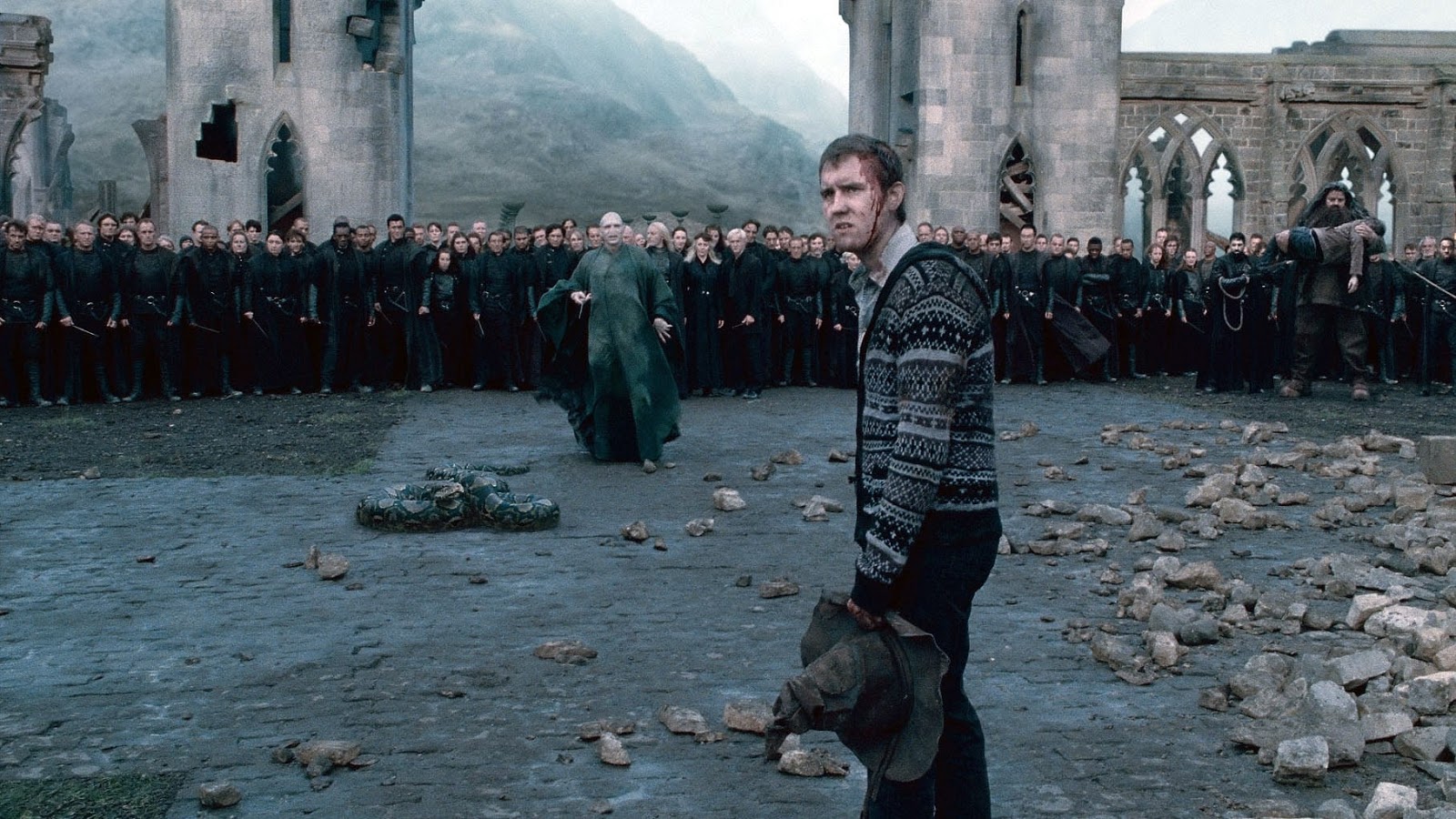
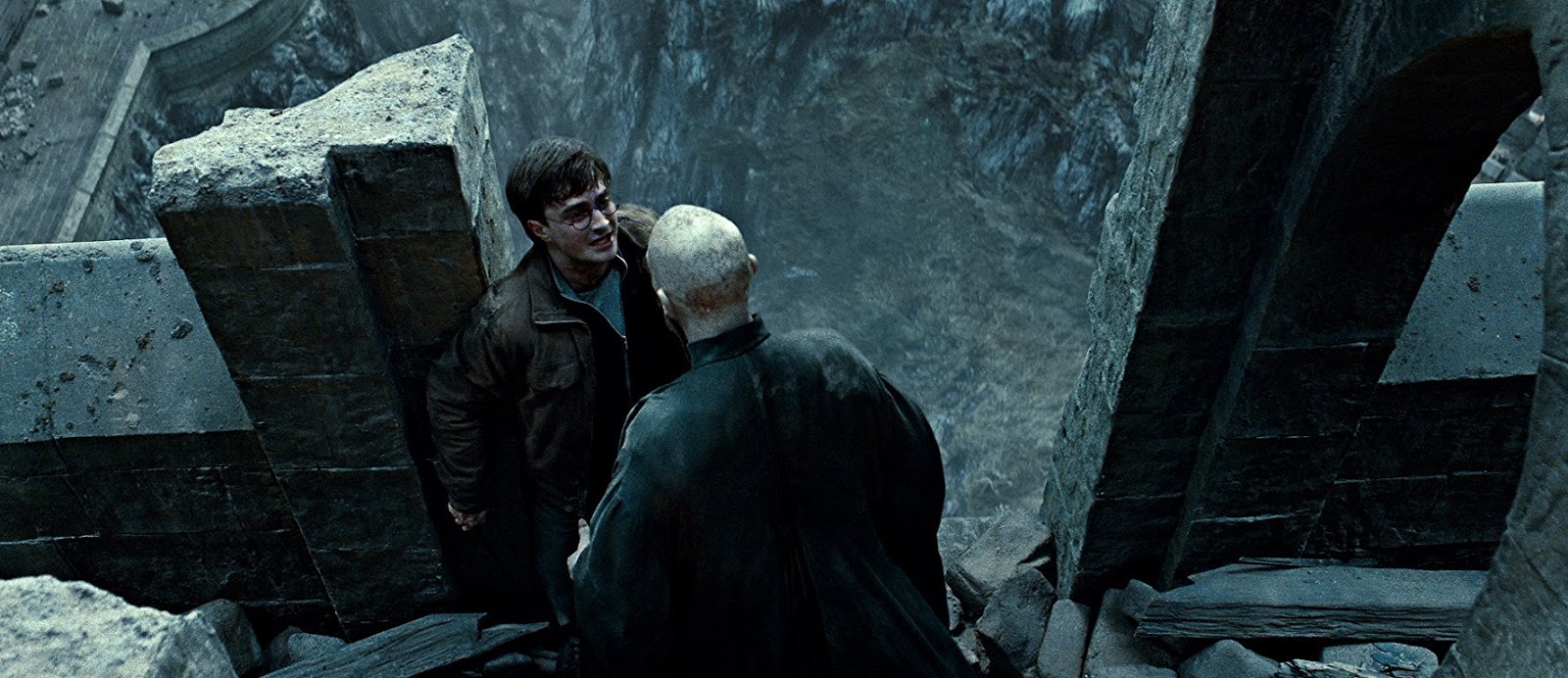
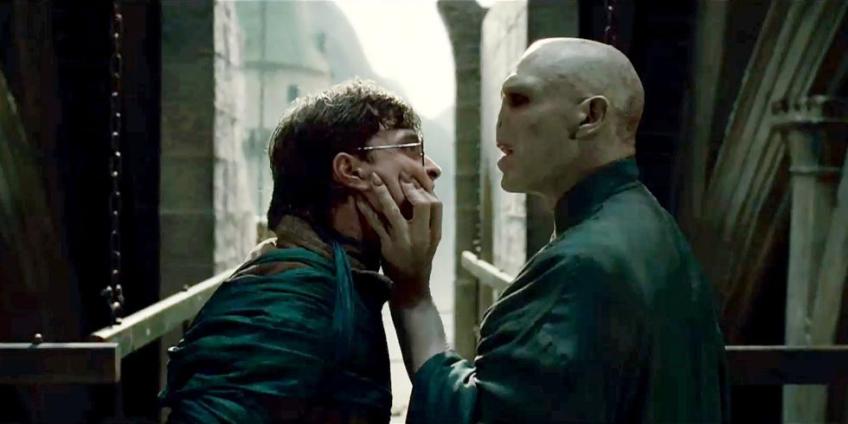
Harry and Voldemort prepare for their final showdown in Harry Potter and the Deathly Hallows Part 2

Director: David Yates

Cast: Daniel Radcliffe (Harry Potter), Rupert Grint (Ron Weasley), Emma Watson (Hermione Grainger), Helena Bonham Carter (Bellatrix Lestrange), Jim Broadbent (Professor Slughorn), Robbie Coltrane (Hagrid), Ralph Fiennes (Lord Voldemort), Michael Gambon (Albus Dumbledore), John Hurt (Ollivander), Jason Isaacs (Lucius Malfoy), Gary Oldman (Sirius Black), Alan Rickman (Severus Snape), Maggie Smith (Professor McGonagall), David Thewlis (Remus Lupin), Emma Thompson (Professor Trelawney), Julie Walters (Molly Weasley), Mark Williams (Arthur Weasley), David Bradley (Argus Filch), Ciarán Hinds (Aberforth Dumbledore), George Harris (Kingsley Shacklebolt), Gemma Jones (Madam Pomfrey), Kelly MacDonald (Rowena Ravenclaw), Helen McCrory (Narcissa Malfoy), Miriam Margolyes (Professor Sprout), Geraldine Somerville (Lily Potter), Adrian Rawlins (James Potter), Warwick Davis (Griphook/Professor Flitwick), Matthew Lewis (Neville Longbottom), Evanna Lynch (Luna Lovegood), Bonnie Wright (Ginny Weasley), James Phelps (Fred Weasley), Oliver Phelps (George Weasley), Domhnall Gleeson (Bill Weasley), Clémence Poésy (Fleur Delacour), Guy Henry (Pius Thicknesse), Nick Moran (Scabior), Natalie Tena (Tonks)
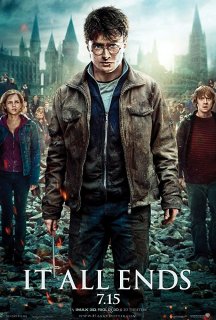
And so here we are. After 19 hours and 40 minutes, the Harry Potter franchise draws to a close in the rubble of Hogwarts. The franchise goes out swinging for some big hits – and it misses some of them – but at least it’s trying. If this turns out to be one of the least satisfying films in the franchise (at best the 6th best Harry Potter film), it’s not because they haven’t thrown anything at it.

The film adapts just under the last half of JK Rowling’s final novel. In an interesting structural twist, it actually ends up covering just over one day of time: between our heroes breaking into Gringotts Bank and the final confrontation between Harry and Voldemort, less than 24 hours has taken place. Nothing is really made of this in the film, but it’s an interesting thought. In fact Yates’ film is full of interesting half-thoughts that never go anywhere. More than any other film in the series, this is one where it is essential you’ve read the book before viewing it. Without the book you don’t get any of the rich context for most of the events.

This all culminates, for me, in the way the film falls apart in the last 20 minutes or so. This final section of the film changes, or cuts, so much of the book’s thematic depth, so many of its plot strands and explanations, that every time I see it I feel my disappointment starting to rise. I don’t want to be the guy who says “just shoot the book” – but if any film could have stuck with the book it’s this one. Why did they cut and change so much of this stuff? Did they really think, after almost 11 years and 20 hours of screen time, we wouldn’t have the patience for some of the more complex things from the book? Did they really feel that they had to stamp their own distinctive vision on it? Anyway, here are the things that always annoy me about this film:

1. Dumbledore’s backstory gets forgotten

Okay this is a minor one – and the film does leave some hints in. But for GOODNESS’ SAKE, they cut this book into two films, spent ages in the first film talking about the mysteries of Dumbledore’s dark past, then just as we meet Dumbledore’s brother Aberforth (a neat turn from Ciarán Hinds) and are about to get an explanation, Harry basically says words to the effect of “I’m not worrying about that. And neither should you folks. On with the film”.  

Even the Ghost of Dumbledore doesn’t get to explain any of this stuff. All the careful mood build of Part 1 is just thrown away. The book is about learning about death, the futility of the search for power, and humility. Dumbledore’s backstory of failed ambition is a massive part of this – and it gets dropped. It’s not like we didn’t have time in a series that has churned out films pushing up to three hours in length. I mean why put all that stuff in the first film, if you aren’t even going to reference it at all in the second film?

2. The Deathly Hallows get benched

Again wouldn’t be quite so bad if we hadn’t spent a huge amount of time in the first film talking about them – but are the words Deathly Hallows even mentioned here? Instead, just like Voldemort, the film is seduced by the elder wand, focusing everything on the ownership of this MacGuffin. The point of the book is that all this stuff is a chimera –and that the real point is learning that death should not be feared but accepted at the proper time. 

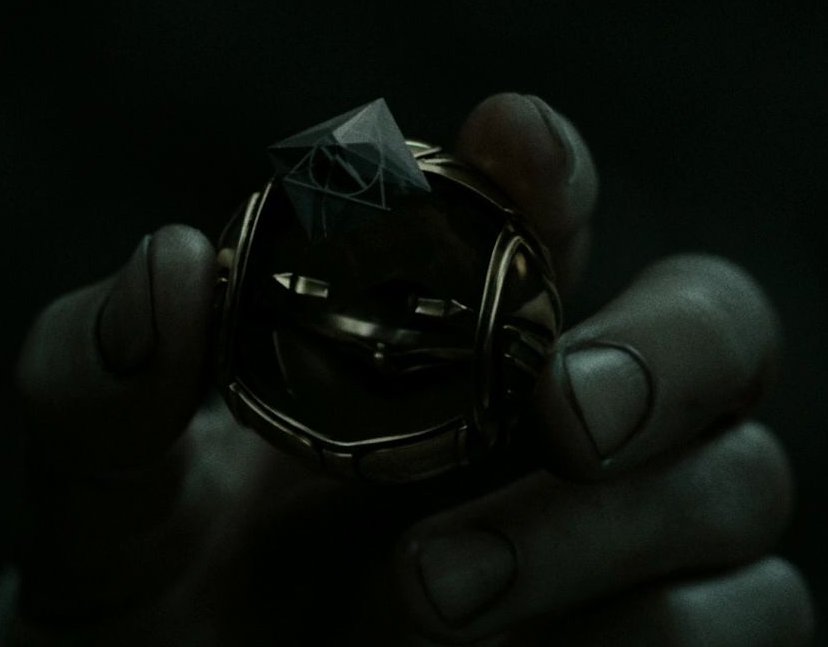
As it is, this never gets built on – and the importance of the resurrection stone (including why it tempted Dumbledore so much) never gets explained. Rather it just comes down to who controls the powerful thing, with none of Rowling’s richer themes.

Harry ends up controlling all three here but we never really get the sense of Harry controlling them all, or understand his decision to throw away the stone, or his realisation that death is not to be feared but accepted.

3. Neville gets blown away

Gotta feel sorry for Matthew Lewis (who is very good here). Reading the book he must have been thrilled: “So I pull the sword out of the sorting hat and then in one move cut the head off the snake like a total bad ass”. This should have been a great moment (it’s an iconic one from the book). Instead Neville gets blasted and, presumably to give them something to do, Ron and Hermione spend ages trying to kill the snake (intercut with Harry and Voldemort fighting) until finally Neville gets to lop that head off – by which point the moment has well and truly passed.

 4. No one mentions Voldemort keeps making the same mistakes

In the book, Harry has a beautiful moment where he basically tells our Tom that he’s made the same mistakes over and over again. Namely that, by killing Harry, who sacrificed himself for love, he made exactly the same mistake as he did with Harry’s mother and now cannot harm any of those Harry died for (i.e. the rest of the cast). It’s a great moment, where finally Harry understands what the novels have been building towards. Doesn’t merit a mention.

Neither does Voldemort’s childish obsession with famous things – he is consumed with belief in the power of a wand, he can’t let go of associating his horcruxes with famous things and the lineage of iconic wizards, etc. etc. Voldemort is basically a big, silly, empathy-free, sulky teenager – the film misses this point entirely.

Instead of explanations and depth, the film reduces Harry and Voldemort’s final clashes into dull punchy-bashy stuff. The director clearly fell in love with the visual idea of Harry and Voldemort’s heads merging together while apparating. This is a visual image that I hate because it (a) feels like showing off and (b) would only work if they were semi-reflections of each other – which they certainly aren’t. They are polar opposites. It’s a flashy effect that actually makes no thematic sense what-so-bloody-ever.

5. Voldemort goes out like a 3D special effect

Perhaps not a surprise in a film, but Voldemort gets killed and disintegrates into a huge puff of 3D-film smoke. I hate this. I hate it. I really, really, really hate it. I’ll tell you why:

  • The spells used in the duel are really unclear – it’s a great moment in the book that Voldemort’s killing curse rebounds against Harry’s disarming curse – instead we get the bright lights.
  • Voldemort dreads death more than anything – and Rowling’s writing of his body falling dead to the ground like any other normal dead guy taps exactly into what Voldemort spent his whole life struggling against. It’s a beautiful irony.
  • No one knew if Voldemort was dead or not the first time because he disappeared. In the book he is killed, by his own curse, in front of everyone and his body is left behind for everyone to look at and say “yup. Guy is dead”. Not here. Here he blows up in a puff of smoke in front of no witnesses. Did Harry just head back into the great hall and say “Okay guys. Take my word for it. He’s dead. He just is. Trust me on this. It’s not like last time. Totally dead. Promise.”

Wow. Okay that’s not really a review is it? That’s just like a disappointed fan whining “I don’t like it because it is different”. But my point isn’t that this is bad because it’s different. It’s bad because it takes stuff from the original and changes it AND NOT FOR THE BETTER. Moments that worked beautifully, or carried so much weight in the original are bastardised crudely for no clear reason.

As I say, after almost 18 hours and a life time (for many viewers) of growing up with these characters: surely we could have given the film a bit more time and allowed some actual intelligent context from the books to creep in? Surely we had the patience for Harry getting to point out to Voldemort how wrong he is? Everyone in the audience was ready for that right? If there was one film people were probably willing to dedicate three hours of their life too, in order to see it done properly it was this one, right? Rather than rushed by in a little over two?

But no this film goes always, always, always for the big spectacle. Not that this always work: Yates doesn’t shoot the battle hugely well. Aside from one excellent sequence which shows our three heroes trying to get across the castle courtyard, while chaos rages around them (beautifully scored as well), the battle is unclear, dingy and not hugely exciting. Again, I’d have liked to have had a bit more of this – to get some moments with this huge cast doing stuff in the battle (especially since they are ALL back – kudos to the producers there).

It’s a real, real shame because honestly parts of this movie are really, really, really good. Tom Felton is cracking again as Draco – and the film gives real development time to showing the impact all this has on the Malfoy family with genuine empathy. The break-in at Gringotts is exciting and fun – as well as giving Warwick Davies his best moment in the series as two-faced Griphook. Inventions and flourishes, such as Harry having visions of an enraged Voldemort slaughtering the staff of Gringotts in fury, are chilling.

Some moments of the book are carried across really well, in particular Snape’s escape – a powerfully filmed sequence of bravery from the pupils, and some great work from Maggie Smith. Yates really understands how to get moments of magic to work: the creation of the shield around Hogwarts is totally spine-tingling. When the film sits and breathes it generally gets it right. Fiennes is terrific still as Voldemort, serpentine, arrogant, unsettling. He gets some lovely moments here – from fury, to pained fear (as horcruxes bite the dust) to an almost-funny-awkward-mateyness as he tries to seduce Hogwarts pupils to his side (his awkward hug of Draco is terrific).
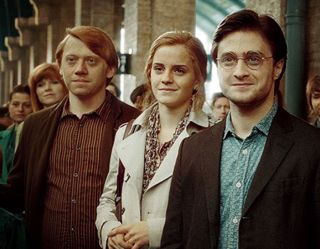
The three leads are of course great. Daniel Radcliffe could certainly have delivered the more complex moments of the book if he had been given the chance. He even does his best to sell the slightly awkward coda “19 years later”: a controversial sequence, it makes a great footnote in the book but it was always going to be a tough ask to make three teenagers look like 40 year olds convincingly, particularly when we are nearly as familiar with their faces as our own.

There are some troubling and failed moments in this film, stuff that doesn’t work. But then there is this:

Oh wow. For all that the film changes stuff from the books for the worst – this is a moment it unquestionably does better. And a massive, massive part of this has to be down to Alan Rickman. Rickman was told this backstory from the start of the films – and he delivers it with a passionate commitment here. Helped by brilliant score, and fascinating re-editing of moments from previous films seen from new angles, Rickman delivers the reveal of Snape’s heartbreaking moments perfectly.

Was I tired? Was it the added impact of Rickman’s own depth? I don’t know but I shed tears watching this again. It’s just a beautiful, beautiful, beautiful piece of film making. Everything in it works perfectly: directing, writing, music, editing, filming and above all the acting. It’s just sublime. For all the film misses the point elsewhere it finally totally gets it here. I would take this moment over dozens of moments of Harry and Voldemort fighting each other.

And yes this Harry Potter film might miss the point, and it might bungle the ending, and it might well fail to carry across the richness and intricate plot explanations of Rowling’s original. Yes it gets bogged down in “who controls this wand” and yes it misses the point completely about the film being about learning to overcome a fear of death and defeat (something Voldemort totally fails to do) but then it has moments where it works wonderfully like this. 

But in these films we got a beautiful franchise, with some excellent films. It’s always going to reward constant viewing. And it will always move the viewer. And it’s always going to be great.

Always.

Harry Potter and the Deathly Hallows Part 1 (2010)

Harry and friends are on the run in the excellent Harry Potter and the Deathly Hallows Part 1

Director: David Yates

Cast: Daniel Radcliffe (Harry Potter), Rupert Grint (Ron Weasley), Emma Watson (Hermione Granger), Helena Bonham Carter (Bellatrix Lestrange), Robbie Coltrane (Rubeus Hagrid), Ralph Fiennes (Lord Voldemort), Michael Gambon (Albus Dumbledore), Brendan Gleeson (Mad-Eye Moody), Richard Griffiths (Vernon Dursley), John Hurt (Mr Ollivander), Rhys Ifans (Xenophilius Lovegood), Jason Isaacs (Lucius Malfoy), Bill Nighy (Rufus Scrimgeour), Alan Rickman (Severus Snape), Fiona Shaw (Petunia Dursley), Timothy Spall (Peter Pettigrew), Imelda Staunton (Dolores Umbridge), David Thewlis (Remus Lupin), Toby Jones (Dobby), Tom Felton (Draco Malfoy), Peter Mullan (Yaxley), Evanna Lynch (Luna Lovegood), Julie Walters (Molly Weasley), Mark Williams (Arthur Weasley), Bonnie Wright (Ginny Weasley), Helen McCrory (Narcissa Malfoy), George Harris (Kingsley Shacklebolt), Clémence Poésy (Fleur Delacour), Domhnall Gleeson (Bill Weasley), Warwick Davies (Griphook), Nick Moran (Scabior), Guy Henry (Pius Thicknesse), David O’Hara (Albert Runcorn), Sophie Thompson (Malfada Hopkirk), Steffan Rhodri (Reg Cattermole), Simon McBurney (Kreacher)

The final book of the Harry Potter series made its own slice of film history: it was the first time a book was adapted in two films to “get the whole story of the book across” (or to make double the box office cash – take your pick). There was scepticism about creating a film about the first half (or so) of The Deathly Hallows, as a large chunk revolves around our heroes walking around the countryside, confused, lost and adrift. Instead, Harry Potter and the Deathly Hallows Part 1 turns this material into one of the richest, most engaging and best films in the series. Any film that expands a throw-away reference from the books to Hermione removing her parents memories of her, into an affecting opening scene showing Emma Watson doing the same is really inventively playing with the original source material.

David Yates takes on his third Harry Potter film – and this is possibly the best he filmed. In fact, the whole film feels fresher and different – perhaps because it’s the only film to not have a single scene at Hogwarts. Instead our characters are out in the forest and on the run – and the film has completely different vibe, immediately lending it a uniqueness. Equally, it isn’t shy about pointing out our heroes are all-at-sea. Harry doesn’t really know what he is doing, or where to start with his self-imposed quest: and surely when Ron angrily asks why Dumbledore didn’t tell him more (or if Harry wasn’t even listening properly) he’s voicing some of the questions of the audience.

This film, more than any other, focuses on the relationship between the leading three characters. While getting an idea of their friendship and loyalty to each other, we also get a sense of the tensions and envy between them. Not least in Ron’s grudging acceptance that he is the number two. Rupert Grint has been slowly building under David Yates’ films from a comic relief character to an increasing (slightly surly) teenage insecurity and troubled sexual maturity. 

This really pays off in this film: Ron is bitter and jealous. These feelings might be exacerbated by the necklace the characters must take turns wearing, but it’s just bringing to the surface Ron’s darker feelings of inadequacy: and Yates even brings them to the screen in a necklace-induced vision of a naked (but artfully concealed in smoke!) Harry and Hermione alternately making out and rubbishing Ron. It’s a plot point that covers Ron overcoming his resentment and cementing his position in the gang. It’s very well done – and Rupert Grint is very good.

Equally good is the gently sad, mutually affectionate relationship between Harry and Hermione. Alone together for large chunks of the film, the characters’ bond is firmly established, the chemistry between the two actors never clearer. The film plays with the subplot it’s been suggesting for a while of a potential deeper relationship between Harry and Hermione: not least in its beautiful silent dancing sequence to Nick Cave in the tent (one of the best ever entirely invented scenes in the series) that is friendly, but with a hint of the possibility of something more – something the characters seem to consciously decide to bench. This sort of emotional reality is what makes the film really stand out. It turns the “camping trip” of the novel into something more profound and engrossing – I’d say this is the only sequence that really outdoes the books altogether in the entire series.

But of course there is still plenty of action, and humour, a highpoint for both being our heroes infiltrating the Ministry of Magic, disguised as ministry employees. Playing the adult disguises of our heroes brings out three hilarious and sharply observed physical performances from David O’Hara, Steffan Rhodri and Sophie Thompson. In fact, the film has a bit of a thing for disguises, from a disfigured Harry (who may or may not be recognised by Draco, in another piece of excellent acting from Tom Felton as a terminally out-of-his depth and terrified Malfoy), to the opening scenes featuring half the cast being disguised as Harry. Daniel Radcliffe excels in this sequence, playing versions of most of the young cast with real wit and skill.

Yates allows a creeping sense of imminent danger to hang over the whole picture, straight from the off. A “conference of baddies” at Malfoy manor shows us Voldemort (the ever sinister Ralph Fiennes) re-establishing his murderous villainy from the start – and also belittling and mocking poor Lucius Malfoy (a crushed Jason Isaacs). From there, via a gripping escape from Harry’s home, to a wedding scene that quickly collapses into a terrifying attack from Death Eaters, it’s a film full of excitement.

Yates shoots this with tension and edge. A sequence with Harry and company fleeing through the forest from snatchers is so well-done, so intense and immersive, that they used it for the poster. This sequence uses really interesting camera work and tracking shots – in fact the whole film is very well filmed and extremely well-paced. It’s also got an eye for the real nastiness of regimes like Voldemort’s: people like Umbridge (an increasingly Himmlerish Imelda Staunton) flourish, while bullying thugs like Yaxley (an intimidatingly excellent Peter Mullan) rule the roost.

Kloves script sets up a lot of the fascinating back-story from the novel, not only around Dumbledore but also the Deathly Hallows themselves (I’ll not mention for now that most of this build-up is fumbled in the last film). There is a beautiful animation sequence establishing the history of the Deathly Hallows, which is an artistic highlight. The slow unveiling and revealing of facts is wonderfully done – and rewards the patient viewer.

The film culminates in a final sequence at Malfoy manor that carries a great wallop of emotional torment and dread (first torture scene in a Potter movie for those interested…). Surprisingly a lot of this emotional force comes from Dobby the elf – irritating as he was in Chamber of Secrets, here he gets a few scenes that carry real emotional force. 

Harry Potter and the Deathly Hallows Part 1 is possibly the only Harry Potter film that is an actual improvement on its original source material (there I said it). I think it’s a brilliant film, a film which carries real emotional weight and has genuine things to say, not just about good and evil, but also about the sort of teenage angst and yearnings we’ve all had. The three leads are all excellent, and there is barely a bum note in the whole thing.