Tag: Raoul Walsh

The Roaring Twenties (1939)

The Roaring Twenties (1939)

Superb gangster film, that sums up a whole era of film-making with a fast-paced grit

Director: Raoul Walsh

Cast: James Cagney (Eddie Bartlett), Priscilla Lane (Jean Sherman), Humphrey Bogart (George Hally), Gladys George (Panama Smith), Jeffrey Lynn (Lloyd Hart), Frank McHugh (Danny Green), George Meeker (Harold Masters), Paul Kelly (Nick Brown), Elizabeth Risdon (Mrs Sherman), Joseph Sawyer (Sgt Pete Jones)

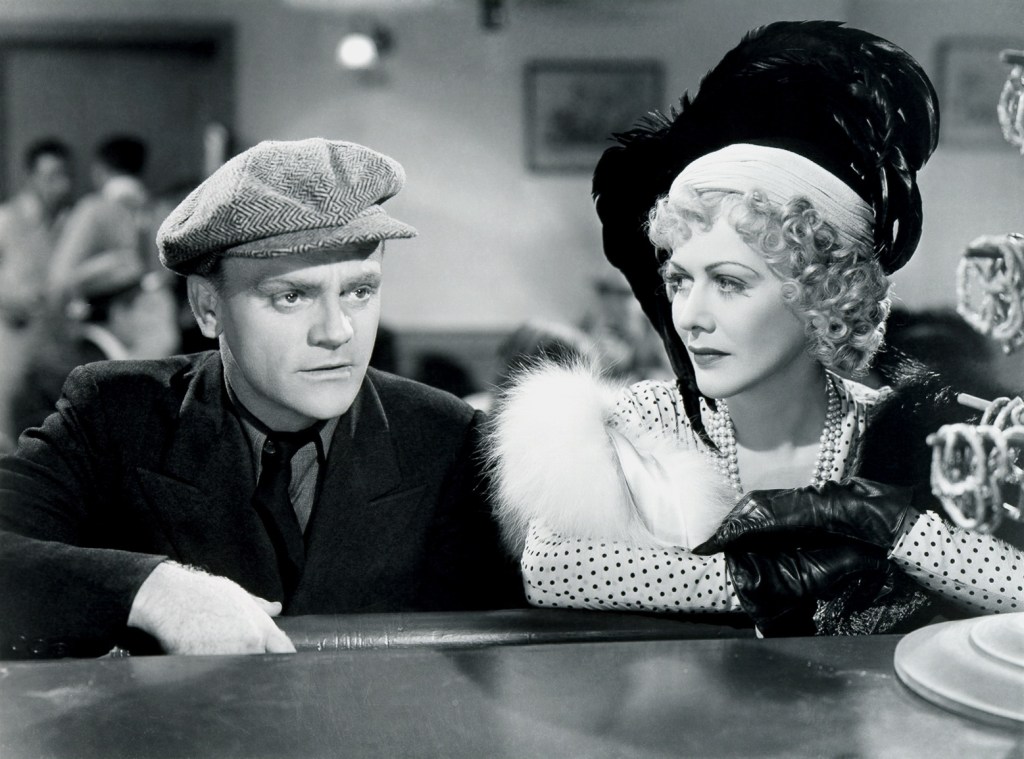
Three guys fall in a foxhole, might sound like the beginning of an odd wartime joke but it’s the encounter that begins The Roaring Twenties. Framed as both a period piece, looking back to a time already a decade away from the contemporary audience, and a sort of memorial piece to a whole cycle of bootlegger gangster films. It’s also a film far too regularly overlooked when discussing that cycle: in my opinion it’s one of the finest and possibly Cagney’s most complex gangster role (with apologies to White Heat). It’s a fast-paced, hugely entertaining slice of crime drama, with fascinating, multi-faceted characters and an intriguing level of social depth.

Those three foxhole guys are Eddie Bennett (James Cagney), destined to run a bootlegging empire in Chicago; George Hally (Humphrey Bogart), destined to become his sociopathic ruthless partner; and Lloyd Hart (Jeffrey Lynn), destined to become a lawyer walking an awkward line. Returning from World War One, Eddie finds little welcome for returning servicemen, but his pluck and sense of personal loyalty eventually see him stumble into, and then embrace, the bootlegging business with glamourous hostess Panama Smith (Gladys George). Problem is danger abounds in the crime-ridden city and its impossible to work in this business without getting your hands dirty. Throw-in Eddie’s candle-holding love for the quietly uninterested Jean Sherman (Priscilla Lane) and you have a recipe for long-term disaster.

The Roaring Twenties is a punchy, well-cut, overlooked gem. From its opening montage that rolls back over newsreel from 1940 to the trenches of World War One to its closing tracking shot that culminates in Eddie’s fatal tumble on the steps of a church (as always in the gangster film, no-one escape death’s moral judgement no matter how psychologically complex they are) it’s a feast of fast-moving entertainment. Along the way Walsh throws in everything, from gun battles to musical numbers, by way of comedy, obsessive love and social commentary. The Roaring Twenties is arguably a nostalgic cocktail with a dim view of its decade: one of crime, hedonism and hypocrisy.

And it’s corrupted Eddie. This is Cagney firing on all cylinders: and it’s remarkable how skilfully he creates a complex, sympathetic character out of similar material to his despicable hood in Public Enemy or the flat-out psychopath he forged in White Heat. Eddie is in many ways a decent man who finds all the dreams he’s been clinging too are fantasies. He can’t land the mechanic job he dreamed of, his uniform is the subject of mockery, the woman he’s been corresponding with turns out to be a teenager (Cagney’s disappointment, discomfort and faint attraction when he first meets Jean Sherman’s skipping late-teens Priscilla is beautifully done). Eddie is left bumming around town desperate for any opportunity.

Cagney’s performance really works, because Eddie – even with an angry streak that means he can knock out two chucking goons with one punch – is fundamentally a decent bloke, corrupted by circumstances. He sees the liquor-brewing game as a short-term fast buck, which he stumbles into because he’s too chivalrous to allow Panama to take the wrap for a bootlegging delivery he’s made. He’s loyal to his friends and tries to solve problems amicably. He’s got a charming, barrow-boy entrepreneurship to him, brewing booze in his bath and selling it as a high-quality import. Cagney shows how desperately Eddie clings to his self-image that crime isn’t a lifestyle choice, but a short-term necessity he’ll jack in one day for the peace and quiet of running a taxi company.

But Cagney never stops letting us see the corruption soaking in: Eddie is learning to heartlessly take what he can get, to forget the consequences of his actions and when violence comes he’ll shrug off deaths as ‘not his fault’ or respond with an increasing ease viciousness (in a nice call back, he even shoves a cigar into a goons face, an echo of his famous grapefruit scene from Public Enemy). When he faces news, he doesn’t like, or is denied the things he wants, lashing out is his first option – and once he starts necking his own product, his downfall is only a matter of time as he falls prey to the sort of ‘World is Yours!’ attitude that doomed Scarface.

From grasping ever more business opportunities to grooming (in more ways that one) the now adult Priscilla into his ideal girl (he can’t watch her perform without grasping the pained hand of Panama, his eyes locked in monomania desire that he’s clearly convincing himself is a sort of pure, brotherly concern). Eddie clearly sees her as his ‘reward’ for his hardwork, a fantasy that doesn’t have any place for her liking him but not loving him. But there is a neat touch throughout The Roaring Twenties – a momentum packed film that races through years in minutes – that Eddie fundamentally isn’t ruthless enough for this game.

Certainly not compared to Humphrey Bogart’s study in shallow, selfish cruelty. Shown early on grinningly shooting a fifteen-year old German soldier in the dying minutes of the war (“He won’t be 16!”), George Hally is the monster Eddie can’t be. A guy who doesn’t care for anyone, who betrays and kills at the drop of a hat, who doesn’t stop for any sense of form and decency. For all Eddie tells George that time has moved on and people like them don’t have a place in the Thirties, Bogart’s cold-eyed George feels like the sort of man who would flourish in the era to come.

Compared to him, Eddie and Panama are romantics. Gladys George gives a fascinating performance as Panama, one of the most complex gangster dames of all. George brilliantly walks a narrow line, clearly loving Eddie but accepting he doesn’t feel the same way – and (reading between the censor lines) entering a relationship with him anyway. Panama is half-partner, half-mother to Eddie giving him a sort of matronly support and tenderness and, when his fortunes drop off a cliff in the thirties, looking after the slubby, drunken figure Eddie becomes (Cagney looks more bashed up, scruffy and pathetic in the final act than almost any other star would dare).

Fascinating character relationships like this underpin a film that feels like a summation of years of Warner Bros gangster films. Walsh’s direction is pin-point sharp, from his montage construction (including a surprisingly surreal Wall Street Crash sequence with melting buildings), through the shoot-outs. The Roaring Twenties script – by Robert Rossen and Jerry Wald among others – offers characters who are complex, flawed and don’t quite seem to realise at times how terrible their world is.

When the end comes, and Eddie’s body slumps on the steps – after an inspired, sustained tracking shot that follows his teetering bullet-ridden body, the sort of athleticism Cagney was a natural at – it seems fitting the famous closing words are “He used to be a big shot”. That sums up not only the character, but an entire era of film-making being confined (temporarily) to the dustbin of history. It’s a melancholic note to end an extraordinarily good film, one of the great gangster films, in which Cagney, Bogart and George bring life to fascinatingly complex characters.

In Old Arizona (1929)

In Old Arizona (1929)

Early Talkie Western has moments of invention, around some awkwardly dated acting and plotting

Director: Irving Cummings, Raoul Walsh

Cast: Warner Baxter (The Cisco Kid), Edmund Lowe (Sergeant Mickey Dunn), Dorothy Burgess (Tonia Maria)

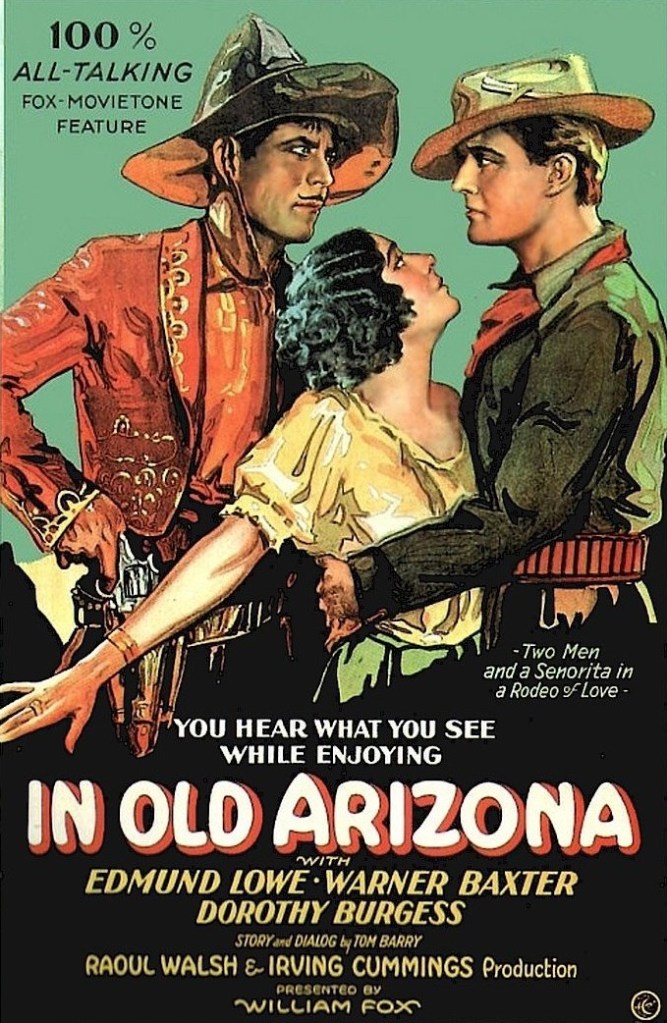
In Arizona, is a public nuisance is plaguing the authorities: The Cisco Kid (Warner Baxter), a charming bandit who holds up stagecoaches, flirts with women and evades the lawmen with a swagger and a smile. But he’s a decent thief: he only takes from those who can afford it (he’ll hand the money back if he finds out otherwise). His Achilles heel is the flirtatiously ruthless Tonia Maria (Dorothy Burgess), a vivacious sexpot who merrily cheats on him left, right and centre. She’s also quite happy to sell him out if she can get her hands on that generous reward money offered by Sergeant Mickey Dunn (Edmund Lowe) – who soon falls for her charms as well.

In Old Arizona was the first Talkie Western – and it stands out from other early Talkies that it’s not set in rigid sets with bolted down cameras, but on location. Imagine the excitement of audiences sitting down to watch a scene in a bustling market, to actually hear the sounds of a church bell ringing (it’s showpiece opening), carriage wheels, passengers bickering and Mariachi bands playing, while the camera tracks through the scene. Of course, much of this was accomplished via synchronised sound, applied after shooting – most of the dialogue scenes are shot with a far more rigid style – but it was still gripping. Never again in film history, would a shot of bacon sizzling (audibly) in a pan attract as much comment as it did with the reviewers of this film.

Other parts of In Old Arizona teeter between sound and silence. As mentioned, when the dialogue kicks in the film falls back on theatrical-front-row framing. All three of the principles – the only actors billed – give performances leaning into the principles of silent acting, with the framing and make-up frequently giving added prominence to their eyes (the main form of communication in silent cinema). Dorothy Burgess, in particular, makes her film debut but finds all her prepared awkward theatrical poses to communicate emotion look increasingly out-of-date (much as she’s clearly enjoying playing this ruthless, faithless schemer).

She’s not alone in this. Warner Baxter lifted one of the first Best Actor Oscars and it’s an entertaining performance, full of swaggering, alpha-male cheek. Baxter makes the Cisco Kid somewhere between a scheming rogue and a Robin Hood. But he also strikes a pose a little too frequently and tends to over accentuate gestures and reactions, a clear hangover of his silent career. He does, however, dance through the dialogue with a rolling Spanish accent, and if the character ends in a slightly awkward territory between camp and ruthless, it’s not really his fault so much as the script. He’s certainly far more entertaining than the wooden Lowe, whose voice is flat and uninteresting.

In Old Arizona quickly turns into two shaggy dog stories, stretched out over about 90 minutes. It’s surprising how little plot there is: it could easily have zipped by in 60 minutes. The first act covers the Cisco Kid’s hold-up of a stagecoach and the aftermath; the second an unwitting game of cat-and-mouse where Dunn is at a serious disadvantage as he has no idea what the Cisco Kid looks like; the third the mutual seduction of Dunn and Maria, their attempt to kill the Cisco Kid for his ‘dead-or-alive’ ransom and the Cisco Kid’s ruthless foiling of their scheme. Each feels like a short story, joined together, so it’s not surprising to find it’s adapted from exactly that from O Henry.

By all accounts O Henry’s Cisco Kid was a far more violent and brutal character than Baxter’s jolly, tuneful, gadabout. Sure, the Cisco Kid can handle himself – there’s a fine little action sequence, where he plays possum to gun down three would-be ransom collectors – but by and large he’s a romantic, and it’s clear he’s genuinely in love with the shallow and unfaithful Maria. This feels like it’s been designed to make her betrayal carry some bite, but since she is so blatantly unfaithful it actually makes the Kid look rather dim and slow on the uptake.

Maria is interesting as a Pre-Code character nakedly open in her sexuality – it’s pretty apparent she’s, at-best, a good time girl. She very smoothly seduces the straight-as-an-arrow Dunn (who up until meeting her, makes a big thing of constantly checking his treasured photo of him and his sweetheart). Dunn is of course not the smartest tool – the Cisco Kid runs rings around him during their first meeting, deftly picking him clean of information while not only giving him no idea who he is, but also making Dunn rather enjoy the company of the man he’s meant to be hunting.

It leads into what feels today a troubling conclusion to In Old Arizona. Primed from so-many Westerns that followed, we expect a gun-on-gun ending between the rivals from opposite ends of the law (and, the film eventually suggests, opposite ends of the moral spectrum – the Kid is loyal and decent, Dunn a hypocritic and treacherous). Instead, it becomes more about the Cisco Kid’s deliberately deadly punishment of a woman who has wronged him. It’s hard not to feel that, selfish as Maria is, she doesn’t quite deserve the fate she meets – or the Cisco Kid’s triumphantly heartless Bondian one-liner afterwards.

It’s an uncomfortable ending to a film that in some areas pushes forward the world of commercial film-making (it’s hard not to credit Walsh for the film’s pacier, on-location sequences with their pre-Fordian landscapes, galloping horses and gun-toting action) but in others still has an awkward foot in both silent cinema and the clumsy world of the early Talkies. There are proto-Western ideas here – the sort of narrative ideas that the likes of Ford and Hawks would later finetune and master – but it feels a little too much like a historical curiosity today.

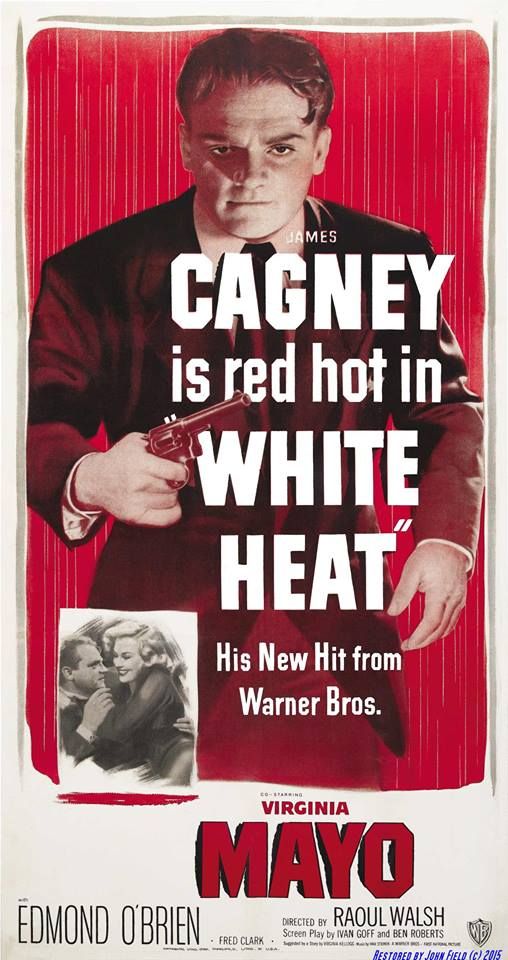
White Heat (1949)

Top of the World Ma! Cagney excels in his final and greatest Gangster role White Heat

Director: Raoul Walsh

Cast: James Cagney (Cody Jarrett), Virginia Mayo (Verna Jarrett), Edmond O’Brien (Hank Fallon/Vic Prado), Margaret Wycherly (Ma Jarrett), Steve Cochan (“Big Ed” Somers), John Archer (Philip Evans), Wally Cassell (“Cotton” Valletti), Fred Clark (Daniel “The Trader” Winston)

After winning an Oscar for Yankee Doodle Dandy, Cagney left Warner Brothers to form his own production company. When that folded, he swallowed his pride and re-entered the Warners’ fold. Money was driving the relationship: and it was the pay cheque that got Cagney to return one last time to the role of a psychotic gangster in White Heat. And if he had to go back, why not make that gangster the most psychotic of the lot? After all who else could make it to “the top of the world”?

Cody Jarrett (James Cagney) is the leader of a gang of criminals, to whom no act of larceny, violence or murder is taboo. A botched train hijack – during which Jarrett shoots two unarmed train drivers – attracts the full attention of the law, but Jarrett dodges justice by having himself sent down for a minor crime that happened at the same time as the train hijack. Not fooled, the Feds send an undercover operative, Hank (Edmond O’Brien), into the prison as Cody’s cellmate “Vic Prado”, tasked with getting the details of the train job and locating the mysterious fixer who set up the job. But such schemes didn’t take into account Jarrett’s psychological disturbance – powered above all by his obsessive, overwhelming love for his mother (Margaret Wycherly), the one dominant influence over his life.

Raoul Walsh’s film is a brutally efficient gangster flick which may be a little too long (the mechanisms of tracing and tracking a car are covered in far too great a depth…), but ticks all the boxes of the genre with exceptional skill and dexterity. It’s shoot-from-the-hip (literally) melodrama, and has all the internal logic of a schoolground game of cops and robbers, but Walsh’s direction is pin-point perfect, and the film is based around a series of stunning and effective set-pieces and crammed with a sort of deep (even disturbing) psychological insight that puts it miles ahead of many of films of the genre. Walsh also throws in some of the finest stylistic touches of film noir, with Virginia Mayo’s femme fatale, darkened frames, dubious morals among even our heroes (one of whom is a practised deceiver and liar) and a whirlwind monster at the centre.

But the film soars and flies because of Cagney, and the no-holds barred sharpness of Jarrett. The film revolves above all around the deep emotional emptiness and need in Jarrett, which sees him lean on O’Brien’s Falon (“like my kid brother!”) and, most famously, fixate like a toddler on his mother. Freud would have had a field day with Jarrett’s obsessive love for his mother, with Cagney turning him into the little boy lost. Consumed with headaches, he literally climbs into her lap so she can comfort him. The slightest criticism of her leads to instant reaction (not least knocking his wife off her chair – how can the poor woman compete with this beatified mother figure?)

This culminates in one of the film’s most famous sequences, as Jarrett digests in prison the news that his mother has died. Sitting in a crowded dining room, he passes word down to a new inmate for an update on his mother. Slowly the question is passed down the line of prisoners – and with trepidation the news of her death is passed back. And here is the Cagney magic. He seems too stunned at first to take it in then a series of low moans explodes into a titanic screaming fit, matched only by the violence he takes out on all who stand in his way. Walsh and Cagney kept the response secret from the entire room of 300 extras, all of whom seem as stunned as us by Jarrett’s total lack of control, his complete consumption in grief.

Cagney’s performance is just about perfect, a simmering mummy’s boy who is also a charismatic leader of men. A dangerous psycho who seems aware that he is not quite normal. A lonely man desperate for love. And Cagney has so many beautiful touches that could only be him – the quip as he plugs with bullets a car boot with a luckless gang member in it, the sly kick away at Virginia Mayo, that screaming sequence. It’s a performance of complete power and charisma, the gangster psychoanalysed and reduced to his bare essentials for a personality barely functional and obsessed with his mother.

Margaret Wycherly is similarly excellent as that mother, as sly and self-confident as her son and clearly as accomplished at leading a gang as him (I love the smug half smile she gives herself after evading the FBI tail she picks up). Edmond O’Brien does sterling work in the “straight man” role of the undercover cop, walking a line between judging and even perhaps sorta liking Jarrett a bit (even if he does get saddled with the mandatory “that’s the moral of the story” final line). Virginia Mayo is a wonderful mix of sex appeal and needling cheapness as Jarrett’s two-faced wife.

The film culminates in one of the most famous endings of all time – one you’ll know even if you haven’t seen the film – as the law catches up with Jarrett at last in a shoot-out at a gas plant. Finally driven mad by betrayal and abandonment – although lord Cagney’s performance makes clear that only a tenuous grip on sanity has been present in Jarrett from the start, fractured beyond repair by the loss of his mother – Jarrett insanely shoots at the police from atop a burning gas plant, before immolating himself (and most of the factory) with the cry “Made it Ma! Top of the world!”. As Jarrett heads down to a firey hell, so Cagney signed off on the gangster flick with perhaps the most dangerous, disturbed and also intriguing gangster on film. It’s such a mighty performance that the Hays-Code mandated final line of tutting disapproval at the criminal life from O’Brien feels even more forced and unnecessary than ever.