Tag: Reese Witherspoon

Wild (2014)

Wild (2014)

Reese Witherspoon finds herself in a film that is more than just Eat, Pray, Hike

Director: Jean-Marc Vallée

Cast: Reese Witherspoon (Cheryl Strayed), Laura Dern (“Bobbie” Grey), Thomas Sadoski (Paul), Michel Huisman (Jonathan), Gaby Hoffmann (Aimee), Kevin Rankin (Greg), W. Earl Brown (Frank), Mo McRae (Jimmy Carter), Keene McRae (Leif)
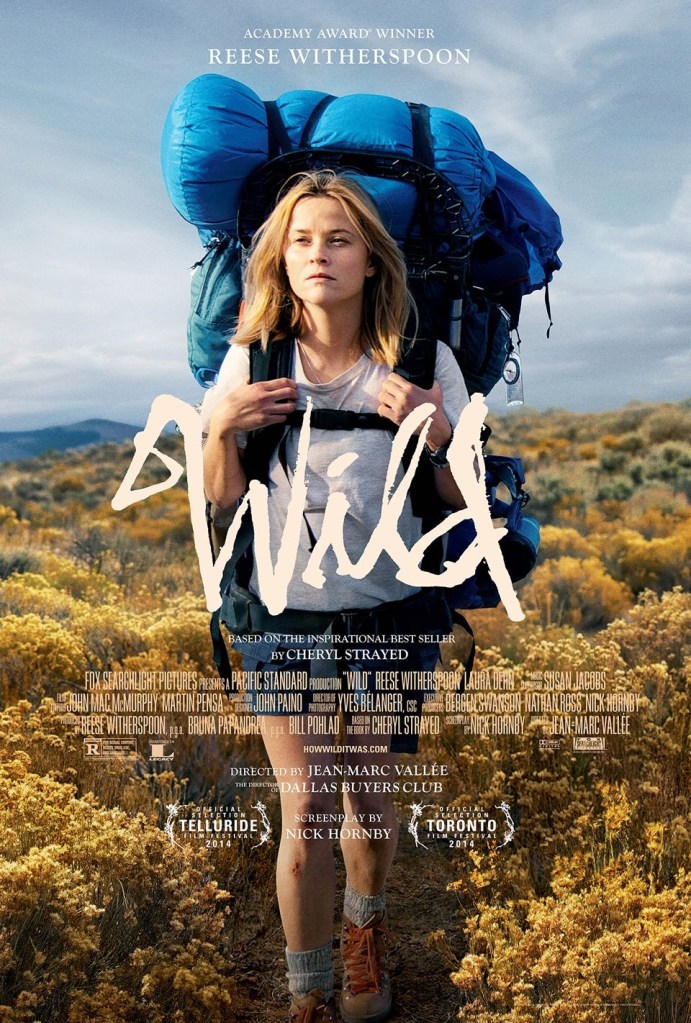
Ever thought tackling a 1,100 mile hike would be a fun adventure? The opening of Wild might change your mind. Gasp as Reese Witherspoon rips out a bleeding toe nail and then throws her ill-fitting hiking boots down a mountain, screaming abuse at them all the way! Want to grab that back-pack now?

In this adaptation of a memoir about loss and self-discovery, Witherspoon plays Cheryl Strayed who (fairly impulsively) decided to hike the Pacific Crest Trail in 1995 to try to find in herself the woman her late mother “Bobbie” (Laura Dern) believed she could be. After Bobbie’s early death from cancer at 45, Cheryl had collapsed – ruining her marriage to Paul (Thomas Sadoski) in an orgy of anonymous sex and heroin addiction. Now she wants to make a new start.

Adapted by Nick Hornby with a good deal of skill and emotional intelligence, Jean-Marc Vallée’s film is an interesting character study via the survivalist genre, mixed with a touching exploration of grief, loss and self-loathing. After throwing us into Day 26 with that bloodied toe-nail, the film rolls back to follow Cheryl’s walk: intercut with powerful memories of her relationship with her mother, each memory activated by different encounters along the way and bubbling into her mind along with a distinctive soundtrack (most especially Simon and Garfunkal’s El Condor Pasa) that reflects the music that reminds Cheryl of her mother.

It could have been a sentimental finding-yourself movie – Eat, Pray, Hike anyone? (I also rather like Reese Witherspoon Finds Herself in a Backpack) – and I won’t lie, there are elements of that. But maybe it caught me in the right mood, maybe because I’ve always fancied testing myself with an epic hike, but I actually found it intelligent, sensitive and just the right side of sentimental.

Wild carefully avoids simple points. It’s a film not about a long journey leading to revelation, but a journey that helps you accept all your past decisions, right or wrong. There is a pointed lack of emotional breakdowns, tearful confessions or flare ups of self-anger and revelation. Instead, it’s about the long grind of starting an internal journey towards contentment. Because trekking 1,100 miles is the long haul: there ain’t any easy ways out or short cuts on this trek.

The film’s principal asset is Reese Witherspoon. Also serving as producer, Witherspoon is in almost every single frame and delivers an under-played but very emotionally satisfying performance. She plays Cheryl as quietly determined, having already hit rock bottom and knowing every step she takes from now is upwards. She meets adversity – aside from the odd flash of frustration – with a stoic will and finds an increasing spiritual freedom in the wild that serves as an escape from the horrific wilderness of her self-destructive years. But she never lets us forget the pain that underpins this journey for Cheryl. It’s a very impressive performance.

The reminders of that pain are distributed through the film, which unflinchingly chronicles Cheryl’s escape from grief in the arms of a parade of sleazy men, anonymous hotel sex and (finally) shooting up heroin on the streets of San Francisco. It ends her marriage to Paul – but not their friendship, in the sort of adult emotional reaction you hardly ever see in a movie. Paul – played with warmth by Thomas Sadoski – may not be able to continue his marriage after discovering his wife’s parade of trust-breaking, but it doesn’t stop him from helping a person he loves who is in need.

All of this is nicely counterpointed by the hike itself. Naturally it’s all slightly episodic, as Cheryl moves from location to location, but Hornby’s script makes these vignettes really work. Vallée’s direction also does a fantastic job of intercutting between the long walk of 1995, and Cheryl’s memories of both her mother (played with a vibrancy that makes a huge impression from limited screen time by an Oscar-nominated Laura Dern) and her own emotional collapse after her death.

I also appreciated that Wild doesn’t shirk from showing the vulnerability of an attractive young woman hiking alone. Some potential predators are revealed to be the opposite: others are exactly what they appear to be. But not every encounter is one of potential danger: far from it.

Cheryl is met time and again by people who only appear to support, share their expertise and help her in her quest. At an early station, a man talks her through the huge amount of equipment she’s bought and advises what she can leave behind (Vallée opens the film with the strenuous effort, including rolling around on the floor, Cheryl has to go through just to put this backpack on). She finds a touch of romance with a handsome musician (a charming Michel Huisman). There’s also comedy, most of all with Cheryl’s encounter with a self-important journalist (Mo McRae), who won’t be convinced that she isn’t a female hobo.

This is all packaged together in a quiet, un-pretentious way that culminates in a thought-provoking monologue about the value of self-acceptance and putting aside regrets. Others would have layered on the sentiment, but here the balance is just right. With Witherspoon at the top of her game, Wild is a well-made and involving road trip that also makes you think.
Election (1999)


Reese Witherspoon runs for office in high-school satire Election

Director: Alexander Payne

Cast: Matthew Broderick (Jim McAllister), Reese Witherspoon (Tracy Flick), Chris Klein (Paul Metzler), Jessica Campbell (Tammy Metzler), Phil Reeves (Principal Walt Hendricks), Molly Hagen (Diane McAllister), Colleen Camp (Judith Flick), Delaney Driscoll (Linda Novotny), Mark Harelik (Dave Novotny)

High school can be a great setting for films that want to comment on our adult world, because they are such exact microcosms for society. Few films get this idea as effectively as Alexander Payne’s simply superb Election.

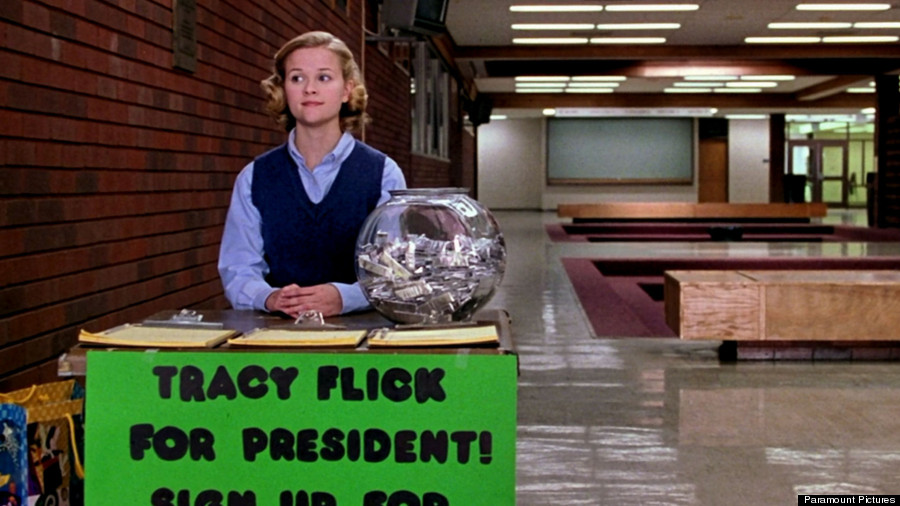
In an Illinois high school, Jim McAllister (Matthew Broderick) is a civics teacher who loves his job but is increasingly annoyed by high-achieving student Tracy Flick (Reese Witherspoon), who he also unconsciously blames for the dismissal of his friend Dave for having an affair with her. Tracy is a ruthless careerist, the sort of girl whose hand is always first up in class, and she wants more than anything to win the election to school president. Feeling it his duty to stop Tracy, McAllister persuades football star Paul Metzler (Chris Klein) to run against her – and slowly unleashes a hurricane of ruthless campaigning and dirty tricks that leads to disaster.

This sharp and brilliant satirical comedy avoids jumping to any easy conclusions: instead it ruthlessly skewers everyone involved. Other films would make McAllister a crushed victim, broken down by events and Tracy’s unstoppable force of will. Instead, Payne turns him into an increasingly self-deluding whiner whose impending mid-life crisis becomes more and more evident. There is a particularly sly decision to cast Broderick as this weak-willed, selfish, self-proclaimed victim. Who cannot think about Ferris Bueller now all grown up into a klutzy loser, ineptly trying to initiate an affair with his wife’s best friend and mentally super-imposing Tracy’s head onto his wife’s body during a routine pregnancy-focused coupling?

In fact, watching the film it’s fascinating to see how much it charts McAllister’s disintegration into bitterness and self-justification. By any measureable standard, everything he does is fairly indefensible, while his annoyance with Tracy is rooted in his barely self-acknowledged sexual fascination with her. By the end of the film, as his cheery voiceover recounts his failures and personal and professional disasters with a self-deceiving optimism, you can’t help but begin to wonder how much this manic cheerfulness infected everything McAllister has told us from the start.

It’s things like this that make the film so much more than a straight political satire. Tracy Flick may be a ruthlessly ambitious young woman, who believes she has a nearly divine right to win – but she’s also the child of an equally ruthless woman (using Tracy to relive her own life), who has been sexually exploited by one of her teachers, whose smiles and enforced cheerfulness and drive hide a volcanic anger and insecurity. She could have been simply a smiling force of political ambition – but instead she feels like a real person diverting her own problems into a domineering careerism.

All of which adds a rich hinterland to the film and helps make it even funnier than it could have been. This might be the best political satire ever made. It’s certainly one of the funniest. There are zinger lines every few minutes. The satire is pin-sharp. Tracy is the qualified political hack that the normal people can’t relate to. Paul the Bush-like jock who can speak the language of the common man but manifestly lacks all qualifications. Tammy represents the anarchic frustration and alienation so many feel for the political process. The entire election is a shrewd, subtle skewering of every campaign in politics you’ve ever seen. Even the jobsworth geeks who run these things get it in the neck – “Larry, we’re not electing the fucking Pope” McAllister snaps (at the end of his tether) as he has the ludicrously elaborate election rules explained to him again.

But the film doesn’t forget the humanity: McAllister is a deluded man, but he feels real. He’s so inept at everything from seduction to deception it’s hard not to feel a little sorry for him. (As if to visualise his uselessness, he spends the last third of the film mostly with a massive swollen eye from a bee sting). Tracy has her own problems. Paul, far from being a heartless jock, is the most sensitive and caring person in the film (even if he is as dim as a failing lightbulb). Tammy’s a touching combination of good natured cynicism and obsessive, vengeful stalker.

Of course, it also helps that the acting is outstanding, the comic timing (both in acting and direction) perfect. Reese Witherspoon might never have been better than as the ruthless Tracy, a hurricane of hilarious repeated concepts from political biographies. Chris Klein is very sweet as Paul, a guy it’s impossible not to like. Jessica Campbell is perfect. Broderick holds the entire film together with a superb schleppy moral weakness. Payne’s direction brings all these elements together brilliantly – and has a way with the freeze frame and quick edit that provides a series of striking visual gags.

Election is a classic film – a brilliant satire on politics and elections, but also human nature itself. The characters have depth and reality that makes the jokes hit home with force. The use of voiceover narration from all the main players helps bring us even closer to them, and helps expose their inner personalities even more. I think this might be the best film Payne has made – Sideways and The Descendantsreceive the greater plaudits and attention, but this is his sharpest, wittiest film, and the one that is perhaps the most rewarding of repeat viewing. It’s simply a brilliant, small scale classic.

Walk the Line (2005)


Reese Witherspoon and Joaquin Phoenix excel in this star-crossed lovers musical biopic

Director: James Mangold

Cast: Joaquin Phoenix (Johnny Cash), Reese Witherspoon (June Carter), Ginnifer Goodwin (Vivian Liberto), Robert Patrick (Ray Cash), Dallas Roberts (Sam Phillips), Shelby Lynne (Carrie Cash), Waylon Payne (Jerry Lee Lewis)

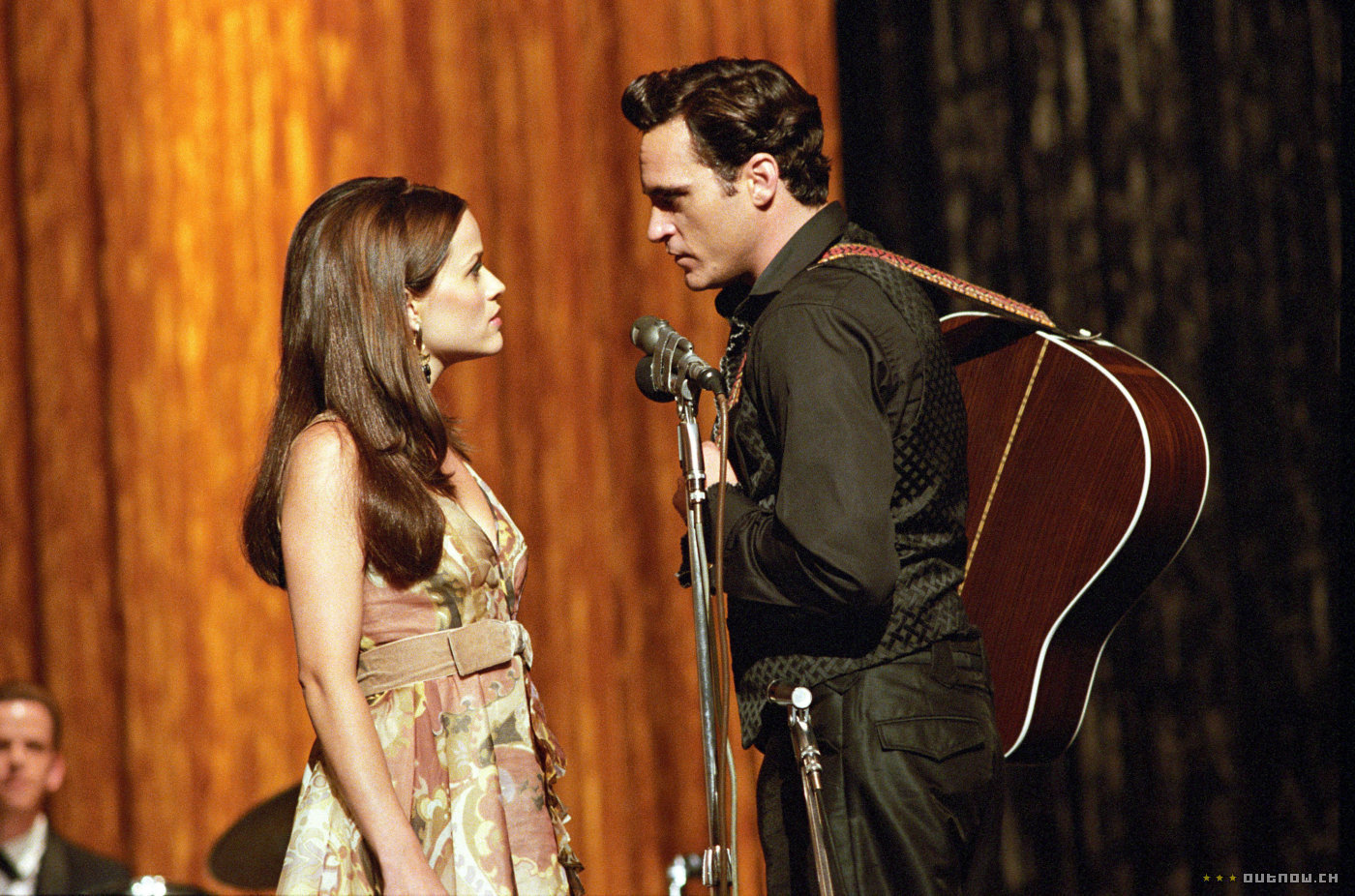
Walk the Line focuses on Johnny Cash’s early career, from 1955-1968, culminating in his live performance at Folsom Prison and the tour it kickstarts. The main element in this story is the long-running courtship/friendship/disagreements between Cash (Joaquin Phoenix) and June Carter (Reese Witherspoon) and their more-than-a-decade-long journey to turn an immediate attraction into a relationship. It’s a very endearing, well directed biopic with a lot of heart at its centre as well as capturing a great deal of the feeling behind the music.

The thing about biopics like this is that they have a standard format, particularly it for music stars: the difficult childhood, the early struggle for success, the glory years, the troubled years (addiction usually rears its head here) before a triumphant rebirth. Walk the Line doesn’t really stray away from this format at all. You also have to acknowledge it was made with the close co-operation of John and June’s son (a co-producer) so there possibility that maybe some of this has been improved for fiction (although there seems no doubt about the strength of the relationship at its centre), even if it doesn’t shy away from Cash’s womanising or addiction to prescription pills during this period.

Well I’m not sure if it is good history, but its damn good story telling. This is a hugely sweet romance, which carefully builds the ups and downs of its central relationship without coating the whole thing with treacle. I certainly found myself very moved by it and deeply invested in seeing the two lead characters finally embrace their feelings for each other. The film does a very good job of establishing the immediate attraction between both Johnny and June, while also carefully demonstrating why it took them so many years to finally be together. It does this without feeling contrived or manipulative, which is quite an accomplishment.

What’s also quite satisfying is that, throughout, Cash plays the “weaker” role – he is the needy one, the one who spirals into depression and moping after rejection, the one who thrives on attention and affection. These traits in his personality are a running theme in the film. It’s a piece of cod psychology to connect these to the death as a child of his older brother, but it makes sense: Cash in this film spends his life trying to find an emotional replacement for this loss, from his over-hasty first marriage to his alternatingly shy and overeager pursuit of June. I also felt that June’s mixed feelings over Johnny – guilt over the attraction, rejection of his sometimes childish behaviour, worry about the public perception of her failed marriages or being accused of being a home-wrecker – also make perfect sense as presented in the film.

If you want to criticise the depiction of the relationship, you could say that it fits neatly into the trope of the female character being hugely supportive and caring over the troubled male genius. However, I think it avoids this – it makes clear that June did consider some of Johnny’s behaviour (both flirting on stage and his drug-taking in particular) unacceptable. At the same time, it also makes clear her affection for him from the start – and in that situation who wouldn’t help someone they care for when he is at his lowest point?

Focusing as it does on the romantic relationship, this film is pretty close to a two-hander. Every scene features either Johnny or June and the majority include them both. Phoenix and Witherspoon are both sensational in the roles. Phoenix’s physical and vocal mannerisms are spot on, but he also seems to have a deep understanding of the feelings of guilt, loneliness and anger that bubble under the surface of Cash, as well as his childish enthusiasm and sweetness. Witherspoon is similarly radiant as June, showing the contrasts between her girl-next-door stage persona and the more complex person below the skin, intelligent and resourceful but anxious about the implications of starting a relationship. Both performances are something quite special.

Alongside all of this, the film is highly accomplished technically, particularly in recreating a series of live performances of Johnny Cash hits. Phoenix and Witherspoon, who do all their own singing, do wonderful vocal and physical imitations, capturing the vibrancy and energy of live performance. Somehow there is something extremely real about seeing Phoenix’s sweating face in close-up, animatedly covering Cry Cry Cry, which manages to get across the excitement of live performance in a way lip-synching couldn’t. The recreation of the era is brilliantly well done – the Folsom Prison sequence is a particular stand out. 

Of course this film is slightly formulaic, and yes it tells a pretty safe story of love conquering all – but damn it when it’s put together with as much heart and skill as James Mangold manages here, who gives a damn. This is very moving, stirring material and I defy you to watch the final 15 minutes without a big grin on your face.