
Tag: Regina King

Enemy of the State (1998)

Will Smith and Gene Hackman dodge the surveillance state in Enemy of the State

Director: Tony Scott

Cast: Will Smith (Robert Clayton Dean), Gene Hackman (Brill), Jon Voight (NSA Director Thomas Reynolds), Regina King (Carla Dean), Jason Lee (Daniel Leon Zavitz), Lisa Bonet (Rachel Banks), Barry Pepper (Agent Pratt), Loren Dean (Agent Loren Hicks), Jake Busey (Agent Krug), Lisa Bonet (Rachel Banks), Jack Black (Agent Fiedler), Jamie Kennedy (Agent Williams), Seth Green (Agent Selby), Ian Hart (Agent Bingham), Stuart Wilson (Congressman Sam Albert), Jason Robards (Congressman Philip Hammersley), Tom Sizemore (Paulie Pintero)

A congressman (a cameoing Jason Robards) is murdered for refusing to support intrusive new counter-terrorism legislation championed by NSA director Thomas Reynolds (Jon Voight). Unfortunately, someone caught the killing on camera. When the NSA come hunting, he plants the recording on an unwitting lawyer friend, Robert Clayton Dean (Will Smith). Dean has no idea he has evidence that could blow the conspiracy – and is nonplussed when they set about destroying his life. The only person who can help is mysterious surveillance expert Brill (Gene Hackman), who has spent decades living off the grid. Can the clear Dean’s name and stop the bad apples in the NSA?

Enemy of the State is a fun chase movie, that enjoys the technical possibilities of the surveillance state, packaged with the fast-pace, bright colour-filtered style of Tony Scott (this is one of his best films). There is more than enough wit and enjoyment about it – not to mention watching a host of very good actors, many of them unknowns at the time, bring a lot of sparkle to the film (you’ve got to give kudos to the casting director). Everything of course gets tied up in a neat, pretty bow but it’s a damn lovely bow so that’s fine.

In its detailed look at the power of the surveillance state, Enemy of the State was, in a way, ahead of its time. The ability for the intelligence agencies here to look into literally everything in your life is pretty unsettling, from bank details to computer accounts. Every camera is an eye and satellites are tasked at will to watch anything. In fact, it’s quite something to remember that the state is only more powerful today – the internet and mobile phones would making tracking Dean even easier than the bugs they secrete about his person, which causes him to flee our baddies stripped to his undies. (Also, if only Reynolds had waited a few years, congress would wave through legislation such as he is requesting here, without batting an eyelid).

The film also dares to shade a little bit of naughtiness into Will Smith’s character. Sure, he’s a crusading labour lawyer (we’ve got to know he’s on the right side!) but he’s also an adulterer with trust problems in his marriage. Smith’s still at his charming best here, and his frazzled desperation as he struggles to understand why on earth the NSA is destroying his life is well-handled. Regina King gets a thankless role as Dean’s shrill wife, whose trust in her husband oscillates according to the requirements of the script, rather than any internal character logic.

Enemy of the State sometimes teeters on the edge of making a point about the dangers of the surveillance state. How easy could it be to abuse this power? Unfortunately it puts most of these arguments into the mouth of Regina King’s holier-than-thou wife, which rather undermines them. It’s also made abundantly clear that we’re witnessing rogue agents. This allows the film to focus more on the cool things surveillance can do, rather than clearer moral statements about whether that’s right or not, other than it being a dangerous tool in the hands of the wrong men.

Scott’s film is more of an entertainment than a treatise though (and thank God for that). It also has a nice little touch of 1970s’ conspiracy thriller to it, something the film leans into with the casting of Gene Hackman in a role reminiscent of Harry Caul in The Conversation. Sure, I can’t remember Caul driving a car while it was on fire or blowing up a building, but Hackman still gives the film some class and a touch of old-school espionage and cynicism. Truth-be-told, other than profession, Caul and Brill have very little in common (Brill is far more confrontational and confident, and much less likely to rip his apartment apart) but it’s still a nice call-back. I also rather enjoy Gabriel Byrne’s smart, playful little cameo as ‘fake’ Brill (hardly a spoiler as you can’t move without knowing Hackman is in the picture).

Scott’s high-energy fun culminates in a smart little trap laid by Dean for all his enemies, that plays nicely off the fact that the NSA agents and the Mafia are definitely paranoid and stubborn enough to not realise they are all talking at cross-purposes. The end of the film sees everything back to normal (it’s unclear how, or if, Dean got his job back considering his unceremonious firing), but I wouldn’t worry about it. It would be nice if it had said more, but as a rollercoaster ride it’s short, sharp and sweet.
One Night in Miami (2020)

one night in miami header
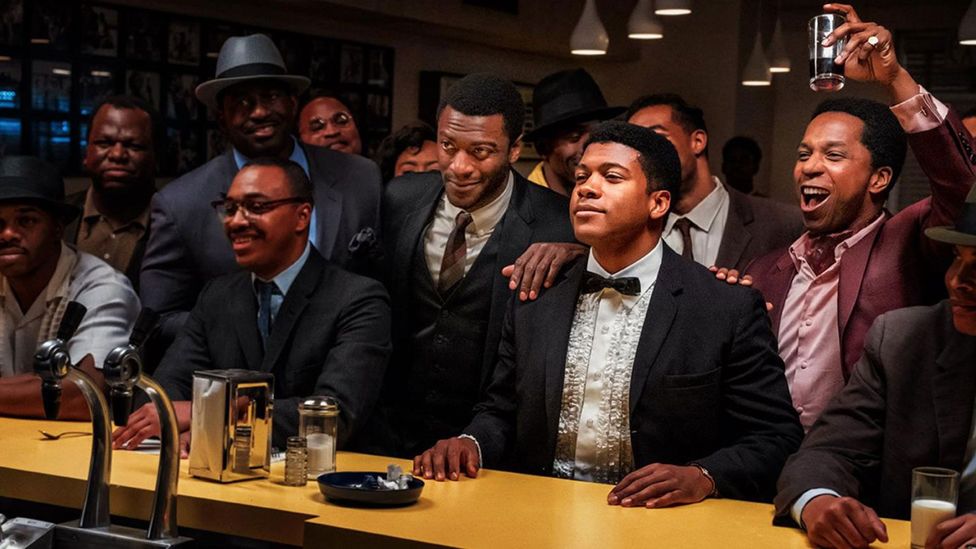
Aldris Hodge, Eli Goree and Leslie Odom Jnr have a passionate debate in One Night In Miami

Director: Regina King

Cast: Kingsley Ben-Adir (Malcolm X), Eli Goree (Cassius Clay/Muhammad Ali), Aldris Hodge (Jim Brown), Leslie Odom Jnr (Sam Cooke), Lance Reddick (Brother Kareem), Christian Magby (Jamaal), Joaquina Kalukango (Betty X), Nicolette Robinson (Barbara Cooke), Michael Imperioli (Angelo Dundee), Lawrence Gilliard Jnr (Drew Bundini Brown), Beau Bridges (Mr Carlton)

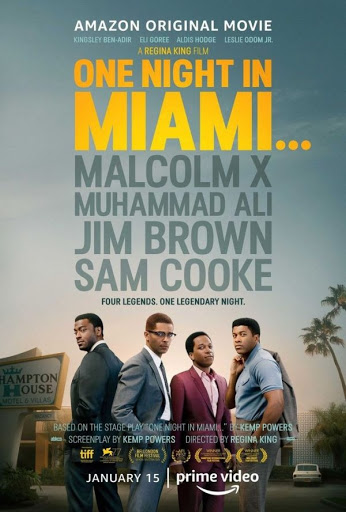
One night In Miami in 1964… civil rights activist Malcolm X (Kingsley Ben-Adir), NFL super-star Jim Brown (Aldris Hodge), “King of Soul” Sam Cooke (Leslie Odom Jnr) and world heavy-weight champion of the world Cassius Clay (Eli Goree) all gathered in a motel room overnight. We’ll never know what they talked about: but playwright Kemp Powers imagined what might have gone down in that room in a play, which forms the basis of Regina King’s film directing debut.

What do they talk about? Along with some home truths, it’s mostly the state of America and the struggle for racial justice. Malcolm X – edgy and worried for his life – feels singer and businessman Sam Cooke has sold out by pandering to white audiences. Cooke angrily argues that building his own record label for himself and his black artists is beating the white man at his own game. Cassius is having last-minute doubts about converting to Islam. Jim Brown is pondering switching from sport to film-making: after all, what are he and Clay really but “gladiators”?

King’s film is passionate and directed with confidence, even if the film never really escapes from its heritage as a single-setting, one-act play. The action largely takes place in a single room – despite efforts to open it up by having our heroes visit the roof or pop out for supplies. It’s not a surprise that the best moments are also the most theatrical, not least the heated debates that allow the actors to shine.

These debates are so strong, I wish there were more of them. The heart of the film is that argument about the balance between pandering and creating something that will sell. Sam Cooke has had a lot of success – but is it at the cost of not singing about the things he really cares about? Or is he right that people like The Rolling Stones will always open doors he can’t – and if he and other artists can make fortunes from the Stones covering their songs, isn’t that a win for the black community? Malcolm X has no time for that possibility, accusing Cooke of a soft-pedal Uncle-Tomism, content to leave the sort of impassioned protest songs he could be singing to men like Bob Dylan.

Both Brown and Clay are largely left to play peacemaker and devil’s advocate. Hugely successful athletes, they balance justifiable pride with a determination to be their own men. But the film fails to really explore issues in their industries – is their success elevating their community, or just enriching rich white guys? It would have been interesting for Malcolm to turn some his fire on these two. After all an early scene with Brown shockingly demonstrates the limits of sporting success to truly change the opinions of some white Americans about their black neighbours. There would certainly have been plenty for him and Malcolm X to get into in a debate about the right way to progress civil rights. But it never quite happens.

Not that the film is afraid to turn some of its guns on Malcolm X. Kingsley Ben-Adir excels playing a far more fragile, anxious and gentler Malcolm than we expect (after all, it’s so hard not to immediately think of Denzel Washington). This is a Malcolm worried for his and his family’s safety, going through the turmoil of leaving the State of Islam and not sure where his life is heading, other than the fear it won’t be a long journey. Ben-Adir has the fire and passion, but also the nervous sense of being the youngest, least well-known (at the time) of the four, and he creates a successful ambiguity as to whether his friendship with Clay is at least partly based on self-interest.

There is some seriously rich material in this film for the four actors to sink their teeth into, and King’s direction allows each of them a showpiece, while expertly shuffling perspectives. Odom Jnr is superb – not least for his heart-rending and emotional performances of several Cooke songs – as a man who knows deep-down there’s truth to what he’s being accused of, while feeling his shared success is part of doing “his bit” and he’s being unfairly picked on.

Aldis Hodge’s Jim Brown is the most settled and content of the four, certain of his own destiny and comfortable with his life. In the hands of a lesser actor, his role could be potentially overlooked, but Hodge’s charisma keeps his careful performance compelling. Eli Goree perfectly captures Muhammad Ali’s exuberance, good-natured arrogance and restless energy and mixes it in with a sweet desire for everyone to get along. All four of these actors riff brilliantly off each other.

The film doesn’t let us forget the dangers of the time either. The opening sequence demonstrates the dangers and prejudices all of them face: from booing crowds to threats of physical harm. It’s something we return to time and time again – while Malcolm X’s fear about shadowy figures watching him is a constant reminder that his own death is so close.

But I feel there could have been more. Sam Cooke would also be dead by the end of 1964 – but you could watch this film and not have a clue that within 18 months half the people in it would be murdered. Away from the debates, the film takes a while to get going, and there gaps in issues of racial politics that you feel could have been richly explored.

For all that the film could have been a moment of time, it actually feels a bit disconnected from the rest of history. Where does this event – and the insights we gain about our characters – fit within the perspective of civil rights for the rest of the 1960s, let alone the rest of the century? The film doesn’t quite capture this. More ambition to expand the play beyond that one night into something more far-reaching (imagine what Spike Lee might have made of it) would have been fascinating. As it is, this is a brilliantly acted, well-made film – but still feels like an adaptation of a night at the theatre, a more reassuring rather than challenging film.