
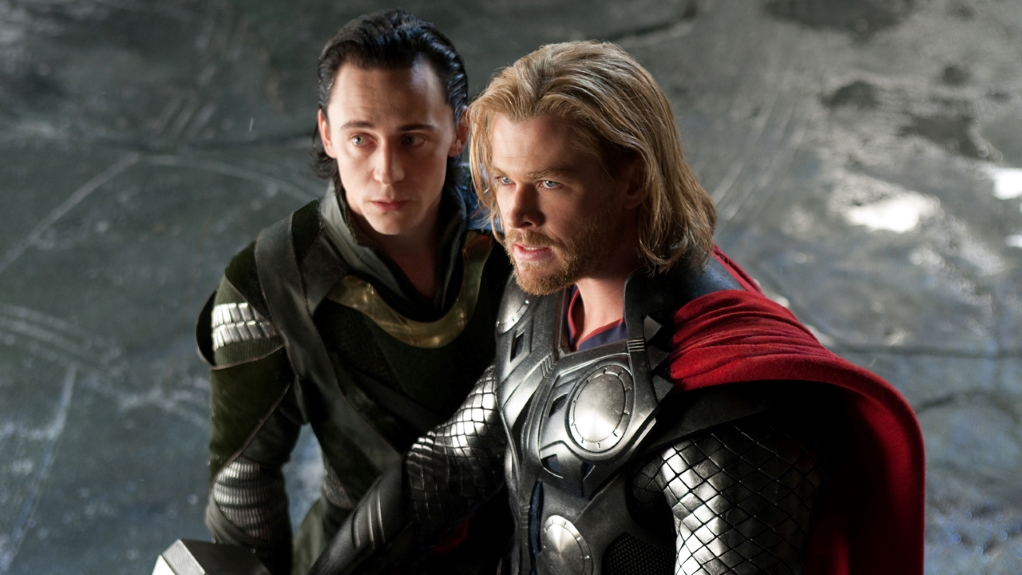
Branagh lives his dream by making the most comic-book, bombastic Shakespeare-homage ever
Director: Kenneth Branagh
Cast: Chris Hemsworth (Thor), Natalie Portman (Dr Jane Foster), Tom Hiddleston (Loki), Anthony Hopkins (Odin), Stellan Skarsgård (Dr Erik Selvig), Kat Dennings (Darcy Lewis), Clark Gregg (Phil Coulson), Rene Russo (Frigga), Colm Feore (Laufrey), Ray Stevenson (Volstagg), Idris Elba (Heimdall), Jaimie Alexander (Sif), Josh Dallas (Fandral), Tadanobu Asano (Hogun), Jeremy Renner (Hawkeye)

If you’d told people after Henry V that one day Kenneth Branagh would direct a high-octane comic book movie about a Norse God who bashes things with a hammer, you’d have been laughed outta town. But Branagh was who Marvel called to launch the Thor franchise – and doncha know it turned out to be a pretty shrewd choice.
Thor (Chris Hemsworth) is the arrogant son of Odin (Anthony Hopkins) and heir to the throne of Asgard, the planet that keeps peace in the Universe. After an attempt by Asgard’s old enemies, the Frost Giants, to re-capture a stolen super-weapon, Thor leads a reckless attack on their homeworld that threatens to shatter a hard-won peace. Disappointed and furious, Odin strips Thor of his powers and banishes him to Earth, where the fallen God of Thunder must learn humility to be worthy of regaining his powers. On Earth, he falls in love with gifted scientist Jane Foster (Natalie Portman), while on Asgard the realm falls under the control of his brother Loki (Tom Hiddleston), who manipulates events to make his own claim for both the throne and their father’s love.
You can sort of see the Shakespearean bits bubbling away there. Fathers and sons, ambition and power, tragic flaws. Destiny verses desire. Loki as a mix of Edmond, Iago and Cassius. Thor as a Prince Hal earning the maturity to lead. Odin as a kindly Lear. Hell, you could see Thor washing up on the shores of New Mexico, like Twelfth Night’s Viola, forced to pretend to be something he isn’t. He even has his own mini-Falstaff, in gluttonous warrior Volstagg. It’s a heightened story of Kings and Queens, Tempest-style magic and Hamlet-style family intrigue. Marvel, of course, partly hired Branagh to bring attention to this (effectively, paying Branagh for his Shakespeare-street-cred to make an otherwise snigger-worthy concept of Norse Gods in space get taken seriously), Thor does a great job of bringing this out without drowning the fun.
And of course, for those paying attention, Branagh had been dying to do bombastic nonsense for years. Shakespeare had disguised that Branagh adored loud crashes, big bangs, showy camera work (half of Thor is done in Dutch angles, apeing comic books) and pounding soundtracks. His Hamlet is crammed with half a dozen genres, from romance to action and Mary Shelley’s Frankenstein showed he could fly over the top with the best of them. But he’s also an actor’s director, and he draws performances here from Hemsworth and Hiddleston in particular that would lay the groundwork for making these two of the most popular actors in the whole damn franchise.
Thor above all does a brilliant job of making us care for a lead character initially presented as a likeable but arrogant, immature and cocky hit-first-think-later warrior, cavalier about people’s lives. There is a very funny humiliation conga inflicted upon Thor on arriving on Earth (a classic rule-of-three gag) leaving him successively tasered, tranquilised by a syringe in the ass and knocked over by reversing car. It’s a brilliant way of breaking the haughty – the Mighty Thor, who trashed an army of Frost Giants, laid low by a middle-aged doctor yanking down his hospital pants. But it all sets us on a path for caring about him, helped by how chivalrous and polite he is with Portman’s winning Dr Foster. Sure, he’s still dripping with hubris – assuming once he gets his hands on his hammer Mjolnir again, everything will be as it was – but at wider traces of humanity emerge we start to care for him.
It’s cemented by a very effective scene where Branagh proves his worth as a director of actors. After failing to lift said hammer – being, at this point, unworthy due to having not really learned anything – Thor sits alone in an interrogation room, visited by a disguised Loki. Hemsworth is very good in his scene: he suddenly makes Thor humbled, fragile, accepting his failures, not lashing out but tearfully apologising for his past behaviour, meekly asking to just be allowed to come home then bravely accepts his permanent banishment. It’s actually an effectiveportrait of overcoming hubris: Thor’s true heroism isn’t trashing Loki’s rent-a-robot that is the film’s penultimate foe. It’s accepting, in his depowered state, his role in the battle is to stay out of the way and help get people out of the way before offering his own life as a sacrifice if he will end the robot’s rampage.

If Thor, in Hemsworth’s gently sweet and funny performance, overcomes hubris, Loki succumbs to it. Tom Hiddleston’s charisma here (cemented by his excellent turn in The Avengers) helped him become Marvel’s most popular anti-hero. Like Thor, he’s a complex character: a second brother who secretly resents his brother’s prominence, wants his father’s love, learns things about his past which make him lean into his worst instincts, all to try and be what he mistakenly thinks his family wants. Hiddleston carries all this angst and tragedy with real skill, while also filling the role with wit and playfulness: it’s a great, star-making turn.
It’s a sign of the film’s surprising complexity that it’s hero and villain switch perspectives over its course. Thor starts by dreaming of destroying the Frost Giants to impress Odin while Loki counsels restraint. He ends it by making enormous personal sacrifices to protect them from a genocidal plan unleashed by Loki who wants to prove he’s as tough as Thor. The film ends not with a hero triumphant, but alone and grieving losses. It’s stuff like this that makes Thor a truly interesting, engaging film in a way other MCU outings are not.
And a lot of it comes from Branagh’s skill with actors. Thor might not offer the greatest acting challenges to the rest, but Hopkins in particular was better here than he had been for years (he credited Branagh with helping him rediscover his passion for acting) and Portman and Skarsgård bring a lot of humanity to thinly written roles. Sure, in other ways Thor is less special: it’s action set-pieces are, by and large, fairly uninspired and run-of-the-mill, the small town trashed by a robot looks and feels like a backlot stunt show, some of the comedy lands flatly. But when it focuses on the character drama of two contrasting brothers and their love for their father it’s feels more real and engaging than a host of more technically adept comic book movies.
Thor gets over-looked in the MCU rankings. But it’s a surprisingly thoughtful, well drawn character study about worthiness not being about muscle and force, but on your wisdom, compassion and humility and putting other people before your own needs and desires. All captured in a magic hammer that is otherwise impossible to pick up. Branagh’s film gets that, with added bombastic comic book thrills. Thor has entertained me each time I’ve seen it and will go on doing so.

 Movie Musings