
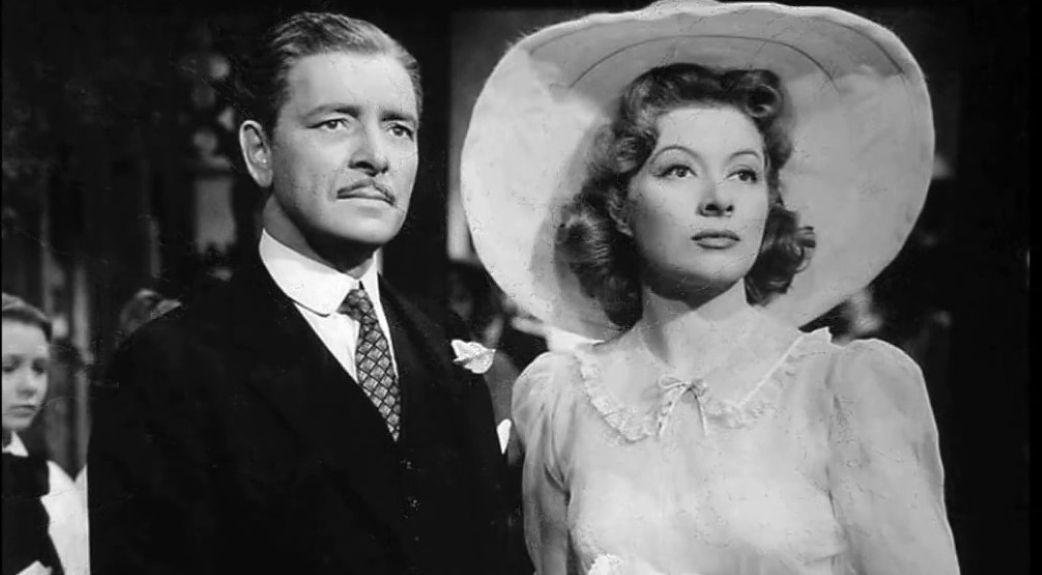
Two superb leading performances hold together a romantic confection of a film
Director: Mervyn Le Roy
Cast: Ronald Colman (Charles Rainier/”Smithy”), Greer Garson (Paula Ridgeway/ “Margaret Hanson”), Philip Dorn (Dr. Jonathan Benet), Susan Peters (Kitty Chilcet), Henry Travers (Dr. Sims), Reginald Owen (Biffer), Bramwell Fletcher (Harrison), Rhys Williams (Sam), Una O’Connor (Tobacco Shopkeeper), Aubrey Mather (Sheldon), Margaret Wycherly (Mrs. Deventer), Arthur Margetson (Chetwynd Rainier), Melville Cooper (George Rainier), Alan Napier (Julian Rainier), Jill Esmond (Lydia Rainier)

Random Harvest is one of the most fondly remembered romances of Golden Age Hollywood – if you want yearning dedication bought to life, this is the film for you. It might also be one of the barmiest films ever made, stuffed with so many outlandish plot developments, hilarious logic gaps and hand-waved contrivances it would put a Netflix soap to shame. You can see why Syndey Pollack and Anthony Minghella eventually abandoned remakes: you can’t imagine a modern audience going with Random Harvest’s essential loopiness and not laughing somewhere along the line. Which is not to say it isn’t beautifully made and winningly bought to life at times.
It’s the final days of World War One, and amnesic soldier “John Smith” (Ronald Colman) can’t remember anything about his life. On the final day of the war, he sneaks out of the asylum and runs into music hall performer Paula (Greer Garson). She takes a shine to “Smithy” and decides to save him. They run away to the country, fall in love, get married, have a baby, he starts to write, goes to Liverpool to start a journalism career… and gets hit by a cab. The collision restores his original memory – but also causes him to forget everything about Paula and his life as Smithy. Instead, he restarts his original life as industrial heir Charles Rainier, presumed dead by his family. While he lives this life for years, Paula takes a job as his secretary “Margaret”. Will he remember who she is?
It says a lot that that summary only scratches the surface of a plot that throws in the kitchen sink in attempting to ring as many tear-soaked tissues out of you as possible. Smithy and Paula carry out their little memory dance over the course of over twenty years. It’s the sort of a film where millionaire Charles only thinks about investigating what might have happened to him in Liverpool when nudged to do so after over a decade. Where the couple enter a ‘marriage of convenience’ as the memory-free Charles and fake Margaret. Where Charles’ owns a major factory in the town where our lovers first met, but neither (a) stepped foot there in 15 years (since the moment he does his memory starts to return) and (b) the heir to the town’s major employer wasn’t recognised by anyone while living in an asylum five minutes walk down the road.
Take it on the merits of logic and conventional narrative and Random Harvest crashes and burns. But this isn’t a film about those things. This is a classic weepie that stole the hearts of a war-torn nation in 1942 (it was the biggest hit of the year). Powered by two committed and emotional performances, if it hits you in the right mood its probably irresistible. The sort of long-term adversity that makes Romeo and Juliet’s look like a casual dalliance (so full of tragedy, the death of their son is literally a throwaway moment). It’s framed with a great, sensual beauty by Mervyn LeRoy and powered by an emotionally throbbing score by Herbert Stothart that’s just the right side of sickly.
Ronald Colman’s performance is quiet, measured and vulnerable (especially in his “Smithy” performance). From the start, he has eyes of hesitant, unknown sorrow and stumbles into a relationship with Paula like a new-born discovering life. Threads of his gentleness and excitability work their way into his Charles persona, tinged this time with the natural confidence of wealth. Nevertheless, Colman makes Charles a man who has dealt with unnerving amnesia by actively not thinking about it, carrying on a watch-chain the key to his “Smithy” home as a subconscious reminder. It’s a fine performance – so much so you can overlook he’s twenty-five years too old (the restored Charles forgoes returning to university, something that looks long gone for Colman).
Just as fine is Greer Garson, fully embracing an emotional roller-coaster as Paula. Introduced as a good-natured music hall singer (and Garson sings a high-kicking She’s Ma Daisy number in possibly the shortest skirt the Hays Code ever allowed), Garson’s warm and playful Paula is drawn towards “Smithy” in ways she almost can’t understand. But it’s a wonderfully different side for an actress so often associated with self-sacrificing wives and mothers: Paula is vivacious, forward and seizes the things she wants from life. It’s the second half – the patient, yearning desperation of “Margaret” hoping her husband will remember her – that leans more into her Mrs Miniver wheelhouse, but Garson mixes this with a real lingering, desperate sadness tinged with just enough hope that her husband might just recognise her.
Both performers overwhelmingly lift this otherwise (frankly) slightly contrived film into something rather sweet and endearing. It is, however, a film that would be even more so if it was shorter: the general morass of missed opportunities, misunderstandings and wrong ends of sticks being grasped would be easier to sustain over 90 than 120 minutes. It’s a rare film that covers so much ground over so much time that it’s lead character is declared dead twice.
The second declaration is Paula gaining that status for “Smithy”, dissolving their marriage and removing (you suspect for Hay’s Code reasons) the risk that Charles might accidentally commit bigamy by marrying his young niece. This is a lovely performance of youthful idealism and earnest devotion from Susan Peters (a tragic accident shortly after curtailed her promising career), and if the whole years-long subplot of the possibility of Charles marrying his besotted niece is a narrative cul-de-sac the overall film would be better without, it does at least mean we get the pleasure of Peters, performance captured forever.
But Random Harvest remains a pure romance: where no less than two women spend decades of their life in selfless, one-sided devotion for the lead and he still comes across as the sort of saintly man cheered by his own factory workers for sorting out a strike. The whole confection is a very fragile thing, but LeRoy carries this fully-loaded glass ornament with pure skill and the performances of Colman and Garson set the bar for classic Hollywood tragic romance. Minghella and Pollack were right – our cynical age can’t believe the nonsense – but on its own terms it still works.


 Movie Musings