Tag: Richard Johnson

The Pumpkin Eater (1964)

Anne Bancroft and Peter Finch in an unhappy marriage in the overlooked The Pumpkin Eater

Director: Jack Clayton

Cast: Anne Bancroft (Jo Armitage), Peter Finch (Jake Armitage), James Mason (Bob Conway), Cedric Hardwicke (Mr James), Richard Johnson (Giles), Eric Porter (Psychiatrist), Rosalind Atkinson (Mrs James), Frances White (Older Dinah), Alan Webb (Mr Armitage), Cyril Luckham (Doctor), Yootha Joyce (Woman at Hairdressers), Maggie Smith (Philpot)
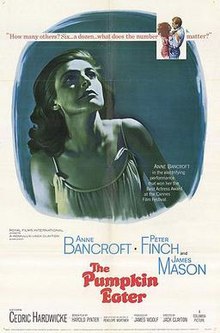
Released in 1964, The Pumpkin Eater was rather unfairly seen as too strongly aping the new-wave of European film-making, in particular Michelangelo Antonioni and Ingmar Bergman. It’s a strange trend in British culture to ruthlessly lambast anything seen to be too good or too well made, as if trying too hard is vulgar and flies in the face of our love for the amateur. This is supremely unfair for The Pumpkin Eater (which I will say is weighed down by a pretty terrible title – Scenes From a Marriage would have been better, but that one got nabbed by Bergman) which is a little classic of a film.

Based on a semi-autobiographical novel by Penelope Mortimer about her marriage to lawyer-turned-writer John Mortimer (creator of Rumpole), Anne Bancroft (with an impeccable British accent) plays Jo Armitage: an intelligent woman, suffering from depression, with a huge number of children from three marriages. Her new husband, Jake (Peter Finch), is a charming man, a hard working screenwriter, an excellent father to all the children – and, alas, a selfish serial adulterer. The film charts the ups and downs of their marriage, often in a non-linear way, including Jo’s battle with depression and the fallout from Jake’s affair with the wife of a film producer Bob Conway (James Mason).

Shot in sumptuous black-and-white, The Pumpkin Eater is so well made by Jack Clayton it became almost a stick to beat it with. One contemporary review even mentioned it was “irritatingly without flaws” in its film-making, as if this was a bad thing! Clayton’s direction is detailed, precise and beautifully done and throws a host of fascinating images at the screen, as well as drawing out some simply superb performances from the cast. Clayton chooses interesting angles and visual mirrors – events from scenes are reflected and repeated, in different contexts, in later scenes. The camera takes up unusual positions, not least a zoom in on James Mason’s mouth as his character spits out vile insinuations.

Clayton’s direction also captures a superb sense of empathy with his characters. His depiction of depression and ennui in Jo Armitage captures the sense of drift beautifully. Early in the film, she is captured in shot aimlessly standing in the shade of a car port. At her lowest she seems to get almost stuck in the frame. The film’s most famous moment features Jo breaking down in despair in Harrods – a wonderful sequence that uses a combination of POV, overhead shots, a camera attached to Anne Bancroft as she works, and a crashing close up on Bancroft’s face (also repeated later in the film) that all serve to stress her isolation, her despair and the mixed to hostile reaction to her tears from the shoppers around her. 
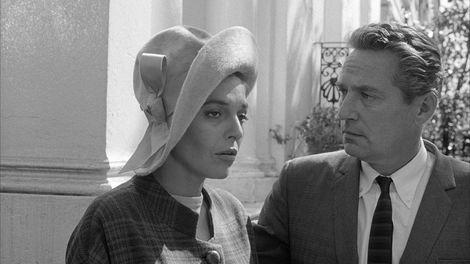
But the film doesn’t solely take Jo’s side. It’s interesting how many contemporary reviewers – men and women – found Jo a tiresome and selfish woman (she’s not, just an unhappy one). That’s partly due to the film’s success in making Jake a fully rounded character. Sure he’s charming and fun, but he’s also clearly a great dad and genuinely cares for Jo – it’s just that he can’t help himself doing things that end up hurting her. The film is also careful to suggest that, deplorable as some of his actions are, he has a point about the pressure of adding another child to a family which already has about seven (two of them at least have been farmed off to boarding schools, and it’s clear in one late sad scene that Jo now hardly knows them). How are they meant to cope? How are they going to be able to support another baby?

The film works as well because both Bancroft and Finch give extraordinary, fully rounded performances in the lead roles. Bancroft had just won the Oscar for Best Actress, and it’s quite something to think that committing to this British picture was her next gig. But she immerses herself in the character, and sells every single one of the complex emotional ups and downs Jo goes through. She’s perfect at drawing us deeply into Jo’s sorrow and uncertainty, but also her brittleness and anger. She’s not afraid to acknowledge that sometimes depressed people are immensely difficult and frustrating – or that they are also intensely vulnerable and fragile. Peter Finch is equally good as a hail-fellow-well-met, whose selfishness doesn’t quite fit into his self-image as a good guy but who is overflowing with good intentions and small moments of kindness.

Both actors are helped immeasurably by a very strong script by Harold Pinter. Pinter’s structure intelligently draws out great depths from the material, as well as playing smart games with structure and timeline that provoke thought. He is the master of the stand-out scene, and the film is crammed with smaller moments that stand out in the memory. Maggie Smith has a brilliant cameo as a shallow, gossipy house guest who may or may not be having an affair with Jake. In one extraordinary sequence, Jo is accosted at a hairdressers by a total stranger (played by Yootha Grace) who recognises her from a magazine article about Jake, who oscillates between wanting to be her friend and vicious bitterness that she isn’t. 

It’s a sign of the gift parts that this film gives to actors. Stand-out amongst the remaining cameos is the great James Mason, whose cuckolded husband at first seems to be a decent, if overly bombastic life-of-the-party type, who reveals himself to have unending reserves of bitterness and poison and delights in pouring anger and suspicion into Jo’s ears.

Clayton and Pinter’s work dovetails perfectly here into a sharply intelligent, haunting film which throws you into a marriage that refuses to paint either side as either completely wrong or completely right (Clayton was even concerned the film may have gone too far in making Jake sympathetic to the detriment of Jo). A compelling storyline, in a beautifully made film crammed with intelligent lines and wonderful moments, The Pumpkin Eater can rightly claim to be an overlooked classic of British cinema.

The Man Who Knew Infinity (2015)


Dev Patel is mathematical genius Srinivasas Ramanujan, struggling against prejudice in The Man Who Knew Infinity

Director: Matthew Brown

Cast: Dev Patel (Srinivasas Ramanujan), Jeremy Irons (GH Hardy), Devika Bhise (Janaki), Toby Jones (John Edensor Littlewood), Stephen Fry (Sir Francis Spring), Jeremy Northam (Bertrand Russell), Kevin McNally (Percy MacMahon), Richard Johnson (Vice Master Henry Jackson), Anthony Calf (Howard), Padraic Delaney (Beglan), Shazad Latif (Chandra Mahalanobis)

The British Empire. It’s a difficult slice of British history, and it undoubtedly contributed to contemporary attitudes of superiority that affected British people and their institutions. It’s these attitudes that form the central themes of The Man Who Knew Infinity, an effective story of a struggle against the odds. 

In the early 1900s, Srinivasas Ramanujan (Dev Patel) works in Madras as a junior accountant – but his superiors quickly realise his mathematical abilities far outstrip his mundane tasks, and encourage him to write to mathematics professors to bring his theoretical work to their attention. Ramanujan starts a correspondence with GH Hardy (Jeremy Irons) of Trinity College, Cambridge, who invites him to England to explore his potential. Once there, Ramanujan quickly proves his genius but, despite Hardy’s support, he struggles to be accepted by the fellows and students of the college, who only see an upstart from the colonies.

The Man Who Knew Infinity is a conventionally structured biography – struggles personal and professional, success followed by setback and a final triumph combined with a bittersweet ending. It’s structurally nothing different from things you’ve seen before, but it’s told with calm, quiet, engrossing dedication, with unflashy direction, a solidly written script and some truly excellent acting. No wheel is reinvented, but it revolves with a highly enjoyable and heartfelt tenderness.

It’s a film that manages to present mathematics without using spurious real-world clunky metaphors, and gets a lovely feel for the hard work and theoretical study that go into mathematical theory. It also brilliantly communicates what the maths is about. I’m no theoretical mathematician (football stats are my limit) but even I could follow (just) why Ramanujan’s insights were so important and what they meant to the field of theoretical mathematics. The film has a real feel, not only for rhythms of academic work, but also the politics of academia (which needless to say are labyrinthine).

But the film’s main point is the resentment and outright racism Ramanujan must overcome. Played by Dev Patel with a quiet decency and modesty that only rarely bubbles over into bitterness, Ramanujan is constantly hit with everything from misunderstanding to contempt. His every achievement is met by questioning and doubt. His proofs must be demonstrated time and time again. To win the support and respect of his peers, he must constantly revise and revise his work, while the slightest slip is held up as proof his fraudulence or luck. 

If you do want to criticise the presentation of this, you could say that much of the campaigning and struggle for acceptance is championed by the establishment figure of Hardy – it’s he who does most to convert others, and who presents Ramanujan’s key theories to the Royal Society at the end. Stressing Ramanujan’s politeness and humbleness does have the downside of making him a slight passenger at times in his own movie.

But then it’s not just his movie, because this is a story of a deep, near romantic, bond that forms between the gentle Ramanujan and the shy and sensitive Hardy. Hardy, the film implies, was a man uncomfortable with emotional closeness, but he feels a huge bond with Ramanujan, having overcome similar class-based prejudice. The two men have a natural understanding, and support each other, finding themselves in perfect sync in their opinions on mathematics and their outlooks on life. In the nature of the British, nothing is ever said – but it’s clear that both men feel an intense personal connection that, quite possibly in Hardy’s case, mixes with a suppressed romantic yearning.


This relationship largely works so well because Jeremy Irons is quite simply fantastic as Hardy. Cast so often as superior types, here he gets to flex other parts of his arsenal as someone shy, timid, and sensitive. Hardy is so uncomfortable with personal friendships, he can rarely bring himself to look directly at other people. Irons sits on the edges of frames, or hunches and shrinks, his eyes permanently cast down. Saying that, he brings out the inner steel and determination in Hardy, his devotion as an advocate for Ramanujan. Irons is so shyly withdrawn, that the moments he allows emotional openness with Ramanujan, and most movingly with fellow mathematician Littlewood (played with a kindly good nature by Toby Jones), are wonderfully affecting. This might be one of Irons’ finest performances in his career.

The Man Who Knew Infinity is in many ways a conventional film, but performances like Irons’ lift it into something a little bit special. It’s a well-meaning and heartfelt film that embraces some fascinating concepts and also presents a story of triumph against adversity that feels genuinely moving and engaging. Filmically and narratively it’s very much by-numbers at times – but it hits those numbers so well, you’ll certainly have no complaints.

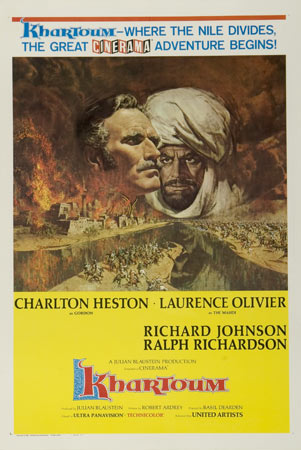
Khartoum (1965)


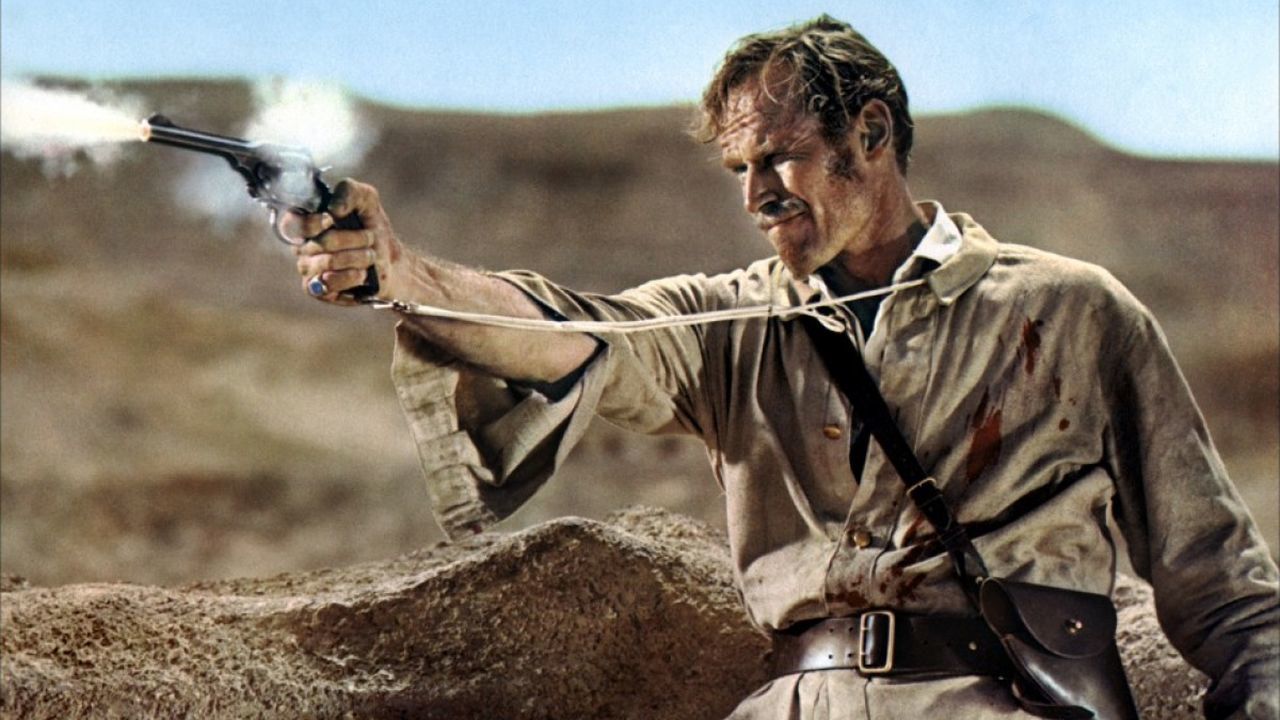
Charlton Heston takes aim in a rare moment of action in Khartoum

Director: Basil Dearden

Cast: Charlton Heston (General Charles Gordon), Laurence Olivier (The Mahdi), Richard Johnson (Colonel John Stewart), Ralph Richardson (William Ewart Gladstone), Alexander Knox (Sir Evelyn Baring), Johnny Sekka (Khaleel), Nigel Green (General Wolseley), Michael Hordern (Lord Granville), Peter Arne (Major Kitchener), Zia Mohyeddin (Zobeir Pasha), Douglas Wilmer (Khalifa Abdullah) 

For me you can’t really beat a big epic film. I love their sweeping vistas, the larger than life personalities, the luxurious running times and the vast array of Brit actors you inevitably find filling out the cast list. There is a lovely Sunday afternoon cosiness about a good epic and, since Hollywood spent large chunks of the end of the 50s and the 60s churning them out, historical events and personages replayed in sweeping panovision, there are plenty to watch.

Khartoum takes as its topic the siege of Khartoum and the death of its commander General Charles Gordon (played here by go-to actor for the big epic, Charlton Heston). Part of the now largely forgotten Sudanese war of the 1870s-80s, the siege was conducted by forces led by The Mahdi (Laurence Olivier) a man convinced that he was a reborn messenger of Muhammed.

Khartoum is a film that means well, but it’s a rather stodgy, po-faced history lesson that struggles with the fact that sieges are rather dull eventless things. Combine this with most of the film’s subplot following faithfully recorded political events back in the UK, and it hardly makes for a event filled spectacular. Instead it’s a slightly muddy lecture, interspersed with invented meetings between characters (Gordon and Gladstone; Gordon and The Mahdi twice!) in which they eloquently talk at each other, mouthing out the writer’s careful research, but give us no real insight into the times or the impact events had on the future.

It’s also rather routinely directed, without any flair or dynamism. It’s clearly aiming to be another Lawrence of Arabia, with everything from its music score to the lingering shots of the desert all aping Lean’s masterpiece. An opening narration (by an uncredited Leo Genn) even mulls over Egyptian and Sudanese history, while lovingly showing the viewer some postcard shots of various Nile attractions, seems particularly dry and dusty.

When the film does allow moments of action (which all seem ill-placed in this seriously serious film) they are rather flat and dull. The final attack on Khartoum has a suddenness about it that works well for the overwhelming force of The Mahdi’s army – and the death of Gordon (inspired by George William Joy’s painting) is rather affecting (although the real Gordon allegedly went down all guns blazing) but this is a film far happier with conversation.

What does work in the film, surprisingly, is Heston, who underplays as an enigmatic Gordon, a quiet, unknowable man addicted to the limelight, a serene soldier with a love of peace and religion, a man of the cloth and accomplished solider. Heston allows his natural charisma to do a lot of the work, and he clearly feels a certain empathy with Gordon, gracing the film with the same determined leadership of the general. Heston is an easy actor to mock, his granite face made for legends, but he’s a quietly assured here.

Olivier’s performance is inevitably more troublesome today, the great man dressed up in blackface and a rum accent as The Mahdi. In fact, as per Hollywood films of the time, most of the major Sudanese characters are played by British actors in blackface. Of course it would never happen today – and it’s tricky not to either gasp or snigger at  Olivier’s first scenes – but looking past that first shock (and his opening speech – “Ohhhhh my belovvvvveed” is too much), Olivier gives a detailed study in ambitious fanaticism which is even more relevant in the age of Al-Qaeda. It’s uncomfortable to see, and Olivier allows the mannerisms too much rein (in particular compared to Heston’s confident underplaying) but it’s a decent performance.

I’ll always have a soft spot for this film as it allows us the chance to see Ralph Richardson as Gladstone, one of my favourite historical figures, and one of the two greatest English statesmen (with Robert Peel) of the 19th century. Richardson would have been brilliant in The Gladstone Story (sadly never made) and he brings to life much of the political scheming back home in Blighty, as a Machiavellian version of the Grand Old Man. Anyway, he’s terrific and the various cabinet room debates are some of the most interesting parts of the film.

It’s a shame that the films gets bogged down too early in Sudanese and Egyptian politics (and still manages to muddle the viewer), before settling into the siege from where, interspersed with slightly repetitive conversations. It’s clear where the film is going, but there isn’t the doom laden dread about this that the film needs. This is a shame, as this story of a colonialist, in love with a colony, killed by colonists while trying to protect other colonists, has a lot to potentially say about the modern world (both now and in the 60s) – it just doesn’t manage to say them.

Note: I was struck in the film by how dangerously many of the horses were thrown about or tackled by soldiers in the battle scenes. “Surely that can’t be safe” I thought as a man knocked over a galloping horse by jumping and tackling its head. Sure enough it wasn’t: allegedly 100 horses bought the farm for this film.