Tag: Richard Vernon

A Hard Day’s Night (1964)

A Hard Day’s Night (1964)

The Fab Four conquer the movies in this fast-paced and funny road movie

Director: Richard Lester

Cast: The Beatles, Wilfrid Brambell (John McCartney), Norman Rossington (Norm), John Junkin (Shake), Victor Spinetti (TV Director), Anna Quayle (Millie), Richard Vernon (Man on Train), Kenneth Haigh (Simon Marshall)
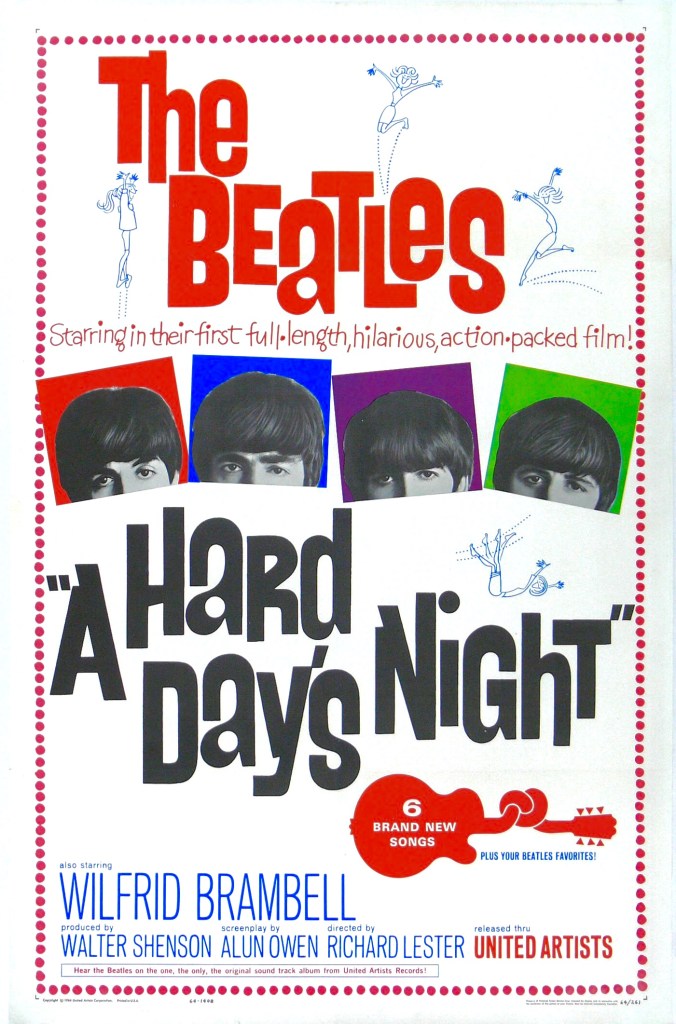
In 1964 they weren’t just the most popular music act: they basically were music. Everywhere they went they were met by crowds of screaming fans. They’d conquered America. They were no longer four lads from Liverpool: they were The Beatles. They were numbers 1-5 in the States, their last 11 songs had gone to number one, they were the most popular people on the planet. Of course, it was time for them to conquer the movies.

What’s striking is that A Hard Day’s Night could have been like any number of god-awful Elvis Presley films, with the King awkwardly playing a series of characters shoe-horned into plots based on songs. Richard Lester would do something different – and along the way he’d arguably invent the music video (when told he was the father of MTV, Lester famously asked for “a paternity test”) and the mockumentary all in one go. Lester placed the fab four into a day-in-the-life road movie, mixed with silent-comedy inspired capers and Marx Brothers style word play, in which they would play versions of their various personas in what basically amounted to a series of fly-on-the-wall sketches.

The film follows the gang in Paul’s (fictional) grandfather John (“Dirty old man” Steptoe’s Wilfrid Brimbell) complains move from “a train and a room and a car and a room and a room and a room”. (In a running gag lost on those not au fait with 60s British sitcoms, he is repeatedly called “clean”). In other words, we see the Fab Four shuttle to London, answer questions at a press conference, skive-off to prat about in a park then go through a series of rehearsals (with interruptions) before performing on TV and choppering off to their next appointment. It’s non-stop (even their night-off is filled with answering fan-mail – and pulling Grandad out of casino) work, work, work and any time outside is spent running from a mob of screaming fans. A Hard Day’s Night indeed.

Lester shoots this with an improvisational energy that feels like its run novelle vague through a kitchen-sink drama. He’s not averse to Keystone Kops style chases, sight gags and letting the camera bounce and jerk around with the actors. If things go wrong – ten seconds into the film George and Ringo fall over during a chase scene, get up and start running again while John laughs his head off – Lester just ran with it and kept it in. Everything feels like it has the casual, cool energy of just sticking the camera down and watching four relaxed, cool guys shoot the breeze.

It helps that he moulds four decent performances from a band that, let’s be honest, was never going to trouble the Oscars for their acting. Screenwriter Alun Owen – whose Oscar-nominated script is awash with pithy one-liners and gags – spent a couple of weeks with the boys and from that essentially scripted them four personas best matching their real-life attitudes. John becomes a cocksure smart-arse, with a quip for every corner. Paul an earnest, decent guy with a taste for wacky gags. George a shier, poetic type. Ringo the closest the band gets to a sad-sack loser, but also the most down-to-earth. Essentially, with these scripted “selves” the band were encouraged to relax and go where the mood takes them.

It works. Of course, it helps that the Beatles are (a) really cool and (b) totally relaxed with themselves, with Lester encouraging an atmosphere where the four feel less like they are acting and more like they are just being. There is an impressive naturalness about this film – really striking since it’s full of silly stuff, from the four hiding in a work tent to a car thief being roped in by the police to drive them through a chase – that means it catches you off guard. After a while you kick back and relax along with the people in it. That’s the sort of casual cool that’s impossibly hard work to pull off.

The musical sequences also feel spontaneous. When the Beatles bust out their kit and do a number on the train among the baggage it makes as much sense as them performing their stuff in the studio. It all stems from confidence – the sort of confidence that makes the group seem cheeky rather than cocky. There is a vein in A Hard Day’s Night of thumbing your noise at the posh, privileged world that was being gate-crashed by four working-class Scousers. It’s hard not to side with the Beatles when they tease Richard Vernon’s snobby city gent on the train (“I fought a war for you lot” he sniffs “Bet you wish you’d lost now” John snarks) or smirk at the deferential police eye these working class lads with suspicion.

What A Hard Day’s Night does best of all is make the Fab Four look like Four Normal Guys. They always look slightly dumbfounded by the pace of their life and the riotous reception from fans. They always seem like they’d be happier joking around or, as Ringo does when he bunks off for some time alone, wandering along chatting with people and dreamily watching the world go. They treat the media attention (and stupid questions) with straight-faced but ridiculous answers (“What do you call this haircut?” “Arthur”) and never feel or look like fame has corrupted them. Their manager Norm (a fine Norman Rossington) essentially treats them like four naughty schoolboys.

A Hard Day’s Night flies by in less than 90 minutes. It’s charm, wit and Lester’s sparkling imagery (the boys pratting around in the park did indeed inspire about a million MTV videos) and ability to shoot musical gigs in imaginative exciting ways makes it almost certainly the finest music-star film ever made – and inspired generations of comedies to comes. No wonder it made the Beatles number one at the Box Office and the Charts.
Goldfinger (1964)

Goldfinger header
Sean Connery defines Bond forever in Goldfinger

Director: Guy Hamilton

Cast: Sean Connery (James Bond), Honor Blackman (Pussy Galore), Gert Fröbe (Auric Goldfinger), Shirley Eaton (Jill Masterson), Tani Mallet (Tilly Masterson), Harold Sakata (Oddjob), Bernard Lee (M), Martin Benson (Mr Solo), Cec Linder (Felix Leiter), Lois Maxwell (Miss Moneypenny), Desmond Llewelyn (Q), Burt Kwouk (Mr Ling), Richard Vernon (Colonel Smithers), Bill Nagy (Mr Midnight)

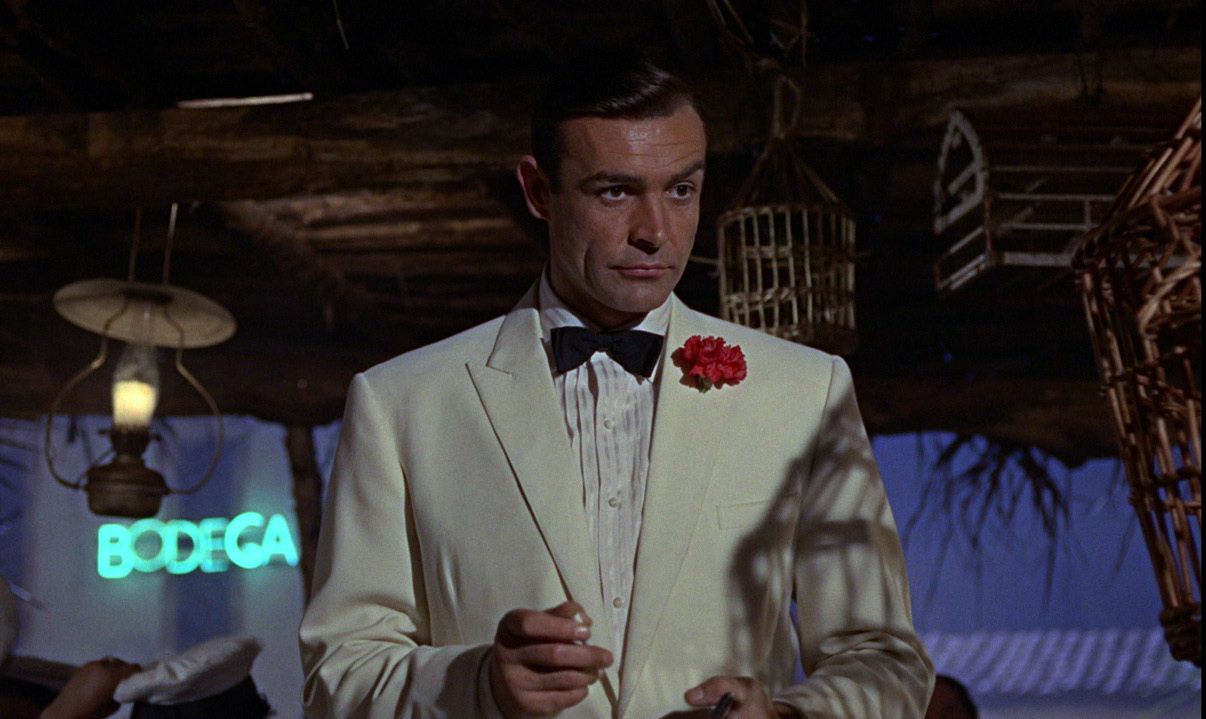
It took three films, but Goldfinger was when they got the James Bond formula spot-on. So spot-on, that all the James Bond films that followed would employ elements introduced here. This is where we got for the first-time: the pre-credits action sequence, Q, a gadget filled Aston Martin, a bizarre assassination tool, a villainous henchman with a bizarre skill, an outlandish scheme and Bond delaying being saved at the end for a few more moments of rumpy-pumpy. It’s Connery at the height of his powers, has a knock-out song, one brilliant sequence after another and marks the moment where Bond wisely severed any connection with the real world, like a laser slicing through gold towards our hero’s crotch.

On vacation in Miami, James Bond (Sean Connery) has a run in with Auric Goldfinger (Gert Fröbe), gold bullion millionaire and card cheat. During this his romance with Jill Masterson (Shirley Eaton) is cut short when she is killed by being covered completely in gold paint (a fatal case of the not-actually-real ailment “skin suffocation”) by Goldfinger’s silent steel-rimmed hatted manservant Oddjob (Harold Sakata). Bond is hungry for revenge when he is tasked by M (Bernard Lee) to find out how Goldfinger is smuggling Gold bullion. He finds out Goldfinger has an even more fiendish plan in the works, involving Chinese agents, a nasty gas, an all-female flying circus headed by Pussy Galore (Honor Blackman) and the US gold reserve at Fort Knox.

Goldfinger was a massive hit and pretty much lands somewhere near the top of any poll of the greatest ever Bond films. That’s because it’s just a massive explosion of cool fun. It’s exciting, funny, perfectly paced and has one scene after another that are so perfect, Bond films for the next fifty years would more-or-less repeat them again and again (taking it even further, A View to a Kill is virtually a remake of Goldfinger and even Quantum of Solace has a homage to death-by-gold-paint). Goldfinger takes place in a heightened reality of thrills and spills – unlike From Russia with Love or Dr No there is not even the slightest pretence espionage might work something like this – and barrels along with such pace and momentum it becomes a thrill ride you don’t want to get off.

The plot is actually rather close to Fleming’s original. Goldfinger’s plan has been tweaked, but the film still finds time for the classic “Bond takes on the cheating villain at a gentleman’s sport”, with Bond duelling with Goldfinger in a round of match-play golf (I like to think this is where Connery’s real-life obsession with the sport began, cunningly swopping the cheating Goldfinger’s ball on the final hole for default victory). But the film adds a playful, tongue-firmly-in-cheek quality. It manages to mix thrills with not taking itself too seriously, becoming a grandly entertaining thrill ride.

The re-working of the elements of the novel for the screen created an indelible template for Bond. Oddjob became a walking icon, his shadow instantly recognisable, invulnerable with a killing method – a steel rimmed hat he throws with Olympian accuracy – that’s a perfect mix of just-about plausible and utterly ridiculous. And also, of course, perfect to playfully imitate a home. What you can’t imitate is bombing around hill roads in a gadget-stuffed Aston Martin, but you can dream. The car chase is not only a show case for cool driving, it also lets you see each of the super-cool enhancements introduced by Q one-after-another (a pattern the series would follow time and again whenever a gadget-stuffed car appeared) and hammers home Bond’s super-cool confidence.

Connery was of course perfect for conveying that. In Goldfingerhe was still interested, clearly enjoying some of the best quips he got as well as just enough acting challenges – from Bond’s sad regret at anger at the death of no less than two Mastersons, to his terror at the prospect of being unmanned by a laser. That sequence has of course gone down in film history – from the striking image to the classic exchange “You expect me to talk?” “No Mr Bond I expect you to die!” – but a lot of it is sold from Connery’s desperate search for the right words to turn that machine off. Connery is cool but still just about vulnerable, cunning, smart and witty but also human. Who wouldn’t want to be so unshakeably cool that he can emerge from a wet suit (with a model seagull on his head!) unzip to reveal a tux, light a nonchalant cigarette while a factory explodes behind him, seduce a woman and then off a killer with a bathtub and a heater (“Shocking!”) – and that’s just the first five minutes!

Every scene in Goldfinger is a doozy. The playful cool of Bond outsmarting Goldfinger in Miami then getting his comeuppance (Connery is so cool in the film btw you forget that Bond is such a staunch conservative, he cheekily disparages the Beatles – that other icon of Swinging Sixties Brit Cool – to Jill as casually as he offs villains). That golf game in Kent (capped by a decapitated statue). Hillside driving with Tilly (with extra dodged bullets). Late night gadget-filled car chase. The first meeting with Pussy Galore (“I must be dreaming…”). Goldfinger’s briefing (his offing of all the attendants makes the whole thing even more funny, since its clearly just Goldfinger enjoying a bit of showing off). Bond dragging a nuclear bomb around an epic Fort Knox set. Oddjob surviving everything but a million volts. Goldfinger earning his wings in the film’s climax. It’s all terrific.

And it all works because it’s got the balance spot-on between cartoon and reality. You can see it come together in Ken Adam’s set for Fort Knox: the inside was all made up (no one would stack gold that high!) but people believed it was the real thing, because it felt like the Fort Knox we shouldhave. Goldfinger is a scowlingly wicked villain, with a little kid’s delight in his own naughtiness. Honor Blackman doesn’t appear until the film is halfway through, but is an assured, forceful, brilliant presence, more than a match for Bond (we’ll gloss over the slightly dated way Bond seems to ‘convert’ her from implied Lesbianism to – well perhaps bisexuality). The briefing sequence with a grumpy, unimpressed Q was so good Desmond Llewelyn would essentially repeat it another 13 times (only OMHSS and Live and Let Die would skip the “Now pay attention 007” sequence between this and TWINE). All of this has the bright, primary colour fun of a rollicking graphic novel.

You can watch Goldfinger about a million times – and anyone who has written a Bond film probably has, it was such a template for the next seventeen films that followed – and it would still thrill, excite and entertain you. Connery’s interest after this went downhill, and the magic wasn’t always recaptured – but this when Bond went from being a cool spy to a cultural phenomenon. Bond became the box-office franchise that would dominate cinemas for decades, the ultimate spy caper that others would be compared to. Goldfinger mixed silliness and seriousness perfectly, thrills and laughs, action and comedy. It’s a superb and hugely influential film. It’s one of the Best Bonds ever: it clearly has the Midas touch.

The Servant (1963)

Through a glass darkly: Dirk Bogarde and James Fox in a dark drama as master and The Servant 

Director: Joseph Losey

Cast: Dirk Bogarde (Hugo Barrett), Sarah Miles (Vera), James Fox (Tony) Wendy Craig (Susan Stewart), Catherine Lacey (Lady Agatha Mounset), Richard Vernon (Lord Willie Mounset)

Imagine a world where Bertie Wooster was a weak-willed, sexually confused drunk and Jeeves a malign force, to whom control over and destruction of his master go hand-in-hand. That’s the basic set-up of Joseph Losey’s masterpiece The Servant, a fascinating and brilliant exploration of class and sex in Britain in the 1960s, a lean, razor sharp, gripping and sinister film that lingers in your memory like a nightmare you can’t shake off.

Tony (James Fox) is a louche, rich young man returning home to Blighty, looking to expand his inherited fortune through dodgy property investments in Brazil. Before then, he needs a home to call his own – and a gentlemen’s gentlemen to run it. Tony hires Barrett (Dirk Bogarde), a scrupulously polite, observant man, able to meet every single one of his employer’s needs. But why is Tony’s fiancé Susan (Wendy Craig) so instinctively hostile to Barrett? And what is Barrett’s exact relationship with the housemaid Vera (Sarah Miles) he introduces into the house – and who quickly becomes the focus of Tony’s interest? Over time, the balance of power between servant and master becomes more and more uncertain.

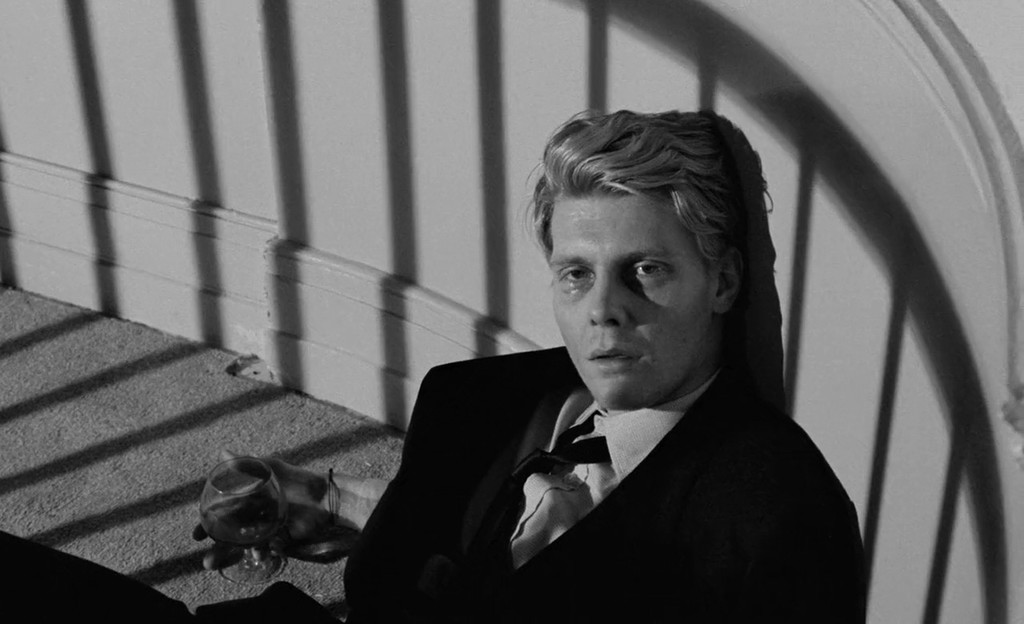
Losey was an ex-pat American, driven out of the country by the McCarthy hearings. This adaptation of a Robin Maugham novel is the sort of brilliant deconstruction of (and assault on) the British class system and manners that perhaps only an outsider) could have made. The film drips with an air of corruption and vice. Even the earliest, most unobtrusive frames carry an air of over-observant malice. No coincidence this is also the leading quality of Barrett, perhaps one of the most darkly malign forces on film, whose piercing intelligence sees everything and whose self-control never slips. Losey’s camera constantly lingers over the slightest shot and detail, to an increasingly unsettling degree. As the plot becomes increasingly dark, claustrophobic and horrifying, the film’s exploration of the class-fuelled psycho-sexual, alcohol-fuelled relationship between Barrett and Tony becomes ever more pointed.

Losey partnered with the perfect script writer in Harold Pinter (who also briefly appears as a posh restaurant goer). Pinter’s lean, spare and menacing dialogue, with its corrupted poetry and acute psychological insight, is easily his finest film script – and perhaps the only one that truly could sit alongside his finest stage work. Pinter’s brutal vision of this twisted world is coated in a dark menacing commentary on Wodehouse (Susan and Barrett’s “duel” over the placing of a vase comes almost straight out of Jeeves) – and above all on the weakness that underlies those dependent on servants, as well as the loathing a servant can develop for his master, while still loving the control he has over his life.

Losey responds to this masterful script with some inspired work, making the house where the action takes place increasingly claustrophobic and disturbing. The camera work slowly becomes more intimate as the film progresses – and Barrett entraps Tony increasingly into a total, infantile dependence on him. Takes become longer as the house itself – increasingly dishevelled, with Barrett’s property increasingly appearing throughout the property, while Tony’s goods are disposed of – seems to close in around the action. Reflections and mirrors increasingly dominate the film, as if pulling us with Tony through a glass darkly.

It’s a good servant who understands his master’s needs before he knows them. Barrett is the best kind of servant. Within seconds, the unctuous, Uriah Heap-like Barrett (ever so ‘umble), has dissected the character of the foppishly weak playboy Tony, and identified him as man with no will of his own, ripe to be dominated and manipulated. Dirk Bogarde has never been better than his work here, a terrifyingly precise and soulless manipulator, whose veneer of obsequious service drops away with his affected accent to reveal a deeply corrupted, terrifyingly cruel man. Bogarde never allows a second of doubt to enter Barrett’s mind – even when it (briefly) looks like he’s lost his position, Barrett’s face is contorted with a contemptuous curl of the mouth and a cocky defiance. It’s brilliant work from Bogarde, creating one of cinema’s greatest monsters, destroying because he can.

His tools are of course to use his master’s fondness for booze and pretty faces against him. Vera – played with a sparkingly flirtatious richness by Sarah Miles, which disguises her ruthless disgust for Tony and his selfishness – is inveigled into the house as Barrett’s “sister” (actually his mistress), and swiftly instructed to seduce the hapless Tony, bending this playboy to her will. Losey’s camera follows in smooth shots as this woman moves from one man’s bed to another – while you can feel the influence of Pinter in the spare, sexually charged power Vera uses to seduce Tony (and the hints of submissive excitement in Tony). Losey soundtracks their first encounter – Miles erotically discussing the weather, pure Pinter genius, while Fox’s throat is so dry you can almost feel it yourself – with first the dripping of a tap, then the rocking back and forth of a pan in the sink. It brilliantly suggests the way Tony himself seems to be being consumed in a hypnotic trap.

Not that Tony is particularly sympathetic himself: a weak-willed, rather feckless and languid playboy whose interests in pleasure quickly tip into addiction. James Fox is perfectly cast in a role that plays on his aristocratic assurance, but finds deep reserves of doubt and inadequacy in him. Pinter and Losey draw more than a bit of a question mark over the sexual undertone in the relationship between Barrett (at least metrosexual) and Tony, that travels across sharing the favours of Vera. After (temporarily) throwing Vera and Barrett out, Tony collapses into a grief-stricken mess over Vera’s bed – the bed shared with Barrett – the camera gliding gently over male nudes pinned to the wall. Later Tony will debase himself fully to Barrett, reduced to crawling around the floor, his tie used as leash, dragged to perform with prostitutes for Barrett’s dark amusement.

If there is a character who sees through this early it’s Wendy Craig’s sensitively played Susan – but even she can have no idea of the horrors of Barrett’s plans to break Tony completely to his will. Susan recognises – even if she can’t understand why – the sinister satanic nature of Barrett, even while she seems powerless to do anything about it. Her attempts to empower Tony to break his dependence on this omniscient figure fail completely. In a beautiful Pinterish touch, at the end she almost considers joining their bizarre, sex and alcohol fuelled menage – as close as cinema as perhaps got to skirting a sort of sexual hell.

The final act of the film (it has a neat three act structure, Pinter superbly constructing the screenplay to show Barrett and Tony’s shifting power relationship), sees an almost infantalised Tony now meekly accepting (almost apologising) as Barrett lets rip – all pretence at humbleness gone and Northern vowels increasingly let loose – with his abuse and disgust.

In a brilliantly dark commentary on the upper and serving class, such is the dependence on one for the other, that the house collapses in Barrett’s temporary absence. The power may lie with Tony – but when Barrett stops collaborating with that, the imbalance between them is revealed. It’s Barrett who can actually do things – from cleaning to cooking – that Tony cannot. The drive and will of the middle classes eventually overwhelms and breaks the upper class, turning them into a vehicle for their own entertainment, like some sort of dark National Trust.

The Servant is a profoundly brilliant film, one that could stake a claim for being one of the greatest British films ever made. Losey’s sharp outsider’s eye brilliantly dissects both the tensions between the classes, but also the disturbingly awkward relationship the British have about sex, a drug for the reserved, a pot of unspoken but deeply desired treats. Bogarde is quite simply superb, Barrett is one of the greatest monsters of cinema who could strike fear into the heart of Hannibal Lecter. Pinter’s dialogue is brilliant. This psycho-sexual class drama is a work of art and essential viewing.