
Tag: Robert Benton

Places in the Heart (1984)

Places in the Heart (1984)

Overcoming adversity and racism are themes not always successfully balanced in Benton’s family epic

Director: Robert Benton

Cast: Sally Field (Edna Spalding), Lindsay Crouse (Margaret Lomax), Danny Glover (Moze Hardner), John Malkovich (Mr Will), Ed Harris (Wayne Lomax), Amy Madign (Viola Kelsey), Yankton Hatten (Frank Spalding), Gennie James (Possum Spalding), Lane Smith (Albert Denby), Ray Baker (Sheriff Royce Spalding), Terry O’Quinn (Buddy Kelsey), De’voreaux White (Wylie)

Partially based on his own childhood memories, set in Texas 1935 as the Depression grips America, Robert Benton’s Places in the Heart is a tear-jerking tale of overcoming adversity, mixed with an earnest attempt to look at Southern racism. It’s often a little heavy-handed in the former, and a little fudged (if very well-meaning) in the second. Places in the Heart is a frustrating film with a genuinely engaging, engrossing story that, for various reasons, the film never manages to quite bring into focus, for all the undoubted skill in its making.

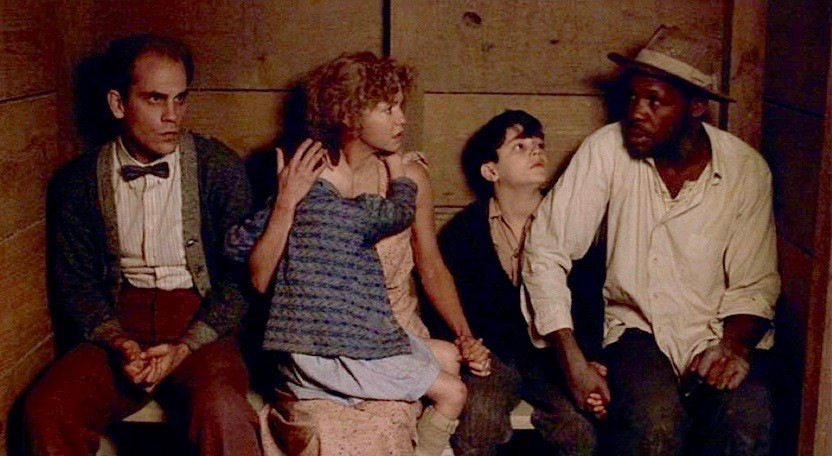
Sally Field plays Edna Spalding, a widow after her sheriff husband (Ray Baker) is accidentally shot and killed by a drunken Black teenager (promptly brutally lynched by the Klan the same day). With the bank pushing to foreclose on the farm she can no longer afford, poverty and homelessness seem certain until a chance meeting with Black drifter Moze (Danny Glover) offers hope. Moze is an experienced cotton worker, and he coaches Edna through getting the fastest cotton crop of the season (and the $100 prize for that feat). Edna and her children throw themselves into the task, and she starts to build a new family with Moze and blind war-veteran lodger Mr Will (John Malkovich). But will weather, the Klan and the banks allow it?

Benton’s film is, in many ways, a master-class in constructing a framework of highly impactful scenes. Places in the Heart is carefully paced with metronomic precision to give us an impactful, powerful scene roughly every ten minutes. From the shockingly sudden shooting of Sheriff Spalding and Edna cleaning his deceased body on her dining room table it gives us scenes that build perfectly to showcase high impact moments. Confrontations, tornadoes that place children in peril, triumphant confrontations with arrogant bankers and facing down corrupt cotton sellers, inevitable fireworks after a disastrous double date and heart-rending racist attacks. It’s a film almost completely constructed of tent-pole moments, to illicit maximum impact.

However, where it fails are the moments in-between. It’s so focused on nailing those big moments, that it allows the emotional journey that should inter-connect them (and make the story truly satisfying) to falter. The clearest example is Malkovich’s blind Mr Will: in no more than three scenes he goes from a man bitter at his disability, dumped on Mrs Spalding by a family who can’t be bothered to care for him, resenting her ‘hooligan’ children to risking his life to becoming their surrogate uncle. It’s a tribute to Malkovich that he sells this lightning fast emotional turn-around, but a more patient film would have spent this change feel organic (rather than, essentially, relying on a tornado act-of-God to complete the arc).

Similarly lightning fast work covers the bond between Edna and Moze: swiftly we go a few scenes from her greeting him with slightly less racist discomfort than her sister, to Jean-Valjean-like claiming she asked him to deliver to a friend the silver spoons he steals from her house, to him becoming another surrogate uncle to the kids and treated in the house like an equal (he notably doesn’t cross the door threshold for the first hour of the film). Now you can admire the efficiency here – for example, the film is good at establishing without fanfare the rope aids hung up around the farm to help Mr Will (vital for a later confrontation). But you can also regret that it is so keen to get to the emotionally cathartic moments, it skims on showing us the journey (after all, a one hundred mile walk seems less impressive if you only see the start and end).
Part of the problem is Benton keeps dragging us away from these engaging plotlines to wallow in a side-plot involving Mrs Spalding’s sister and her wayward husband’s affair with a school teacher. This storyline barely intersects with events on the Spalding farm, in no way serves as a commentary on events there (a braver film would have contrasted it with a romantic relationship between Edna and Moze, which you can be sure would not have been as genteelly resolved as that affair in a South as racist as this). All it really does – for all the efforts of Crouse (Oscar-nominated, presumably due to her husband-slapping confrontation scene), Harris and Madigan, it’s meandering, dull and feels pointless even while you are watching it.

And it always takes us away from the real interest on the farm. The depiction of triumph over adversity is fairly straight-forward – with a host of hissable strawmen, led by Lane Smith’s patronisingly sexist banker – but it’s told with such professional skill it can’t help but land.  Who doesn’t enjoy a woman who never believed she amounted to anything, suddenly discovering an inner-fire and sense of purpose she never knew. You may notice the similarity to Sally Field’s other Oscar-winning role (Norma Rae). Her performance here is cut from the same cloth, only this time she can’t find the same naturalness: she is frequently mannered, precise and actorly when she should feel raw, grounded and real.

The real daring interest here is the way the film tries to address racism. You can’t deny there is a certain romanticism in its looks at the Ol’ South, but its balanced with putting on screen something of the real horrors of racism. Perhaps even more shocking than the sudden shooting of Sheriff Spalding is the sight of young Wylie’s disfigured body dragged behind a truck full of gun-totting racists. (And that this is objected to, not for the violence, but for the poor taste of dragging a dead man to Spalding’s wake). Needless to say there is no investigation or punishment for this crime whatsoever.

Moze’s story captures some of the perils of being Black in Depression-era Texas. Danny Glover, in the film’s finest performance, perfectly captures both the anger of the unjustly oppressed and the fear (and shame of that fear) that death could come from the wrong word or looking at someone the wrong way. Moze constantly shuffles himself to the back, casting his-eyes down and changing the timbre of his voice to something slower and more humble when confronted with white men of power. It’s markedly different from the warmth, decency and sharp opinions he shows with people he trusts. And Places in the Heart’s most appalling moment is when he is confronted with the white-hooded face of the South’s ‘defenders’.

At times this sometimes over-balances a film that, at heart, wants to be optimistic. (As you can tell, all too clearly, from its bizarre, overly demonstrative, deliberately dream-like ‘we-can-all-be-the-same’ ending which must have felt meaningful to Benton but to me feels shockingly trite). Moze’s suffering is shown with real compassion, but he is still presented as a character who magically shows up at exactly the time he is needed and then disappears when his task is done. It’s a film that imagines a utopia where a desperate mother, a blind white man and a Black man can learn all men are equal, while struggling to accept that this is nestled in a land riddled with Klan racists where the n-word is so casually used it doesn’t even raise an eyebrow. In the end cold, hard reality is a little too much for Places in the Heart to digest.

Kramer vs Kramer (1979)

Kramer vs Kramer (1979)

Father and son post divorce are explored in this Best Picture winning look at the state of marriage in the 1970s
Director: Robert BentonCast: Dustin Hoffman (Ted Kramer), Meryl Streep (Joanna Kramer), Justin Henry (Billy Kramer), Jane Alexander (Margaret Phelps), Howard Duff (John Shaunessy), George Coe (Jim O’Connor), JoBeth Williams (Phyllis Bernard), Howland Chamberlain (Judge Chamberlain)

Kramer vs Kramer is a near perfect example of how time changes the perception of a film. On its release, it was the smash-hit of the year, scooping five Oscars. It took a sympathetic look at divorce and explored the then unthinkable idea that a single father could find fulfilment in taking on the woman’s role of caring for a child. Today, it’s more likely to be seen as a thinly veiled attack on feminism and a promotional video for Fathers4Justice. But a film can be a warm celebration of a father building a relationship with his child and an implicit criticism of women who want it all.

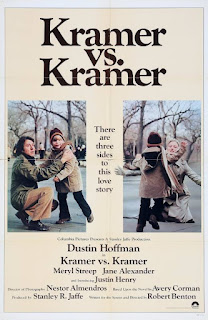
The film opens with Joanna Kramer (Meryl Streep) tucking her 7-year-old son Billy (Justin Henry) into bed, telling him she loves him, and then walking out of her New York apartment for good. She tells husband Ted (Dustin Hoffman) – a workaholic advertising executive – she is deeply depressed and has to find what she wants from her life. Ted, a loving but distracted father, has no idea either how to raise his son or run a household. At first, he resents Billy for distracting him from his career, just as Billy resents him for being unable to care for him as Joanna could. Eventually though, Ted and Billy build a loving relationship, with Ted placing Billy’s needs first. At which point Joanna returns and demands custody, a clash that will lead to the courts.

Benton’s film, adapted from a successful novel, is shot with a chamber-piece richness by Nestor Almendros and signposts its art-house credentials with a Vivaldi string score. It’s superbly acted. Hoffman (winning for Best Actor) is hugely committed, running a gamut of emotions from anger and despair to a joyful devotion for his son. Streep won Best Supporting Actress as the deeply-torn and conflicted Joanna. Hoffman and Benton draw superbly natural work from Justin Henry as Billy, an unaffected, completely unmannered performance. Benton marshals these three actors through a series of simply shot but often surprisingly affecting scenes, alternating between raw hurt, anger and tender forgiveness.

But this is a film that needs a sister film. Specifically, one that shows events from Joanna’s perspective. Although the film – at Streep’s insistence – tries to avoid demonising her feminist desire for more in her life than cooking and cleaning, it still gives short shrift to her departure. With the film’s focus on the heart-warming relationship between father and son, it’s very hard not to implicitly see Joanna as first a selfish abandoner and then a hypocritical antagonist trying to steal Billy. There is little attempt to not stigmatise Joanna as, on some level, a bad parent.

For all the film opens with a long hard look at Joanna’s face, struggling with the conflict between her depression and leaving her beloved son, there is no real effort to explain or understand what motivates Joanna to do the things she does. There are some half-hearted justifications very late in the film, during its courtroom sequences – but these only dip lightly into any turmoil Joanna must have been feeling. Worst of all, it’s all presented as something Ted has to learn to “forgive” rather than understanding it was a crisis he played a role in causing.

The film’s main focus is on Ted learning to become a father. Ted is a classic workaholic dad of the 1970s. He stays late at the office boozing with his boss, has literally no idea about Billy’s everyday schedule and is so inept at home that cooking French toast is completely beyond him. He has no idea about how to enforce rules with Billy, alternating between showering him with ice cream to keep him quiet and then vainly trying to re-enforce rules. (In a great scene, Billy slowly and deliberately sees how far he can push these rules as he first refuses dinner, fetches ice cream from the freezer and then starts eating it, all while Ted lamely states “Don’t you dare do that” – it ends of course with mutual screams of “I hate you”.)

What Ted does is learn to become a parent. Or rather, learn how to become a 1970s mother – since it’s a joke made time again that he is the only man dropping his son off at school, taking him to the park or attending his school play. Benton’s film takes some decent pot shots at the poisonous masculine world of work, as Ted eventually loses his job for letting his single-minded focus shift towards his son – his boss offers no sympathy at all for a man whose mistakes are due to his distraction by “woman’s work”. And the Ted at the start of the film would have agreed.

The relationship between Hoffman and Henry is beautifully played, a gently paced but very naturally flourishing of love and acceptance between two people who have had their lives shattered in different ways. The Ted we met at the start could never have run several blocks to the emergency ward, carrying an injured Billy (shot with a one-take urgency by Benton) – and then point-blank refused the doctor’s suggestion he needn’t bother staying with his son while the wound is stitched up. That Ted wouldn’t have taught Billy to ride a bike or helped him learn his lines for the Halloween play. For all its dated attitudes at times, the film deserves praise for the way it stressed that men could – and should – be this involved in the lives of their children.

It should be noted that Hoffman, at the height of his method dickishness, smashed a glass in this scene without warning Streep he was going to do it – her shock was real. Hoffman also made Henry cry for camera at one point by telling him, when filming was done, he would never see any of his new ‘friends’ on the set again. You see now why he was perfect for Tootsie?

But it’s not perfect. The final act, with the return of Joanna, sees both parents gearing up for a paternity battle– and having watched Ted and Billy spend nearly an hour and 20 minutes build a heart-warming relationship, we know where our sympathies lie. Even at the time, lawyers denounced the viciousness and one-sided result of this court case, which seems inexplicable given these two parents live only a short-distance apart with similar salaries. Not that it matters as the film ends with a puff-piece Hollywood fiction moment, as Joanna bravely sacrifices her custody because she recognises she can’t take Billy from his home.

Of course, what the film doesn’t do is acknowledge that Joanna spent essentially seven years doing the sort of all-consuming parenting Ted has only just discovered in the last 18 months. Neither does it do much to avoid suggesting Ted taking these tasks on is an astonishing act of character, just as Joanna abandoning them is an act of calculated selfishness. That’s not to attack the obvious love Ted discovers for his son. He even – eventually – confesses to his son that Joanna’s leaving was his fault for taking her for granted. But the film is so taken-up with the (admittedly beautifully done) relationship between father and son, that it neglects any exploration of the wife and mother beyond her (twice) being a cataclysmic event in their lives.

But it’s a film of its time. And in trying to at least show a divorce where no one was too much at fault and stressing a father could be as much of a parent as a mother, it was trying to do a good thing – even if it sometimes looks like an elderly relative who clumsily says something offensive while trying hard to be open-minded. The three leads are superb and the film has some genuinely heart-warming moments. It looks more and more flawed at times today, but this was trying to do something very daring. And nothing dates worse than daring.