
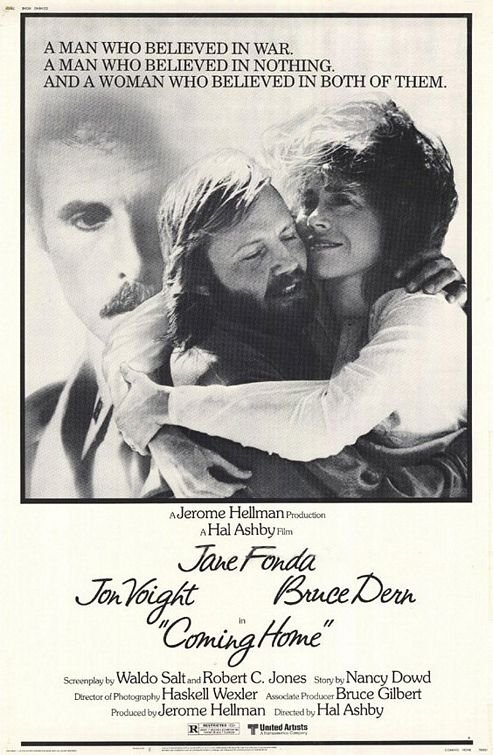
Emotional but a little too worthy Vietnam message movie, well-directed with great performances
Director: Hal Ashby
Cast: Jane Fonda (Sally Hyde), Jon Voight (Luke Martin), Bruce Dern (Captain Bob Hyde), Penelope Milford (Vi Munson), Robert Carradine (Robert Munson), Robert Gintu (Sgt Dink Mobley), Mary Gregory (Martha Vickery), Kathleen Miller (Kathy Delise)
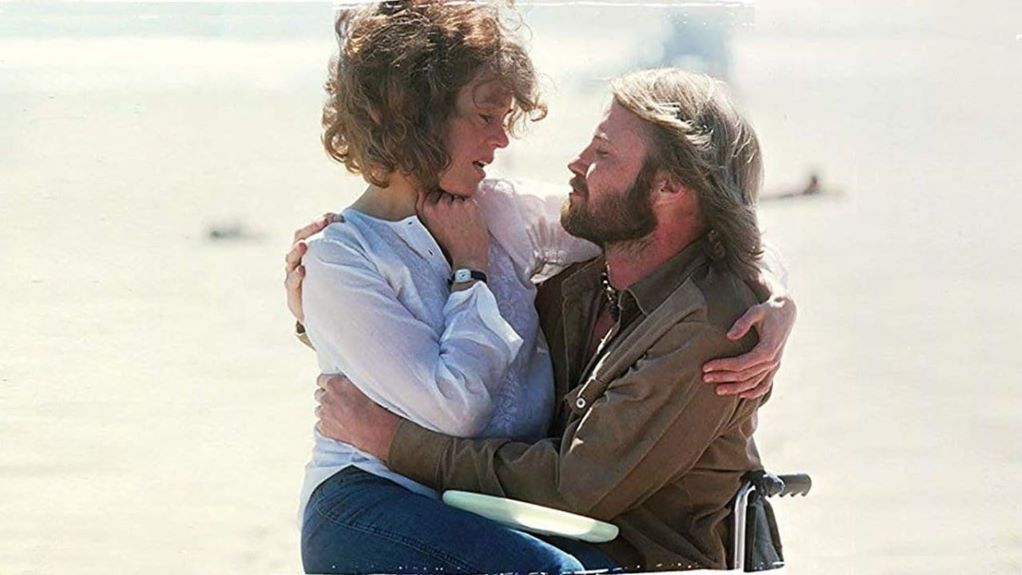
Vietnam is a jagged scar on the soul of America but, more than that, it’s been a literal scar for the veterans. Luke Martin (Jon Voight) was a college athletic star, now returned from the frontlines as an angry paraplegic, struggling with post-traumatic stress. Helping him – eventually – is old school-friend Sally Hyde (Jane Fonda), married to a Marine captain Bob (Bruce Dern) who has himself shipped out to Vietnam. Sally and Luke find themselves growing closer and closer emotionally, as their hostility towards the brutal war grows. But how will Bob – still loved by Sally and himself ever more scarred by trauma – react when he returns from the front?
Coming Home was released in the same year as The Deer Hunter and makes for an interesting comparison. While Cimino’s film is a horrific plunge into the grisly horrors of war, combined with a sort of mesmeric epic poetry, Ashby’s Coming Home is a quieter, more domestic piece, an earnest attempt to explore trauma. There is no doubting the passion of all those involved: but Coming Home is at times a little too earnest. Despite its moments of undeniable emotional impact, its sometimes feels a little too pointedly like a “message” film, worn a little too heavily on its sleeve.
But, saying that, there are many positives. It’s shot with a skilful casualness by Ashby, whose unobtrusive camera makes us a witness to events (at one crucial point it is even half obstructed by a door). Ashby has a poetic sensibility that flies in the face of what could have been its soapy roots. He lets scenes unfold with such ease and gentleness of touch that you only slowly notice how extremely well assembled the film is. There is a whimsical, lyrical sadness about the whole thing – matched with a striking lack of condemnation of people, only for a system that bends and twists human beings into killing machines.
It uses a parade of hit songs, but the songs play not as snippets but as full performances, playing out over several scenes, scenes which at first seem to be directly counter to the lyrics and tone of the song itself. Then you notice the skill with which the film has been edited to the beat of the music, and how much The Rolling Stones, The Beatles, Hendrix, Simon & Garfunkel, Bob Dylan and many others set the tone for a whole era. Coming Home captures this tone, an era of optimism crushed by brutal contact with the cold, dark realities of the world. The songs weave themselves in and out of scenes, capturing an overwhelming sense of a nation lost and confused.
It’s in this framework the relationship between Luke and Sally flourishes as Luke begins finding purpose in his life. Heavily based on the life of Ron Kovic, Jon Voight won an Oscar for his extraordinarily committed performance. From early outbursts of naked fury and pain, wheeling himself around on a hospital bed, his outbursts seemingly only prevented by medication, Voight charts the development of Luke as a humanitarian and compassionate man, committed to helping others overcome their pain and loss.
He also develops an attachment to Sally that transcends physical attraction: the two are kindred spirits. Fonda (effectively the film’s producer), generously takes on the film’s least interesting role as the disengaged, homespun Sally, increasingly horrified by the war’s impact on veterans – and the lack of interest from others (capturing the whole sweep-it-under-the-carpet attitude of the armed services, her military wives’ club refuses to include a report from Luke’s hospital in their newsletter because it’s too depressing). This translates into a deep attraction for Luke, the only other person who truly shares her growing resentment for the war.
Coming Home gained much attention at the time for its frank depiction of sex, with Luke and Sally tenderly overcoming the barriers of his disability. (Although today, their coupling – with Fonda replaced by a body double – culminating in Sally’s first ever orgasm feels a little too obvious in its comparisons with her passionless flings with Bob). But sex is less important than sharing their feelings, from Luke’s talk of dreams where he can still walk to Sally’s doubts about her life choices.
If there is a problem with Coming Home, it’s that the film doesn’t really know what to do with these characters other than showcase their pain. It tends to make sharp jumps – Luke’s recovery from initial rage to tender, thoughtful man feels very swift. And although Penelope Milford is good value as Sally’s best friend, struggling to deal with her veteran brother’s collapsing mental health, her plotline and performance is a little too obviously designed to contrast with Sally’s.
The basic problem with Coming Home is that in its rush to establish the fundamental decency of its characters – and the appalling horror of the war they are wrapped up in – it often avoids drama of struggle. It makes an interesting contrast with Zinnemann’s The Men which turned Brando’s paraplegic veteran’s psychological recovery into an entire movie: here Luke’s finding of a new purpose is as swift as his mood shift is.
The film’s most interesting plotline actually follows Dern’s Bob Hyde. Dern gives the film’s most complex performance as a dedicated solider, struggling with deep denial about his growing disaffection and unacknowledged PTSD, confronting his wife’s infidelity with a mix of anger and desperation to receive a comforting hug from her. Hyde’s discovery of the affair is its most melodramatic moment, but also strangely its most unpredictable – and a film exploring this character’s switch in perspective might just have been a little more challenging.
But Coming Home has plenty to recommend it. Voight has never been better, warm, tender and throbbing with emotion, his closing speech to a roomful of students exhorting them not to fight and choking back tears that taking another life is never worth it, is worth the price of admission alone. Ashby’s film has a poetic sensibility to it and if it sometimes feels a little too self-righteously earnest about its anti-war credentials, and a little too aware of its status as a “message movie”, at least it is a message that needs to be heard.
 Movie Musings