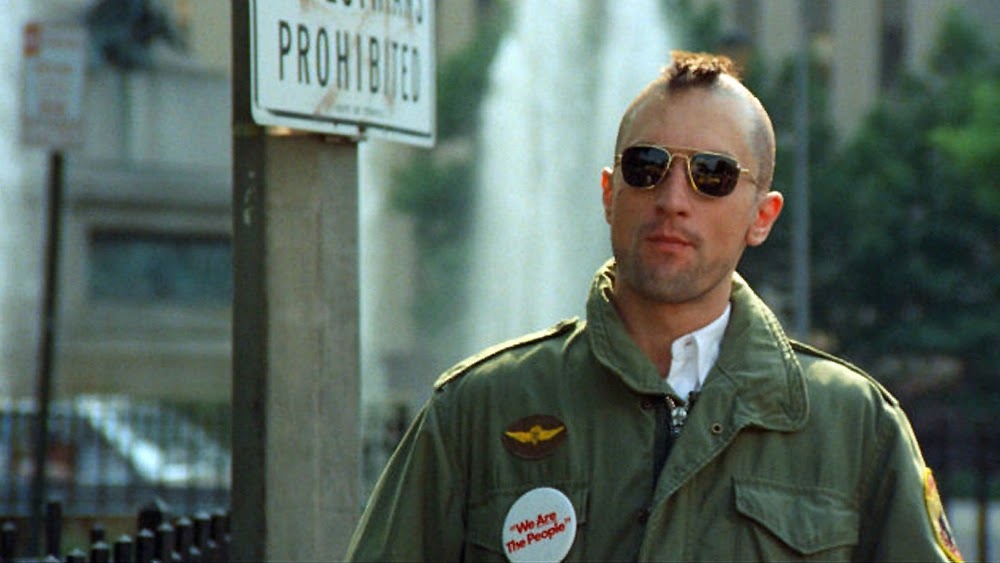
Tag: Robert De Niro

Taxi Driver (1976)

Robert De Niro embodies dangerous loners everywhere in Taxi Driver

Director: Martin Scorsese

Cast: Robert De Niro (Travis Bickle), Jodie Foster (Iris), Cybill Shepherd (Betsy), Albert Brooks (Tom), Harvey Keitel (Sport/Matthew), Leonard Harris (Charles Palantine), Peter Boyle (Wizard), Harry Northup (Doughboy), Steven Prince (Easy Andy), Martin Scorsese (Passenger)

A grungy taxi ploughs through the neon-lit back alleys of New York, the glow of stop signs and tail lights washing the car in a hellish red glare. Inside that taxi, the interior monologue of its driver tips ever closer towards paranoia and fantasy. It’s no surprise that something is going to give. Martin Scorsese’s influential Taxi Driver is the definitive exploration of fractured psyches, the key text in film for exploring how isolation, loneliness and an inability to connect with people can tip someone into being a danger to others.

Travis Bickle (Robert De Niro) is our taxi driver, an honourably discharged Vietnam vet who can’t sleep so works the night shifts. He’s seemingly quiet, shy, self-contained but this hides a desperation to connect with the world, a horror at what he sees around him that he can’t understand, a paranoid disgust at the crime and dirt he feels infect the street and a desire to be someone or do something. His failure to understand to or relate to the world on any level will eventually lead to a gradual collapse as Bickle determines that he must lash out at something, must attack something, to make himself a place in the world.

Taxi Driver is such a brilliant analysis of disaffection and confusion at the world, such an insightful understanding of how feeling separate and locked out from events around them can make a person feel they must act to make their mark, that it profoundly influenced the motivations of Ronald Reagan’s would-be-assassin John Hinckley Jnr in 1981. The film was even screened for the jury as part of Hinckley’s (successful) defence that he acted due to insanity (Hinckley claimed he was trying to impress Jodie Foster). Tragic as that is, it speaks something to the power of the film and its acute understanding (but not excuse) for lonely, fractured, potentially violent souls like Hinckley.

Scorsese’s direction is pitch-perfect. The film uses a series of tightly held shots – and some go on for a very long time, staring at trivial events (such as the shot of an empty corridor while we hear Bickle being rejected on the phone by his stalking target Betsy) – or stately intercutting between actors that brilliantly serve to establish both Bickle’s isolation and his lack of connection. This is intermixed with tighter editing that captures Bickle’s undirected fury and paranoia towards the real world, presented as he drives as a concussive collection of sounds and images that seem to hammer down on the taxi, combined with Bernard Herrmann’s superb classically tense score, lyrical but haunting. 

Every scene Scorsese constructs is designed to show Bickle’s isolation, his weakness and continual succumbing to fantasy and false perspectives. His internal monologue has a monotone fluency to it, but talking to people he’s tongue tied, clumsy or prone to tip into the rantings of a crazy man. Slow motion camera tracks show Bickle moving through crowds like an alien, unable to comprehend or understand what he is seeing, later prowling the frame like a misguided hunter. New York is a hellish underworld – although you are certain we are seeing it largely as Bickle sees it, every scene filtered through his disturbed POV (Michael Chapman’s photography by the way is faultless). 

It works so well because De Niro himself is so restrained, and at first feels rather sweet, even handsome, like someone who you want to look after or feel sorry for – a million miles from the mohawked gun totter he will become by the film’s end. He’s quiet, shy and desperate for friends. He can manage bursts of seeming like a compelling person – his fooling of Cybil Shepherd’s Betsy into a date is a tribute to his ability in short bursts to appear charmingly eccentric. The date of course flounders on his inability to understand human norms (buys her a record she says she has, takes her to a porn film, points out he has a taxi when she tries to get into one to leave), and his response to it is of course to get angry and make a scene, to blame the other person for his own failings.

De Niro immersed himself in the dark psyche of this man, and never loses touch of the gentleness and vulnerability that underpin his violent actions. Bickle talks the talk often of a crazy person, but by his own lights he’s a well-meaning man. It’s just that his well-meaning actions involve multiple murders, and it’s only by a twist of fate that he guns down a house full of pimps and gangsters rather than putting a bullet through a Presidential candidate.

And that’s the scary thing about the film: Bickle is strangely sympathetic, for all his obvious psychosis. Who hasn’t felt alone and lost in the world? Who hasn’t felt scared by events around them or dangers unknown? Who hasn’t wondered “why don’t people like me”? We just deal with it a lot better than Bickle and his messianic sense of mission that he develops.

Bickle channels what human emotions he can muster or understand into ciphers he barely knows. These people become totems, or stalking targets, who he becomes persuaded must be “saved”. With Cybil Shepherd’s Betsy, the delusion is clear: here is a confident, career woman, independent and smart, for whom Bickle can feel an attraction but clearly no understanding at all beyond her being an object he cannot have. The awkwardness and later stunningly poor judgement and reactions he shows when around her mark him immediately as a weirdo and danger to others.

But the film’s smarts – and it has a terrific script by Paul Schrader, whose understanding of dark psyches was never better captured than here – is that these fixations have a totally different impact when targeted on a child prostitute. Suddenly, Bickle’s unwanted attentions have the air of righteousness, even though intellectually he makes no distinction between either Betsy or Jodie Foster’s Iris (a performance of staggering emotional maturity from an actress barely 12 at the time). For all Iris is clearly a victim of society and abuse (in a way Betsy isn’t), for Bickle she’s pretty much the same, someone he must ‘rescue’ – and from her pimp Sport (a disturbingly fey and incestuous turn from Harvey Keitel).

So Bickle takes up the guns, and eventually does what we all wish we could do sometimes. Because who hasn’t stood in front of the mirror and dreamed about saying “you talkin’ to me” to our enemies – the difference being most of us don’t fantasise about blowing them away, let alone actually go on to do it. De Niro’s brilliance is the chilling emptiness behind the exterior, the way he captures universal fears and doubts but shows us a character who has no personality of his own but only collects titbits from those around him (like his would-be murderous passenger – played by Scorsese himself – who eagerly talks about how he wishes he could murder his cheating wife).

So the violence comes – and it is horrific – as Bickle shoots up a lowlife prostitute den with sickening graphicness (nothing this violent had really been seen before). But it’s only fate that has turned him away from his real target, Senator Palatine (George Lucas must have had this film in the back of his mind when naming his Evil Emperor!), reverting to his secondary target and killing a group of people far more acceptable to Joe Public to be wasted.

Scorsese’s genius final epilogue asks us questions about truth but also perceptions. The camera takes on a “God’s view” POV overhead shot as Bickle’s slaughter ends (and De Niro’s jerky, terminator like physicality here is stupendous), tracking back through the house. Is this his soul leaving a dying body? But then we flash forward and there is Bickle in the taxi again, hailed as a hero by society for rescuing the girl – the same society that would have condemned him as psychopath if he had taken his first target. He even gets a sympathetic conversation with Betsy.

But he hasn’t changed. And the world hasn’t changed. And Bickle may be a hero now but the same dark impulses still ride within him – and they will, the film suggests, lead him to kill again. Scorsese’s film is a masterpiece of alienation and disaffection, a brilliant analysis of what makes a killer kill – and how vagaries of fate can see us miss the signs – with a wonderful script and a superb performance from De Niro, a landmark turn that manages to tap into such existential fears we all have on our place in the world that we completely miss we are starting to relate to a psychopath. Dark and brilliant, a landmark.

The Godfather Part II (1974)

Al Pacino defines his career (and film history) as The Godfather Part II

Director: Francis Ford Coppola

Cast: Al Pacino (Michael Corleone), Robert Duvall (Tom Hagen), Diane Keaton (Kay Corelone), Robert De Niro (Vito Corleone), John Cazale (Fredo Corleone), Talia Shire (Connie Corleone), Lee Strasberg (Hyman Roth), Michael V. Gazzo (Frank Pentangeli), GD Spradlin (Senator Pat Greary), Richard Bright (Al Neri), Gastone Moschin (Don Fanucci), Morgana King (Mama Corelone)

For what shall it profit a man, if he shall gain the whole world, but lose his soul? It’s the question that drives this triumphant, Oscar-laden, sequel to Coppola’s cinema-defining masterpiece, The Godfather to create what is, without doubt, the greatest one-two punch in cinema history, two films that develop and contrast each other naturally it’s very easy to consider them as one perfect film.

It’s 1958 and Michael Corleone (Al Pacino) has seen his power grow to control Crime across several states. However problems confront him including rivalry from Hyman Roth (Lee Strasberg) his business partner, a disaffected capo Frank Pentangeli (Michael V Gazzo) talking to a Senate investigation and growing tensions in his marriage to Kay (Diane Keaton). The story is intercut with the rise to power of his father Vito (Robert DeNiro), a man raising his family in Little Italy and realising the temptations of a life of crime.

Happy with just one Godfather film, Coppola only agreed to a second in return for a pile of cash and complete creative control. He used that to create a film even deeper, richer and mesmeric (perhaps) than the first film. While The Godfather is high grade pulp fiction, shot and assembled with arthouse skill and layered with depth, Part II is a profound family saga, an arthouse epic spliced with rich vein of pulp fiction at its heart. A multi-generational story that illustrates the dark corruption at the heart of America from top to bottom, it also demonstrates the stark differences in personality and action between two ruthless, authoritarian father figures who do all that they do in the name of family, one of whom sees that family prosper and grow around him, the other who destroys everyone near to him.

Coppola’s film removes much of the slightly cuddily family element from the Corleone family to show a darker, bleaker, chillier movie than its landmark predecessor. Coppola uses his control to expand and deepen the Corleone saga both in the past and present, but also in the dark hearts and secrets of a family built on crime, extortion and murder. It’s a thematically rich, engrossing and beautifully assembled piece of film-making. Exquisite in every touch and beat, completely convincing and breath-taking in its confidence it is clearly the greatest sequel ever made.

The film charts the final descent of Michael Corleone into the dark recesses of his own worst desires and instincts. The brutal, unforgiving, unrelenting coldness and absolute certainty matched with the overwhelming hunger to win that has left him hollowed out and unrecognisable from the naïve, idealistic young war hero we were introduced to at the wedding that opens The Godfather. Of course, even at the start of the film, as Michael holds court with a chilling coolness and maintains only awkward contact with his family – all of whom must submit to him and his wishes or face lethal consequences – it’s clear that the man who talked of “it’s my family Kay, it’s not me” is a long, long way away.

During the film we see Michael seem to harden even further, an adamantine chillness captured superbly by Al Pacino. In, without doubt, the greatest performance of his career, Pacino restrains bar maybe three times, the explosive energy and ferocity that has been the hallmark of his career (a feat that allegedly made him physically ill). Instead, he presents a Michael who is an almost pathologically cold fish, a fiercely intelligent, scheming observer with eyes that observe and understand everything, jet black boreholes that suggest only whirlpools of emptiness behind them. He’s unrelenting, lacks any doubt and (it becomes clear) has not a vestige of pity left in him, with empathy forced out of his body like water from a squeezed sponge. Pacino prowls every frame like a quiet tiger, oozing sharpness, intelligence and lethal, ruthless ambition.

Everything is done to protect and secure his family and its legacy, but each action seems to strip him one by one of everyone he claims to be protecting. His children seem to live in intimidation and later terror of him. His wife turns from misery to loathing to being ejected from the family home, even aborting her pregnancy to prevent herself bringing another Corleone into the world (a reaction that leads to a final, relationship severing explosion of rage from Michael). His brother Fredo, poor sweet, foolish Fredo, is sacrificed to an unrelenting desire for revenge. The man who did everything for “the family” ends the film by having his last surviving brother executed. The brother who, the film’s coda reveals, was the only member of the family to support his signing up for service in World War Two.

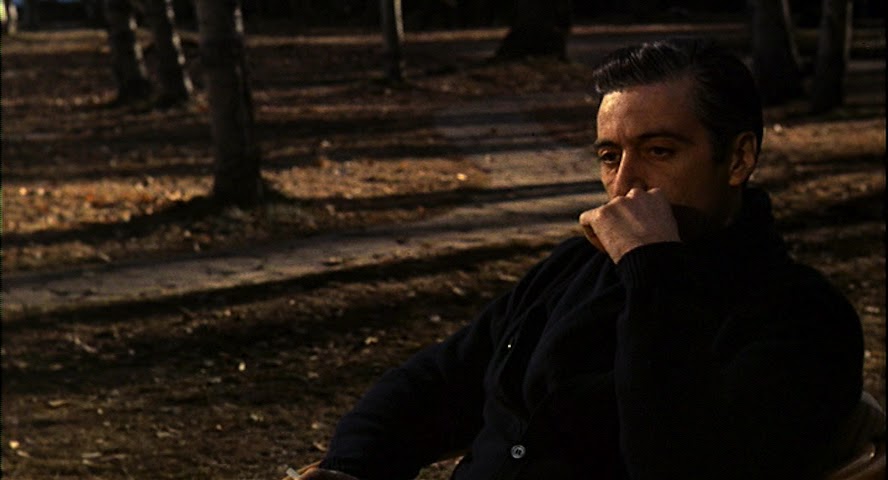
As Coppola’s camera drills into the face of Michael, cold, greying, alone in an autumnal garden – and how often the film simply studies the ruthless calculation of Michael, the man who understands every move everyone makes before they even make it – you know we are looking at a man who has damned himself, who has destroyed everything who claims to hold dear while working to protect it.

Brilliantly, Coppola intercuts the storyline of Michael’s damning collapse into complete moral damnation with the rise of his father. The Young Vito Corleone – played with Oscar-winning skill by De Niro who superbly channels the basic facets of Brando’s performance mixed with his own charm – arrives in America to find it a land as in thrall to the rule of the gangs as his hometown in Sicily. Like Michael in the first film, he is tempted by the world of crime and finds he has a natural aptitude for it: like his son he is a man who people follow, and the man who has the will to do what must be done. Like him he is an empire builder who commands respect and honour.

But unlike his son, he is a man capable of warmth, of empathy. He is man who can be playful, who respects others, who can feel forgiveness, who sees others as people, not just (as Michael does) simply being tools to be manipulated. Vito may be a murderer like his son, but he loves his wife, he loves his children and he can form bonds with them – natural, warm, loving bonds – that Michael can only dream of doing. For Vito it is all about the family, and providing for them is what inspires his actions. For Michael it’s words, but for Vito – it is everything.

Coppola masterfully intercuts these two storylines so they brilliantly comment and contrast with each other. Each step of Michael’s struggles to overcome the plots around him, are perfectly bookended with contrasting moments of Vito’s own rise to power, and the bonds of loyalty he builds even as Michael destroys those own bonds in his own life.

But then Michael is dealing with high stakes. While Vito’s early life shows Mafiosi running Little Italy, and calling the shots on the neighbourhood, a local tradition inherited en masse from the mother land, Michael moves in the worlds of government corruption. The empire we see Vito start to build is destined under his son to interfere in the rule of whole countries in Cuba, and commit unspeakable crimes to bring Senators and witnesses under their control in Senate Hearings into Organised Crime.

Coppola had intended the storyline around the reluctant family witness to be Clemenza, but Richard Castellano famously refused to reprise his role unless he was allowed to write his own dialogue. (The Godfather Part II was blighted with actor disputes: Brando refused to reprise his role in the film’s coda, while James Caan was paid more for a day’s work than he was for the whole of the first film). Instead the role was passed to Michael V Gazzo (Oscar nominated) as Frankie Pentangali, a loud-mouthed Capo manipulated into thinking he has been betrayed by the family. This threat hangs over the second half of the film – but Michael barely seems to break sweat under interrogation.

He has more problems with the Meyer Lansky inspired Hyman Roth (played by Pacino’s teacher, the legendary Lee Strasberg – also Oscar nominated). Roth it is who immerses Michael in a corrupt takeover of the Cuban government by the Mafia – an attempt foiled by the revolution – and Roth who becomes his nemesis, an old man in a hurry, who believes he can match the ruthlessness of this man without a soul. Coppola’s scenes of Cuban excess – not to mention the danger on the street as the country starts to tear itself apart – are of course masterful.

Cuba destroys Fredo, a snivelling John Cazale (inexplicably not nominated, despite extraordinary work here – never mind nomination he arguably should have won). Cazale’s Fredo is endearing but simple, a fundamentally weak man in a family of wolves, whose guilt is almost embarrassingly easily unveiled. Petulantly – but terrifyingly – raging late in the film at Michael at being passed over, he sits (sweaty and veins throbbing) in a reclining chair that bounces on each point he makes – a simple touch that makes him seem more and more impotent and pathetic every second.

The film echoes much of the structure of the first film, but here retold with a chilling coldness as the warm heart that – for all his crimes – Vito bought to this family is removed. The opening family event, Anthony’s confirmation, is a public show with no personality at all, where the Italians feel all at sea, their culture not known or cared for. Doors are closed on Kay with an alarming regularity – their marriage is so non-functional that even at the start they seem to have very little to say to each other. Vito returns to Sicily, as Michael did, but this time to extract revenge for his parents not to fall in love. The ending of the film culminates in a dark, ruminative and tragic hinged cleansing of Michael’s – crucially not the families but Michael personally – enemies.

The film is blessed with a brilliant array of supporting turns, from Diane Keaton’s soft-faced sadness masking deep and lasting resentment as Kay, to a flashily amusing tone from GD Spranlin as the greasily corrupt Senator. Robert Duvall does unsung but powerful work as a Tom Hagen coldly loyal, perhaps even in slight fear of his adopted brother, but despite his seeming decency willing to carry out truly terrible deeds for the family. Talia Shire (also nominated) is great as the rebellious Connie who pleads in vain for Fredo’s salvation.

This is all beautifully packaged together by Coppola into a film that meditates on the building and the destruction of a family, two stories neatly told together in parallel, with each echoing the other. It is a film shot at a riveting but controlled pace, that uses the classical filmic style of the original but mixed even further with the genius shooting of Gordon Willis to add a dark tinged 1970s style to ever shot. The film is an art house classic, but also a superb plot boiler, a gangster film that tells us profound truths about the attitudes that make us men and those that destroy us, just as it suggests that the darkness at the heart of crime will eventually consume the very thing it starts out to protect (even if it does take generations). While it is not as entertaining or engaging perhaps as the first film – it is perhaps an even greater achievement, a superb triumph of atmosphere and tone and a terrifying insight into the darkness that man can achieve.

For at the end Michael has won utterly. But he is also utterly defeated.

The Irishman (2019)

De Niro and Pacino under digital facelifts bring to life Scorsese’s meditative The Irishman

Director: Martin Scorsese

Cast: Robert De Niro (Frank Sheeran), Al Pacino (Jimmy Hoffa), Joe Pesci (Russell Bufalino), Ray Romano (Bill Bufalino), Bobby Cannavale (Felix “Skinny Razor” DiTullio), Anna Paquin (Peggy Sheeran), Stephen Graham (Anthony “Tony Pro” Provenzano), Stephanie Kurtzuba (Irene Sheeran), Jesse Plemons (Chuckie O’Brien), Harvey Keitel (Angelo Bruno)

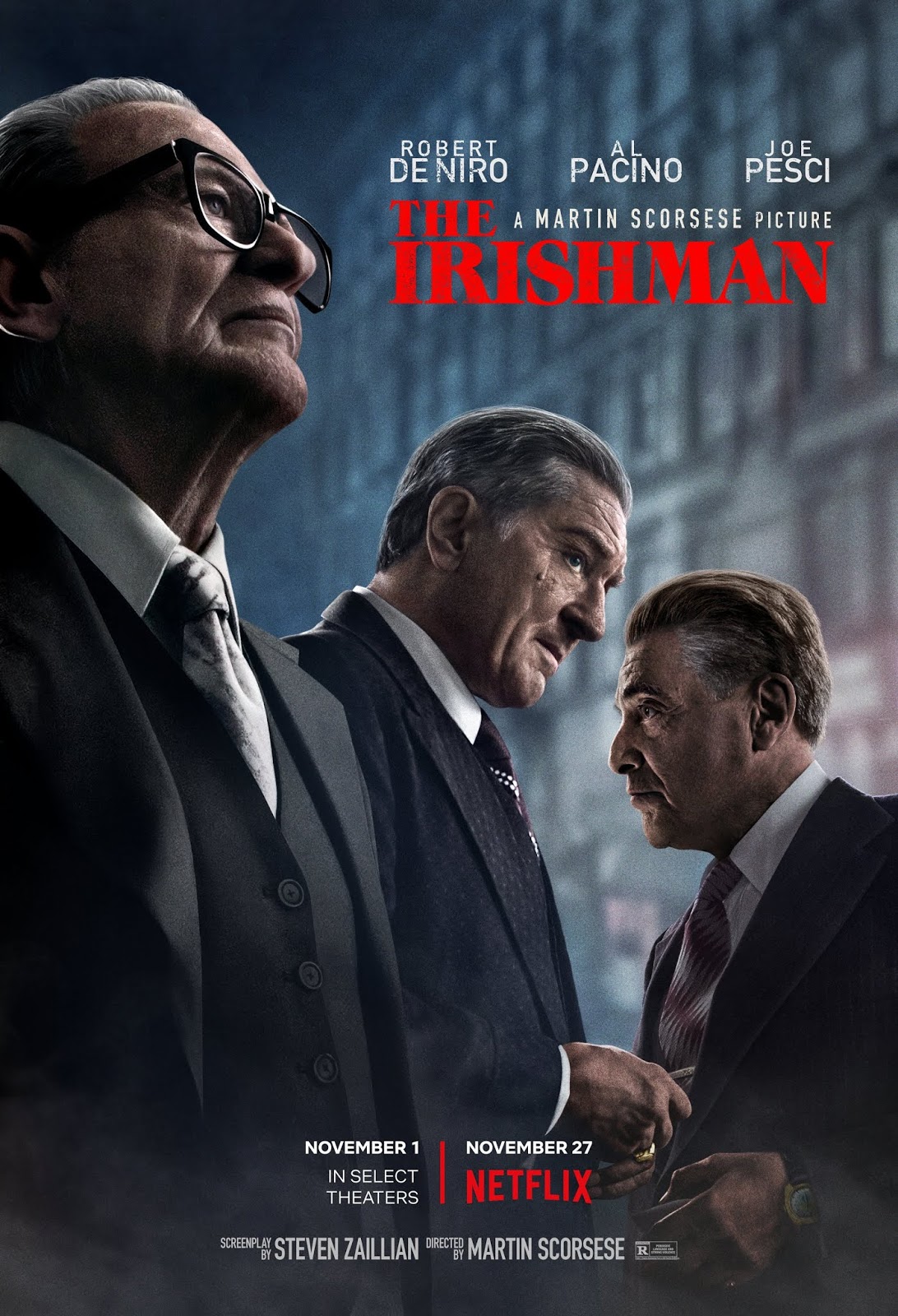
Scorsese had wanted to make this film for almost 20 years but it took the mega bucks of Netflix (to the tune of over $150 million) to finally bring it to life. With complete creative control, we get Scorsese’s epic as he saw it, an over three-and-a-half hour long sad meditation on the life of the gangster. For the first time in almost 25 years, Scorsese is reunited with his muse Robert De Niro – appearing here under various digital facelifts to tell the story of Frank Sheeran, an Irish member of the Mafia, and his relationship with infamous Teamster union leader Jimmy Hoffa (Al Pacino). Was the film worth the effort to make it?

I first saw The Irishman in the cinema. I now feel that was a mistake. This is a film that needs to be soaked in like a warm bath. Like reading an involving novel, it needs to savoured and consumed at your own pace. In the cinema in one take – with no intermission – its runtime is punishing. It’s the worst form of criticism but in one take, the film can overstay its welcome. In fact it can become a little boring.

Re-watching the film a year later at home – where I could break it up into three chunks as (I feel) so many people have, it becomes a richer and more engrossing viewing experience. Because this is a totally different beast to Scorsese’s previous gangster movies, a quiet mood piece, contemplative, sad, a genuinely tragedy-tinged, doom-laden reflection on the emptiness and costly violence of the gangster life, and the empty shells it leaves of the people in it. And at its centre, a man so dehumanised by war, by obeying orders, so lacking of personality, so incapable of emotion it seems, that he ends the film as a blank, lonely, abandoned slate. It’s a real, and deliberate, counter-point to his electric gangster films of the past, from Mean Streets via Goodfellas to Casino and the cartoonish The Departed. Here the price of doing business is your soul – and when that final bullet comes (as it inevitably will) you have nothing to show for it.

It makes for a late Scorsese epic – nearly a TV mini-series – slow-paced, wintery and a perfect counterpoint to Goodfellas. There crime is ruthless but you can see it’s also fun. Here it’s hardwork, unrewarding and inevitably leads to a bloody demise. Time settles on the shoulders of its leads like deadweights and their is a weary sadness as they trudge from one feud to another, each of which can only be resolved by putting another body in the ground. And everyone knows that the next feud might well mean it’s their body that will end up six feet under.

Frank Sheeran is a drained automaton, a human being possibly in name only, who takes on violent acts without question, who can kill without remorse. This is the very picture of a second-tier career criminal, a man who takes orders and carries out missions. De Niro brilliantly creates an sociopathic monster, a man almost devoid of his own personality, with little to him but a taciturn killer. Sheeran is a tough character to relate to or understand – but that’s because he’s not really a character at all. Interestingly he doesn’t have the sort of flaws that undermine other Scorsese gangsters, like Henry Hill. His flaw is in fact his entire existence. His sociopathic acceptance of violence, his thoughtless carrying out of killing, his inability to relate to human beings. It’s what leaves him alone, unloved and isolated in a care-home. This is a man who can barely muster much emotion about killing his best friend, whose quiet, placid nature perhaps only hides his lack of capability of even experiencing emotion.

The Teamster union politics content of the film is often dense and hard-to-follow. At times it tips into being not that interesting. So it’s tough that it takes up almost two hours of the film’s run-time. It’s a sign of the films overindulgence. At the end of the day I’m not sure it adds much to your overall impression of the film. But reviewing the film perhaps that’s the point. The very shallowness and even pettiness of this feuding – not to mention the naked, unromantic greed – over how to distribute union pension money, explodes the myth of any romance to this crime. These are blue-collar conmen, using violence as a way to conclude a board meeting.

As Jimmy Hoffa, Al Pacino is the best he’s been in literally decades – the film uses his “hoo hah” shoutiness to great effect, but Pacino also makes Hoffa an unexpectedly vulnerable and lost figure amongst all the politics, a showman who overestimates his importance and invulnerability. The entire film is shaped (we discover) around a series of flashbacks from Sheeran on a road trip on what turns out to be the final days of Hoffa’s life (the film includes a solution to Hoffa’s famous disappearance). De Niro and Pacino spark beautifully off each other as a bond forms between them – the films lingering on their growing friendship (and at times strangely homoerotic intimacy) one of its strongest elements, as well as carefully demonstrating how disloyalty is a crucial survival skill in this world.

The film strongest elements are the doom-laden nihilism of the gangster life. Told by Scorsese deliberately without flash and excitement, with a score so sparse that long stretches of the film echo with silence, there seems to be no fun at all in the gangster world, instead a series of mundane men sitting in small restaurants, talking about admin and punching the clock. Many of the gangster characters are introduced with on-screen captions that detail the dates and natures of their violent deaths. It’s the exact opposite of what you might expect from a Scorsese film. It’s a director showing the dark flipside of his previous films, of the way the gangster life is a dwindle through a dull life marked with moments of danger, where death is a sudden violent explosion that ends a life too soon.

And it leaves families in a mess. Anna Paquin speaks very few words as Sheeran’s adult daughter, but only because her silent disapproval and disgust at her father’s life becomes the haunting of Sheeran’s whole life. His daughter’s silent disgust is a recurrent theme (even from childhood, she is repulsed by his capacity for violence and his heartlessness). Sheeran’s attempt to break through her silent disapproval, to get her to acknowledge him in some way becomes a large part of the sad coda of Sheeran’s life. It’s all part of Scorsese’s message: what is the point of a life like this that brings wealth and power, but also leaves you broken, lonely and despised by everyone around you?

And you can’t argue with the skill with which this quiet, meditative, grim and slow exploration of the gangster world is put together by Scorsese – or the artistry that every moment of the film has, or the control of the director. It’s beautifully shot and edited. It’s pace is at times glacial, but this is resolved by watching at your own pace on Netflix. It’s not a film to be binged (ironically Scorsese has made a television novel that he wants you to watch in one go) but instead one to be savoured and considered. That’s where it’s strengths are.

There are also excellent performances. Joe Pesci, lured from retirement, is outstanding. He’s a revelation as a sort of cool, calm, grandfatherly fixer a million miles from the lunatics he played in Casino or Goodfellas. Pesci quietly dominates several scenes, using stillness and quiet like a vicious badger who knows he only needs to swat once to remove his foes. This is a performance of beautifully judged grace and stability, a calm reflectiveness that carries a vicious coldness at its heart. Russell may prefer a peaceful solution – but he will order your death without thinking twice. Also excellent is Stephen Graham as the sort of dangerously impulsive bully Pesci played to such great effect in those earlier movies.

And those famous digital facelifts? Well they are fine technically. You ignore them after a while. But no matter of digital trickery can make De Niro move with the gait, physicality or certainty of a man more than 30 years younger than he is. As we watch De Niro (supposedly a killer in his prime) shamble forward, or gingerly give a rude grocer a kicking, you can’t forget that he’s really a much older man. To be honest the film would have been just as good – maybe better – with actors the correct age filling in for the younger roles. Watching it again, I’m never convinced that I am watching a De Niro the age he was in Mean Streets or even Goodfellas. To be honest, at times the facelifts don’t look a lot more convincing than hair dye and a little tape to stretch the skin back.

In fact the digital facelift at times is almost a metaphor for the film: it’s a film where age and time are a constant presence. Knowing the lead actors are old men, trying to look young kind of sits with that. These are not dynamic, triumphant young men. But then they never were. These are men who feel the burdens of the world on their shoulders every day. Who at the end of their lives will have nothing to show for it over than a satisfaction that they managed to live slightly longer than they expected. Whose friends and family will hate them and who find they sold their souls and gained nothing but dust in exchange. Long, slow, sometimes trying – but on a second rewatch, also compelling, thought-provoking, heartfelt, insightful and inspiring.

Joker (2019)

Joaquin Phoenix goes all out as Joker

Director: Todd Phillips

Cast: Joaquin Phoenix (Arthur Fleck), Robert DeNiro (Murray Franklin), Zazie Beetz (Sophie Dumond), Frances Conroy (Penny Fleck), Brett Cullen (Thomas Wayne), Glenn Fleshler (Randall), Leigh Gill (Gary), Bill Camp (Detective Garrity), Shea Whigham (Detective Burke), Douglas Hodge (Alfred Pennyworth), Marc Maron (Gene Uffland)

The mystic of Batman’s nemesis the Joker is his unpredictability, his other-worldly insanity laced with malicious viciousness and an anarchic sense of fun. There is a reason such an electric character has been the go-to for so many Batman related films – and why people are drawn time and time again to re-exploring him. With the DC Universe struggling, it makes sense that a stand-alone film around the most-popular, most-famous comic book villain of all time would be attractive. It’s been a massive success, but is it truly a good movie? I’m not so sure.

Arthur Fleck (Joaquin Phoenix) is a struggling professional clown in 1981 Gotham City, living with his invalid mother Penny Fleck (Frances Conroy). A run-down, dirty and no-good town with astronomical divides between the haves and the have nots, Fleck is a guy who can’t make the world work for him. Dreaming of a being a professional stand up and appearing on the popular nightly talk show hosted by Murray Franklin (Robert DeNiro), Fleck is actually a maladjusted, bitter outsider and fantasist who struggles to adjust to the real world. Will the idea of taking brutal vengeance on those around him, be eventually to tempting to resist? Hey: why so serious world?

Joker is a grim, trying and rather uninvolving film that even contained within a fairly tight two hours still feels like it drags on way too long. It perhaps feels like this because it signposts all its major narrative developments far too far in advance, meaning very little if anything surprises you. Fleck is essentially a time bomb waiting to go off, and everyone knows by the film’s final act he will do. The long wait to get there doesn’t really give us anything fresh or interesting to think about, other than presenting a comic book world mixed with the grimy atmosphere of classic Scorsese films. It’s a film made by people who love classic urban Hollywood films – but who seem unable to bring anything really fresh to a series of ideas better film makers have already had.

Instead it’s a film that relies heavily – in fact is completely dependent on – its inspirations, torn from comic books, other films and news bulletins. Your understanding of Fleck’s character arc is dependent on having some sort of visual image in your head for the Joker. Your appreciation of the film’s style and tone relies on you having seen Taxi Driver and King of Comedy. Your reaction to the sudden growth of flash-mob violence in Gotham depends on you knowing about these attitudes in the real world. The film largely fails to develop any of these ideas organically within itself or its own narrative, but instead throws them to the screen knowing that we will do the work of making them stick on our own with our past associations.

As the film doesn’t really try and build its own ideas, or really try to take ideas from anywhere else to really original places (apart from a few Joker developments which I’ll talk about later), for people who are familiar with its themes and inspirations, it just manages to make for a rather dull watch. The Joker character has been done better elsewhere, King of Comedy and Taxi Driver are films so full of depth and interest around maladjusted losers, stalkers and fantasists yearning for recognition, that this film’s showy coverage of the same ground come across as deep as puddle. Its political positions are so simple, basic and unchallenging that they might as well have come from a school essay. 

Both the film’s greatest strength, and its greatest weakness, is Phoenix’s lead performance. There is no question that this is a powerhouse performance, fully committed physically and emotionally. Phoenix has explored every inch of the psychological make-up of a misfit who believes the world owes him something and whose vulnerability eventually becomes twisted into a psychotic rage. As a portrait of the making of a school shooter (say) it’s a fascinatingly successful performance. But it’s also overwhelming. It’s so quirky, so twitchy, so detailed, so mannered it finally becomes too much. 

Finally, and this is perhaps intentional, it doesn’t feel like the Joker. When I think of that character, I think of one defined by joy. A twisted sense of joy, a psychotic killer’s joy, but joy nevertheless. Joy is something that never enters Phoenix’s interpretation for a second. This makes sense for the first three quarters of the film, but when the final push of the narrative takes us towards Joker territory, Phoenix’s character is still by-and-large the same tearful, desperate, tragic figure he was before. That doubling down on villainy, that “just let the world burn” anarchism is something completely missing from the performance. It makes the part something that is all impact but no real depth, no real development. It’s a showy performance of tricks and manners, impressive in its commitment but in the end empty and unaffecting.

It also means the film focuses almost completely on Fleck, meaning it has not time to develop its themes of urban clashes and rich vs poor narrative. Instead it just throws these ideas straight in to the film with no real introduction or context and trusts that we will do the work ourselves. It does the same with Fleck’s fantasies and obsessions. It’s no great surprise that all these dreams fail to pan out, and it’s no great surprise that killing ensues. All the victims of Fleck’s rage are completely predictable from the first few minutes, but Phillips film feels like it takes a very long time to get there. 

Joker does at least try to do something different, but Phillips film is more a scrap book of ideas and themes explored better elsewhere. Phoenix tries too hard and the film itself ends up telling a not very compelling story. In the end the character of the Joker is fascinating because the character is unknowable, unpredictable, a rootless force of nature. Giving him a back story weakens the character and makes him (and the film) less and less successful. And the general get-out-of-jail card the film holds (and plays) that all or some of this might just be happening in Fleck’s fractured mind isn’t clever, it’s just irritating.

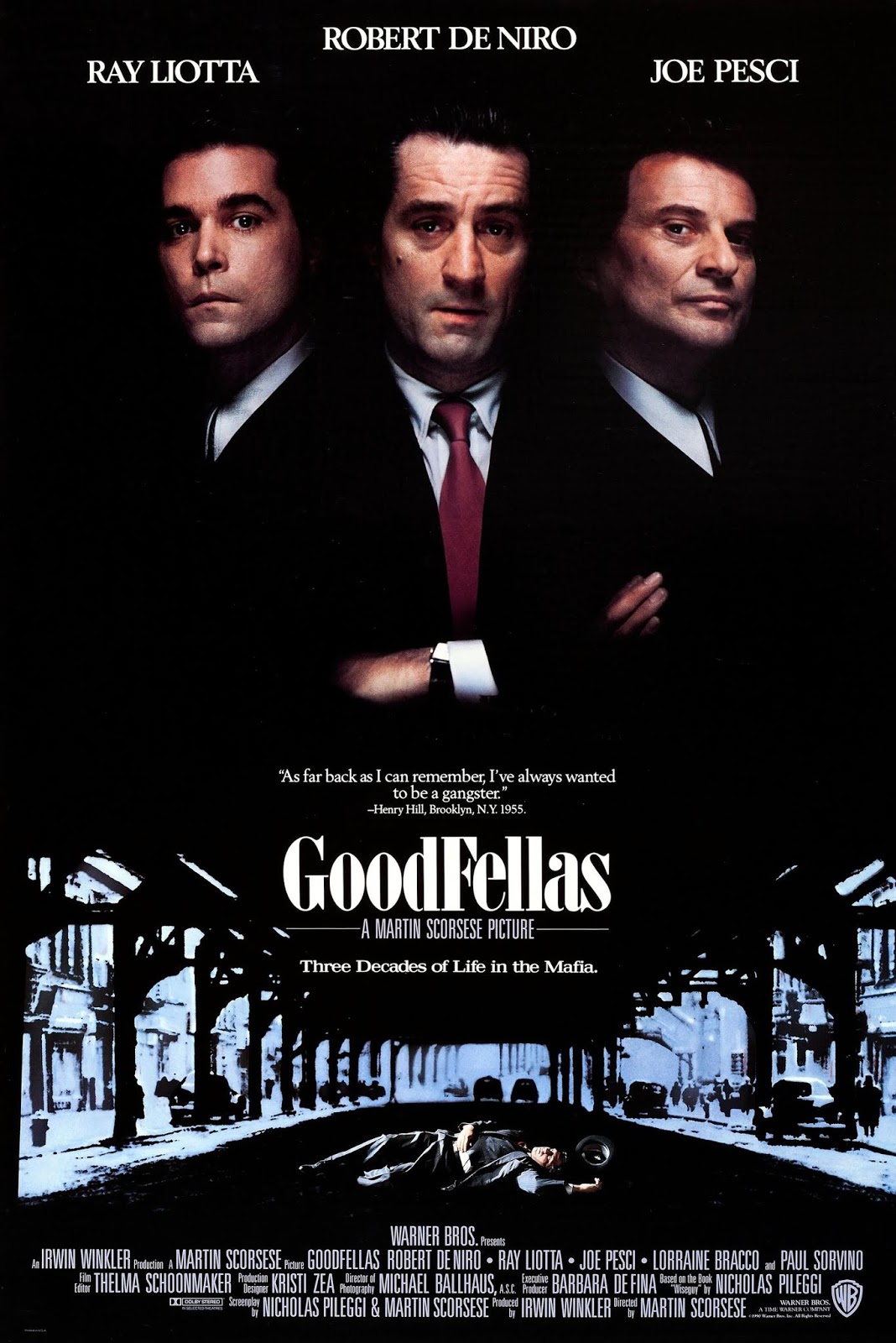
Goodfellas (1990)

Pesci, Liotta and De Niro embrace the life of crime in Scorsese’s masterpiece Goodfellas

Director: Martin Scorsese

Cast: Ray Liotta (Henry Hill), Robert DeNiro (Jimmy Conway), Joe Pesci (Tommy DeVito), Lorraine Bracco (Karen Hill), Paul Sorvino (Paulie Cicero), Frank Sivero (Frankie Carbone), Frank Vincent (Billy Batts), Tony Darrow (Sonny Bunz), Mike Starr (Frenchy), Chuck Low (Morrie Kessler), Frank DiLeo (Tuddy Cicero), Samuel L. Jackson (“Stacks” Edwards), Catherine Scorsese (Tommy’s mother), Michael Imperioli (Spider), Debi Mazar (Sandy)

If there is one film loved more than any other in Martin Scorsese’s filmography, it’s probably Goodfellas. It’s a seismic high-point, not just in its genre – the greatest gangster film ever made since The Godfather Part II – but in film-making, it’s influence and legacy seeming to hung over everything ever since, not least the next-great gangster epic The Sopranos (with which it shares a whopping 27 actors, most notably Lorraine Bracco, Michael Imperoli, Frank Vincent and Tony Sirico). But, on top of all that, Goodfellas works so well because it is a masterpiece of both style and substance, a superbly inventive film that uses all the tricks of cinema to tell a fascinating and brilliantly paced morality tale.

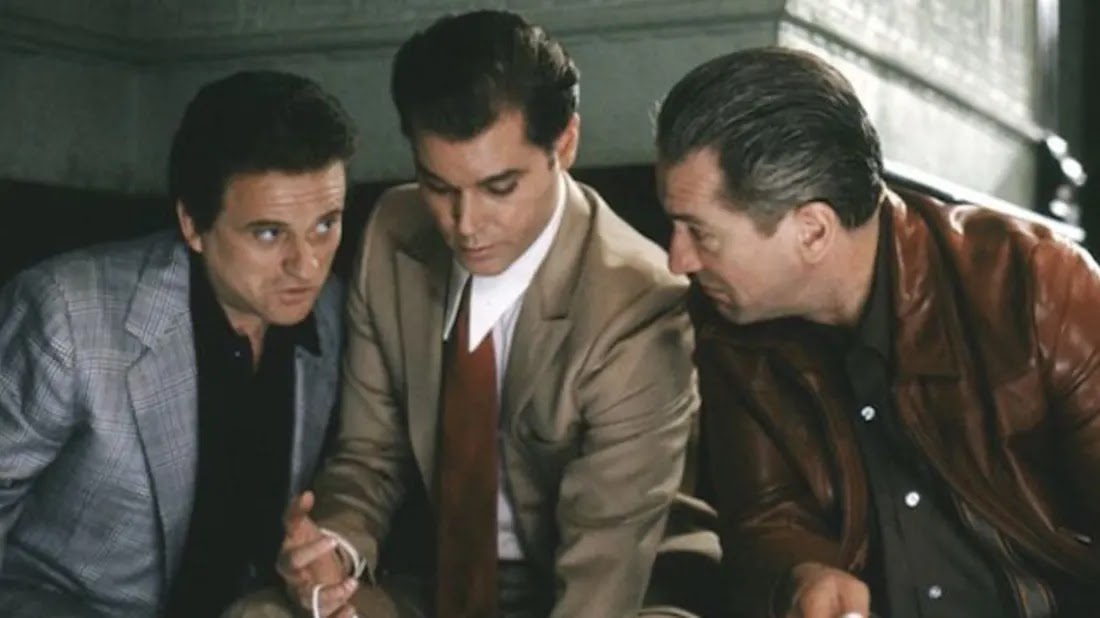
“As far back as I can remember I always wanted to be a gangster”. So says Henry Hill (Ray Liotta), our Irish-Italian guide (and those heritage distinctions are very important in this world) who joins the wrong crowd as a teenager in the 1960s and winds up a strung-out, cocaine-addicted wreck in the 1980s caught by the cops and turned for states evidence, fleeing to an obscure life in witness protection with his long-suffering wife and sometime-accomplice Karen (Lorraine Bracco). Along the way though, Hill loves the glamour and greed of the gangster life, it’s excitements and boys-club rules, guided by his mentor the terrifyingly ruthless Irish-Italian Jimmy “the Gent” Conway (Robert DeNiro), psychopathic fellow gangster Tommy DeVito (Joe Pesci) and menacingly quiet capo Paulie Cicero (Paul Sorvino – never better). 

Scorsese’s film is an electric celebration of movie making, partly why it’s so beloved of film buffs. Scorsese marshals all the weapons in his considerable arsenal as filmmaker. We get jump cuts. We get freeze frames (each marking a significant moment in Hill’s life). We get sharp editing. We get unreliable narration. We get dizzyingly brilliant long-shots and tracking shots (none more so famous than Henry and Karen’s arriving at a club – from travelling from the back door, through the kitchen and into the best table at the club all in one wonderful shot). We get Scorsese’s brilliant use of music, his perfectly placed camera, his brilliance in knowing when to hold his shots, his mastery of lighting (an early hit is so bathed in red it feels like digging a grave in hell). This film was the master at his ultimate height, inspired by everything from the New Wave to old-school 1930s gangster films.

He was also perfect for the material, as no one perhaps understood this world better than Scorsese: and that’s the seductive good and the terrifying bad. Back to that shot of Karen and Henry arriving at the club. The whole sequence – the deference with which Henry is treated, his cool comfort with power, the exclusiveness and special treatment of the whole thing – that smacks of the sort of ultimate party we can only dream of. For most of the first half of the film, Scorsese totally understands why this life is so appealing and exciting. Sure there is violence. There’s danger. But there’s also comradeship. There’s doing anything you want all the time (so long as you stick within the clubs rules). There’s being treated by a God by those around you. Who wouldn’t enjoy that? Is there any wonder Henry saw this as he was growing up and, more than anything, wanted a part of it? In voice-over Karen makes it clear, all this violence and power and being asked to hide guns by your boyfriend is sexy. Who cares about the implications, give me a slice of that pie.

Without understanding this glamour, the film could never show the dark depths of the underbelly of gangsterism. Strangely, perhaps because this is a blue-collar film (the highest gangster we see, Paulie, is still only a few steps away from the street), it’s easier for viewers to give these guys a pass for their behaviour (in a way no one did with Scorsese’s spiritual sequel, his white-collar crime movie The Wolf of Wall Street). Don’t be fooled. Scorsese hints at it with the opening prologue, with Henry, Jimmy and Tommy pulling over a car to brutally finish off (with a spade, knife and gun) a body of a yet-to-be-revealed victim in the back of a car. These ain’t good guys, and for all Henry is shocked by the capacity of violence from the other two he does nothing to stop it.

Because violence is what powers this film, it can happen anytime, it can happen to anyone and your killers always come to you smiling as friends. The gangster code preaches all the time about never betraying your friends, never ratting. But these guys stab each other in the back all the time. There is no honour among thieves. Every hit comes seconds after friendly enquiries and laughs. When Jimmy masterminds a brilliant heist, so paranoid and distrusting is he of those he did the crime with that he has them all killed (a masterful cut montage). Later in the film, strung out on cocaine and terrified of the law Henry treats every meeting like it’s the entrée to him being killed. Even Karen isn’t safe – witness the brilliantly oblique scene late in the film when Jimmy offers her some coats ‘they’re just round the corner’ – is it a hit? Are the coats real? Who knows…

Loyalty is only extended at best to one or two figures. Jimmy (Robert DeNiro in imperious form, terrifyingly cold and also generously ceding the best moments to his co-stars) seems to have a never-ending patience for the psychopathic, instinctive violence of his best friend Tommy. Played with a petrifying Oscar-winning flourish by Joe Pesci, Tommy is like a murderous Rumpelstiltskin, a brutal killer and wired murderer who can explode at any moment. Witness the famous “Funny how?” scene – it plays superbly off Tommy’s unpredictability, his hair-trigger possibility to either laugh with you or shoot you. Much of the film’s problems for our ‘heroes’ – not less that body in the boot of the car – stems from Tommy’s capacity for thoughtless violence. 

Scorsese directs these scenes with such unbearable tension, that any romance of the early sequences of the young Henry Hill disappears. How could you even begin to imagine spending time in a room with these violent, soulless men who kill each other at the drop of a hat? Despite all this, never for one moment until the very end does Henry even consider leaving this world behind. Like so many of the characters in The Sopranos the addiction of this world of power is just way, way too much and if that means a short life then, hell, so be it. Even at the end on witness protection, Henry’s punishment is that he is forced to live a normal life like a no-body (or rather like the rest of us) while balancing the guilt of betraying the people he left behind. Loyalty is a complex thing, but always one-sided in the Gangster world.

As Hill Ray Liotta gives the finest performance of his career. Henry is part wide-eyed naïve dreamer unaware that his dream is a nightmare, and loving every minute of it. Liotta’s Hill is an addict to everything he touches – danger, violence, infidelity and most damagingly of all the mountains of cocaine he is consuming by the 1980s. Compared to the other gangsters, he’s a decent guy – but only in the sense he hesitates (slightly) in the face of murder. He’s selfish, greedy, strangely likeable oddly sympathetic but you feel he gets everything he deserves. Just as good is Lorraine Bracco as his wife Karen, too aroused and infatuated with the bonuses the crime life brings her to listen to her conscience. 

Scorsese’s film is a masterpiece that completely understands that the gangster life is, at the end of the day, a series of boys who never grew up who espouse concepts like duty, honour and faith but live lives of greed, petty murder, vengeance and savagery. Sure walking on the dark side can be fun, can be exciting and can bring you some immediate bonuses. But it also leaves your soul as cold as Jimmy’s or as blackly non-existent as Tommy, the sort of guy who can pour affection on his mother while shrugging off her worries about what that terrible smell is in the boot of his car. These guys are having fun for half the film, until they aren’t, but don’t get seduced by the fun of it. Scorsese knows only too well that they’re going where the film started: a red light washed grave in the middle of nowhere.

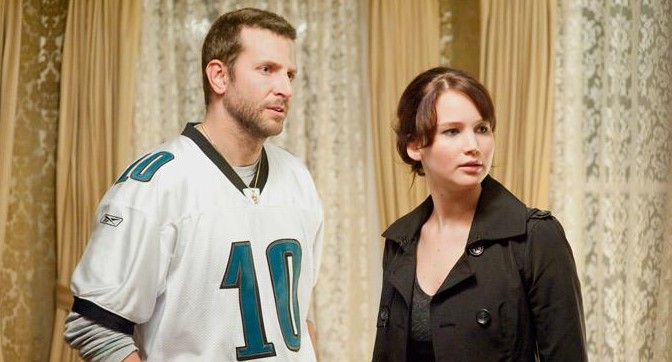
Silver Linings Playbook (2012)

Bradley Cooper and Jennifer Lawrence in an unusual love story Silver Linings Playbook

Director: David O. Russell

Cast: Bradley Cooper (Pat Solitano Jnr), Jennifer Lawrence (Tiffany Maxwell), Robert De Niro (Pat Solitano Snr), Jacki Weaver (Dolores Solitano), Anupam Kher (Dr Cliff Patel), Chris Tucker (Danny McDaniels), Julia Stiles (Veronica), Shea Whigham (Jake Solitano), John Ortiz (Ronnie)

David O. Russell is a director it’s easier to admire than fall in love with. I can see why actors come back to work with him time and again – he’s clearly an actors’ director who crafts stories that give them chances to shine. But his films often have an archness about them, while I find too many of them settle for a sort of middle-of-the-road quirky cool. I’ve never really, truly, loved any of them – even if I have enjoyed them while watching them. The closest I think I’ve got is Silver Linings Playbook.

Pat Solitano (Bradley Cooper) is released from psychiatric hospital, after being confined for assaulting his ex-wife’s lover, into the care of his parents Pat Snr (Robert De Niro), unemployed now making a living as an underground bookmaker, and Dolores (Jacki Weaver). Suffering from a host of compulsions connected to his bipolar disorder, Pat is fixated on winning back his wife. To do so, he enlists the help of Tiffany (Jennifer Lawrence), the widow of a policeman who died in a road traffic accident, who has her own borderline personality disorder and has been dealing with her grief through a parade of casual sexual encounters. Together they enter a dance competition – Tiffany because she always wanted to, Pat because Tiffany has offered to take Pat’s letters to his wife if he says yes and because Pat wants to prove to his wife that he has changed. But is there more than mutual convenience between the two?

Silver Linings Playbook is an unusual romance, that also explores themes of mental health and compulsions and how thin the lines can be between what we consider healthy and not healthy. When does obsession tip over into something that should be treated? Pat is the sort of guy who wakes his parents up to furiously denounce the Hemingway book he has just finished reading in one sitting (a scene played exuberantly for laughs – including Pat smashing a window by throwing the book out of it) but it quickly tips into danger when in a similar mania he awakens the entire neighbourhood at 3am tearing the house apart for his wedding video, accidentally hits his mother, and ends in a tear filled scuffle with his dad. Similarly, Tiffany’s tendencies towards aggression and self-destruction frequently put her in situations both funny and dreadfully damaging.

But just as close to this, we have Pat Snr’s addiction not only to gambling, but also to a raft of superstitions designed to better his chances of winning (and which dominate large parts of his life). Dolores seems obsessed with maintaining peace and order in the family. Pat’s brother has an almost savant tendency to speak his mind, causing more harm than good. Every character in this seems to have their own psychological hang-ups, with resulting problems.

But the film marries this up with an actually quite sweet romantic story between two damaged souls, both very well played by Cooper and Lawrence. This was the film where Cooper repositioned himself as a major actor of note. His performance here is a perfect mixture of charm, pain, confusion, frustration, insight and self-destructive monomania. He’s both funny and deeply moving, sweet and also slappable, gentle but with a capacity for unpredictability. He’s a terrific performance, deeply affecting. It also helps he has fabulous chemistry with an Oscar-winning Jennifer Lawrence. Lawrence’s Tiffany is a vulnerable soul, desperate to appear as tough and impossible to harm as possible and not caring about any of the collateral damage. She’s as brittle as she seems rigid, and as desperate for affection as she pretends to be uncaring about it.

The film throws these two together with an obvious spark from the start, and brilliantly uses their preparation for a dancing contest to show them growing closer together physically and emotionally, as well as adding a purpose to their lives and giving them a common goal to work towards. There is a rather nice gentleness, amongst all the chaos of this film, that something as simple as taking up a new hobby can help to ground two people.

The film builds the romance gently, carefully showing it developing organically and leaving us to guess at what point the bond between these two enrichens and deepens from an instant connection to something more profound. It’s sure got a lot to overcome, with Pat’s obsessive focus on his wife and Tiffany’s compulsion for meaningless sex and her own desire to destroy promising relationships (she almost immediately alienates the surprisingly gentlemanly Pat with an offer of casual sex on their first meeting). With a gentle slow-burn, the film builds towards something that ends up being rather moving.

Russell’s adaptation of the original novel is well-structured and entertaining and his unfussy, stylish direction brilliantly creates an enjoyable mode. De Niro (in what many people called a joyous return to form) and Weaver are both very good as the parents (both were Oscar nominated – this is one of the few films to be nominated in each acting category) and there is hardly a weak beat in the cast. After several quirky, indie-cool, rather distant films, this is possibly the most fun and the most heart-warming Russell has ever been. It’s a career high. Heck even Chris Tucker is really good. And I’d never thought I’d say that.

American Hustle (2013)

Glamour and confidence tricks in David O. Russell’s flashy American Hustle

Director: David O. Russell

Cast: Christian Bale (Irving Rosenfeld), Amy Adams (Sydney Prosser), Bradley Cooper (Richie DiMaso), Jennifer Lawrence (Rosalyn Rosenfeld), Jeremy Renner (Mayor Carmine Polito), Louis CK (Stoddard Thorsen), Jack Huston (Pete Musane), Michael Peña (Paco Hernandez/Sheik), Elisabeth Röhm (Dolly Polito), Shea Whigham (Carl Elway), Alessandro Nivola (Anthony Amada), Robert De Niro (Victor Tellegio)

In 2013, American Hustle was nominated for ten Oscars and won none of them. Somehow, being invited to the big party but not receiving any prizes was strangely fitting for a film about small time grifters forced into a big game way beyond their control. Russell’s film is like a celebration of his strengths and weaknesses as a director: it’s stuffed with some very good (if rather mannered) performances, offers lots of dynamic film making, but is still basically a rather cold and arch film that’s hard to really invest in – rather like a con game in itself.

In 1978, Irving Rosenfeld (Christian Bale) is a small-time grafter, running scams with his partner and lover Sydney Prosser (Amy Adams), who uses the identity of a young English aristocrat “Lady Edith Greenslly”. Rosenfeld longs to leave his unstable, selfish wife Rosalyn (Jennifer Lawrence) for Sydney, but fears he will lose all his access to his adopted son. Rosenfeld and Prosser’s career of clever investment frauds is brought to an end when Prosser is caught red-handed by FBI agent Richie DiMaso (Bradley Cooper). DiMaso forces the pair into his entrapment operation, targeting New Jersey politicians with offers of bribes as part of a Fake Sheik investment. Initially it targets Mayor Carmine Polito (Jeremy Renner), but the operation quickly expands, as the ambitious and impulsive DiMaso constantly follows every connection and the operation expands to dangerous levels, taking in the mafia. Scared, Rosenfeld and Prosser desperately try to play both ends against the middle.

American Hustle is a decent film, which pulls together the sort of capers, turmoil and antics that you would expect from a film about a long con. It throws into the melting pot the vibes of several other films, from The Sting to Goodfellas, and asks us to admire the results. Russell encourages the actors to play it with an edgy verisimilitude that pretty much works as a metaphor for con men. Each performance is an effective display of high-wire character acting work laced with arch, studied tricks. But only rarely do you get a sense of something that’s real.

That’s part of a film that wants to have a cake and eat it as well. It’s striking in the entire story that the most sympathetic character is the initial target, Jeremy Renner’s well-meaning, passionate New Jersey politician, bamboozled into taking a bribe (money he mostly uses in the local community) because he is convinced it’s a crucial part of getting Arab investment. It’s even more striking that the most honest, subdued (and deadly) character is the Mafia kingpin Victor Tellegio, played with chilling menace by an unbilled Robert DeNiro. Nearly everyone else on the side of the entrapment operation is pretty much a selfish prick or verging on the unhinged.

But then that’s part of the point of the film, which throws two people who know what they are doing (Rosenfeld and Prosser) at the mercy of people playing with fire (Roselyn and in particular DiMaso, a permed, tightly-wound powderkeg). This is one hell of a performance from Bradley Cooper – and a sign again after Silver Linings Playbook that Russell and he have a natural understanding. Cooper is a force of nature, a bundle of terrible impulses combined with an utter lack of shame or self-control, who is quite happy to trample over everyone to get what he wants and has no regard whatsoever for the danger he puts himself and others into. Utterly unpredictable, he never sticks to a plan, veers between rage and hysterical laughter and, worst of all, is always convinced he’s right.

It’s DiMaso who spins the operation into dangerous waters with his vaulting ambition to land yet another big fish, recklessly peddling insubstantial, unprepared lies on top of each other – to the terror and horror of practised peddlar of bullshit Rosenfeld, whose whole successful schtick is based on saying “no” and having the mark do all the desperate work. DiMaso’s approach not only puts the operation at risk, it puts lives at risk – not that DiMaso cares, preoccupied as he is with his childish one-upmanship with his boss and a teenage sexual obsession with Prosser.

What chance do the (mostly) small-fish politicians and local figures have, whose lives are placed on the altar of DiMaso’s ambition? It’s no wonder that, late in the film, our conmen heroes start to feel guilt and remorse – none more so than Irving Rosenfeld. Played by Christian Bale with the sort of tricksy, Olivier-ish disguises that he so loves (in this case increased weight, a balding comb-over and a pair of tinged glasses he obsessively fiddles with), Rosenfeld is an operator happy with the level he is working at and incredibly wary of stepping up into the dangerous big leagues. Justifiably convinced of his own professionalism at fleecing money and winning trust, Rosenfeld has no problem with taking money from the selfish but every problem in the world with destroying the life of a fundamentally honest man. Bale’s performance, for all the tricks, manages to successfully build a picture of a selfish man who believes himself in his way to be honest in a way and is just trying to make his way.

That way also involves balancing between two very different women. Amy Adams does decent work as a blowsy fake-aristocrat, sporting a series of tops with neck lines that literally plunge down to her waist, although she is perhaps a little too “nice girl next door” to really convince as the love-em-to-manipulate-them Prosser. She’s not also helped by the script giving her an ill-defined arc of self-doubt linked to pretending to be someone else. Sweet as the genuine love can be her between her and Rosenfeld – and excellent as her chemistry is between Bale and Cooper – it’s the character who remains the least knowable in the film.

Also not helping is the fact that Jennifer Lawrence burns through the film as Rosalyn, the sort of electric, larger-than-life but still very real performance of arrogance, selfishness, dangerous stupidity and greed that marked her out as a major actress. Whether inadvertently putting Rosenfeld’s life at risk through blabbing details she’s half-overheard and half-understood, cleaning the kitchen while singing an aggressive rendition of Live and Let Die or nearly burning the house down because she won’t believe metal can’t go in “the science oven” (aka microwave), Lawrence is the film’s MVP.

Russell’s film showcases all these actors brilliantly, but his overall story remains a little cold and not as clever as it thinks. With a film about conmen you expect a final rugpull – and this film sort of manages one – but the story telling to take us there isn’t quite as articulate and clever as it needs to be in order to be really satisfying. Perhaps it’s the film’s ragged, hip, indie style of telling – or the air that the actors are making a lot of this stuff up as they go with edgy, semi-improvised performances – but the film never really engrosses or engages. For all that we see the inner worlds of Rosenfeld and Prosser, I can’t say I really, truly cared what happened to them. 

Instead Russell focuses on the marshalling of his resources, and cool, slick film-making. He uses expert camera work and editing, mixed with a superbly chosen soundtrack, overlaid with voiceover, sudden transitions, some narrative jumps and a vibrant sense of cool to make a story that finally feels a little too much like a style-over-substance trick – in fact a con game all of its very own, as enjoyable and entertaining as the rest of the film, but when it finishes you realise your pockets are empty.

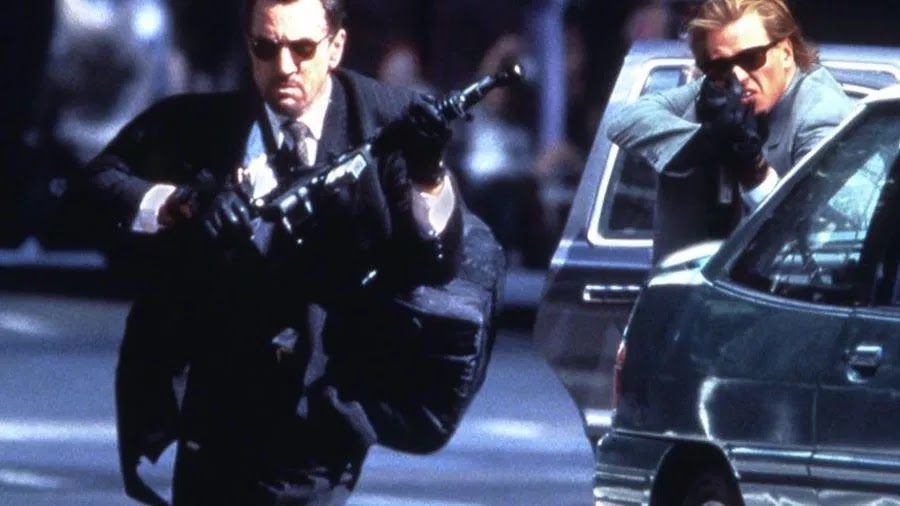
Heat (1995)

De Niro is packing Heat

Director: Michael Mann

Cast: Al Pacino (Lt Vincent Hanna), Robert De Niro (Neil McCauley), Val Kilmer (Chris Shiherlis), Jon Voight (Nate), Tom Sizemore (Michael Cheritto), Diane Venora (Justine Hanna), Amy Brenneman (Eady), Ashley Judd (Charlene Shiherlis), Mykelti Williamson (Sgt Drucker), Wes Studi (Detective Sammy Casals), Ted Levine (Detective Mike Bosko), Dennis Haysbert (Donald Breedan), William Fichtner (Roger van Zandt), Natalie Portman (Lauren Gustafson), Tom Noonan (Kelso), Kevin Gage (Waingro), Hank Azaria (Alan Marciano), Danny Trejo (Trejo), Xander Berkeley (Ralph)

In the mid-90s, Heat was the cinematic event of the year. De Niro! Pacino! Together! In one scene! The two acting heavyweights – wildly proclaimed and popular since the 1970s – had of course made The Godfather Part II together but had shared no scenes. Here, however, we’d see them both at the same time riffing off each other. The great thing is that there is so much more to Heat than just that one scene. Heat is a sort of poetic cops and robbers flick, part stunning action adventure, part profound exploration of the internal souls of men chasing down leads, both good and bad.

Neil McCauley (Robert De Niro) is a skilled career criminal who lives his life with a monastic self-denial, saying you can have nothing in your life “that you cannot walk out on in 30 seconds flat if you spot the heat around the corner”. Vincent Hanna (Al Pacino) is a bombastic, egotistical, workaholic detective with a self-destructive family life. Naturally, these two men find themselves on opposite sides, as McCauley plans his next job and Hanna works to stop him. But the men, with their similar codes dedicated to their chosen career, find that they have an increasing mutual respect – not that that will stop either of them “putting the other one down” if push comes to shove.

Heat is the pinnacle of Michael Mann’s career, and his most triumphant exploration of the conflicted, complex, masculine personalities at the heart of the high-adrenalin worlds of crime and police work. Mann has a gift for giving the simple rush and tumble of cops and robbers a sort of epic poetry, like a metropolitan Beowulf, and he achieves this again here. Heat is a film that throbs with meaning, it’s cool blue lensing and chilly, modern architecture serving as a perfect counterpoint to the cool, professional and focused personalities of its characters.

Heat also goes the extra mile by building this playground confrontation into a mythic battle of wills, a battle of principles and ways of living that seem separated only by a few degrees. Mann invests this with such sweep, such grandiosity (without pomposity), such scale that it becomes a sort of modern epic, a film where intense meaning can be mined by the viewer from every scene. Whether there is in fact any meaning there – avoid listening to Mann’s commentary which drills down so many of his elliptical character beats and open-ended scenes into the dullest, most predictable tropes that he had in mind while filming – is another issue, but Mann’s trick as always with his best work is to make something really quite small and everyday seem like a grand, timeless epic.

It all boils down to that famous coffee shop scene, where De Niro and Pacino for a few magic moments come together. It’s a scene that explicitly asks us to see cop and criminal and understand that there is in many ways very little to choose between them. It hinges on the gentle competitiveness of the actors, and the way they subtly play off each other. It also plays on our own histories of these two actors, of decades of seeing them as two sides of the same coin, both carrying so much cultural baggage for a string of iconic roles that saw them rule Hollywood for over a decade. It’s the sort of scene given extra investment, where you sense the mutual respect of the actors fuelling the strange bond that powers the scene. 

It’s also the one scene of the film that Pacino underplays in. The rest of the film he goes way bigger, powering through each scene with an explosion of shouting and drama. It’s a performance ripe for parody, with more than an edge of ham, but it just about works. Pacino turns Hanna (hilariously the character shares a name with a BBC political journalist of the 1980s) into the purest form of adrenalin junkie, a larger-than-life personality who tears through people and cases with a focused determination that allows no room for a personal life. De Niro downplays far more by contrast, apeing a sort of 1940s noir cool, a monkish insularity that prevents anyone from getting close to him, mixed with a laser-guided determination to do whatever it takes to make his score.

Mann’s film throws these two characters into a series of stunning set pieces with the bank robbery at the centre (“the one last score” that McCauley can’t pass up no matter the danger). The robbery – and the shoot out that follows it – is a triumph of action cinema, brilliantly shot and edited. The gun play is stunning, with Andy McNab having served as a consultant for the actors on the use of automatic weapons. The scene rips through the screen, spewing bullets all over the place in a ruthless, no-onlooker-spared rampage that also really pushes the limits of effective sound design. That’s just the highlight of several scenes that – with guns or otherwise – hum with tension, danger and excitement.

Mann also has enough room in this film though to skilfully establish a number of supporting characters with compelling story lines of their own. Val Kilmer is a tad wooden as McCauley’s number two, but his storyline of troubled marriage is mined for unexpecting pathos (thanks also to Ashley Judd’s fine work as his wife). Kevin Gage is very good as a psychopathic criminal unwisely brought on board to fill a slot in an early robbery. Dennis Haysbert has his own tragic plotline as a criminal trying to turn straight. Diane Venora is excellent as Hanna’s neglected wife, as is Portman as his vulnerable daughter-in-law. This isn’t to mention excellent performances from a rogues gallery of character actors, from Jon Voight to William Fichtner. 

Mann keeps all these plotlines perfectly balanced in a film that is very long but never drags for a minute. Crammed with exciting set pieces and brilliant sequences, it’s a film that manages to feel like it is about a very masculine crisis – the failures of men to balance the personal and their career, selfishly harming those around them because of their addiction to action. Mann’s film looks brilliantly at the essential emptiness and sadness this leads to – as well as the blinkered drive that never prevents men from stopping for a second and changing their lives, no matter how many reflective cups of coffee they have. Mann partners this existential, poetic feeling drama with the ultimate crash-bang cops and robbers and thriller, which will leave you on the edge of your seat no matter how many times you see it. Quite some film.

The Untouchables (1987)

The Untouchables (1987)

Super stylish cops and robbers thriller, as Costner and Connery take on Capone

Director: Brian de Palma

Cast: Kevin Costner (Eliot Ness), Sean Connery (Jimmy Malone), Andy Garcia (George Stone), Robert De Niro (Al Capone), Charles Martin Smith (Oscar Wallace), Patricia Clarkson (Catherine Ness), Billy Drago (Frank Nitti), Richard Bradford (Chief Mike Dorsett), Jack Kehoe (Walter Payne)

“What are you prepared to do!”

It’s the motto of this electric law-enforcement film, one of those all-time classics that provides endlessly quotable lines and moments you can’t forget. It’s crammed with iconic moments, from its brilliantly quotable dialogue from David Mamet, via its wonderful music score, to its artful film literacy and iconic performances. If there is an untouchable film, this one is pretty close. I love it.

It’s 1930, prohibition is in full force and Chicago is ruled by gangland kingpin Al Capone (Robert De Niro). Young Federal Officer Elliot Ness (Kevin Costner) is thrown into Chicago to end Capone’s reign and stamp out the illegal liquor business. Not surprisingly, it’s hard to know who to trust in a town as stinking as this one, until a chance meeting with disillusioned beat cop Jimmy Malone (Sean Connery) helps him find a group of people he can trust – “Untouchables” who aren’t going to go on Capone’s payroll. But to bring Capone down he’s going to have to embrace the “Chicago way” and start to bend his strict moral code. 

Listening to Brian de Palma talk about the making of the movie, you can’t help but suspect he felt he was doing one for the suits rather than one from the heart. Well perhaps he should do that more often, because The Untouchables is a lean, mean, hugely entertaining action-adventure, that plays with genuine ideas and but also nails every single moment. Every scene is shot with a confident, compelling swagger – the sort of thing that reminds you what a conneseur of high-class pulp de Palma can be. The Untouchables plays out like a super-brainy graphic novel adaptation, and every scene sings. There is barely a duff moment in there.

A lot of this comes straight from David Mamet’s brilliant script. Really, with lines like this, moments as well-crafted as this, characters as clearly, brilliantly defined as the ones on show here, you can’t go wrong. Quotable lines fall from the actors’ lips like the gifts they are: “He brings a knife, you bring a gun. He sends one of yours to the hospital, you send one of his to the morgue. That’s the Chicago Way!” It’s dialogue like this that just has ageless appeal, the sort of stuff you find yourself trying to work into day-to-day conversation.

But Mamet’s script is also sharply clever. It swiftly lays out at the start Ness’ moral compass, his code – and then, as the film progresses, it cleverly shows the whys and wherefores for Ness compromising these. Needless to say, the man at the end of the film is totally different from the bright-eyed naïve agent we met at the start. Mamet also brilliantly works shades of grey into all our heroes, while scripting some compelling moments of grandstanding bastardy that an actor as marvellous as De Niro is just waiting to send to the back of the net.

De Niro was of course the inevitable choice as Capone. Bob Hoskins was contracted just in case De Niro said no (when told De Niro would be taking the job but he would get a $20k pay-out for his time, Hoskins told de Palma he’d be thrilled to hear about any other movies de Palma didn’t want him to be in), but it had to be Bobby. The film drops Capone in at key moments: the film opens with the swaggering bully delighted at holding court with English newspapers while being shaved (de Palma’s camera draws down from an overhead shot, like a spider descending from the ceiling, to reveal him in the barber’s chair) – a flash of danger emerges when the barber slips and cuts Capone’s face (de Niro’s flash of fury, followed by his decision to pardon – combined with the barber’s terror – is perfect). Later Capone rages at Ness, hosts a very messy dinner party with a baseball bat, and weeps at the theatre while a key character bleeds to death at his home (a brilliant example of de Palma’s mastery of B-movie cost cutting). He’s the perfect dark heart.

And opposite him you need a white knight – even if it a white knight who is set to be sullied. I’m not sure Kevin Costner ever topped his performance here, in the film that made him a superstar overnight. Looking like the perfect boy scout – his fresh faced earnestness is one of his finest qualities – Costner also has a WASPish hardness under the surface. The burning determination he has to destroy Capone, his disgust at the murder and chaos Capone deals in, is never in doubt – just as his initial naïveté about how to end Capone is all too clear. Costner masterfully shows how each event pushes Ness a step or two further in bending his rules, to fight Capone’s ruthlessness with ruthlessness of his own. “What are you prepared to do!” Malone asks him, and the film is about Ness working out how far his moral compass can stretch. I can’t think of many films that so completely and successfully have the lead character change as much as Costner does here without it feeling rushed or forced. It’s a wonderful performance.

But the film is stolen – and it’s no surprise, as he has the showiest part, most of the best lines, and of course the movie-star cool – by Connery. It’s easy to mock Connery’s blatantly Scottish Irish cop – he gives the accent a go for his first scene, but promptly drops it. What Connery’s performance is really all about is an old dog who never got a chance to do the right thing, finally being given the licence, the support and the inspiration from the younger man to clean up this filthy city. And Connery rages in the film, a force of nature, the perfect mentor, the cop who against all initial expectations is prepared to go through any and all risks to get Capone. He’s the samurai beat cop, and Connery (Oscar-winning) growls through Mamet’s dialogue with all the love of the seasoned pro letting rip. It’s an iconic performance – and led to a five year purple patch of great films and roles for Connery.

But the film works partly because of these great performances and the script, but also because of de Palma’s direction. The pacing is absolutely spot-on, the camera full of moments of flash and invention. Every action sequence has its own distinct tone, from the horse riding hi-jinks of a Canadian border interception of a booze truck, to the dark slaughter late at night of one of the film’s main characters (a masterful, Hitchcockian piece of genius by the way that uses the POV shot to exceptional effect). A late roof chase sizzles with a ruthless energy.

But the real highpoint of the action is of course that famous train-station shoot out. Allegedly the original plans on the day had to be ditched due to budgetary reasons – so cinephile de Palma pulled a sublime Battleship Potemkin homage out of his locker. Shot in near silence, save for gunshots, the bounce of a pram falling down the station stairs (baby on board) and a spare score from Morricone, the sequence is true bravura cinema, both hugely exciting and strangely endearing for all those who know anything about the history of cinema. 

De Palma and Mamet keep the story focused, clear and every scene has a clear purpose and goal. There isn’t a single superfluous character or moment. Everything is perfectly assembled to serve the overall impact of the film. It’s gripping, entertaining and compelling: the sort of film where if you catch it at the right age it has you for life. Ennio Morricone’s operatic score is perfect for the film, underlining and emphasising every moment and effectively sweeping you up. Costner and Connery are superb, De Niro is perfect, the film is a gift that has something new to give every time you see it.

The Deer Hunter (1978)

Robert De Niro goes into a journey into the dark heart of America’s Vietnam experience in The Deer Hunter

Director: Michel Cimino

Cast: Robert De Niro (Mike Vronsky), Christopher Walken (Nick Chevotarevich), John Savage (Steven Pushkov), John Cazale (Stan), Meryl Streep (Linda), George Dzundza (John Welsh), Pierre Sagui (Julian Grinda), Shirley Stoler (Steven’s mother), Chuck Aspregren (Peter Axelrod)

The Deer Hunter is a mighty 1970s milestone of American cinema. Michael Cimino’s Vietnam story is a big poetic epic – its plot is slim but it’s all about the atmosphere, and Cimino’s understanding of the impact that the trauma of war has on different types of men. For vast stretches of the film nothing much in particular happens, followed by short, sharp bursts of gut-wrenching tension – but these have such impact because we have taken the time to see these men’s ordinary lives.

Mike Vronsky (Robert De Niro), Nick Chevotarevich (Christopher Walken) and Steve Pushkov (John Savage) are three Polish-American friends working in a Pittsburgh steel yard, who have volunteered to serve in Vietnam. Before they ship out, they celebrate Steve’s wedding, in a traditional Polish ceremony, and go for one last deer hunt in the woods together – where Mike outlines his philosophy of “one clean shot” (or “This is This”) and the near sacred experience of man communing with nature and hunting. In Vietnam, the three friends are captured by the Viet Cong and forced to take part in a chilling competition of Russian roulette. The impact of these experiences changes their lives – and not for the better – as they struggle to adjust as the war comes to an end.

Michael Cimino was seen at the time as the next great director. This reputation lasted little more than two years, when the box office disaster of his next film Heaven’s Gate (with its tales of ludicrous excess and Cimino’s overly demanding perfectionism) led to the destruction of a studio and effectively ended his career. To be honest, the roots of all this are there in The Deer Hunter. Cimino fought tooth and nail to prevent anything in the film being cut – and he lucked out that he had a few supportive producers and a picture powered by great performances and capturing something of the spirit of the age. Because just this once, more was indeed more.

In some ways The Deer Hunter is an over-indulgent mess. It’s very long, its plot is very slight, it’s very pleased with itself, the camera dawdles for ages through first the friends preparing for a wedding, the wedding itself and then a long hunting trip. This takes up a solid opening hour and 15 minutes of this long film – and progresses the plot forward very little other than establishing the characters and their relationships. But somehow, despite this, the film is magnetic during this. I’m almost not quite sure why, because nothing really happens at great length, but there is a sort of poetic majesty about these sequences that just makes them work.

It’s also a perfect entrée into our characters. After basically sitting and watching them for over an hour do little more than live their everyday lives, we really feel like we understand them. We know Mike is distant, controlled, slightly repressed but prone to moments of exhibitionist wildness that suggest primal, raging emotions beneath the surface. We also understand, with his famous “this is this” speech (“what the fuck does that mean?” his frustrated friend-cum-adversary Stan blurts out), that he is reaching for some sort of symbolic, expressionist understanding of man’s place in the world. He wants to be a poet but doesn’t have the abilities of expression to achieve that.

Similarly, we see Nick as a more carefree, open spirit, someone more in touch with expressing himself and more ready to seize life by the horns. He’s also got a gentle, conciliatory quality to him – out of all the characters, he fits most naturally into the role of confidante. Steven is a child, just trying to do his best in the world, but too naïve for the grown-up world. Most crucially we also see how they interact with each other, and how they relate to women. 

Most women in the film are clearly of very little importance to the characters. Wives and girlfriends are very much on the outskirts of the macho world of the steelyard. And they are of similarly little concern to the men when they come home. Meryl Streep – excellent in an almost nothing part, really it’s amazing how slimly this role is written – plays a woman torn between feelings for Mike and Nick, but the men’s feelings for her waver between uncertainty, indifference and confused affection. Barely any other woman gets a look in, certainly not Steve’s wife who is treated with open suspicion as some sort of floozy.

All this thematic manly matiness then explodes in the later acts of the film, as the after-impact of war – and PTSD, although the word is never used – hits our characters square in the face. And there are few things that will hit you as square on as a bullet. Cimino of course faced waves of criticism about his inclusion of the grisly gambit (no evidence that it was used by the Viet Cong) – but as a metaphor for going to war, and the trauma it will do to your mind, there are few things better than a “sport” which involves placing a gun to your head and pulling the trigger. 

These scenes are already tension-inducing to watch (you can’t help but put yourself in the shoes of the men putting that gun to their heads and wondering if they’ll hear a click or nothing ever again) but Cimino ramps up the pressure here, helped by truly powerhouse performances by De Niro, Walken and Savage. The unbelievable intensity of these scenes, and the total gear shift from everything you’ve seen up to this point in the movie, is a justification of Cimino’s slow pace earlier. After a luxurious opening sequence where we’ve watched the guys fool around, dance, sing and play pool, to suddenly be thrown into this grim, despairing, terrifying situation works brilliantly.

No wonder the rest of the film feels as much in shock as the characters do. Walken is exceptional (and Oscar-winning) as the sensitive soul whose spirit and will to live are destroyed by the incident, who no longer sees any point going home and barely even (by the end) seems to remember who or what he was. Cimino even makes the film feel colder, drabber and chillier in the third act back in Pittsburgh, following Mike’s return home – and his utter inability to deal with his experiences or communicate the horrors of what he has gone through to his friends.

This is also where the film gains immeasurably from a truly sublime performance from De Niro as Mike. In any other actor’s career, this performance would be the stand-out, so it says a lot for De Niro that it’s so often overlooked. But he underplays to devastating effect, as an inarticulate, slightly shy man who has a sheen of confidence, who will do what it needs to survive, who has a poetry and power of love in him that he can’t really express or understand. De Niro is truly brilliant in this film, a still centre that bears almost the total weight of Cimino’s thematic intentions. Essentially De Niro kinda plays an everyman Vietnam vet, and the burden of a whole country after the war without ever having the release of fireworks. He’s excellent.

But then the whole film is a little bit excellent. The Deer Hunter is a masterpiece of a sort, a compelling, dark, tragic and unsettling piece of poetic movie-making. Saying that, there’s something uncomfortable in its depiction of its non-American characters – to a man they are all violence loving degenerates – but then in a film that focuses on the unsettling experience of these Hicksville Americans in a land they don’t understand and can’t deal with, this is at least justifiable in a sense. The Deer Hunter’s main problem at points is that it is a rather pompous, pleased with itself film, but it’s not so much the story that is so strong here but the telling – and Cimino’s telling is first class.