Tag: Robert De Niro

Midnight Run (1988)


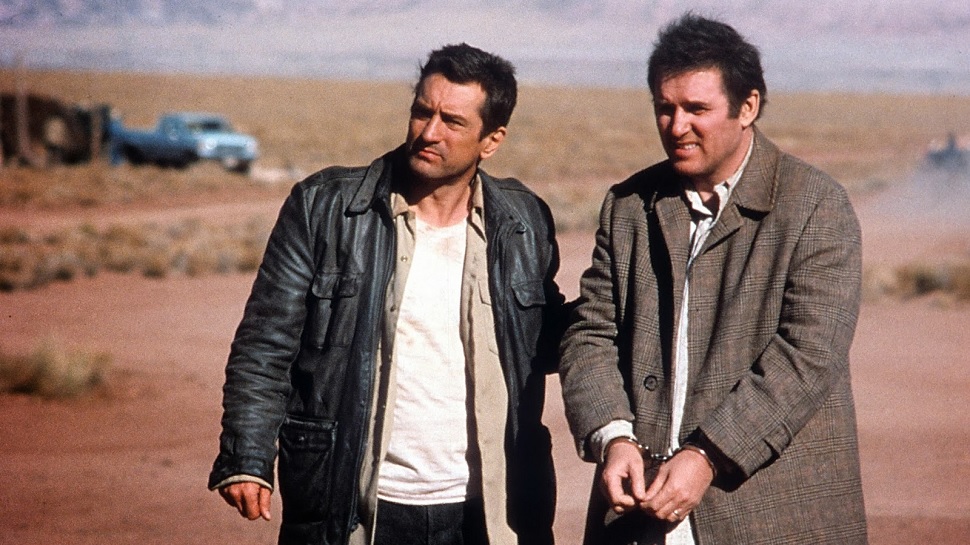
Robert De Niro and Charles Grodin go on the road in terrific buddy-movie action comedy Midnight Run

Director: Martin Brest

Cast: Robert De Niro (Jack Walsh), Charles Grodin (Jonathan “The Duke” Mardukas), Yaphet Kotto (Special Agent Alonzo Mosely), John Ashton (Marvin Dorfler), Dennis Farina (Jimmy Serrano), Joe Pantoliano (Eddie Moscone), Richard Foronjy (Tony), Robert Miranda (Joey), Jack Kehoe (Jerry Geisler), Wendy Phillips (Gail), Danielle DuClos (Denise Walsh), Philip Baker Hall (Sidney)
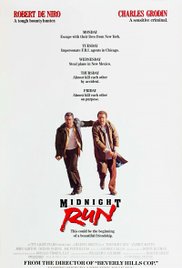
There are few comic set-ups you can get better mileage from than an “odd couple” – they meet, they argue, they grow closer, they fight again, they reconcile. It’s a standard formula. Midnight Run throws this together with a road trip formula (two people have to get from A to B but via every other letter of the alphabet). Really it should be hugely predictable. But Midnight Run is well written, very well acted and hugely fun – it manages to feel both light and frothy, but also sufficiently real and dangerous. It’s a great comic movie.

Jack Walsh (Robert De Niro) is a down-on-his-luck bounty hunter. Having been run out of the Chicago police force years ago for not taking a bribe, he’s skilled at his job but fundamentally unlucky and disenchanted. He’s looking for one big job to get him out: and it comes when mob accountant Jonathan “The Duke” Mardukas (Charles Grodin) skips bail. Hired by bail bondsman Eddie Moscone (Joe Pantoliano), Walsh has four days to find the Duke bring him back to LA before his bail is forfeit – manage it and he’ll get a cool $100k. But the Duke has stolen millions from the mob – so they want him dead, the FBI want him to testify, rival bounty hunters want to take him in – it’s all working out into a very long week for Walsh.

I really enjoyed Midnight Run when I first watched it years ago – and it’s been years since I’ve seen it – so it’s a delight to find it is as good as I remember. In fact, if anything, I think it might be better. It’s very funny – without anyone playing the material for overt or obvious laughs – but it’s also got a lot of soul. It never loses sight of the characters at its heart, in particular the loneliness, sadness and regret at the heart of Walsh, who presents a chip-on-his-shoulder stance to the world, to hide a decent and honourable man who can’t believe his principles are rewarded.

De Niro took on Midnight Run because he wanted to try comedy (he had just played Satan and Al Capone, so probably had earned a rest). Walsh is probably one of his best comedic performances, because he treats it with the investment he gave his greatest roles. He makes Walsh a real person – and he’s willing to downplay the comedy. He doesn’t mug or play to the camera (as he has more recently), he just plays the role with a slight wryness, a touch of lightness from the actor, while the role itself is kept real. His increasing frustration and world-weary resignation matches up perfectly with the hint of sadness he keeps under the surface. It’s a very effective performance.

It helps as well that De Niro allows Charles Grodin to carry the bulk of the comedy. Grodin was cast over the wishes of the studio – but it was an inspired move as the chemistry between the two actors is fantastic. They play off each other brilliantly, Grodin the more worldly, urbane and dry accountant, opposite the stressed out Walsh. Grodin is very funny, and very genuine – and he’s as whippersmart as the Duke himself, constantly keeping us on our toes as to when the Duke is telling the truth, and when he is pulling the wool over our (and Walsh’s) eyes. 

The film throws these two into a series of increasingly hilarious events – from a panic-attack on a plane, to a sneaky piece of con-man work in a back-district town – but mixes it up with genuine moments where the two open up to each other (there is a wonderful scene where Walsh, under the Duke’s gentle probing, final opens up about his past). Each of these moments is wonderfully played, and works so well because the two actors have a genuine connection between them. Both lift the other: Grodin clearly helps De Niro relax and loosen up, De Niro encourages Grodin to bring a greater depth to his acting than ever before.

The contrivances and competing parties they take on also throw in plenty of fun problems. My recording from the BBC from years ago was somewhat sanitised, so it’s a surprise to hear how many times De Niro uses the f-word in this film! Martin Brest films all this with a controlled restraint – perhaps a little too much control (Yaphet Kotto has talked of his misery of performing endless takes of even the simplest scenes). But the dangers Walsh has to take on walk just the right line between feeling real, and feeling comedic.

So we have a sinister gang-boss (played with lip-smacking relish by Dennis Farina), but his underlings on the ground are realistic-feeling, but non-too-bright gangsters (sharp enough to keep track of Walsh, dull enough to constantly say the dumbest things). The Feds are led by a tensely wound-up Yaphet Kotto, but the comedy comes from his cold stares at his underlings, who are prone to state the obvious. John Ashton is good value as a rival bounty hunter, a regular joe not-as-smart-as-he-thinks, but more than smart enough to win the odd hand. Joe Pantoliano gives possibly one of his most Pantoliano-performances of weasily whininess as Walsh’s bail bondsman boss.

Midnight Run rattles along brilliantly. It’s hugely entertaining, with a series of surprisingly high-blown action set-pieces (all met with a dry reaction from the Duke – “I’m sure we’re completely safe” when a pursing gun-laden helicopter temporarily drops out of view – and in turn a furious “Will you shut the fuck up!” from Walsh). Martin Brest gets the balance just right between comedy and drama, and creates a very funny movie where you end up caring a great deal for the characters. It’s a road-movie, buddy comedy that feels fresh and really works because it manages not to feel like it’s trying too hard. And of course it has a great closing scene – and one of my favourite end-lines to a movie ever: “Looks like I’m walking”. Check it out. You’ll like it.
Mary Shelley's Frankenstein (1994)


Kenneth Branagh struggles to bring Mary Shelley’s Frankenstein to life

Director: Kenneth Branagh

Cast: Robert De Niro (The Creature), Kenneth Branagh (Victor Frankenstein), Tom Hulce (Henry Clerval), Helena Bonham Carter (Elizabeth), Ian Holm (Baron Frankenstein), John Cleese (Professor Waldman), Aidan Quinn (Captain Robert Walton), Richard Briers (Grandfather), Robert Hardy (Professor Krempe), Trevyn McDowell (Justine Moritz), Celia Imrie (Mrs Mortiz), Cherie Lunghi (Caroline Frankenstein)

In 1994 Kenneth Branagh was the heir of Laurence Olivier: a man who could act, direct and produce, who never had a false step, whose every film was a success. In other words he was ripe for a kicking, and Mary Shelley’s Frankenstein was the stick used to beat him. It was practically the founding text of “Branagh-bashing”, for a time one of the favourite sports of the British press.

Victor Frankenstein (Kenneth Branagh) grows up obsessed with defeating death, traumatised by the death of his mother. Training as a doctor in Vienna, after the murder of his mentor Professor Waldmann (an effectively serious John Cleese), he uses the body of the murderer to create the Creature (Robert De Niro) – but, horrified by what he has created, he flees home to Geneva. While the Creature comes to terms with being an outcast, Victor marries his sweetheart Elizabeth (Helena Bonham Carter) – only for her to become a target when the Creature vows revenge.

Okay the good stuff about this film: the production design is terrific, the Frankenstein house in particular a marvellous set. It’s also a very faithful adaptation, pretty much following the book (apart from a late, horribly melodramatic “Bride of Frankenstein” sequence). Branagh gets some affecting moments out of the film, particularly in the calmer moments – De Niro gives an interesting performance and the retention of the Walton framing device in the Arctic is well done. There is a good film in here. But it’s buried completely under the overblown shouting, swooping cameras and booming music that covers the rest of the film.

Contrary to his reputation as a purveyor of intricate Shakespeare adaptations, Branagh has always been a lover of big movies, who brings an operatic intensity to cinema. The problem is he goes too far here. This is at times so ridiculously overblown and frenetic in its tempo, you start to think Branagh is trying too hard, desperate to make a big budget smash. Wanting to make a big, gory, gothic horror film, he dials everything up to eleven, and the sturm und drang eventually becomes a tale full of sound and fury signifying nothing.

Interestingly, this intensity is particularly overbearing in the Frankenstein scenes, rather than those focusing on the Creature. Several scenes are filmed with the camera swooping round in circles over long intense takes, while the score thunders away. This principally happens in scenes of high emotion – the deaths of Frankenstein’s mother and his mentor Waldmann are both operatically overblown (in the latter Branagh literally cranes up and screams “No!”). Eventually it all becomes too much. You are crying out for everyone to take a breath and just deliver a line calmly.

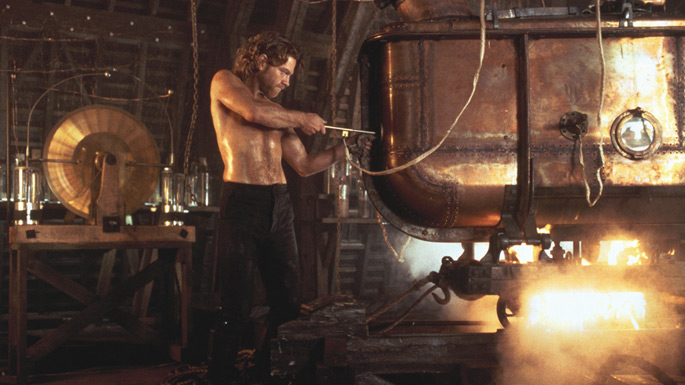
Now I can see what Branagh is doing here. He’s looking to emulate the high-Gothic semi-camp of 1930s horror films. That’s the charitable explanation for why he spends the entire Creature-birthing scene running round topless (he must have spent ages on that chest), with Patrick Doyle’s score booming away, while the camera swoops and sweeps around him. Branagh is partly channelling Colin Clive’s mad scientist from James Whale (he even bellows “Live!” in pure Clive style twice in the film), but by going for overwhelming bombast in his performance, he misses out on making the character relatable. Now Victor is a selfish asshole of course, but we should at least relate to him a little bit: I’m not sure many people can in this film.

It’s a real shame because there is in fact, under the frantic editing and dizzying camerawork, a quieter, more intelligent film trying to get out. Branagh’s Frankenstein is a man deep in trauma about death, unable to cope with losing people, whose fear becomes a dangerous obsession. The romance between Victor and Helena Bonham Carter’s sweetly innocent Elizabeth has a lot of warmth (the chemistry is also excellent: no surprise to hear that the actors started a long term relationship on the set of this film). There are moments here meditating on life and death, but they constantly get lost in the next ridiculous bloody action scene, or explosion of overblown acting.

Similarly, De Niro mines a lot of confused sympathy from the Creature – probably because he seems the quieter and more “normal” person, for all his scars and acts of murder. The sequence with the Creature looking after the family of a blind man (a decent Richard Briers) sees De Niro mine a great deal of vulnerability and innocence from his situation. The contained camera work and restrained acting make these the finest scenes in the film, more memorable than any of the blood and guts that fill the final half hour.

De Niro and Briers: Your only chance to see Travis Bickle and Tom Good share a scene

And those blood and guts are a problem, because this is not a scary film. Not even one little bit. Instead it’s either ridiculous or juvenile – in a sequence where a character literally has their heart ripped out by the Creature, Branagh can’t resist not only having the Creature holding it up to the camera, but for the camera to jump to a close up of the heart literally beating in its hand. Not scary, not gross, just stupid and childish. At any points of tension we get the pounding music and running around and shouting like a Gothic Doctor Who. If only Branagh had taken a breath and treated the material more calmly and sensibly we could have ended up with something creepy and spooky, rather than garish.

It’s a real, real shame because honestly there are some good things in this movie. I’ve mentioned De Niro, but Tom Hulce is also terrific as Clerval and Bonham Carter very good as Elizabeth. There are moments of real class in the design and production – I’ve lambasted Patrick Doyle’s score a bit, but there are some very good tracks in here. The problem, much as it massively pains me to say it because I love him, is Branagh. His performance and direction is just too much: too giddy, too overblown, too frantic, too overwhelming. The film comes across less as a tribute to old style melodramatic horror movies, more a very intelligent gifted man talking down at fans of the genre, giving them what it appears the genre is about on the surface, rather than the depths that actually appeal to people. Despite its merits, the film is not alive, but dead inside.

Stardust (2007)

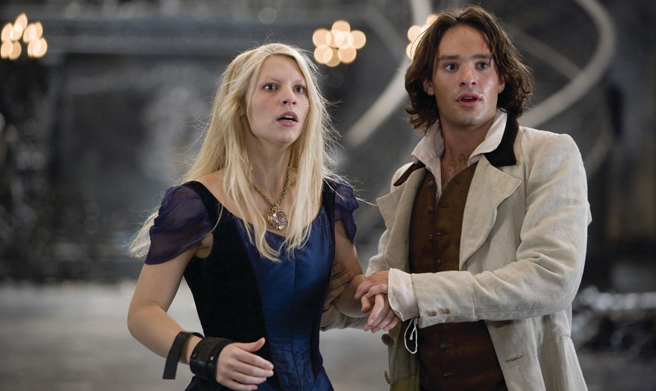
Claire Danes plays a star and Charlie Cox a village boy in charming adventure fairy-tale Stardust

Director: Matthew Vaughn

Cast: Claire Danes (Yvaine), Charlie Cox (Tristan), Michelle Pfeiffer (Lamia), Mark Strong (Prince Septimus), Robert De Niro (Captain Shakespeare), Sienna Miller (Victoria Forester), Jason Flemyng (Prince Primus), Rupert Everett (Prince Secundus), Kate Magowan (Una), Ricky Gervais (Ferdy), Peter O’Toole (King of Stormhold), Joanna Scanlan (Mormo), Sarah Alexander (Empusa), Nathaniel Parker (Dunstan Thorn), Henry Cavill (Humphrey), Dexter Fletcher (Skinny Pirate), Ian McKellen (Narrator)

Stardust is loosely adapted from Neil Gaiman’s novel of the same name, an adult fairy tale refashioned into a crowd pleasing family film: a warm and genuine adventure story, stuffed with romance, excitement and drama.

Tristan (Charlie Cox) is a dreamy young man in the village of Wall, which neighbours the mystical and forbidden world of Stormhold. In love with the selfish Victoria (Sienna Miller), Tristan vows to travel to Stormhold and bring her back a fallen star. However, the star has landed in the form of a beautiful young woman, Yvaine (Claire Danes), and the two of them find themselves on a difficult journey to return to Wall. Along the way they must dodge the witch Lamia (Michelle Pfeiffer) who wishes to sacrifice Yvaine to regain her beauty, and the surviving sons of the late king of Stormhold, particularly the ruthless Septimus (Mark Strong), who need Yvaine’s necklace to claim the throne.

What works about Stardust is that it has an air of whimsy about it, without ever feeling whimsical or corny. It’s a grown-up fairy tale, in the sense that it has some black humour and acknowledgement of sex, but really it’s more of a charming adventure story in a fantasy setting, which manages to keep its tongue in its cheek and not take itself too seriously. Matthew Vaughn’s direction has a very light touch and never allows this soufflé of a film to either puff itself up too much, or to deflate. Instead it rolls along with a giddy charm, with a delightful odd-couple love story at the centre. It’s a film that totally gets its tone spot-on, helped by confident direction and a wonderful score.

Charlie Cox plays romantic lead Tristan with a great deal of charm and really captures the romance at his centre. He also manages that extremely difficult task of being likeable – you can’t help but warm to him despite the fact that his self-awareness is completely off for a large chunk of the film. Claire Danes is equally good as the prickly Yvaine, hiding a great capacity for emotion and longing under a defensive exterior. Their romance is of course highly traditional – they bicker because they love each other! – but both actors carry it off with a great deal of style. You can’t help but want them to get over their problems and get together.

The romantic plotline is also never overwhelmed by the faintly Pythonesque comedy that surrounds it, particularly from the ghostly chorus of deceased Princes of Stormhold. Vaughn produces a great cast of comic actors for this group, while entrusting Mark Strong with the lion’s share of the screentime as the dashing decoy antagonist. In fact, the construction of the film’s narrative is rather neatly done, as this plotline of the inheritance of Stormhold is largely kept separate narratively from the romantic Tristan/Yvaine storyline, with the intersections only occurring at key points.

The real antagonist of the film however is Michelle Pfeiffer’s witch Lamia, Pfeiffer offering a neat portrait of vanity intermixed with cruelty. It’s a very decent inversion of a “movie star” glamour performance, and Pfeiffer’s heartless ruthlessness is a very nice contrast with Tristan’s altruistic openness. In fact Pfeiffer is very good in this film: she gets the balance so right that Lamia constantly keeps you on your toes as to how villainous or not she may be. I’m not quite sure that the film quite manages to completely bring the two characters plot lines together to provide a really effective narrative drive to the film, but she certainly works as an effective antagonist.

The film’s structure is a combination shaggy dog story and classic quest structure, which allows each sequence to take on its tone and structure, from thriller to comedy, depending on the characters involved. What threads this together is the growing (and very sweetly structured) love story between Tristan and Yvain which keeps the momentum up as the film moves from location to location, with cameo roles sprinkled throughout, without the film losing momentum (though it is probably 15 minutes too long). The film’s comfort with letting it sequences expand is clear with Robert De Niro’s Captain Shakespeare, a feared cloud pirate whose secret desires are not so secret as he might think. The film delights in essentially extended jokes like this – but it gets away with it because these jokes manage to be quite funny (De Niro in particular turns in a very good comic performance).

It’s a film that manages to remain distinctive and original, while appealing to a wide audience, which is quite some trick to pull off. It also manages to do this without losing its distinctive rhythm, which is both endearing and enjoyable. The “rules” of its world are clearly established, and while many of the actors are slightly tongue in cheek, they never laugh at their characters but only gently tip the wink at the audience. This freedom largely comes from the conviction and honesty Danes and Cox endow the central characters with, to ground the film. It alsohas a great sense of emotional intelligence to it, and brings a lot of depth to the characters. It also helps that it’s brilliantly designed, looks ravishing and is full of several delightful performances.

There’s lots of terrific stuff in this film, with a very sweet story at its centre. In fact this sweetness is probably the secret of its success: it never takes itself very seriously, it dances lightly from scene to scene and never allows itself to become too overblown. It’s got a terrific cast and is well directed, with a snappy bounce. At moments it does feel a little long, and some sequences overstay their welcome a bit too much – but the central characters are so winningly played that you don’t really mind. Sure this is not a masterpiece, but it has a sort of magic about it, the charm, excitement, adventure and romance, all mixed together with such confidence that it’s a pleasure to watch.

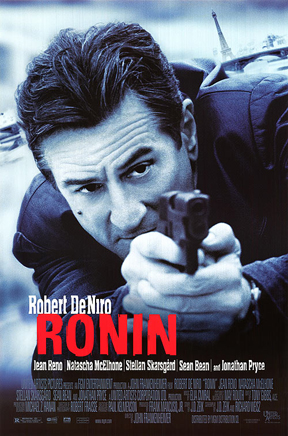
Ronin (1998)

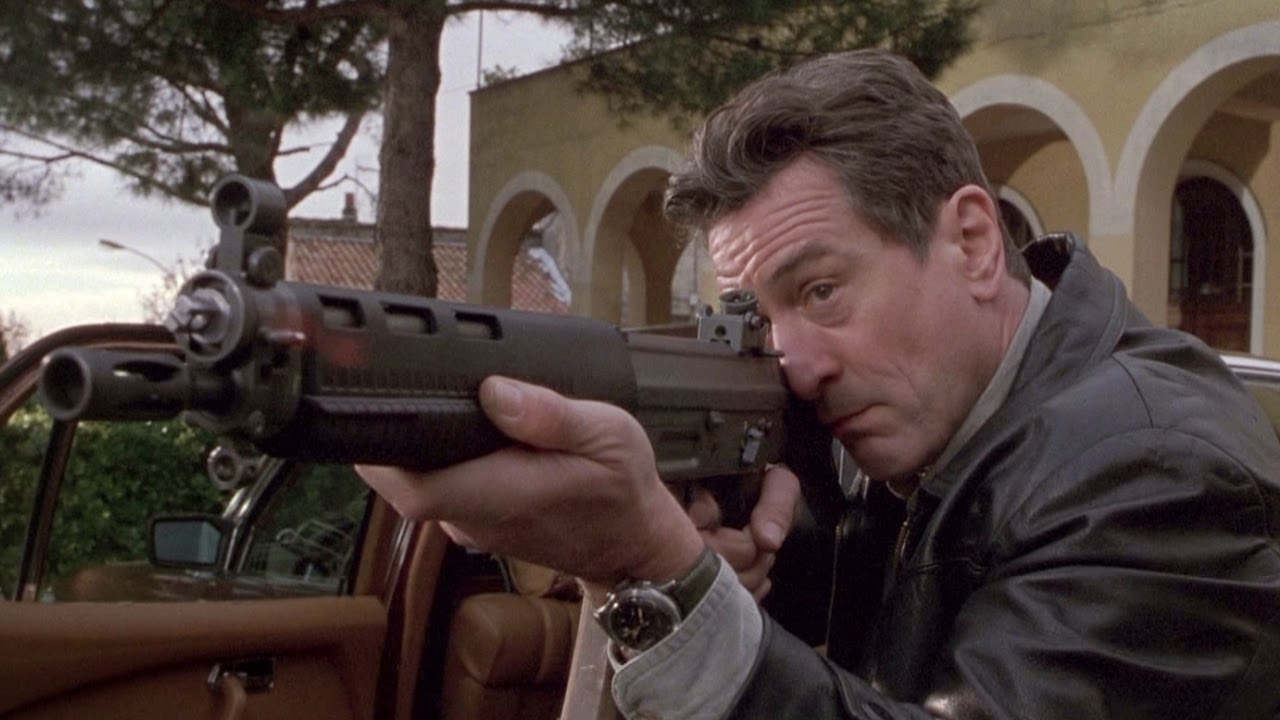
Robert De Niro takes aim in super cool car-chase classic Ronin

Director: John Frankenheimer

Cast: Robert De Niro (Sam), Jean Reno (Vincent), Natascha McElhone (Dierdre), Stellan Skarsgård (Gregor), Sean Bean (Spence), Skipp Sudduth (Larry), Michael Lonsdale (Jean-Pierre), Jonathan Pryce (Seamus O’Rourke), Jan Triska (Dapper Gent), Féodor Atkine (Mikhi)

Sam (Robert De Niro), Vincent (Jean Reno), Gregor (Stellan Skarsgård), Spence (Sean Bean) and Larry (Skipp Sudduth) are ex-intelligence operatives from the Cold War (or “the late unpleasantness”). Now working as mercenaries, they are hired by IRA operative Dierdre (Natascha McElhone) to steal a mysterious case. The operation becomes increasingly complex as trust is betrayed, new competitors emerge, and a stream of gun battles and car chases soon bursts out.

I don’t think there are enough words to say how much I love this film. I have seen it I honestly don’t know how many times. Some films just connect with you, or something about them so completely works for you that you can’t help but enjoy them. Ronin is quite simply one of my favourite ever films – others may poke at it, but to me I think this is a perfectly structured piece of film-making, a 1970s-style thriller produced in the 1990s, the last flourish of old-school, Cold War spy film-making. In fact, I genuinely think the further we move away from the bombastic 90s, the richer this film looks. It’s becoming less and less of a guilty pleasure and more and more of a pleasure.

First and foremost you have to talk about what Ronin is most famous for: its jaw dropping car chases. What’s particularly exciting about these is that everything you are seeing was done for real. There is barely a spot of trickery in this – they simply hired the best stunt men in the world, got hold of some cool looking cars, and let them go to town all over France.

Of course, watching cars going round and round in itself isn’t massively interesting: what makes it compelling in Ronin is the skilled story-telling. Not only do we always know what’s going on, but the characters are kept in the forefront (most of the actors’ terrified faces were real, as they tore round the streets of Paris for real at 90+ miles an hour). In addition to that, the editing and shooting of these scenes is simply superb. The film gets a perfect balance of sound effects and musical cues: the soundtrack of the final car chase is split 50/50 between revving engines and music. A combination of low angles (putting us practically on the front of the car) and medium and long shots keep the visuals of each chase fresh. You’d actually have to be without a pulse to not be gripped by these sequences. These are without a doubt the best car chases ever committed to screen.

But it’s not just about car chases. This is a brilliant mood piece, filmed in a drained out colour palate that makes the whole thing feel like the characters have been transplanted intact from the 1970s. Frankenheimer’s direction is crisp and cool, and he has an eye for an excellent shot. He also allows plenty of subtle character and mood building to counterpoint the action, as in the excellent, almost wordless, opening sequence following De Niro’s arrival at a café. Carefully he cases the joint while the others arrive, putting in place a possible escape route (we later discover) before heading in. Later, the film builds a moment of exquisite tension and excitement about a drawing on a board and the colour of a boat house. We even get a scene where De Niro guides some of the characters through performing surgery on him to remove a rogue bullet.

The whole film is packed full of excellent vignettes like this: I love the moment when De Niro pretends to have lost his nerve and carelessly knocks a coffee cup off a table to see how Skarsgard’s slightly sinister Gregor may respond (he catches it before it hits the ground and then immediately looks sheepish as if he has given something away). The film also sprinkles dark hints throughout of a wider world (“Where do I know you from?” “Vienna” “Of course…” an example of exposition-free dialogue that establishes a back story), while the characters’ backgrounds and their recruitment by “the man in the wheelchair” remain deliberately obscure.

It’s also one of the best Macguffin films you are going to see ever. What’s in the case? Who knows? Who cares? The film’s structure totally understands that it doesn’t matter to us what’s in the thing at all. It’s only important in that it matters to the characters: and that most of them are willing to go to any lengths to secure it (preferably for free).

The other major strength of the film is its cracking dialogue, the work of an uncredited David Mamet (allegedly pissed off that the Writer’s Guild of America declared he had to share billing). The dialogue is endlessly quotable, and deftly sketches out character: for instance, we understand immediately De Niro’s cool confidence and Bean’s blustering faux machismo from exchanges like this: 

Spence: You worried about saving your own skin?
Sam: Yeah I am. It covers my body.

That only scratches the surface of the film’s dialogue, which crackles – this exchange between Vincent and Sam sums up its wit, and lived-in quality:

In fact the film is full of cool lines like this that seem to carry a flavour of working in intelligence, and stick in the imagination (“The map is not the territory” or “Either you’re part of the problem or you’re part of the solution or you’re just part of the landscape”). The best moments sizzle with an effortless cool, with dialogue that you find yourself (or I do anyway) regularly dropping into everyday conversation. It also helps to slowly build relationships within the film, with Sam and Vincent’s dialogue quickly finding itself in sync, a clever little indicator of their building friendship.

The relationship between Sam and Vincent is in many ways the heart of the film – while other characters fall by the wayside, events ruthlessly exposing their weaknesses, it’s these two who form a close bond. Vincent may believe “Everyone’s your brother until the rent comes” but their friendship develops a real warmth and trust – they are the real romantic link in the film (despite a flirtation with Natasha McElhone’s steely IRA gun runner Dierdre).

All this content comes together brilliantly into a tightly contained and carefully paced thriller. It’s also strikingly well-acted in a tight, stripped down manner. This is probably the last engaged, “serious” role De Niro did before his career drifted into decades of self-parody. He gives Sam a brilliant lived-in quality, with a wry sense of humour. Jean Reno is equally well cast as the laconically cool Vincent, while Natasha McElhone is engaging and intriguing as Dierdre. Stellan Skarsgård is a stand-out as the ice-cool Gregor. Of the no-less than three Bond-baddy actors, Michael Lonsdale probably has the best part as a model-building fixer, though Sean Bean does decent work as twitchy poseur. Jonathan Pryce is, I have to say, not completely convincing as an IRA heavy, but does a decent job.

Okay I’ll concede the final reveal and resolution of the film’s plot is not the best moment (a particularly heavy-handed, plumbily voiced BBC radio voiceover explains much of the ending), but that’s a bump in the road of gripping, smart and old-school thriller. It’s accomplished in its filming, and its mood sizzles from the screen. The car chases are edge-of-your-seat gripping, and there is barely a false beat in acting or dialogue. The direction is full of character and has a brilliant eye for little details. Above all else, I really love this film – probably more than is healthy – and I have seen it a crazy number of times. I can’t imagine not enjoying watching it – and I don’t think I ever haven’t, even though I must know it frame-by-frame. Brilliant stuff!