
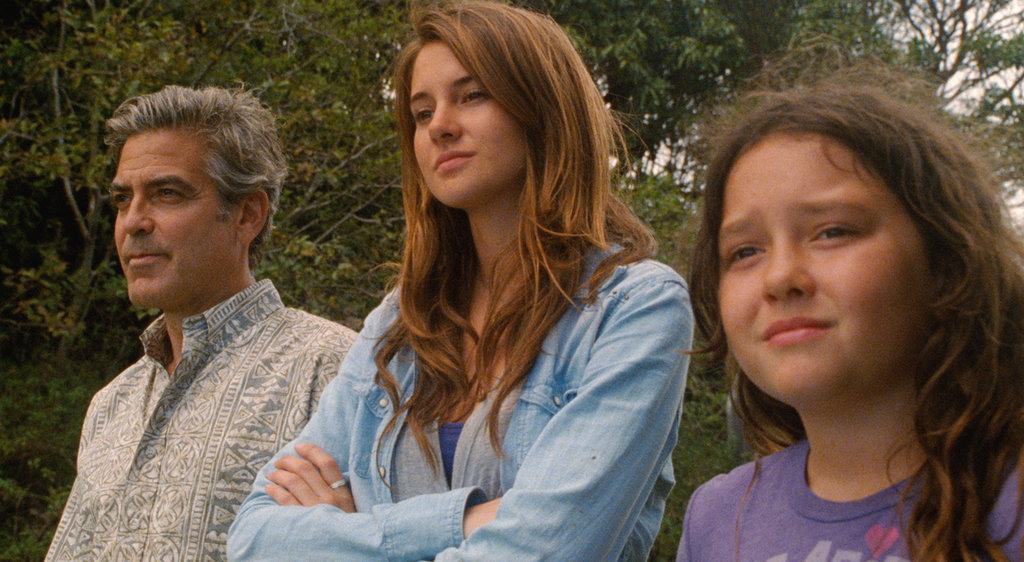
Tag: Robert Forster

The Descendants (2011)

George Clooney is a family man dealing with difficulty from The Descendants

Director: Alexander Payne

Cast: George Clooney (Matt King), Shailene Woodley (Alex King), Amara Miller (Scottie King), Nick Krause (Sid), Beau Bridges (Hugh), Judy Greer (Julie Speer), Matthew Lillard (Brian Speer), Robert Forster (Scott), Patricia Hastie (Elizabeth King)
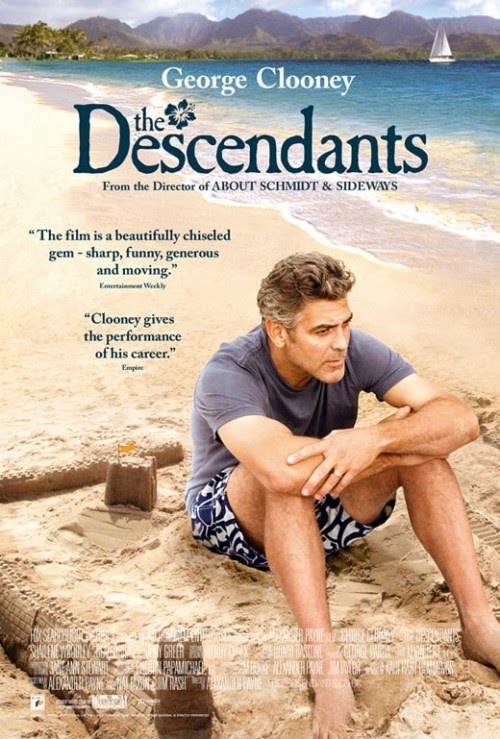
Anyone expecting a straight comedy hasn’t been familiar enough with Alexander Payne’s career. Payne’s movies are triumphant, slightly quirky, explorations of crisis in the lives and emotions of middle-aged, middle-class men. Few directors do it as well, bringing both a lightness of touch and a profound understanding of the tragedy that can underpin ordinary lives. He has an astute understanding of the pain of opportunities lost. And The Descendants is full of these, just as it is full of the hope you can gain from seizing new opportunities in the future.

Matt King (George Clooney) is a Honolulu attorney who is the last trustee representative in his vast family for a site of 25,000 pristine acres on Kauai. With the trust due to end, Matt is under pressure from his family to sell the land for hundreds of millions and gain them all their financial security. In the middle of this, his wife suffers a boat accident that leaves her in an unrecoverable coma. Matt has to rebuild the relationship with his two daughters Alex (Shailene Woodley) and Scottie (Amara Miller) as well as deal with the reveal this his wife was planning to leave him for her lover, a married estate agent Brian Speer (Matthew Lillard).

Payne’s film is heartfelt, low-key and a marvellous showcase for George Clooney who has probably never been better as the grieving and shocked Matt, struggling to come to terms with revelations about his own life that come completely out of the blue. In particular, his own realisation that he has left far too much of his family life to his wife, and his wife has in any case a less than perfect relationship with their two troubled children. Alex (Shailene Woodley) has a history of substance abuse and hell-raising while her sister Scottie (Amara Miller) is using bullying as a way of acting out. King, its clear, has let his connection with his family drift away with his consumption in his work, a character flaw that leaves him with a serious of painful revelations about his own failures.

These revelations are expertly acted by Clooney, who gives the part a rawness and edge beneath his natural charm that becomes deeply involving. He makes Matt both desperate, bewildered and confused as well as kind, decent and forgiving. Payne’s films never present easy solutions to problems, and frequently hold up their leading characters as being the root of their own troubles. It’s the case here as well, as King must learn to realise that many of the problems he is discovering in his family life come out from his own mistakes and lack of focus. How should he respond to his discovery of his wife’s infidelity? How should he decide to react when he discovers his wife’s lover had his own family? 

It’s never the easy choice, and it’s never a clean and easy solution that wraps everything up neatly. The problems we encounter will eventually require us to make intelligent, emotional decisions and accept there are no clean answers. When we meet Brian Speer, he’s not a bad guy just a bit weak. It’s the same throughout. Every character has depth and hinterland. Robert Forster as Matt’s father-in-law may seem foreboding and harsh – but then he is perhaps right to blame Matt for his daughter’s unhappiness, even while he never holds it too harshly against him. Alex’s spaced out boyfriend Sid (Nick Krause) suddenly surprises Matt with his emotional insight into family dynamics.

And of course, his daughters who seem tearaways are in fact far more mature and supportive than might have been expected. Shailene Woodley is excellent as Alex, a young woman who doesn’t blame but demands to be part of solutions, and supports her father to make the tough calls. And the moral problems keep coming, mixed with surrealist comic touches. It’s the sort of film where Matt can make a shocking realisation about his wife, and then return to his table in his restaurant to be assailed by a garish traditional music band.

Despite all this Payne’s film captures a sense of affection and warmth without succumbing to sentimentality or easy solutions. The sort of satisfying outbursts of pain and cathartic anger are largely avoided for far more mature and realistic feelings of joint responsibility for problems and an acceptance that what our lives become are what we make of them as well as other people. It’s a sort of complex avoidance of black-and-white solutions that help to make the film feel truly real and grounded. While not many of us need to worry about the pressures of making decisions that will make us millionaires, all of us have had to deal with our own mistakes leading to others making mistakes and the emotional fallout that this can bring. 

In the centre of Payne’s emotionally intelligent film are these excellent performances, with George Clooney hugely unlucky to miss out on an Oscar for his emotionally intelligent and rich performance here. Payne’s film takes the male mid-life and family crisis and subtly analyses from a host of positions and angles, not just the man itself. We can feel sorry for a bloke who has suffered blows but also see his own decisions have contributed to his position. It makes for a delightful and heartfelt film, which is beautifully made by Payne and superb showcase for intelligent, grown up film making.

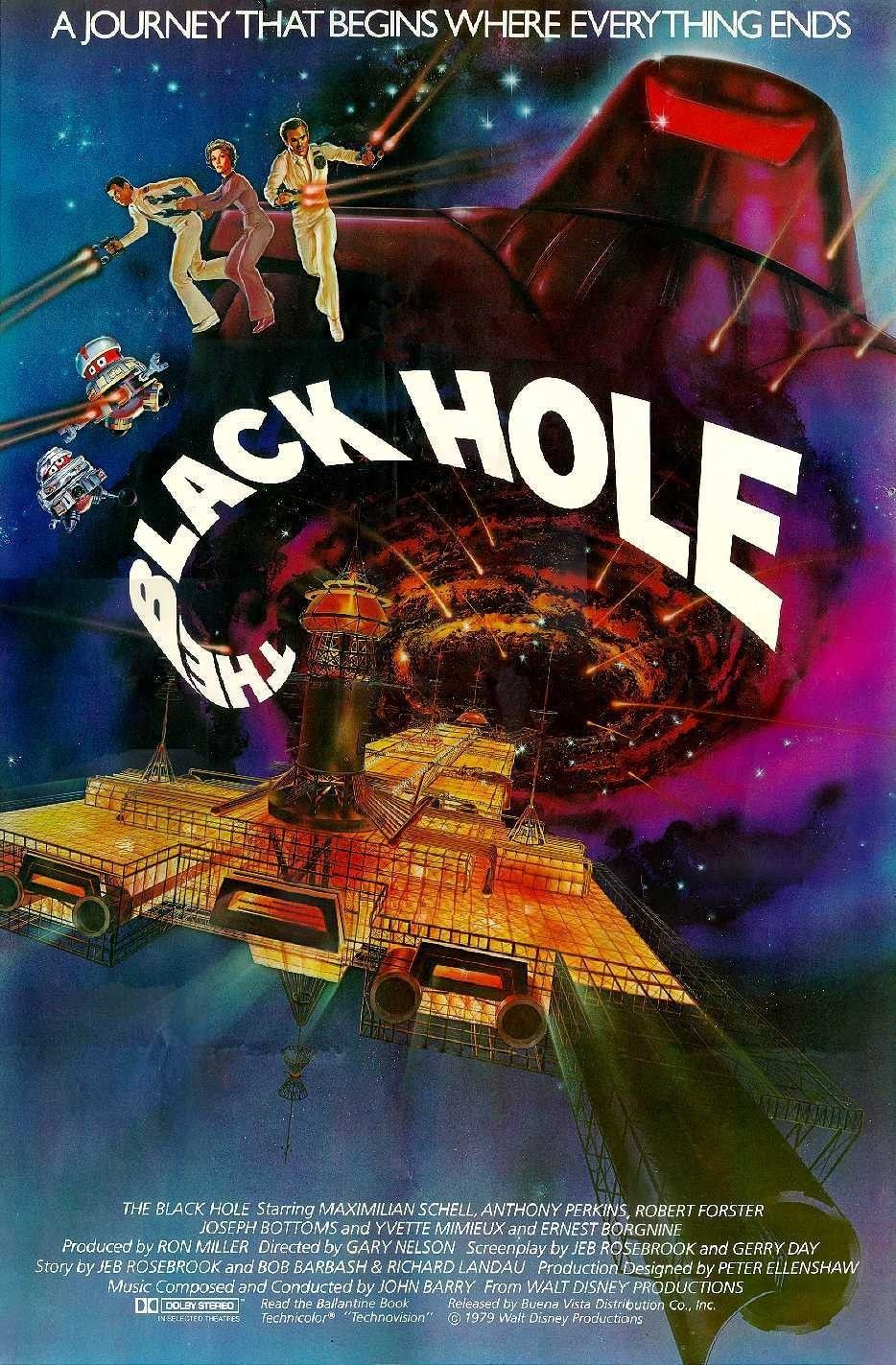
The Black Hole (1979)

Maximilian Schell in one of his quieter moment, planning a journey into The Black Hole

Director: Gary Nelson

Cast: Maximilian Schell (Dr Hans Reinhardt), Anthony Perkins (Dr Alex Durant), Robert Forster (Captain Dan Holland), Joseph Bottoms (Lt Charle Pizer), Yvette Mimieux (Dr Kate McCrae), Ernest Borgnine (Harry Booth), Roddy McDowell (VINCENT), Slim Pickens (BOB)

When Star Wars became a massive smash hit, every single studio assumed all they needed to do was to search out any damn space-set saga it could find, dress it up with a few Star Wars-feeling elements (usually shooting and funny robots) and, Bob’s Your Uncle, you would have a box-office smash of your very own. Well that turned out not to be the case – and Disney’s The Black Hole was a case in point.

At the end of a long mission, the crew of the USS Palomino is on the way back to Earth, when they discover a black hole with a spaceship hovering around it. The ship is the long-lost USS Cygnus, commanded by legendary genius Dr Max Reinhardt (Maximilian Schell). The crew are at first welcomed by the Cygnus – but is there a dangerous secret on board? You bet there is.

The Black Hole feels like several different types of story all very unsuccessfully stapled together.  There are elements in there of a 2001-style intellectual, “what does life mean” science fiction saga. But every time we start to get near those tones, up jumps a funny robot, or a bit of shooting, or an odd “haunted-house-in-space” sequence, or a mad scientist ranting. None of these stories, by the way, are particularly good or unique. They are all rather clumsily assembled. The tone of the film is also all over the place – so we get a comedy robot with funny bug eyes getting up to hi-jinks, closely followed by Anthony Perkins being ruthlessly killed by a drill (even if it is mostly offscreen blood and guts). Who is this film for? Too dark and grim for kids, too stupid and childish for their parents.

Robert Forster and Anthony Perkins look barely interested in the events around them (Perkins must have been wondering by this point in his life where it had all gone wrong). Ernest Borgnine plays the sort of blow-hard he could do standing on his head. Perhaps aware that most of the rest of the performers weren’t really engaged in it, Maximilian Schell acts for everyone. Never one to be afraid of going overboard, Schell’s wild-eyed enthusiasm leaves no scenery unchewed. It’s the sort of performance that seems to capture the wildly uneven tone of the film: so one minute Schell is a sort of space Byron, the next minute he’s literally slapping his head over the incompetence of his minions like some sort of Space Skeletor.

There really isn’t any actual plot in The Black Hole – it takes no more than about 40 minutes to hit the final “we gotta get off this ship” run around. There are some vague ideas bandied around about the spiritual meaning of touching the edge of God’s creation – but these barely get any air time. The last 30 minutes are a hurried dash through the ship, before we finally fly through the wormhole. This wormhole flight is left obliquely unclear (it’s crammed with odd imagery inspired by Dante), and I suspect there were more ideas in the original script that were cut when they basically decided to make this a kids’ film.

But then that’s like the whole film. It’s a 2001 wannabe that has been retrofitted into something as Star Warsy as possible. VINCENT and BOB are a low-rent R2-D2 and C3P0 (they even have basically the same personalities) and Dr Reinhardt’s robot followers are nothing more than imitation storm troopers with the Cygnus like some sort of Death Star. That’s not even mentioning odd touches, such as the ESP powers given to Kate McCrae. None of these elements fit well together at all. The special effects have dated very badly (surely they can’t have looked too impressive back then either?).

It’s also of course possibly one of the least scientifically accurate films ever made. Most of the black hole physics are errant nonsense (at least so I’m told, I’m not qualified to comment). But I know enough about science to know that if anyone ever spent as much time in the cold vacuum of space as most of these characters do, they would all be frozen and dead. Most of the last chase sequence sees the crew moving through the Cygnus as parts of the ship break off, with holes to space all over the place. One character even drifts out into space only to be dragged back in absolutely fine. I guess it’s for kids but it still immediately stands out as odd. 

And then there is that ending. As our heroes head down into the wormhole, the film makes a play for some sort of cult classic status. Angles distort and bend. Bizarre imagery is thrown at us. Reinhardt merges with his robot Maximilian and seems to go to hell. Angels fly across the screen. Lights and whizzbangs. What is going on? I don’t think the film knows: its the sort of cult classic stuff where it’s left open to the viewer to give it more meaning than it probably has. The final emergence from the black hole is a total let down – hard not to have a “what was all that about?” feeling…

The Black Hole is just, to be honest, a little too rubbish. I mean there are elements in there I don’t mind: some people hate VINCENT, but I find him probably the most engaging hero (that’s probably a pretty damning statement). Schell’s scenery chewing (“MAXIMILIAN!!!!!”) is reasonably entertaining. Some of the chasing around is fun. Villainous robot Maximilian is very well designed and looks creepy. But it’s not enough. There is too much damn nonsense everywhere. It’s a film with no spiritual or intellectual depth, which means when it does try to leave questions answered it merely frustrates rather than making you think.