Tag: Robert Loggia

Prizzi’s Honor (1985)

Prizzi’s Honor (1985)

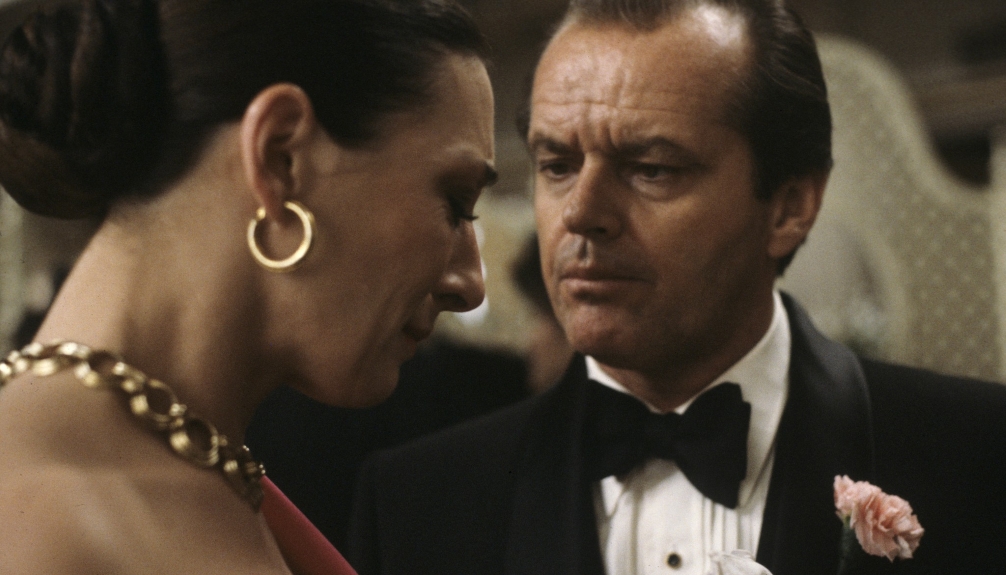
Would-be satirical mafia farce, that is slow, dense and insufficiently funny to hit its target

Director: John Huston

Cast: Jack Nicholson (Charley Partanna), Kathleen Turner (Irene Walkervisks/Irene Walker/Mrs Heller), Anjelica Huston (Maerose Prizzi), Robert Loggia (Eduardo Prizzi), John Randolph (Angelo Partanna), Lee Richardson (Dominic Prizzi), Michael Lombard (Rosario Filangi), Lawrence Tierney (Lt Davey Hanley)

Charley Partanna (Jack Nicholson) is a good-natured guy, loyal to his job – which just happens to be rubbing people out for the Prizzi crime family in New York. His gentle amble through Mafia life is thrown out of whack after a parade of unlucky events, silly mistakes and random occurrences. All of these can be linked back to his falling in love with Irene Walkervisks (Kathleen Turner), a con-woman, assassin and practised liar who may-or-may-not be in love with the besotted Charley. These two find themselves in the middle of a complex Prizzi family feud, much of it built up by Charley’s former girlfriend Maerose Prizzi (Anjelica Huston). What sides will everyone pick?

John Huston’s Prizzi’s Honor was one of the first films to take Mafia tropes, all that iconography The Godfather had made so ubiquitous and try and satirise it. Adapted from Richard Condon’s novel (by Condon), it carefully recreates the style and features of Mafia films, replaying the conventions – feuds, hits, femme fatales, pay-offs – with a streak of comedy. But what it lacks is the zip and energy this sort of dark satire really needs. It’s far too stately and never quite funny enough. Instead, it’s often slow and difficult to follow – and, damningly, is most engaging when it’s most like a regular gangster film.

It feels like an old man’s film. I’d defy you to look at this and then The Asphalt Jungle and not feel Huston was lacking fire here with this frequently untense, and slow film. It opens with a hugely over-extended wedding sequence, almost twenty minutes long, which laboriously introduces the characters. It frequently fails to pick to the pace from there: too many scenes lack thrust and drive, working their way slowly towards narratively unclear purposes. Now sometimes that is because so many of the characters are lying to each other – but Prizzi’s Honor does a consistently poor job of making sure we are either aware of the real truth or that we are in full understanding of the stakes at play.

A large part of the fault is the wordy, dense screenplay from Richard Condon (how did a sharp adapter of books like Huston allow this?). It takes nearly an hour for the film to really get going with a proto gang-war initiated by Irene impulsively shooting a police captain’s wife during a botched hit. Along the way, it creates too many long conversation scenes that lack spark or wit. It’s a far too faithful an adaptation, relying far too much on telling not showing. Multiple off-screen plot developments (involving complex double cross schemes) are related to us through conversations that are (honestly) hard to follow, boring to watch and delivered and shot with a flat, functional lack of interest. All of these would have worked better with a mixture of words and visuals – seeing some of these complex events playout, with an accompanying voiceover (the sort of thing Scorsese would have done brilliantly – see Casino).

Neither script nor direction is sprightly or engaging enough. It’s languid musical score and the ambling camerawork and editing also doesn’t help. It consistently feels slow, it’s meaning fuzzy, it’s action not gripping enough, it’s jokes not funny enough. Each scene is either too over-stuffed with plot-heavy information or too light on emotional connection or purpose. I’d be surprised if many people could explain exactly how the plot mechanics worked when the credits roll which, for a film that gives over a lot of time to slowly explaining things in dense dialogue is not a good sign.

The film depends on its performers to spring into life. Best of all is Anjelica Huston’s Oscar-winning turn as Maerose, disgraced black sheep of the Prizzi family. She rips into this vampish manipulator, running rings around the other characters with her sexual power or superb play-acting (there is a great scene when she makes herself up to look depressed and miserable to win the sympathy of her dim kingpin father played by Lee Richardson). It’s a funny, engaging and dangerous performance that you wish was in the film a hell of a lot more than it is. Close behind is William Hickey, rasping with malice, as a lizardry Godfather full of greed, ambition and utterly lacking in morals, presenting a neat sideways parody of Brando-style figures.

The two leads have their moments. Jack Nicholson is surprisingly restrained as Charley, surely one of the most gentle and dim characters he’s ever played (probably the film’s best joke, since it’s JACK). Nicholson gives him a childish naivety, easy to manipulate, whether that’s Irene saying she definitely didn’t know about the Prizzi-robbing scam her late husband pulled alongside her or the rings the smarter Prizzi’s and his consiglieri father (a coldly jovial John Randolph) run round him. He’s sexually naïve – putty in the hands of Maerose (‘With the lights on?’ he asks with meek bewilderment when she invites him to a clinch in her apartment) and Irene (‘On the phone? Now?’ he asks when she suggests some sexy banter) – and, with his New Yoick accent and prominent upper lip feels like a dutiful child trusted to run errands by his parents.

Opposite him Kathleen Turner embraces the lusty femme fatale qualities that made her a star, playing a husky voiced practised liar with a ruthless heart. Prizzi’s Honor though deals Turner a tough-hand: she’s the most enigmatic character and possibly its most poorly developed, the film giving so little clarity to her inner life that part of me wonders if Turner herself was slightly confused as to her character. Even in a film where the female lead is a ruthless, murdering grifter, she’s still largely only seen in relation to the men in the film – a potentially satirical point the film doesn’t really develop at all.

Both actors give sterling performances, but so slow and artificial is the film, so laboured its pacing that I found it extremely hard to care about what was truth what was a lie. Prizzi’s Honor has small moments but it’s devoid of the energy and pace that could have made it a dark comic delight. With the lack of investment it creates in an audience, it’s frequently hard-to-follow plot developments and clumsy, unengaging exposition, even the dark ending is unlikely to make much an impact. Hugely praised at the time – partly, you feel, due to affection for its director – it’s a slow, unengaging film that only briefly sparks to life.

Jagged Edge (1985)

Jagged Edge (1985)

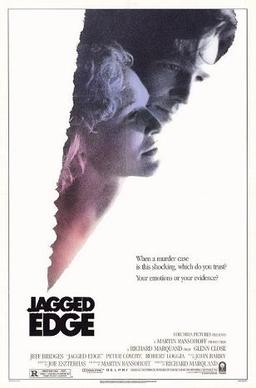
Exploitation and barmy courtroom and steamy romantic couplings abound in this silly but fun mystery

Director: Richard Marquand

Cast: Glenn Close (Teddy Barnes), Jeff Bridges (Jack Forrester), Peter Coyote (DA Thomas Krasny), Robert Loggia (Sam Ransom), John Dehner (Judge Carrigan), Karen Austin (Julie Jenson), Guy Byd (Matthew Barnes), Marshall Colt (Bobby Slade), Louis Giambalvo (Fabrizi), Lance Henricksen (Frank Martin), Leigh Taylor Young (Virginia Howell)

Teddy Barnes (Glenn Close) is done with criminal law after her time at the DA’s office, working under ambitious, unscrupulous Thomas Krasny (Peter Coyote). But she’s dragged back in to defend handsome newspaper editor Jack Forrester (Jeff Bridges), accused of brutally murdering his wife and her maid (for the money naturally). Teddy takes the case and soon crosses that line marked “personally involved” as she and Jack swiftly move from riding horses to riding each other. But what if Jack is really guilty after all?

Jagged Edge is a big, silly courtroom drama, a sort of erotic thriller B-movie that got some serious notice because two critically-acclaimed, three-time Oscar nominated actors fleshed out the cast. Written by Joe Eszterhase (for whom this was the springboard for a career of sex-filled, murder-and-legal dramas that would culminate, via Basic Instinct, with Striptease), Jagged Edge is full of pulpy, super-tough dialogue that its cast loves to chew around their mouths and spit out. It’s got the sort of courtroom dynamics that would see a case thrown out in minutes and would make its lead character unemployable in seconds. It’s daft, dodgy and strangely good fun for all that.

What it is not, really, is either any good or in any way surprising. One look at rugged, casually handsome Jeff Bridges and sharp-suited, charming-but-whipper-smart Glenn Close and you just know its only a matter of time before they end up in bed together. This leads to all sorts of unprofessional sex-capades and legal decisions, not to mention the sort of pathetically readable poker-faces in courtrooms that I would definitely not want from my lawyer.

Jagged Edge makes no secret of its hard-boiled, pulp roots. It opens with a POV home invasion as the killer breaks into his victim’s house that is only barely the right side of exploitative. Marquand doesn’t shirk any opportunities to chuck crime scene photos up on the wall. Peter Coyote’s uber-macho DA loves to say lines like “he has a rap sheet longer than my dick”. Best-in-show Robert Loggia (Oscar-nominated) is the sort of grimy flatfoot investigator who has a fridge full of booze and can’t go more than five words without cussing (when asked if his mother ever washed his mouth out with soap he simply responds “Yeah. Didn’t do no fuckin’ good”).

It’s similarly open about its sexy energy. Close and Bridges have a blue-filtered, late-night roll in the sheets, made even more exciting (perhaps) by the fact she spends half the film suspecting he did the deed. That’s the question the film challenges us with. On the one hand, Bridges seems far too boyish and aw-shucks to have slaughtered two women with a jagged knife. He sure looks upset when he visits the crime scene. Problem is there doesn’t seem to be any other possible suspect, and all that circumstantial evidence just keeps stacking up around him.

Close plays all this with a great deal of force and emotional intelligence, far more than the part (or the film) really deserves. She’s amicably separated from her husband (a very decent guy) and the film even finds a little ahead-of-its time space to make clear that Kransky’s animosity for her (and her loathing of him) is based on his sexual harassment of her as much as his flexibility with courtoom rules. Close balances the whole B-movie set-up with a real dedication – it’s effectively a warm-up (in a way) for the nonsense she’d play in Fatal Attraction.

Bridges is also pretty good, always keeping you guessing from scene-by-scene. How bothered is he when he spreads his wife’s ashes off his yacht? But then how affronted and hurt he looks when he is accused of the crime? It’s a tricky part, but he does a great job of constantly shifting the audience viewpoint and his relationship with Close’s Teddy is just smooth enough to have you guessing how genuine it is.

Wisely – perhaps – he doesn’t hit the stand during the trial. It would probably lead to drama meltdown. The courtroom is full of unbelievable curveballs, witnesses crumbling in a way they never do in real life. Every single disaster for each case is signposted by the fixed horror on the faces of the lawyers. Revelations fly-in and a new suspect effectively incriminates himself mid-trial to the delight of all (this suspect even enforces his caddishness by threatening Teddy in a car park in another moment where the film tries too hard).

The film culminates in the inevitably silly reveal, with plot twists abounding, where we are asked to believe that a killer who has ingeniously considered every single angle of his crime casually leaves incriminating evidence hanging around waiting to be discovered. Its final scene, where the killer is revealed, is either tense or unbearably, ridiculously stupid, depending on your viewpoint (everyone behaves ludicrously out-of-character and takes stupid, unnecessary risks). But for the bulk of its runtime, Jagged Edge is dirty, cheap fun.

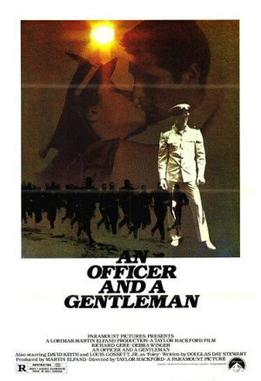
An Officer and a Gentleman (1982)

An Officer and a Gentleman (1982)

Classic 80s romance? Or is it, in fact, a searing kitchen-sink drama about class and depression? One of the great mis-remembered films of all time

Director: Taylor Hackford

Cast: Richard Gere (Zach Mayo), Debra Winger (Paula Pokrifki), Louis Gossett Jnr (Gunnery Sergeant Emil Foley), David Keith (Sid Worley), Lisa Blount (Lynette Pomeroy), Robert Loggia (Byron Mayo), Lisa Elbacher (Casey Seeger), Tony Plana (Emiliano Santos Della Serra), Harold Sylvester (Lionel Perryman), David Caruso (Topper Daniels)

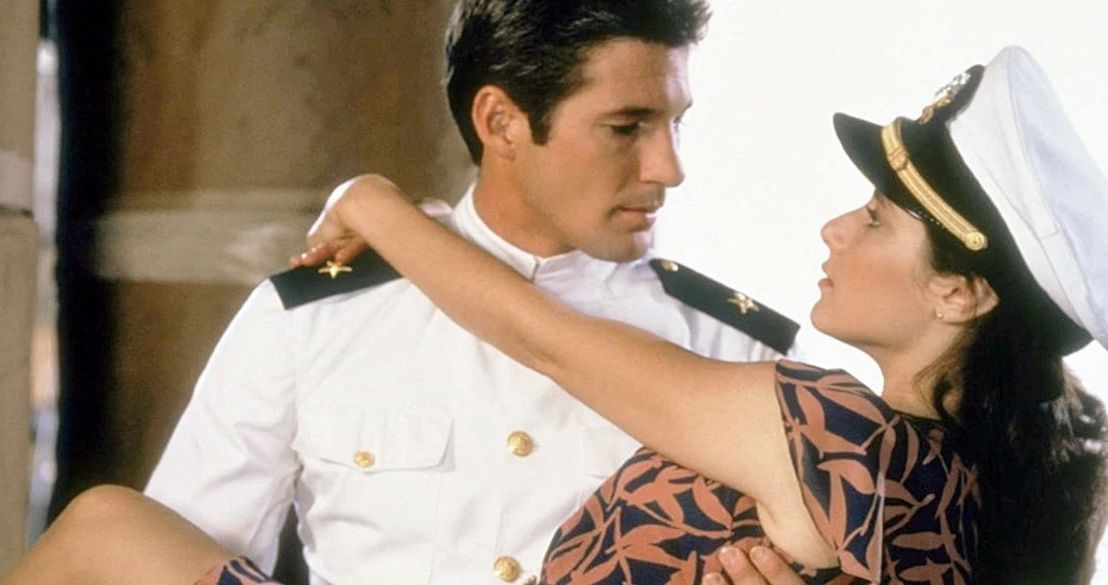
An Officer and Gentleman is remembered as a sweep-you-off-your-feet romance, with power-ballads underplaying attractive Hollywood stars passionately proclaiming their love. It ain’t anything like that. This proto-Top Gun – a film it has strong similarities to in structure and design – is actually a kitchen-sink drama masquerading as a feelgood movie, with a final romantic image and “Up Where We Belong” leaving a deceptive memory behind. Where Top Gun is loud, brash and fundamentally reassuring and straight-forward, An Officer and a Gentleman is jagged, surprisingly difficult and unsettling. Put it this way: Tom Cruise doesn’t call anyone the c-bomb in Top Gun.

Zach Mayo (one of Richard Gere’s legendary performances, the memory of which guided much of the rest of his career far more than its reality) is a Navy-brat determined to be nothing like his alcoholic, whoring dad (Robert Loggia). He’s going to graduate from Naval Flight Candidate school and become “an officer and a gentleman”. Zach is a damaged soul, defensive, closed-off and selfish, a smarmy, cruel loner interested only in what he can get out of any relationship. The film is about whether Zach will learn to become a sympathetic, caring person, rather than a resentful douche.

There are three influences that might just change him. Firstly, fellow trainee Sid (David Keith), from a Naval officer family, attending because his deceased brother can’t. The second is training officer and uncompromising disciplinarian Sgt Emil Foley (Louis Gossett Jnr). And, finally, factory worker Paula (Debra Winger), one of the local women officer candidates are warned are intent on bagging a husband by fair or foul. Each will play a different role in making Zach a fully rounded person.

Hackford’s film is a tough, hardened one that takes a long hard look at mental health, guilt, suicide, parental resentment and a host of other complex issues. Any romantic moment is matched with one of pain, fury or characters doubled over with guilt and shame. It dives deep into its flawed hero and shows how someone can, almost unwittingly, be reconstructed into something warmer. It does all this in grimy, scruffy settings with characters making desperate choices motivated by poverty and lack of choices.

It opens with a shaggy-haired, scruffy Gere starring into a mirror in a dark motel room while his father is passed out in bed with two prostitutes. We are constantly reminded of Zach’s working-class background, his life growing up trailing behind his (largely indifferent) father after the suicide of his mother, left to fend for himself in the rough and tumble of the Philippine streets. At naval school, the same chippy resentment of how people perceive his roots persists – along with the lessons he has spent his whole life learning: that he should count on no-one but himself.

Zach doesn’t believe he’s worth loving. Facing abandonment issues (of different kinds) from both his parents, he doesn’t give a toss about anyone and expects them to feel the same. He sets up a grift selling pre-polished buckles and boots to his fellow candidates, only helping them for a price. He completes exercises alone, cheats in aeronautical class, and gloats as he passes anyone on physical trials. When dating Paula, he frequently retreats into cold rudeness when conversation turns to anything emotional, and repeatedly claims he wants nothing more than a bit of fun. It all stems – as Paula realises – from a defensive hostility, pushing people away before they can leave him.

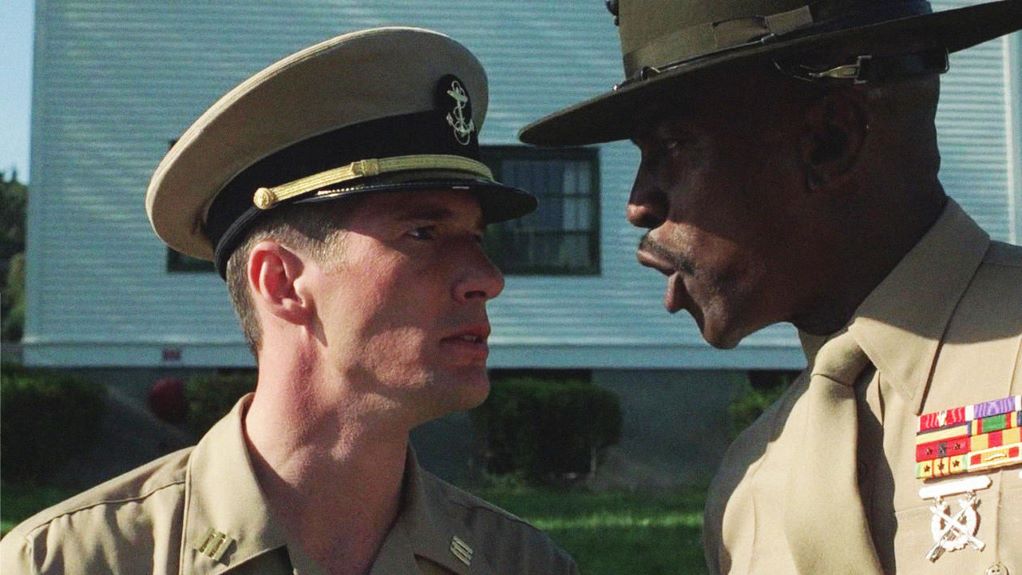
His lack of team-playing is identified early by Foley as his Achilles heel. Louis Gossett Jnr won an Oscar for his impressively nuanced work here. At first Foley seems an almost unbelievably horrible man, a bully dropping racist and homophobic slurs with casual ease, who makes it his mission to drive his candidates out of the programme (right down to bragging that he chisels a mark on his swivel stick whenever another one drops out).

However, Hackford and Gossett Jnr skilfully show this is, to a degree, a show: Foley is tough because the military is tough, and deep down he does care. Candidates slowly earn his respect (female candidate Seeger may fail to climb a wall, but goddamn he respects her guts) and he quietly goes to great lengths to support them. Foley’s act is intended to get them to excel – and he’ll be proud of them when they do, just as they will be grateful to him. The strength of Gossett Jnr’s performance mean his scenes dominate the narrative (at the cost of the romance), but this is to the film’s benefit.

Interestingly, that romance is often the least effective part of the film. Gere and Winger have fine chemistry (despite, allegedly, not getting on) but the narrative often takes sudden time jumps. From one scene to another they’ll go from together to split up, and the film never quite manages to show us naturally how this is changing Zach. Instead, it frequently stops to tell us this, with on-the-nose conversations. Winger is good, but the relationship feels forced – as if it a film couldn’t exist without a romance, when actually Paula could be removed altogether and it wouldn’t really change the film.

It’s forced perhaps because what really feels like it changes Zach is the friendship with Sid. Played very well by a sensitive David Keith, Sid is everything Zach is not. Confident, happy to help others, a natural leader and team player. Under the surface he isn’t – doubtful and insecure – but the friendship between them is the spark that changes Zach. Sid is, much like Goose in Top Gun, the sacrificial pal, but this sacrifice promotes real growth in Zach. The parallel romance between Sid and gold-digger Lynette (a fine Lisa Blount) is also an effective commentary on Zach and Paula, both characters being mirror images of the leads.

The film culminates in that romantic sweep-you-off-your-feet moment in the factory: but that feels like it belongs in a different film than the hard-boiled one we’ve been watching of a man confronting his fear of failure and lack of self-worth. Gere, by the way, is very good as Zach – his smirk a defensive screen for a host of psychological problems (few actors would have been willing to be as unlikeable as Gere is here). An Officer and a Gentleman is really a character study in working-class resentments, but somehow is mis-remembered as the quintessential 80s romance. It truly isn’t. Instead Hackford’s film – flawed as it is – is smarter and pricklier than that.

Scarface (1983)

“Shay hell-o to my leetle friend!” Al Pacino puts it all out there in Scarface

Director: Brian de Palma

Cast: Al Pacino (Tony Montana), Steven Bauer (Manny Ray), Michell Pfeiffer (Elvira), Mary Elizabeth Mastrantonio (Gina), Robert Loggia (Frank Lopez), Miram Colon (Mama Montana), F. Murray Abraham (Omar), Paul Shenar (Alejandro Sosa), Harris Yulin (Detective Bernstein), Mark Margolis (Shadow)

Remember when Al Pacino played the softly spoken, chillingly self-contained Michael Corleone? Watching The Godfather, who could have imagined that performance would be the outlier in a career that gleefully embraced the insanely OTT in a way few other great actors have dared. And possibly no other performance in Pacino’s career was as large as in Scarface, a ball of nervous energy, foul-mouthed aggression and drug-fuelled instability, the burning heart at the centre of Brian de Palma’s wildfire of a film. Scarface dials every single thing up to about 11 and then some, becoming the director’s brashest and most enduring work – but it owes everything to Pacino’s furious, unreserved energy at its centre.

Pacino plays Tony Montana, a working-class crook from Cuba dispatched (along with boatloads of undesirables from Castro’s regime) to Miami in the early 80s. There, in refugee camps and the local community, it’s crime and violence that give these guys the best chance of grabbing a share of the American Dream. Montana is no different, graduating from hits to drug deals and swiftly moving up the chain with his determination, gruff no-nonsense attitude, fierce loyalty and ruthless focus. But once you hit the top and the world is yours, there is really only one way to go – back down again, made easier when you are hooked on snorting mountains of your own product, incestuously in love with your sister Gina (Mary Elizabeth Mastrantonio) and your increasing arrogance and unreliability put you on the wrong side of your partners and kingpins in South America.

A remake of the 1932 original by Howard Hawks (the film is dedicated to Hawks and the scriptwriter Ben Hecht), Scarface is a brash, unsettling, nervy and incredibly violent cartoon-style gangster movie that owes almost its entire legacy to Pacino’s snarling wit at the centre. Is Pacino taking the piss here with this performance? Surely, he must have wondered if he could get away with it. This is a whirlwind tour-de-force, Pacino throwing himself into it with nothing left in the locker-room. He delightedly wraps his vocal chords around a thick Cuban accent (turning words like cockroach into a three syllable delight – “Cock-ah-roatch”) and embraces his small stature by turning Tony into a little pressure cooker. Seemingly incapable (bar one scene) of staying still, he’s supremely tense, his shoulders hunched up, his teeth on edge, voice growling.

It gives the film an unpredictable energy, because you don’t know what Pacino the performer will do any more than the characters do. He’ll suddenly throw you off with a moment of silence, just as often as he will blast your eardrums with a roar of anger. Emotionally Tony is a complete mess. His obsession with his sister is obvious, a devotion that Tony seems to only half (if that) understand is sexual in nature. But he also has a slight homoerotic bond with best friend Manny Ray (Steven Bauer – the only actor of Cuban heritage in the film), their closeness and macho-posturing carrying more than a whiff of Top Gun-ish “he protests too much”.

Pacino also invests Tony with strangely sympathetic qualities. Sure he’s a violent and ruthless killer and dedicated criminal, but he’s also got a firm sense of loyalty and certain moral lines he won’t cross. He’s got no time for bullshitters and respects only strength and honesty – watch the scene where he brutally talks over the weasely Omar (F. Murray Abraham – jetting back and forth between shooting this and Amadeus for goodness sake!) during a negotiation with drug lord Sosa – he has no respect or regard for his more politically minded boss, only for straight-talking that makes a deal.

It’s all this that ends up making Tony an anti-hero the viewer sort of ends up liking – even while he dopes himself to the brim with coke and funnels piles of it onto the street (not that we see any of that). Tony is a violent killer, but he’s a sort of honest man, a monster yes but a public one that we enjoy seeing. Tony himself recognises this, calling out a crowd of people in a posh restaurant for treating him as a monster so that they can feel better about themselves (slightly undermined by the fact he’s coked to the eyeballs, incoherent and has brutally ended his marriage a second earlier).

So much is Tony a force of nature that, hilariously, it feels like many of the fans of the film – bling gangsters and wannabe street punks – miss that this film is a brutal satire of the culture of excess and greed. Tony’s life falls apart the more money he gets, his addictions and problems growing as his wealth does. He’s an instinctive, but not wise, man who builds a household of fantastic excess and tasteless ostentation (surely, like Saddam, his taps are gold-plated) but also manages to destroy his business and life in a few months due to his greed, stupidity and self-destructive streak.

The things that made him a high-riser are lost the more Tony surrounds himself with garish status symbols. Inevitable destruction walks hand-in-hand with Tony’s “more is more” attitude. The more he attempts to add class and polish to his life, the more he demonstrates his own lack of both qualities. Also, as he gets more obsessed with pointless status symbols he loses the very skills – honesty, energy, shrewdness – that made him a kingpin in the first place. Instead he becomes a drug-fuelled narcissist, making impulsively stupid decisions and wrecking everything he spent the first half of the film building up. Tony Montana is the face of a certain type of Reagan/Thatcher economics, where private enterprise rolls in and ruthlessly takes and takes, with no regard for the impact on other people and no interest in sustainability.

De Palma captures this pretty well – although he probably ends up making this satire of excess more of a hubristic tragedy. Largely because the film falls so hard for Tony – or rather Pacino – that the fact that Tony is, despite his own moral code, a pretty reprehensible person can be easily lost. Not that de Palma probably cares that much, since his main aim here seems to be to create a hell of a ride. And there are some great set-pieces, and some wonderfully character beats – not least a sequence where Tony seizes control of the empire from weak boss Robert Loggia and sinister corrupt cop Harris Yulin.

The film certainly does that, flying from set-piece to set-piece so swiftly and with such a sense of pace and shark-like momentum, you almost don’t notice that it runs for as long as it does. Every few minutes gives us a scene with stand-out moments of either Pacino grandstanding, shocking violence or both. Scarfaceis a very violent film – everything from chain saws to bullets are used to pull gangster bodies apart – and while it has a sort of moral message (“Excess is bad”) it’s really just an excuse like Cecil B DeMille to make us feel good about ourselves by watching someone pretty bad (but with a few redeeming qualities) dance like a bear for two and a bit hours doing terrible things (entertainingly) before being carved down in a hail of bullets as the devil comes round to collect.

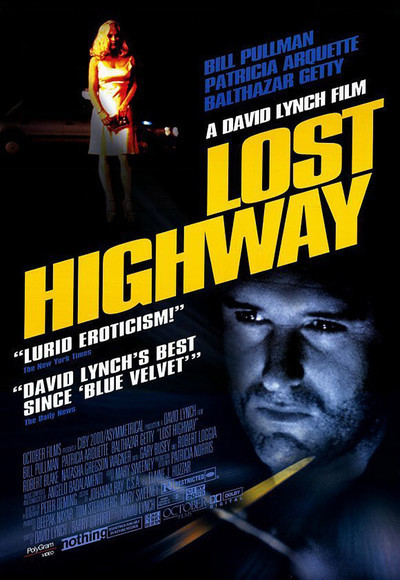
Lost Highway (1997)


Bill Pullman goes out of his mind in David Lynch’s deliberately weird Lost Highway

Director: David Lynch

Cast: Bill Pullman (Fred Madison), Patricia Arquette (Renee Madison/Alice Wakefield), Balthazar Getty (Pete Dayton), Robert Loggia (Mr Eddy/Dick Laurent), Robert Blake (The Mystery Man), Gary Busey (Bill Dayton), Lucy Butler (Candace Dayton), Michael Massee (Andy), Richard Pryor (Arnie)

It wouldn’t be a David Lynch film unless the plot was impossible to explain, but here goes. Fred Madison (Bill Pullman) and his wife Renee (Patricia Arquette) marriage is on the rocks. The couple start receiving packages containing camcorder videos of their home. These videos become increasingly more and more personal and intimate. The final video shows Fred murdering Renee. Imprisoned, Fred suffers from headaches and then overnight he transforms into another person, Pete Dayton (Balthazar Getty). Released back into the world, Dayton encounters the glamorous Alice Wakefield (Arquette again). Then things get even weirder. Yup that’s right: weirder.

Lost Highway is probably Lynch at his most obscure and baffling. Like a lot of Lynch films, it’s a question of taste. What do you want to get out of a film? If it’s a puzzling mystery then this might be the film for you. Lost Highway is like an impossible jigsaw, or a landscape with no frame of reference: trying to judge what the overall actual picture is, is nearly impossible. Traditional film making elements, such as story and character, are subservient here.

So whether you like Lost Highway will probably come down to how much you are willing to accept everything you see is constantly being dismantled and repositioned by the film. It strikes a less successful balance between this “Lynchian” material and more traditional storytelling than Blue Velvet or Mulholland Drive (both, I would argue, superior films). However, for those willing to run with a mystery, Lost Highway is a baffling but intriguing watch – unsettling, unnerving, but fascinating.

So what is it about? Now I confess I needed to read up a little bit, but the best way to understand the film is as some sort of elliptical, dreamlike fantasy created by its lead character. It seems pretty clear that the majority of the film is, at best, subjective recollection or out-and-out fantasy. A little too much attention is paid in the film to a line from Fred Madison that he dislikes video cameras as he prefers to “remember things my own way rather than how they happened”. A fairly on-the-nose statement, but a clear mission statement for a film if I ever I saw one.

In fact, Fred Madison is so keen to remember the world only as he sees it that, he literally becomes someone else to build some sort of internal fantasy world where he can win the girl. But Fred/Pete is such a screwed up, confused person he can’t even get his own fantasy world right –impressions from the real world keep draining in. At least, that’s a fair interpretation. The film of course deliberately keeps things open: is this some fantasy Fred has while trapped in his cell? Or is there some sort of metaphysical transformation that fades into the real world? Is there an element of this story being circular and self-perpetuating? Is there any reality to it at all? How much you engage with these questions is a pretty good indication of what you’ll make of this film.

Whatever your response to it, as a piece of film-making it’s a very impressive piece of work. All the usual Lynchian touches are here: the strident and discordant lighting at key moments, the intelligent and daring use of music, the intermingling of design from the modern world and Americana of the 1950s, not to mention the moments of extreme violence and graphic sex. Lynch uses unsettling camera angles and sudden tilts of angle and sound to constantly keep the audience on their toes and questioning what they are seeing. Disturbing and haunting imagery, a testament to Lynch’s painter’s eye, is perfectly judged. Confusing as this film is, it offers a parade of intriguing images.

It’s an important landmark in Lynch’s filmography: a flowering of ideas he had been dabbling with since Twin Peaks, of mysticism, perversion and human darkness, and a jumping off point for haunting, almost illogical films to come like Mulholland Drive. The Mystery Man (unsettlingly played by Robert Blake – not least as this is the last film Blake made before his conviction for murdering his own wife) is a haunting, perfect Lynchian character – unsettling in appearance and confusing in intention. Is he a real person, or a mystical force? Is he some sort of external expression of evil driving Fred on, or is he part of Fred’s fractured mind?

Patricia Arquette plays two very different femme fatales, but to what extent are they reimaginings or reversionings of each other? It’s a very good performance from Arquette, playing someone who is not quite a real person, nor quite a fantasy, who feels like a character from a film moving into a real world, which itself is probably a fantasy. Just writing this sentence shows what a crazy film this is.

For the rest of the performances, there is a good mix of the genuine and the artificial. Bill Pullman, at his most understated, is perfect to ground the film, while Balthazar Getty gives a fine, detailed performance as a character who is similar and slightly different to Fred. Robert Loggia mixes ferocity and a bizarre tenderness as a character who may or not be a foul-mouthed gangster. These performances add a level of heart to the film, allowing a bit for freedom for the strangeness.

Lynch’s Lost Highway isn’t a masterpiece – it’s perhaps too self-consciously oddball and unusual, too reliant on mood and atmosphere to make up for its lack of story and characterisation. It is however intriguing, a brilliant puzzle, even though it doesn’t really allow you to invest emotionally in it at all. You can admire it as a mystery, but you can never really open your heart to it. It’s a film that is daring and dangerous, but it’s also one that, for all its erotic sex and tortured psyches, never really feels like it’s about real people with real feelings. It’s a mixture that, as I’ve said, works better in Mulholland Drive. But this is a very good staging post to that film.