Tag: Robert Mitchum

The Night of the Hunter (1955)

The Night of the Hunter (1955)

Laughton’s only masterpiece is a fairy-tale, stuffed with beautiful images and dreamlike logic

Director: Charles Laughton

Cast: Robert Mitchum (Harry Powell), Shelley Winters (Willa Harper), Lillian Gish (Miss Rachel Cooper), James Gleason (Uncle Birdie), Evelyn Varden (Icey Spoon), Don Beddoe (Walt Spoon), Billy Chapin (John Harper), Sally Jane Bruce (Pearl Harper), Gloria Castilo (Ruby), Peter Graves (Ben Harper)

Few films have had their critical reputation change quite as much as The Night of the Hunter. When released, its reception from film critics and audiences was so negative that the crushing disappointment saw director Charles Laughton decide his debut would also be his last film. Flash forward seventy years and it’s now hailed as one of the great American films, a pictorial masterpiece. The Night of the Hunter sits alongside Citizen Kane as the classic film unappreciated in its day.

Adapted from Davis Grubb’s best-selling novel, it follows the nightmareish experiences of young John Harper (Billy Chapin) and his sister Pearl (Sally Jane Bruce). These kids witness their father Ben (Peter Graves) dragged away by the cops to imprisonment and execution – but not before he’s hidden $10,000 in Pearl’s doll and sworn them both to secrecy. Word about the money gets out: it’s why sinister ‘Preacher’ Harry Powell (Robert Mitchum) arrives and starts a-courting their mother Willa (Shelley Winters). After swiftly disposing of Willa, Powell turns his attentions to the kids – who flee down river, eventually coming under the protective wing of kindly widower Rachel Cooper (Lilian Gish) and her brood of young waifs and strays. Is it far enough though to escape Powell’s clutches?

The Night of the Hunter plays out like a fairy tale. Its images are full of the magic of the countryside and mysticism of nature. It frequently, deliberately, uses artificial sets and locations to create a dream-like state. It’s got a classic monster its heart, with Powell a demonic force-of-nature. It follows a pair of children on a journey reminiscent of Hansel and Gretel. There is a kindly old woman and a moral message of the importance of love, family, faith and loyalty. Everything in it feels, to various degrees, heightened. This is Southern drama via Hans Christian Anderson.

I wonder if that’s what threw people off on release. I’d agree that the film’s opening – Lilian Gish’s face superimposed over a starry night sky (followed by a cut of five kids heads superimposed over the same sky raptly listening) – might tee us up for the film’s mood, but looks and feels kitsch. The moments where Laughton deliberately aims at heightened, almost cartoonish, reality push the envelope of what you can accept – why does Powell, at one point, chase the kids up a flight of stairs, hands stretched out before him like he’s in a live action Tom & Jerry cartoon? Stumble onto The Night of the Hunter unwarned about its fantastical grounding and melodrama and it must look and feel odd, bizarre and even a bit laughable.

But it’s these same qualities that have made the film last. Laughton created a film of magical force and power, crammed with striking, imaginative images and beautiful sequences that tip between dream and reality. Its real heart lies in the children’s escape down the river, a remarkable sequence as the camera follows the boat drifting down an obviously artificial river, the children asleep as it glides past spider’s webs, frogs and other wildlife. From a film that opens with the aggressive arrest of the Harper’s dad, this burst of Where the Wild Things Are mysticism intentionally feels like we are crossing into a completely different world, let alone movie. But it’s also part of the film’s striking originality and quirky memorability. Few things look conventionally ‘real’ – in fact, like the farmhouse the kids stop at overnight in their long drift down river it feels even intentionally artificial – but it also gives the film a timeless, poetic feeling.
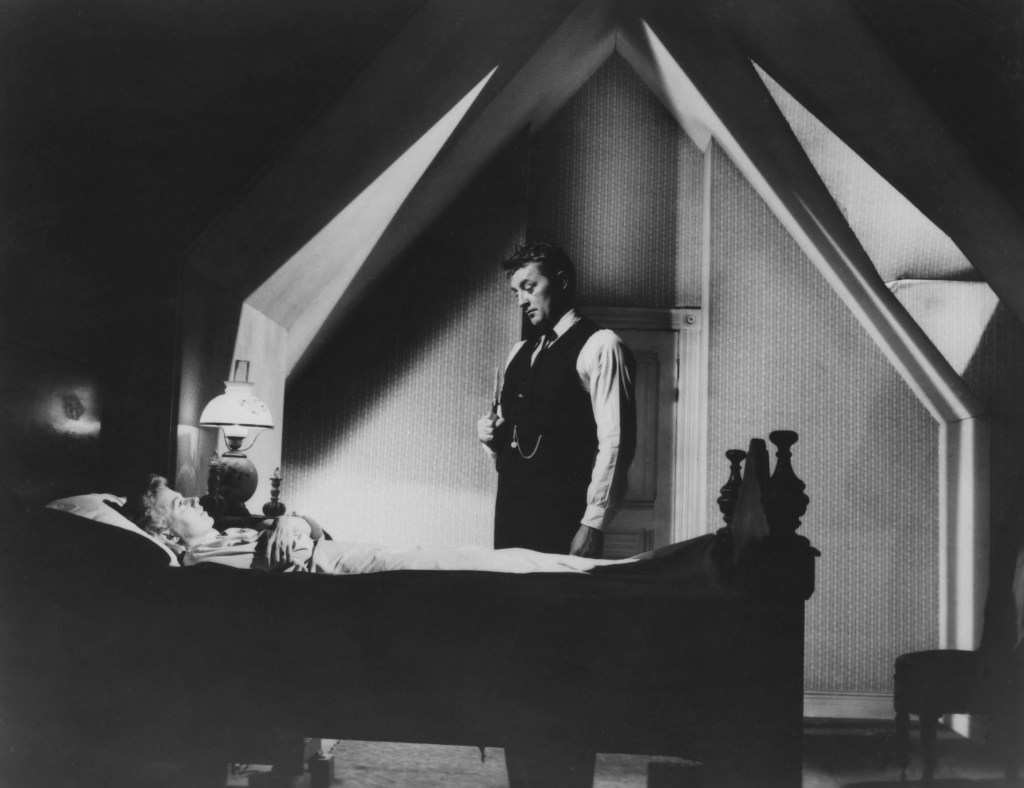
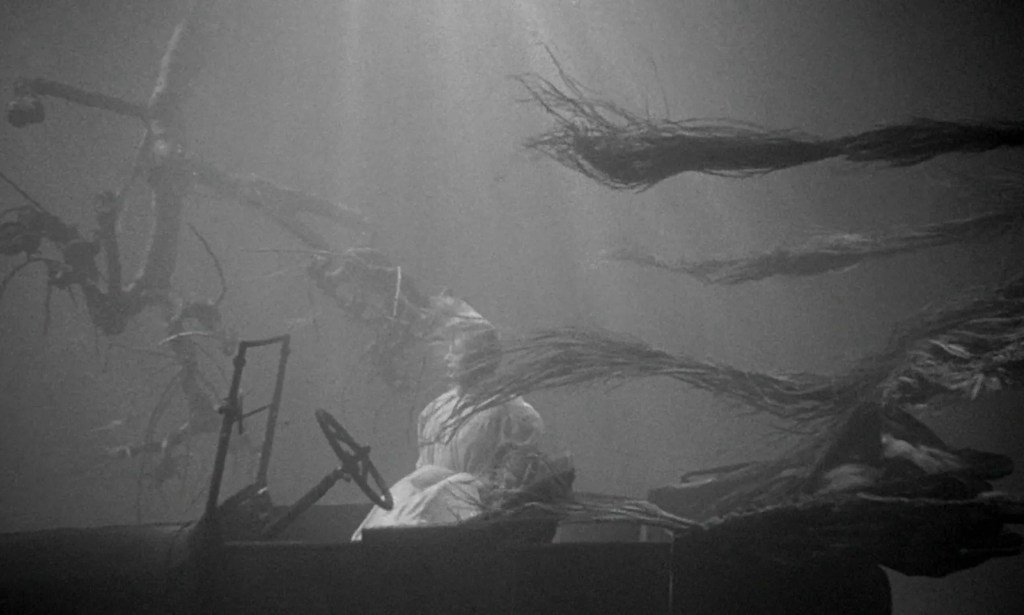
It’s a beautiful sequence in a film stuffed with them. Laughton worked closely with cinematographer Stanley Cortez and several sequences are awash with poetic visual flourishes inspired by some of the great German silent cinema of the 1920s. Who can forget the visually stunning shot of Willa’s body in a car at the bottom of the river, her hair flowing in matching waves with the weeds around her (possibly the most beautiful image of death in the movies)?  From the countryside shots that bring back memories of Murnau’s Sunrise to striking sets that seem to have emerged from The Cabinet of Dr Caligari. Most striking is the high-ceiling, Church-like set that is Powell and Willa’s bedroom, a shadow-laden expressionist nightmare. The scene is played with the same carefully choreographed expressionist force, from Mitchum’s vivid gestures to Winter’s corpse-like resting.

Death comes from Mitchum’s Preacher, one of the great monsters in cinema. With those famous ‘Love’ and ‘Hate’ tattoos, Mitchum makes the role truly terrifying. Mitchum kept up a studied public contempt for acting, but he immerses himself in Preacher in a way he did with few other roles. He makes him horrifyingly charming (he wins adult confidences easily) and his smooth gravel-voice and masculine bearing are both imposing and intimidating. But Mitchum also embraced the weirdness, the psychopathy of a man who murders without a second thought while keeping up a private conversation with the Lord. Preacher is an animalistic demon wrapped up in human skin – he lets out the most bizarre, piercing screams when foiled or injured – twisting his body into unsettling shapes before his misdeeds or letting his eyes boil with anger and disgust (most particularly at sex, something he seems to find repulsive and fascinating).

It’s an extraordinary, terrifying, monstrous performance unlike almost everything else in Mitchum’s career in its willingness to go to such twisted, eccentric, unnatural extremes. Mitchum credited Laughton as his finest director – and Laughton’s skill with actors is clear from all the performances. Shelley Winters’ has rarely been better in a role she skilfully downplays, as an unhappy woman, desperate for redemption, forced to feel ashamed of her desires. The two children are very good, in particular Chapin’s frequently raw panic and trauma and determination. The rest of the cast is stuffed with striking, Dickensian pen portraits, performances of striking eccentricity.
These performances fit within the magical realism of the film in a film that is as stylised as this. Again, I can’t imagine that audiences at the time – used to blockbusters, shot on gloriously realistic locations – were ready for something that aped so strongly the artistic flourishes of silent cinema. But it works spectacularly for a film about a children’s semi-magical quest into the wilderness. It’s hard to think of another film that leans so completely into such an aesthetic unreality as this one – even the town the kids eventually escape to feels like it’s a movie set rather than a real place.

The film’s final act in the home of Miss Rose Cooper is not as strong as those before. There is something rather po-faced and self-satisfied about the slightly clumsy moral message of finding faith and goodness which feels rather twee and disappointing considering the gothic film we’ve just watched. The film’s final sequence, on a peaceful Christmas day, belongs in a more conventional film (even though you could argue it’s also a conventional fairy tale ending). Much as I enjoy several moments of Lillian Gish’s performance as a tough old woman – like a shot-gun wielding Whistler’s Mother – the shift of focus away from Preacher’s demonic schemes feels like a loss.

The Night of the Hunter, for me, isn’t the complete masterpiece it’s sometimes hailed as – there are clumsy moments (I would agree the Tom & Jerry Preacher chase feels tonally out of place, and neither the opening or closing is strong), but it’s also filled with moments of pure cinematic magic – and has a performance from Mitchum that is one for the ages. Its imagery is beautiful, it’s tone mostly perfect and its imagination limitless. The greatest sadness about watching it is that Laughton never directed again – based on this, imagine how good his next film might have been?

The Longest Day (1962)

John Wayne leads the charge on The Longest Day

Director: Ken Annakin, Andrew Marton, Bernhard Wicki

Cast: John Wayne (Lt Col Benjambin Vandervoot), Henry Fonda (General Theodore Roosevelt Jnr), Robert Mitchum (General Norman Cota), Richard Burton (FO David Campbell), Eddie Albert (Col Lloyd Thompson), Sean Connery (Pvt Flanagan), Curd Jurgens (General Gunther Blumentritt), Richard Todd (Maj John Howard), Peter Lawford (Brig Lord Lovat), Rod Steiger (Lt Com Joseph Witherow Jnr), Irina Demick (Jeanine Boitard), Gert Frobe (Pvt “Coffee Pot”), Edmond O’Brien (General Raymond Barton), Kenneth More (Capt Colin Maud), Robert Ryan (Gen James Gavin), Red Buttons (Pvt John Steele), Christian Marquand (Cpt Philippe Kieffer), Jean-Louis Barrault (Fr Louis Rolland), Arletty (Mdm Barrault), Paul Hartmann (Field Marshall Gerd von Rundstedt), Werner Hinz (Field Marshall Erwin Rommel), Wolfgang Priess (General Max Premsel), Peter van Eyck (Lt Col Karl Williams Ocker)

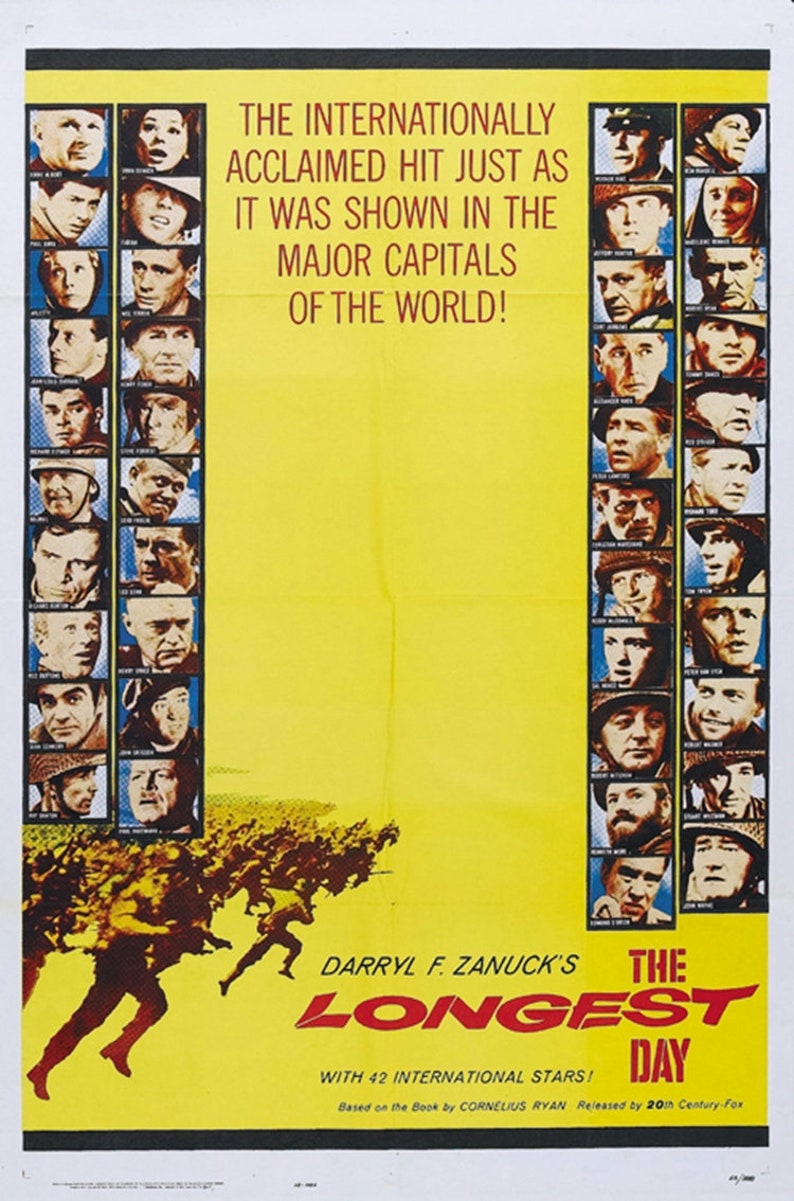
Darryl F Zanuck wanted to make the War Film to end all War Films. So, what better way than to restage D-Day itself, with a cast (as the poster brags) of 42 International Stars, playing out almost in real-time. It’s a grand ‘mock-documentary’ shot in black-and-white (so that actual war footage can be integrated into the film) and aims to show the perspectives of the four main combatants (the Americans, the British, the French and the Germans – with all their scenes played in their respective languages). Adapted from a definitive D-Day book by Cornelius Ryan, it makes for huge, now slightly old-fashioned, Sunday afternoon fun and one of the most iconic second world war films.

To make his dream come true, Zanuck left no stone unturned. Pretty much every single part is played by a ‘name’ actor (although, rather like Around the World in 80 Days, time has left some of them less recognisable than others) no matter how small the role. And I mean no matter how small. Many of the actors appear in no more than one or two scenes. Steiger chips in a brief speech as a Naval officer. Burton has two scenes as an RAF officer, one of the last of the “Few”. Fonda contributes a few minutes of heroism as Theodore Roosevelt Jnr. Robert Ryan briefs The Duke as General Gavin. Jean Servais makes a grand speech as a French Admiral. Gert Frobe doesn’t even speak as a (what else?) bullying German soldier. This parade of stars does though does mean you pay a lot more attention to every single part and it makes it a lot easier to keep track of who’s who.

It’s certainly a ‘producer’s’ film. Zanuck held complete creative control, splitting the directorial duties between three hired hands. Annakin directed all the British and French scenes (and most of the American ‘briefing room’ scenes). Martan, an experienced second unit director, was hired to shoot most of the battle sequences. Wicki looked after the German sequences. With the brief being to replicate the documentary style of actual footage, naturally this basically led to a film that doesn’t have the feel of being ‘authored’ (in the way, say, Saving Private Ryan does), but it’s functional shooting style and design does make it fairly easy to follow.

And it needs to be easy to follow, as this is a very long film indeed – and with the cast frequently changing from scene to scene, can become overwhelming. The quick changes of location – and the lack of time spent with any single character – often means it’s hard to connect to strongly to any of the individual characters. Most of the more prominent characters gain their personality solely from the actors playing them: so I don’t really know what the real Colonel Vandervoot is like, but I know his character here is basically ‘John Wayne’.

The more prominent roles in the script rely on these personality parts. Wayne probably has the largest individual role as the Paratrooper commander who breaks his ankle on landing, but doesn’t let that slow him down from hitting his objective. (Wayne also gets a great little speech, the sort of thing much missed in Ryan, where he praises Brit fortitude under the Blitz, which is a lovely moment of Allied brotherhood). Mitchum gets the juiciest action as General Cota, the highest-ranking soldier on Omaha Beach, who leads the first break out. At the other end of the ranking, Red Buttons brings charm and heartfelt emotion to the most memorable sequence as Pvt John Steele, the paratrooper who landed on top of the church spire at Sainte-Mère-Église, deafened by bells and forced to watch the rest of his platoon slaughtered on landing.

The scale is really what it’s all about. The recreation of the D-Day landings is stunning (the first boats, though, don’t hit the beaches until well over two hours into the film), and its genuinely hard to tell the difference between what is recreated and what is actual war footage. The film doesn’t shirk from showing the cost of war, or the slaughter on that beach (although of course, it looks reserved compared to Ryan). But the combat and operations elsewhere are also perfectly recreated. Richard Todd is very good as Major John Howard, in an expert reconstruction of the seizing of the Orne Bridges near Caen (in real life, Todd himself was one of the commandos serving under Howard and even has a scene where Todd as Howard talks to another actor as Todd).

These battle sequences make for compelling viewing. Slightly less so is the long build-up of the Allies to the attack. There are many, many scenes in various briefing rooms and for every delight (such as Jack Hedley’s briefing around “Rupert” a model paratrooper, dropped as a distraction) there are po-faced actors staring into the middle distance and discussing how important everything is. By far and away the most interesting content in the first half is less the Allies (waiting to leave) than the Germans (trying to work out how and where the Allies will arrive). These scenes feature a range of German officers, from the quietly resigned to die-hard, head-in-the-sand Fascists, and revolve around a series of fascinating debates on where, when or even if at all the Allied attack will come. With a cast of excellent German actors – Jurgens, Preiss, Hartmann, Hinz and Wolfgang Buttner are particularly fine – these scenes stand out as they present a perspective we don’t often get to explore. (Even though the film squarely accepts the German military view that the defeat was all Hitler’s fault and the army was completely blameless of any of the crimes of Nazism.)

After the slow-build, the explosion of tension and action is done really effectively. Sure, the film is long and episodic, but the ever-changing locations do frequently help with the pace. The film’s documentary style also lends it a great deal of authority that a more ‘fictional’ film would not have. After all, pretty much everyone in the film is ‘real’ and while the film could be seen as a collection of D-Day anecdotes, strange moments – such as a platoon of Germans and Americans passing each other on opposite sides of a low wall without noticing each other – have the ring of truth. The script was doctored by a host of major novelists and playwright (including Noel Coward) to brush it up, but really this is a producer’s triumph.

And it is a triumph for Zanuck. Everything he sought to do, he accomplished here – and the doubts that he could pull it off were moved as wrong, as those who doubted whether the Allied plan to cross the Channel would work. Hugely impressive in its staging, detailed in its recreation and with a cast of stars and top actors giving every scene a fresh bit of life, this makes for one of the all-time classic war films.

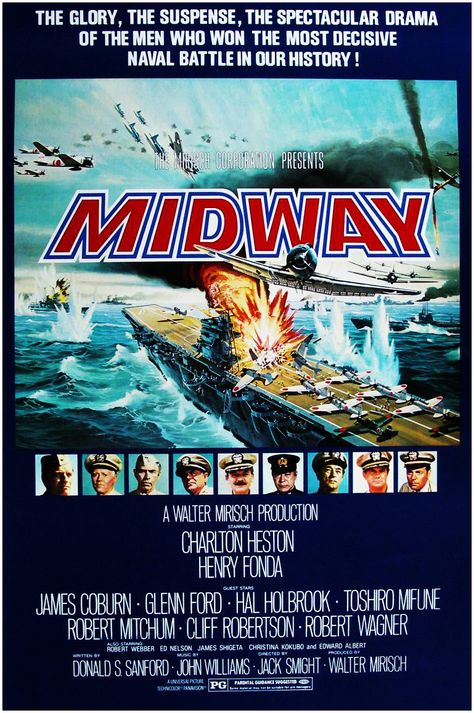
Midway (1976)

Charlton Heston fights in one of the great naval battles at Midway

Director: Jack Smight

Cast: Charlton Heston (Capt Matt Garth), Henry Fonda (Adm Chester W Nimitz), James Coburn (Capt Vinton Maddox), Glenn Ford (Rear Adm Raymond Spruance), Hal Holbrook (Comm Joseph Rochefort), Toshiro Mifune (Adm Isoroku Yamamoto), Robert Mitchum (Adm William Halsey), Cliff Robertson (Comm Carl Jessop), Robert Wagner (Lt Comm Ernest L Blake), Robert Webber (Rear Adm Jack Fletcher), James Shigeta (Vice Adm Chuichi Nagumo)

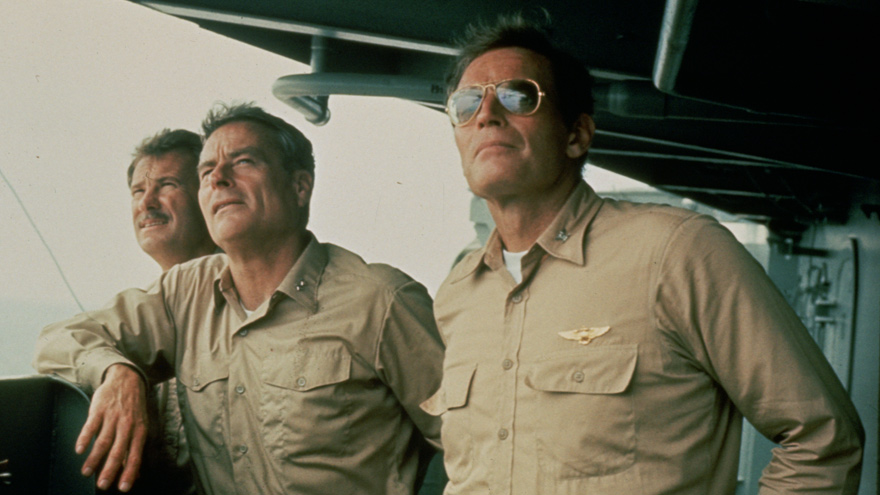
On 4th June 1942, the fate of the Pacific naval war was arguably settled. The Japanese plan to invade the American base on the island of Midway and, crucially, wipe-out the American aircraft carrier force, instead saw a near total US victory and all four Japanese aircraft carriers destroyed. The story is re-told here as a classic all-star Hollywood epic, with the first hour dedicated to the planning and the second hour to the events of 4th June.

After its – successful – run in the cinemas, Midway was re-edited into a two-part TV mini-series. To be honest, that feels more like its natural home. It’s competently directed by Jack Smight – but no more than that – and revolves around several scenes of star-actors pushing models around maps and less famous actors pretending to fly planes in front of blue-screen. The film makes a proud statement at the start of how it has chosen to use only actual archive combat footage to “honour those who fought” – but this actually, you suspect, was motivated more by the fact it’s much cheaper to purchase and clean up piles of stock footage than it is to shoot things afresh.

The main narrative covers the planning and the crucial day of the battle itself. A brief “human interest” story is introduced via Charlton Heston’s (fictional) Captain Matt Garth, an aide of Admiral Nimitz. Will Chuck improve his relationship with his fighter pilot son, who has fallen in love with a Japanese girl? Whadda you think? Saying that, this rather clumsy human-interest story (which features the only female character in the film) does make some interestingly critical points about the policy of internment against Japanese Americans – stressing both the injustice and explicit racism (American Germans and Italians faced no such fate) behind the policy.

In fact, Midway is very sympathetic in general to the Japanese – as Nimitz even says at the end, perhaps it was less a question of skill than luck that led to the final outcome. The Japanese navy is presented as an honourable and thoughtful opponent, respectful of human life and conducting the war via a code of honour (the kamikaze runs of cliché are completely absent). In particular Admiral Naguma (well played by James Shigeta, in possibly the film’s stand out performance) is a decent man caught-out continuously by horrendous luck and timing, who pays a heavy price. Midway is strong in stressing there is no leeway at sea – get caught out there and it’s the bottom of the briney for you.

The Japanese planning is even slightly tragic in its flawed assumptions – crucially they are totally unaware that their codes are broken and that, far from launching a surprise strike, they are actually sailing into something of a trap – while Toshiro Mifune brings a lot of nobility to Yamamoto even if all he really does is pensively stare at a series of maps.

On the American side, Fonda leads the way, giving Nimitz more than a touch of Fordian home-spun heroism. Heston’s presence does well to link together the various true-life characters and location. Most of the rest of the all-star cast are restricted to one or two scenes: Coburn rocks up to handover a report from Washington, Wagner briefly pushes models across a table in a planning room and (hilariously of all) Mitchum delivers both his tiny scenes from a hospital bed, coated in skin cream.

When the action gets going though, it’s done pretty well with the po-faced, stodgy seriousness these war-time later 70s epics nearly all seemed to have in common. The stock footage does actually look pretty good and the drama of the battle – and the tactics – are captured fairly well. It’s intermixed with some real ships and all scored with a great deal of punch by John Williams. It’s all really B-movie, TV-movie-of-the-week stuff but it’s also far from obviously flag-waving either, instead doing its best to be even-handed and even a little bit critical. You’ll learn what happened and also have a bit of fun into the bargain.

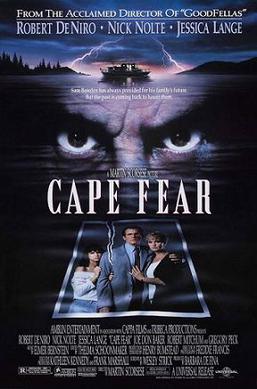
Cape Fear (1991)

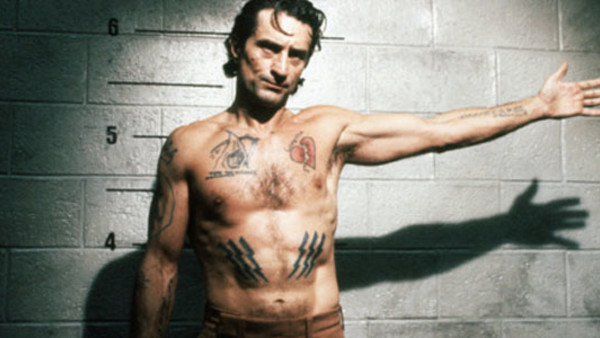
Robert De Niro terrorises his lawyer’s family in Cape Fear

Director: Martin Scorsese

Cast: Robert De Niro (Max Cady), Nick Nolte (Sam Bowden), Jessica Lange (Leigh Bowden), Juliette Lewis (Danielle Bowden), Joe Don Baker (Claude Kersek), Robert Mitchum (Lt Elgart), Gregory Peck (Lee Heller), Illeana Douglas (Lori Davis), Fred Dalton Thompson (Tom Broadbent), Martin Balsam (Judge)

Max Cady (Robert De Niro) is out of prison after 14 years. He went in as an ill-educated psychotic bum, sent down for the rape and assault of a young woman after his appalled lawyer Sam Bowden (Nick Nolte) buried evidence on her sexual history that might have lightened his sentence. He comes out as a self-educated, articulate and psychotic force of nature, not sorry for one minute and intent on making Sam and his wife Leigh (Jessica Lange) and daughter Danielle (Juliette Lewis) pay. 

Scorsese’s remake of J. Lee-Thompson’s deliberately Hitchcock-esque thriller sees the great director go one better by trying to channel Hitchcock’s style as closely as possible. Framing and editing decisions echo Hitchcock, its design apes as much as possible cinematographer Robert Burk’s lensing, Elmer Bernstein remixes the original film’s Bernard Herrmann score into something even more Hitchcockesque than the original. Scorsese throws in several of the master’s favourite themes, with sexual obsession and frustrated, working men forced to defend themselves in extreme situations. Combined with the sort of lavish violence and extreme imagery Hitchcock couldn’t use, we end up with something like an odd film-school experiment, by film students who have watched too many slashers. It’s grim, tasteless, overlong and troubling – and not in a good way.

The film adjusts Nolte’s character from a lawyer and witness against Cady into his corrupt lawyer (no matter that his corruption in this case was well intentioned). The film has a slightly unpleasant concern with modern worries about masculinity, with Bowden now concerned he is not “man enough” to defend his home – the film constantly passes subtle judgement against Bowden’s lack of physical prowess. It also readjusts Bowden into a weasel, corrupt at work and having an affair with a young attorney (whom Cady then beats and rapes later in the film, with a slightly queasy air that she is at least partly culpable by allowing Cady to pick her up in a bar beforehand). To be honest Bowden is hard to sympathise with, and his quest to assert his masculinity rather than rely on the law or hiring others to do his dirty work not really that pleasant. Frankly Nolte was never the actor to engage sympathies in the way original choice Harrison Ford (he wanted to play Cady) would do.

Cady himself is played by Robert De Niro, channelling heavily the original’s star Robert Mitchum (with lashings of The Night of the Hunter) as the sort of articulate psychopath so beloved by film. It’s fun to watch De Niro grandstanding as this sort of violent Tyrannosaur, weaving both psychological and shockingly violent games to unnerve and panic Bowden and his family. The film doesn’t give much scope to make Cady much more than a sort of comic-book monster, but De Niro does at least have moments of reflection in amongst his insanity. And there is a sort of admirable emotional intelligence in Cady’s knack of detecting the underlying tensions in the Bowden’s marriage and family life and exploiting these to torment the family.

The film’s most effective moments are the quieter ones, none more so than Cady’s quiet befriending/seduction of Bowden’s daughter Danielle behind her parents’ back. This culminates in a deeply unsettlingly seduction scene in Danielle’s school hall, where Juliette Lewis (extremely good) fascinatingly and bashfully becomes entranced with Cady’s interest in her teenage reading list and problems with her parents. The sexuality of the scene is possibly even more unnerving today and a highlight of the film – not least, ending as it does, with Danielle sucking Cady’s thumb before kissing him and leaving with the giddy, confused excitement of someone both scared and fascinated. Few other things in the film match this moment for psychological complexity – or the unsettling exploration of teenage sexuality overlapping with rebellion against domineering parents. 

Least of all the film’s overblown and final confrontation between the Bowden family and Cady, in which Cady rises from death no  less than three times and which stretches on forever, jettisoning all the small stock of goodwill the film had built up in its quieter moments. But then this is just part of a film that chooses the graphic and the overblown over calculated and chilling, every chance it gets. It’s a shame as there is a more chilling, psychological terror film – with Cady as a demonically clever opponent – struggling to come out here, but which keeps tripping into slasher territory with Cady as an invulnerable Michael Myers.

Perhaps Scorsese just thought of the whole thing as a sort of cineaste’s private joke? All the Hitchcock references, the careful apeing of styles, even the casting of the original’s leads in small roles (a joke further amplified by casting Mitchum as the police officer, while ultimate straight arrow Gregory Peck plays a lawyer even more corrupt than Bowden). But jokes like this don’t really make for long-term entertaining films, and Cape Fear is so full of basically horrible people doing horrible things to each other (in an increasingly Grand Guignol fashion) that after a while you more than cease caring about it. You start getting actively annoyed by it.