Tag: Robert Rossen

Alexander the Great (1956)

Alexander the Great (1956)

An odd epic, which both loathes its subject and also presents him as a golden-boy

Director: Robert Rossen

Cast: Richard Burton (Alexander the Great), Fredric March (Philip II), Claire Bloom (Barsine), Danielle Darrieux (Olympias), Barry Jones (Aristotle), Harry Andrews (Darius), Stanley Baker (Attalus), Niall MacGinnis (Parmenion), Peter Cushing (Memnon), Michael Hordern (Demosthenes), Marisa de Leza (Eurydice), Gustavo Rojo (Cleitus the Black), Peter Wyngarde (Pausanias), William Squire (Aeschenes)
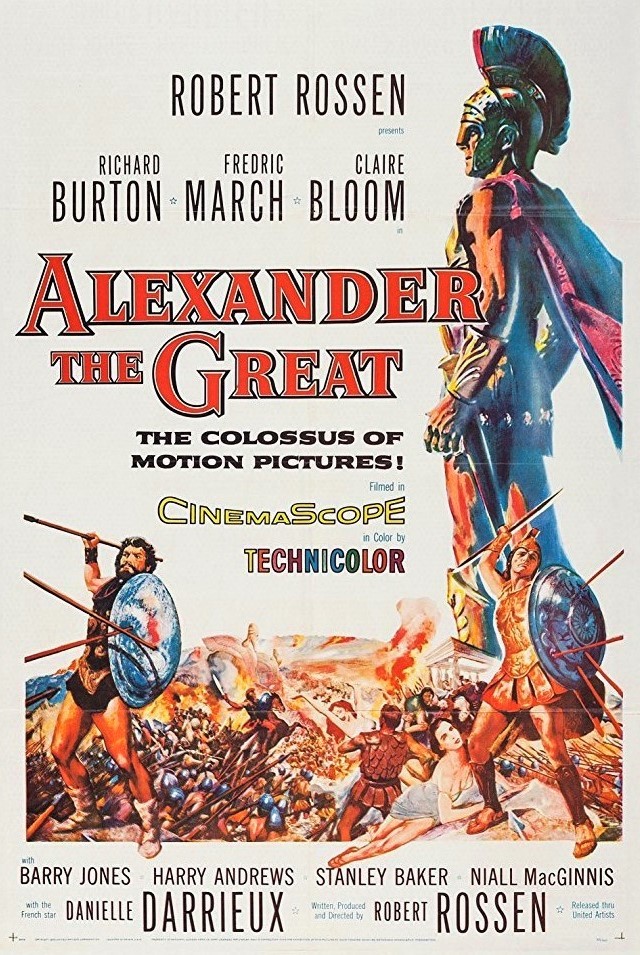
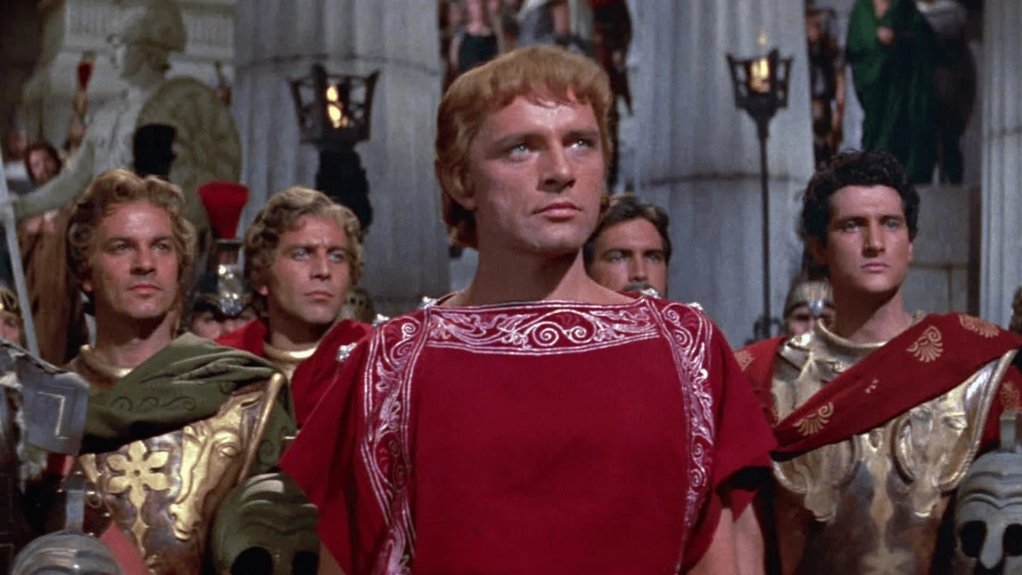
No one in history achieved so much, so young as Alexander the Great. He conquered most of the known world before he was thirty and left a legend that generations of would-be emperors found almost impossible to live up to. He did all this, while remaining a fascinatingly enigmatic figure: either a visionary nation-builder or a drunken man of violence, depending on who you talk to. Alexander the Great, in its truncated two hours and twenty minutes (sliced down from Robert Rossen’s original three-hour plus) can only scratch the surface of his story and that’s all it does.

As the great man, Richard Burton flexes his mighty voice in a film that splits its focus roughly equally between the early days of Alexander and his troubled relationship with both his father Philip II (Fredric March) and his mother Olympias (Danielle Darrieux) and his own kingship and conquest of the known world until his early death. Surprisingly, perhaps because the world is so vast, it’s the first half of the film that’s the most interesting – perhaps because showing up the internecine dynastic squabbles between petulant royals are more up director and writer Rossen’s alley than global dominance.

Perhaps as well because it feels pretty clear Rossen doesn’t particularly seem to like Alexander. Over the course of the film, the pouting monarch will prove to have a monstrous ego (even as a teenager fighting Philip’s wars, he cockily re-names a sacked city after himself), ruthlessly slaughters opponents after battles, is prone to fits of rage, informs his followers with wild-eyes that he’s God himself, leads his army into the dried out hell of the deserts of the Middle East and turns (at best) a blind eye to his mother’s plans to assassinate his father and then murder his father’s second wife and baby son.

The film culminates in a shamed Alexander kicking the bucket more concerned with maintaining his legend for future generations than assuring any kind of future for his kingdom. But the sense of hubris destroying the great man is never quite captured. This is partly because the grand figure we are watching lacks any personal feelings or fear. He can’t seem to experience loss or grief and only understands negative events in terms of their impact on his reputation. And he never seems to truly learn from this – even when he harms friends, his regrets are based around the impact such action will have on how those around him see him. At the same time, Rossen can’t quite follow his heart and make a real iconoclastic epic meaning he instead leaves titbits here and there for the cinema-goer to hopefully pick up among the spectacle.

As such, Alexander is still pretty persistently framed as we expect a hero to be, with a rousing score backdropping Burton’s speeches and poses, even while the film seems deeply divided about whether this guy who conquered most of the known world and lay waste to Babylon was a good or bad thing. While acting half the time like a egomaniac tyrant, the film still carefully partially shifts blame for his character flaws onto his mother’s Lady Macbethesque influence (Darrieux does a good line in whispering insinuation) or Philip’s bombastic egotism (March, growling with impressive vigour).

Rossen has far more admiration for people like the fiercely principled Memnon (a fine Peter Cushing) who refuses to compromise only to be rewarded by a post-battle one-sided butchering from Alexander after his offer to surrender and spare the lives of his men is turned down. Even Michael Hordern’s Demosthenes comes across as a man of principle, certainly when compared to Alexander’s Athenian-of-choice Aristotle, interpretated here as a pompous windbag cheer-leader for dictators. Oddly even Harry Andrews (possibly, along with Niall MacGinnis’ wily Parmenion, the films finest performance) as Darius comes across as a man of surprising human doubt under his regal exterior. But, perhaps because of choppy-editing cutting down a complex story into just over two hours, Alexander the Great can’t resist framing its hero as a sun-kissed golden-boy, towering above everyone else in the film.
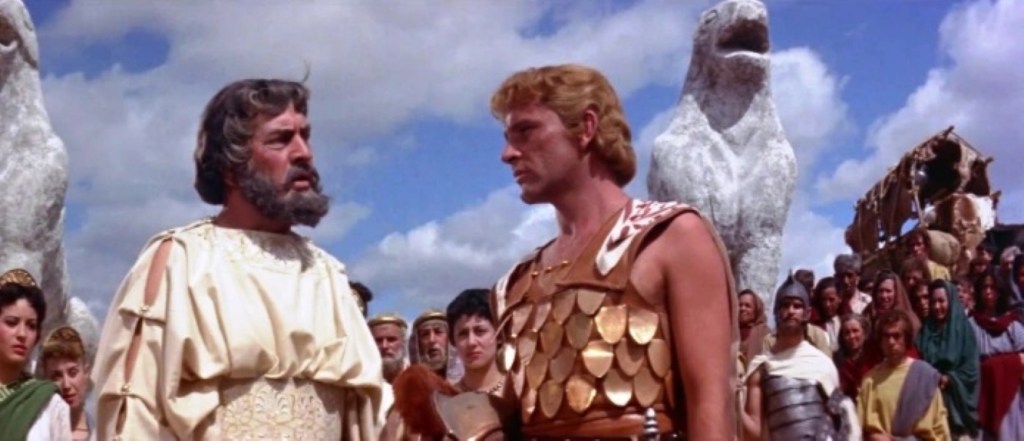
Watching Alexander the Great you get the feeling the film has effectively entombed him as a marble statue, so devoid is he of fundamental humanity. Perhaps this was Rossen’s solution to shooting a film about someone he seemed so devoid of human interest and sympathy for. There is a reason why Charlton Heston – the first choice for the role (can you imagine!) – called Alexander the Great “the easiest kind of picture to make badly”. Frequently Alexander the Great tips into a sort of sword-and-sandles camp made worse by how highly serious it takes itself. Not helped by Burton’s all-too-clear boredom with the part and contempt for the material, Alexander strikes poses and delivers speeches as if he’s been ripped straight out of Plutarch or a bust display in a museum.

Apart from rare moments – usually in the first half as he processes his complex feelings of love and loathing for his overbearing father – he is almost never allowed to be human. His friends – most notably his famed best-friend (and lover) Hephaestion – are reduced to a gang of largely wordless extras and only Claire Bloom’s Barsine is given any scope to talk to him as if he’s a man rather than just a myth. It gets a bit wearing after a while as you long for something human about the man you can cling onto.

It’s also a shame that Rossen seems uncomfortable with shooting the battle sequences. The battles of Granicus and a combined Issus-Gaugamela look rather like damp scuffles over shallow streams than some of the mightiest clashes of the Ancient world. Rossen communicates no visual sense of either strategy or scale (despite the bumper budget). Similarly, the grand sets look too theatrical and never quite as impressive as they should do, despite some fine painterly compositions. Rossen can never quite find a way to make his hundreds of extra seem like thousands and he falls back in the second half to communicating Alexander’s success through a tired combination of map montages, voiceover and repeated shots of men marching left to right and burning cities.

Alexander the Great is a deeply flawed epic. It’s neither swashbuckling fun that bowls you along, or a breath-taking piece of historical spectacle. Nor is it psychologically adept or insightful enough to show you something truly different about its hero. Instead, it tries to straddle both ways of thinking and ends up collapsing in the middle. If only Rossen had found his own Alexanderian solution to cutting this Gordian knot. Instead, the film just ends up a cut-about mess that fades from memory all too soon.
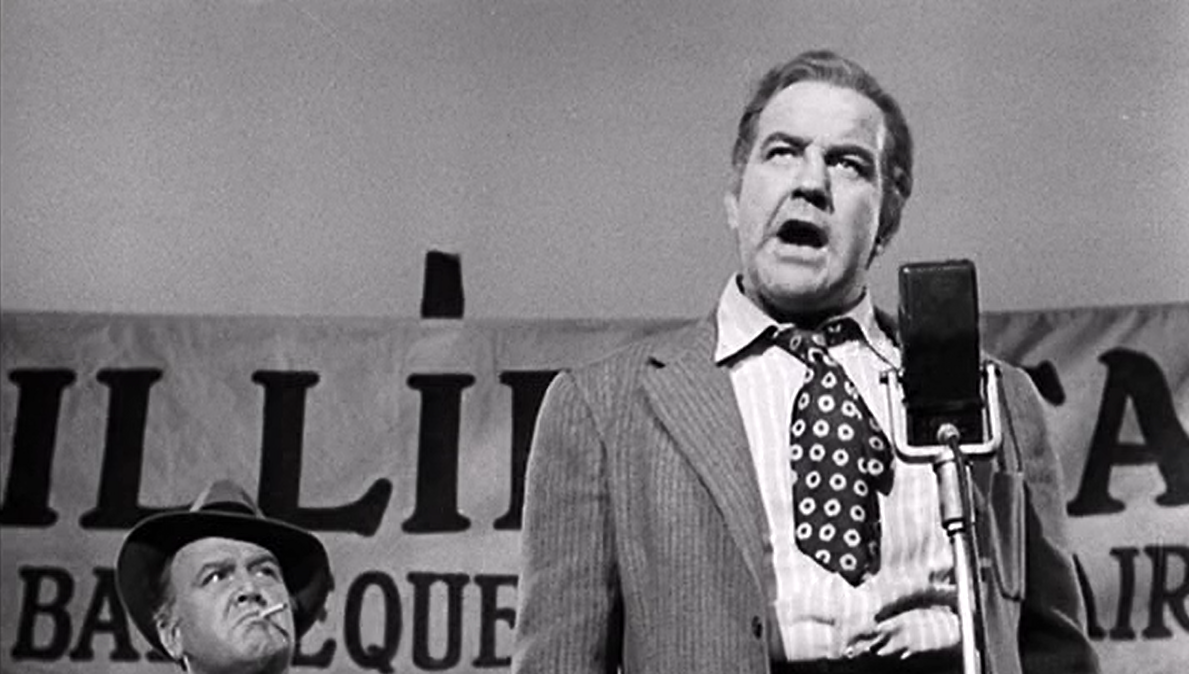
All the King's Men (1949)

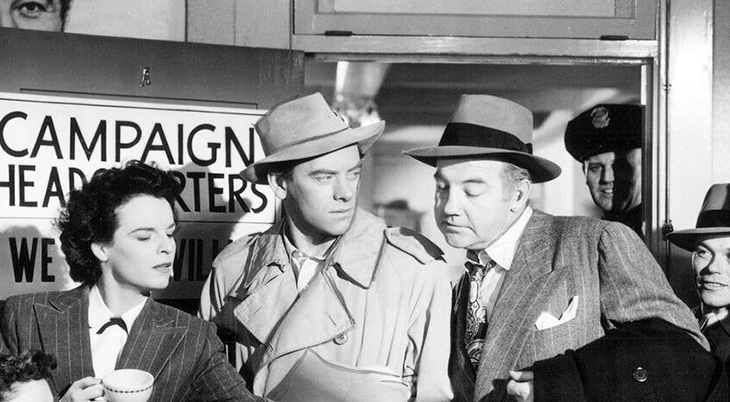
Broderick Crawford is a corrupt politician in All the King’s Men

Director: Robert Rossen

Cast: Broderick Crawford (Willie Stark), John Ireland (Jack Burden), Joanna Dru (Anne Stanton), John Derek (Tom Stark), Mercedes McCambridge (Sadie Burke), Shepperd Strudwick (Adam Stanton), Ralph Dumke (Tiny Duffy), Anne Seymour (Lucy Stark), Katherine Warren (Mrs Burden), Raymond Greenleaf (Judge Monte Stanton), Walter Burke (Sugar Boy)

We only need to look at recent elections to see populist demagogues are far from being consigned to history. So, there will always be a touch of relevance to Robert Rossen’s Oscar-winning film All the King’s Men. Based on Robert Penn Warren’s Pulitzer-Prize-winning novel, which was itself a fictionalised version of the life of Huey P Long, the Louisiana Governor who championed the working man but also turned the State into his own personal fiefdom, until his assassination. Rossen’s film looks at the dangers of populist politicians, but at times it’s a blunted, simplistic look and is too quick to colour shades of grey into more digestible black and white.

Willie Stark (Broderick Crawford) is a hick with a dream of running from office. His first campaign for county treasurer is impassioned but naïve, and he stands no chance against the ruthless (Democratic – although it’s not named) party system ranged against him. He loses but gains the attention of idealistic journalist Jack Burden (John Ireland), dissatisfied scion of a rich family. Stark teaches himself law and runs for Governor – but is manipulated by the party machine to split the ‘hick’ vote and allow their own candidate in. However, Stark rediscovers his fire and later runs again and wins. Stark promises a state run for the little people: but his pockets are lined by big-business and the man who started as a sober Christian becomes a drinker juggling two mistresses: his secretary and advisor Sadie (Mercedes McCambridge) and (proving power is an aphrodisiac) Jack’s girlfriend Anne Stanton (Joanna Dru). But can proof of his growing corruption bring him down?

All the King’s Men is a film that would be far more effective if it allowed more scope to seeing the good in Stark, not just the bad. This is after all, a self-made man (teaching himself law at home), who builds roads, hospitals and schools. He’s not a Trump, interested only in himself and damn the consequences. Many of his policies are solid Roosevelt New Deal fare. Sure, he becomes grasping, lascivious and a terrible father – but how did this happen? Was it that Stark realised that corruption was the game and he needed to play it if he wanted to win? Were there deep lying flaws already in his character? We just don’t really know.

Instead this film sets out its stall very cleanly: populist working-class politicians are much worse than tortured wealthy liberals. The characters the film admires all hail from the same gated island community of the rich. Any hypocrisy or corruption on their part is a tragic character flaw. Stark comes from poor farm land – but any corruption makes him a monster. Really is Stark all that bad? The film stresses its moral disgust at his drinking and womanising, but in office he produces the sort of modern infrastructure the State will need. Sure a newsreel questions if the state needs a modern highway (in a patronising “they are just country folk” way) and maybe it didn’t immediately – but ask how they feel ten or fifteen years down the line.

The real problem with politics in this era is not demagogues like Stark. It’s the corrupt machine style politics that settles the elections in advance, shuts the doors against anyone they don’t like and uses muscle (metaphorical and literal) to enforce its will. This is an institutional fault line in American politics of the era: and you could argue Stark’s tragedy is not that he’s corrupt, but rather that he has to fashion himself into exactly the sort of corrupt, machine-style politics boss that the system can accept in order to win. The film isn’t really astute enough to recognise this. Instead it settles for the standard “Great Man” approach, where we can point at a single man and say “yup, he’s the problem. Get rid of him and problem solved”.

Rossen’s film takes an easy soft-left approach. The poor people love Stark, because the media tell them to (although the film has its cake and eats it by only really showing the liberal press attacking him). Stark raising campaign contributions to run from office is an unpardonable sign of tar coating his hand – never mind that we’ve seen his personally funded campaign for a minor office didn’t stand a chance. Working for the people, its argued, doesn’t cancel out the evils of trousering some cash for yourself – never mind that the wealthy liberals Rossen sympathises with, living in their large country houses, have clearly been doing so for decades.

Instead All the King’s Men is a simple film that only scratches the surface of demagoguery. Stark makes great speeches, but we never find how far it’s a show and how far it’s empty rhetoric. We never find out enough either about what he has done or hasn’t done in office to make our own minds up. Rossen’s film fixes the tables and places all the blame not on the system but on a single man – and even suggests that getting rid of that man by violence and murder is in fact justified if the liberal elite decide it is. It’s not a good look for a film.

It bungles it’s politically and personally commentary, but you can’t argue that it’s not a well-made film. Inspired by neo-Realism, much of the film was shot on location (including effectively running a mock Governor campaign in parts of California) and its shot with an edgy immediacy, in places using non-professional actors. That’s a feeling helped by its sharp, jagged editing. Rumour has it that, with the first cut running long, Rossen asked the editor to find the narrative centre of every scene and then cut a hundred feet of film either side of it. The cleaned-up result of this is a edgy film that has the air of genuine reportage and effectively uses montage.

Broderick Crawford won the Oscar as Stark, and he plays the role with a sweetness that turns into brilliant bombastic swagger. The film uses his hulking physicality to marvellous effect, and while his character often feels simplistic, Crawford nails the speeches and Stark’s Lyndon B. Johnson like powers of physical intimidation. John Ireland (Oscar-nominated) does a decent if uninspired job as the weak-willed Burden, and Joanna Dru is a little too theatrical as Anne Stanton.

The most fascinating character though might well be political fixer/secretary Sadie Burke, played by fellow Oscar-winner Mercedes McCambridge. A radio actress making her film debut, McCambridge’s performance frequently avoids the obvious choices. Sadie is a hard-edged woman, unreadable, who has sharpened her personality to survive in a man’s world. Rossen’s film subtly codes that she is Stark’s mistress, but her relationship with him seems conflicted. She’s both vulnerable, but also bitter and cold to him – moments when you expect her voice to break, she’s hard, where you expect her to be sharp she’s brittle. She’s a bitterly cynical character who has given up hope. It’s a fascinating performance.

Rossen’s film is well made and is always going to have some relevance. But you feel it could have delved far deeper into its themes. But bluntly as a portrait of corruption, it’s not a patch on Citizen Kane and in Stark it sets up a monster we can have uncomplicated fun knocking over and then patting ourselves on the back once it’s done. For all its edgy, reportive feel, it’s a fantasy film.

Lilith (1964)

Jean Seberg lures Warren Beatty and Peter Fonda into a psychologically dangerous web in Lilith

Director: Robert Rossen

Cast: Warren Beatty (Vincent Bruce), Jean Seberg (Lilith Arthur), Peter Fonda (Stephen Evshevsky), Kim Hunter (Dr Bea Brice), Anne Meacham (Mrs Meaghan), Jessica Walter (Laura), Gene Hackman (Norman), James Patterson (De Lavrier), Robert Reilly (Bob Clayfield)

Movies have long had a fascination with mental illness – in particular the impact of mental illness on women. Lilith is an intriguing, elliptical, somewhat cold but intriguing film that looks at the impact isolation, loneliness and seclusion can have on people and how these damaged psyches can sprawl out and cause further pain and suffering for others. However, it’s also a difficult, unclear and occasionally hard to like film, that deliberately clouds so many of its points in a veil of doubt and uncertainty that it’s difficult to really embrace it.

Returning from an undisclosed war (possibly Korea), Vincent Bruce (Warren Beatty), a lonely, slightly troubled young man, drifts into a job as a counsellor at a private mental hospital, under the supervision of Dr Brice (Kim Hunter). Bruce is empathetic and keen to understand and help the patients, but he finds himself slowly drawn towards Lilith Arthur (Jean Seberg), a sensual and seductive patient at the institute. Encouraged to spend more time with Lilith – as only Vincent seems able to draw her out of a fantasy world to engage with the real one – he increasingly finds himself infatuated with her, increasingly bending any personal or professional ethics to fuel his emotional and sexual need for her.

Just in case you are in any doubt from reading that, it’s pretty clear from early on in the film that the real person in need of help is Vincent. Played with a methody introspection and brooding insecurity by Beatty (he impassively and wordlessly drifts through several scenes or merely watches, and only rarely shows any emotional engagement), Vincent is frequently framed by Rossen alone, lost in the centre and sides of frames, or walking seemingly aimlessly forward. The camera often drifts towards him, if only to stress his lack of real engagement with the things he is seeing in front of him. His obsessive qualities are there from the very start, with his fixations switching between his mother, a former girlfriend (played with a flirtatious seductiveness by Jessica Walter) and finally settling, overwhelmingly, on Lilith whom he follows with the glazed eyes of a potential killer. Beatty struggled with the part – and I can see why, as our central character is such a distant cipher that he becomes someone very hard for the audience to invest any interest in.

Lilith herself is an intriguing if, it seems, unknowable character – almost impossible to tell if she is a truly destructive force or someone who simply behaves as she feels in the moment with no understanding of the impact her actions have. She is frequently callous and cruel, and then will revert to sadness, vulnerability and insecurity. She looks for love – or at least affection and loyalty – at every turn, but then also seems unable to understand any personal relationship except through the filter of sex. Starting the film placing an erotic spell around sensitive fellow patient Steve (Peter Fonda, vulnerable and rather sweet) she quickly switches all her efforts to wrapping Vincent in a web of enchantment (as the film rather clumsily stresses to us in a scene where a doctor explicitly compares her to a spider).

Lilith is increasingly seen as an unsettling, indiscriminate figure. No sooner does Vincent become her lover, than she begins flaunting a sexual relationship she is having with another female patient. (Lesbianism was quite radical for a film at the time). Even more surprisingly the patient is a staid, rather imperious middle-aged woman (played imposingly by Anne Meacham), and the relationship seems to be partly conducted to get a rise (of one sort or another) out of Vincent. Earlier, Lilith flirts disturbingly and erotically with a very young child (who seems disturbed) – although the viewer is perhaps even more disturbed by Vincent’s blank watching of the whole scene. At every point we are reminded of Lilith’s erotic allure – and the framing of the film, and its beautiful photography by Eugene Schufftan helps to create this mystic image. Lilith is often shown behind grills and bars earlier on, before she emerges into the outside world and one enchanting image sees her kissing her reflection in a lake, the very act reducing the reflection to shimmering ripples on the surface: can anyone know her?

The part leans on being borderline sexist, the idea of the enchanting, liberated woman as somehow being a dangerous (almost evil) threat to the safety and mental security of the men around her, deliberately endangering the decent world with her sexual openness. It largely manages to avoid this due to the performance of Jean Seberg, who gives Lilith a vulnerability and suggestions of deep psychological trauma that underpin her surface sexuality, flirtation and predatory nature. It’s no surprise that she is so completely able to overwhelm the repressed, inverted Vincent, or that he becomes such a willing slave to her whims and spur-of-the-moment suggestions.

Much of this disintegration of Vincent underpins the second half of the film, as he and Lilith engage in a dance that ends up having overwhelmingly negative consequences for each of them and for many of those around them. Intriguingly, Rossen’s vision of this mental institute as a more bohemian organisation suggests that the staff all seem aware of (and even tacitly encourage) the relationship – although whether this is part of a treatment or some sort of bizarre other motive is unclear. However, all this doesn’t help to make either character one we really care about, or make the story crystallise into something that carries real impact.

That captures the central problem of the film – Rossen deliberately builds the story with an elliptical sense of mystery in which the actions and motives of characters remain deliberately unclear, and the world they live in takes on elements of the dreamlike fantasy world that Lilith herself sometimes lives in (complete with her own language). Events seems to move with little sense of time. There are surreal interludes, not least an extended sequence where Vincent takes Lilith to a jousting competition (yes you read that right). It’s perhaps all a part of understanding how the personalities of the two lead characters slowly collapse over time into themselves, but it also serves to keep a distance between the film and the viewer. The final tragic outcomes are predictable from the very start of the film, but there is still a certain power to them. As a study of what slow mental disintegration may look like, Lilith is an intriguing little picture, but basically a little too hard to invest in emotionally to carry real impact.