
Tag: Robert Taylor

Ivanhoe (1952)


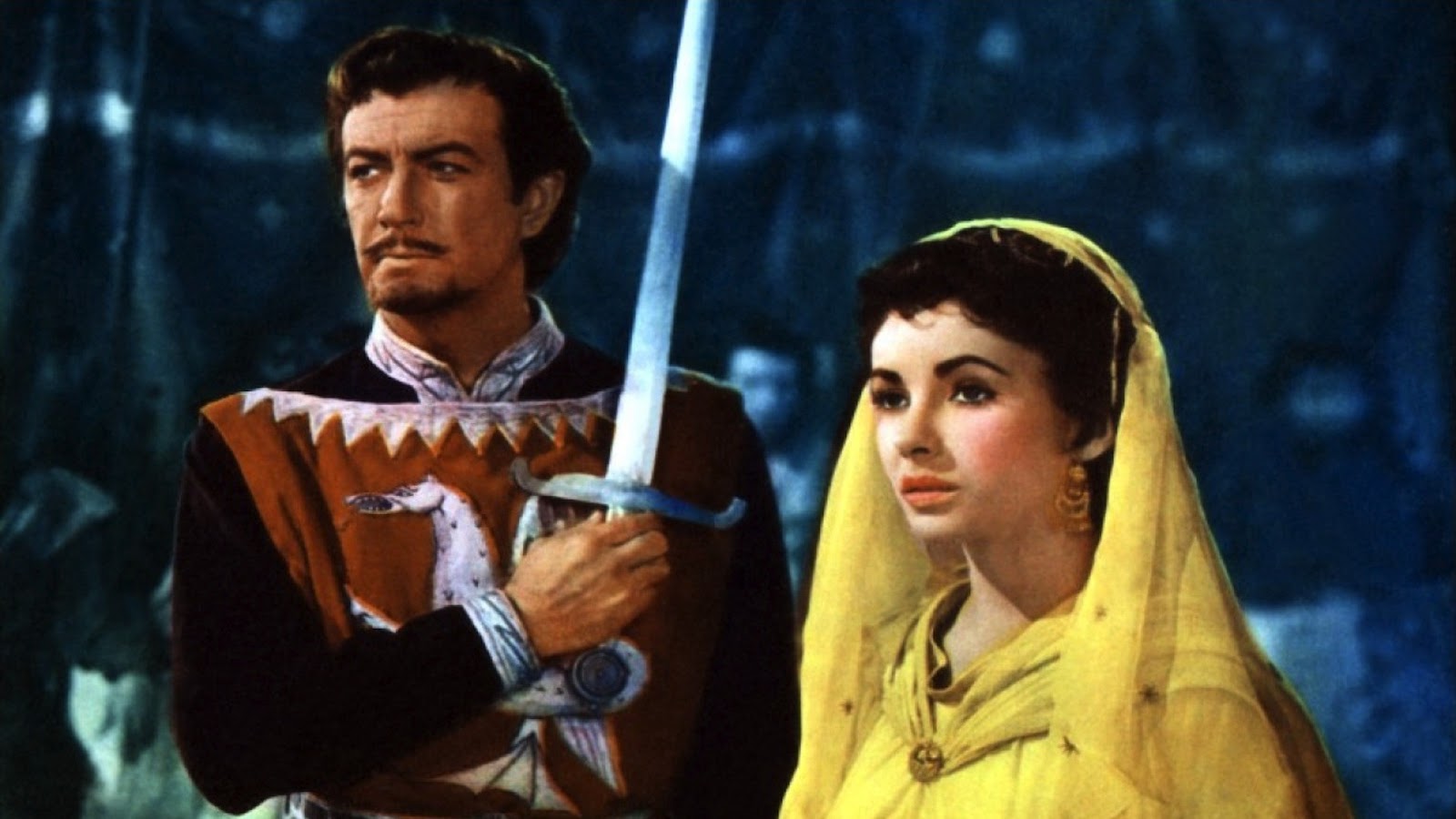
Robert Taylor and Elizabeth Taylor (no relation) fighting for Good Old England

Director: Richard Thorpe

Cast: Robert Taylor (Sir Wilfred of Ivanhoe), Elizabeth Taylor (Rebecca), Joan Fontaine (Rowena), George Sanders (Sir Brian De Bois-Guilbert), Guy Rolfe (Prince John), Emlyn Williams (Wamba), Robert Douglas (Sir Hugh De Bracy), Finlay Currie (Sir Cedric of Ivanhoe), Felix Aylmer (Isaac of York), Norman Wooland (King Richard), Basil Sydney (Waldemar Fitzurse), Harold Warrender (Robin Hood)

Adapted (very loosely) from Sir Walter Scott’s novel, Ivanhoe was another instalment in Hollywood’s battle to drag people away from their new-fangled TV sets. This rivalry meant technicolour spectacles like this were the most valued animals in a studio’s stable, which probably explains why Ivanhoe was the MGM film nominated for Best Picture in 1952, while The Bad and the Beautiful (which set a record for most Oscar wins for a film not nominated for Best Picture) and, almost unbelievably, Singin’ In the Rain were overlooked.

Noble knight Ivanhoe (Robert Taylor) finds Richard the Lionheart (Norman Wooland) locked up in Austria. Returning to England, he looks to raise funds to rescue the King – mostly by putting the gentle squeeze on Jewish banker Isaac of York (Felix Aylmer) while flirting with his daughter Rebecca (Elizabeth Taylor). He must also reconcile with his father (Finlay Currie) and his sweetheart Rowena (Joan Fontaine), and prevent wicked Prince John (Guy Rolfe) and his sidekick Sir Brian (George Sanders) from taking control of the Kingdom.

Bless, this film looks quite dated now. The bright primary colours of the costumes are endearingly sweet, with our heroes dressed in capes and tights with all the delight of primary school children in a play. You need to tune into its simplicity – failing to do so means you’ll struggle to watch the final battle scenes as characters go toe-to-toe with all-too-obviously bouncy rubber swords (at one point, a sword literally bends and snaps back into place after a strong blow). The film is crammed with fights, jousts, sieges and battles – there is precious little room for plot, dialogue or character, but at least you get a maelstrom of action (even if it rarely makes much sense).

At the centre of it all is Robert Taylor as Ivanhoe. As in his other roles, Taylor is as stiff and lifeless as a board, while his transatlantic vowels clang with even more painful obviousness amongst the cut-glass and ‘ever-so-’umble’ accents from the cast of jobbing British actors. Taylor squares his jaw and does his best with the derring-do – although, as per usual, he makes Ivanhoe such a dull person, you can hardly raise the slightest interest in him. Inexplicably every woman in the film (i.e. both of them) are head-over-heels in love with him.

But then all the heroes in this film are stick-in-the-muds. Harold Warrender is the most arrogant, least fun Robin Hood you’ll ever see. Finlay Currie gives swagger as Ivanhoe’s father, but is basically a pompous windbag. Emlyn Williams as comic relief “Wampa” is so tiresome you’ll breathe a sigh of relief when he burns to death in a fire. Joan Fontaine is so saintly opposite the balsawood Taylor that you find it unlikely that we will ever hear the pitter-patter of little Ivanhoes.

The bright spots are the villains. Guy Rolfe has huge fun as a moustachio-twirling, scheming Prince John. George Sanders gets the most out of Ivanhoe’s rival Sir Brian (can you think of any other film with a villain called Brian?), although the part (and the film) is far beneath him.

Brian is of course infatuated with the Jewish Rebecca (played with a radiant charisma by a very young Elizabeth Taylor). If the film has any claim to being a more than just a gaudy knight’s tale, it’s in its treatment of its Jewish characters and careful exploration of anti-Semitism in medieval England. Taylor and Felix Aylmer (as her father) give sensitive performances as put-upon, civilised people, ill-used by those around them and expected to lend support at the drop of a hat. Ivanhoe’s assumptions that they (a) have tonnes of money and (b) will feel duty-bound to help Richard are met with a quiet regret and a pointed comment that Richard’s own anti-Semitism track-record is hardly that good. Later Rebecca is placed on trial, her Jewishness central to accusations of sorcery. Persecution is an underlying theme of the film – and although it ends with all right as rain, the threat of it throughout much of the action makes the film feel more substantial than it is.

The main problem is it’s not made with any inspiration. Thorpe is a mediocre director, and the editing flashes through some parts of the story almost too fast to follow what’s happening. The ending suffers in particular from this economy: suddenly we cut from Brian and Ivanhoe fighting to the death, to Richard arriving with an army of knights, Brian being killed largely off-camera, a quick dying speech from him, then Richard announcing everything is fine in the kingdom. It’s all so sudden, it feels like they just ran out of film so needed to wrap it up quickly.

Still, Ivanhoe is fairly good fun despite all of this. It doesn’t require any concentration – and is hardly a minor-classic, let alone any other form of classic – and it has some truly hit-and-miss performing, but it barrels along ago. It may be workmanlike in the extreme, but its bright primary colours mean there’s always something to look at.

Quo Vadis (1951)


Peter Ustinov revels in the Status Quo (Vadis) of Imperial Rome

Director: Mervyn LeRoy

Cast: Robert Taylor (Marcus Vinicius), Deborah Kerr (Lygia), Leo Genn (Petronius), Peter Ustinov (Nero), Patricia Laffan (Poppaea), Finlay Currie (St. Peter), Abraham Sofaer (St. Paul), Marina Berti (Eunice), Buddy Baer (Ursus), Felix Aylmer (Plautius), Ralph Truman (Tigellinus), Rosalie Crutchley (Acte), Nicholas Hannen (Seneca)

In the 1950s, epic films were the way for the movie studios to defeat the onslaught of television. What better way to best the creeping presence of the small screen in every home than offering more action, sets, crowds and colour than could ever be squeezed into that small box in the corner of the room? Quo Vadis was the first film that started a wave.

Returning to Rome after years on campaign, Marcus Vinicius (Robert Taylor) falls in love with a Christian hostage, Lygia (Deborah Kerr). Gifted Lygia as a reward by the decadent Emperor Nero (Peter Ustinov), Marcus slowly becomes fascinated by her religion – and more aware of the insanity of Nero. Petronius (Leo Genn), Marcus’ uncle and Nero’s cynical retainer who hides his barbs under double-edged flattery, unwittingly plants in the Emperor’s mind the plan for a Great Fire in Rome. After the mob reacts with fury, Nero kicks off a persecution of Christians that will end in slaughter in the arena…

There is a charming stiffness to some of this film which actually makes it rather endearing. Like many films that followed it, this balances a po-faced reverence for Christian history with a lascivious delight in sex, destruction and violence. This means the audience can be thrilled by Rome burning, entertained by Nero’s decadence, watch Christians mauled by Lions and burned alive – while also being comforted by the triumph of good-old fashioned Christian values and persuaded the film has some sort of higher purpose because it ties everything up with a nice faith-shaped bow.

Of course this all looks rather dated today, but back in 1951 this was the studio’s most successful film since Gone with the Wind and the biggest hit of the year: it started a nearly 15-year cycle of similarly themed religious epics. The money has clearly been chucked at the screen – the sets are huge, the casts sweeping, the staging of the Roman fires and Christian sacrifices very ambitiously put together. Perhaps the only surprise is that the lush, attractive cinematography isn’t in wide-screen – this was the last film of this kind to not be filmed in the widest lens available. 

Despite its nearly three-hour run time, this is quite an entertaining story, laced with enough real history to make it all convincing (even if it telescopes the last few years of Nero’s reign into what seems like a week or so). Despite this, the storytelling does feel dated at times as we get bogged down in back and forth about Christianity (told with an intense seriousness by the actors, mixed with long-distance-stares type performances), and the homespun simplicity of its message lacks the shades of grey we’d expect today (as well as being a little dull) but it just about holds together.

The main problem is the lead performers. Robert Taylor is an actor almost totally forgotten today – and it’s not difficult to see why here. Not only does he speak with the flattened mid-Atlantic vowels recognisible from American leads in historical films from this era (the jarring mixture of accents in the film is odd to hear) but he is an uncharismatic, wooden performer sorely lacking the power a Charlton Heston would have brought to this. Marry that up with his character being a dull chauvinist and you’ve got a bad lead to root for. The relationship between him and Deborah Kerr’s (equally dull) Christian hostage is based on a terminally dated, borderline abusive, set-up: he kidnaps her from her home and wants her to change her faith, she won’t but never mind she loves him anyway without condition and surely her love will make him a good man, right!

Despite the efforts of the leads and some decent supporting actors (Finlay Currie in particular makes a very worthy Peter) the Christian story never really picks up. There are some nice visual flourishes – the recreation of some Renaissance paintings is well-done, and the stark image of Peter crucified is striking – but the Christian story isn’t what anyone will remember from this film. It’s all about the corrupt Romans.

Not only do they have the best lines and all the best scenes, but in Leo Genn and Peter Ustinov they also have the only actors who perhaps seem to realise they are not in a work of art, but a campy popcorn epic. Both actors give wonderfully complementary performances. Genn’s dry wit as the cynical Petronius (whose every line has a cutting double meaning) underpins his wry social commentator to fantastic effect, delivering many of the films laugh-out loud moments. He elevates many of the best lines in a dry but educated script.

Genn’s low-key performance also brilliantly contrasts with Ustinov’s extravagance as Nero, making the emperor a sort-of sadistic Frankie Howerd. Ustinov has enormous fun in the role, cheerfully going up and over the top with Nero’s man-child depravity, bordering on vulnerability and a needy desire to be liked and respected by the people and his underlings. Depictions of his singing are hilarious, his petulant sulking extremely funny. Yes, it’s an absurd performance – more a comic sketch almost – but it somehow works because (a) everything else in the film is so serious and (b) Genn’s world-weary cynicism anchors the character for the first two-thirds of the film, giving Ustinov much freer reign to go over the top. 

So it’s all about the baddies – as was often the way with films of this era. You’ll remember the scenes of Nero holding court, and the archly written dialogue between Petronius and Nero. Ustinov and Genn are, in very different ways, terrifically entertaining (both received Oscar nominations). The Christian message of the film is on-the-nose (to say the least), and the lead actors are more like kindling for the Great Fire than actual characters. It’s a strange film, at times a bloated far-too-serious religious epic, at others a campy tragi-comedy with a dry wit. Yes it’s dated and far from perfect, but it’s also strangely entertaining and even a little compelling.