

Man’s gotta do what man’s gotta do in this iconic rollercoaster of a Western
Director: John Sturges
Cast: Yul Brynner (Chris Adams), Steve McQueen (Vin Tanner), Horst Buchholz (Chico), Charles Bronson (Bernardo O’Reilly), Robert Vaughn (Lee), James Coburn (Britt), Brad Dexter (Harry Luck), Eli Wallach (Calvera), Vladimir Sokoloff (Old Man), Jorge Martinez de Hoyos (Hilario), Rosenda Monteros (Petra), Rico Alaniz (Sotero), Pepe Hern (Tomas)
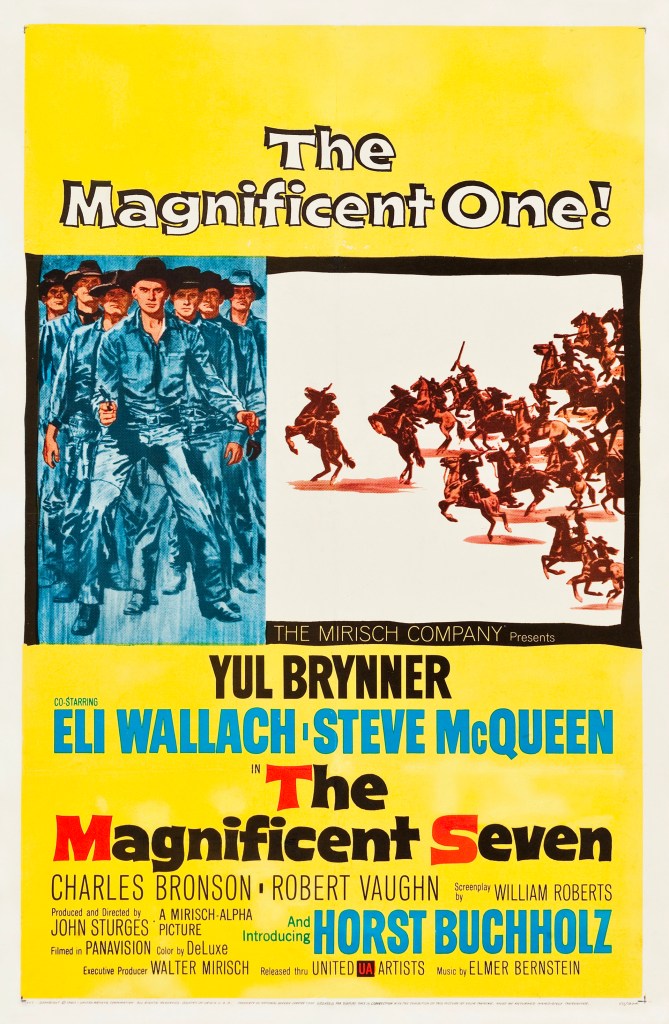
“That’s the greatest shot I’ve ever seen!” – Chico after seeing Britt take down a bandit on a horse with a pistol from an unimaginable distance.
“The worst. I was aiming at the horse.” – Britt’s response.
To be honest I could probably just watch The Magnificent Seven for that moment alone. Akira Kurosawa enjoyed this remake of his greatest film so much, he presented Sturges with a samurai sword as congratulations. It’s a staple of any rainy Bank Holiday and the actors who played the seven is a classic pub quiz question (how many have scratched their heads trying to remember Brad Dexter’s name?). The Magnificent Seven has passed into cultural legend.
It’s a very faithful remake of the Japanese original (if an hour shorter). A farming village is plagued by bandits, led by scruffy, smug rogue Calvera (Eli Wallach). So, the farmers set out to find a gang of gunmen willing to work (almost literally) for peanuts to protect them. And they find themselves a heck of a posse: Chris (Yul Brynner), the unflappable tactician, Vin (Steve McQueen) the maverick sharp-shooter, tough-as-nails Bernardo (Charles Bronson), nervy veteran Lee (Robert Vaughn), samurai-like Britt (James Coburn), boisterous mercenary Harry (Brad Dexter) and plucky newbie Chico (Horst Buchholz). But will these few protect the village or will they cut and run when the going gets tough?
What do you think? The Magnificent Seven is one of those classic men-on-a-mission films, where men were stoic, noble and only stopped taking names to kick some ass. While The Magnificent Seven sheds much of the class and culture-based depth and tragedy of the original, it certainly doubles down on its fun and excitement. It barrels along with glorious energy from set-piece moment to set-piece moment, all marshalled with great skill by Sturges.
And those set-pieces are great. Chris and Vin riding a hearse shotgun (literally) through town when no-one else has the guts to do it. Britt’s dazzling knife-throwing skills calmly winning him victory in a one-on-one with a braggart. Chico proving his worth on the journey back to the village and berating the villagers running in fear from their rescuers (“Now we are seven”). The first battle with the bandits. That legendary bad shot from ice cool Britt. The final face-off in the village. What’s not to love about this explosion of well-paced, gripping, exciting action?
The casting was a smorgasbord of talents. Books have been written about Brynner and McQueen’s personality clash. The evidence of their on-going game of one upmanship is all over the picture. In nearly every shot Brynner is in, McQueen can be spotted in the background fiddling around with his hat to pull focus. Brynner took to elaborate cheroot lighting using his boot to keep eyes on him. Either way, the two of them bring their qualities perfectly to the screen. Brynner has more than a touch of the old master samurai to him, McQueen the cocksure cool (it wouldn’t be a surprise to see him turn up to the village on a motorbike). Sturges’ film builds a surprisingly warm friendship between these two that forms the emotional heart of the film.
The rest of the gang all get their moments in the sun. Robert Vaughn expertly makes Lee’s loss of nerve look like careful, deadly precision rather than a desire to duck whenever bullets go flying – in a few strokes he presents a lifetime of front to maintain presence. James Coburn – a huge fan of the original – brilliantly channels Seiji Miyaguchi as an unflappable professional. Brad Dexter bounces along as jovial chancer. Bronson gets the dullest role as the guy who befriend the village kids but manages to make his priggish material (the Western equivalent of “you kids should take care of your education and listen to your parents”) sound like tough-guy cool.
The film’s main change was to dramatically reduce the importance of Toshiro Mifune’s character, here represented by Horst Buchholz’s farmer turned gunman (also taking on Isao Kimura’s romantic subplot). Buchholz gets a version of the “the farmers are made who they are by the warriors” speech that the iconic Mifune nailed in Seven Samurai. But it’s a weaker, under-written part – it feels like what it is, a functional role for a pretty actor – with Buchholz awkwardly and dutifully going through the romantic motions with village girl Petra.
It’s part of the lack of depth to The Magnificent Seven. The original’s study of shattered world orders and the dangers of progress and change have no comparison here, although the film has a rather nice moment as the heroes bemoan the loneliness of their chosen lot (“Home, none. Wife, none. Kids… none. Prospects, zero. Suppose I left anything out?”). Brynner’s Adams has a lovely touch of regret at lost chances behind his manly eyes. The surviving gunmen know it’s the farmers who really win in the end. But, even with that, this is a film more interested in entertaining you.
That’s why we get a proper villain – Wallach’s great value as this ingratiating bully, who can’t even begin to understand what would motivate people to do something for so little gain – to give the final battle even more of a personal touch. Sturges also makes sure we get the full entertainment value of these grizzled fighters giving their all – perhaps for the first time – for a cause that goes beyond their immediate needs and that might just help give some meaning to their lives.
Above all though it’s rollicking good fun. Sharply written with tons of good lines, well-played by the cast and shot with pulsating excitement by John Sturges, every scene offers a little moment of delight. It’s a film you can kick-back and enjoy no matter what day it is, full of thrills and spills. One of those classics that never troubles the greatest films list, but always finds a place on the most popular lists.

 Movie Musings