
Tag: Robert Wagner

Midway (1976)

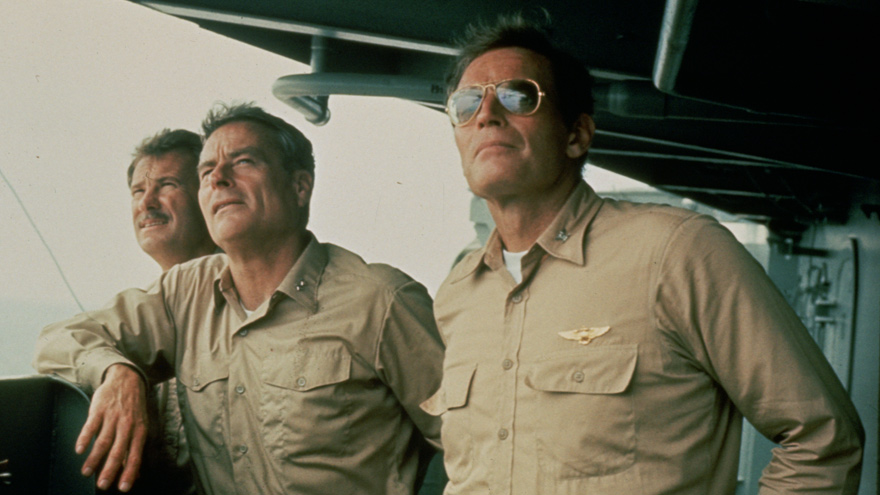
Charlton Heston fights in one of the great naval battles at Midway

Director: Jack Smight

Cast: Charlton Heston (Capt Matt Garth), Henry Fonda (Adm Chester W Nimitz), James Coburn (Capt Vinton Maddox), Glenn Ford (Rear Adm Raymond Spruance), Hal Holbrook (Comm Joseph Rochefort), Toshiro Mifune (Adm Isoroku Yamamoto), Robert Mitchum (Adm William Halsey), Cliff Robertson (Comm Carl Jessop), Robert Wagner (Lt Comm Ernest L Blake), Robert Webber (Rear Adm Jack Fletcher), James Shigeta (Vice Adm Chuichi Nagumo)
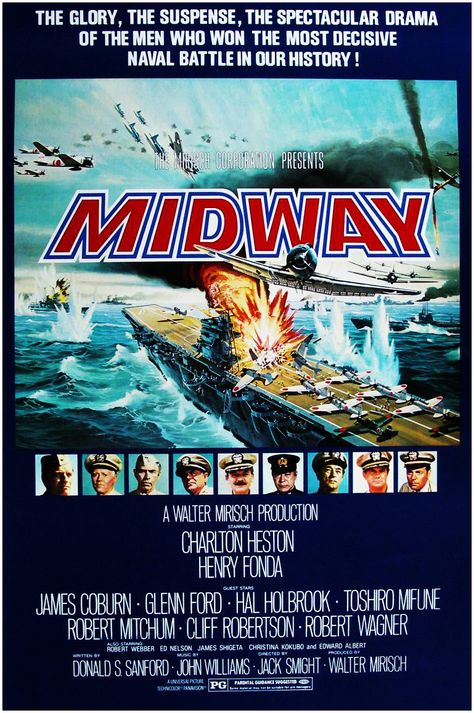
On 4th June 1942, the fate of the Pacific naval war was arguably settled. The Japanese plan to invade the American base on the island of Midway and, crucially, wipe-out the American aircraft carrier force, instead saw a near total US victory and all four Japanese aircraft carriers destroyed. The story is re-told here as a classic all-star Hollywood epic, with the first hour dedicated to the planning and the second hour to the events of 4th June.

After its – successful – run in the cinemas, Midway was re-edited into a two-part TV mini-series. To be honest, that feels more like its natural home. It’s competently directed by Jack Smight – but no more than that – and revolves around several scenes of star-actors pushing models around maps and less famous actors pretending to fly planes in front of blue-screen. The film makes a proud statement at the start of how it has chosen to use only actual archive combat footage to “honour those who fought” – but this actually, you suspect, was motivated more by the fact it’s much cheaper to purchase and clean up piles of stock footage than it is to shoot things afresh.

The main narrative covers the planning and the crucial day of the battle itself. A brief “human interest” story is introduced via Charlton Heston’s (fictional) Captain Matt Garth, an aide of Admiral Nimitz. Will Chuck improve his relationship with his fighter pilot son, who has fallen in love with a Japanese girl? Whadda you think? Saying that, this rather clumsy human-interest story (which features the only female character in the film) does make some interestingly critical points about the policy of internment against Japanese Americans – stressing both the injustice and explicit racism (American Germans and Italians faced no such fate) behind the policy.

In fact, Midway is very sympathetic in general to the Japanese – as Nimitz even says at the end, perhaps it was less a question of skill than luck that led to the final outcome. The Japanese navy is presented as an honourable and thoughtful opponent, respectful of human life and conducting the war via a code of honour (the kamikaze runs of cliché are completely absent). In particular Admiral Naguma (well played by James Shigeta, in possibly the film’s stand out performance) is a decent man caught-out continuously by horrendous luck and timing, who pays a heavy price. Midway is strong in stressing there is no leeway at sea – get caught out there and it’s the bottom of the briney for you.

The Japanese planning is even slightly tragic in its flawed assumptions – crucially they are totally unaware that their codes are broken and that, far from launching a surprise strike, they are actually sailing into something of a trap – while Toshiro Mifune brings a lot of nobility to Yamamoto even if all he really does is pensively stare at a series of maps.

On the American side, Fonda leads the way, giving Nimitz more than a touch of Fordian home-spun heroism. Heston’s presence does well to link together the various true-life characters and location. Most of the rest of the all-star cast are restricted to one or two scenes: Coburn rocks up to handover a report from Washington, Wagner briefly pushes models across a table in a planning room and (hilariously of all) Mitchum delivers both his tiny scenes from a hospital bed, coated in skin cream.

When the action gets going though, it’s done pretty well with the po-faced, stodgy seriousness these war-time later 70s epics nearly all seemed to have in common. The stock footage does actually look pretty good and the drama of the battle – and the tactics – are captured fairly well. It’s intermixed with some real ships and all scored with a great deal of punch by John Williams. It’s all really B-movie, TV-movie-of-the-week stuff but it’s also far from obviously flag-waving either, instead doing its best to be even-handed and even a little bit critical. You’ll learn what happened and also have a bit of fun into the bargain.

The Towering Inferno (1974)

Newman and McQueen tackle a huge blaze in The Towering Inferno

Director: John Guillermin, Irwin Allen

Cast: Steve McQueen (Fire Chief Michael O’Halloran), Paul Newman (Doug Roberts), William Holden (James Duncan), Faye Dunaway (Susan Franklin), Fred Astaire (Harlee Claiborne), Susan Blakely (Patty Duncan Simmons), Richard Chamberlain (Roger Simmons), Jennifer Jones (Lisolette Mueller), OJ Simpson (Harry Jernigan), Robert Vaughn (Senator Gary Parker), Robert Wagner (Dan Bigelow), Susan Flannery (Lorrie), Shelia Matthews Allen (Paula Ramsay), Jack Collins (Mayor Ramsay)

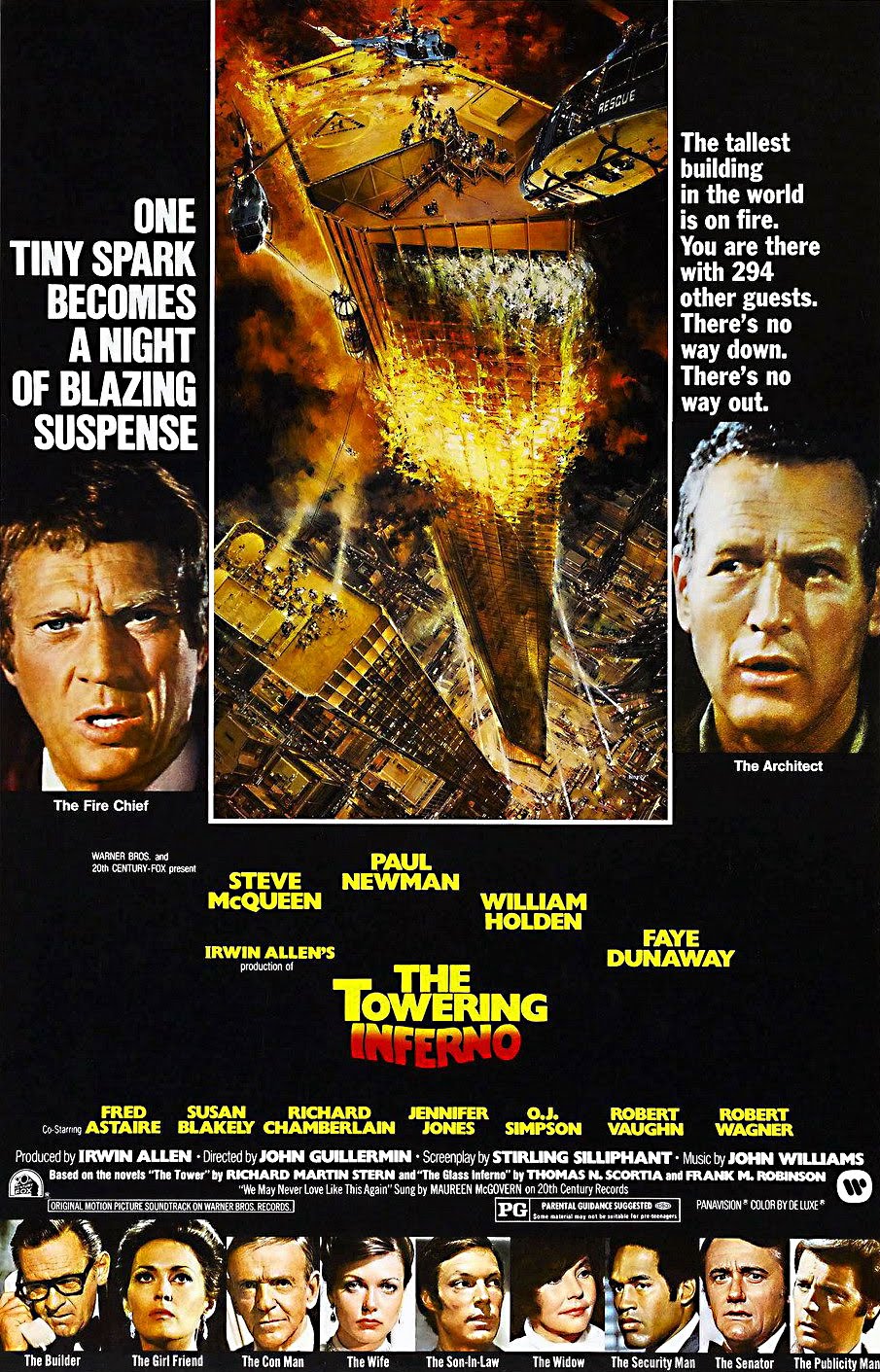
Architect Doug Roberts (Paul Newman) flies into San Francisco for the grand opening of The Glass Tower, the newly constructed tallest building in the world which he has designed for developer James Duncan (William Holden). A celebration with the rich and famous is planned – too bad Duncan’s rogueish son-in-law Roger Simmons (Richard Chamberlain, smarming like his life depends on it) has saved a few dollars by stuffing the building with sub-standard wiring. Surely the world’s largest building can’t catch fire? You bet it could – and only heroic Fire Chief Michael O’Halloran (Steve McQueen) has the expertise to put it out.

The Towering Inferno was the peak of the “all-star disaster” genre. It was bought to the screen by Producer (and “Master of Disaster”) Irwin Allen, and pretty much ticks all the boxes you expect from the genre. A star at every turn! A huge running time! Constant denials that anything could go wrong (of the “This building can’t burn down!” variety)! Kids in peril! Death-defying stunts! A brave pet! An elder statesman of Hollywood risking life and limb! A scoundrel we can boo! A tear-jerking death! The Towering Inferno pretty much has it all, and it plays every single beat with the sort of po-faced seriousness that was already starting to look a bit silly by 1974.

Films like this work because audiences – as we’ve seen time and time again – never lose their taste for watching things get trashed. In the 1970s every studio wanted its own mega-budget disaster film. The Towering Inferno’s real uniqueness is the story behind its making – two studios had competing “Skyscraper on Fire!” projects but, instead of competing, pooled their resources to make one mega hit. So, Warner Brothers The Tower and 20th Century Fox’s The Glass Inferno became this.

Irwin Allen was handed the keys – because no-one did it better – and each studio contributed a star. McQueen and Newman spent almost as much time negotiating equal terms as acting in the movie. Both were paid 10% of the gross and agreed they would have exactly the same number of lines (many of Newman’s final scenes sees him perform stunts wordlessly, as he burned through his allotted lines during the 40 minutes he spends on screen before McQueen turns up). The billing was negotiated carefully: their names would appear on screen together with Newman slightly higher, but McQueen’s name to the left (both could therefore claim they were “first billed”).

Their interest in the film pretty much ended there. Newman was famously disparaging of what he called “a piece of shit” and the only time he did something purely for the money. He coasts through on those blue eyes and twinkly grin. Eager that his character be absolved of responsibility (he has designed a tower that will claim 200 lives!) Newman’s architect is continuously absolved of any responsibility by the rest of the cast and leads on saving lives. McQueen grabbed the better role as the all-action fire-chief, riding in after 45 minutes (thus wisely missing out the tedious build-up of the soapy plot lines), takes charge and does nothing but manly action, but he also looks like someone going through the motions.

But then they know the things that will be remembered are the set-pieces. As flames stretch up the building, our star names dodging explosions, climbing up shattered staircases, dodging collapsing ceilings and taking on vertigo-inducing heights, it’s hard not to be excited. As in all disaster films, the disaster takes a strong moral stance. Of all the characters who die only one ‘doesn’t deserve it’. Aside from that, the actors playing philanderers, swindlers and bastards inevitably bite the dust, while the upstanding and noble pretty much see their way to the end.

The disaster sequences are impressive – and the fire-effects are really well done. Allen directed the ‘action sequences’ – aka the only bits of the film you really remember – while Guillermin handled ‘the acting’ (the dull, soapy, badly written bits you forget). The cardboard characters (no wonder they catch fire so easily!) could have had their personalities scribbled on the back of a stamp, and are pretty much dependent on the charms of the actors playing them. Fred Astaire’s gentle conman (the sweetest grifter you’ll ever meet) is a ludicrous character, but works because of Astaire’s twinkle-toed charm (Astaire grabbed a wave of affectionate awards nominations). Jennifer Jones plays off him rather well in the film’s ‘heroic elder statesman of Hollywood’ role, as a woman who puts herself at huge risk to save two kids (and their deaf mum) from immolation.

But pretty much all the character-based stuff in Towering Inferno is ludicrously silly, with some strikingly bored actors (Faye Dunaway looks like she wants to be anywhere else) but it hardly matters as we are there to watch the world burn. Which it does to spectacular effect, and the reassuringly, camp predictability of the film’s events is endearing – and raises a few good-natured laughs (you have to laugh at something like this, even though it wants to take itself so seriously). The Towering Infernowas the largest of all the disaster flicks of the 1970s. Allen shoehorns in a few points about fire safety in tall buildings for the ‘serious bits’, but his heart is in consigning most of the second tier of his all-star cast to dramatic, firey deaths. Overlong, very silly but rather sweet.