Tag: Roger Moore

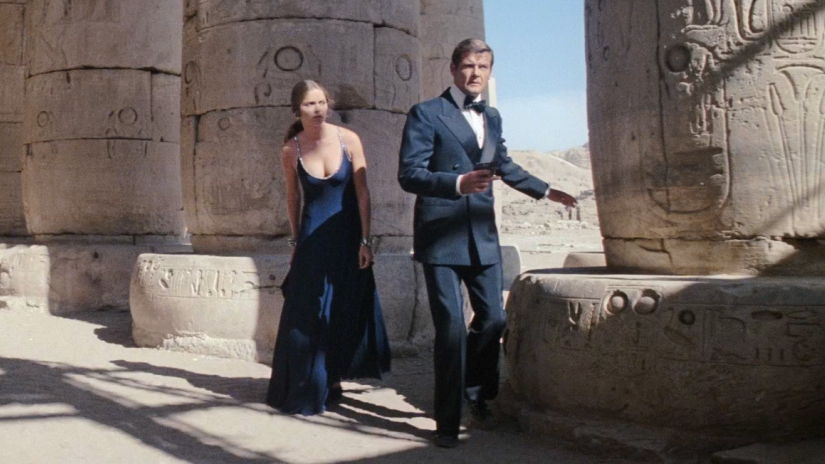
For Your Eyes Only (1981)

Roger Moore takes aim in this most low-key of his adventures – and one of his best

Director: John Glen

Cast: Roger Moore (James Bond), Carole Bouquet (Melina Havelock), Topol (Milos Columbo), Julian Glover (Aristotle Kristatos), Lynn-Holly Johnson (Bibi Dahl), Michael Gothard (Emile Leopold Locque), Cassandra Harris (Lisl van Schlaf), John Wyman (Erich Kriegler), Desmond Llewelyn (Q), Jill Bennett (Jacoba Brink), James Villiers (Bill Tanner), Geoffrey Keen (Minister of Defence), Walter Gotell (General Gogol), Lois Maxwell (Miss Moneypenny), Jack Hedley (Sir Timothy Havelock)
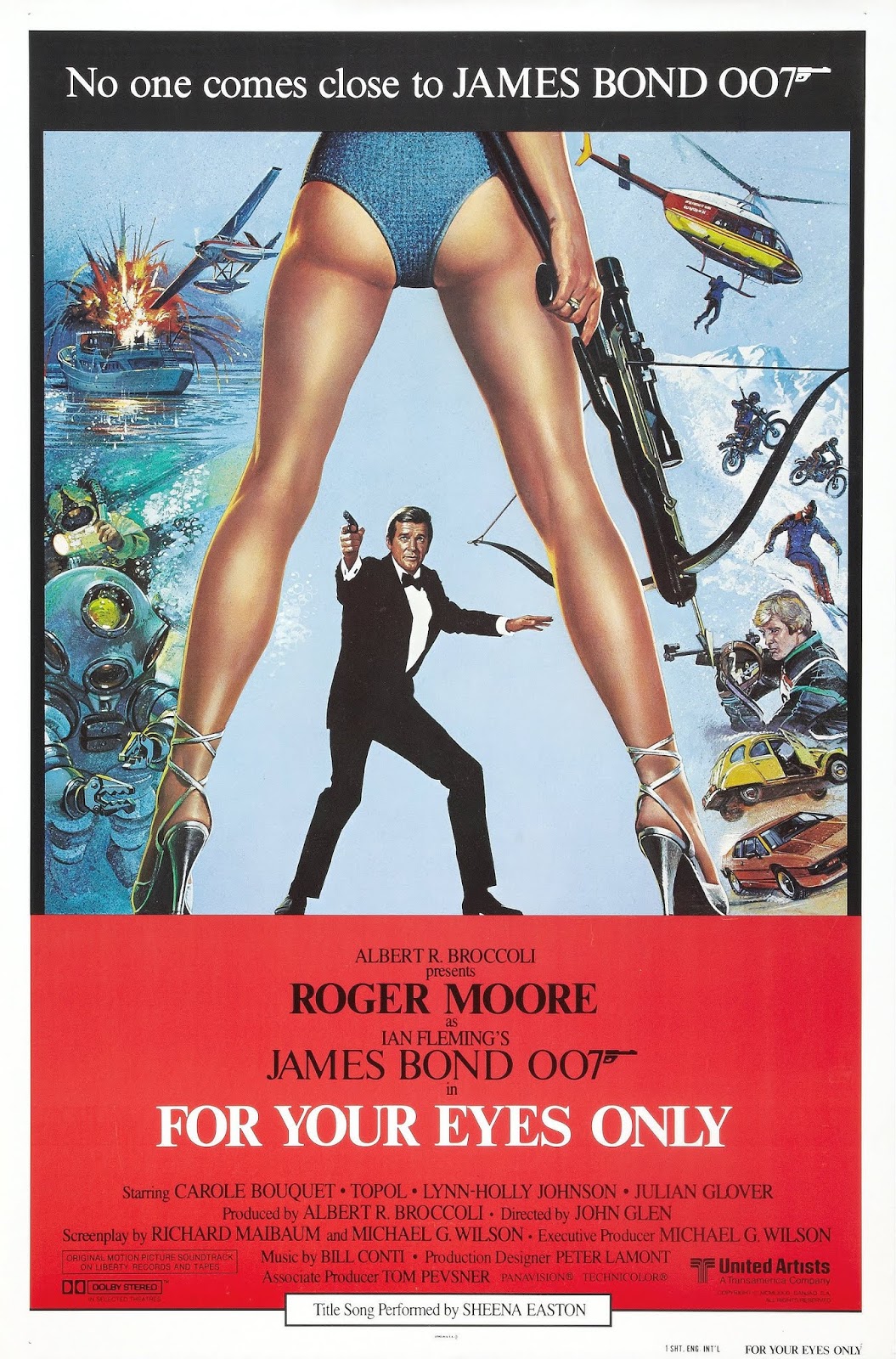
Where could Bond go after he went to space in Moonraker? Another planet? The future? The producers of Bond decided they couldn’t top that – probably wisely – so for Bond’s next outing they went back to low-key basics. For Your Eyes Only Bond would find himself in an old-school Cold-war game of cross and counter-cross, scrambling for the Russians for ownership of what looks like a cross between a typewriter and child’s cash till toy. 

That toy is the ATAC (though it might as well be called MCGUFFIN) a ministry of defence system used to co-ordinate nuclear subs or some such. When the ship it’s on sinks somewhere off the coast of Greece, MI6 and the KGB swing into gear to be the first claim it from the Ocean depths. So Bond is off to Greece to investigate, not knowing who to trust: should it be MI6 contact and shipping magnet Kristatos (Julian Glover) or playboy smuggler and former resistance man Columbo (Topol)? And how will he deal with Melina Havelock (Carole Bouquet), the long-haired, half-Greek archer intent on revenge on whoever ordered her parents killed while they (without her knowledge) searched for the ATAC? Either way it will involve chases, deadly winter sports, flirtatious teenage ice skaters and a death defying climb up to a monastery at the top of a mountain.

For Your Eyes Only is one of those quiet gems of Bond movies that, because it is about something quite small scale and quiet compared to the films it precedes often gets overlooked. It’s certainly the point where Moore should have stopped making the films – when your turning down the advances of someone because she’s too young (as he does ice skater Bibi) you know it’s time to go – and to be honest Moore was flagging already here, clearly too old for the action and certainly far too old for Carole Bouquet, who looks like she could have him for breakfast (she struggles to muster much sexual interest in him). But it doesn’t really matter because this is an old-school bit of spy cool, mixed with some decent but grounded fights and chases and shot with a loving eye for Switzerland and Greece (with plenty of clichéd visuals and sound cues thrown in from both as you would expect).

The producers wanted to shy away from the gadget filled antics of the previous films. As if to make the point, Bond’s car is destroyed almost immediately, forcing him to make a getaway at one point in a bashed up Citroen 2CV. The long sequence in the film where Bond is chased around a ski resort – which takes in cross-country skiing, a ski jump, a toboggan and several other winter sports is remarkable for nary a gadget in sight, with Bond relying on his wits and native skill with skis. Even when ascending the mountain at the film’s end, he uses nothing more than standard climbing equipment, putting his trust in ropes and hooks. It’s possibly the least tech heavy Bond film since Doctor No. There isn’t even a novelty watch and no humorous Q briefing on the gadgets. The only visit to Q’s lab is to use a cumbersome facial recognition system, that hilariously uses computer disks the size of stone slabs loaded into something that today resembles a dishwasher.

Other than that Bond is on his own, and it’s fairly neat to see him go about an investigation and follow a trail – even if Bond is, as usual, a hopeless undercover agent who largely relies on waiting to see who tries to kill him first. The villains, as always oblige, spending most of the film attempting to off Bond for all sorts of confused ill-defined reasons. Perhaps it has something to do with our main villain – the rather low-key Julian Glover, playing possibly the least colourful Bond villain ever, a guy who just wants to sell the ATAC for some cold hard cash – using so many cut outs for his operations, speechless goons (including an early appearance from Charles Dance) and East German skiing champions who seem motivated to kill Bond purely for larks and the evilz.

The first half of the film though is huge fun, watching Bond blunder around the ski resort dodging hits, fighting people, punching out butch hockey players and the like that it hardly matters that most of the plot is pretty inconsequential. When Bond finally stops mucking around in Switzerland and heads to Greece the ATAC is found in about 5 minutes flat (Havelock helpfully left a map with the downed boat coloured in on it, making his daughter’s ability to translate his cryptic notes pretty much useless), while the villain immediately takes this chance to comprehensively unmask himself.

After a further elaborately sadistic attempt to off Bond involving dragging him across coral in shark infested waters (sharks are always such deadly threats in Bond films), Bond unites with Topol to storm the castle in an actually pretty gripping and vertigo inducing climb sequence, another triumph of John Glen’s mastery of the action sequence. It’s a nice touch as well to introduce the “guest star” of the film not as the antagonist but as a protagonist ally, a neat twist that must have come as quite a shock back in the day. Topol plays his role with realish, cracking nuts, gags and heads with equal glee.

The film also heads into some dark places. For all his charm, gallantry and debonair wit, Moore does his meanest thing in years here when he kicks a heavy’s teetering car off a cliff. But that’s a fair repayment for the brutal running over of his mid-film squeeze (played by Pierce Brosnan’s real life late wife Cassandra Harris) earlier on by the same heavy. The early murder of the Havelock’s is surprisingly graphic (and also gives a great reaction shot for Carole Bouquet as she turns and looks back as the plane carrying her parent’s murderers jets away, her eyes screaming “I shall have my revenge!”) and Carole Bouquet’s Melina is determined figure, who does more than her fair share of the action.
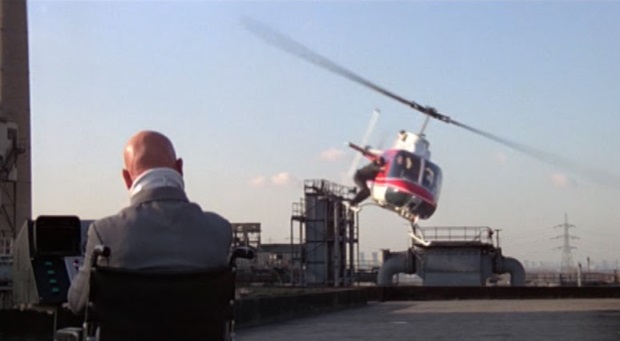
Of course the film can’t endorse too much her need for revenge. “That’s not the way” Bond, like a disapproval uncle, rather prissily tells her several times. Which is a bit rich coming from a man who opens the film by dropping his wife’s murderer down a factory chimney shaft. That opening sequence by the way is a joy, a neat call back to On Her Majesty’s Secret Service (whenever Bond went serious, it referenced Bond’s status as a widower) as well as a the dispatching of a it-could-be-anyone bald, scared, cackling villain with a white cat who makes an ill-advised attempt to kill Bond with a remote controlled helicopter (the film is so anti-Gadgets, only the baddies seem to use them and they don’t even work for them). It’s a neat “fuck you” to Kevin McCloy, at that time in a feud with the producers over the rights to Bond who had refused to allow them to use Blofield or Spectre again in the films. Keen to show they didn’t need Blofield, the producers introduced him in all but name to ignominiously kill him off, his final pathetic words a hilariously meaningless offer to buy Bond a “delicatessen in stainless steel” if only Bond would let him go.

FYEO is a crackingly old-fashioned Bond film that, despite being more grounded, has some great action sequences and a host of actors having a good time. Carole Bouquet is one of Moore’s best Bond girls and Moore himself certainly should have stopped here, this film throwing together one of his best mixes of light comedy, moral uprightedness, playfulness mixed with a dash of cruelty. John Glen did such a good job assembling this one he directed the next four films. It’s not got the smash-and-grab of The Spy Who Loved Me, but it’s an excellent action adventure.

The Spy Who Loved Me (1977)

Bond finds himself in another pretty pickle in The Spy Who Loved Me

Director: Lewis Gilbert

Cast: Roger Moore (James Bond), Barbara Bach (Anya Amasova), Curd Jürgens (Karl Stromberg), Richard Kiel (Jaws), Caroline Munro (Naomi), Walter Gotell (General Gogol), Bernard Lee (M), Desmond Llewelyn (Q), Lois Maxwell (Miss Moneypenny), Geoffrey Keen (Frederick Gray), Robert Brown (Vice-Admiral Hargreaves), George Baker (Captain Benson), Michael Billington (Sergei Barsov), Vernon Dobtcheff (Max Kalba), Nadim Sawalha (Fekkesh)

Roger Moore had made two Bond films before he made The Spy Who Loved Me – but this is the one when he finally hit upon the formula that works for him. It’s also probably the moment where the Bond films became – once for all – comedy adventure capers. It was but a few more degrees from here until Bond was telling a tiger to “sit” or racing past a double-taking pigeon in the middle of St Mark’s Square. And the public loved it. For better or worse, Moore’s Bond here helped define the franchise for a whole generation.

Anyway, the story. It’s eerily familiar in many ways to Thunderball and You Only Live Twice: a power-crazed lunatic (Karl Stromberg) running a secret organisation wants to destroy the world. His plan? To capture one American and one Soviet submarine and use them to fire nuclear missiles at the nation’s two capitals, to kickstart a nuclear war, leaving only his underwater kingdom intact. Just as well then that an over-keen Stromberg (Curd Jürgens) first captures a British sub, meaning James Bond (Roger Moore) is called in to investigate. Bond will work with the USSR’s finest agent – Anya Amasova, Triple X (Barbara Bach) – to find out what’s going on and why.

TSWLM is a lot of fun, possibly the ultimate expression of what a lot of people think Bond is. It’s hugely silly, rather exciting and has almost no connection with reality whatsoever. Moore goes through the whole thing with his eyebrow forever arched, tipping the wink at the audience – “You do know, dear boy, this is all dreadfully silly stuff”. Sometimes in Bond this humour gets a bit much – but here it’s pretty much pitched perfectly. And Moore looks like he is having the time of his life.

The film is crammed with action set pieces in striking locations: the Alps! The pyramids! A converted oil tanker base! Nothing is left to the imagination, and everything is thrown at the screen. It gets the sense of excitement right from the pre-credits sequence, with Bond’s high-speed ski chase across the alps from Russian would-be hitmen. Fools – what chance did they have? I don’t know what I like most about this scene: is it the wild ski stunts? The way music and camera action combine so well? The fact that it’s crystal clear Moore probably spent precisely zero days on location for this sequence? What am I talking about, it’s got to be that insane parachute jump at the end – with the camera leaving it just long enough for you to start to think “is Bond going to get out of this one?”. (Spoilers he does.)

That’s almost nothing compared to the famous Lotus-turned-submarine car chase, which pretty much set the standard for all the car-based action (not to mention gadget filled cars) that would follow in the franchise. The idea of a car that turns into a submarine: it’s both brilliant and so overwhelmingly silly that, like Bond at its vibrant best, it seems to transcend class and logic into a higher plane of excitement.

And all this with a plot that is almost staggeringly stupid. Jurgens has a lot of arch, naughty fun as scheming monomaniac (with subtle webbed hands) Stromberg, a pompous arsehole and a great villain. Of course he wasn’t a physical threat – hence the invention of Jaws, surely the most popular henchman ever invented for Bond. Jaws is a lunking, vicious but strangely endearing brute – it’s hard to put your finger on why he’s strangely likeable, maybe it’s just the totally absurd idea of a hitman whose killer tools are metal teeth. Maybe it’s because Richard Kiel has such a dorky sense of humour – and is as good at the glance at the camera as Moore himself is.

Of course it is a dated film – and it’s always the women that show it. If this set a lot of good Bond archetypes, then it also helped to cement a few bad ones. Anya Amasova is (allegedly) the greatest agent Russia has. Not that you would know it, as she stumbles in this film from moments of staggering incompetence and stupidity to victimhood and damsel-in-distress. There is a hint of character development – Bond offs her boyfriend in that alpine chase literally without a backward glance – but that’s soon forgotten by the end under Bond’s charms. The poor woman can’t even drive stick (“That’s reverse, let’s try again shall we” says Bond with smackable smugness) and by the end of the film she’s bikini-clad and being rescued by Bond. It says a lot when the strongest thing about her character is that her name isn’t an innuendo.

But you can let it go, because the rest of the film is such good fun. Everything is nonsense of course, and you could steer a submarine through the plot holes. If Stromberg only needs two submarines to start his evil plan, why on earth does he grab a third one at the start of the final act? (Just as well he does, of course, as otherwise Bond would never get on board his base.) Stromberg is ruthless enough to eliminate three underlings and to set up a nuclear war to wipe out the world – but those captured submarine crews he keeps alive, imprisoned, with a small guard, next to the armoury on his base. Ooops. His plan is almost effortlessly undone with a radio message from Bond. But never mind. It doesn’t matter.

The point is that this is all great fun and basically set the tone for the next ten years of Bond films – until Dalton shifted gears. Moore is really good in it, as a sort of ringmaster of silliness – and he’s clearly enjoying it wildly. The Spy Who Loved Me is his best film – and for all its dumbness, its leaning into cheap humour, its ludicrous plot and sexist attitudes, it’s still up there at the top of the franchise. Because for a lot of people, all those negatives are exactly what they now expect from Bond.

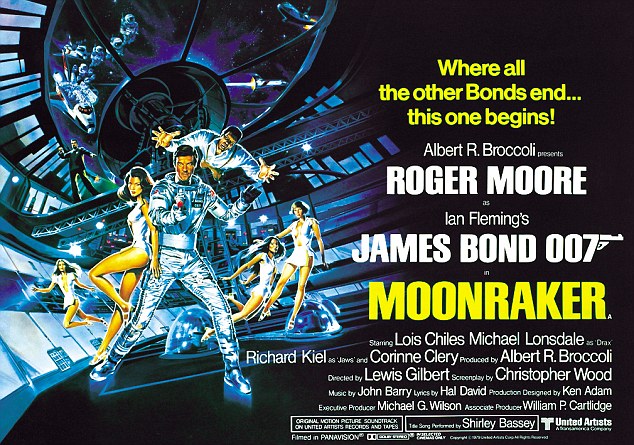
Moonraker (1979)


Roger Moore is James Bond…IN SPACE!!!!

Director: Lewis Gilbert

Cast: Roger Moore (James Bond), Lois Chiles (Holly Goodhead), Michael Lonsdale (Hugo Drax), Richard Kiel (Jaws), Corinne Clery (Corinne Dufour), Bernard Lee (M), Geoffrey Keen (Defence Minister), Desmond Llewelyn (Q), Lois Maxwell (Miss Moneypenny), Emily Bolton (Manuela)

After The Spy Who Loved Me, the Bond producers had finally found a format that suited Roger Moore’s take on the role:  a comedic, tongue-in-cheek style, with Moore leaning on the fourth wall, winking at the audience. In fact, SWLM made so much money that this one feels almost like a remake rather than a new film – it’s got the same basic concept, the final sequence is pretty similar, the opening sequence again revolves around a daring parachute stunt, even Jaws pops up again. For a film that heads into truly unchartered physical territory for Bond (space!), it’s as familiar and derivative as Bond gets.

Bond (Roger Moore) investigates Hugo Drax (Michael Lonsdale), a shady businessman whose operations are expanding into space. After a string of exotic locales (a chateau in France! Venice! Mexico City! Brazil!) an evil scheme to destroy the world from space clicks into place. Bond has to take to the stars to take down Drax. Despite the criticism that will follow, this is probably near the end of Moore’s high point in the role – and in none of his future films was he quite as debonair and dashing as he is here.

If you ever needed evidence that the James Bond franchise looked at whatever was popular in the cinema at that moment in time and then ripped it off as quickly as possible in their next film, then it’s Moonraker. Surely never in anyone’s lifetime would they expect to see a film that could be tagged “James Bond…in SPACE!” but after the success of Star Wars that is exactly what they were served up. The idea is so completely silly that people wonder if you’ve made it up.

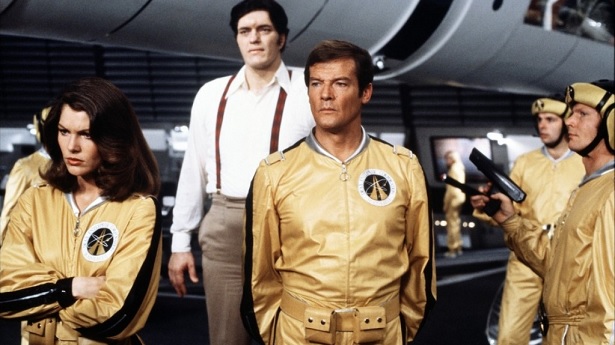
But, sigh, that’s what we get here. And it is beyond silly. The film climaxes in a space battle between the NASA Marines (don’t ask) armed with laser cannons (yes you read that right), duking it out with Drax’s own personal guard also armed with cannons (it really is as silly as it sounds). All this against a backdrop of Drax’s own personal Death Star. Afterwards, Bond has to shoot down three deadly missiles that will wipe out the population of the Earth. Naturally, his targeting computer doesn’t work for the final one, so Bond has to basically “use the force” to target and shoot it down. Star Wars in all but name right? Had the producers no shame?

It doesn’t help that Moonraker amps up the already jokey tone of SWLM to an overbearing degree. At least it was a formula that works with Moore, but so little is treated seriously that when they do something violent it sticks out tonally like a sore thumb. This is probably the only film I can think of in which a woman is ripped apart (off screen) by a horde of hounds, followed shortly afterwards by a pigeon performing a comic double take after an amphibious gondola sails through the middle of St Mark’s Square (don’t even ask). It’s a film that has no discipline, no control and no real consistency. It dances all over the place with no logic at all. It gets the balance wrong and instead of being tongue-in-cheek often comes across as overblown, heavy-handed and ludicrous.

In fact the plot, such as it is, is hard to follow because it’s almost an afterthought. It’s effectively a reheat of SWLM (repopulate the planet with a chosen elite), while the space battles are similar to the slow motion fights of Thunderball. Bond moves from location to location with only the barest logical links. Drax identifies Bond as a threat early on – but then continues to pull out a series of bizarre and unreliable schemes to eliminate him. The action sequences feel like versions of previous films in the series – and don’t get me started on the fact Bond still hasn’t learned that punching Jaws in his metal mouth is a bad idea (he does it three or four times in this movie). Everything moves forward with a restless momentum that never allows us to connect with anything that happens.

There is some decent potential here. The fight on the ski lift is pretty good. Michael Lonsdale has a psychotic chill about him that, in a better film, might have made him a memorable villain. In fact, Lonsdale is so grounded as a villain he feels wrong for a film that’s so silly. And it’s all the more surprising he has such an outlandish scheme – or that he hangs around with such a pantomime villain as Jaws. Jaws clearly returns due to popularity – and has been thoroughly neutered as a threat here. Even before he falls in love with a girl with pigtails and switches sides, he’s already an almost comic buffoon – even bashful about knocking off a Bond aide in front of witnesses.

It’s a film that can’t decide if it’s a thriller or a comedy. It probably leans more towards comedy – which is a shame as it’s not that funny. The hideously overplayed gondola sequence tells you everything you need to know about the film’s lack of wit. Its comedy is as overplayed and heavy-handed as some of the action can be – more likely to get you rolling your eyes than holding your sides. Saying that, it does have possibly the best final punchline of any of the films (“I think he’s attempting re-entry sir”) – the sort of joke you probably didn’t get when you first watched the film aged about 10. Other than that it’s like a series of gags told by people who aren’t really that funny.

Moonraker is the sort of bizarre freak of nature that you almost can’t believe exists. Leaving aside its amping up of the tongue-in-cheek formula into the realms of the bizarre, it’s basically a bit too stupid and unbelievable for even this franchise to pull off. Lasers? Space-stations? Space marines? Bond in space? I mean really? As a rip off of Star Wars it leaves a lot to be desired – and so long as these films take place in a world that is even vaguely linked to our own, plots like this just have the stench of bullshit.

The Man with the Golden Gun (1974)


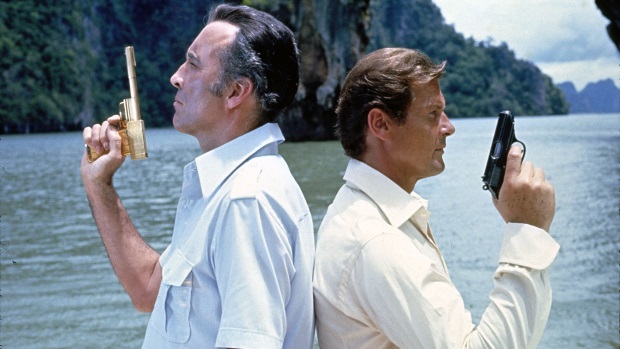
Christopher Lee and Roger Moore duel to the death in the confusing and strangely pointless The Man with the Golden Gun

Director: Guy Hamilton

Cast: Roger Moore (James Bond), Christopher Lee (Francisco Scaramanga), Britt Ekland (Mary Goodnight), Maud Adams (Andrea Anders), Bernard Lee (M), Hervé Villechaize (Nick Nack), Richard Loo (Hai Fat), Soon-Tek Oh (Lt Hip), Clifton James (JW Pepper), Desmond Llewelyn (Q)

I sat down to watch The Man with the Golden Gun having just heard the news of Roger Moore’s death. It seems an odd one to choose, as this was easily Moore’s least financially successful, and least fondly received, Bond film. But it had just been on TV, and I wanted to raise a glass (or eyebrow) to Britain’s finest.

MwtGG was very much the formula trying to find its way in a post-Connery world, with Moore’s performance an odd half way house between his later light persona and the harder edge of Connery. Anyway, the plot, such as it is: Bond is sent a bullet with his name literally on it from Francisco Scaramanga (Christopher Lee), the world’s greatest hitman who only uses golden bullets and charges a (now rather sweetly modest-sounding) $1million per hit.  Bond goes to Hong Kong to find out more and gets embroiled in some complex (and not particularly interesting) back-and-forth about hijacking the world’s solar energy supply, hindered by incompetent agent Mary Goodnight (Britt Ekland). It all culminates into a duel of guns on Scaramanga’s private island.

The problem with this film isn’t so much that it’s a bit dull – it’s that it’s not really about anything at all. Does anyone really understand Scaramanga’s scheme? Even he seems confused about it. As far as I can tell it’s something to do with controlling solar energy, but how the heck he’s going to control access to the sun I don’t know. Scaramanga seems far more interested in a silly heat gun he’s got as a side installation. Anyway, whatever the heck this is about, lots of other people seem interested in it. It’s powered by “the Solex”, which looks like some sort of robotic cigarette pack. This Solex changes hands even more regularly than Bond changes love interests, but its purpose and why it’s important are such a poorly explained macguffin it’s really hard to care.

What the film is nominally about (but turns out not to be) is the duel between Scaramanga and Bond. Turns out, of course, Scaramanga doesn’t have a clue about the bullet. His motivations towards Bond are as unclear as the plot, alternating between indifference, admiration and envy. On top of that, to make a duel like this work we need the feeling Scaramanga and Bond are two sides of the same coin – that with a push at the right time in his past, Bond could have turned into the ruthless hitman Scaramanga is. This could have worked with Connery’s early Bond – or Dalton and Craig – but never do you believe Moore’s Bond has a streak of black through his soul.

This is despite some ill-fitting moments in the film, created solely in an effort to show Moore’s Bond acting tough, moments that feel horrendously out of place and against character. In particular, early in the film Bond quite viciously roughs up Andrea Anders (he slaps her, nearly breaks her arm, spies on her with the shower and threatens her with a gun in a weirdly sexual manner). It feels totally wrong for Moore’s gentle suaveness. At other points in the film, Moore plays with a hardness and general prickishness that isn’t present in his other films, and doesn’t match his light style. Throughout the film he feels annoyed at Goodnight, he pushes a kid off a boat, he treats his colleagues dismissively – it feels all the time Moore is struggling to play a Bond way against his style.

To be fair, I can see why Bond is annoyed with Goodnight: Britt Ekland is probably the nadir of Bond girl stupidity. Literally nothing she does in this film is any use, and most of the rest of the time it actively helps the villains. She’s stupid, clumsy and not funny. She’s so incompetent you need to keep double checking she is actually meant to be an MI6 agent. Ekland has indignities heaped upon her on this film, from being locked in the boot of a car, to being hidden in a cupboard by Bond mid-coitus so that he can do the nasty with Scaramanga’s girlfriend. Late on, she nearly kills Bond by backing into a button with her bottom. Ekland’s main reason for being cast was of course her physical assets in a bikini – so it’s lucky that Scaramanga keeps her on his island dressed only in a bikini for the last third of the movie. Only way to make sure she doesn’t have a weapon, doncha know!

As the plot drifts around, going either in circles or nowhere at all, the producers land Bond in a kung-fu training school in Hong Kong. Bond films as a genre have always gently ripped off as much as possible whatever was popular at that time in Hollywood (Blaxploitation in Live and Let Die, Star Wars in Moonraker, Bourne in Quantum of Solace etc. ), and so it merrily climbs on the Bruce Lee bandwagon here. Unfortunately, it’s all highly stupid and adds nothing (Scaramanga even comments in the movieabout the ludicrousness of sending Bond to a school rather than just putting a bullet in him) and hits heights of ridiculousness when the entire school of elite trainers is bested by Bond’s sidekick and two teenage schoolgirls in school uniform.

That’s another thing wrong with this movie – the wildly varying tone. So at times we get Bond chasing down leads like Philip Marlowe. Next we have him roughing up a weeping woman. We’ve got Goodnight’s buffoonery, Scaramanga’s suave cruelty… It’s all over the shop. The comic moments of the film particularly grate. Was anyone waiting for Sherrif JW Pepper’s return from Live and Let Die? Didn’t think so, he’s as funny as a bout of gonhorrea. Even some of the good moments get undermined by bizarre tonal shifts: the classic car flip stunt (which is amazing, particularly because you know they did it for real after hours of careful calculations) is overlaid with a stupid “whoop” sound effect, like a Carry On film (even Guy Hamilton subsequently said this was a terrible idea).

However, it’s not all bad – no Bond film ever really is, such is the triumph of the formula. Christopher Lee is very good – you wish he was in a much better film than this one. The late duel in the film between Scaramanga and Bond is pretty good, even if it all ends a little too easily. Scaramanga’s funhouse seems totally bizarre (why the hell does he even have this on the island next to a power plant?) but its good fun. The MI6 base on a half sunk ship off the coast of Hong Kong, with all the corridors on the wonk is an absolute triumph of design. Bernard Lee gets lots more to do than he usually does – and delivers his exasperated boss lines with a sense of dry timing.

It doesn’t change the fact, though, that this is possibly one of the weakest Bonds around. It’s not a terrible film – I enjoyed watching it, though at least part of that comes from growing up with these films, making them as familiar as family members. But it’s way down there in the Bond list. It’s a slightly tired movie, in a franchise trying to find its feet under a new lead. Tonally it’s a complete mess for large chunks of it, and manages to make its plot seem inconsequential and dull. Nothing really seems that much at stake, and Scaramanga (despite Lee’s good performance) never feels like a villain we really understand. I’ve no idea what he wants, and no idea why he should be stopped.

The Man with the Golden Gun is only worth it for a doze in front of the television on a Sunday afternoon. Thank goodness that’s the only time it’s likely to appear on your TV. And putting all else aside, Moore was a terrific Bond and an even more terrific human being. Rest in Peace.