Tag: Roman films

The Eagle (2011)

eagle header
Jamie Bell and Channing Tatum on a spectacularly un-fun adventure in The Eagle

Director: Kevin Macdonald

Cast: Channing Tatum (Marcus Flavius Aquila), Jamie Bell (Esca), Donald Sutherland (Marcus’ Uncle), Mark Strong (Guern/Lucius Caius Metellus), Tarah Rahim (Prince of the Seal People), Denis O’Hare (Centurion Lutorius), Douglas Henshall (Cradoc), Paul Ritter (Galba), Paul Ritter (Galba), Dakin Matthews (Legate Claudius), Pip Carter (Tribune Placidus), Ned Dennehy (Chieftan)
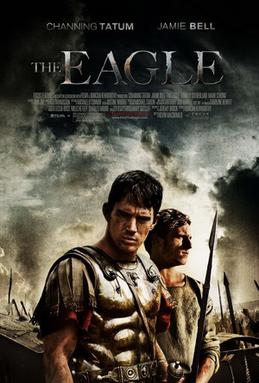
Rosemary Sutcliff’s The Eagle is one of the classic young adult stories of all time. An enjoyable odd-couple-turned-brothers-in-arms series, with plenty of action and adventure it arrives on screen as a dark, gloomy and above all not-really-fun-at-all story that doesn’t seem to know whether it’s aiming for a boys-own yarn or an adult adventure. It basically fails to make either work.

In Roman Britain AD 140, Marcus Flavius Aquila (Channing Tatum) is a young centurion whose father was one of the commanders of the Ninth Legion, which disappeared twenty years before somewhere in the North. Now Marcus is working to save his family honour – but his career as a centurion is cut short after he is injured almost single-handedly saving his garrison from attack. Depressed, he resolves to head north to try and find his father’s legion’s missing eagle standard – accompanied only by his strong-willed slave Esca (Jamie Bell), who hates Rome but owes his life to Marcus who saved him from execution in the gladiatorial ring. Heading North they find the eagle is in the hands of a savage tribe of warriors, who take no quarter.

Kevin Macdonald’s film probably should work like a Bernard Cornwell novel remixed in Roman Britain – or, better yet, like a proto-Simon Scarrow novel. There should be a growing sense of odd-couple bond – or at least chemistry – between Marcus and Esca as unlikely allies who become even more unlikely friends. Sadly, Macdonald misjudges the mood and instead turns the film into a grimly serious, mud spattered and miserable travel saga, which slowly drains any sense of enjoyment out of the story and its mission.

Instead, Esca and Marcus seem to hate each other’s guts for most of then movie until the plot finally absolutely demands that they lay down their lives for each other – at which point, an unearned switch takes part. Rather than an amusing “opposites attract”, men on a mission banter that the film sort of needs, instead everything is morose, angry and very, very serious. By the time the film hits the sort of banter tone it needed at the start, the credits start to roll.

It’s not helped by the choices of the two lead actors. Tatum is at his most “serious” here, with none of the playfulness and lightness that can make him an engaging presence. Instead he’s muscle bound and frowning, dispatching enemies without a second thought and forever gloomily reflecting on his father’s lost honour. Bell gets the tone slightly more on point, but he’s given almost nothing light to work with, instead having to juggle guilt and resentment at the oppression his people face and his part in it. With the dreary photography, all this misery finally starts to wear the viewer down.

Where’s the enjoyment of all this adventure? I get the film wants to make a serious point about the cost of empire and conquest, but did that have to be at the cost of any sense of fun? At least the film does take an interesting decision to make all the Romans American – reflecting the fact that America is “the new Rome” – but it doesn’t really take these revelations anywhere.

Not that you would really want it too as this is supposed to be an adventure story. Instead it’s a gloomy trip of two angry people in extreme cold and mud to grab a metal eagle, punctured by darkly framed fights, dully assembled dialogue scenes and a bubbling dislike between the two lead characters that never flowers into respect until far too late. By making neither of the two lead characters particularly likeable, we never really invest in their journey – and in the end just plain don’t care about what happens to them or if they ever get that eagle at all. For an adventure story, this is one trip you’ll insist you’d rather stay at home and guard the base.

Gladiator (2000)

Russell Crowe dominates in Ridley Scott’s Oscar-winning Gladiator

Director: Ridley Scott

Cast: Russell Crowe (Maximus Decimus Meridius), Joaquin Phoenix (Emperor Commodus), Connie Nielsen (Lucilla), Richard Harris (Emperor Marcus Aurelius), Oliver Reed (Proximo), Derek Jacobi (Senator Gracchus), Djimon Hounsou (Juba), Tomas Arana (General Quintus), Spencer Treat Clark (Lucius Verus), David Schofield (Senator Falco), John Shrapnel (Senator Gaius), Rolf Moller (Hagen), Tommy Flanagan (Cicero), David Hemmings (Cassius)

When Gladiator hit the big-screen the swords-and-sandals epic genre was dead. A relic of the early days of technicolour Hollywood, where the widest possible screens were designed to tempt audiences away from the television and into the movie theatre, Roman epics were often seen as stodgy things, usually carrying heavy-handed Christian themes while gleefully throwing as much of the decadence of the empire on the screen as possible. Gladiator changed all that, bringing an emotional and psychological complexity to the genre, as well as a rollicking good story and some brilliant film-making. An Oscar for Best Picture confirmed the genre was back.

In 180 AD General Maximus Decimus Meridius (Russell Crowe) commands the final battle of the Roman forces to conquer the German tribes and bring them under the control of the Emperor Marcus Aurelius (Richard Harris). The humble, dutiful and principled Maximus is a natural leader and the son Marcus Aurelius wishes he had, rather than the son he has the insecure and ambitious Commodus (Joaquin Phoenix). When the Emperor decides that Maximus not Commodus will succeed him – with the brief to restore the Roman republic – Commodus murders the Emperor. When Maximus refuses to give Commodus his loyalty, the new Emperor sentences him and his family to death. Maximus escapes, although he is badly injured, but arrives too late at his home to save his wife and son from death. Collapsing, the General is taken by slavers, healed by fellow slave Juba (Djimon Hounsou) and sold to the North African Gladiator school of Proximo (Oliver Reed). Maximus will play the Gladiator game – because he longs to have his revenge on Commodus.

Gladiator is superbly directed by Ridley Scott, who perfectly mixes the epic scale of the drama with the intimate, human story at its heart. The film looks absolutely fantastic from start to finish, with the superb visuals backed by a breathtakingly beautiful score by Hans Zimmer and Lisa Gerrard that skilfully uses refrains and themes to instantly identify the core emotions in the audiences mind. These themes are associated with emotional beats that immediately plug us into the interior thoughts and emotions of the characters. 

It works because of the emotional truth at its heart. Basically it’s a love story between a man and his dead wife, and isn’t afraid to explore the depths of love that we feel for those closest to us and our pain of their loss. Maximus’ wife and child are represented in silent flashbacks and by two small icons Maximus carries with him on campaign. When, late in the film, he is reunited with these items his raw, tearfully quiet joy carry as much force as any real reunion would do. What drives the film is less a drive for revenge – although there is no doubt this is a motivator for Maximus – but of a continued sense that he must fulfil all his duties (in this case restore the Republic as his surrogate father wished) before he can return to his wife and son (i.e. die).

It’s that which makes the film so easy to invest in emotionally, and which makes Maximus (a hardened killer) so easy to relate to. If he was just a raging man out for revenge, the film would carry a leaner harsher look. But he is instead a man motivated by love, who yearns to be with his family again. Mortality hangs over the entire film – the first shot of the film, famously of the hands in the wheat, have buried themselves in the consciousness because we can all relate to a man who longs to lay down his labours and be with the people he loves. Christianity doesn’t appear too much in Gladiator (unlike older Hollywood Roman epics) but faith is there in spades. And Maximus will do nothing that will jeopardise a reunion with his family in heaven.

This deeply involving story of a man who remains faithful to the memory of his wife – and Scott wisely removed any love plot with Lucilla, which would have felt like cheatingso strongly does the film build Maximus’ love for his wife – that audiences are happy to go with the film through all the violence that follows. Gladiator hit the sweetspot of having something for everyone, from emotion to action. And the action is brilliant. The opening battles is hugely impressive, from its scale to the imaginative interpretation of Roman tactics. It’s trumped by the more raw and ragged action that comes in the Gladiatorial ring, as Maximus transfers his brutal efficiency at war into the ring for the amusement of the crowd.

Like all Gladiator films and series the film successfully has its cake and eats it – so we get a sense of the horror of people fighting to the death for our entertainment, while also heartily enjoying watching our heroes kick ass. The sequence that uses this most effectively, as Proximo’s outmatched Gladiators follow Maximus’ strategic experience and military training to defeat a group of deadly chariot fighters, would-be a stand out in any movie.

The film further works due to the assured brilliance of the Oscar-winning Russell Crowe in the lead role. Crowe exudes natural authority as a general – he genuinely feels like the sort of man that first his soldiers and then his fellow Gladiators will follow to the bitter end. Crowe also dives deep into the soulful sadness at the heart of Maximus, the romantic longing and the searing pain of the betrayal and murder of his family. It’s a performance of immense, small-scale intimacy that also never once gets over-shadowed by the huge spectacle around him. I’m not sure many other actors could have pulled it off.

But the whole cast is extremely strong, Scott encouraging great work across the board. Joaquin Phoenix in particular takes the villain role to a bravely unusual place. His Commodus, far from a sneering Caligula, is in fact a weak, anxious, jealous even strangely pitiable man, so insecure and riven with envy for others that he becomes twisted by it. But we never lose a sense of the humanity at his heart, the sense of a little boy lost, scared by the world around him. It makes sense the Connie Nielsen’s Lucilla – walking a difficult line as a character who has to play both sides – could both fear and hate him but still love the fragile little brother she still senses in him.

Scott’s trusting of experienced pros – many you feel hungry for an opportunity like this – is clear throughout the whole cast. Richard Harris was pulled out of a career slump and reinvented here as an elder statesman, with a wry, playful and eventually moving performance as Marcus Aurelius. Scott’s biggest risk was pulling Oliver Reed from a life better known for drinking bouts to play Proximo. Playing his best role for almost thirty years, Reed reminded us all for one last time that as well as a chat-show joke he was also a powerful and dominant performer, his Proximo a snarling scene stealer. Reed’s death – his final scenes completed with special effects – made this a better tribute than he could have ever imagined.

There are few feet placed wrong in Gladiator. As an action spectacular it’s faultless, but this works because of the truth and love at its heart. It creates an epic that is emotionally involving as it is exciting to watch. The reconstruction of Rome is hugely impressive and Scott paces the film perfectly, letting its force grow along. You never once feel thrown by its scope, and so completely does it wrap you up that, as it becomes more operatic in the final act, the film is never at risk of losing you. It deserves to be remembered with the best of the Hollywood epics.

Centurion (2010)

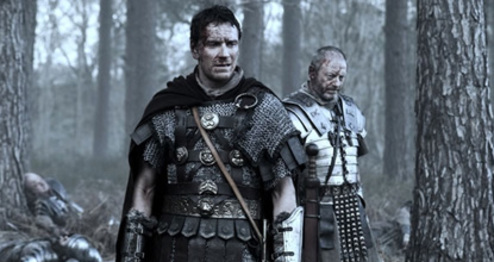
Michael Fassbender surveys the devastation that is Centurion

Director: Neil Marshall

Cast: Michael Fassbender (Quintus Dias), Olga Kurylenko (Etain), Dominic West (General Titus Flavius Virilus), Liam Cunningham (Brick), David Morrissey (Bothos), JJ Feild (Thax), Noel Clarke (Macros), Riz Ahmed (Tarak), Dimitri Leonidas (Leonidas), Ulrich Thomsen (Gorlacon), Imogen Poots (Arianne), Paul Freeman (Gnaeus Julius Agricola), Rachael Stirling (Drusilla), Less Ross (Septus)

It’s an old fable: the “missing” Roman legion, the 9thLegion that allegedly marched to Scotland around 120 AD. We don’t know what happened (if anything) but it usually gets tied into Hadrian’s decision to build his famous wall. Anyway, Neil Marshall’s film tries to plug the gap, with the Legion eradicated on an ill-judged expedition north to settle affairs there once for all. A “ragtag bunch” of survivors (all of whom match expected character tropes) have to run over hostile countryside, led by surviving senior officer Centurion Quintus Dias (Michael Fassbender) to get back to safety and Roman lines.

It’s a Neil Marshall film, so you can expect blood-letting aplenty and high-octane action on a budget. And you more or less get it, mixed with his love for accelerator-hitting chases and against-the-odds action. It’s entertaining enough, but its main problem is that it feels a little too by-the-numbers, as if all the thought about how to make it original and exciting went straight into the look and style of the film – all drained out colours and serious claret – and none at all into storytelling or character.

You sort of end up caring for the characters in a functional way – largely because they are all such familiar types – but their personalities seem to have been designed entirely around the various deaths that have been invented for them. So the enthusiastic meet unjust ends, the likeable fall to cruel chance, the world-weary give their lives for one more stand, the selfish meet justice. At the end, the characters you would basically expect to stumble to the finish line do. It’s a film that lacks any uniqueness.

In fact, what gives the characters life is the professional character actors playing them, all of whom can do what they are doing here standing on their heads and look like they were largely there with an eye on pleasant after-shooting hours in a series of local pubs. It’s hard otherwise to think what attracted them to these cardboard cut-outs and pretty familiar structure.

Not that there is anything wrong with what Marshall does with his film here – it’s a lot of fun when stuff is happening, it’s just that nothing feels like it carries enough weight or originality to survive in the memory. Everything is fine but nothing is really inspired. There is very little sense of Ancient Rome or any other place. The Romans are basically squaddies, an idea that sounds interesting until you remember turning period warriors into versions of modern soldiers is hardly new, while the Brits chasing them are woad-covered psycho stereotypes.

So while it passes the time, Centurion does nothing special with it. It feels like a wasted opportunity – that with a cast this good and a decent premise, plus a nice little historical mystery to pin it onto in order to give it depth, Marshall could have come up with something that was more than the sum of its parts rather than less. Perhaps it needed more time with its ragtag group so they actually became characters rather than plot devices. Perhaps it needed to take more of a rest from its constant chasing to allow quieter moments of reflection and character. Perhaps it’s just a chase film that is never quite compelling enough to make you overlook these things. Either way, Centurion isn’t an all-conquering empire of  film.

Quo Vadis (1951)


Peter Ustinov revels in the Status Quo (Vadis) of Imperial Rome

Director: Mervyn LeRoy

Cast: Robert Taylor (Marcus Vinicius), Deborah Kerr (Lygia), Leo Genn (Petronius), Peter Ustinov (Nero), Patricia Laffan (Poppaea), Finlay Currie (St. Peter), Abraham Sofaer (St. Paul), Marina Berti (Eunice), Buddy Baer (Ursus), Felix Aylmer (Plautius), Ralph Truman (Tigellinus), Rosalie Crutchley (Acte), Nicholas Hannen (Seneca)

In the 1950s, epic films were the way for the movie studios to defeat the onslaught of television. What better way to best the creeping presence of the small screen in every home than offering more action, sets, crowds and colour than could ever be squeezed into that small box in the corner of the room? Quo Vadis was the first film that started a wave.

Returning to Rome after years on campaign, Marcus Vinicius (Robert Taylor) falls in love with a Christian hostage, Lygia (Deborah Kerr). Gifted Lygia as a reward by the decadent Emperor Nero (Peter Ustinov), Marcus slowly becomes fascinated by her religion – and more aware of the insanity of Nero. Petronius (Leo Genn), Marcus’ uncle and Nero’s cynical retainer who hides his barbs under double-edged flattery, unwittingly plants in the Emperor’s mind the plan for a Great Fire in Rome. After the mob reacts with fury, Nero kicks off a persecution of Christians that will end in slaughter in the arena…

There is a charming stiffness to some of this film which actually makes it rather endearing. Like many films that followed it, this balances a po-faced reverence for Christian history with a lascivious delight in sex, destruction and violence. This means the audience can be thrilled by Rome burning, entertained by Nero’s decadence, watch Christians mauled by Lions and burned alive – while also being comforted by the triumph of good-old fashioned Christian values and persuaded the film has some sort of higher purpose because it ties everything up with a nice faith-shaped bow.

Of course this all looks rather dated today, but back in 1951 this was the studio’s most successful film since Gone with the Wind and the biggest hit of the year: it started a nearly 15-year cycle of similarly themed religious epics. The money has clearly been chucked at the screen – the sets are huge, the casts sweeping, the staging of the Roman fires and Christian sacrifices very ambitiously put together. Perhaps the only surprise is that the lush, attractive cinematography isn’t in wide-screen – this was the last film of this kind to not be filmed in the widest lens available. 

Despite its nearly three-hour run time, this is quite an entertaining story, laced with enough real history to make it all convincing (even if it telescopes the last few years of Nero’s reign into what seems like a week or so). Despite this, the storytelling does feel dated at times as we get bogged down in back and forth about Christianity (told with an intense seriousness by the actors, mixed with long-distance-stares type performances), and the homespun simplicity of its message lacks the shades of grey we’d expect today (as well as being a little dull) but it just about holds together.

The main problem is the lead performers. Robert Taylor is an actor almost totally forgotten today – and it’s not difficult to see why here. Not only does he speak with the flattened mid-Atlantic vowels recognisible from American leads in historical films from this era (the jarring mixture of accents in the film is odd to hear) but he is an uncharismatic, wooden performer sorely lacking the power a Charlton Heston would have brought to this. Marry that up with his character being a dull chauvinist and you’ve got a bad lead to root for. The relationship between him and Deborah Kerr’s (equally dull) Christian hostage is based on a terminally dated, borderline abusive, set-up: he kidnaps her from her home and wants her to change her faith, she won’t but never mind she loves him anyway without condition and surely her love will make him a good man, right!

Despite the efforts of the leads and some decent supporting actors (Finlay Currie in particular makes a very worthy Peter) the Christian story never really picks up. There are some nice visual flourishes – the recreation of some Renaissance paintings is well-done, and the stark image of Peter crucified is striking – but the Christian story isn’t what anyone will remember from this film. It’s all about the corrupt Romans.

Not only do they have the best lines and all the best scenes, but in Leo Genn and Peter Ustinov they also have the only actors who perhaps seem to realise they are not in a work of art, but a campy popcorn epic. Both actors give wonderfully complementary performances. Genn’s dry wit as the cynical Petronius (whose every line has a cutting double meaning) underpins his wry social commentator to fantastic effect, delivering many of the films laugh-out loud moments. He elevates many of the best lines in a dry but educated script.

Genn’s low-key performance also brilliantly contrasts with Ustinov’s extravagance as Nero, making the emperor a sort-of sadistic Frankie Howerd. Ustinov has enormous fun in the role, cheerfully going up and over the top with Nero’s man-child depravity, bordering on vulnerability and a needy desire to be liked and respected by the people and his underlings. Depictions of his singing are hilarious, his petulant sulking extremely funny. Yes, it’s an absurd performance – more a comic sketch almost – but it somehow works because (a) everything else in the film is so serious and (b) Genn’s world-weary cynicism anchors the character for the first two-thirds of the film, giving Ustinov much freer reign to go over the top. 

So it’s all about the baddies – as was often the way with films of this era. You’ll remember the scenes of Nero holding court, and the archly written dialogue between Petronius and Nero. Ustinov and Genn are, in very different ways, terrifically entertaining (both received Oscar nominations). The Christian message of the film is on-the-nose (to say the least), and the lead actors are more like kindling for the Great Fire than actual characters. It’s a strange film, at times a bloated far-too-serious religious epic, at others a campy tragi-comedy with a dry wit. Yes it’s dated and far from perfect, but it’s also strangely entertaining and even a little compelling.