Tag: Romantic comedy

Up in the Air (2009)


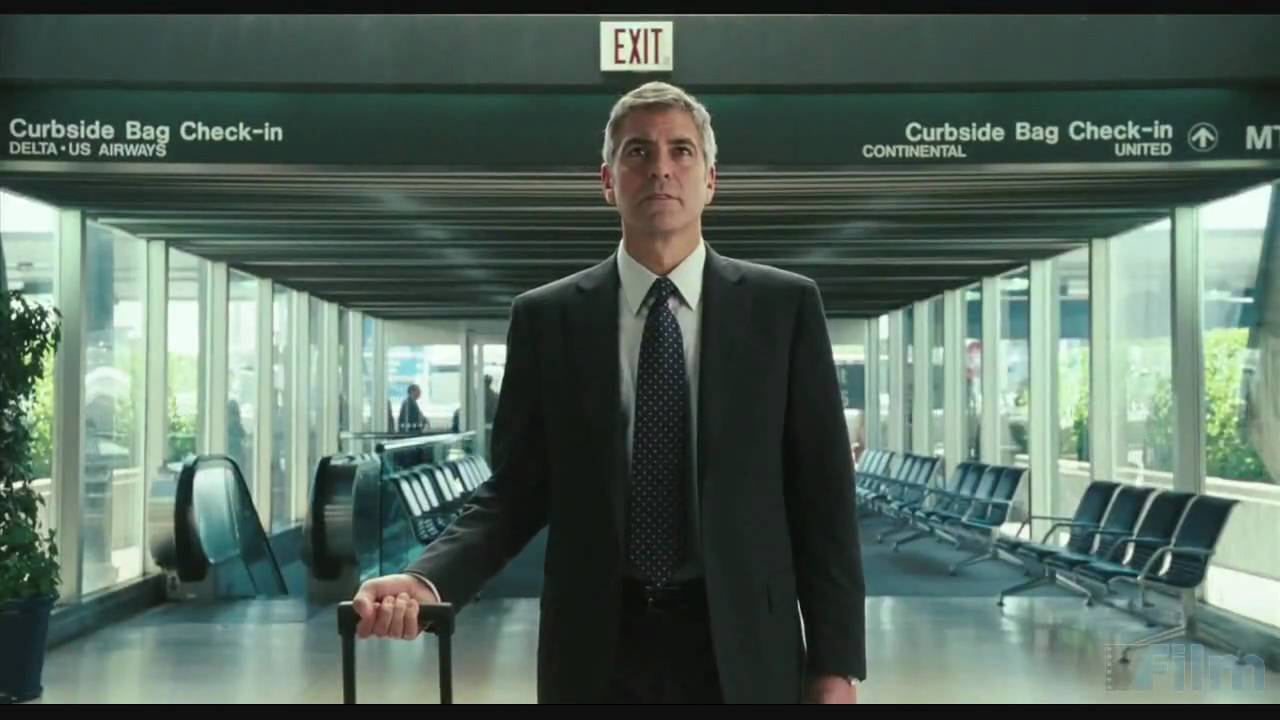
George Clooney about to head Up in the Air in Reitman’s brilliant bitter-sweet comedy

Director: Jason Reitman

Cast: George Clooney (Ryan Bingham), Anna Kendrick (Natalie Keener), Vera Farmiga (Alex Goran), Jason Bateman (Craig Gregory), Amy Morton (Kara Bingham), Melanie Lynskey (Julie Bingham), Danny McBride (Jim Miller), Zach Galifianakis (Steve), JK Simmons (Bob), Sam Elliott (Marnard Finch), Tamala Jones (Karen Barnes)

One of the worst days in your life can be the day you lose your job. The uncertainty, the insecurity, the sudden feeling of no longer knowing what the future holds – it hurts. Imagine, however, if you were the other side of the equation. What if it was your job to actually tell other people they no longer had a job?

Ryan Bingham (George Clooney) works for a Human Resources consultancy company who specialises in firing people for companies. Ryan spends his life flying from company to company across America, fires thousands of people a year, and gives motivational speeches promoting his ideology of no relationships with people or possessions. His relationships are on-the-road flirtations, in particular with one of his female counterparts Alex Goran (Vera Farmiga). However, Ryan’s world is facing threat: his company has hired young, ambitious Natalie Keener (Anna Kendrick), and wants to introduce a video conferencing system to conduct firings remotely. Ryan argues Natalie knows nothing about the ‘human element’ of his job, and she joins him on the road to find out more.

Up in the Air is a marvellous, perfectly formed, small-scale film: thought-provoking, endearing, with plenty of laughs as well as an air of bittersweet sadness. It manages to focus on all its issues and themes equally without short-changing any of them, and leaves you feeling rewarded and rich at its end. There are moments in there that will make you cry, make you laugh but also make you a little angry. Reitman never insults your intelligence though: he presents things as they are and trusts you to make the judgements you want to make. It’s quite simply wonderful, a little masterpiece of cinema. 

It’s also a wonderful film of its time, which very deliberately doesn’t shy away from the brutality of the economic climate so much of its plot focuses on. Reitman used a series of talking heads of real people who really had gone through meetings exactly like this, and their emotional, very real reactions to losing their jobs gives the picture a profound depth. 

Up in the Air doesn’t take the easy route of condemning Ryan’s work. Sure our sympathies are naturally with those losing their jobs, but Ryan isn’t a heartless shark. He genuinely feels he is there to support people: his principal objection to the video conferencing is it removes the human element from an extremely difficult moment in people’s lives. He has platitudes, and smooth professionalism, but also a brilliant understanding of people and he gets so close to appearing that he cares deeply about people’s lives (even if he can’t remember them days later) it’s as near as damn it to counting. Watch the scene where he fires JK Simmons’ character – he’s read Simmons’ CV, gently questions why Simmons is working anyway at a company he hates and encourages him to follow his dream of becoming a chef. Sure it’s about defusing a situation – but to Ryan it’s also about helping a person see possible future steps, if only for a moment.

It’s such a brilliant snapshot of how Ryan can analyse in seconds what might encourage a person to find greater depth in their lives, that you forget for a moment that Ryan prides himself on having nothing. His flat is a facelessly cold place, which looks less welcoming (and cheaper and colder) than the hotel rooms he stays in. He’s never happier than when in a VIP lounge. He proudly lives out of a suitcase perfectly sized to avoid checking bags. His motivational career stresses the aim of getting everything that matters to you in the world into a backpack. He has no friends, he’s a stranger to his family, no fixed abode (he spends over 320 days a year travelling). He shares a few painful minutes with people and then never sees them again. 

This might just be the part Clooney was born to play: his handsome, slightly smug grin, his studied chuckles, his slight air of blankness behind his good looks are perfect for Ryan’s surface, but Clooney’s great gift as an actor is the emotional weight and depth he is able to show beneath this veneer as soon as it is scratched. He’s a marvellous physical actor – watch his growing flirtatious ease with Alex turn into a comfy affection. He understands the psychology of Ryan completely and never judges him: he can see why Ryan does what he does, and why it works for him. His performance gives Ryan the dignity of his convictions, doesn’t present with any inch of satire Ryan’s feeling that his job is partly about helping people. Even the slightest touch of distance from the part would have shattered the film’s delicate equilibrium – Clooney doesn’t do it for a second.

Of course, drama means Ryan is thrown into situations that challenge this way of thinking, not least his relationship with Alex (essentially the female version of himself). Vera Farmiga is outstanding as a woman with a very male outlook on the world. Perhaps because they share so much, their relationship grows from a sexually charged flirtation (a brilliantly shot and edited sequence in a VIP lounge) into one that increasingly becomes more and more tender. The film dangles before us and Ryan the option for a new way of life – but it doesn’t lie to us about the nature of either of these people. The relationship doesn’t develop the way we expect – and in fact it becomes a commentary in its own way on the very same future prospects Ryan spends his life selling the people he fires, that despair is a gateway to future opportunity.

Anna Kendrick’s Natalie comes at the world of firing from our ruthless modern age – how can we do this faster, quicker and cheaper? Let’s put together a framework for all conversations, let’s do it remotely, let’s use as many buzzwords and platitudes as we can. While Ryan’s work (to him) is all about not forgetting you need to guide an actual human being through without them getting angry or upset, for Anna it’s a simple progression from A to B. Kendrick’s wonderful performance is all about unpeeling these layers. As she finds out first-hand what the job involves, so we discover she is a far more sensitive, “normal” person than we expect, someone who can’t see the logic behind Ryan’s world-view.

And the film asks Ryan to look at the logic of this world view as well. Everything he expresses at the start of the film comes under fire. Change threatens to make him as redundant as the people he fires. His growing closeness to Alex challenge his ideas about commitment (“we fall in love with pricks and are then surprised when they are pricks” Alex comments, something the film explores late on). The impending marriage of his sister – and the realisation of the complete lack of presence he has in his family’s lives – makes him start to think about the strength of his rootless existence.

But the film doesn’t hammer these points home, it juggles them all perfectly within its framework of looking at corporate America today. In a world where people are increasingly becoming faceless numbers on a spreadsheet, is it surprising so many need a faceless man to do the firing for them? Travel has made the world smaller, but also our lives smaller – like Ryan we can be everywhere and nowhere. Up in the Air is a sad and tender film, but one which leaves a kernel of hope somewhere – there are moments that make you think there are opportunities for change and rebirth. Sure it might be pulling the same trick Ryan does, but if so that’s smart – and shows what a good trick it is. Up in the Air is a hell of a movie, and Reitman is one hell of a director.

Much Ado About Nothing (1993)

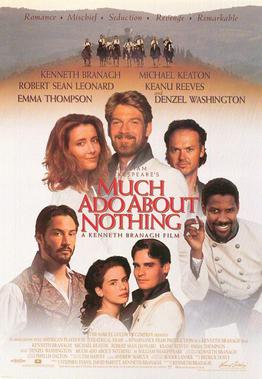
Kenneth Branagh and Emma Thompson triumph in this brilliant adaptation of Much Ado About Nothing

Director: Kenneth Branagh

Cast: Kenneth Branagh (Benedick), Emma Thompson (Beatrice), Denzel Washington (Don Pedro), Michael Keaton (Dogberry), Keanu Reeves (Don John), Richard Briers (Leonato), Robert Sean Leonard (Claudio), Kate Beckinsale (Hero), Gerard Horan (Borachio), Imelda Staunton (Margaret), Brian Blessed (Antonio), Ben Elton (Verges), Jimmy Yuill (Friar Francis), Richard Clifford (Conrade), Phyllida Law (Ursula)

Branagh’s Much Ado About Nothing was his second Shakespearean directing gig, but his fourth film – and it’s clear from the first frame what a confident director he has become. Much Ado is one of the best Shakespeare films ever made, and certainly the greatest film version of a Shakespearean comedy, largely because it’s not only charming and hugely enjoyable but also actually funny – a pretty rare feat for any filmed version of a Shakespeare comedy.

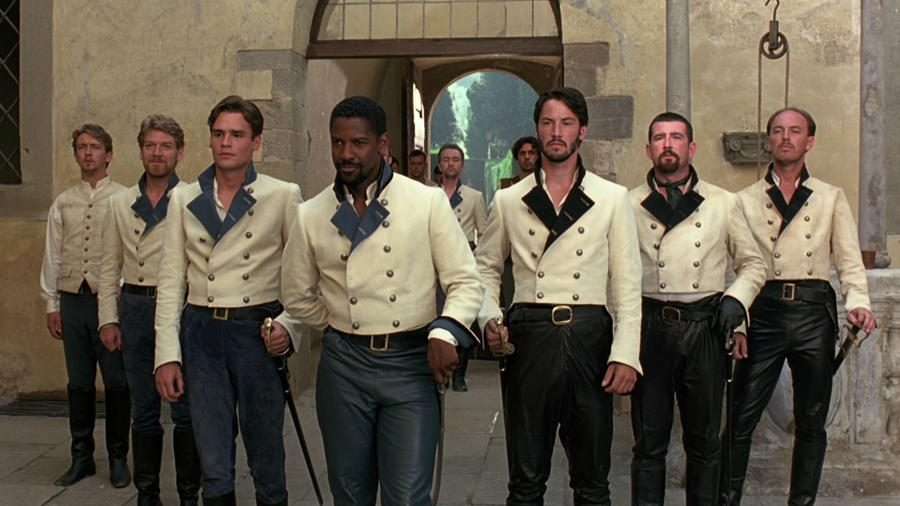
From the opening you pretty much know you are in safe hands. Branagh loves the vibrant excitement of cinema, and delights in bringing the meaning out of Shakespeare’s text. Both ideas are central to the opening of the film, with Emma Thompson’s luscious reading of “Sigh No More”, while the camera pans across a bucolically blissful Tuscan setting. This feeds straight into Beatrice’s playful banter with the messenger – and Richard Briers gives the first indication of the film’s attention to small character details with his “don’t go there” look when the messenger tries to correct Beatrice’s teasing defamation of Benedick. From there the film explodes into a triumphant Magnificent Seven style arrival of Pedro’s lords on athletic horseback (backed by Patrick Doyle’s inspiring overture), while Leonato’s household excitedly (in a typical Branagh tracking shot) prepare to greet them, before an overhead crane shot introduces the two groups meeting in a courtyard. Everything you need to know about the sort of film you are getting – and Branagh’s ability to marry the language of cinema with the language of Shakespeare – is right there.

Branagh’s setting of the play in a golden Tuscan villa is perfect for both its playful, relaxed, soldiers-back-from-the-war plot line and the heated romances and jealousies that fuel the plot. Is it any surprise feelings are running high in such a sultry and hot climate? The two worlds – the army men and the people of Leonato’s household – are immediately clear. And the setting communicates the film’s mood – fundamentally bright, sunny, cheerful. Kick back your heels, you are being taken on a high-spirited, exotic holiday.

In this playful setting, Branagh invariably gets the tone just right. Shakespearean comedy is so reliant on live audience reactions, on bouncing off the audience, that creating this on film without that live element is really difficult. Trust me, watch any number of BBC Shakespeare comedies (don’t worry I’ve done it for you) and you will see immediately how hard it is to get that bounce and comedic juice out of these shows. Branagh gets it spot on here – the characters are so likeable, the delivery of the actors so assured, the spirit of the film so light yet perfectly controlled, that the comedy lands nearly every time. Above all, the actors look like they had a whale of a time making the film – and that enjoyment completely communicates to the audience.

The gulling scenes of both Beatrice and Benedick are expertly played and hugely entertaining: Branagh skilfully cuts them to fast-paced essentials, and then gets the best possible comic mileage out of them – from skilled cut-away shots for reactions to wonderful ensemble playing (Briers in particular is superb as a Leonato slightly out of his depth in trickery). It’s easy for the Beatrice gulling scene to fall a little short after the Benedick one – but, largely thanks to Emma Thompson’s excellent performance, that certainly doesn’t happen here.

But Branagh understands Much Ado is not just a comedy: it comes perilously close to being a tragedy. For at least an act of the play, our heroes are at loggerheads, and murder and death are almost the end results. From Claudio’s explosively violent reaction to Hero’s perceived betrayal at the wedding to Leonato’s furious denunciation, horror and danger are ever-present. This then leads us into Beatrice and Benedick’s wonderful post-wedding. Branagh sets this in a small chapel – adding an echo of marriage vows to the understanding the pair reach – and Thompson’s passion, fury and pain are met (for the first time) with quiet, mature understanding from Branagh’s Benedick. Thompson’s order for Benedick to “kill Claudio” carries a fiery conviction that chills. It’s a brilliant scene.

A lot of this works so well because of the brilliance of the acting. Branagh is charming, very funny and mixes this with a growing emotional depth and maturity as Benedick. But the film belongs to Emma Thompson who is quite simply astounding as Beatrice – surely one of the greatest performances of the role you will catch. She is the soul of the movie, at turns playful, frustrated, joyous and consumed with grief and rage. She speaks the lines (needless to say) with absolute clarity and emotion, but even more than that her intelligence dominates the movie. You can’t take your eyes off her.

But this is a very strong cast of actors, the best mix Branagh got between Hollywood stars and his regular players. Denzel Washington is simply perfect as the noble but strangely distant Pedro (his moments of isolation at the close of the film are as touching as they are unsurprising). Richard Briers gives some of his best work in a Branagh film as a Leonato, moved to great emotion and feeling. Leonard and Beckinsale are perhaps not given huge amounts of interpretative depth, but are very lovable. Gerard Horan is very good as a swaggering Borachio.

It’s easy to knock Keanu Reeves but – aside from his untrained voice, which makes him sound duller and flatter than he actually is – his Don John is actually pretty good. As a physically very graceful actor he completely looks the part, and he glowers and fumes with all the intensity you could require – and after all, Shakespeare didn’t give Don John much more to do than that.

No the real problems with the production – and the parts that don’t work – are Dogberry and Verges. Now I can see what Branagh is trying to do here: the malapropisms of Dogberry’s dialogue are rarely, let’s be honest, that funny, and would work even less well on film. But the decision to make Dogberry and Verges a cross between Monty Python and the Three Stooges doesn’t really work. Michael Keaton is giving it his all here to try and get some humour out of this – but his straining for every laugh, combined with gurning over delivery, bizarre accent and physical over-complications, just deaden every single Dogberry scene. These scenes largely flop.

But it doesn’t matter when every other scene in the film works so damn well. And, however much you might drift away during the Dogberry moments, the rest of the film will capture your heart and mind every time. Filmed with a luscious richness and stylish confidence, this is a ravishing and flamboyant film that will never fail to entertain. By the time the final reconciliation has happened, and the house erupts into a joyous celebration party – filmed, with astonishing chutzpah, as a single take, staggering in its complexity, that covers close-up, tracking shot and huge crane shot – while Patrick Doyle’s score gives a swelling version of Sigh No More, you’ll be in love yourself. And if not – well look to yourself.

Day for Night (1973)


Jean-Pierre Léau and Jacqueline Bisset are the leading actors in FrançoisTruffaut’s film making masterpiece Day for Night

Director: François Truffaut

Cast: Jacqueline Bisset (Julie Baker), Jean-Pierre Aumont (Alexandre), Valentine Cortese (Séverine), Jean-Pierre Léaud (Alphonse), Dani (Lilane), François Truffaut (Ferrand), Alexandra Stewart (Stacey), Jean Champion (Bertrand), Nathalie Baye (Joëlle), David Markham (Dr Nelson), Nike Arrighi (Odile), Bernard Ménaz (Bernard)

François Truffaut is perhaps the greatest example of a critic turned film maker. A noted French film expert, he made a splash when he turned to film directing and became one of the leading figures of the French New Wave. This movement was seen as a rejection of old-school, literary melodramas of French cinema, instead embracing social issues and using the techniques of cinema in new and imaginative ways. Truffaut later stated though he was not a revolutionary, but a man who wanted to make stories that were important to him, using all the tools of cinema available. And as a man who loved cinema – and worshipped the great directors of yesteryear – what story could be more important to him than the making of films themselves?

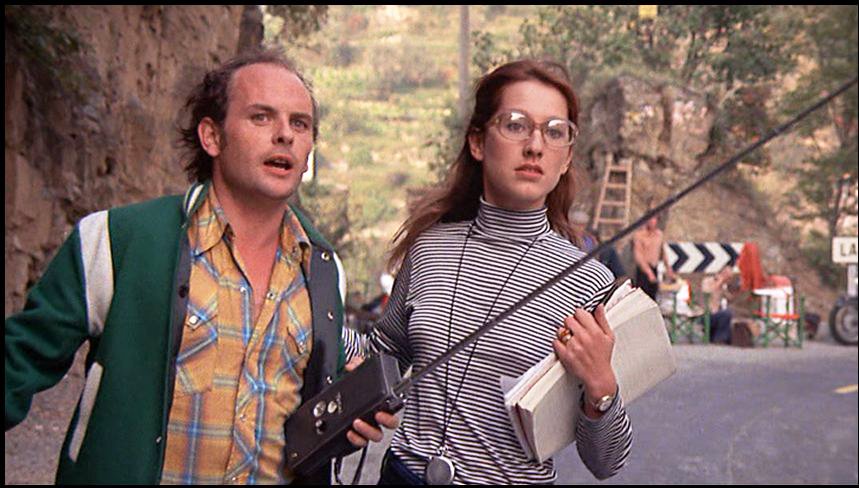
Day for Night (the term means to place a filter on the camera in order to shoot scenes set at night, during the day) is set during the production of Meet Pamela, a melodrama starring gentlemanly screen icon Alexandre (Jean-Pierre Aumont), increasingly fragile screen diva Séverine (Valentine Cortese), neurotic young star Alphone (Jean-Pierre Léaud) and British film star Julie Baker (Jacqueline Bisset) recovering from a nervous breakdown. The film is directed by Ferrand (Truffaut himself), working in close collaboration with the crew (many of them played by the real life crew of Day for Night) not least passionate cinephile script-editor Joëlle (Nathalie Baye). The film is plagued by compromise, reshoots and actor-induced difficulties, with Ferrand and his crew constantly forced to rewrite and adjust the story to compensate.

Day for Night is partly a gentle, satirical farce on movie-making (it even has a documentary camera crew, following events around), but really it’s a deeply romantic, wonderfully engaging, desperately sweet homage to cinema and movie making itself. In fact, I can’t imagine anyone who loves movies not loving this film. It’s a charming warts-and-all, behind-the-scenes look at how a movie is made, and what motivates the people who make it. The fact that it’s really funny, and has some wonderfully engaging characters in it, is the icing on the cake.


Truffaut places himself at the centre of the film in more ways than one. Obviously he’s playing the director – the still-centre of the film, who constantly must address and overcome a string of practical problems, from actors disappearing to malfunctioning props and (in one stand-out moment) a cat who refuses to lick milk from a saucer. But the film also places Truffaut the man at its heart: Ferrand’s love of cinema is Truffaut’s own. Three times we see Ferrand dreaming at night (it’s possible it’s even the same night – each set-up is the same). We see snippets of the dream before its full content is revealed: it’s a memory of the boy Ferrand (based on Truffaut’s own childhood) going to cinemas at night to steal still photos of Hollywood masterpieces (in this case Citizen Kane). Cinema is such a powerful, all-embracing part of Truffaut’s life that even as a child he had to worship at its alter, and commit theft to take a small part of it home with him.

This love of cinema runs through the whole film. Joëlle (a truly wonderful performance from Nathalie Baye: smart, sweet, engaging and sexy) can imagine leaving a man for a film but never vice-versa. The props man, Bernard, loves the tricksy solution search to overcome filming problems – and clearly carries a yearning to be on screen himself. The film is packed with longing stories of the golden age of Hollywood: at one point Ferrand drives around his set, bemoaning the loss of the era of studio-made films. It’s a film that celebrates the artisans of film, perhaps even more than artists. It’s an insight into what all those little jobs on the credits actually are, and the heroes are frequently carpenters, script editors, assistants, soundmen, extras directors… In fact all the problems of the film are caused by the actors themselves, the self-absorbed public face of an industry that is built on the love and dedication of the working people behind them.

The actors in the film do, however, contribute most of its comedic and romantic elements. Neurotic, needy matinee idol Alphonse (Jean-Pierre Léaud in a neat performance of childish self-obsession), fawns possessively over his girlfriend Liliane, who he treats as part lover, part sister, part surrogate mother. Frequently he disappears or melodramatically announces that he is finished with acting. He contrasts nicely with Alexandre (a gentlemanly and endearing Jean-Pierre Aumont), who goes through the film with a professional calmness, laced with charm, who is never late and never causes any trouble, but enjoys gossip – and quietly lives with a far younger male tennis player.

Jacqueline Bisset (again hugely engaging – it’s hard not to fall in love with the people in this film) perfectly captures both the attractive likeability and vulnerability of the person who lives their whole life in the spotlight, in a thinly veiled portrait of Julie Christie. She has a natural ease with the assistants and crew – but it’s her fragile mental state that has the insurance companies worried. It’s easy to see why she might feel like that, as the film set is a hot bed of flirtation and casual one-night stands – at one point even called out as such by an outraged assistant-director’s wife. What’s “nice” about the affairs though is their relative lack of long-term drama – short term tears and tantrums are swiftly forgotten, as everyone pulls together to make the film.

The drama of film creation is the magic here. The film is bookended by elaborate set-ups for a street scene (the film even playfully doesn’t reveal at first that what we are seeing is a film-within-a-film) – one carefully rehearsed, the other reshot with the set covered in snow to help cover up the reasons for an urgent reshoot. A scene between the father and the daughter-in-law is conceived, written, rehearsed and shot in one sequence – all in response to Ferrand and Joëlle’s perceptions of the dynamics between the actors. Ferrand, behind his quietness, is ruthless in using things for the film – one character finds their heartfelt confessions about the emptiness of life pushed under their door the next day as lines integrated into the script. It’s not cruel – and that’s the best thing about this film, it’s never cruel or bitter – it’s just the way of the game, the way we struggle to create art.

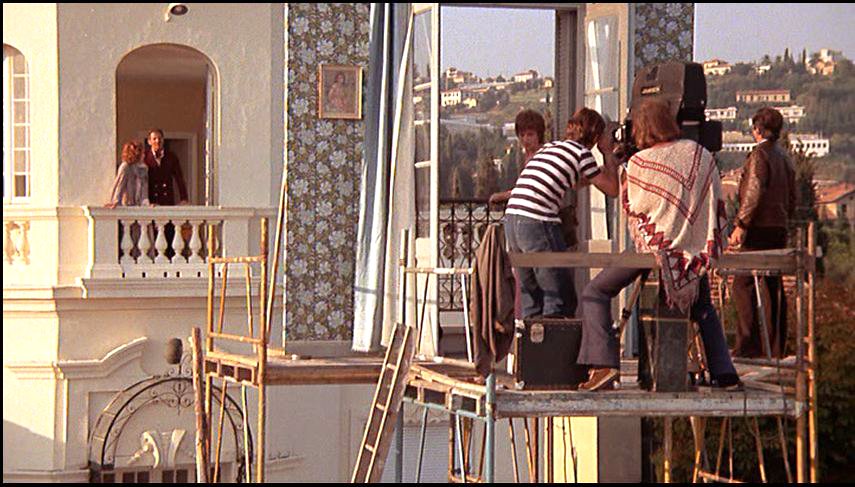
And the struggle is what is clear here. Ferrand bemoans in voiceover that every film starts with him wanting to make the best film he can, but always seems to end as a salvage job. Much time is spent setting up a complex ballroom sequence, which circumstances later require to be cut. Séverine (a winningly bright performance of diva self-parody from Valentina Cortese) frequently struggles with lines and blocking, regularly bringing the film to a halt – at one point her lines are stuck on a wall out of camera shot. It’s another example of the exposure of film magic – at one point a window and part of a wall is built on a scaffolding to give the impression of a building – only what will appear on camera is built, everything else is scaffolding. 

Interestingly, the film all this effort and work is being put into looks like a pretty forgettable melodrama. It’s in many ways another piece of comedic self-parody – Truffaut’s Ferrand is filming a thinly veiled version of Truffaut’s own The Soft Skin (I’m indebted to the Criterion Collection blu-ray special features for that titbit) – but it’s also a sign of how art and compromise go hand-in-hand. The final film is hewn from the circumstances of its making: it might not be what was intended at the start, but it’s the best we can do with the marble the artist has been given. Sure Meet Pamelalooks pretty average – but the important thing is the love invested in making it. If this goes into an average film, the same level (perhaps more) goes into a great one.

Day for Night is the perfect film for film aficionados. It’s warm, funny and moving. It’s crammed with wonderful performances. It’s shot with a playful expertise. It has a marvellous score by Georges Delerue – part actual score, part score recordings for Meet Pamela – and Truffaut keeps the whole light confection perfectly intact, never letting it burst or sink. It’s a masterclass in film crafting, which is about the craft behind making a film. It’s like peeking behind the magic curtain. It’s brilliant.

Annie Hall (1977)


Diane Keaton and Woody Allen on the quest for love and romance. How much of this is autobiographical eh?

Director: Woody Allen

Cast: Woody Allen (Alvy Singer), Diane Keaton (Annie Hall), Tony Roberts (Rob), Carol Kane (Allison Portchnik), Paul Simon (Tony Lacey), Janet Margolin (Robin), Shelley Duvall (Pam), Christopher Walken (Duane Hall), Colleen Dewhurst (Mrs. Hall), Donald Symington (Mr. Hall)

Why is love so damned difficult? And, as it is, why do we keep setting ourselves up for a fall with it? Why are we all such relationship addicts? These are questions that Woody Allen tackles in Annie Hall, the film that elevated him from comedian to Oscar-winning cinematic super scribe (he won three Oscars for the film – Picture, Director and Writer). Does it deserve its reputation? You betcha.

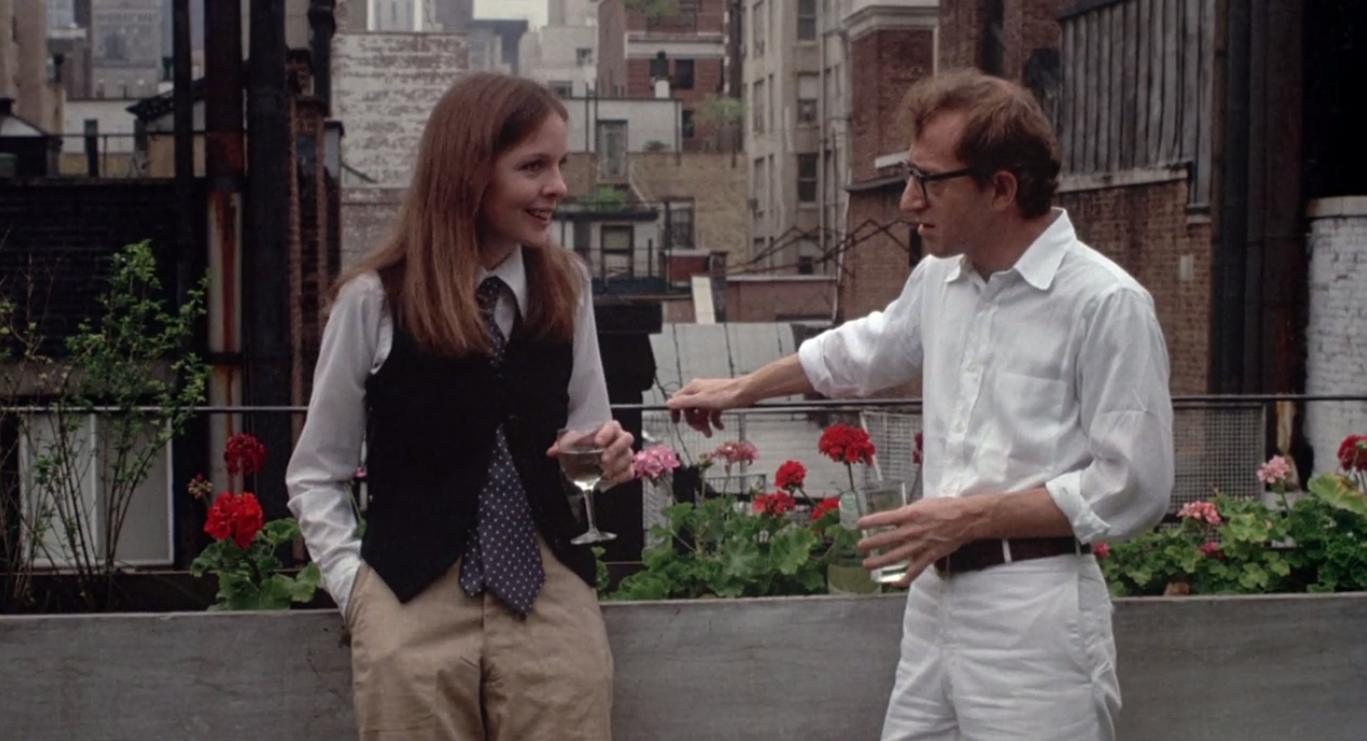
Alvy Singer (Woody Allen) is a neurotic New York comedian (is it any wonder he was seen as synonymous with Allen himself?), twice divorced and incapable of maintaining a relationship. He meets Annie Hall (Diane Keaton, Allen’s ex-girlfriend playing Allen’s character’s eventual ex-girlfriend, using Keaton’s real name as a character name – confused?) over a game of mixed doubles tennis, and their immediate chemistry and shared sense of humour leads to a romantic relationship. Their only problem? Their innate neurotic self-analysis that stands forever in the way of maintaining a relationship.

Annie Hall is a deliriously funny film – I actually think it might be one of the funniest I have ever seen – with an astounding gag-per-minute hit rate. Allen uses multiple techniques to deliver gags: commentary, voiceover, celebrity cameos, an animated interlude, “what they are really saying” subtitles, flashback, direct to camera address – and the blistering parade of delivery styles never seems jarring, but ties together perfectly. Large chunks of the film are inspired high-wire dances where a punch-line is a few beats away, and the film never settles into a style or becomes predictable. So many of the jokes have become so familiar due to their excellence that it’s almost a shock to see them minted freshly here – and the fact they all land so effectively is a tribute to the performers. 

In many ways, Annie Hall is a series of sketches loosely tied together with an overarching plot line. In fact Alvy’s constant commentary on events (a brilliant playing with conventional cinematic storytelling form), add to the feeling this is in some ways an illustrated stand-up routine by a gifted self-deprecating comedian. The material seems so synonymous with Allen’s personae (and the characters of Alvy and Annie so close to what we know about the actors who play them) it’s very easy to see the whole film as auto-biographical. Not that there’s anything wrong with that – particularly as the hit rate of the gags here is so phenomenally high. 

But what makes this film such a classic is that it is more than a collection of excellent jokes. Allen is also telling a story about romance – or rather or need for romantic connection, and how easily we can sabotage or undermine this through our own mistakes, errors and (above all) neuroses. Alvy Singer is almost chronically incapable of embracing happiness and contentment, with every good thing merely an interlude between crises. Annie is the most promising opportunity he has had for long-term contentment – and still his neurotic self analysis gets in the way. As such the film is about the quest for love – and the title Annie Hall(not the character) is a metaphor for this – to Alvy Annie Hall represents the perfect relationship, something he (and indeed she as well) will never accomplish. 

The film perfectly captures the dance of first meeting – the shy, stumbling early conversations of people who are attracted to each other but are both trying too hard (the subtitles here are a brilliantly funny choice – we’ve all thought to ourselves “what am I saying?” in that situation!). There is a wonderfully playful scene where Alvy panics over the cooking of lobsters – clearly playing up for Annie’s delighted engagement in it, as she photographs his distress. These photos appear in the background, framed on their wall, as their relationship breaks up relatively amicably later. At another point, Alvy attempts to recreate the same moment (same location, lobsters again) with a new girlfriend – only to be met with unamused, annoyed confusion. It’s a perfect little vignette that captures the magic of chemistry – and the difficulty of finding it or holding onto it.

Because what is striking is that Allen allows the relationship to break apart surprisingly early. Roger Ebert has written about Annie almost “creeping into” the film – and this is true. She is only briefly seen in the first 25 minutes (the first third of the film almost!) as the focus is on Alvy’s discussion of his background and childhood, and his past romantic failings and sense of disconnection from people. Then very swiftly after its establishment, the relationship is past its prime, with both parties finding it hard to keep the interest going. The second half of the film follows them amicably drifting apart – meaning this is probably the most romantic film about a long break-up ever made.

The film has a beautiful little wistful coda of Alvy and Annie meeting outside a cinema, each with new partners. In long shot we see them engage in an animated and engaged conversation while their new partners look on, nervously smiling. The magic link between them hasn’t faded away, and their importance to each other, and natural chemistry, hasn’t changed – but, the film seems to be saying, their natures work against them. It’s one of several touching moments in the film that demonstrate the heart that underpins the jokes. After their first break up, Annie calls Alvy round to get rid of a spider in the bath. He does so with comic incompetence, then in a still medium shot he comes to Annie in the corner of the frame sitting on the bed. They reconcile and then embrace tenderly – it’s a beautiful, moving, gag-free moment, all the more effective as its reality is contrasted with the humour throughout the rest of the film.

The film is a full of tender and real moments like these in between the jokes: it’s a nearly perfect balance between them. The parts are perfectly written for the actors: Allen is so brilliantly good here as Alvy that the character has essentially become the public persona of Allen (and allegedly his desire to never make a sequel was linked to his unease with the association between Alvy and himself). Diane Keaton (her real surname being Hall and her nickname Annie) also had this part perceived as a loose self portrait (her past relationship with Allen not helping). Truth told, it’s a very simple part and Keaton actually has to do very little in the picture beyond react (the focus is so strongly on Alvy) and deliver the role with charm – but she captures the sense of an era shift, a woman stuck between transitioning from the hedonistic 60s to the ambitious 80s, an ambitious free-spirit. The Oscar for the role was generous, but not undeserved.

For all the film’s emotional understanding and complexity, it’s the jokes though that you will remember, and they are glorious: Alvy’s schoolfriends telling us what they are doing now as adults; Alvy’s description of masturbation; the accident at the cocaine party; Christopher Walken’s monologue on driving; the puncturing of the pretention of a loud-mouth know-it-all in a cinema queue – it’s a blistering array of comic genius and it will have you coming back for more and more. It’s Allen’s most garlanded movie and it’s certainly the best balance he ever made between “the early funny ones” and his “later serious ones”. It’s simply shot, but told with heart, feeling and emotional intelligence and with dynamic, comic wit – it’s one of Allen’s greatest movies.

Pretty Woman (1990)


Hard bitten businessman meets prostitute: of course romance blossoms. Happens all the time right?

Director: Garry Marshall

Cast: Richard Gere (Edward Lewis), Julia Roberts (Vivian Ward), Ralph Bellamy (James Morse), Jason Alexander (Phillip Stuckey), Héctor Elizondo (Barney Thompson), Laura San Giacomo (Kit De Luca)

In a parallel universe there exists a gritty prostitution drama Three Thousand. Al Pacino plays a cool, heartless besuited executive who picks up a prostitute, played by Diane Lane. The prostitute is bitter and cynical and addicted to cocaine. Pacino needs a female face and pays her top whack for a weekend’s work with one condition – no crack for a week. However, addiction and bad company are hard to shake off, and Lane’s prostitute succumbs to addiction once again and is turfed out on the street. Realising her life is in the toilet, she closes the movie by catching a bus to Disneyworld (her childhood dream to visit) – hoping that tomorrow “will be another day”.

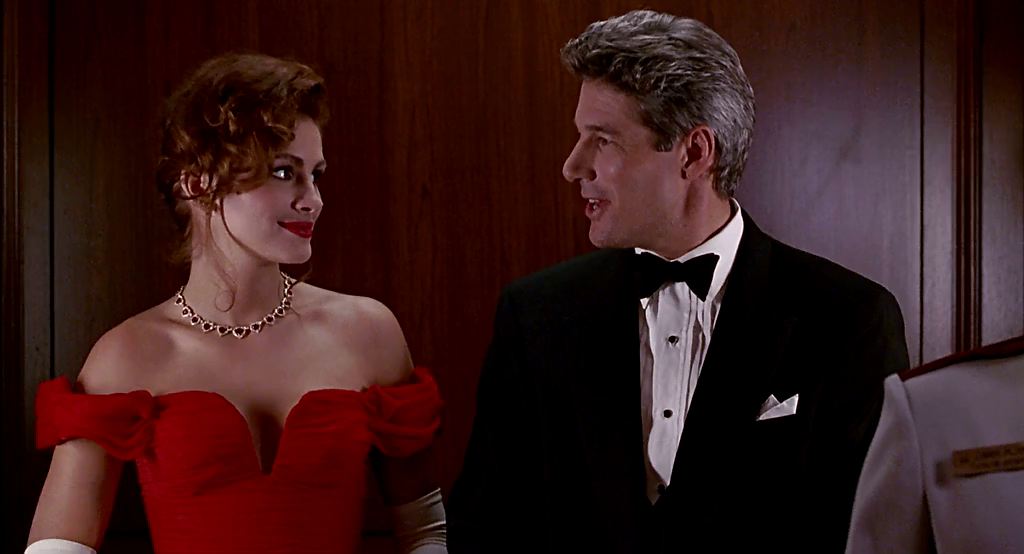
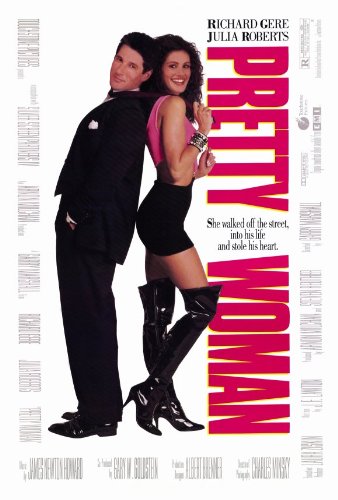
But that’s a parallel universe, where writer J.F Lawton’s original screenplay Three Thousand emerged onto screens in line with his vision. In this one, Garry Marshall and Hollywood realised that the same story, with a heft of rejigging and a dollop of charm, could become a modern Cinderella story. So in this universe it became Pretty Woman, a charming romantic comedy where a besuited executive (Richard Gere), who has mislaid his soul but is still a charming hero, picks up a wholesome, sweet prostitute (Julia Roberts) – and they both change each other’s lives for the better.

I don’t think such a film would be a hit today. Can you imagine the online backlash? Can you imagine the bashing a film would get that presented prostitution largely as just another possible career choice for a girl in Hollywood? Flipping heck, we’re currently going through a backlash against Ryan Gosling’s character in La La Land, so goodness only knows what the Twitterati would make of Julia Robert’s Vivian Ward in this.

But despite everything, Pretty Woman gets away with it. Julia Roberts oozes so much charisma and joie de vive that you let slide the fact that she is not 1% convincing as a prostitute – or that despite living on the streets and being practiced at selling herself for sex, she remains wholesome and untouched by the nastiness around her. But then that’s par for the course for the entire film – it’s a bizarre fairytale that’s told with such swooping charm and playfulness, and with such an old-fashioned lightness of touch, that it makes you feel churlish to point out that it’s rooted in something profoundly troubling and unpleasant.

Not surprisingly given the character’s initial appearance as a prostitute, Vivian is a role that half of Hollywood turned down before Roberts said yes. But her star-making combination of girl-next-door charm and the perfect amount of sass makes her totally endearing.  She is brilliant. Equally Richard Gere gives a perfect low-key, Cary Grant style performance as the smirking executive. To be honest, he’s no closer to what a hard-bitten businessman would really be like than Roberts is to a real LA prostitute, but hell it doesn’t matter, you still come out of this movie wanting to give him a hug. As the guy sings at the end while our heroes embrace on the stairs, “This is Hollywood!”.

So despite the fact that it should really hit all your outrage buttons, and make you gag on its sentimentality, it’s funny, sweet and lovable enough that you just disengage your brain and go with it. The film does this because it taps brilliantly into the same class unease as we all feel – who hasn’t popped into a high class hotel or (most brilliantly of all) a high-class shop and felt (or been made to feel) “I don’t belong here…”. Despite its subject matter, it all feels endearingly old fashioned, like something from the 1930s. The old fashioned shooting style, the structure that owes a lot to fairy tales, the jaunty old school musical numbers, the restrained sense of sex – it’s all successfully mixed together to make us feel safe.

Away from the wonderful leads, Jason Alexander and Laura San Giacomo have the thankless tasks of showing us what big business sharks and Hollywood Boulevard prostitutes are probably really like, but handle them well. Hector Elizondo is marvellous as a cuddly hotel manager, part a sort of benevolent uncle to Vivian, part a smoothly charming and caring Henry Higgins (although of course, the idea that prostitutes are unknown at high class hotels is equally nonsense).

The film is old fashioned, demands you not think about it and has two perfectly cast, charismatic leads who rarely played these sort of parts better. It’s not remotely rooted in any sense of reality and don’t even begin to think about any sort of message this could send to anyone. Think about it – as millions and millions of people do – as a handsome prince sweeping a normal girl off her feet. Perfect cinematic comfort food.