
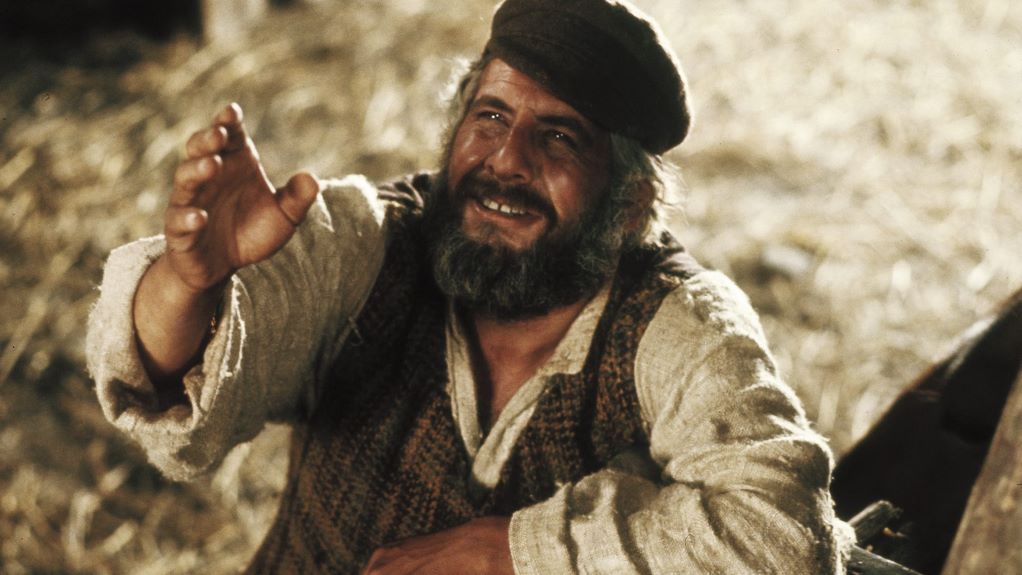
Film adaptation successfully aims for drama and emotion over showbiz bells and whistles
Director: Norman Jewison
Cast: Topol (Tevye), Norma Crane (Golde), Rosalind Harris (Tzeitel), Michele Marsh (Hodel), Neva Small (Chava), Molly Picon (Yente), Paul Mann (Lazar Wolf), Leonard Frey (Motel Kamzoil), Paul Michael Glaser (Perchik), Ray Lovelock (Fyedka), Zvee Scooler (Rabbi), Louis Zorich (Constable), Alfie Scopp (Avram), Howard Goorney (Nachum), Barry Dennen (Mendel), Ruth Madoc (Fruma-Sarah)

Sometimes it’s a surprise to remember Fiddler on the Roof is one of the most successful musicals of all time. A sensation when it opened on Broadway in 1964, it became the first musical to pass 3,000 performances and was soon playing all over the world. Based on a series of stories by Sholem Aleichem about life in a Jewish village in turn-of-the-century Imperial Russia, it feels like odd material for a hit. But it’s universal themes of the struggles between generations, persecution of a community and finding a balance between tradition and change struck a universal chord. So, it shouldn’t be a surprise that Jewison’s film version became the biggest hit of 1971.
It’s 1905 and milkman Tevye (Topol) lives his life by the traditions of his faith and Jewish community, balancing a series of competing demands like a fiddler perched on a roof playing his fiddle (it’s a tortured metaphor but it’s the title…). He has three daughters – sensible Tzeitel (Rosalind Harris), romantic Hodel (Michele Marsh) and kind Chava (Neva Small) – all of whom need marrying off, ideally to suitable husbands. But can life continue for ever when you live in a country rife with antisemitism, with pogroms as regular as clockwork?
Fiddler on the Roof was perfect material for a director as passionate about social issues as Norman Jewison. It balances comedy and theatricality very effectively with gritty realism and a sense of generational trauma at the suffering inflicted on innocent people for no reason other than their heritage. Although the film is undoubtedly too long (at nearly three hours), this does make the mood transition from gentle comedy to loss and bleakness something slow but relentless, helping it carry even more impact.
Jewison effectively translates stage musical to screen reality. Fiddler on the Roof is neatly edited, it’s opening number Tradition showing a montage of everyday-activities in the village (meat chopped, clothes sewn, pray books opened) with every action cut to mirror the song’s beat. It avoids glossy choreography in favour of something either more cinematically literate like this or more intimate, with many songs delivered in medium-shot, the camera zeroing in on the thought process and allowing the actors to give intense, emotional renditions.
Not that Jewison isn’t averse to a big theatrical number. Matchmaker, Matchmaker is the first number that could be on the Broadway stage but gets away with its moments of classical beats of choreographed movement because of the playfully-natural delivery of Harris, Marsh and Small. Jewison saves his real fire for Tevye’s Dream, liberated from the film’s realistic approach by happening in a dream. This number is pure theatre, with a chorus of dancing ghosts and a diva-ish spectre (played by Hi-de-Hi’s Ruth Madoc of all people) giving it everything they’ve got.
But Fiddler on the Roof’s main beat is realism. Oswald Morris’ Oscar-winning cinematography – its slightly sepia tone captured by stretching a pair of tights over the lens, its gauze clearly visible at points – displays a world that is, for all the vibrancy of the people living in it, frequently cold, unhospitable and difficult. That matches the attitudes of their Russian rulers, prejudiced bullies whose local representative stutters the sort of excuses about “just following orders” that are even more chilling with our knowledge of the horrors to come forty years later.
What makes the village flourish is its community. Run by tradition and faith, where (for better or worse) everyone understands their roles, duties and expectations. Fiddler on the Roof is about how far these can be pushed in changing times, structured around a man’s choice of his daughter’s husbands. Can Tevye accept a daughter choosing for herself? How about a daughter marrying a firebrand radical who wants to leave the village? How about another wanting to marry a gentile?
They are ideas initially beyond the ken of Tevye, a firm traditionalist with passing dreams of riches but who wants a world where nothing changes. To make this dyed-in-the-wool conservative a warm and entertaining figure, requires the right casting. In America, the role was associated with its originator Zero Mostel (desperate to play it on film). But Jewison felt Mostel’s personality was too large for cinema, that Mostel’s theatricality would work against the realist film he wanted. Instead, he cast the Israeli actor playing the role in London’s West End, Chaim Topol.
It was a masterstroke (much as it crushed Mostel and outraged fans). Topol, like Yul Brynner in The King and I, would define his career with the role, playing it over 3000 times on stage in a series of productions over almost forty years (eventually Harris would graduate from playing his daughter to his wife!). Astonishingly he was only 35 in 1971 – a brilliant combination of make-up and Topol’s gift for physical acting makes him feel 25 years older – and Fiddler, for a large part, relies on his charisma and charm. Topol is as comfortable with the conversational address to the camera – which dominates much of the film’s opening – as he is with the world-weary sadness and frustrated anger Tevye responds to the changing world around him with.
Topol’s performance works in perfect tandem with Jewison’s aim to ground and avoid flights of whimsy or vaudeville comedy. The harsh conditions don’t dampen the warmth in the community – wonderfully captured in the marvel that greets the arrival of tailor Mostel’s (an endearing, Oscar-nominated, Leonard Frey) sewing machine – and means the Tsarist repression and gangs of Cossacks who ride in, torches in hand, to burn and pillage carry real impact.
Jewison’s film carries foreknowledge of the Holocaust throughout, not dodging the knowledge that communities like this would be destroyed under Nazism. The film’s closing exodus may bring hope for Tevye and family (bound for New York) but also brings death to those who speak of heading to Krakow. It’s part of understands why tradition is so important to Tevye: as the imaginary fiddler follows Tevye’s family on the road, we understand the link to a shared cultural past is what gives identity and hope to a people facing persecution at every turn for thousands of years.
Fiddler on the Roof mines it’s material for emotion and character over showbiz bells and whistles. While it undoubtedly takes too long to explore in depth its slight plot, its length does conversely add even more impact to its closing look to the future. A fine musical adaptation.
 Movie Musings