Tag: Rossano Brassi

Three Coins in the Fountain (1954)

Three Coins in the Fountain (1954)

The first big travelogue hit, full of beautiful images and a nice song – and almost no plot

Director: Jean Negulesco

Cast: Clifton Webb (John Frederick Shadwell), Dorothy McGuire (Miss Frances), Jean Peters (Anita Hutchins), Louis Jourdan (Prince Dino di Cessi), Rossano Brazzi (Giorgio Bianchi), Maggie McNamara (Maria Williams), Howard St. John (Burgoyne), Kathryn Givney (Mrs. Burgoyne), Cathleen Nesbitt (Principessa)

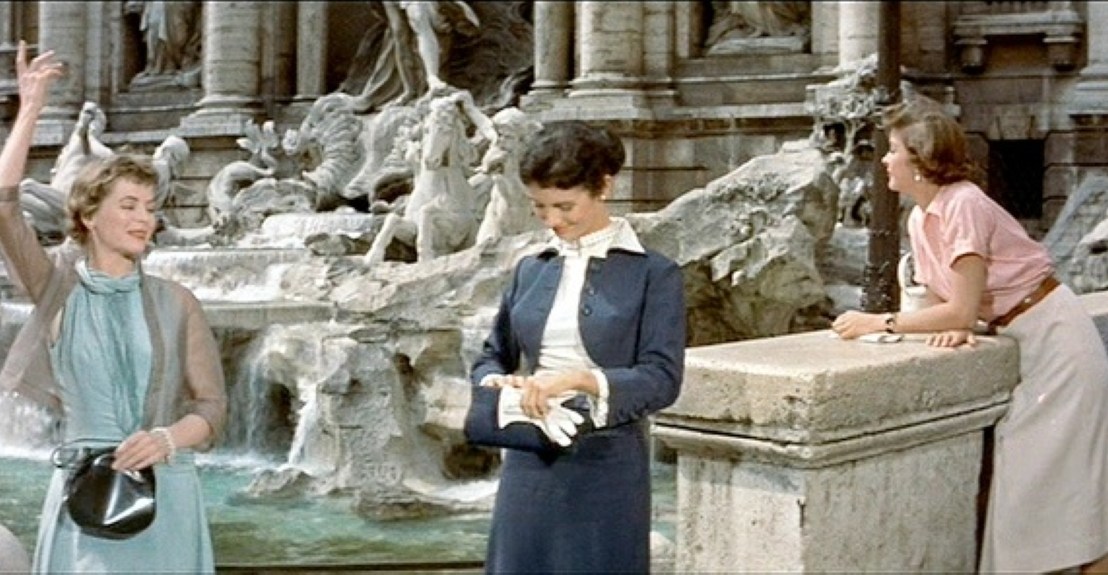
Did you ever visit the Eternal City and wondered why the Trevi Fountain seems to be full of small change? Well, a large chunk of the responsibility probably lies with this film. Three Coins in the Fountain, the very first Cinemascope travelogue super smash, meanders from our heroes chucking a coin into the fountain in line with the local myth that it means they will, one day, return to Rome. I can’t blame them – pretty sure I did the same when I was there. Whether many people have ever tossed a coin wishing to return to Three Coins in the Fountain is another question.

But Three Coins in the Fountain, a picturesque romance as shallow as the fountain itselfmade the idea internationally famous (it doesn’t trouble itself, by the way, with the fact only two of them actually toss a lira in). The story from there is as thin as paper. Our three leads are American secretaries: Frances (Dorothy McGuire) works for famed expat author John Frederick Shadwell (Clifton Webb) whom she secretly loves, Anita (Jean Peters) is seeing out her final weeks in the American embassy before flying home to a fictional fiancée, training up her replacement Maria (Maggie McNamara). Anita can’t afford to marry her Italian translator beau Giorgio (Rossano Brazzi) with his family of thousands to support. Maria sets her cap at Prince Dino (Louis Jourdan), ruthlessly researching and copying his views and opinions on everything from art to playing the piccolo.

Will these three relationships end well? What do you think! Drama in any case largely takes a complete back seat to the film’s main focus: filling the screen with the gorgeous architecture of Rome (and Venice as a two-for-one, thanks to a brief stop-off in Dino’s private plane) and basically giving the American cinema-going public a mouth-watering chance to see in glorious technicolour sights they had only previously seen in black-and-white photos. If 20th Century Fox and director Jean Negulesco didn’t have some shares in the Italian tourist industry squirreled away somewhere, I’ll eat my Panama hat.

Surely one of the most forgettable Best Picture nominees of all time, Three Coins in the Fountain did win two Oscars for its most memorable features. The first was Milton Krasner’s picture-postcard cinematography, making Rome look like the sort of place you’d jump on the first plane to get to. The other was Jule Styne and Sammy Cohn’s charming little ditty Three Coins in the Fountain (the velvet vocals of a surprisingly unbilled Frank Sinatra must have helped here). You can enjoy the finest moments of each in the film’s opening three minutes that plays the entire song (endlessly refrained again throughout the film) while the camera glides through the most beautiful sights of Rome. Truthfully, the rest of the running time is more of the same with added soap suds.

The plot lines are so slight and insubstantial it almost feels mean to poke critical holes in them. Few moments in this film ever ring true, but then this is the sort of luxurious fairy tale where American secretaries live in what seems to be a five-star hotel with panoramic views and work jobs that are really just time-fillers for their real quest of finding husbands. (The sexual politics of Three Coins in the Fountain, where women can’t imagine any other life horizon than typing up a gruff employer’s dull thoughts, and dream of swopping that for setting up house-and-home for a wealthy man, is as dated today as Anita and Maggie seemingly working for the 50s equivalent of USAID). Three Coins in the Fountain knows though the romantic plots are just there to keep us occupied between the postcards, and so long as they don’t offend or bore the viewer they’ve done their job.

Dorothy McGuire invests all the charm she can in playing a role written as a fussy busy-body interfering in her friend’s romantic lives and pining for Clifton Webb’s John Patrick Shadwell but seems oblivious to the fact that he is all too clearly coded to be what gossip columnists of the day called ‘a confirmed bachelor’. Their resolutely sexless ‘companionship’ contrasts with Jean Peter’s Anita giving a lusty fire to her flirtation with Giorgio (an underused Rossano Brazzi, who got a much better go round at this sort of thing in David Lean’s vastly superior Summertime). Various artificial obstacles are placed in their way (a modern film, unburdened by the Hays Code, would have leaned more into hints of a pregnancy scandal in Anita’s otherwise inexplicable decision to leave Rome).

Finally, Maggie McNamara gives a lightness of touch to a hilariously transparent campaign of romantic deception launched by Maria to win the heart of Prince Dino. Dino is, of course, deeply hurt that ‘the only woman I can trust’ has been lying to him – but I couldn’t help but feel most men at the time would jump like Casanova in heat on a woman who smilingly repeated back their own opinions to him with total conviction. Louis Jourdan, like Clifton Webb, charmingly offers up the sort of Euro-charm he was called to produce for most of the 50s.

There are amusing moments in Three Coins. Webb (clearly having a nice holiday in between dialling in his trademarked waspy socialite) is always pretty good value, and his arch glance through Maria’s charade is as grin-inducing as Frances being seen as so destined to become a frustrated spinster that Shadwell’s maid gives her a cat so she won’t be alone. Giorgio’s family eagerness to practically shove Anita into a wedding dress the second they meet her is almost as funny as watching the clueless Anita fail to control Giorgio’s truck as it rolls wildly downhill (inexplicably she tries to put it into gear rather than, oh I don’t know, hitting the brakes…)

But moments like this are few and far between in an otherwise gentle amble through the tourist hotspots of Rome. (The Venice shots, hilariously, see all the actors appear in brief scenes in front of projected images – clearly just the camera crew got that trip.) Negulesco keeps it all flowing forward like the pro he was, but by the time it ends you’ll be left with a vague longing to stroll around the streets of one of the world’s most beautiful cities – and only a vague idea about whether there was any other point to the film you just watched.

Summertime (1955)

Summertime (1955)

An independent woman finds romance in Venice in this luscious travelogue, one of the best of its genre

Director: David Lean

Cast: Katharine Hepburn (Jane Hudson), Rossano Brazzi (Renato de Rossi), Darren McGavin (Eddie Yaeger), Jane Rose (Mrs McIlhenny), Mari Aldon (Phyl Yaeger), Macdonald Parker (Mr McIlhenny), Gaetano Autiero (Mauro), Jeremy Spender (Vito de Rossi), Isa Miranda (Signore Fiorini)

American spinster Jane Hudson (Katharine Hepburn) has dreamed of her holiday-of-a-lifetime in Venice for as long as she can remember. So long in fact, that she wants to capture every single minute on camera and not miss a single sight in the gloriously romantic city. But there is more in this canal city than she expected, something her life of proud, self-sufficient, isolation has had little of: romance – namely from antiques dealer Renato (Rossano Brazzi), the two of them thrown together by chance, in a meeting of hearts and minds.

Summertime was, surprisingly, referred to by David Lean as his personal favourite of his films. It feels like an odd choice: the final film shot in the period between his ever-green 1940s British classics (and Summertime has echoes of Brief Encounter, from love affairs to train stations) and the super-epics that would fill the rest of his career. But, in its patient, quiet and slightly sad look at the continuous presence of regret in our lives and our feelings of loneliness, it perhaps speaks of something in the soul of this surprisingly vulnerable great director.

It won’t have hurt either that Lean himself fell in love with Venice during the shooting of the film. Summertime is very much in the genre of “romantic holiday travelogue” so beloved of the 1950s, when it was practically de rigeur to send glamourous Hollywood stars to exotic locations to conduct star-cross’d love affairs. Summertime might just be the finest of these, combining one of Hollywood’s all-time greats with a director and cameraman who made the setting truly cinematic, rather than the holiday snaps the journeymen who shot similar films reduced the locations to.

I’ll admit it helps I love Venice as well (and it’s amazing, watching this, how little the city has changed in the past 70 years). But Lean and gifted photographer Jack Hildyard shoot it with an intimate wonder. We follow Hepburn down the city’s winding streets and across its many bridges with a close intimacy that doesn’t shy away from the bustle of the city. A beautiful moment sees the camera slowly reveal the appearance of the St Mark’s Square campanile through an arched streetway. Carefully cut imagery flicks over striking features of Venetian architecture. Lean and Hildyard make the city feel like both a dream of a destination, but also a real, organic place, full of delightful nooks and crannies. It’s a masterclass in how to shoot a city both for impact and truth.

It’s a backdrop for an affecting, low-key, character study that gains hugely from the intelligent, emotionally precise performance from Hepburn. No actress in Hollywood could convince more as a woman full of enough brio and confidence to be very comfortable in her own solitude. The brilliance of Hepburn though is to play this all as a carefully maintained front shielding a loneliness she is always aware of but doesn’t want to acknowledge. It’s there from her compulsive need to make conversation with a fellow passenger (a lovely uncredited cameo from André Morell) on the train into the city, or with the people she meets at her hotel. The desire for human contact fills the easy rapport she builds with street urchin Mauro (a lovely performance from Gaetano Autiero) or the awkwardness she feels sitting alone in the bustle of St Mark’s.

It’s why romance – or perhaps the lack of it in her life – creeps up on Jane. Her first chance encounter with Renato is at a café in St Mark’s when he signals down the waiter she’s struggled to catch the eye of, leaving her discombobulated and uncomfortable, as if surprised that a man has taken even a passing interest in her, and uncertain how to respond. She retreats and sit on the canal-side, her eyes caught by a lion-headed drain that water laps in and out of. Perhaps only Hepburn could turn such a small moment into one of such profound passing reflection – and Lean shoots it with a beautiful simplicity.

The relationship slowly builds as she happens to chance on Renato’s antiques shop and he sells her an 18th-century Venetian red glass goblet. Hepburn has a beautifully sensitive, almost girlish tentativeness to her as they walk idly together the next night through the streets. After they kiss under a bridge, she impulsively mumbles she loves him and then runs, as if she was startled by her own confession. The next night she prepares to meet him with a pampering session not out of place in a teen drama, sitting waiting for him with a giddy excitement.

As her beau, Rossano Brazzi has a wonderful unknowable quality to him. There are touches of his own sensitivity and isolation. There is also the worry, as he sits with cosmopolitan ease at a café table or (possibly) flogs Jane a worthless red glass goblet (she later discovers they are ten a penny, though he swears his is a genuine antique) that he could be a heartless roué. Jane worries it as well. But does she care? After all, this is a holiday-of-a-lifetime and perhaps a love affair is just part of that. It might well be the same for Renato: like Brief Encounter, two lonely people who recognise qualities in each other come together for a brief time, to find a little comfort. Let the fireworks explode (which Lean literally does in one more-than-suggestive cross-cut late in the film).

Summertime is very romantic, but it’s also very true. Both Jane and Renato know exactly what they are getting going into this: a blissful moment in time, but not a lasting commitment. There is something very true about this: and a pleasing acknowledgement that independence isn’t a condition to be fixed, but a state that allows bursts of companionship in between voyages of self-contentment. It’s mixes this with touches of humour (Hepburn sportingly performs a pratfall into the Venetian water – although it left her with an eye infection that troubled her for the rest of her life).

It’s possibly the finest travelogue romance ever made, very well paced and gently but handsomely filmed by Lean. Hepburn gives a stunningly intelligent, gentle and wise performance and its honest look at loneliness and passing regret at that loneliness – but still being contented at the choices you have made in life – also make it perhaps one of the most realistic and true-to-life.

The Barefoot Contessa (1954)

The Barefoot Contessa (1954)

An enigmatic beauty finds fame but not happiness in Hollywood in Mankiewicz’ slightly muddled mix of satire, romance and tragedy

Director: Joseph L Mankiewicz

Cast: Humphrey Bogart (Harry Dawes), Ava Gardner (Maria Vargas), Edmond O’Brien (Oscar Muldoon), Marius Goring (Alberto Bravano), Valentina Cortese (Eleanora Torlato-Favrini), Rossano Brazzi (Count Vincenzo Torlato-Favrini), Elizabeth Sellers (Jerry Dawes), Warren Stevens (Kirk Edwards), Franco Interlenghi (Pedro Vargas)

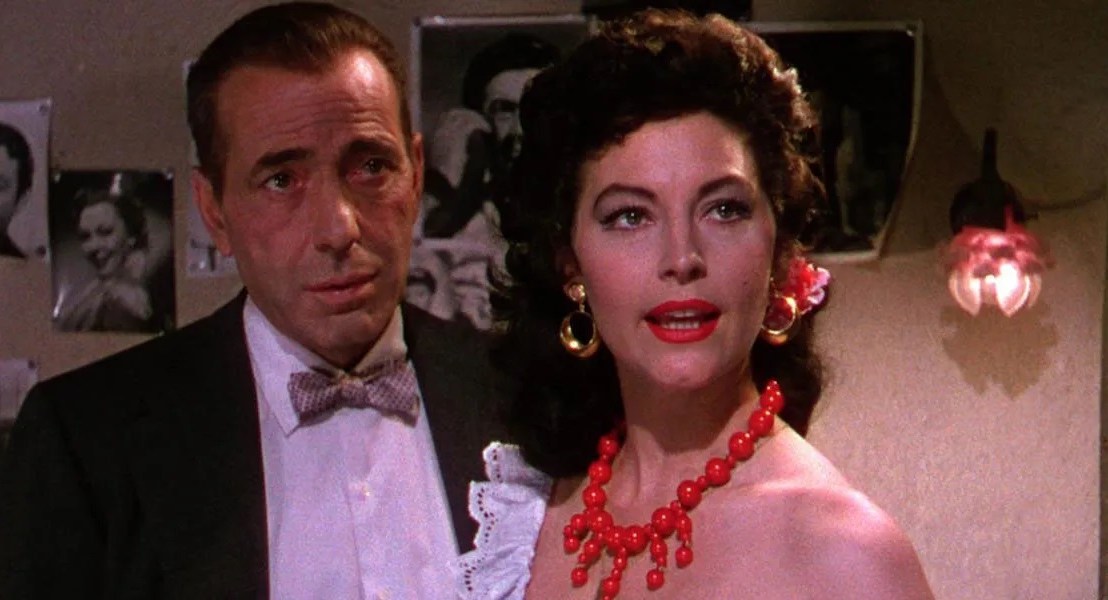
Rain hammers down on a funeral in the Italian Rivera. A group of (mostly) men gather to pay their respects to deceased film star Maria Vargas (Ava Gardner). In flashback, two of the men who discovered her as an exotic dancer in a Madrid nightclub, remember her. Harry Dawes (Humphrey Bogart) is the world-weary writer-director and her friend and mentor, Oscar Muldoon (Edmond O’Brien) a publicist to power-mad producers and self-satisfied millionaires who wanted to use Maria for their own ends. Maria’s success goes with a growing loneliness and ennui: marriage to Count Vincenzo Torlato-Favrini (Rossano Brazzi) feels like a fresh start but leads only to further tragedy.

Mankiewicz’s The Barefoot Contessa was an attempt to do for Hollywood what he so superbly did for theatre in All About Eve. What’s fascinating is that it’s clear Mankiewicz loved the theatre – for all its bitchy acidness – but clearly didn’t like Hollywood that much. The Barefoot Contessa is a cold, cynical film where Hollywood is a shallow, selfish place with no loyalty and where people are only commodities.

The only exceptions are Dawes and Maria. Dawes – an obvious Mankiewicz stand-in (and who hasn’t wished they could be Humphrey Bogart?) – is an artist, with an abashed guilt about wasting his talents on shallow films. Played with a quiet, observational languor by Bogart (so ashen faced at times, he seems almost grey), Dawes narrates with a dry distance, seeing but avoiding involvement, an arched eyebrow for every event. He’s also got a level of principle and integrity largely missing from the other Hollywood figures.

What we see of them is often hard to like – could Mankiewicz already be so bitter about his profession, just a few years after dominating the Oscars? Maria’s first producer, Warren Stevens, is a spoilt millionaire (inspired by Howard Hughes), played with a stroppy greed by Kirk Edwards. Stevens humiliates underlings in restaurants, treats Dawes like a bellboy, demands total devotion from Maria (sulkily ordering her to stay away from a potential rival at a dinner party) and has not a shred of interest in art. Under his control, Dawes directs films which sound formulaic (Black Dawn!) and which he clearly despises. A screen-test for Maria is gate-crashed by a series of European producers who gossip about money, stars, finance and never art.

Maria rises above all this as a true romantic ideal, her tendency to go barefoot part of her defining characteristic as a natural free-spirit in touch with the Mother Nature (“I feel safe with my feet in the dirt”). Ava Gardner is perfectly cast as this romantic but enigmatic figure, an idealised figure we never quite understand. Introduced as curiously indifferent about auditioning for Hollywood (partly due to her instinctive dislike for Stevens), Maria almost drifts into stardom but finds little contentment. She lives the ultimate Cinderella story (as she comments on with Dawes) but never find a satisfying fairy tale ending after her rags-to-riches story.

The Barefoot Contessa starts as a Hollywood expose, but becomes an ill-focused study of this almost unknowable glamour figure. Gardner is, of course, nothing like what a Madrid dancer from the slums would look or act like, but she is perfectly cast as the idealised figure Mankiewicz wants for his Maugham-ish exploration of ennui and shallowness among the jet-set of Europe. They’re not that different from Hollywood producers: obsessed with status and class, and uninterested in truth and art. Marius Goring’s Italian millionaire turns out (for all his Euro-charm) to be as much a stroppy ass as Stevens (humiliatingly blaming Maria for his gambling losses). Her husband, the Count, seems to be her salvation, but turns out to be as much a deceptive empty-suit as anyone else.

I suppose it’s part of the point that we never get to hear Maria’s own voice, only the perceptions of the men around her. You could say the same about All About Eve’s Eve and Margo, but they were such rich characters our understanding of them was always clear. But Maria is never quite compelling enough and Mankiewicz never escapes from making her feel a variation on a fantasy figure (between sex bomb and earth mother). Mankiewicz was forced to compromise on his central conceit (rather than gay, her husband is cursed with ludicrous war-wound induced impotency) of Maria marrying the man least suited to giving her the family-life purpose she seeks.

The Barefoot Contessa – strangely for a film from a director whose best work was with women – eventually becomes a film about men, fascinated with a woman they can never really understand. Dawes gets the closest, the only man free of sexual desire for her, but to the others she is often seen as an unobtainable sexual figure (on a yacht, she defiantly confronts the lecherous stares of the men on board). When we finally see her dance, she has a freedom and naturalness you feel has been crushed by the circles she now moves in.

It feels like two films pushed together: one a Hollywood expose about a newly-grown star (that film is a broader, farcical one where Edmond O’Brien’s hammy Oscar-winning turn as a wild-eyed, famously sweaty publicist seems to fit); the other a novelistic musing on ennui in the moneyed jet-set classes, where an unobtainable woman is at last obtained by a man who can do nothing with her.

Mankiewicz’s weakness is not pulling these two narratives together into a coherent thematic whole. He himself was later critical of the films structure. It’s beautifully written of course – Mankiewicz is a master of theatrical pose – and Jack Cardiff’s technicolour beauty is outstanding. The Barefoot Contessa sits in the shadow, both of In a Lonely Place (Bogart’s vicious 1950 Hollywood expose) and films that loosely followed in its ennui-exploring footsteps, like La Dolce Vita. But it’s as if Mankiewicz got a bit lost (like Dawes) about what his intentions were in the first place.