Tag: Russell Crowe

Noah (2014)

Russell Crowe is getting ready for action as the rains come to Noah

Director: Darren Aronofsky

Cast: Russell Crowe (Noah), Jennifer Connelly (Naameh), Emma Watson (Ila), Ray Winstone (Tubal-Cain), Logan Lerman (Ham), Douglas Booth (Shem), Anthony Hopkins (Methuselah), Marton Csorkas (Lamech), Nick Nolte (Samyaza), Frank Langella (Og)

Everyone kind of understands what they are going to get when watching a Biblical epic right? A lot of “thous” and “thees”, sandals and swords, priests with long beards, sweeping musical scores and an actor like Charlton Heston (ideally just Charlton Heston) at the centre, standing tall with the word of God behind him. Obviously Darren Aronofsky must have been unfamiliar with this formula as he put together Noah, without a shadow of a doubt the weirdest Biblical epic you are ever going to see.

Set at a time that could be thousands of years either in the future or the past (with a steam-punk aesthetic and timeless mix of ancient and medieval technology with hints at modern ruins), God has had enough of man wrecking the world. He sends a cryptic vision to Noah (Russell Crowe), last descendent of Abel, telling him that a flood will take out the world. Noah will build an ark to protect the animals – but Noah also becomes convinced that God’s will is that mankind will not survive the flood. After Noah and his children die that’s it. This fanaticism is met with concern by his family, but also with fury from the rest of mankind led by descendant of Cain, Tubal-Cain (Ray Winstone). 

And that’s only scratching the surface of the film’s trippy eccentricity. The story of the ark is familiar to generations of children, and the image of Noah as a jolly bearded fella saving the animals like some sort of nautical Doctor Doolittle is one we all share. Aronofsky remixes this into a more adult mood by reminding us that this bloke was also happy to stand by and watch the rest of mankind drown, and followed the word of God with a fanatical monomania. Noah is, for large chunks of this film, not a nice bloke. As he tells son Shem “He chose me because he knew I would finish the job”. No hugs on this boat.

It makes sense that Noah is embodied by Russell Crowe at his most gritty. Going through a series of haircuts that reflect his journey from nature lover to chosen man of God to fanatical cult leader through to reborn family man, Crowe gives the role a blunt determination and earthiness ­– so much so you half expect him to address everyone as “mate”. But it’s essential for Aronofsky’s reimagining of the role as part environmentalist part cult leader. Noah is uncompromising, unshakeable and totally certain that all his decisions come direct from God, ergo they are unquestionable. As he shows time and time again in the film, he is willing to commit actions that are at best morally questionable, at worst down right bad, to do what needs to be done.

He’s the man who is willing to watch his crapsack world burn (or rather drown) and feel that, yes, it is good. Aronofsky’s vision of this wasteland of a world fits this perfectly. Resources are low, mankind has turned (it is heavily implied) partly cannibal, industry has destroyed nature, the law of man has become the law of the strong. There is a clear modern parallel here with environmentalism, and Noah himself is strongly reimagined as a man with a deep respect for nature – and the balance mankind must make with it; and the danger of us burning through our resources with no regard for the future is a major theme throughout the film. 

Evil mankind is represented by Ray Winstone as Tubal-Cain. Greedy, selfish, ambitious and a demagogue, Winstone is at his most physically imposing and dangerous here, a fitting obstacle for this reimagined muscular Noah. Aronofsky does however acknowledge that, for all his faults – and his unashamed embracing of violence – Tubal-Cain does have a point: it’s not fair for all of mankind to be sentenced to oblivion with no chance to save itself, regardless of their personal morality.

This uncomfortable darkness behind the story of Noah – and the destruction of mankind by their creator – is one of many things that made some Christians uncomfortable with the film. The Creator (as he is referred to throughout the film) is noticeable by his silence, speaking only to Noah through dreams and everyone else, not at all. Noah’s hardline interpretation of God’s plans (extinction) is enforced by him with all the obsession of a fanatic (a large chunk of the second half of the film is given over to the danger of an expectant mother sharing a boat with a man who has stated his intention to end the race with his immediate family). Of course the film shows Noah eventually changing his mind (and getting royally pissed in self-disgust at his lack of will), but it’s a way darker tone to take for a story more familiar to people through children’s playsets.
Aronofsky places this film at a hinge point of what sort of race are we. It’s expressed in several scenes that mankind is still fighting the struggle between Cain and Abel. Is it violence and strength that wins out? Or are there better qualities in man that can end the cycle of destruction? What sort of world has man built – and what sort of world does Noah believe could emerge from the floods? Striking imagery accompanies this musing throughout, not least a flashback to Cain killing Abel in silhouette against a blue dappled starry night sky – an image that shifts and changes at one point to replace the brothers with antagonists from our entire history of warfare.

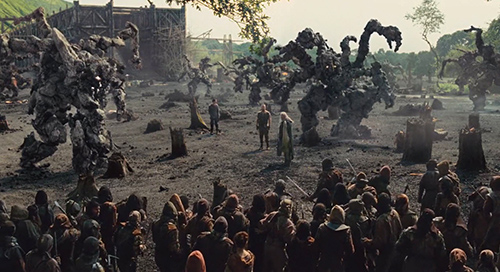
There are miracles and divine power in this film, but its actions seem to be based around inspiring fear and obedience rather than devotion. Forests spring from the ground for Noah to build from. Geysers of water take out mankind. Fires take out armies. There are moments of gentleness – a woman given back her ability to have children, rainbows etc. – but the Creator is a hard taskmaster. Noah is assisted by a gang of fallen angels – the Watchers – who, as punishment for siding with mankind when Adam and Eve were expelled from Eden, were thrown to the ground and encased in stone, turning them into freakish, gangly, giant rock monsters. Despite this, they retain their devotion to their creator – and their assistance is essential for the construction of the ark.

The inclusion of Giant Rock Monsters shows you again how far off the Biblical beaten track Aronofsky goes. This same embracing of unconventional oddness is seen throughout the film’s aesthetic – dirty clothes that have been cobbled together from several different eras, hints of metalwork and industrial ruins throughout Tubal-Cain’s kingdom, blasted wastelands – it’s miles away from The Ten Commandments. But it all sort of works because, regardless of his eccentricity, Aronofsky is a unique and intelligent director of visuals and his work is full of striking images and staging that draws inspirations from all over the shop, from old films to classical children’s story book images from Biblical tales.

Noah ain’t perfect. It’s overlong and its genre defying oddness occasionally feels a little too much. It suffers from the fact that the visuals and themes are so overwhelming that they crush most of the characters: Jennifer Connolly has little to do as Noah’s wife, while Emma Watson et al playing various Noah family members are left with just crusts to chew on. But embrace its bizarreness and the points it wants to make and you are left with a film that is quite unlike anything else you are likely to see. Aronofsky has made a Biblical epic unlike any that has ever, or will ever, be made. And that at least is worth some praise.

The Next Three Days (2010)

Elizabeth Banks and Russell Crowe go on the run in workmanlike thriller The Next Three Days

Director:  Paul Haggis

Cast: Russell Crowe (John Brennan), Elizabeth Banks (Laura Brennan), Brian Dennehy (George Brennan), Lennie James (Lt Nabulsi), Olivia Wilde (Nicole), Ty Simpkins (Luke Brennan), Helen Carey (Grace Brennan), Liam Neeson (Damon Pennington), Daniel Stern (Meyer Fisk)

What would you do to protect the person you love? How far would you go to keep her safe? What would you sacrifice? What rules would you break? Paul Haggis’ serviceable thriller tries to answer these questions, but doesn’t really get much closer to the answers than I have here.

Russell Crowe is John Brennan, a teacher of English Literature at a mid-ranking college. One day, his wife Laura (Elizabeth Banks) is arrested for the murder of her boss. Despite her pleas of innocence, before they know it she is sentenced to spend most of the rest of her life behind bars. When desperation at the thought of her fate – and missing the upbringing of their young son – leads her to attempt suicide, John decides to take the extreme step of breaking her out of prison. But where to begin with the planning? And what will he be prepared to do?

It’s the sort of film that early-on has the lead character meet a ruthless expert (in this case an ex-con with a history of prison breaks, played with a growling enjoyment by Liam Neeson in a one-scene cameo) who outlines a list of rules and terrible things that the hero will be forced to do. The hero looks askance – but sure enough each situation arises and doncha know it the hero is forced to bend his own morality to meet the needs of his mission. What a surprise.

Only of course the film doesn’t have the courage to force Crowe’s John to actually do things that bend his morality. There is always a get-out clause. When his actions lead to him taking a petty criminal’s life (while stealing money from a drug den), it’s self-defence. When he looks like he may be forced to put innocent people in harm’s way, he backs away. When he’s asked to sacrifice something major, he refuses. The film wants to be the sort of film where we see the lead character change inexorably as he becomes harder and more ruthless to achieve his mission. But it worries about losing our sympathy, so constantly gives the audience and the character get-out clauses to excuse his behaviour.

Not that Crowe gives a bad performance – he’s actually rather convincing as a humble, slightly timid man way out of his depth at the start – but the film fails completely to show these events really changing the man. It believes that it’s turning him into a darker, more ruthless person, but it isn’t. At heart, this film isn’t really a character-study at all but a dark caper movie. Obstacles are constantly thrown in the path of our hero, many of which bamboozle him: but then when we hit the prison break itself at last, suddenly he’s pulling carefully planned rabbits and double bluffs out of his hat like Danny Ocean. It’s a film that wants to have its cake and eat it: to show a hero bewildered by his task, in danger from this ruthless world he finds himself in – but also to have him become a sort of long-game con artist thinking three moves ahead of the police.

It just doesn’t quite tie up. It’s the film adapting to whatever it feels the requirements and desires of the audience might be at a particular moment rather than something that develops naturally. Enjoyable as it is to see these sort of games play out, you can’t help but feel a little bit cheated – there has been no indication before this that the character has this level of ingenuity in him.

He doesn’t even really need to pay a price beyond that which he had accepted from the start: at points major sacrifices are dangled before him but he never needs to make any of them. He never has to really bend his personal morality significantly. It’s the cleanest conversion to criminality that you are likely to see.

The film cracks along at a decent pace – even if it is a little too long – and shows its various twists and reveals fairly well. Elizabeth Banks is pretty good as Laura, even though she hardly seems the most sympathetic character from the start (the audience has to do a bit of work for why Crowe’s character seems so devoted to her). Most of the rest of the cast are basically slightly larger cameos but no one disgraces themselves.

The main problem with the film is its lack of depth and ambition. Mentioning Don Quixote several times in the narrative doesn’t magically grant a film depth and automatically create intelligent contrasts with the novel. Instead it just sounds like straining for depth rather than actually having it.

Robin Hood (2010)

Russell Crowe takes aim as Robin Hood

Director: Ridley Scott

Cast: Russell Crowe (Robin Longstride), Cate Blanchett (Marian Locksley), William Hurt (William Marshal), Mark Strong (Sir Godfrey), Mark Addy (Friar Tuck), Oscar Isaac (Prince John), Danny Huston (King Richard), Eileen Atkins (Eleanor of Aquitaine), Max von Sydow (Sir Walter Locksley), Kevin Durand (Little John), Scott Grimes (Will Scarlet), Alan Doyle (Allan A’Dale), Matthew Macfadyen (Sheriff of Nottingham), Lea Seydoux (Isabella), Douglas Hodge (Sir Robert Locksley)

When this film was developed, it was a CSI style medieval romp called Nottingham. Russell Crowe was cast as the film’s hero – an ahead-of-his-time Sheriff of Nottingham, busting crimes in Olde England and dealing with rogue thief (with good press) Robin Hood. Yes that really was the original idea. Mind you, it would at least have been more original than what we ended up with after Scott and Crowe had a bit of a rethink.

So here we are: Robin Hood: Origins (as it might as well have been called). Russell Crowe is Robin Longstride, on his way back from the crusades as an archer in the army of King Richard (Danny Huston) army. When Richard is killed at a siege in France (it was one last siege before home – what are the odds!), the messengers carrying the news back to France are ambushed and killed by wicked Sir Godfrey (Mark Strong). Robin finds the bodies and assumes the identity of Sir Robert Locksley, travelling to England to tell Prince John (Oscar Isaac) the news of his succession – then returning to Nottingham with his friends, where Robert’s father Sir Walter (Max von Sydow) asks him to continue pretending to be Robin for dull tax reasons – and soon feelings develop between Robin and Sir Robert’s widow Marian (Cate Blanchett). But John is intent on farming the land for taxes, and Sir Godfrey is in cahoots with the French to conquer England.

Robin Hood is a semi-decent, watchable enough retread of a story so totally and utterly familiar that even the things it rejigs end up feeling familiar. In fact, to be honest you sit watching it and wondering why on earth anyone really wanted to make it. Scott brings nothing original and different to it, and the film looks like a less visually interesting retread of Kingdom of Heaven. Plot wise it’s empty. What’s the point of it all? It slowly shows us all the pieces of the Robin Hood myth coming together, so best guess is that it was intended to be the first of a series (there seems to have been no interest or demand for a sequel of any sort). 

And then we’ve got Russell Crowe. Leaving aside everything else, Crowe looks about 10 years too old for the part. He delivers some sort of regional accent that meanders from Ireland to Yorkshire in its broadness, a laughable stumble around the country. Crowe does his slightly intense, sub-Gladiator mumbles and stares at the camera and attempts to suggest a deep rooted nobility, but actually comes across a bit more like a snoozing actor awaiting a pay-cheque.

Cate Blanchett does her best, lending her prestige to the whole thing in an attempt to make it land with some dignity (she of course does the opening and closing narration, which struggles to add some sort of grandeur to the whole flimsy thing). She’s saddled with a Maid Marian who is granted various “action” moments, but still has to be saved by Robin and face possible rape from a leering Frenchman (at least she saves herself from that one). 

It also doesn’t help either actor that their romance plays out in the dull middle third of the film, where the plot grinds to a halt as we deal with Sir Walter (Max von Sydow almost literally acting blindfolded) using Robin as some sort of tax dodge scheme. The film is overloaded with characters, all of whom are separated at this point and struggling manfully to make their disconnected plotlines interesting: so we get John dealing with the pressures of office, Sir Godfrey scheming and looting, William Marshal trying to find a middle ground, Robin and Marian falling in love – it’s a mess. On top of this a get a ludicrous reworking of the Magna Carta as some Medieval version of the Communist Manifesto (it’s written by Robin’s executed dad no less, giving him a bizarre “painful backstory” to overcome). None of these plots really come together, and so little time is spent with each of them that they all end up getting quite boring.

The film culminates in a totally ridiculous battle scene on a beach, as Sir Godfrey’s French allies arrive on the shores of medieval England in some sort Saving Private Ryan landing craft. The tactics of this landing and the battle that ensues are complete nonsense. Every single character rocks up at this battle, which should feel like all the plot threads coming together but instead feels like poor script-writing. When Marian turns up, disguised as a man (how very Eowyn), leading a group of warrior children (I’m not joking) who feel yanked from the pages of Lord of the Flies, it’s just the crowning turd on this nonsense.

And all this fuss to defeat Sir Godfrey? Why cast Mark Strong and give him such a nothing part? Sir Godfrey is a deeply unintimidating villain. Everything he does goes wrong. He is bested in combat no less than three times in the film (once by a flipping blind man!). His motivations are never even slightly touched upon. He has less than one scene with John, the man who he is supposed to be manipulating. He runs away at the drop of a hat and Robin gets the drop on him twice on the film. He’s neither interesting, scary or feels like a challenging adversary or worthy opponent.

But then nothing in this film is particularly interesting. The set-up of the merry men around Robin (they seem more like an ageing band of mates on tour by the way than folk looking to rob from the rich and give to the poor) is painfully similar to dozens of other film, particularly in the Little-John-and-Robin-fight-then-become-brothers routine. Crikey even Prince of Thieves shook up the formula by making Will Scarlet Robin’s brother. Scott is going through the motions, like it was one he was committed to so needed to see through to the end despite having long-since lost interest. It’s not a terrible movie really, just a really, really, really average one with a completely miscast lead and nothing you haven’t seen before.

The Mummy (2017)

Like the film, Annabelle Wallis stares at Tom Cruise in awe in disaster laden (in more ways than one) The Mummy

Director: Alex Kurtzmann

Cast: Tom Cruise (Nick Morton), Sofia Boutella (Ahmanet), Annabelle Wallis (Jenny Halsey), Jake Johnson (Chris Vail), Russell Crowe (Dr Henry Jekyll), Courtney B Vance (Colonel Greenway), Marwan Kenzari (Malik)

Mummy PosterMany films have killed their franchises. It takes a really special film to kill a franchise before it has even started. Welcome to the first, and probably last, entry in Universal’s misguided Dark Universe franchise, a Marvel-style playground for all Universal’s old monsters like Frankenstein, Dracula, the Wolfman etc. etc. And of all of them, The Mummy was the one they decided to start with? 
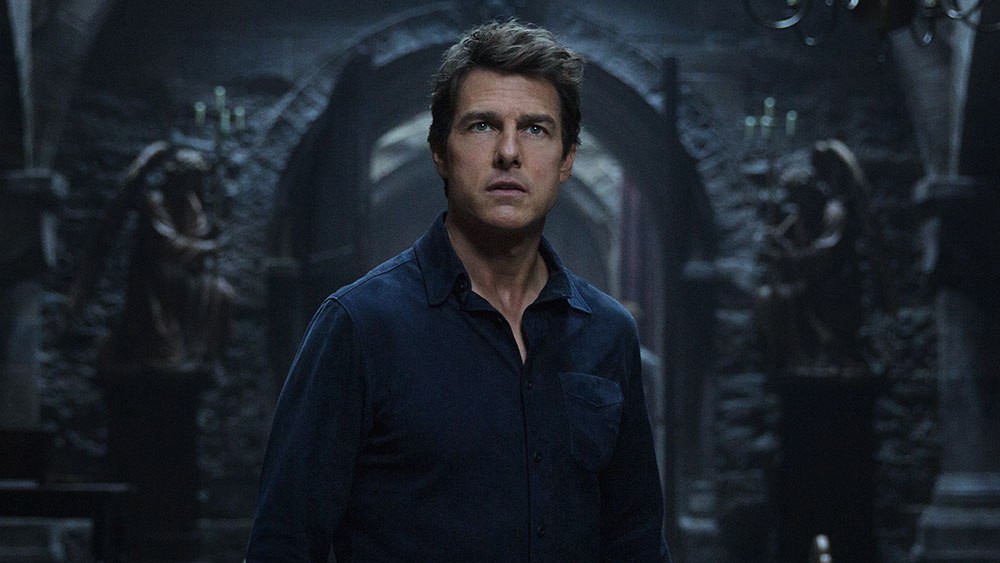
Anyway, our hero is Nick Morton (Tom Cruise) a sort of soldier of fortune in modern day Iraq, plundering antiquities under the banner of the US Army like some low-rent Indiana Jones. He and his hapless sidekick Vail (Jake Johnson) stumble upon a tomb of mysterious lost Egyptian princess Ahmanet (Sofia Boutella) after stealing information from archaeologist Jenny Halsey (Annabelle Wallis). On the clock to take as much as they can from the tomb, Jenny and Nick take home Ahmanet’s sarcophagus. Their plane crashlands in Dover, with Jenny the only survivor – only for Nick to be resurrected in the mortuary. Looks like reborn Ahmanet wants to bring Set, the God of Death, into the world and has chosen Nick as the vessel for Set’s soul. Or something. It’s not really clear. 

In fact the whole film is pretty awful. What sort of film were they trying to make here? Is this a horror or an action film or a buddy film or some sort of black comedy? The tone shifts wildly from moment to moment: one minute Tom Cruise is exchanging Indiana Jones-style banter with his buddy Vail (Jake Johnson). The next he is shooting a possessed Vail at point-blank range (even this is played for laughs a bit). The next he’s being haunted American Werewolf style by a ghost or vision or zombie or somethingversion of wise-cracking Vail. What is going on here? What kind of film is this?

Tom where he normally is – centre of the frame

Well actually we know what kind of film it is: it’s a Tom Cruise starrer. Allegedly, the Cruiser (already quite the control freak perfectionist) took over most of the production from inexperienced, Universal suit Alex Kurtzmann. The DVD’s special features don’t half support this, with Cruise shown effectively directing most of the action sequences while Kurtzmann stands quietly to one side or (best of all!) greeting the star after the opening aircraft crash has been filmed to be told “you’ll love the footage Alex!”. 

Well the studio had doubled-down on Cruise to launch their franchise with his glittering smile and international box-office appeal, so I guess it’s fair enough the guy was shoved square centre. I know the film is called The Mummy but it might as well be Nick Morton. Cruise is in almost every single scene, most of the characters spend the whole time talking about him, and all the action is done by him (every other character is completely useless). The best lines, such as they are, go to him. He’s starting to look a little bit too old for the “young buccaneer” role he has here – and certainly too old to be flirting with Anabelle Wallis – but the film doesn’t care.

Anyway, the plot charges about London with odd time jumps, and unclear character motivations abounding. Why does Ahmanat have such an idee fix that Nick has to be the vessel for Set (other than, of course, his Tom Cruise Awesomeness)? Is it a good or bad thing that Nick could or could not get the powers of a god? Why does Ahmanet need Set in the first place – she “sells her soul” to him in ancient Egypt times for the throne, but basically just cuts the throats of her family at night (hardly requiring the demonic powers of the dead)? In Egypt she’s easily defeated with a blow dart but by the time she’s reborn in London she has incredible powers over minds, matter and animals – why didn’t she use any of this before? 

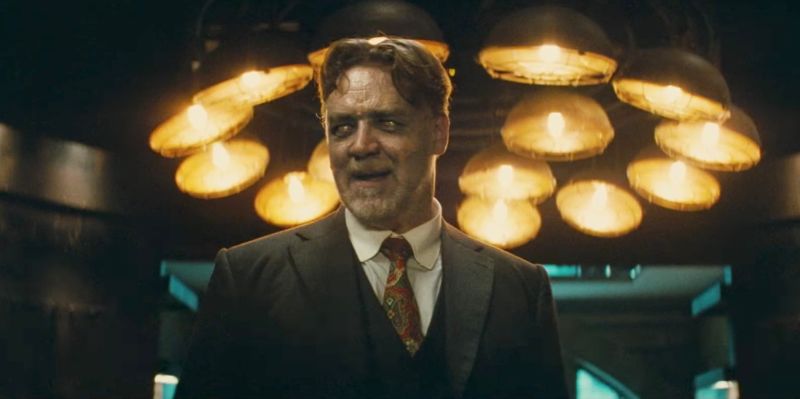
On top of that, we’ve got the incredibly dull Prodigium organisation (a sort of SHIELD for monster fighting) run by Nick Fury-ish arc character Dr Henry Jekyll, played with lumbering crapness by Russell Crowe. Why Russell, why? Crowe plays the part half like a plummy Stephen Fryish professor, the other half like some demented OTT cockney geezer. Of course the film isn’t subtle enough to avoid giving us Jekyll going full Hyde, a laughable moment of cheesy rubbishness with a wild-eyed Crowe reduced to “alrigh’ mate” hamminess while tossing Cruise around in a punch-up that looks like two drunk dads at a wedding going at it.

Oh Russell, why? Why do you make it so difficult for your fans?

The film is also saddled with one of the most inept female characters since Roger Moore’s Bond years. At one point, poor Anabelle Wallis stumbles on Ahmanet and her zombie minions on the verge of stabbing Nick to death and turning him into a demon-host, and Nick’s response is an irritated cry of “Jenny!” as her total lack of proactive response to this, like even he finds her arrival pointless and annoying. I’m afraid to say after that moment, every moment in the film with Wallis weeping, panicking, running away or laughably cheering Nick’s Tom Cruise Awesomeness from the wings (“Kick her arse Nick!”) was met by me and everyone I was watching the film with shouting “Jenny!” at the screen with the same exasperated annoyance.

The only good sequence in the film is the opening plane crash – and that is spoilt as it was all over the trailers. By the time we are in a secret crypt (getting in the way of the crossrail construction) with zombie Templar knights wrestling Nick (no seriously) you’ll have long since ceased caring. Even the fun of saying the next line in the cliché-ridden script before the actors do will be less fun than it used to be.

The Mummy sounds like it should be some sort of camp classic. But it’s really not. It’s ineptly made, poorly written, with a plot that makes no sense and action that varies from dull to laughable. Terrible characters, awful pace, rubbish acting, lousy direction and half-hearted from start to finish – it could barely launch a fart let alone a franchise.