
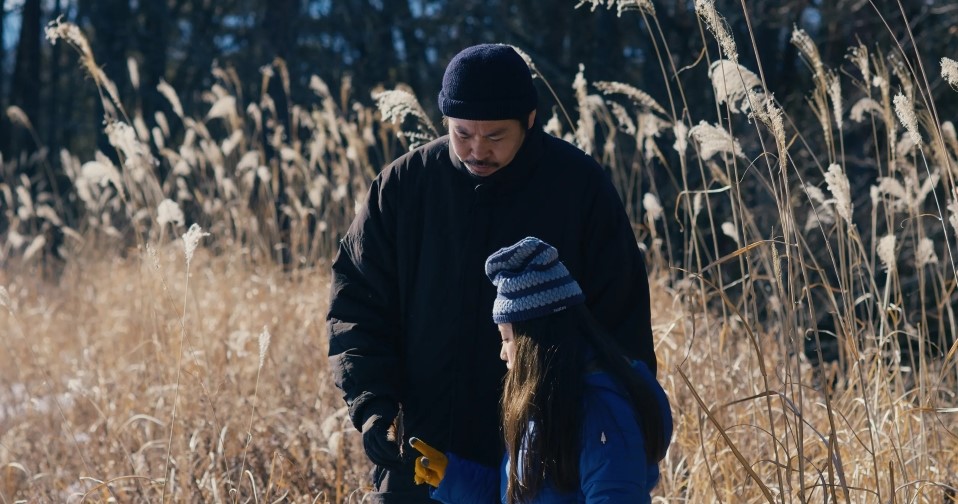
Haunting, enigmatic parable on nature and modern society that leaves a lingering impression
Director: Ryusuke Hamaguchi
Cast: Hitoshi Omika (Takumi Yasumura), Ryo Nishikawa (Hana Yasumura), Ryuji Kosaka (Takahashi Keisuke), Ayaka Shibutani (Mayuzumi Yuuko), Hazuki Kikuchi (Sachi Minemura), Hiroyuki Miura (Kazuo Minemura), Yûto Torii (Tatsuki Sakamoto), Takako Yamamura (Yoshiko Kizaki), Takuma Nagao (Tomonori Hasegawa), Yoshinori Miyata (Akira Horiguchi, Takahashi), Taijirô Tamura (Ippei Suruga)

Imagine a beautiful Japanese mountain village, where the water is so clean, jugs of are taken straight from the stream to the local restaurant where its unique taste adds to the food’s beauty. Everything here is in careful harmony. Until a corporation reckons it’s the perfect site – keen to exploit, while it can, lingering Covid subsidies – to build a glamping site with a 95% effective septic tank (because that’s fine with government regulations). The corporation hosts a charade of a consultation where the plans are rejected by the community, unconvinced by the ‘trickle down’ wealth promised and more concerned with that 5% sewage being tipped into their gloriously pure water supply.
Perhaps the point of Evil Does Not Exist is that there is no real malevolence here. The corporation that wants to effectively shatter the harmony of this community isn’t doing it because they are cruel, they’re just doing what they do to create profits. And they genuinely don’t really see the problem because with a classic lack of empathy they’re convinced what is good for them is good for everyone. And that deep-down everyone shares their outlook. The villagers are just angling for a bigger pay-outa and they don’t really need to fix the septic tank because it falls within the rules and the water will still be okay with a little bit of sewage in it.
Evil Does Not Exist it seems, because most of the bad stuff happening in the world is because of empathy-free systems, people not really caring about impact of their actions and a general lack of interest in long-term impacts over short-term gain. Hamaguchi’s beautifully filmed, Godard-inspired (from title fonts, to shooting-style to Hamaguchi’s use of non-professional actors) environmental parable carefully and subtly deconstructs a world where the beauty of nature can be rinsed away simply out of a sense of inevitability and quick-buck expediency.
Originally envisioned as a short film that would showpiece the beautiful orchestrations of its composer Eiko Ishibashi, Hamaguchi expanded it as he shot more and more material, eventually developing it into a fascinating and open-ended parable about our relationship with nature. Nature here is an elemental and unknowable force: the first five minutes of the film is a sustained tracking shot through the trees, the only sounds we hear being Ishibashi’s music. It’s almost ten minutes before we hear any dialogue. The village’s ‘odd-job man’ Takumi (Hitoshi Omika) is very much one with the natural world around him, taking only what he needs and living in gentle, stoic harmony with the environment.
Hamaguchi’s film – utilising his careful, Ozu-inspired camerawork and Godardian love of realist observation – creates a natural world which is both beautiful and hauntingly mysterious. In the film’s calm shots of nature, the forest becomes a haven but one strangely inhuman. There is a feeling of unknowable, unrelatable forces in this world, an organic Gaia understanding that the villagers are unconsciously plugged into, which governs the ‘rules’ of existence. It’s an understanding utterly inaccessible to those who arrive from the city and want to pave paradise and put up a parking lot.
Evil Does Not Exist pivots around its consultation meeting, which takes place in a town hall, chaired by initially bored consultants going through the motions with a slide deck they don’t understand and a ring-binder of notes they are unfamiliar with. As the villagers quickly discover (their adroit questioning taking the under-prepared consultants off guard), this consultation is a sham – anyone with any control over the fate of the project isn’t there and the glamping site is happening regardless of anyone’s feelings. All this meeting is about (as the head of the company later says, dialling in to chat to his consultants on a video call) is demonstrating the company has ‘listened’ and to tweak a few token issues (it’s telling that the head of the company describes the disastrous meeting as a complete success). None of this is evil of course: it’s just the bureaucratic acquisitiveness of the modern world, which values procedures and rules over impacts and end results.
Both consultants however find themselves taken with the village. But Hamaguchi demonstrates this is always rooted in a patronising sentimentality that’s as much about themselves as it is the actual village. Takahashi (Ryuji Kosaka) in particular, a disaffected company drone, spontaneously decides he can just jack it all in and become a skilled man of the wilderness like Takumi. Takahashi comes across as an embarrassing romantic, identical in many ways to the likely glamping customers (who want a sense of the nature without actually living there). He’s hideously clueless about the fauna of the forest and his practical skills (captured in a hilariously awkward attempt to chop wood) are woefully inadequate. None of this stops him from assuming he can fit right in on a whim with no preparation or training. Takumi’s just an odd-job man, how hard can that be to pick-up?
It doesn’t kid Takumi, who stares at him with an impassive face that hints at a range of emotions from contempt to humorous indulgence. Perhaps he’s aware that Takashi (again patronisingly) sees him less as an individual and more as his personal Yoda, placed on earth to mentor Takashi’s personal growth: to the outsiders the village and its inhabitants are always filtered through what they can do for them. Takashi’s patronising expectation that Takumi will welcome a ‘student’ isn’t wildly different from the company’s view that Takumi can be won over to supporting the project because they’ve offered him a job and a semi-decent salary.
This all culminates in a mysterious, open-ended conclusion which sees Hamaguchi lean into hints of folk-horror. Does the conclusion of Evil Does Not Exist show the dangerous consequences of mankind’s interference of nature on the most innocent? Does Takami represent a resentful natural world biting back? Questions hang over the film’s cryptic ending, which has been neatly foreshadowed throughout.
Evil Does Not Exist has a quietly hypnotic quality to it, but also a haunting chill behind its beautiful imagery. But it also asks subtle but intriguing questions about our link to nature and how a myopic focus on our own interests and needs inadvertently damages the world far more than actively ‘evil’ acts ever could.




 Movie Musings