Tag: Sally Hawkins

Wonka (2023)

Wonka (2023)

Charming but light confection that repackages Wonka into a Paddington type figure

Director: Paul King

Cast: Timothée Chalamet (Willy Wonka), Calah Lane (Noodle), Keegan Michael-Key (Chief of Police), Paterson Joseph (Arthur Slugworth), Matt Lucas (Gerald Prodnose), Mathew Baynton (Felix Fickelgruber), Sally Hawkins (Mrs Wonka), Rowan Atkinson (Father Julius), Jim Carter (Abacus Crunch), Natasha Rothwell (Piper Benz), Olivia Colman (Mrs Scrubit), Hugh Grant (Lofty), Rich Fulcher (Larry Chucklesworth), Rakhee Thakrar (Lottie Bell), Tom Davis (Bleacher)

What did Willy Wonka do, before the factory and the carefully stuffed golden tickets in selected chocolate bars? According to Paul King’s amusingly light confection of a film, he was just a guy with a sweet box and a dream, befuddled by the big city. A bright-eyed, naïve young man, Wonka (Timothée Chalamet) is swiftly bested by the Chocolate Cartel and conned into a life of servitude by his landlady Mrs Scrubit (Olivia Colman), after not reading the contract small print. But Wonka’s invention, good cheer and alliance with put-upon fellow Scrubit victim, orphan Noodle (Calah Lane), sees him turn adversity into cartel-smashing triumph.

It might be clear from that paragraph that the Willy Wonka of this film bears very little resemblance to the figure from the Dahl original who happily allows children to face dangerous punishments in his factory. King’s film has some flourishes of Dahl in its character names and eccentricities but, in terms of tone, it takes far more after his successful Paddington films than anything Dahl wrote. Wonka himself, in his accident-prone naivety, decency and fundamental sense of fair-play, is certainly a figure in the shadow of Peru’s most beloved bear, with the film swiftly also giving him a version of Paddington’s eccentric surrogate family and increasingly comic traps to get out of.

Wonka isn’t really Dahl and doesn’t bother to begin to explore how on earth the man we see here might become the character from the books. Does that really matter? I suppose not. I guess you need to judge each film on its merits, and while the Dahl purists are unlikely to consider this fitting for the great storyteller, I’d point them instead towards Wes Anderson’s gorgeous short films, which are a true blast of Dahlish delight.

Wonka instead is a sweet, bouncy, family-friendly musical with a hero designed to appeal to all ages, carefully set in a non-descript European-ish location that combines elements of multiple cities, regions and periods (so much is the film a higgledy-piggledy fantasia combination of places, all enhanced with CGI, that it’s a surprise to see Oxford’s Radcliffe Camera appear in the film’s conclusion unadjusted and intact). It’s packed with songs – which, if I’m being honest, are mostly clever and decent than catchy or memorable – and is set in a world where corrupt monks and police detectives will bend any rules for another chocolate fix.

At the heart of all this, Timothée Chalamet gives a sprightly and engaging performance. Chalamet dials up the eccentricity of Wonka, creating a character that is whimsical but caring, an innocent abroad who just can’t understand why people would be cruel or lie. Chalamet throws himself into some effective singing and dancing, and generally lands the role pretty much in the sweet spot between sickly sweet and deliciously more-ish. It helps a great deal that he develops a brilliant sibling chemistry with Calah Lane, who is street-smart and a lot of fun as an orphan whom the world has taught to be cunning and creative.

King crafts a number of set-pieces that fit this revisioning of Wonka as a song-and-dance man at the heart of an Arthur Freed-style musical. There is a fine word-play packed song (as Wonka searches for effective rhymes for Noodle) in a giraffe pen, a balloon-carried number in the skies and, best of all, a very funny work song sung by those poor unfortunates conned by Mrs Scrubit into a lifetime of debt. This surrogate family, by the way, is a neat illustration of King and co-writer Simon Farnaby’s trick of turning potential one-note characters into people you care for, ably embodied by Jim Carter as a stuffy accountant, Natasha Rothwell as a bouncy seamstress, Rakhee Thakrar as a nervous telephonist and Rich Fulcher as a past-his-best comedian.

Much like his Paddington films, Wonka takes place in a world of minimal threat. The villains are largely comic – Olivia Colman surely will spend most of the next few years duelling with Helena Bonham Carter to land toothy, sweaty grotesques roles like Mrs Scrubit – with the Chocolate Cartel in particular making a droll collection of smugly superior types, ably played by Paterson Joseph, Matt Lucas and Matthew Baynton. Their operations take place in a surreally complex underground base (under a cathedral guarded by chocolate-obsessed monks naturally), built around a vault full of liquid chocolate. Following the structure of both Paddington films, naturally this becomes the site of an act four heist by our heroes.

Wonka frequently feels a little too often like it is simply repeating and representing stuff that had worked well for King and Farnaby in the past. (You also feel that about the casting of Hugh Grant as an Oompa-Loompa – fundamentally that is the joke, although Grant delivers it repeatedly marvellously.) While few people do this sort of thing better than them, you feel Wonka offered the chance to be something more rather than a spiritual retread of the superior Paddington films.

It’s a film that never quite finds it own identity, or really finds a Dahlish uniqueness. It settles, happily, for being a feel-good confection, a charming series of scenes and songs delivered with just the right level of enthusiasm and glee by a cast who look like they are having a marvellous time. It’s charming enough and I enjoyed it, but I can’t say I loved it like I do Paddington 2. I can’t help but feel that’s because the emotional connection isn’t there. Wonka himself, repackaged as he is, is a little too odd to be as adorable as the Bear, and without really, deeply, caring for Wonka the film itself doesn’t carry the impact it should. It’s entertaining, but it didn’t win a place in my heart.
The Lost King (2022)

The Lost King (2022)

Bizarre, grudge-settling comedy-drama that celebrates amateurism and hates experts

Director: Stephen Frears

Cast: Sally Hawkins (Philippa Langley), Steve Coogan (John Langley), Harry Lloyd (Richard III), Mark Addy (Richard Buckley), Lee Ingleby (Richard Taylor), James Fleet (John Ashdown-Hill), Bruce Fummey (Hamish), Amanda Abbington (Shelia Lock)

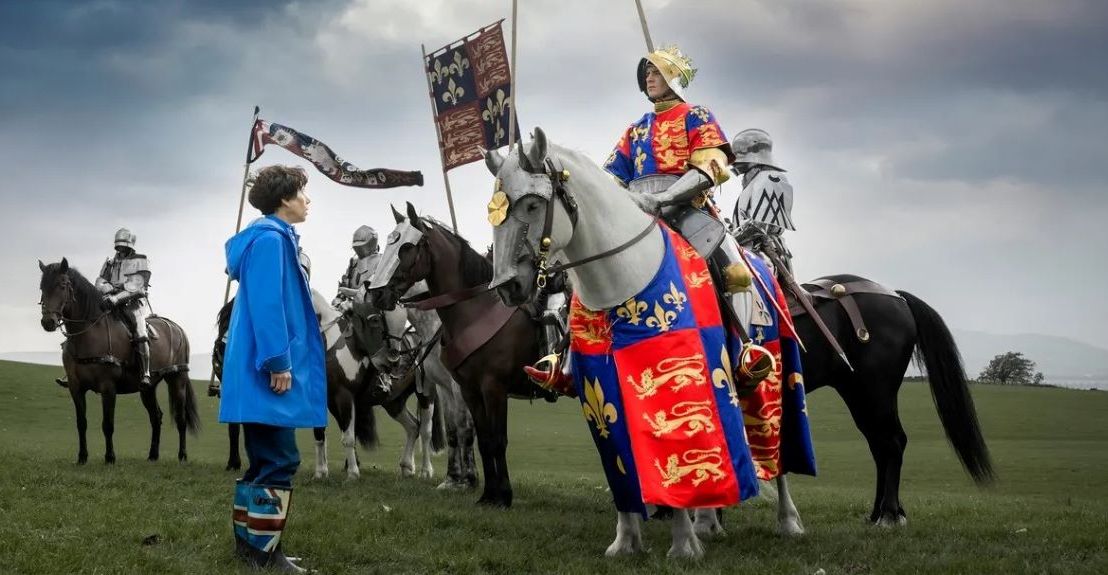
In 2012 the world’s media descended on Leicester after the body of King Richard III was discovered in priory turned car park. Richard III had long had passionate supporters – Ricardians – who rejected the idea that the man Shakespeare turned into Britain’s most hated monarch was anything of the sort. It was one of those fans, Philippa Langley (Sally Hawkins), who researched for 20 years to find evidence for where he was buried and became the public face of the search through ratings-winning television documentaries and writing a best-selling book.

All of this is rejigged in a silly, sentimental, bizarre film that repositions Langley as an inspired amateur butting heads with the self-promoting professionals of Leicester University. I suppose there is something ironic in a film which insists someone had their reputation sullied in the name of drama, itself sullies peoples names in the name of drama. (Richard Taylor, the deputy registrar of Leicester, here portrayed as a sexist, elitest self-promoter who mocks the disabled, has openly declared his intention to sue). The Lost King wants to be an affectionate Ealingesque comedy of the triumph of the little guy. It’s actually got an uncomfortable feeling of grudges being settled and a stench of Brexity anti-intellectualism.

Fascinatingly the anti-intellectualism even extends to Langley herself. Remember that 20 years of research? All deleted in this film. Here Langley is a working mum, suffering from ME (the film draws vague parallels between this and Richard’s scoliosis) who one day stumbles into a performance of Richard III and basically falls in love with the dead king. She pops down to a second-hand bookshop, buys eight books on Richard and in a few months is digging up the car park. It’s as if the idea she spent time in archives, triple checking sources, studying maps etc. would somehow have been “cheating” – that we could only root for her if she was an amateur, “one of us” who makes her (always correct) decisions purely on gut instinct.

But it fits with a film that portrays Leicester University as a sort of scheming club of middle-managers and moustachio-curling villains. No one from the university can so much as draw breath without disparaging “that woman” as an obsessive weirdo. They batter everyone with their expertise, arrogantly dismiss any ideas they don’t have themselves and stand around growling so Langley can puncture their pretention with her common-sense wisdom. Case in point: she suggests they overlay a modern map of Leicester over a medieval map to check locations. First they object, then look at her like she’s split the atom. Of course, they are right to object: medieval maps are hand-drawn approximations often more based on aesthetics than accuracy. But that doesn’t matter to the film, which of course immediately shows the two maps lining up in microscopic detail. If only 500 years’ worth of scholars could have thought of that, eh?

Embodied by Lee Ingleby’s Richard Taylor as a number-crunching obstructive bureaucrat who does everything he can to steal the credit (honestly, if you are going to take this kind of pop at a regular person at least change his name), Leicester University are unilaterally baddies. All this score-settling seems to have come from Langley’s resentment at not being invited to speak at a couple of press conferences. No matter that TV documentaries and books made her name synonymous with Richard III to anyone who really cares (even the film can’t pretend it’s telling “an untold true story”). This is a film with an axe to grind – so much so that the eventual discovery of Richard becomes secondary to this mud-slinging as Langley rebukes Taylor publicly (inevitably shaming him into silence) for equating disability with wickedness and cutting her out of meetings.

What’s particularly odd about The Lost King is that the film ends up painting Langley as exactly the kind of un-credible crank its villains (villainously) see her as. Having removed all her rigorous research, it replaces it with Having A Feeling. This is communicated visually with Langley communing regularly with a vision of Richard III, personified by the actor from the play she saw. Langley chats to this vision with the breathless excitement of a giddy teenager, and he helps her discover reams of facts, not least a bizarre moment of ecstasy when she spots an “R” in the car park and just knows Richard is under there.

Harry Lloyd is all adrift in this bizarre part and its main impact is to raise unfortunate giggles and make Langley look exactly like the sort of person you wouldn’t invest tens of thousands of pounds in. Mind you, Langley here is way more competent than any other Ricardian society member, all of whom are portrayed as cranks and pub bores, talking as if they only discovered famous primary sources this week, and utterly unable to even tie their own shoelaces until Langley sails in and discovers the king’s body in about ten minutes.

Hawkins plays a part firmly in her wheel-house, as an eccentric but determined woman in love with a ghost, while co-scriptwriter Steve Coogan generously writes himself a “stop reading Holinshed and look after the kids” role as her supportive ex-husband. Langley, like other characters, bends and changes according to the needs of the scene but is always the hero. When the script needs her to be a determined leader, she won’t take no for an answer. When it needs her to be oppressed by those nasty Leicester professionals, she won’t say boo to a goose. (Similarly, Mark Addy’s archaeologist yo-yos between dismissive of Langley to affectionately supportive almost scene-to-scene.)

The Lost King wants to be a triumphal little-guy film, but actually it has an unpleasant air to it. It feels like a massive grudge being publicly settled. It belittles and ignores expertise, patience and research in favour of gut instinct and amateurism. It bizarrely paints its lead character as a mixture of oddball weirdo, genius and saintly crusader. It’s also neither dramatic nor funny (except accidentally). It’s a bad film.

Paddington (2014)

Paddington (2014)

Michael Bond’s lovable bear makes an almost perfect screen-transition in this heart-warming tale

Director: Paul King

Cast: Ben Whishaw (Paddington Bear), Hugh Bonneville (Henry Brown), Sally Hawkins (Mary Brown), Madeleine Harris (Judy Brown), Samuel Joslin (Jonathan Brown), Julie Walters (Mrs Bird), Nicole Kidman (Millicent Clyde), Peter Capaldi (Mr Curry), Jim Broadbent (Samuel Gruber), Imelda Staunton (Aunt Lucy), Michael Gambon (Uncle Pastuzo), Tim Downie (Montgomery Clyde)

If there is one thing we need in troubled times, it’s kindness. Few characters are as overflowing with warmth and decency as Michael Bond’s Paddington Bear. First introduced in 1958, the lovable marmalade-consuming little bear all the way from darkest Peru is never anything less than kind and decent – even as the well-meaning bear gets himself into a string of catastrophes.

Paddington is one of the most universally beloved figures from post-War British culture – surely no surprise he was the perfect tea-party guest for that other beloved icon of the same period, the Queen. The pressure was on for a Paddington film – could it match the tone of the books? The answer was an over-whelming yes. Paddington is an endlessly heart-warming triumph, which it is impossible to watch without a warm glow building inside you, and a goofy smile on your face.

Explorer (Tim Downie) discovers a species of intelligent, marmalade-loving bears in darkest Peru. Forty years later, after a terrible earthquake, a young bear travels to find a new home in London. He meets the Brown family – overly cautious father Henry (Hugh Bonneville), caring Mary (Sally Hawkins) and their children Judy (Madeline Harris) and Jonathan (Samuel Joslin) – who take him into their home and name him Paddington after the train station where they found him (his bear name being unpronounceable). Paddington (Ben Whishaw) works hard to settle in with his new hosts – but danger looms from an ambitious Natural History Museum taxidermist (Nicole Kidman) who longs to make Paddington the centrepiece of her collection.

Directed with a great deal of unobtrusive flair by Paul King, Paddington is a truly endearing film about the triumph of opening your heart to strangers. The Brown family don’t realise it, but they are in need of a burst of kindness in their lives to help bring them together. They get it in spades with Paddington. The film captures perfectly the little bear’s personality. This is Paddington exactly as you remember him: polite, decent, kind and hilariously accident-prone. King’s film also gets the tone exactly right – there are no pop-culture references or rude gags (although there are a few subtle double-entendres of a sort) and the film is set in a timeless mix of 1950s London and today.

The film’s CGI Paddington is gorgeously designed – a wonderful rendering of the bear’s appearance tailored with more realistic fur, but still the same as the book– and perfectly voiced by Ben Whishaw. Whishaw was a late replacement – Colin Firth voluntarily withdrew, as he felt his voice was ill-matched to this naïve, gentle young bear – but his light and gentle tones convey all the warmth you need. It’s a superb performance, humane, kind and deeply funny, and so well suited you suddenly realise in your head Paddington always sounded like this.

King creates a series of gorgeously handled set-pieces to showcase Paddington’s possibilities for well-intentioned mayhem. On his first night in the Brown household, he duels with toothbrushes, mouthwash, toilet flushes and showers, culminating in flooding their bathroom with a swimming pool’s worth of water. He gets mummified in sellotape, slips up in the kitchen and causes several marmalade-sandwich involved disasters (most hilariously a marmalade baguette-pneumatic tube mix-up). But he always means well: a caper-filled set-piece through the London streets sees Paddington finally collide with a man he’s trying to return a dropped wallet too – allowing someone we’ve known all along to be a pickpocket to be apprehended by the police.

The Brown family’s home – already a beautifully designed dolls-house made real, with a tree blossom mural that changes to reflect the mood of the scene – comes to life with Paddington in it. (Watch how the colours of their clothing change depending on how much Paddington is part of the family or not). Mary (a wonderfully warm Sally Hawkins) is already eager for him to stay. Judy and Jonathan (superbly sparky performances from Madeline Harris and Samuel Joslin) are quickly won over by him. It’s only Mr Brown – a performance of perfectly judged fussy, pinickity, rule-bound caution and stuffiness by Hugh Bonneville which flourishes into something warmer – who is unsure. But then this is a man so obsessed with his risk analysis job, he prevents his children from doing anything (34% of all childhood accidents happen on the stairs!) and has forgotten how to have fun.

Watching Mr Brown slowly warm to Paddington is a huge part of the film’s charm and warmth. Who could imagine the man who tries to leave him at the train station (and urge his family not to catch the bear’s eye, muttering “stranger danger”) would later be dressing up as a Scottish cleaning woman to help him infiltrate the Geographer’s Guild building? (This sequence is a little comic physical and verbal tour-de-force Bonneville.) It’s a larger part of the film’s wider – and most rewarding – message: the importance of treating migrants to this country with respect and care.

The pro-migration message is throughout the film – and the film is a fabulous reminder to many of what we have gained from those who have come to this land from across the seas, from NHS staff to political leaders to entertainers. Paddington’s journey to London – in a small boat, then sneaking past customs – is all-too-familiar.  Next door neighbour Mr Curry (a comically ingratiating Peter Capaldi) voices many of the “concerns” of anti-immigrant communities (let one bear in and who knows how many will follow?). Even Mr Brown voices worries about bears telling you sob stories to win your trust. The important message here is the value migrants bring us. A recurring calypso band reminds us of parallels with the Windrush generation. It’s not spoken but Jim Broadbent’s antique shop owner’s accent and memories of arriving on a train in London as a child clearly mark him as a Kindertransport child. Paddington has a subtle and truly important message for people: when we open our arms to people, we gain as much as they from the exchange.

Paddington throws in a few moments of darkness: the shock death of Uncle Patuszo is surprisingly affecting and Nicole Kidman’s taxidermist is possibly the scariest villain you’ll see in a kid’s film this side of the child catcher. But in some ways this enhances the warmth even further. By the film’s end you’ll feel your own life has been enriched by the small bear’s presence as much as the Brown’s has. We need him in times like this.

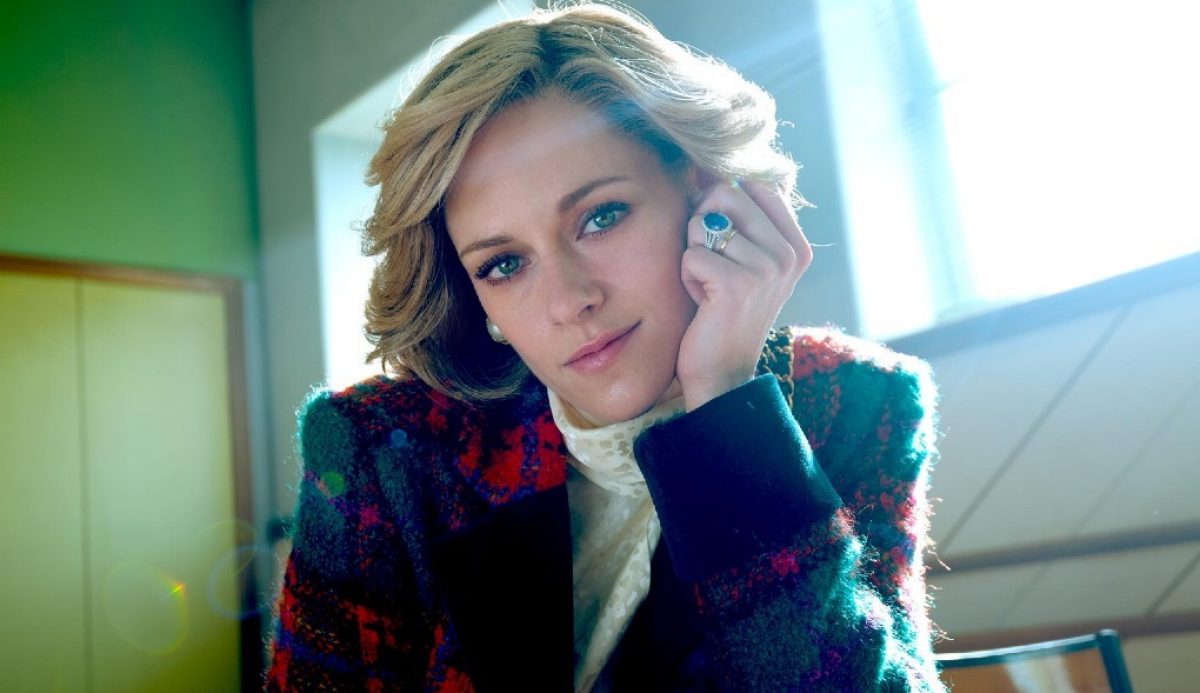
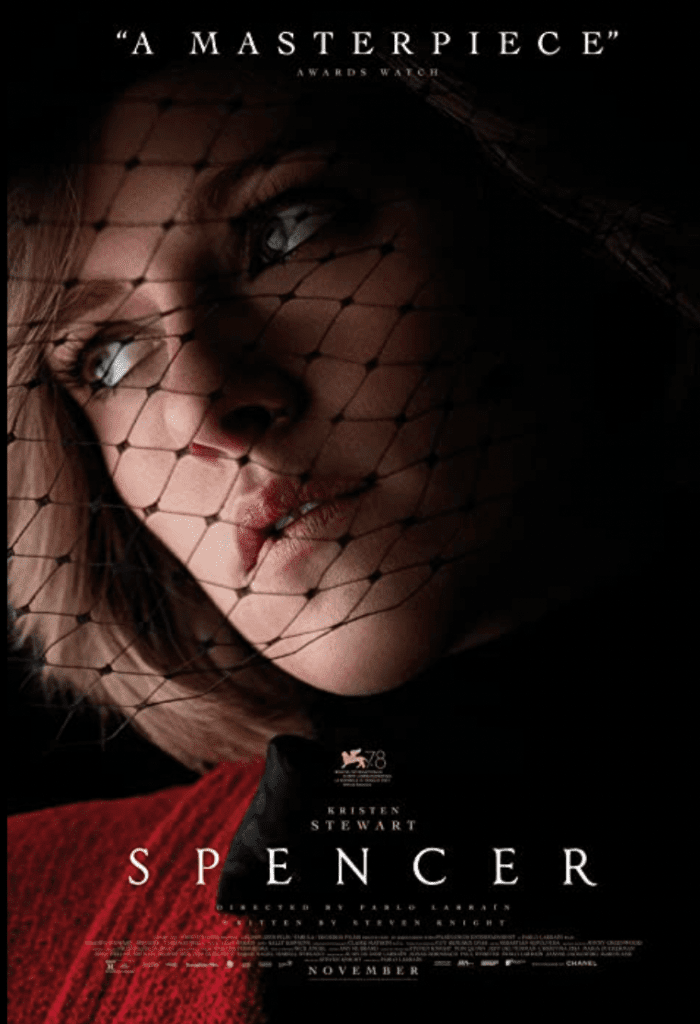
Spencer (2021)

Kristen Stewart channels the People’s Princess in Spencer

Director: Pablo Larrain

Cast: Kristen Stewart (Diana, Princess of Wales), Timothy Spall (Major Alistair Gregory), Jack Farthing (Prince Charles), Sean Harris (Chef Darren McGrady), Sally Hawkins (Maggie), Jack Nielsen (Prince William), Freddie Spry (Prince Harry), Stella Gonet (Queen Elizabeth II), Amy Manson (Anne Boleyn)

There is no more famous fairy-tale-gone-wrong in history than Prince Charles and Diana. It’s been explored in countless books, memoirs and films. It’s the meat of Netflix’s The Crown. Interest in it has been rekindled again after Prince Harry’s royal resignation. It’s a fable (also what this film claims to be, based, it claims, on “a true tragedy”) that will only become more of a legend. At its centre is Diana, a figure idealised and enshrined by a tragic early death, who had all the warmth, lovability and public humanity the more reserved Charles lacked. Diana’s romanticism has always helped her be remembered as the hero of this tragedy, with Charles the villain. You’ll see no difference in opinion here. Spencer is a fantastia on Diana that feels like it has been squeezed out of the pages of a host of sentimental pro-Diana memoirs from the likes of Paul Burrell.

Set over a three-day Christmas holiday at Sandringham, around 1991, the film follows a disastrous holiday of psychological depression, despair and isolated crisis for Diana (Kristen Stewart) as her marriage to Charles (Jack Farthing) finally, irretrievably, collapses. Over those days, Diana hides in her room, throws up meals, is treated with stony silence from the Royal family and quietly bullied by Sandringham equerry Major Gregory (Timothy Spall). Her only friends are besotted loyal dresser Maggie (Sally Hawkins) and avuncular chef Darren (Sean Harris) and her only moments of happiness are with her two young sons, giving her the only taste she has of a normal life.

If there is one thing Spencer does very well, it is giving an insight into how overbearing and crushing depression can be. Diana is erratic, frequently tearful, prone to fantasies and suffers through prolonged periods of self-loathing, exhibiting as chronic vomiting after every meal and possible self-harm. Stress makes her sharp and waspish with those she doesn’t trust and almost overwhelmingly needy with those she does. Larrain visualises this with muted pallets and drained colours, showing this world in the same oppressive, depressing light as Diana see it, while Johnny Greenwood’s excellent score makes superb use of a series of unsettling chords to constantly put us ill at ease.

The downside is, the film so completely consumes the Diana-side only, that it feels like being crushed to death by a collapsing mountain of “People’s Princess” bargain-bucket memoirs. Diana is always the victim and never at fault. The film takes an idealised view of her as “one-of-us” chewed up and spat out by an uncaring system, with the Windsors as monstrous gargoyles. (A bit rich considering she’s the daughter of an Earl). Charles is cast firmly as a cold-fish and villain, heartlessly openly carrying on an affair, gifting the same pearls to Camilla as he does Diana. Where Diana is warm and playful with the children, Charles is cold and authoritative, angrily tutting at William’s failures at shooting. Where she has a natural touch with people, Charles is cold and dictatorial.

It is, basically a one-sided vision of this story. That would be fine if the film had suggested that what we are seeing is Diana’s depression-filtered perception of the world – her perception told her surroundings were like, cold, cruel and oppressive. But there is no suggestion that we are seeing this, no extenuating circumstances or slight doubts raised to suggest that there may be different interpretations of these events or that there were two people in this marriage, both in different ways at fault.

It’s something The Crown has carefully – and skilfully – done, by demonstrating these are two people never in love with each other in the first place, with no common interests and outlooks. Spencer could have delved more into helping us understand how this situation came about. It isn’t interested in doing this: as far as the film is concerned, Charles is an unfaithful bastard (Jack Farthing’s channels his Warleggen from Poldark, playing every scene with a razor-blade growl) intent on gaslighting his wife. It doesn’t seem fair.

And lord knows, I’m sorry for Diana who should never have agreed to marry a man she was unsuited to and in love with another woman from day one. There is a film to be made (eventually) about Diana which explores the fascinating puzzles in her identity. The woman who loathed the press but also was an expert manipulator of public opinion, who yearned for privacy but loved public and private devotion. Spencer doesn’t explore any of this, instead presenting a simplified, romantic vision of a woman exactly as you would expect to see from a cliched TV movie. At heart, in fact, that’s what Spencer is – a slushy made-for-TV-movie shot like an arthouse film.

That’s perhaps why its full of such ridiculous flourishes. We’ve obviously talked about the stone-cold Royals. We get cod psychology – “Where the fuck am I?” are Diana’s opening lines, hammering home for us (in case we are about to miss it) that her tortured psychology is the heart of the film. As the Royal Court arrives at Sandringham, their cars drive over the dead body of a pheasant – symbolism you see! Diana reads a book about Anne Boleyn – and sure enough she is soon literally communing with a ghost of the beheaded Queen, both of them claiming themselves as victims of a cruel king who loved someone else. Everything in the film is heavy-handed and designed to push Diana as the faultless victim and the Royals as scowling monsters.

Kirsten Stewart gives a decent impersonation of Diana – vocally she’s spot-on – but for me she struggles in the shadow of Emma Corrin’s extraordinarily transformative work in The Crown – a show that also gained a lot more emotional insight into this story than the film even begins to achieve. It’s shot with a real arthouse style, but at heart it’s a silly and shallow film that never tries to understand either Diana’s inner life or how her marriage became what it was.

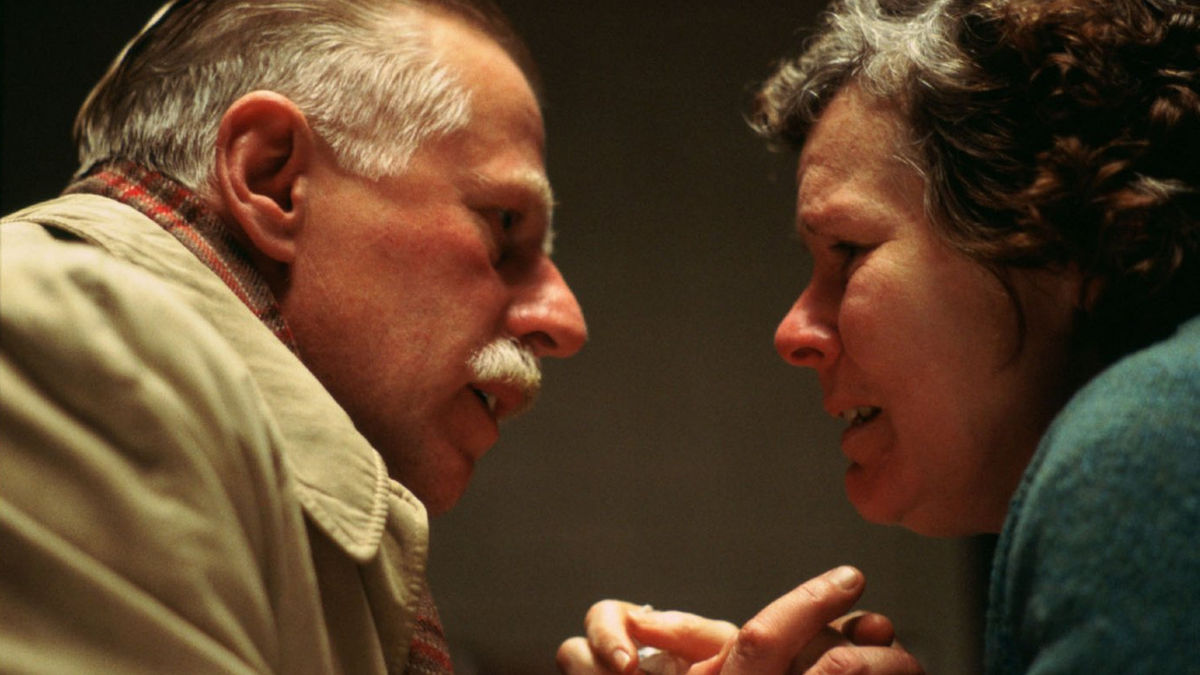
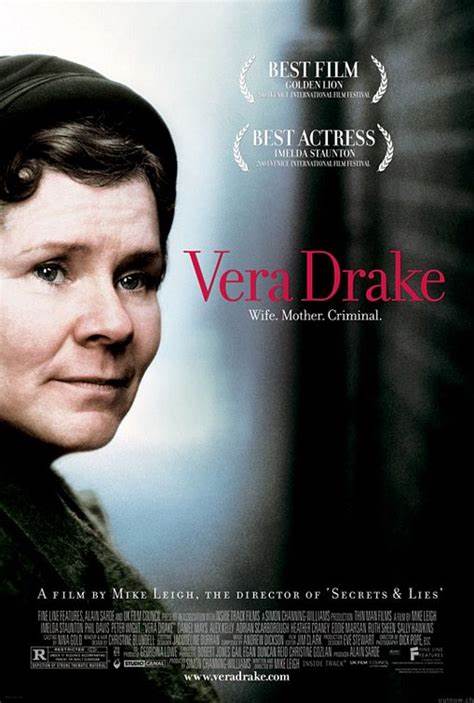
Vera Drake (2004)

Phil Davis and Imelda Staunton are superb in Mike Leigh’s masterpiece Vera Drake

Director: Mike Leigh

Cast: Imelda Staunton (Vera Drake), Phil Davis (Stan Drake), Peter Wight (Inspector Webster), Daniel Mays (Sid Drake), Alex Kelly (Ethel Drake), Eddie Marsan (Reg), Adrian Scarborough (Frank Drake), Heather Craney (Joyce Drake), Sally Hawkins (Susan Wells), Ruth Sheen (Lily), Lesley Sharp (Jessie Barnes), Liz White (Pamela Barnes), Martin Savage (Sergeant Vickers), Helen Coker (WPC Best), Vincent Franklin (Mr Lloyd), Lesley Manville (Mrs Wells), Jim Broadbent (Judge)

If you passed her on the street, you’d be sure to say hello and she’d be sure to ask after your family – and really mean it. She has a kind word for everyone and never thinks about herself. And, as far as the law is concerned, she’s a multiple murderer. Vera Drake mixes warmth and goodness with anger at social injustice and is stuffed with perfectly observed detail and marvellous acting. It might just be Mike Leigh’s masterpiece. Certainly, few other of his films carry such an emotional wallop.

In London in 1950, Vera Drake (Imelda Staunton) spends her life helping those around her and is a devoted wife and mother. But what her husband Stan (Phil Davis) and children Sid (Daniel Mays) and Ethel (Alex Kelly) don’t know is that for decades she has been “helping young girls out” who find themselves unwillingly in the family way. All Vera wants to do is help – but with abortion illegal, her actions are a ticking timebomb, which explodes when Vera is arrested.

Vera Drake is a film about “the family way” – in every sense. Leigh’s unique film-making technique is familiar now: long weeks of research and intensive, improvisational rehearsals help the actors to create fully-fleshed characters who they know so well, they can predict their reactions in any circumstances. During rehearsals, none of the actors in the family knew Staunton was playing an abortionist until the actors playing the police knocked on the door mid-rehearsal – and even Staunton was completely unaware she was to be arrested. The genuine shock the actors felt feeds this intensely powerful scene – and every moment that follows.

In perhaps no other film has Leigh’s technique been more successful: every single character feels completely and utterly real. You could look in any direction and find a character with such a rich hinterland you want to know their stories. Just as intriguing films could be formed around the lives of the young women Vera helps out – Sinead Matthews ‘very young woman’ (and the boyfriend who waits outside), Tilly Vosburgh as a mother of seven with a sick husband, Rosie Cavaliero as a nervous married woman or Vinette Robinson’s scared Jamaican girl – as has been about Vera.

These women have fallen through the cracks – unable to support a family, but deprived any chance of making choices about themselves and bodies. There is a clear social gap – Sally Hawkins gives a sensitive, gentle performance as an upper-class woman, raped by her boyfriend, who obtains an abortion through psychiatric loopholes available only to the rich. No fault of hers – you can imagine she’d be horrified at how others suffer – but for the poor, their only option is Vera. It’s a huge flaw in the system – and removing Vera won’t solve the ‘problem’. It only means women will turn with more desperation to the sort of uncaring sleazy abortionists Denholm Elliott played in Alfie.

The film works because of its tenderness and the raw emotion of the performances. Leigh’s camera is a largely stationary and observatory, but that immerses us in the domestic charm of the first half as much as it does the horrifying coldness of the legal system in the second half. The Drake family home is small and cramped, reflecting their poverty, but also because it feels stuffed with love. Their children – the extremely shy Ethel and her outgoing son Sid – both reflect their intensely loving home, and her husband Stan is full of kindness, generosity and decency.

Leigh carefully demonstrates the warmth of this family. There’s a tear-inducingly sweet romance between Eddie Marsan’s Reg (a beacon of human decency) and the shy Ethel. Stan’s brother Frank (Adrian Scarborough, marvellous) and middle-class wife Joyce (Heather Craney, wonderfully torn in her feelings) struggle to conceive a child. The family laugh and joke together, every day ending in smiles and expressions of love. It’s beautifully immersing and deeply moving – and makes the wait for this world to shatter even more dreadful.

As Vera, Imelda Staunton gives an astonishing performance. A quiet, polite, open-hearted lady whose greatest pleasure is other people’s happiness. Leigh’s film follows her acts of caring around the community – cleaning neighbours houses, looking after her ill mother, inviting lonely newcomer Reg to dinner – showing she applies the same heart-felt but unshowy care to those, as she does to her abortions. It’s twenty minutes before we see one of these, and what’s striking is the well-practised calmness Vera goes about this work, carefully repeating the same reassuring instructions. She never asks for anything (the posh doctor treating Sally Hawkins’ character takes £100). Lily, who puts her in touch with those in need, has no qualms charging £2 without Vera’s knowledge.

Then the arrest comes. This sequence – and the rest that follows – is frankly extraordinary. Staunton’s face when she sees police is a heart-breaking thing of wonder – a horrified realisation that what she has dreaded for decades has finally happened and the realisation that the world as she knew it is over. Throughout she is astoundingly fragile. Barely able to speak, mute with shock – and horrified to hear one of her girls nearly died (it’s never revealed what went wrong). Her first thought is the girls health and how this will ruin her family’s celebration of Ethel’s engagement. So warm and joyful has the first half of the film been, we feel the shocking coldness as the law goes about – albeit with a regret, beautifully underplayed by Peter Wight’s sympathetic detective and Helen Coker’s gentle WPC – the black-and-white business of cataloguing wrongs.

Staunton is extraordinary: she shrinks and diminish, terrified and mortified. The reactions of her family – confused then stunned and in some cases appalled – feel immensely true: some jump forward in support, others in anger. Phil Davis’ deeply moving performance sees Stan suppress his anger under love. Mays’ Sid rages, Heather Craney’s Joyce is resentful, Scarborough’s Frank is a pillar of support, Alex Kelly’s Ethel quietly holds her mother and will not her go. The emotion of this is so affecting as it feels so real: when Reg quietly shows his support and later gently says the disastrous post-arrest Christmas is the finest he has ever had, you’ll feel tears spring to your eyes.

The relentless march of the law is chronicled perfectly by Leigh. This is a director at the top of his game, creating a low-key film that switches on a sixpence from warmth and familial love to shattering emotional impact. Staunton’s performance is breathtakingly brilliant, avoiding all histrionics and will break your heart. The entire cast is astounding. The research and filming is exquisite. The film will quietly devastate you, but also remind you that nothing is more reassuring than the fundamental goodness of people. A beautiful, moving, masterpiece of a film.

Blue Jasmine (2013)

Cate Blanchett dominates the screen in Blue Jasmine

Director: Woody Allen

Cast: Cate Blanchett (Jasmine Francis), Sally Hawkins (Ginger), Alec Baldwin (Hal Francis), Peter Sarsgaard (Dwight Westlake), Louis CK (Al Munsinger), Andrew Dice Clay (Augie), Bobby Cannavale (Chili), Michael Stuhlbarg (Dr Flicker), Aldren Ehrenreich (Danny Francis)

Every so often an actor intersects with a director and, such is the actor’s brilliance, they seem to take the film by the scruff of the neck and almost carry the director along to success. Such is the case with Blue Jasmine, a film so seized upon, so wonderfully played and brilliantly observed by a truly phenomenal (she won every award going) Cate Blanchett, you feel Woody Allen just let the camera record her work and carefully built the film around her.

Allen’s film, easily one of his best of his troubled later years, is a modernised remix of Streetcar Named Desire. After a Ponzi scheme scandal leads to her husband Hal’s (Alec Baldwin) arrest and suicide, Jasmine (Cate Blanchett) finds herself landing in the poor end of San Francisco and sharing a house with her sister Ginger (Sally Hawkins). Ginger’s marriage to Augie (Andrew Dice Clay) collapsed after Hal’s dirty dealings destroyed their lottery win landfall. Jasmine, teetering on the edge of a nervous breakdown, living half in the present and half in an imagined version of her own past, soon clashes with Ginger’s new boyfriend Chili (Bobby Cannavale) and eventually finds hope for a second chance with diplomat Dwight (Peter Sarsgaard) who is oblivious to her background.

The parallels between Blue Jasmine and Streetcar should be pretty clear to anyone reading that summary, and Allen draws some neat modernisation parallels (and thankfully, and wisely, drops the rape plotline that ends that play) between the two. Placing Blanche/Jasmine as the trophy wife of a corrupt businessman, who has shut her eyes to his dealings and let her own intellect drain away in shallow frippery, works really well. Not least dramatizing very well the cultural shift from this extreme wealth (detailed in a series of cleverly interwoven flashbacks) to the relative poverty of normal life.

But the film really works from the super-intelligent, hyper-brilliant, eye-catching wonderfulness of Cate Blanchett in the lead role. This is one of those performances for the ages, a tour-de-force of fragility, self-pity, self-deception, hostility, undirected anger, desperation and pain that dominates and shapes the entire movie. Blanchett is particularly effective because she never, ever overplays the role, but let’s these complex, contradictory emotions play constantly behind her eyes and slowly seem to dribble out until they dominate her entire body. Several times, Allen plants the camera and allows us to simply watch Blanchett go through various stages of mental collapse in front of our very eyes, with this amazing actress able to seemingly fall apart in slow motion in front of us.

Jasmine is a complex and fascinating character, in some ways hugely unsympathetic. She’s a massive snob, she certainly feels the world owes her something (she flies into San Francisco first class complaining she has had to sell everything just to make ends meet, while dragging Louis Vuitton luggage behind her), she lies when she needs to and treats everyone around her with a slight air of condescension. But she’s also  incredibly vulnerable, and carrying a great deal of guilt and pain, as well as only barely able to deal not only with the loss of her privileged lifestyle, but also her growing (but denied) realisation that the price of the lifestyle wasn’t worth the having it. 

The film throws her into a series of contexts that show her at her best and worst, as victim and as fantasist. Getting a job at a dentist’s reception desk – a job she seems to only barely have the patience or aptitude for – she is forced to see off the unwelcome advances of her creepy boss (played with a passive aggressive sleaziness by Michael Stuhlbarg) with horror. Later though, she wilfully deceives Dwight (a fine performance of assured arrogance by Peter Sarsgaard) about her background and character. She is partly right in her assessment of her sister Ginger having a very low opinion of herself, so only pairing herself with men who treat her badly; but Chili is also right about her having no regard or time for her sister when she was wealthy.

The use of flashbacks throughout the film works very well to show us Jasmine before and after her economic crash. What’s fascinating is that her fragility is an ever-present, kept suppressed under a shower of gifts, but quickly coming to the fore when Hal’s (has there been a better role for Baldwin than this jovial, greedy cheat?) serial infidelity is bought to her attention. It also serves to remind us to keep Jasmine at a certain distance, her own evaluations of what her past life was like frequently not squaring with the version we see.

All of this hinges on Blanchett’s brilliant work, but she’s not alone in delivering a fine performance. As her blousy sister, moving like a weathervane from person to person, changing her opinions quickly depending on her recent experiences, Sally Hawkins is possibly at her best here as well. Andrew Dice Clay is excellent as an honest Joe who hovers over the film like an object of destiny. Bobby Cannavale does some very good work as a feckless but sort-of honest Stanley Kowalski.

Allen’s direction is calm and almost in awe of Blanchett, and that’s fair enough because whatever you look at, it comes back to her striking genius in the film. Blue Jasmine may remove some of the depth that Blanche has (with her life of pain and guilt in the play’s backstory) but it substitutes that with a gripping exploration of a long-running mental collapse that is so movingly and superbly brought to life by Blanchett you can’t help but be engrossed by it.

Made in Dagenham (2010)

Up the Women! British comedy wallows in nostalgia but tells a still relevant tale of sexual equality

Director: Nigel Cole

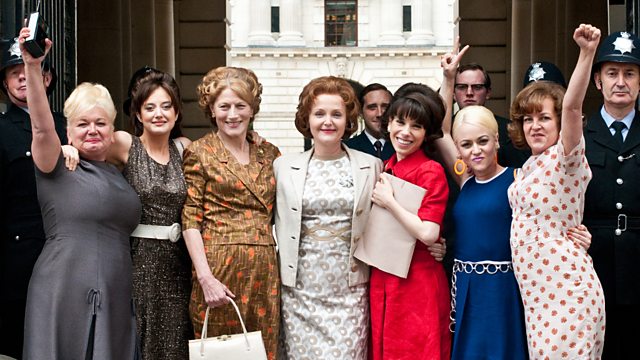
Cast: Sally Hawkins (Rita O’Grady), Bob Hoskins (Albert), Miranda Richardson (Barbara Castle), Geraldine James (Connie), Rosamund Pike (Lisa Hopkins), Andrea Riseborough (Brenda), Jamie Winstone (Sandra), Daniel Mays (Eddie O’Grady), Richard Schiff (Robert Tooley), Rupert Graves (Peter Hopkins), Kenneth Cranham (Monty Taylor), Nicola Duffett (Eileen), Lorraine Stanley (Monica), Roger Lloyd-Pack (George), Andrew Lincoln (Mr Clarke)

You’d like to think a film made ten years ago about a strike for equal pay in the 1960s would be more of a history piece than something that still carries real relevance today. But this is still a world where women are often paid less than a man, and where their work is often devalued or held as less “important” than their male counterparts. Made in Dagenham looks at all these issues with a rose-tinted, feel-good stance that aims to entertain first and make you think second. Nothing wrong with that, but it means the film is largely just a crowd-pleaser, when you feel it could be more.

At the Ford factory in Dagenham, the female sewing machinists are not paid as skilled workers, and are forced to accept less work. Frustrated at the patronising attitude from their all-male union reps, and encouraged by foreman Albert (Bob Hoskins, lovely in one of his cuddliest performances), the women decide to go on strike for equal play, led by Rita O’Grady (Sally Hawkins). As public attention builds, the Ford owners in America mobilise for a battle and the strike attracts the interest of Secretary for Employment Barbara Castle (Miranda Richardson), someone who knows the struggles a woman faces in a man’s world.

It’s no great surprise based on the fluffy, charming tone of this film that Nigel Cole’s previous credit was Calendar Girls. (Also no surprise that, like that film, this has been turned into a crowd-pleasing stage musical.) William Ivory’s script deftly sketches out some familiar movie-dynamics for its characters, establishes clear heroes and villains, gives us a good sprinkling of information and “things to think about”, mixes in at least one tragic sub-plot and provides a steady stream of high points, heart-string tugging moments and punch the air moments. As a piece of writing playing to the masses, it’s pretty flawless.

It’s in love with the 1960s details, with nostalgia dialled up to 11, with a love of the look, feel and styles of the era and plenty of sound cues mixed in that will have you tapping your toes. It’s all designed for you to have fun, and if that means some of the deeper questions get a bit lost at points, that doesn’t really matter. 

And there is more than enough enjoyable material to be seen in setting up a series of bigoted or patronising men (gamely played principally by Kenneth Cranham and Rupert Graves) and seeing them knocked down. You could argue that a slightly braver film would touch at the implications of what Richard Schiff’s corporate big-hitter says about equal pay: make it more expensive to make cars here and we will make our cars somewhere else. (In fact it was pretty hard to forget that, watching the film today, as Brexit has already caused at least three major car factory closures in the UK. In fact the film is very happy to talk all about equal pay for women in the Western World but never even raises the question of how we are quite content to have people in the third world slave away in conditions far worse than this for a few pennies an hour.) But that’s not the film’s point, and instead it’s all about those male-female relationships. 

Sally Hawkins does a good job as a woman slowly growing a social and political awareness and then turning that new-found enlightenment on her own domestic life with well-meaning but of-his-time husband Eddie (a sweet but cluelessly sexist Daniel Mays). It’s all conventional stuff, but Hawkins and Mays play it very well.

The real meat actually comes from plotlines elsewhere. Rosamund Pike is excellent as a woman with a first in history from Oxford, reduced to wheeling out nibbles for her patronising husband and keeping her ideas to herself. Geraldine James and Roger Lloyd-Pack get the tragic plotline of a couple struggling with his post-war undiagnosed PTSD, which gets most of the heart-string tugging. 

Eventually all is made well by Miranda Richardson’s Barbara Castle, floating into the picture to wave a magic wand and save the women’s bacon. Richardson thoroughly enjoys herself in a rather cardboard role, at least two scenes of which are solid exposition, in which Castle’s lecturing of two uppity civil servants is used to introduce the political context. By the end you won’t be surprised that good triumphs. But it’s a film which largely only looks to put a smile on your face, and doesn’t really look at the wider implications or injustices of unequal pay. To the film’s credit it has a final montage of the real Ford women talking about their lives and the battles they had to be respected, which gives it a bit of extra depth. A truly brave film would have found a few minutes – and that’s all it really needs – to look at the wider issues (then and today) economically and socially, and to make us think a little. As it is this just entertains, which is what you want, but it could be more.

Godzilla (2014)

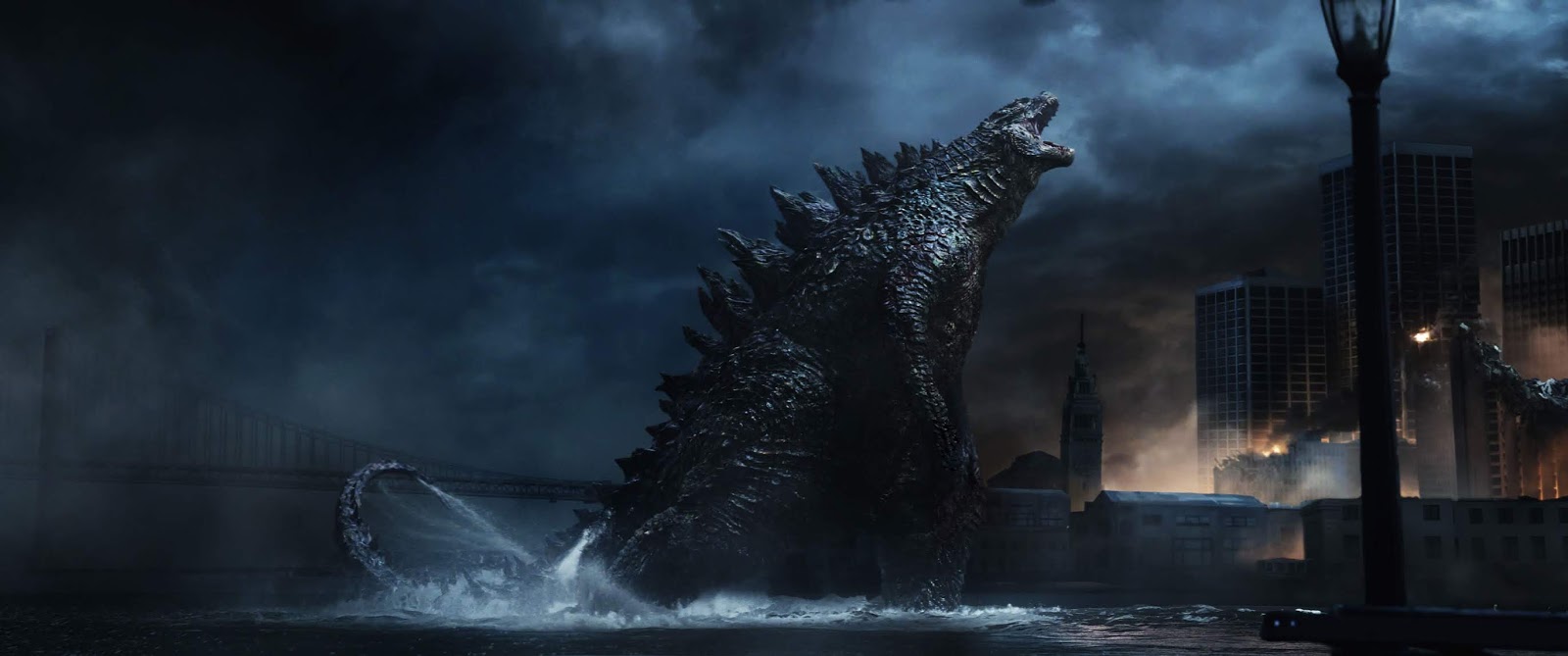
Godzilla the only character this film is truly interested in.

Director: Gareth Edwards

Cast: Aaron Taylor-Johnson (Ford Brody), Ken Watanabe (Dr Ishiro Serizawa), Bryan Cranston (Joe Brody), Elisabeth Olsen (Elle Brody), Juliette Binoche (Sandra Brody), Sally Hawkins (Dr Vivienne Graham), David Strathairn (Admiral William Stenz)

There is a lot of affection out there for Godzilla. I’ve never quite felt it myself, so I guess I was the wrong person to watch this film. This is a film celebrating the legend of a series of films from Japan about a guy in a rubber suit hitting other guys in rubber suits in a set designed to look like a miniature city. Gareth Edwards’ has directed an affectionate homage that at times flirts with being a more interesting film but never really commits to it.

In 1999, Joe Brody (Bryan Cranston) is forced to watch his wife Sandra (Juliette Binoche) die in front of him in a mysterious accident at the nuclear plant in Japan they work at. Fifteen years later, his now grown-up estranged son Ford (Aaron Taylor-Johnson), a bomb disposal expert, is called to Japan after Joe trespasses into the exclusion zone. There Ford and Joe discover there is no fall-out at the accident site – and that the accident was actually linked to a series of mighty beasts from prehistoric times who feed off radiation. The beasts are being investigated and monitored by a global organisation called Monarch – and they are starting to stir. Soon cities are at risk and our only chance of survival may be from alpha-predator Godzilla bashing the other monster out of existence.

Godzilla starts with a brilliant human interest story – a husband forced to sacrifice his wife to save hundreds of thousands of others. But around the halfway mark it loses all interest in its human characters, who become mere spectators to the mighty monsters hitting each other. By the final act, your interest in the action will depend on how much you can invest in a huge CGI monster hitting another huge CGI monster. With nary a character in sight, I’m not sure how much I could. 

Gareth Edwards does a good job directing the film. It’s intelligently and imaginatively framed and Edwards shows some wonderful restraint in showing Godzilla himself, gently avoiding showing too much too soon (the monster doesn’t appear full in camera for well over an hour into the film). In fact, Edwards has a lot more interest in showing the perspective of ordinary people watching the rampage, running or simply standing in awe starring upwards at these mighty beasts. It immediately hammers home the scale and awe of these creatures. Edwards often films from the perspective of those on the ground, with the camera craning upwards seeing the colossal beasts.

It’s a shame that the film doesn’t lavish as much attention on the cardboard cut-out characters who are running around beneath the beasts. A fine company of actors are assembled, most of whom are relegated for much of the first half of the film to spouting exposition and the second half of the film to staring upwards in awe. Remember when Edwards made his breakthrough film Monsters? This film, sure, had monsters in it but it was a human interest story about two very different people thrown together after cataclysmic events. Edwards’ film worked because it was above all about people and their problems. Hollywood came calling.

And Hollywood of course missed the point. Edwards is a director who I think has some truly interesting work in him. Watch the scene as Cranston is forced to slam the safety doors on Binoche. This is a scene crammed with more drama, emotional investment and tragedy than the whole of the rest of the runtimes of Godzilla and Edwards’ Rogue One. Both of those films are well-made but derivative bits of geek chic, pandering towards the crowds by giving them parts of what they think they want, homage-stuffed retreads of other films that focus on bashes and toys rather than on people and characters. Edwards is becoming a purveyor of B-movie thrills, well made, but basically empty. 

That’s your Godzilla movie here. Well-made but rubbish. Full of spectacle wonderfully filmed, but fundamentally empty. A film that is careful about what it shows you and when, but is basically lacking any real soul.

The Shape of Water (2017)


Sally Hawkins and Octavia Spencer work together to save a misunderstood creature in The Shape of Water

Director: Guillermo del Toro

Cast: Sally Hawkins (Elisa Esposito), Michael Shannon (Colonel Richard Strickland), Richard Jenkins (Giles), Doug Jones (The Creature), Michael Stuhlbarg (Dr Robert Hoffstetler), Octavia Spencer (Zelda Delilah Fuller), Nick Searcy (General Frank Hoyt), David Hewlett (Fleming), Lauren Lee Smith (Elaine Strickland)

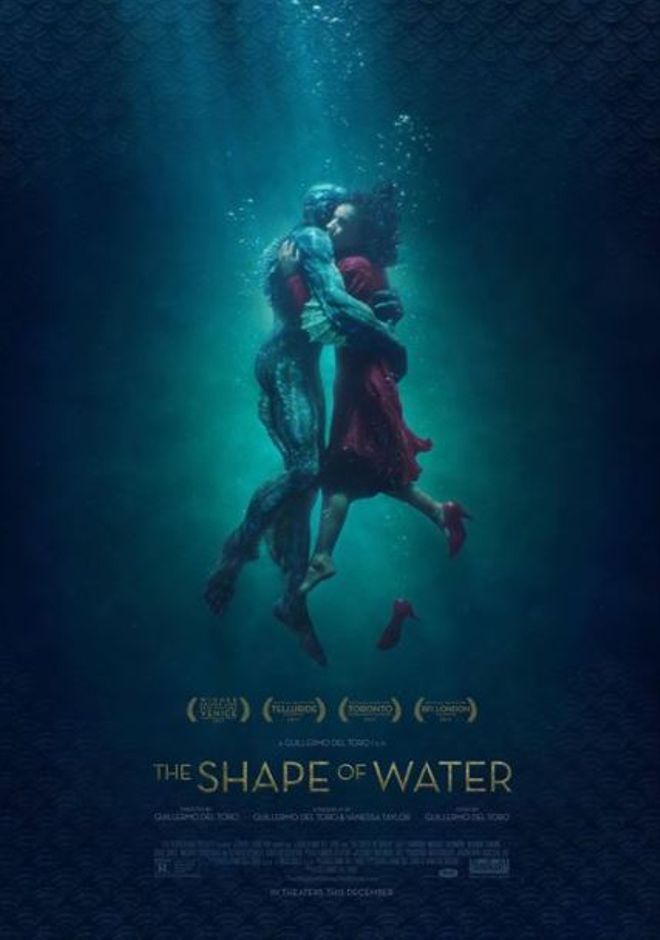
Guillermo del Toro: part arthouse director, part thumping action director, who else could have made both Pan’s Labyrinth and Pacific Rim? The Shape of Water falls firmly into the former category, and continues the director’s long-standing interest in fairy-tales and fables, creating adult bedtime stories filled with romance and wonder, but laced with violence and human horror (and it’s always the humans who are the monsters). The Shape of Water has been garlanded with huge praise – but yet I’m not quite sure about it. Just not quite sure.

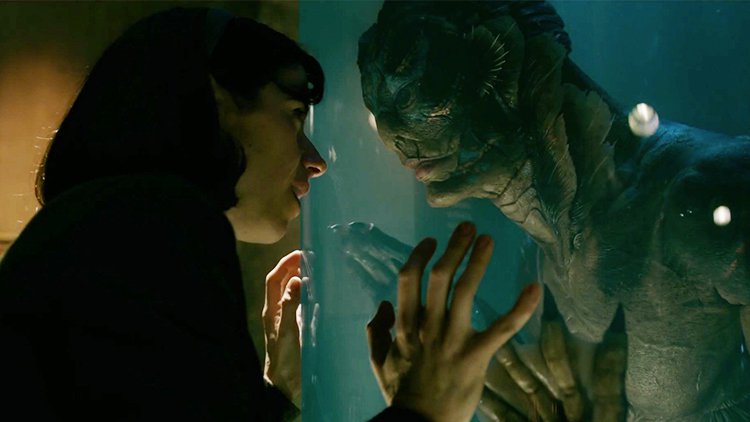
In 1962 in Baltimore, Elisa Esposito (Sally Hawkins) is a mute cleaner working in a government facility with her colleague, friend and effective translator Zelda (Octavia Spencer). Her only other friend is her neighbour, a gay out-of-work advert artist Giles (Richard Jenkins). The research facility takes delivery of a strange amphibious creature (Doug Jones), captured in the wild by sinister CIA man Richard Strickland (Michael Shannon). While Strickland and lead scientist Dr Hoffstetler (Michael Stuhlbarg) conduct tests on the creature, Elisa befriends it – the two of them drawn together by their isolation and inability to communicate verbally. When the decision comes from above to dissect the creature, Elisa decides to help it escape. 

The Shape of Wateris an adult fairy-tale that uses the structure, rules and heightened reality of the bedtime story. So we have Elisa as “the Princess without a voice”, the government facility as the evil castle, the creature as a mixture of damsel in distress and knight errant, and Michael Shannon’s vile government spook as a sort of perverted evil Queen. While the film is set in 1962, it’s aiming for a fantasy world feeling: Elisa and Giles even live above an old-school movie cinema, while the facility itself is a dank, subterranean concrete prison, part medieval dungeon, part industrial complex, dressed in a retro-1950s style. There’s no denying the film looks fantastically impressive.

The plot hinges on the growing bond between Elisa and the creature, which flourishes first into a mutual friendship, then semi-romance and finally into a full-blown relationship. If there is one part of the movie which I felt didn’t quite work, it was the build between friendship and love. While del Toro does some excellent work showing these two bonding over a common lack of language – she teaches him some basic sign language, they both share a love of music – I felt the jump between friendship and sexual attraction seemed a little big.

Del Toro films it all beautifully – and his empathy for both characters is very moving. But the film wants us to feel this deep connection for (and between) the two characters – and I’m just not sure I did. I’m not sure the film gives the time it needs for this development. Great as Michael Stuhlbarg’s (and excellent as his conflicted performance is) character is, could the film have removed his sub-plot and invested more time in the relationship? Yes it could – and I think this could have made a stronger movie. This is of course a personal reaction – I’m sure plenty of people will be bowled over by the romance of the film – but I didn’t quite buy it. For all the soulfulness of the film, I just didn’t find myself investing in this relationship as it built as much as I should.

This is despite Sally Hawkins’ expressive acting as Elisa. I find Hawkins a bit of an acquired taste: she is a little too twee, something about her eyes and vulnerable smile is a little too head-girlish. Of course that sprightly gentleness works perfectly here, but the character is more interesting when del Toro explores her depths, her desire and well-concealed resentfulness under a cheery exterior (practically the first thing we see her do is masturbate in the bath – a daily ritual timed to the second via egg timer, functionally getting these feelings out of the way before the day ahead). Hawkins mixes this gentle exterior and passionate interior extremely well throughout the film.

The principal supports are also excellent. It’s no coincidence that del Toro makes our heroes all outsiders: a mute, a black servant and an ageing gay man. As well as showing why these characters might be drawn together, it’s also a neat parallel commentary on attitudes of the time – Octavia Spencer in particular makes a huge amount out of a character that is effectively a voice for Elisa half the time, investing the part with a huge sisterly warmth.

Richard Jenkins is both very funny and rather sweet as a man scared of being alone and frightened about doing the right thing. Most of the film’s laughs come from him – but so does a large degree of its heart. Jenkins gets some fantastic material – from hints that he has been fired for social and sexual misdemeanors from his Mad Men-ish former job, to his growing realisation that his hand-drawn art is being left behind in a world embracing photography (“I think it’s my best work” has never sounded like a sadder mantra), and above all his hopelessly sad infatuation with the friendly barman at a local diner (the sort of hopeless crush you feel he must realise isn’t going to go anywhere good – but still manages to be endearing before it gets there).

Del Toro’s dreamy fable has plenty of potential monsters and obstacles in it – from government suits to Russian heavies – but the main antagonist is Shannon’s Strickland. Great as Shannon is in this role as a menacing heavy with a hinterland of insecurities and self-doubt, it’s a character that feels a little obvious. He’s the monster, you see! It’s a heavy-handedness the film sometimes uses – not least in its occasional references to the race politics of the era – that weights the deck, and tries to do a little too much of the work for the audience. Again, a film with one fewer sub-plot might have allowed this character greater depth. As it is, his vileness is established from the first second, which means the metaphor of his hand with its increasingly rotten, gangrenous fingers seems a little to on-the-nose.

But The Shape of Water is a labour of love, and a testament to love – and del Toro reminds us all what a luscious and romantic filmmaker he can be. The later romantic moments between Elisa and the Creature have a beauty to them – not least the moments when they immerse themselves together in water. Other moments are too obvious: an imagined song-and-dance routine is so signposted in advance that it carries little emotional impact. In fact, the film’s main fault may be it is too predictable: most of its plot developments I worked out within the first few minutes – but it sort of still works. After all, fairy-tales are predictable aren’t they?

Del Toro has made one from the heart here. It’s not a perfect film – it’s not a masterpiece, and I think it’s a less complex and affecting work than the brilliant Pan’s Labyrinth – but it’s made with a lot of love and a lot of lyrical romanticism. It looks absolutely astounding. It’s actually surprisingly funny and wonderfully acted: Richard Jenkins probably stands out, and my respect for Octavia Spencer continues to grow. Del Toro is gifted filmmaker, and he is working overtime here to make a romantic, sweeping, monster movie cum adult fairy-tale. All the ingredients are there: but somehow I didn’t fall in love. Did I miss it? Maybe I did. And I can’t think of much higher praise than I’m more than willing to go back and look again and see if I get more of a bond with it next time. But, for all its moments of genius, I found the delight was on the margins rather than the centre.

An Education (2009)


First love: Never as smooth as you think it will be

Director: Lone Scherfig

Cast: Carey Mulligan (Jenny Mellor), Peter Sarsgaard (David Goldman), Dominic Cooper (Danny), Rosamund Pike (Helen), Alfred Molina (Jack Mellor), Cara Seymour (Marjorie Mellor), Emma Thompson (Miss Walters), Olivia Williams (Miss Stubbs), Sally Hawkins (Sarah), Ellie Kendrick (Tina)

The education in question is the first sexual relationship of a girl who is 16 going on 17. Jenny (Carey Mulligan) is a schoolgirl and prospective Oxford candidate who finds herself winning the attention of charming older man David (Peter Sarsgaard). Jenny is swept off her feet by the world of classy bars, art and culture David introduces her to and begins to lose interest in her literal education: if all education can do is turn women into either lawyers’ wives or teachers what is the point?

Strangely for a film based on a man approaching middle-age taking advantage of a naïve and excited teenager, it’s strangely cosy and charming, with the whiff of “safe” family viewing. Nothing wrong with that of course, but the whole confection is just a little too slight, a little too well packaged, a little too carefully and thoughtfully put together to really leave a lasting impression. Instead it’s an enjoyable enough 90 minutes which doesn’t really have anything that stays with you.

What it does have going for it above all is the marvellous lead performance from Carey Mulligan. At the time best known for appearing in the Blink episode of Doctor Who, Mulligan cements her early promise by demonstrating what a charismatic and vibrant performer she is. Jenny delights in the ease with which David deceives everyone without it ever occurring to her that he might be lying to her, and this teenage arrogance could easily be smackably annoying – but Mulligan makes her deeply engaging and loveable. You want to protect her from making an irrevocable decision that will ruin her life at 16 (sort of the opposite to Bella in Twilight). But Mulligan’s endearingly engaging performance sweeps the audience up into Jenny’s fascination with the exciting life David seems to be offering, and makes you understand why she believes it to be a viable option. She’s a radiant centre to the film and it’s almost impossible to imagine it working at all without her.

It is in fact very well-acted throughout. Sarsgaard underplays the role, suggesting the underlying shallowness and weakness to David which is far clearer to the audience than the characters. The supporting cast are knock-outs: Rosamund Pike is hilarious as a sweet airhead, Alfred Molina embodies the gullibility of the striving middle-classes mixed with great reserves of unspoken love and affection, Olivia Williams is terrific in an underwritten part as Jenny’s concerned teacher.

It’s strange watching the film to see how it romanticizes the sort of behaviour that, if we encountered it today, would be denounced as grooming at best, paedophilia at worst. In fact, the film soft-peddles a lot of the unpleasantness of its characters: David and Danny, it is clear, are conmen and swindlers, though I suspect the film wants us to think of them more as charming rogues. I suppose it’s the impact of seeing the story from Jenny’s perspective, but some more outside commentary would perhaps have been interesting: it also might have been more interesting to see Jenny actually having to deal with the moral consequences of some of the actions that happen around her. 

This is a slight affair, almost a shaggy dog story. There are many more things it could have explored (the swindling career of David, the role of women in the 1960s, the changing perceptions of “blue stockings” and their career options) but instead it settles for being a charming period piece. It makes no secret of the fact that, deep down, we are not meant to trust David and nothing in the plot ever really surprises you. It’s a gentle amble through an ill-advised teenage romance. But, despite all that, it’s very well acted and Carey Mulligan proves she was set to become a star.