
Tag: Sam Reid

The Railway Man (2013)

Colin Firth is haunted by the past in The Railway Man

Director: Jonathan Teplitzky

Cast: Colin Firth (Eric Lomax), Nicole Kidman (Patricia Lomax), Stellan Skarsgård (Finlay), Hiroyuki Sanada (Takashi Nagase), Jeremy Irvine (Young Eric Lomax), Sam Reid (Young Finlay), Tanroh Ishida (Young Takashi Nagase)
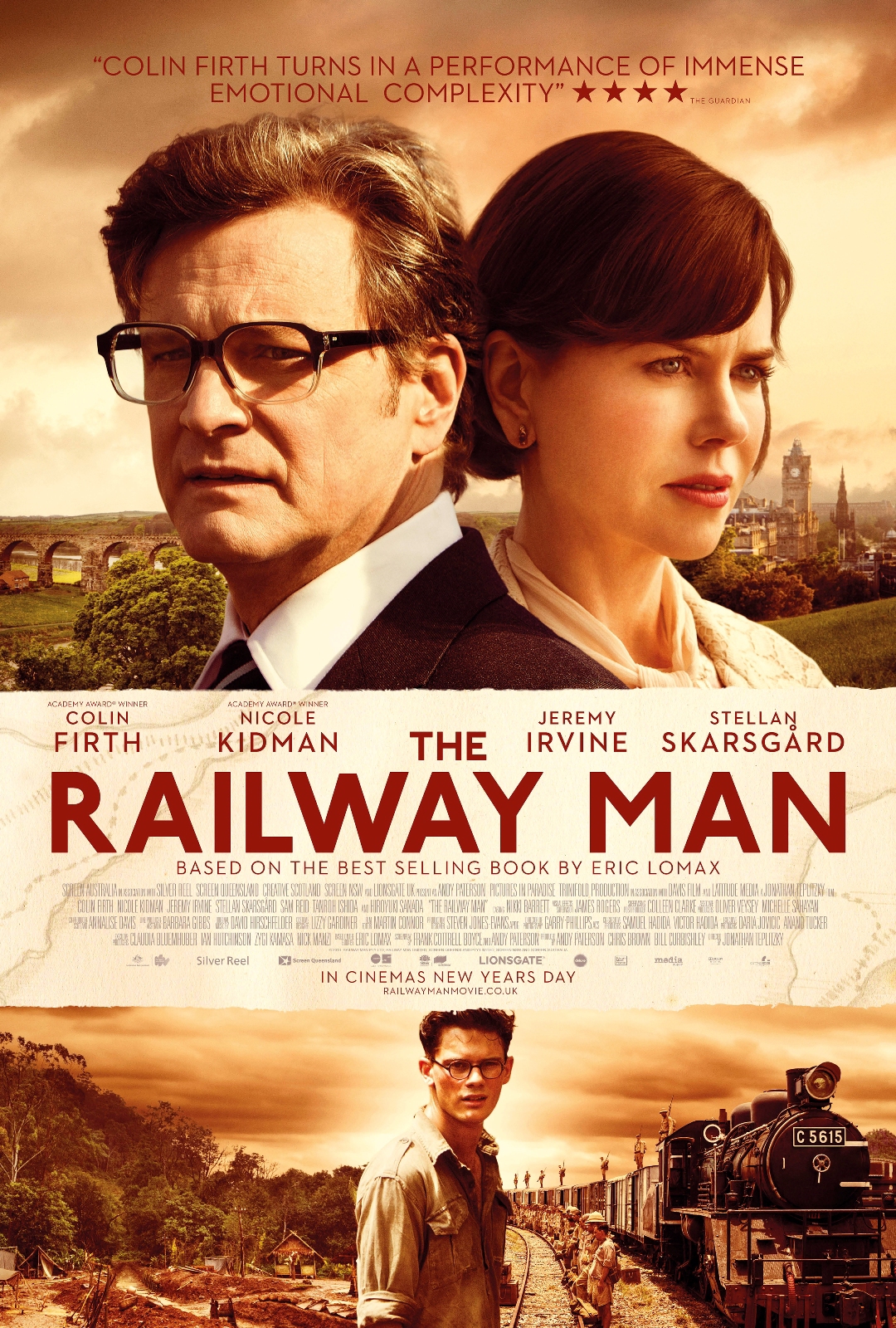
There is perhaps nothing harder to do in life than to put the past behind you and forgive. We all seem to be hot wired to want revenge and to seek it against all odds. It’s rare indeed the man who learns to put the rage against the past behind him and to extend the hand of friendship.

Such a man was Eric Lomax (played here by Colin Firth). In the 1970s Eric meets and falls in love with Patricia (Nicole Kidman). The two are married, but Patricia soon discovers Eric is still plagued by memories of his imprisonment as a young man (played by Jeremy Irvine) by the Japanese during the Second World War, and in particular a prolonged period he spent being tortured by the Japanese secret police for building a radio. Lomax is unable to begin to talk about his experiences, even as trauma causes his life to deteriorate. Fellow ex-POW Finlay (Stellan Skarsgård – very good in a small but vital role) is the only one who has even the faintest idea of his experience, but cannot persuade him to even speak about his past or try and move on. After discovering his torturer Takashi Nagase (Hiroyuki Sanada) is alive and well and working as a tourist guide in the very camp where Lomax was tortured, he travels to Japan, torn about what he should do.

Teplitzy’s film is powered by several marvellous performances, not least Colin Firth who is excellent in the lead role as the deeply repressed, tormented Lomax who in his heart has never left the prison where he suffered unbelievable torment. The film is a carefully structured, and deeply moving, character study of how atrocious and inhumane actions trap us all – both the victims and perpetrators – in patterns of suffering where we feel our own humanity drain away. Even handed, honest and generous, like Lomax’s book, it’s an engaging and moving tribute to the strength of the human spirit and our capacity for generosity.

Not least because when we finally meet the aged Nagase, he is far from the monster we expected. Like Lomax he too is haunted by the past, but where Lomax cannot escape the horrors he suffered, Nagase is plagued by guilt and disgust as he realises his actions as a young man were far from those of a righteous soldier, but rather a brainwashed pawn in a brutal army. Nagase, like Lomax, is desperate to purge himself of memories of this past, and has worked his whole life to try and make amends for the suffering he has caused. No simple good guys and bad guys here – both torturer and tortured are dehumanised, scarred and traumatised by the actions they have carried out. 

Teplitzky films that torture with an unflinching honesty, that leaves you in no doubt about why it has had such impact on Lomax. Jeremy Irvine is very good as the young Lomax, scared, vulnerable but brave and self-sacrificing who puts himself in the way of danger to try and protect his friends and then goes through savage beatings, interrogations and water boarding for information he doesn’t have. It’s difficult to watch, but never sensationalised and the traumatic pointlessness of these methods is abundantly clear. 

These memories, slowly revealed, are all too apparent in any case in Firth’s blasted face.  The film slowly reveals his psychological damage, with the opening sequence in fact suggesting a far lighter film ahead. The opening follows the meeting of Lomax and Patricia on a chance train journey. Playful and charming, these scenes work so well due to the wonderful chemistry between Firth and Kidman. It plays off in spadeas the plot gets darker and more disturbing. Kidman is very easy to overlook here in the “wife” role, but she invests it with an emotional honesty, a supportive woman eventually driven to the edge of her capabilities.

After the lightness of the opening, Terplitzky introduces the past literally like ghosts, with Lomax caught in a sudden delusion of himself being dragged through the hotel on his honeymoon, screaming in panic, to be carried to his torture danger. Throughout the film, the image of his torturer as a young man appears at various points (including at one point in a field as a train passes behind him), a constant reminder of how the past is here and now for Lomax.

It builds towards a sensational series of scenes as Lomax confronts Nagase, powered by two exceptional performances from Firth (barely able to control his anger, rage and pain) and a beaten down, distressed performance of shame from Hiroyuki Sanada, who matches him step for step. Sanada is superb as a man who confronts his nightmare – a man from his past – but also overwhelmed with the opportunity this gives him for amends. 

That’s what the film captures so well. This tension between past and present encapsulates the universal theme of our desire for revenge and our human need to connect coming together. Lomax and Nagase had every reason to kill each other, but their reaction to seeing each other is surprising, moving and a deep tribute to the human capacity to connect and move on. Grief and the past will destroy us all if we let it. The heroic examples of both Lomax and Nagase show us this doesn’t need to be the case.

Belle (2013)


Gugu Mbatha-Raw is the mixed race daughter making waves in society in Amma Asante’s underwhelming pseudo-historical film Belle

Director: Amma Asante

Cast: Gugu Mbatha-Raw (Dido Elizabeth Belle), Tom Wilkinson (William Murray, Lord Mansfield), Sam Reid (John Davinier), Emily Watson (Lady Elizabeth Mansfield), Sarah Gadon (Lady Elizabeth Murray), Miranda Richardson (Lady Ashford), Penelope Wilton (Lady Mary Murray), Tom Felton (James Ashford), James Norton (Oliver Ashford), Matthew Goode (Captain Sir John Lindsay), Alex Jennings (Lord Ashford)

The British film industry produces a constant stream of costume dramas, many covering alarmingly similar ground on the aristocracy or wealthy of the Georgian period onwards. It’s to be commended then that Belle takes a similar plot, but from a radically different direction. Here, a famous real painting of a white and mixed-race pair of ladies becomes the jumping off point for a drama about an illegitimate mixed-race daughter of a wealthy family.

Dido Elizabeth Belle (Gugu Mbatha-Raw) is the daughter of naval captain and a slave in the West Indies. After his death, she his raised by her uncle William Murray (Tom Wilkinson), Earl of Mansfield, and his wife (Emily Watson) to raise her as their own alongside their niece Elizabeth (Sarah Gadron). Belle is treated as an equal among the family, but is not allowed to dine with guests or move freely in society. However, Belle has inherited a fortune from her father – unlike Elizabeth – and quickly finds herself a source of interest from the younger sons of the nobility. Meanwhile Lord Mansfield, the Chief Justice, is asked to rule on the slave ship Zorg case (where slavers threw their slaves overboard in a storm), a case that brings passionate abolitionist John Davinier (Sam Reid) into Belle’s life and makes her start to re-evaluate society’s attitude to her.

Belle is a formulaic costume drama, given an imaginative twist by placing a black woman at its heart. It explores issues around the imbalanced attitudes of British society at the time (and since), and the hypocrisy and racism that bubbles under the surface of the British gentry. Belle is rejected by all and sundry – until knowledge of her wealth becomes known, at which point many of these objections are choked back to secure her money. The film gets much mileage out of Belle slowly comparing her position first to the black servants around her and then to the slaves who lost their lives on the Zorg.

However, what undermines Belle is that it is a work of fiction – and it feels like it’s hiding it. What we do know about the real Belle (which isn’t much) doesn’t relate at all to what we see in the film. She wasn’t an heiress. She didn’t fall in love with an abolitionist lawyer – Davinier was not the aspiring son of a cleric, but a French steward. Elizabeth probably wasn’t a penniless relative. Mansfield’s credentials as a proto-Abolitionist and reformer were never in doubt – by the time of the Zorg case he had already passed a ruling 10 years earlier that there was no basis for slavery in British law. Belle actually lived in Mansfield’s house until his death as effectively a housekeeper and semi-secretary (the very fate she rejects in the film). The film’s lack of interest in historical fact even affects small details – at one point James Norton’s pleasant but empty Oliver boasts his father has purchased him a commission as a Captain in the Navy, virtually the only institution in Georgian England which promoted solely on merit! (This annoyed me a lot more than it should have.) 

Belle is not a true story by a long stretch – but that doesn’t stop it proclaiming a “what happened next” series of captions at the end. It could have got away with this in a way other non-historical films have, if its story itself was more compelling. But instead Belle offers a merely serviceable story, offering a unique prospective on the aristocracy but largely using it to tell a fairly conventional “love across the social divide” story. Honestly, for large chunks of the film you could replace Belle with any slightly shameful second daughter, and the story would remain largely the same.

Which is a shame because it feels like it wastes something really interesting – and also wastes Mbatha-Raw’s star-making turn. She is excellent – sweet and naïve, but growing in confidence, determination and wisdom, gaining the strength of will to shape her own destiny. The film introduces interesting themes as Belle begins to question the attitudes of her family – do they accept her because they must? Would they be as open to a black stranger? – but these themes don’t quite coalesce into something really solid and coherent. Instead they are trotted out, but we don’t really feel we learn anything.

Similarly, the case of the slave ship Zorg seems rather loosely defined. We don’t get a real sense of public pressure or interest in the case, or really understand the essentials of what the case involved. Instead, it’s used primarily as a tool to question the attitudes of Lord Mansfield, and whether he has the ability to expand his obvious love for Belle into a wider statement of man’s equality. Tom Wilkinson is very good as Mansfield – prickly, but essentially decent and caring under a gruff surface – even if the role can hardly be a challenge for him. But the film doesn’t really manage to make a really compelling argument about what it is trying to say, other than slavery is of course bad.

Elsewhere, the film takes simple shots and shoots fish in the barrel. The Ashton family are introduced to stand in for British society. Lord Ashton is brisk and businesslike and interested only in maintaining the status quo. Lady Ashton – played by Miranda Richardson at her most coldly standoffish – only cares about securing wealth for sons. Of those sons, James Norton gets the most interesting part as the decent but shallow Oliver. Poor Tom Felton though: his character might as well be Draco Malfoy in period costume, all but spitting out ‘Mudblood’ at Belle. None of these performances offer anything different from what we’ve seen before.

That’s part of the problem with Belle – it wastes an interesting idea by slowly turning it into a more conventional story, primarily focused on who is Belle going to marry, rather than the implications of a black woman in a racist society, or the hypocrisy of that society being only willing to accept her when she has money. Despite some good acting – Penelope Wilton and Emily Watson also give tender performances – and a star-turn in the lead, it’s not really that interesting a film. You keep expecting it to burst into life, but it never does: for such a film offering a fresh perspective on history, you don’t feel like you’ve learned anything new about Georgian society at the end of it.