
Tag: Samuel Fuller

Hell and High Water (1954)

Hell and High Water (1954)

Action below the waves in this dutiful, for-the-money thriller from Samuel Fuller that lacks imagination or freshness

Director: Samuel Fuller

Cast: Richard Widmark (Captain Adam Jones), Bella Darvi (Professor Denise Gerard), Victor Francen (Professor Montel), Cameron Mitchell (“Ski” Brodski), Gene Evans (Chief Holter), David Wayne (Tugboat Walker), Stephen Bekassy (Neumann), Richard Loo (Hakada Fujimori), Wong Artarne (Chin Lee), Henry Kulky (Gunner McCrossin)
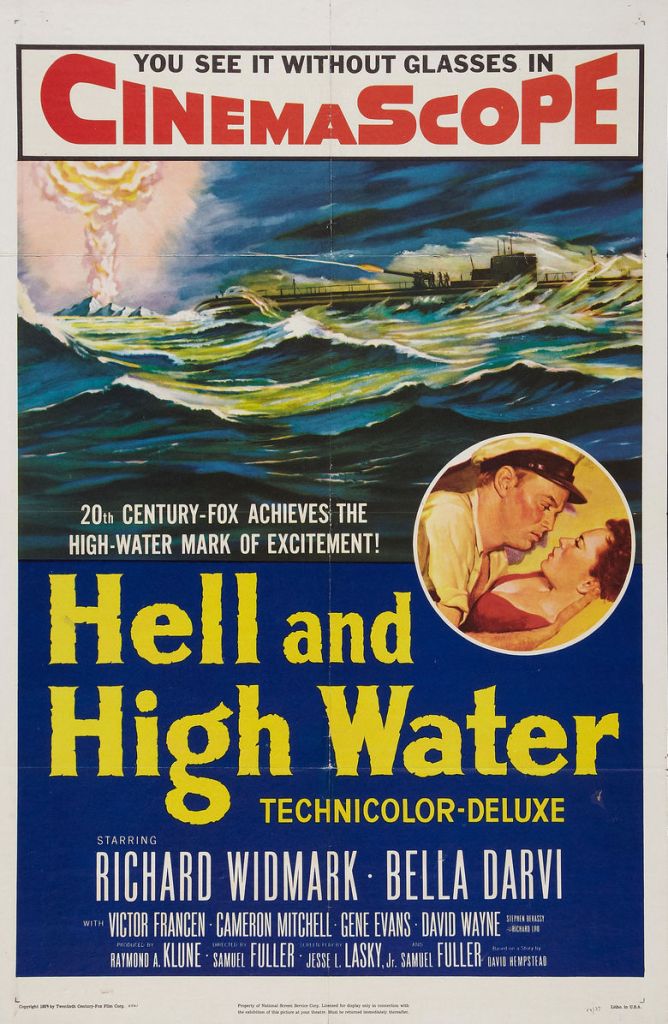
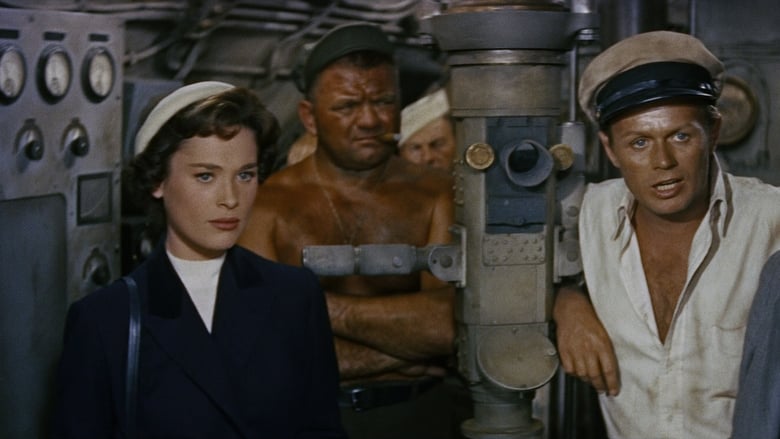
Few films start with a bigger bang than Hell and High Water: a nuclear explosion. What caused it? The film winds back to tell us. Retired submarine captain Adam Jones (Richard Widmark) is hired by a cabal of intellectuals and scientists working to maintain world peace. Somewhere on an island off Japan, the Commies are working on a secret nuclear bomb. Jones – in return for a fee – will shuttle Professors Montel (Victor Francen) and Denise Gerard (Bella Darvi) to investigate. Cue submarine duels, personality clashes, romance and shoot-outs.

To be honest, nothing in Hell and High Water lives up to that bang at the start. Samuel Fuller took on the film as a favour to producer Darryl F Zanuck, but had a low-opinion of the result (labelling it his worst film). Fuller rewrote the script, added a lot of his compulsive drive to the direction and handled it well – but it feels like a “gun for hire” film. Goodness only knows what Fuller made of Spielberg telling him in 1979 he loved it so much he carried a print of it in his car (perhaps “Have you not seen Pickup on South Street?”)

Hell and High Water is a serviceable men-on-a-mission film that sneaks in a few interesting beats, but otherwise goes for well-shot action and predictable events over invention and insight. It’s anchored by a grumpy Richard Widmark (who thought the script was crap and co-star Darvi couldn’t act) as a hard-to-like hero. Never-the-less Jones’ ruthless mercenaryism is the film’s most interesting beat – even if it is a repeat of the same actor’s attitude in Pickup on South Street, right done to mouthing almost the same contemptuous line about ostentatious flag wavers. Jones does his job professionally – and he’s got no truck with his country being dishonoured or attacked by Commies – but his main concern is always the $50,000 fee he’s been promised.

Also paid off are the whole crew who, in the film’s other interesting beat, are a regular united nations all of whom treat each other with equality and respect (the only people not represented here are Black people). We’ve got a German, a Japanese, a Frenchman, several Americans – considering only nine years previously all these nations had been working over-time to kill each other, it’s great to see the team on the ship working as a tension free-unit. We even have a Chinese sailor – who entertains his fellow crew with improvised ditties – becoming a crucial hero.

Fuller also shoots the sub action – a mix of models and trick photography – very well. The angles he uses of the subs underwater, in particular their turns, and the sweaty look of those underwater (and the increasing tensions) influenced several future films. All the submarine lingo you’d expect is trotted out with real commitment (“Right full rudder!”) and every box is carefully ticked, from sinking the bottom, to the costly rush to close a bulkhead. The torpedo fights are well-staged and whenever the film dives it’s at its best.

Where it is less so is whenever the film dwells on its characters. It tries to push the envelope a bit by introducing a female professor who is assured, competent, super-smart and gets stuck in with helping out when things go pear-shaped. She’s played by Bella Darvi, a protégé (and more) of Zanuck, who he was determined to elevate to stardom. Despite Widmark’s criticism, she’s fine here, even if she struggles to convey the charisma the role needs, often falling back on slightly grating over-earnest, head-girl smartness. What fails is the complete lack of chemistry between her and Widmark, their half-hearted, dutiful romance (probably mostly Widmark’s fault).

You’ll feel sorry for her though as the crew – and Jones – eye her up like a piece of meat when she arrives. Of course, this dated sexual leering is par for the course, but is still more than a little uncomfortable. But this is still the era when a sailor taking his top off to push his tattoos into a woman’s face was funny rather than a crime. The film does gives Darvi’s Professor a lot of proactivity and does generally take her side – even if she, inevitably, needs to learn our hero knows best.

Hell and High Water charges through to a decent ending, with just the right mix of self-sacrifice, tension and pay off. Victor Francen gives the films best performance as an illustrious, brave French scientist. But it never feels like anything more than a dutiful, for-the-money film. There is none of Fuller’s fire or feeling here, no real imagination or freshness in the ideas or concepts. It hits all the beats, ties things up with a bow and sends you home – but its very hard to really remember anything distinctive about it when the credits roll.

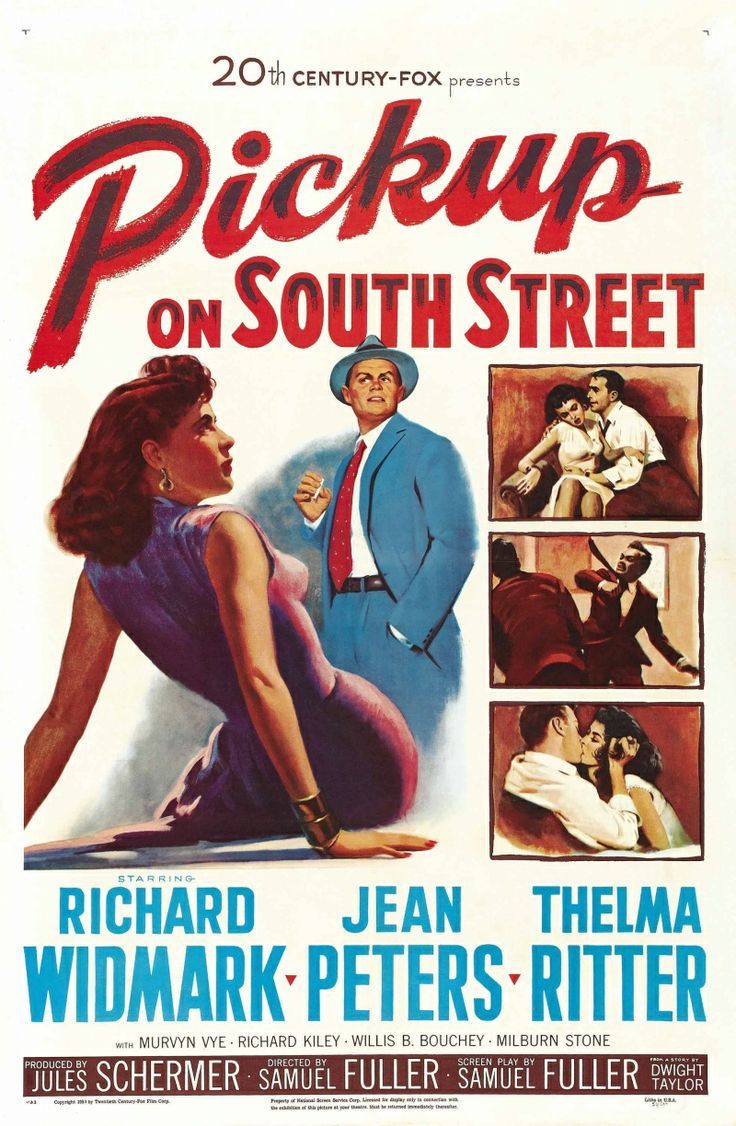
Pickup on South Street (1953)

Richard Widmark and Jean Peters feel the heat from the cops, the commies and their own passion in Pickup on South Street

Director: Samuel Fuller

Cast: Richard Widmark (Skip McCoy), Jean Peters (Candy), Thelma Ritter (Moe), Murvyn Vye (Captain Tiger), Richard Kiley (Joey), Willis B Bouchey (Zara), Milburn Stone (Winoki), Henry Slate (MacGregor)

It’s 1950s, and the biggest bogeyman in America is the Commies. Candy (Jean Peters) is one of their unwitting couriers, funnelling top secret microfilm for her ex-boyfriend Joey (Richard Kiley) to pass to his Moscow superiors (poor Candy just thinks she engaged in helping Joey with some good-old All-American industrial espionage). Trouble is, while the Feds are trailing her, they watch her being pickpocketed by career thief Skip McCoy (Richard Widmark). Skip now has on his hands on some serious state secrets. Should he return the film to the police who want to lock him up? Or make a big score by blackmailing the Commies who want to kill him?

What makes Pickup on South Street so intriguing is it’s not necessarily as straight forward as you might think. Fuller’s film is an anti-communist film – the sort of “reds under the bed” scare that terrified millions in a country still reeling from Klaus Fuchs and the Rosenbergs. But this isn’t your standard Red Scare film. Because our heroes have about as much stake in the USA as they do in the USSR. They are the down-trodden, the under-class, the grifters. At the end of the day, I’m not sure Skip McCoy really cares who ends up with the MacGuffin. He’s motivated firstly by financial gain and secondly by personal revenge. No appeal to flag and country cuts any ice with him.

Making the hero this sort of anti-social career criminal was a master-touch as it not only enriches the entire perspective of the film – what has their country ever done for these people – but also adds an air of uncertainty over the whole thing. There would never be any doubt if the microfilm had fallen into the hands of a clean-cut Henry Fonda type. The fact that it’s Richard Widmark – who always looks like he’s torn between laughing in your face or punching it – means you never quite know what he’s going to do. If it works out best for him to hand that film over the Russkies, you can be sure he will.

That’s despite the heavy-handed entreaties of the cops and feds. Skip faces a barrage of hostile interrogations, vague promises, handcuffs and searches from law agents who are damn sure he has the film, but can’t prove it. Like many Fuller films, there is more than a hint of roughness and violence in every frame – and the law and order figures aren’t averse to this. Captain Tiger (what a name!) has already served a suspension for beating Skip in custody. An illegal search or two isn’t beyond them. You can see why the FBI was unhappy with this film – not least because it shows them constantly out-thought by a pickpocket.

The Commies though are a thoroughly bad lot. After all, it’s still an anti-Communist film. Richard Kiley’s snivelling coward Joey is no true believer, but the kind of low-breed opportunist tempted by a quick buck. The other communists we meet are corrupt, shady types, sitting in backrooms puffing pipes and casually handing out death sentences. Kiley’s weak-willed and increasingly desperate Joey becomes more and more despicable as the film goes on, desperation to save himself from the fury of his paymasters leading to ever lower and despicable crimes.

So the only people who really come out as truly decent – and playing by a very fixed moral code of their own – are the criminal underclass. In this world, everyone knows where they stand. Skip isn’t angry at stool-pigeon Moe, who carefully trades information with the police – everyone has to make a living he observes. Skip will pick pockets to earn his keep, and punch back when he’s attacked, but there is no sense that he has any taste for the crimes of the Communist agents. He’ll sell on the microfilm to them – but that’s only because his own government offer him nothing but hot air and empty promises. And, as the unspoken message of the film goes, what difference would it really make to Skip and his like anyway where the film ends up?

Instead Skip becomes motivated by personal feelings – specifically his feelings for Candy and Moe. There is a genuine sexual frisson between Skip and Candy from the start: Skip’s pickpocketing of Candy is shot like a sex scene, all sweaty brows, heavy breathing and close-ups (with Skip’s hands ‘penetrating’ Candy’s handbag with all the metaphorical energy of a train speeding into a tunnel). As events draw them closer together, the two maintain this electric sexual energy – whether arguing or fighting or lying to each other they seem unable to take their hands off each other – and the intimacy of close-ups and low angles Fuller uses for this brings a real sexual charge to their scenes. Widmark – superb as a heavy with a (hidden) heart – and Peters are also great, with Peters bringing a real roughened hinterland of disappointment to her role.

The other motivator for Skip becomes the stool-pigeon Moe, brilliantly played with an eccentric bag-lady energy by an Oscar-nominated Thelma Ritter. Moe is a grifter, selling ties by day and trading information on the side. She embodies the underdog nature of the criminal world, wanting nothing more than to earn enough to buy a decent funeral when she goes. Ritter has a marvellous speech on just how tied she feels from this constant scramble of scrapping by on the edge of society. A surrogate mother figure of a sort to Skip, Ritter’s performance is a classic piece of character acting.

Fuller’s scene is lean, short and fast-paced. Like many of his films there is a lot of violence – beatings, fights, shootings – all shot superbly with the camera pulling back to soak up the action. Sex and violence go hand in hand – Skip accidentally punches out Candy thinking she has broken in to kill him, and the two of them are in a passionate embrace moments later. Mixed in with touches of reality, that bring the tough urban world the characters live in, Pickup on South Street is a lean and mean film that manages to be more than just a straight anti-Communist film. It doesn’t just give us something to fight against: it also asks how we might give people something to fight for.