

Well filmed and acted Bernstein biopic, that doesn’t really get to the heart of its subject
Director: Bradley Cooper
Cast: Carey Mulligan (Felicia Montealegre), Bradley Cooper (Leonard Bernstein), Sarah Silverman (Shirley Bernstein), Gideon Glick (Tommy Cothran), Maya Hawke (Jamie Bernstein), Matt Bomer (David Oppenheim), Vincenzo Amato (Bruco Zirato), Michael Urie (Jerry Robbins), Brian Klugman (Aaron Copland), Zachary Booth (Mendy Wager)

You can’t fault his ambition. In bringing the family life of legendary composer, conductor and cultural icon Leonard Bernstein to the screen, Bradley Cooper pulls out all the stops in a medley of inventive staging mixed with single shot trust in actors. Maestro is, in many ways, a perfect capturing of Bernstein: dazzling, giddy film-making that never lets you really peek into its subject’s soul. It’s a hugely impressive sophomore effort, but not quite fully satisfying as a film.
It opens with the life-changing night in 1943 when a 25-year-old Leonard Bernstein (Bradley Cooper) stands in (with no rehearsal) to conduct the New York Philharmonic at Carnegie Hall for a packed crowd and millions listening on the radio. From there, Bernstein never stops his ascent, becoming one of the world’s leading conductors and a composer who triumphs in every genre. He also marries successful actress Felicia Montealegre (Carey Mulligan), in a marriage full of mutual love and support. But Bernstein is the epicentre of his own fame, whose primary sexual attraction is to men. Over the decades, his marriage bends, fractures and reforms as Bernstein’s numerous affairs and party-filled lifestyle increasingly alienate the loyal Felicia.
Maestro is shot with all the zest and energy Bernstein himself was full of. Cooper keeps the pace the brisk and frequently transitions between scenes with a bravura trust that we can keep up. We see Bernstein receive the phone call for that fateful stand-in performance in his apartment: jubilant, he runs out the door (stopping only to playfully slap the bottom of his lover David en route), the camera taking an angle above to watch the pyjama-clad Bernstein run through a series of halls and emerge into the auditorium of Carnegie Hall.
It’s one of several transitions that mix reality and fantasy. Felicia will turn around from Leonard, during a flirty date in an empty theatre, to stride forward to applause from a packed audience. Felicia and Leonard run from a snobby garden party straight into a theatre (again with an overhead shot tracking them in a single smooth cut) where dancers from On the Town pirouette on stage as a visual representation of Bernstein explaining his work, the dancers eventually luring Leonard, Felicia and several other characters into an impromptu ballet. It’s a playful mix of reality and fantasy. At other times, the film skips years in seconds, successes dizzyingly referenced in throwaway lines.
The film’s focus is Leonard and Felicia’s complex, multi-layered marriage. Two people, in many ways soulmates, deeply stress-tested by Leonard’s frequent selfishness. Cooper, in a remarkable physical transformation (his capturing of Bernstein’s voice, mannerisms and conducting style is faultless) makes the composer a force of nature, high on his own genius: garrulously charming, a man who can focus all his attention on one person as easily as he can absent-mindedly drop another. The sort of man who excitedly introduces his fiancée to his lover David (a sensitive Matt Bomer) and then abashedly apologises immediately after for springing the news on him.
It’s part of the message of that On the Town ballet: living with Bernstein is a never-ending, dizzying pile of social engagements that doesn’t stop ever. Felicia feels she is ready for that: but the drift of Bernstein’s primary emotional commitment away from her and towards protégé Timothy Cothran (Gideon Glick) deeply hurts her. It’s part of Bernstein’s increasing lack of care to at least pretend to keep his promiscuity under semi-wraps, including awkwardly dismissing unspecified “rumours” that have distressed his daughter Jamie (Maya Hawke, very good) as nothing more than “jealousies”.
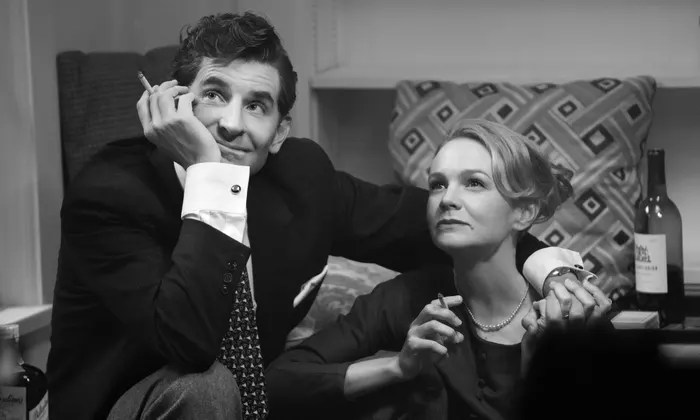
As Felicia, Carey Mulligan delivers what might just be a career best performance. Luminous, she makes Felicia savvy, loving but realistic about the “sacrifices” loving Bernstein involves. It’s a marriage where she is often in Bernstein’s shadow – at one point literally so, a shot showing Bernstein’s giant conducting shadow dwarfing Felicia in the wings. Mulligan’s performance mines deep emotional depths, Cooper frequently showcasing these in long, still takes. Most strikingly, a dynamite argument in New York after the opening of Bernstein’s Mass plays out in one visceral shot as Mulligan conveys the release of years of tension, in angry home truths. She is also heart-breaking during the film’s affecting chronicle of Felicia’s cancer, another striking single-shot scene showcasing Mulligan’s skill at letting all pain play behind her eyes while talking to visiting friends.
Maestro is about the underlying strength between these two who always turn to each other at hours of need or emotional triumph. Felicia’s successes on stage are shared with Bernstein, while it’s she who accompanies him (after their unofficial split) to his ground-breaking Mahler concert in Ely (another virtuoso sequence, directed and acted by Cooper with aplomb). Bernstein abandons his career – and all other relationships – to nurse Felicia, their bond finally something that could not be shaken by his thoughtlessness.
However, Maestro fails at times to really show how this relationship buckled. The giddying speed with which it moves through events means the middle act and, in particular, the sense of Bernstein’s numerous affairs gets lost. When Felicia finally does erupt, it’s easy to think it’s due to one late night and Bernstein holding his lover’s hand during the Mass premiere, rather than years of slow emotional distancing. It’s one time when a montage, stressing the repetitive nature of Bernstein’s self-obsession, would have really made a positive impact.
It’s also a film that focuses so much on the relationship, it leaves Bernstein himself a curious enigma. Strangely, despite sampling Bernstein compositions throughout the film, its almost as dismissive of his musical theatre work as it implies Bernstein himself was. West Side Story gets barely a passing mention, On the Waterfront is bundled up with “film scores” and almost nothing of the rest of his work is placed in any form of context. The epic Mahler concert in Ely is brilliantly restaged, but its artistic importance never explained and it’s easy to come out of the film not really appreciating either Bernstein’s cultural or musical impact.
Instead, Bernstein remains somewhat of an enigma, a charismatic figure who, for all the excellence of Cooper’s performance, remains a showman we never get to really know, someone capable of great care and intimacy (he’s extraordinarily tactile) for people, but also keeps them (and us) at a distance. The affairs have a veil tastefully drawn over them. There is very little overtly gay content in Maestro, which feels a conservative choice.
It’s hard not to think at times Cooper is more focused in Maestro on demonstrating his own directorial invention and pushing himself to never go for the obvious shot. Maestro is a dazzling dive into the playbox of film technique – it changes in aspect ratio and colour stock to reflect the cinematic era (though an odd decision for a film about a composer, that never explores his connection to cinema) and offers a host of interesting visual compositions and daring long-takes. Cooper and especially Mulligan are superb, but it’s a film that perhaps leaves more questions in the mind. A dazzling piece of film-making, but not always a dazzling piece of story-telling.

 Movie Musings