

Tag: Scoot McNairy

A Complete Unknown (2024)

A Complete Unknown (2024)

Engaging but traditional biopic, very well-made and full of knock out performances

Director: James Mangold

Cast: Timothée Chalamet (Bob Dylan), Edward Norton (Pete Seeger), Elle Fanning (Sylvie Russo), Monica Barbaro (Joan Baez), Boyd Holbrook (Johnny Cash), Scoot McNairy (Woody Guthrie), Dan Fogler (Albert Grossman), Norbert Leo Butz (Alan Lomax), PJ Byrne (Harold Leventhal), Will Harrison (Bob Neuwirth), Eriko Hatsune (Toshi Seeger), Charlie Tahan (Al Kooper)

In 1961 Bob Dylan seemed to emerge from nowhere – or, if you like, from being A Complete Unknown – to become the big star of American music and the centre of a battle for the soul of American folk music. On one side, were the traditionalists – they loved Dylan’s thoughtful, lyrical ballads and use of guitar, harpsichord and other instruments. They believed Dylan could lead a whole new generation to traditional American music. On the other side were the modernists, inspired by rock and roll, and the new (electric) sound. A Complete Unknown is about Dylan’s – inevitable – journey towards exploring new music sounds, culminating in his strum-heard-around-the-world as he played an electric set at the Newport Folk Festival (to a mixed reaction to say the least).

That’s the meat of James Mangold’s traditional, but very well-made and enjoyable musical biography, a spiritual sequel to Walk the Line (with a decent, but drink-addled Cash here played by Boyd Holbrook). Much like that film, this tweaks and amends some historical facts, but manages to get close to the spirit of its subject all within a familiar biography set-up of early success, mid-way struggles and triumphant (of a sort) resolution. There is nothing in A Complete Unknown to surprise you but it’s still a highly enjoyable, very professionally assembled journey.

Its main success is the depth and insight with which it penetrates Dylan’s character. A Complete Unknown embraces Dylan’s enigmatic quality, not to mention his stubborn, relentless and obsessive focus on his music and the austere distance he can treat the world. This all comes across beautifully in Timothée Chalamet’s superb performance – not only a pin-point physical and vocal and impersonation, but also a soulful rendering of a poet who constantly pushed against being classified and categorised, bristling against ideas he should play certain songs certain ways.

The roots of the culture clash that will dominate the film are clear from the start when Dylan and Pete Seeger (Edward Norton) drive from visiting visited Dylan’s hospitalised idol Woody Guthrie (Scoot McNairy) and Dylan flicks through radio channels. Dylan finds interest in all the different music they encounter; Seeger smiles pleasantly and nods his head, but clearly can’t hide his patient disregard for the electric beats of rock and roll. It’s the platform for the surly discontent Chalamet so perfectly embodies as Dylan is expected to pigeon hole himself as a folk singer, who (as he puts it) stands with his acoustic guitar at a mic and sings Blowin’ In the Wind for the rest of his life. A Complete Unknown falls in love with Dylan’s passionate self-expression, his search for his own sound.

That search frequently makes Dylan a difficult person to spend time with. Awkward and hesitant with other people – Chalamet’s Dylan is constantly cautious about exposing too much of his inner thoughts and feelings – the poetic writer mumbles in monosyllables and responds to fame with a grudging disdain that seems him rarely remove his sunglass shield between him and the world. He has no interest in fame and is positively alarmed at adulation from strangers (there is a neat line when he is unrecognised by a street vendor and asked if he has kids to which he wearily replies ‘Yeah, thousands’). Match that with his ruthless determination to put his artistic calling above anything else, and you’ve got a man who verges on using other people.

It feeds into Dylan’s relationships. At his request, his girlfriend Suzie Rotolo is very-lightly disguised as Sylvie Russo, played with an emotional richness by Elle Fanning. The film skips the more difficult parts of their break-up – Dylan stated the only song he regrated was one he wrote about Rotolo’s abortion, calling himself a shmuck for doing so. But in doing so, the film steams off Rotolo’s contribution to Dylan’s writing and much of her own dynamic and interesting qualities. The original Rotolo, an artist, was an important sounding board: we don’t see a jot of that here, as she is repackaged into offering Dylan much-needed stability and security, dealing with movie-girlfriend insecurity about Dylan’s attraction to collaborator Joan Baez.
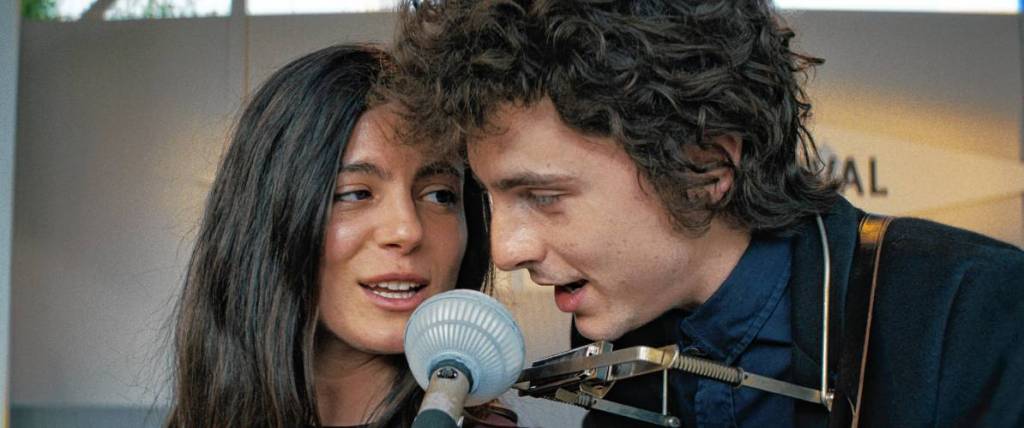
Dylan returns to Russo when he needs comfort at times of stress (from dropping in on her apartment – and waking her new boyfriend – late at night, to bringing her with him to the folk festival when he intends to turn electric) but Chalamet’s simmering self-focus makes clear Dylan at this stage can’t settle into a mutual relationship. It also comes between him and Joan Baez, played with dynamic charisma by Monica Barbaro, Despite their attraction and musical synchronicity, Dylan never sees her as a true artistic partner, even calling round one night for a booty call followed by private song writing using her guitar (she throws him out). On tour together, Dylan archly points out he writes the song and he leaves Baez hanging at a concert when he flat-out refuses to play the advertised favourites. The chemistry however is still there, within when it tips into aggression.

Dylan goes his own way, and if that means turning against surrogate fathers Peter Seeger and Woody Guthrie, then he will. A Complete Unknown features one of Edward Norton’s finest performances as a warm, tender and heartbreaking Pete Seeger (matched with a wonderful performance from Eriko Hatsune as Pete’s wife Toshi). Norton is brilliant at making Seeger – an environmentalist and gentle, accommodating advocate of folk music – a portrait of inevitable disappointment-in-waiting. There is a heart-rending moment where Norton beams as if all his dreams have come true as Dylan plays his first Newport festival: heart-breaking because we know Dylan’s next performance (where a guilty Dylan brusquely shrugs off Seeger’s gentle pleading to stay acoustic for just one more day) will see these dreams left in shattered pieces.

A Complete Unknown is a handsome, very well-mounted film from James Mangold, who has proved time-and-again that he can explore classic Americana with a freshness and energy few other directors can match. The film is perhaps overlong – probably due to the innumerable recreations of performances from Dylan, Seeger and Baez, all excellent but there are far too many – and it’s biopic approach is relentless traditional. But it’s filled with a parade of rich performances (with Chalamet outstanding), rolls along with energy, carries an emotional impact and will leave you engaged and entertained throughout.

Argo (2012)

John Goodman and Alan Arkin say hoorah for Hollywood in Ben Affleck’s middle-brow, over-praised award-winner Argo

Director: Ben Affleck

Cast: Ben Affleck (Tony Mendez), Bryan Cranston (Jack O’Donnell), Alan Arkin (Lester Siegel), John Goodman (John Chambers), Victor Garber (Ken Taylor), Kyle Chandler (Hamilton Jordan), Tate Donovan (Robert Anders), Clea DuVall (Cora Amburn-Lijek), Christopher Denham (Mark Lijek), Scoot McNairy (Joe Stafford), Kate Bische (Kathy Stafford), Rory Cochrane (Lee Schartz), Taylor Schilling (Christine Mendez)

There is an art to telling a “true story”. Apollo 13 is a masterclass in turning a story everyone knows into edge-of-the-seat tension. For many people, Argo does a similar trick. It doesn’t for me. I can’t understand the praise for this middle-brow, conventional movie other than that its smoothly made blandness makes it easy to watch. I got so annoyed when re-watching it I threw my slipper down in anger, like the middle-class rebel I clearly am.

Anyway, the film kicks off with the US embassy in Tehran being stormed on 4th November 1979. While the embassy staff are taken hostage, six embassy officials escape and find shelter with the Canadian ambassador Ken Taylor (Victor Garber). But how to get them out of the country safely? CIA extraction officer Tony Mendez (Ben Affleck) comes up with the “best bad plan we’ve got” – set up a fake Hollywood production company, finance a fake movie, fly to Tehran, then fly the fugitives out on Canadian passports, passing them off as the movie’s crew on a scouting mission. The cover film is sci-fi epic Argo, and with producer Lester Siegel (Alan Arkin) and famous make-up artist John Chambers (John Goodman) on board to give the project realism, the mission is on.

Argo won itself a lot of friends on the way to its Oscar for Best Picture. Why? Because this is a very easy-to-swallow, middle-of-the-road film that successfully turns an American foreign policy disaster into a charming heist movie with a happy ending. It faithfully follows the pattern of all heist movies: the crazy idea, pulling together the perfect team, the difficult rehearsal, the weak link who pulls it out of the bag at a crucial moment even the panicked “we do it anyway!” ending as the best-laid-plans need to be partially improvised on the fly.

In fact, for all its desperate attempts to look like a smart, political, 70s-style piece of cinema making, The Sting is by far and away the 1970s film it most resembles, for all it wants you to think it’s The China Syndrome by way of All the President’s Men. The film starts with an inspired story-board montage of the way Western interference in Iranian politics from 1953-1979 effectively ruined the country. But that’s as good as it gets politically. After that, any further attempt to engage with either Iran or America’s foreign policy gets completely abandoned. It becomes a simplistic rescue story stuffed full of uncomplicated goodies and baddies.

Hollywood of course loved it. Why wouldn’t it? There’s only one thing Hollywood loves more than a film that takes good-natured insider pot-shots at itself. And that’s a film where Hollywood saves the day. Argo does both. It’s a celebration of how Hollywood may be shallow, but when push comes to shove it delivers. Alan Arkin (Oscar-nominated for a role he could play standing on his head) coasts as a (fictional) old-school producer, selling the film’s mediocre punchlines about the Golden Globes, WGA and the uselessness of directors. Argo has a real “slap-on-the-back” air to it, the sort of gentle roast you might get from a guest speaker at an end-of-year party.

But of course you want to know: why did I threw my slipper? Quite frankly, Argo is a con. It starts with a burst of documentary-style realism, charting the attack on the embassy. The film uses a range of different film stocks, including home-movie style footage and newsreel material. It gives an impression of complete factual reality. But, like the movie, that’s just an impression. None of the footage we see is from the time period. It’s all glossily re-created to give the idea that we are watching something snatched from the headlines.

It’s probably the last time the film touches reality. Because from there Argo is a “true” story only in the broadest sense. Almost every single specific in the film is invented or repackaged. Most crucially, the film presents all this as a CIA operation from top-to-bottom. In reality, it was a Canadian operation, with the CIA providing assistance. Not the impression you get here. Even worse the end even has the team at Langley smugly smacking each other on the back and saying they’ll give the Canadians the credit for National Security reasons. Ouch. Not content with that, it also falsely accuses the Brits and New Zealanders of leaving the fugitives hanging out to dry. Ouch again.

I don’t mind most of the film’s other myriad inventions. Its fine to hugely expand the Hollywood stuff, as it’s fun. I don’t care that Mendez (who was Hispanic by the way – but I guess Affleck with a beard is the next best thing) was only in Tehran for 36 hours not the several days he is in this film. Building a bit of tension at the airport passport control – until that weak link proves his worth by talking fluently through the made-up film’s plot – is classic heist cinema. It’s cliched but its fine.

What really, really bugs me is that Affleck and team obviously decided the real story wasn’t exciting enough so – while poking fun at the shallowness of Hollywood – turned this story into exactly the sort of shallow adventure-fantasy that’s Hollywood’s bread-and-butter. In real life, there were nerves at the airport, and a delay to the flight. And there is a lot of old-school-conspiracy-thriller-tension that could have been created with that – if the film really was the sort of The Parallax View style thriller it wants you to think it is.

But that’s not bombastic enough for Affleck et al. Instead the ending is ludicrously overblown, stuffed with problems to overcome. The mission is off-then-on-again (this convoluted resolution requires a real-life childless man to have two kids at school). Then the Iranians work out something is up, and tear through the airport, guns waving in a race to stop the flight. Police cars race onto the runaway as the plane carrying our heroes takes off. And then I threw my slipper.

I threw it because it makes no sense. If the Iranian secret service knew about the extraction, they wouldn’t run through the airport. They’d RADIO THE CONTROL TOWER and stop the plane taking off. They’d scramble jets to bring the plane back while it was still in Iranian airspace. They certainly wouldn’t race cars onto the runaway – and I’m not sure a civilian plane would take off with an armoured car just underneath its wing. Nothing like this happened, or would happen. Its reality filtered through the tired cliches of Hollywood movies. It doesn’t even feel true.

Argo starts trying to comment on world affairs, but then focuses overwhelmingly on a minor victory in the middle of a disaster. The Iranian hostage crisis was a national humiliation that lasted years. But in this film, Affleck shows he learnt something from Pearl Harbor just like that film’s celebration of the Doolittle raid, this uses a small success to excuse a disaster. We even get Jimmy Carter bragging in voiceover that the crisis was resolved without resorting military force: the only reason for that was because the military strike Carter himself ordered was so ineptly planned it had to be humiliatingly cancelled mid-mission.

Argo doesn’t care. It’s a cuddly story about Hollywood saving the day, that starts with a critical eye and turns into a cheerleader for Carter’s disastrous policy in Iran. The hostage crisis is a tough story it doesn’t want to talk about (a brief scene of some hostages undergoing a mock execution only reminds us that the film can’t be bothered to talk about them). It repackages disaster as triumph and pretends to be a cleverer, richer film than it is. It apes 1970s conspiracy thrillers and political films but is only a faint shadow of them. Garlanded with awards, it’s competent-at-best.

Destroyer (2018)

Nicole Kidman goes way-against-type as a bend the rules cop in Destroyer

Director: Karyn Kusama

Cast: Nicole Kidman (Detective Erin Bell), Sebastian Stan (Chris), Toby Kebbell (Silas), Tatiana Maslany (Petra), Bradley Whitford (DiFranco), Jade Pettyjohn (Shelby Bell), Scoot McNairy (Ethan), Toby Huss (Gil Lawson)

There are few things that pique the interest of reviewers and viewers more than a celebrated Hollywood star going well against type, looking rough, playing tough and letting those shades of grey flow freely. That’s the cheap interest in Destroyer, Karyn Kusama’s engaging, well-made thriller which showcases the sort of way-against-type performance by Nicole Kidman that practically demands the poster scream “Kidman as you’ve never seen her before!”. Of course this all serves to obscure that Kidman is a damn fine actress and a committed performer, and she gives it everything in this grimy, underworld thriller of compromised cops and ruthless robbers.

Erin Bell (Nicole Kidman) is a detective with a shady past: an undercover operation with an FBI Agent Chris (Sebastian Stan) which went wrong 15 years ago. In the present day, the body of a John Doe in Los Angeles opens up links to this case from the past, causing Erin to start a rogue investigation into her old undercover days and the gang members she knew back in the day, specifically her long-held grudge against the psychopathic Silas (Toby Kebbell).

Destroyer gives us a familiar story – the cop with the dodgy past, gone to seed, playing against the rules, tired of life, with a shattered family background, investigating what could be one last case that has devastating links to the past – but presents it from a slightly new angle by making the protagonist a woman. This calls for a terrific performance from Nicole Kidman, who is bashed up, run down, grouchy, seedy and above all immensely damaged. Kidman’s skill at a performer is evident in every scene, creating a character who cannot escape from the burdens of her past, who rejects all help and who is unable to live with the burden of some sort of unspecified guilt.

Much has been made of Kidman’s roughed up, broken nosed, run down, alcoholic appearance (the film gets a lot of mileage over close ups of her ravaged, aged, alcoholic’s hands), but her commitment to the role transcends any deliberate slumming. She is completely believable as the sort of rough-and-tumble, rule breaking cop. The make-up also means that the flashback scenes to a 15-years younger Erin are immediately clear – and give us a clear indication of how far she has fallen since her more hopeful days.

The film is all about the burden of the past, and the film constantly flashes back and forth between the present day and Erin’s time undercover. The film carefully and slowly unveils the exact reasons for Erin’s guilt and why she has become the person she is, but the burden of it hangs over every scene in the present and is visible in Kidman’s eyes in every scene. It brings these themes to life extremely well and weaves an engaging story, even if everything in it seems like a collection of familiar events from other films.

In fact that is the film’s biggest weakness, right there. Many of the events, characters and themes in it feel like they have been plucked from a range of noir thrillers, thrown up into the air, and then reassembled into a new patchwork. As impressive as Kidman’s character is, it’s familiar to us from any number of hard-boiled cops past. The film’s structure – of Kidman going from contact to contact to get closer to Silas – basically allows for a series of actors to give performances that, for all their skill, end up feeling like a random collection of stock characters. None more so than Silas himself who, despite Toby Kebbell’s best efforts, is a totally forgettable rent-a-psycho. But then you can say the same for Tatiana Maslany’s aged junkie and, for all his slimy excellence in the role, Bradley Whitford’s sleazy money launderer. Other characters feel the same as well, from Kidman’s troubled teenage daughter, her would-be gangster boyfriend, Erin’s put upon ex-partner or her wearily understanding partner. These people all seem, to various degrees, to be stock caricatures rather than characters.

What really makes the film work is the dynamic, often hand-held, kinetic energy of Karyn Kusama’s direction. Jittery, immediate and very real, Kusama makes a number of these stock situations – from shoot outs to roughing up suspects – look at least new and exciting. The two main shoot outs in the film are extremely excitingly done and make for gripping set pieces, with the added originality of seeing the main players being women. 

But the film itself is just a little too obvious and stock for it to really stand by itself, for all the quality of the direction and the excellence of Kidman. There are some moments that work brilliantly with the unexpected twist of having a woman in the lead role and seeing Kidman throw herself into a gunfight with a heat-packing disregard for her own safety is all the more electric for it. But it’s still a little too predictable and familiar – for all the fact that there is a decent semi-twist towards the end that reveals not all is as we thought at the start – which perhaps doesn’t make it a film for all time.