Tag: Scott Glenn

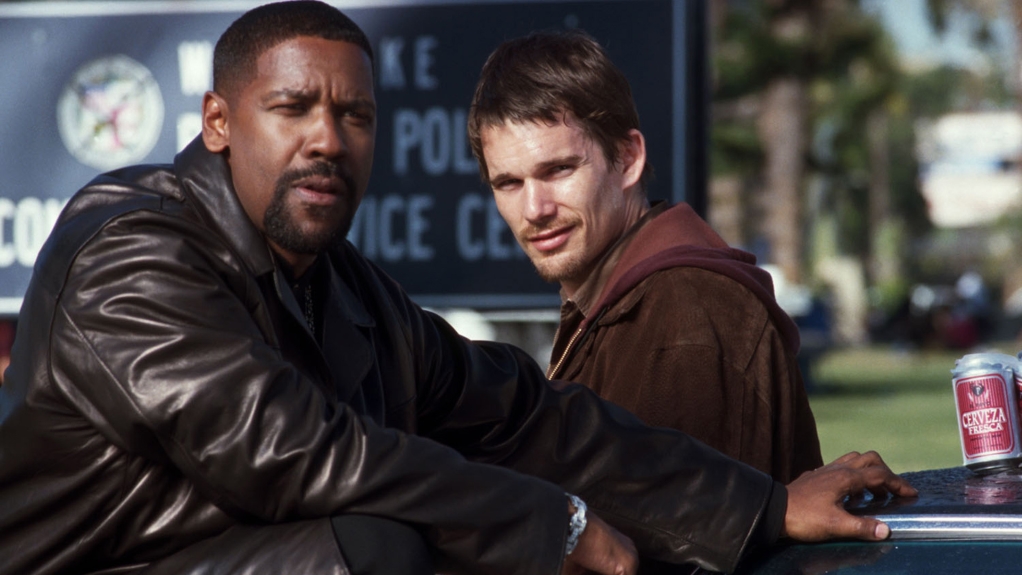
Training Day (2001)

Training Day (2001)

Pulsating corrupt-cop drama, highly entertaining with a full-throttle Denzel Washington

Director: Antoine Fuqua

Cast: Denzel Washington (Detective Alonzo Harris), Ethan Hawke (Officer Jake Hoyt), Scott Glenn (Roger), Tom Berenger (Stan Gursky LAPD), Harris Yulin (Doug Rosselli LAPD), Raymond J Barry (Lou Jacobs LAPD), Cliff Curtis (Smiley), Dr Dre (Officer Paul), Snoop Dogg (Blue), Macy Gray (Sandman’s wife), Charlotte Ayanna (Lisa), Eva Mendes (Sara)

“King Kong ain’t got nothing on me!” That’s the mantra of larger-than-life legendary cop Alonzo Harris (Denzel Washington), who has immersed himself so much in the dirty neighbourhood gangland of LA that it’s hard to see where cop ends and crook begins. Alonso claims to believe to keep the town clean, you gotta break a few rules. But then he also believes in filling his own pockets with stolen money. It’s all going to come to a head in one day: first day on the job for ambitious boy-scout officer Jake Hoyt (Ethan Hawke) who thinks he’s auditioning to join an elite squad only to find he’s the victim of a series of elaborate mind-games and dodgy moves by Alonzo, testing to see whether he is potential asset or sacrificial pawn. It’s going to be a long day.

Training Day is basically a massive dance with the devil, offering his little Faustus all the wonders of the world in return for his soul. It’s all there for Hoyt’s taking: respect, glory, standing – and of course oodles of plastic-wrapped dollar bills. All he has to do is sacrifice every inch of his integrity and personal morality to Alonzo Harris, a grandstanding Mephistopheles. This first day is all about Harris pushing Hoyt to see how far he will go. Will he smoke a little dope so he could pass as an undercover druggie? Will he search a house under a false warrant? Will he rough up a suspect? Will he murder a drugdealer and steal his cash?

Throughout all this, Denzel Washington barnstorms to fantastic Oscar-winning effect. This is a delightfully Devilish performance, Washington leaving it all out on the pitch. Alonzo Harris has inhabited the persona of the gangsters he follows for so long he’s basically become one. Harris is scarily charismatic, the unshakeable confident cool he uses to cow and terrify criminals and punks on the street, also making him a hugely attractive figure. This is despite his complete amorality, his ruthless capacity for violence and his shocking willingness to abuse and use almost everyone around him. He does all this by convincing Hoyt for long stretches that his poor treatment, abuse and deception of him is all in Hoyt’s own interest: to toughen up this naïve puppy into a killer.

Hoyt spends half the time if this is some elaborate show-and-test. Who can blame him? Washington’s exuberance plays masterfully on the edges of someone putting on a massive performance. There are neat moment where we see how fragile some of Harris’ control is, once he is outside of his comfort zone: he’s in hoc for millions to Russian gangsters and as events of the day pile up his thermonuclear self-confidence tips into moments of impotent fury. Washington is fantastic as this street monster, whose seductive lines on modern policing (do a little bad to do a greater good) start off sounding like common sense before you realise they tip quickly into justifying open criminality. It’s a performance of perfect physical swagger matched with his limitless charisma, inverting the qualities that made him a perfect Steve Biko or Malcolm X into a Lectorish monster.

Ethan Hawke is also extremely good as his polar opposite, the eager to please rookie who realises there is a lot more going on here than he thought. Training Day suggests there may well be a middle ground between Hoyt’s straight-as-an-arrow idea of policing and Harris’ corruption – and it’s part of Harris’ appeal that his perverted mentoring ends up making Hoyt a tougher, more unrelenting (better?) cop than he was before. But also, Hawke is great at showing that Hoyt (under his sheen of moral uprightness) is also a tough, hardened professional. In classic story-telling style, Harris is a dark reflection of Hoyt: they share a stubbornness, a conviction that they are right, a refusal to be intimidated (Hoyt may nervously try to please Harris at first, but once he realises the score he refuses to be forced into doing anything he doesn’t want to do) and a capacity for throwing themselves into decisive action. There is a reason why this rookie can get the drop on Harris – much to his wicked mentor’s delight and admiration – in a way no one else can.

That alone shows the dark magnetism of people like Harris: like Hoyt we end up wanting their approval even when we hate or fear them. Even as he holds a shotgun to his head, there is a part of Hoyt you suspect is proud that Harris’ gut reaction is to shout an impressed “My man!”. Of course Harris knows his validation is important to people. Monsters like this know the weaker-willed crave their respect. But then Harris also knows no one else in his team – all of them weak-willed bullies, desperately trying to imitate them – have even a quarter of the independence of mind Hoyt has.

What Harris under-estimates is Hoyt’s survival instinct. The final third of the film, the clash that has been building inevitably between these two, again demonstrates both their similarities and their fundamental differences. The main difference between them being Hoyt cares for, and protects others, and Harris cares only about himself. Hoyt’s humanitarianism will save him from dangerous situations and even Harris’ girlfriend (a tough-but-cowed performance from Eva Mendes) recognises Hoyt has shown more concern for her son in a few minutes than his father, Harris, ever has in his whole life.

The final act of Training Day hinges a little too much on one whopper of a coincidence: the sort of narrative contrivance so colossal that, in a less magnetic film, you’d be throwing stuff at the TV shouting “oh come on!” It’s final, inevitable, confrontation between Harris and Hoyt feels rather too much like many, many other films before it in every single beat, while the ending has a whiff of Hays Code morality (all wrongs righted!) about it that rather undermines the edgy, unpredictable film it precedes.

But when Training Day focuses on the sound and the fury of Washington and the Faustian dance on the deep grey lines of street policing, this is a sensational, energetic and highly watchable cop thriller, pulsatingly directed by Antonie Fuqua. With Washington superb and Hawke easy to overlook as his straight-laced partner, it’s a character study that constantly shifts our expectations and leaves us genuinely worried about the fate of its hero. The sort of slick entertainment Hollywood does at its best.

The Right Stuff (1983)

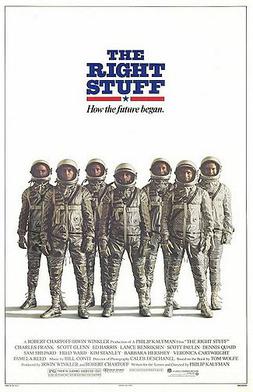
The Right Stuff (1983)

Patriotic heroism subtly retold as shrewd satire – no wonder the film bombed

Director: Philip Kaufman

Cast: Sam Shepard (Chuck Yeager), Scott Glenn (Alan Shepard), Ed Harris (John Glenn), Dennis Quaid (Gordon Cooper), Fred Ward (Gus Grissom), Barbara Hershey (Glennis Yeager), Kim Stanley (Pancho Barnes), Veronica Cartwright (Betty Grissom), Scott Paulin (Deke Slayton), Charles Frank (Scott Carpenter), Lance Henriksen (Wally Schirra), Donald Moffat (Lyndon B Johnson), Levon Helm (Jack Ridley), Mary Jo Deschanel (Annie Glenn), Scott Wilson (Scott Crossfield), Kathy Baker (Louise Shepard), David Clennon (Liaison man), Jeff Goldblum (Recruiter), Harry Shearer (Recruiter)

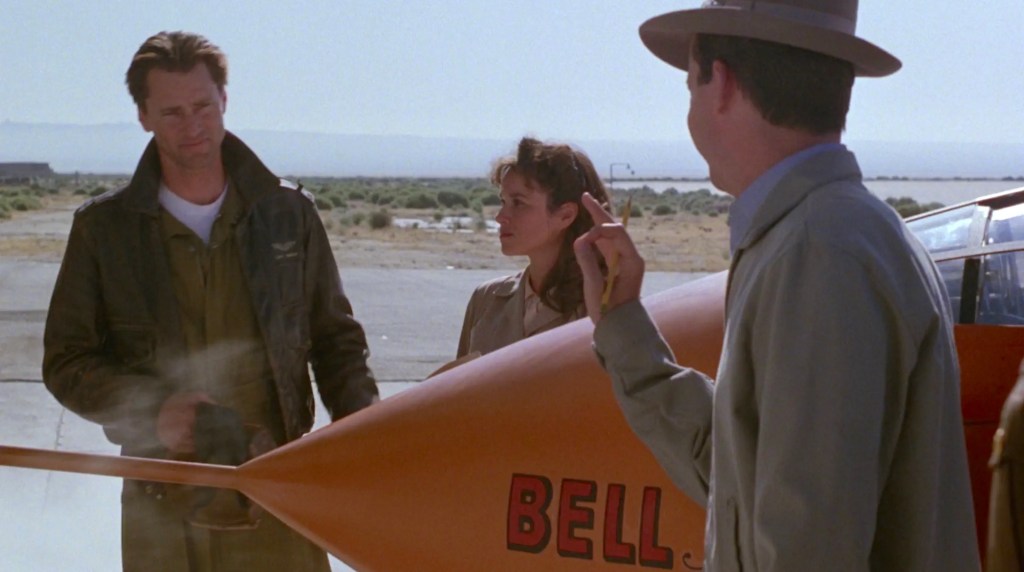
During the Cold War, the US and Russia had to fight with something – from proxy wars to chess, but most famously with Space: the competition to go further, faster and higher among the stars. The Right Stuff focuses on the Mercury Seven pilots at the centre of the US response to Soviet success including Alan Shepard (Scott Glenn), John Glenn (Ed Harris), Gus Grissom (Fred Ward) and Gordon Cooper (Dennis Quaid), a mix of the cocksure and the confident. But in a space programme where a monkey is an acceptable “pilot” for this human cannonball, do any of them have “the right stuff”? Could any of them match the skill of legendary test pilot Chuck Yeager (Sam Shepard) – one of the guys who scorned this astronaut programme for being “spam in a can”?

The Right Stuff, adapted from Tom Wolfe’s book, seemed destined to become a patriotic smash-hit. Despite its eight Oscar nominations (and four wins) it was, in fact, a catastrophic bomb. Perhaps that was because it subverted its patriotism so well. The Right Stuff is, in fact, a subtle, anti-heroic satire (told at huge length) masquerading as a patriotic yarn. It’s marketing avoided that meaning those most likely to enjoy didn’t go and see it, and those who went for that felt alienated. While largely respecting the astronauts, it suggests space race triumphalism was a sort of mass hysteria, with limited results, inflated into something mythic by political expediency, media spin and industrial might. Not the happy, flag-waving message Reaganite America expected or wanted.

Kaufman’s sympathy instead lies with an older, “truer” America. The Right Stuff is an intensely nostalgic film: but for a completely different time. It is in love with Frontier America, where men-were-men and the daring proved themselves in taming the frontier, in this case the sky itself. Our tamer is Chuck Yeager, played with a monosyllabic Gary-Cooper-charisma by Sam Shepard. Yeager is the last of the cowboys (even introduced riding a horse in the desert), taking to the skies like an old frontiersman hunting down that “demon” who lives at the sound barrier.

This is the sort of America The Right Stuff celebrates, and Yeager is the guy who has it. Unlike the Mercury programme, Yeager isn’t interested in showbiz and self-promotion (his reward for breaking the sound barrier? A free steak and a press embargo), just the quiet satisfaction of having done it. It’s the old, unflappable, quietly masculine confidence of a certain kind of American tradition and it’s totally out of step with the world the media is now celebrating with the astronauts. Instead, these effective passengers in the rocket will be hailed as the great pilots.

Kaufman’s film is a long, carefully disguised, quiet ridicule of many of the aspects of the Mercury programme. It’s conceived, in a darkened room, by a group of politicians so clumsy they can’t even work a projector. It’s head, Lyndon B Johnson (Donald Moffat on panto form) is a ludicrous figure, at one point reduced to an impotent tantrum in a car when he doesn’t get his way. The NASA recruiters are a comedy double act – Goldblum and Shearer sparking wonderfully off each other – who first suggest (in all seriousness) circus acrobats as pilots and then fail to identify Yuri Gargarin. The programme begins with a series of failed launches that travel tiny distances before exploding, culminating in one attempt ending with an impotent pop of the cap at the top of the rocket.

NASA is slightly ramshackle and clueless throughout. Far from the best and brightest, Kaufman is keen for us to remember that many of the scientists fought for the Germans in the war, that decisions were often made entirely based on what the Russians have just done, that the astronaut recruitment tests are a parade of bizarre physical tests because no one has a clue what to test for, and that the final seven selected aren’t even the best just the ones who persevered through the tests and (crucially) were small enough to fit in the capsule. That doesn’t stop the media – played by a San Francisco physical comedy troop – from turning them overnight from jobbing pilots to superstars.

The astronauts status is frequently punctured. Scott Glenn’s granite-faced Shepard is strapped into the cockpit for hours on his first flight, until finally he begs to pee (followed by a montage of coffee being slurped, hose pipes blasting and taps dripping) before being instructed to release his bladder into his suit, meaning he heads into space sitting in a puddle of his own piss. Dennis Quaid’s cocksure Cooper has an over-inflated idea of his skills and is prone to dumb, blow-hard statements (arriving at Yeager’s Air Force base he non-ironically states he’ll soon have his picture up on the deceased pilot’s memorial wall). Fred Ward’s Gus Grissom is a slightly sleazy chancer – controversially The Right Stuff presents him as panicking on re-entry from his first mission, blowing his hatch and sinking his ship, something he categorically denied (and was later proved not to have done).

Even John Glenn, played with a sincerity and decency by Ed Harris (if this had been a hit, Harris’ career of playing hard-heard would have been totally different), is subtly lampooned. So straight-laced he literally can’t swear (his attempt to say ‘fuck’ never gets past a strained Ffff), he’s introduced via a ludicrous TV quiz show and his square-jawed morals frequently tip into puritan self-importance. Undergoing physical tests, Kaufman even cuts from his grimacing face to a grinning chimp on the same test (and who will beat him into space). Compared to Yeager, who can correct a plane on a desperate nose dive and beat the skies into submission (and has the only outright heroic refrain in Bill Conti’s Oscar-winning score), none of them have that right stuff.

Do they get it? In a way: but their triumph is establishing their character, not their skills. Kaufman uses Yeager to point us towards this (his seal of approval is vital for the film): after Grissom’s debacle, he defends him in the bar and praises their courage in essentially sitting on top of a massive bomb.
Tellingly, the astronauts’ most courageous moment in the film isn’t in the cockpit at all: it’s Glenn supporting his stammering wife’s refusal to go on air with LBJ, despite the pressure from NASA bigwigs – and the other astronauts uniting in fury when Glenn is threatened with being dumped from the next flight. The others become more noble through maturing and casting aside fame’s temptations.

In a way they prove their spurs, even if Kaufman’s film makes clear none of them can match Yeager’s traditional values. The film ends with Yeager, maverick to the last, undertaking an unauthorised test flight in a desperate attempt to keep funding for his jet programme going. Even with this final flight – dressed in a bastardised version of a space suit – Yeager shows he’s not lost it, a man so undeniably superhuman in his American resilience that even a bit of fire won’t slow him down.

The Right Stuff celebrates Yeager, but he’s the B-story – and the film frames him as a forgotten figure, left behind by a world obsessed with the bright and shiny. The Right Stuff has to centre the astronauts but it doesn’t focus on the missions (which, apart from Glenn’s, barely receive any screen time – certainly not compared to the time given to Yeager’s flights) or the glory, only quietly implies there was a slight air of pointlessness about the whole thing – that the space race was perhaps just a dick-waggling competition between superpowers. It makes for interesting – if overlong – viewing, but as punch-the-air entertainment, no sir. No wonder it bombed.

The Hunt for Red October (1990)

The Hunt for Red October (1990)

Shailing into Hishtory! The Hunt for Red October is the finest Tom Clancy adaptation made

Director: John McTiernan

Cast: Sean Connery (Captain Marko Ramius), Alec Baldwin (Jack Ryan), Joss Ackland (Ambassador Andrei Lysenko), Tim Curry (Dr Petrov), Peter Firth (Ivan Putin), Scott Glenn (Commander Burt Mancuso), James Earl Jones (Admiral James Greer), Jeffrey Jones (Skip Tyler), Richard Jordan (National Security Advisor Jeffrey Pelt), Sam Neill (Captain Vasily Borodin), Stellan Skarsgård (Captain Viktor Tupolev), Fred Dalton Thompson (Rear Admiral Joshua Painter), Courtenay B Vance (PO Jones)

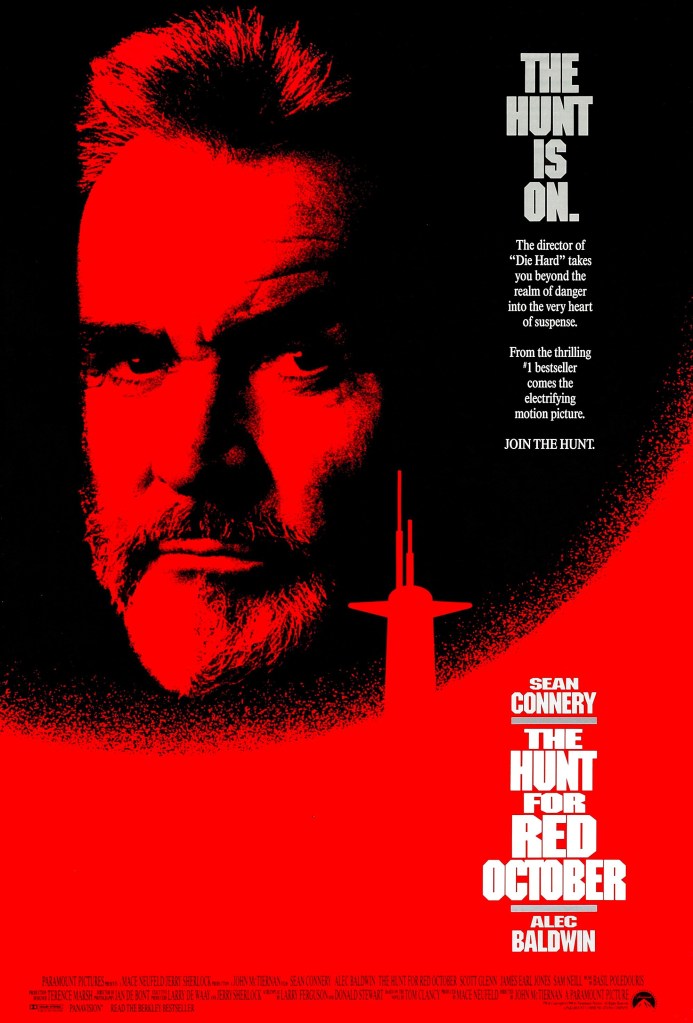
“We shail into Hishtory!” It’s the film that launched a thousand Sean Connery impressions. Only Connery could get away with playing a Soviet submarine captain with the thickest Scottish accent this side of Lithuania. He only took the role – from Klaus Maria Brandauer – at short notice, but he’s a pivotal part of the film’s success. The Hunt for Red October is a superb film, the finest Tom Clancy adaptation ever made and one of the cornerstones of the submarine genre. It expertly mixes beats of conspiracy, espionage, naval adventure and even touches of comedy, into a superbly entertaining cocktail.

Connery is Captain Marko Ramius, the USSR’s finest naval captain, given command of The Red October on its maiden voyage. The Red October is equipped with a technical miracle: a “caterpillar drive” that uses a water powered engine to run silently, making it invisible to sonar. So why is the entire Russian fleet being scrambled to find and sink the submarine? Could it be, as the USSR tells the US, that Ramius has gone mad and plans a nuclear strike? Or is it, as CIA analyst Jack Ryan (Alec Baldwin) argues, because Ramius plans to defect and bring the technological marvel with him?

Of course, we know Connery plans to defect. After all, we’ve already seen him murder shifty political officer Ivan Putin (Peter Firth – to whom alphabetical billing is very kind) and tell his handpicked crew of officers, led by loyal second-in-command Borodin (Sam Neill, so dedicated to affecting a Russian accent it’s as if he felt he needed to do in on behalf of himself and Connery) that there is no turning back. The film’s expert tension – and it rachets it up with all the precision of a well-oiled machine – is working out how. How will Ramius evade the Russian fleet? How will he manage to arrange his defection without communicating with the US? And will he and Ryan – unknowingly working together – persuade the US not to blow The Red October out of the water?

With McTiernan, in his prime, at the helm it’s not a surprise the film is expertly assembled. The parallel plot lines are beautifully intercut. Our two heroes, Ramius and Ryan, face very different obstacles (dodging Soviet torpedoes vs patiently making his case to sceptical superiors mixed with risky long-range travels to far-flung US subs) but somehow seem to be building a bond before they even meet. Ryan is an expert on Ramius and his career, while his thoughtful, good-natured decency is exactly the sort of American Ramius tells his crew they need to meet (as opposed to “some sort of buckaroo” – a word Connery relishes).

McTiernan isn’t just an expert mechanic though. There are lovely touches of invention and magic here. The Hunt for Red October has possibly one of the finest transitions ever. Connery, Neill et al start the film speaking in Russian. Ramius meets with Firth’s Putin (great name) in his quarters to open their orders. The two chat briefly in Russian, then Putin reads from Ramius’ copy of the Book of Revelations. As Firth reads (in fluent, expertly accented Russian), McTiernan slowly zooms in on his lips until he reaches the word “Armageddon” (the same in both languages) – the camera then zooms out and both Firth and Connery continue the scene in English (Firth switching mid-shot from Russian to English without missing a beat). It’s a beautifully done transition, rightly a stand-out moment.

But then it’s a film full of them. Many rely on Connery’s performance, superb as Ramius (this was his career purple patch, where one effortlessly excellent performance followed another). Ramius has a grizzled sea-dog charm and a twinkle in his eye, but he’s also nursing a private grief and pain that motivates his defection. He can be demanding of his men, but also inspires loyalty – that “We Shail into Hishtory!” pep-talk speech is delivered perfectly (and McTiernan makes Soviet sailors singing the Soviet anthem a punch-the-air moment even though (a) we know they are technically the bad guys and (b) we know Ramius is lying through his teeth in his speech). But he is always a commander, Connery investing him with every inch of his movie star cool.

Ramius is also an interesting reflection, in a way, of Ryan. Played with a great deal of young-boy charm by Baldwin (and also wit, Baldwin dropping impersonations of other cast members into the film – including a stand-out Connery), Ryan is brave, determined but also slightly naïve and out-of-his-depth. But like Ramius he respects his “enemy”, is open to negotiation, thinks before he acts and wants to save lives. The two even share similar upbringings. The film triumphantly shows a desk man, spreading his wings and doing stuff he couldn’t imagine: the guy who tells an air hostess in an early scene he can’t sleep on flights due to fear of turbulence, will later have himself dropped into the sea from a perilous helicopter flight, steer a Russian sub and duke it out with the last Soviet hard-liner standing in The Red October’s missile room.

McTiernan shoots Ryan’s conversations like combat scenes: quick reversals and cross shots and even whip pans and zooms. It ratchets up the tension and drama in these sequences – and allows him to play it cooler in the sub shots which (with its more constrained set) where patient studies of tense faces follow sonar reports of the approach of torpedoes or enemy subs. Sound is a triumph in Red October – every ping or sonar shadow is sound edited to perfection, with much of its tension coming from their perfect rising intensity.

It builds towards a superb resolution as several plot threads come together in a dramatic face-off that gives us everything from sub v sub to gunfights, with tragedy and triumph all mixed in. It’s a perfect ending to a film that is a masterpiece of plotting and construction, acted to perfection by the whole cast (Connery and Baldwin, but also Jones, Neill, Glenn – perfect casting as a no-nonsense naval captain – and several reliable players in smaller roles). McTiernan directs with exceptional pace and excitement, it’s sharply scripted and technically without a fault – from its gleaming Soviet sub (with church like missile room) to brilliantly edited sound-design. It’s a joy every time I watch it.

Nashville (1975)

nashville header
Robert Altman’s sprawling classic takes on a whole city in the brilliant Nashville

Director: Robert Altman

Cast: David Arkin (Norman), Barbara Baxley (Lady Pearl), Ned Beatty (Del Reese), Karen Black (Connie White), Ronee Blakley (Barbara Jean), Timothy Brown (Tommy Brown), Keith Carradine (Tom Frank), Geraldine Chaplin (Opal), Robert Du Qui (Wade Cooley), Shelley Duvall (Martha), Allen Garfield (Barnett), Henry Gibson (Haven Hamilton), Scott Glenn (Pfc Kelly), Jeff Goldblum (Tricycle Man), Barbara Harris (Winifred), David Hayward (Kenny), Michael Murphy (John Triplette), Allan F. Nicholls (Bill), Dave Peel (Bud Hamilton), Cristina Raines (Mary), Bert Remsen (Star), Lily Tomlin (Linnea Reese), Gwen Welles (Sueleen Gay), Keenan Wynn (Mr Green)

Robert Altman’s magnum opus, Nashville has the city has its set and, seemingly, its entire population as the cast. Over the course of a few days, Nashville charts the interweaving lives of a host of people making (or trying to make) a living in the home of country and western and the hangers on and fans flocking around the edges. Meanwhile a presidential campaign plays out, trying to recruit stars as fund-raisers.

You could say that, on the surface, Nashville isn’t really about anything. Certainly, it’s plot (such as it is) is more based on observing our characters interacting with and responding to events. Wonderfully rich short stories overlap each other, the focus mothing smoothly from one and another. It’s not really grounded in an overarching plot, such as McCabe and Mrs Miller or The Long Goodbye. In many ways its more similar to M*A*S*H, an experience piece trying to capture the thoughts and emotions of a particular moment of time. It’s that which I think is the heart of it. Nashville is about very little, but really it’s about everything – and it’s one of the most enlightening and vital studies of twentieth century America you are ever going to see. A rich and fascinating insight into a particular point in history, in a country rife with tensions.

You can’t escape that Nashville takes place in an America under the shadow of traumatic events. The 1970s (and the legacy of the 1960s) has pulled America further apart than ever. It’s a country struggling with a wave of assassinations, still deeply scared by the sacrifice of JFK (several characters, most notably Barbara Bexley’s permanently intoxicated Lady Pearl, reflect on the loss of innocence that came with it). Scott Glenn’s uniform clad army private is only the most visual reminder that the country is being ripped apart by Vietnam. Bubbling racial tensions are captured by short-order cook Wade (a lovely performance by Robert Du Qui) who angrily denounces black country singer Tommy Brown (a suave Timothy Brown) as an Uncle Tom.

Politically, America isn’t heading anywhere. The film is continuously framed by a car literally driving around in circles, blaring out meaningless platitudes straight from the lips of Hal Phillip Walker a third-party Presidential candidate who is against a lot of stuff (lawyers in congress and the Election College) but doesn’t seem to be ‘for’ anything. His smooth advance man John Triplette (Michael Murphy, quietly unimpressed by the music stars around him) drums up musicians to appear at a benefit – not one of whom even ask about the politics of the man they are being asked to endorse. Nashville isn’t a film that feels particularly enamoured either with politics or the level of our engagement with it.

Instead there is a new religion in town: fame. The musicians of Nashville at the time were unhappy with the film, feeling that Altman planned an attack on their industry. Altman is, of course, smarter than this. Of course, there are some satirical blows landed – but the film has respect and admiration for artists with genuine talent. Its real criticism is for fakes and poseurs (of which more later). But for the talents at the centre, sure they are flawed – but there is a respect for their skills and genuineness that keeps the film relatable. (Altman would be far more vicious when he turned his eyes to Hollywood with The Player).

The artists at its heart are flawed but human. Haven Hamilton (a grandiose Henry Gibson) may be a blow-hard reactionary, but his patriotic pride and sense of personal responsibility is genuine (late in the film he will ignore a serious injury to show concern for others). At the film’s centre is fragile super-star Barbara Jean (a delicate Ronee Blakely), the beloved super-star teetering on the edge of a dangerous breakdown, overwhelmed with the pressures of fame and expectation. A lonely person, reduced to trying to communicate her unease to her audiences in rambling monologues. Looking for a human connection she’s unable to make elsewhere (this makes for a neat contrast with her rival, Karen Black’s bubbly but coolly distant Connie White who knows where to draw the line between public and private).

This humanity also makes for intriguing personal dilemmas. Singing trio Tom (a swaggering Keith Carradine), Bill (a frustrated Allan F Nicholls) and Mary (a saddened Cristina Raines) are in the middle of a love triangle (caused by Mary’s love for Tom, who loves the attention but doesn’t return the favour). Made more tense by Tom’s desire to go solo, the couple’s tensions are never firmly resolved – part of Altman’s avoiding of neat endings. Tom himself, in many ways a shallow lothario, is also shown to be feeling the same loneliness and emptiness as others.

It’s interesting that the film’s warmest character, Lily Tomlin’s Linnea, lies half-way between the world of the music and the world of normal life. A dedicated performer of gospel with an all-Black choir, Linnea also works tirelessly at home to support her two deaf children (who attract very little interest from their father, would-be fixer Ned Beatty). Linnea though is never portrayed as someone trapped in her life, in the way others are, but in complete acceptance – and even contentment – with her lot. Similar to Keenan Wynn’s grieving husband, desperate for his niece to engage with her aunt’s illness, the film’s real warmth is for those people grounded in real-life worries.

The film’s real fire is saved for the shallow wannabes that flock around the edges. The music stars may be flawed but they have talent (as witnessed by the film showcasing almost an hour of musical performance in its runtime – all the songs written and performed by the stars). Shelley Duvall’s would-be groupee is hilariously empty-headed and selfish. Ned Beatty’s greasy-pole climbing political animal is ridiculously pompous. At the top of the pile is Geraldine Chaplin’s reporter, an empty headed fame obsessive, hilariously fawning to the rich and famous and abrupt and rude to ‘the staff’, pontificating emptily in a car junkyard. Is she even a real reporter or just a fantasist?

Altman’s film also finds time for two very different women trying to find fame in this heartland of country and western. Sueleen Gray (Gwen Welles) is a waitress carefully cultivating all the patter of a star, but lacking the key attribute – talent. So desperate is she to ‘make it’ that she is willing to be exploited for a big chance, with only Wade having the decency to tell her she should cut her losses (advice she bats away in anger). By contrast, Barbara Harris’ Albuquerque, running from her husband to find fame, has the talent but never gets the opportunities – until of course at the very end (and it’s the result of the tragic fate of another woman whose doomed fate hangs over the film).

Nashville is a rich character study, but all these characters link back into an America at a turning point in its cultural history. Detached and disillusioned with politics, this is a country that is starting to see fame – and the indulgence of your own passions and desires – as the new religion. A religion that attracts both wannabes and also stalkers and dangerous obsessives (at least two of whom populate the film, one with fatal consequences). In this world, as idealism dies and is replaced by cynicism, people start to check out and either engage more with their own problems or yearn to change their lives and become something else. Altman’s film captures this moment in time personally, as well as being a compelling melting pot of stories. A rich, multi-layered tapestry – of which a review can only scratch the surface – it’s a great film.

The Silence of the Lambs (1991)

Jodie Foster and Anthony Hopkins carry out a strange dance in the compelling The Silence of the Lambs

Director: Jonathan Demme

Cast: Jodie Foster (Clarice Starling), Anthony Hopkins (Dr Hannibal Lecter), Scott Glenn (Jack Crawford), Ted Levine (James “Buffalo Bill” Gumb), Anthony Heald (Dr Frederick Chilton), Brooke Smith (Catherine Martin), Diane Baker (Senator Ruth Martin), Kasi Lemmons (Ardelia Mapp), Frankie Faison (Barney Matthews)

Is there a more unlikely Oscar winner than The Silence of the Lambs? In fact, double down on that: is there a more unlikely film to have won all five of the Big Ones – Picture, Director, Actor, Actress and Screenplay – only the third film in history to have achieved that (It Happened One Night and One Flew Over the Cuckoo’s Nest being the others)? Re-watching the film, it’s actually a triumphant vindication for Hollywood to have chosen a thriller for the ages, a complex and intriguing puzzle wrapped in an unsettling outer layer of thrills and horror, as if the academy was (late in the day) finally tipping an award-lined hat to the film’s spiritual grandfather, Hitchcock himself.

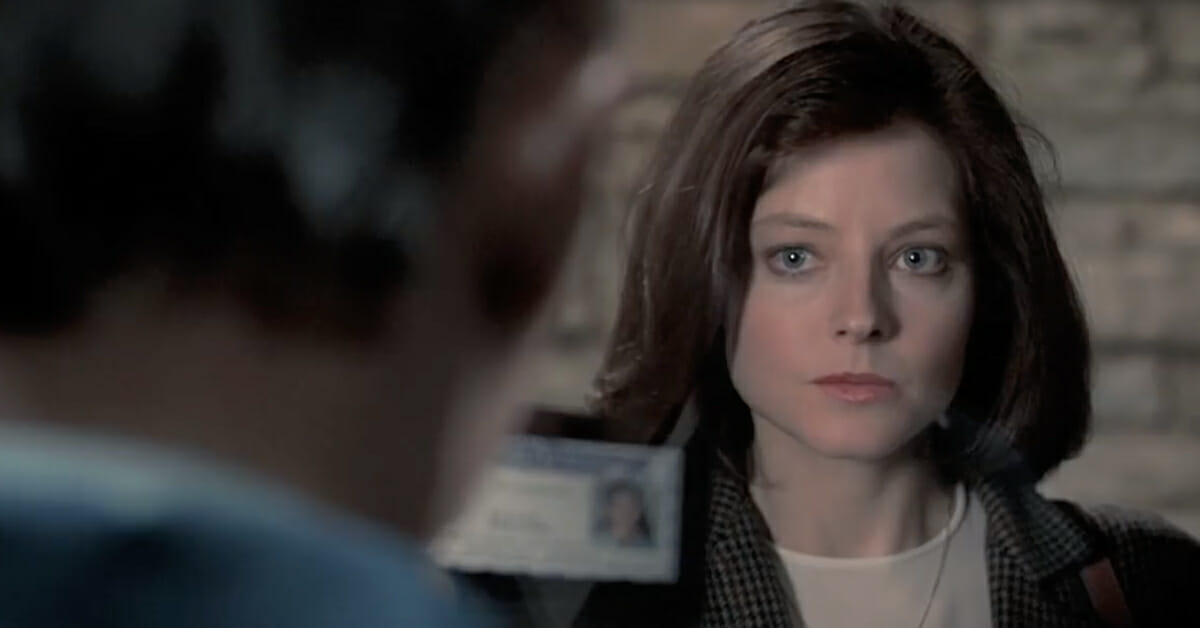
Clarice Starling (Jodie Foster) is a trainee FBI agent, in the final weeks before her graduation. Out of the blue she is plucked from Quantico by the head of the Behavioural Science Unit, Jack Crawford (Scott Glenn), to interview notorious psychiatrist-turned-cannibalistic-serial-killer Dr Hannibal Lecter (Anthony Hopkins), now interned in a psychiatric prison-cum-dungeon in Baltimore. Crawford hopes the Lecter might be able to shed light on the motives of “Buffalo Bill” (Ted Levine), a serial killer kidnapping and skinning young women across a number of states. Lecter can shed some light – but the price is an opportunity to investigate further into the psyche of the determined and ambitious Starling. A three-way game of cat-and-mouse between Bill, Clarice and Lecter soon starts to emerge.

Demme’s film is a sublimely made entertainment that brilliantly pulls together the trappings of multiple genres (there are splashes of horror, thriller, police procedural, romance and black comedy to name but a few) into an unsettlingly tense and engrossing whole. It’s truly a film Hitchcock would have been proud of, a masterfully assembled thrill ride where every shot serves a purpose, and each scene is carefully constructed to establish a clear story and push the audience’s buttons. It has two of the best tense “prolonged misdirects” in film history (wittily signposted in advance by an early car chase that is revealed in a pull-away to be a training exercise in Quantico – don’t trust your eyes!) and it brilliantly immerses you in the world and emotions of Clarice Starling.

Demme’s aim was to get us to empathise above all with Clarice, as she descends into the dark underbelly of this terrifying world. Demme uses a carefully selected combination of POV shots and straight-to-camera addresses to deliberately put us into the position of actually “being” Clarice Starling. From following her perspective through rooms and corridors, to seeing the characters she is talking to address the camera directly as if talking to us, through to carefully placed close-up shots that allow us to study the thoughts and feelings travelling across Clarice’s face, it brilliantly allows us to invest overwhelmingly in her without us even really noticing we are doing it.

And of course that is put together with Jodie Foster’s extraordinarily brilliant performance in the role. One of the film’s many strengths is exploring the nature of being a determined, brave and ambitious – but still slight and feminine – woman in the alpha-male world of crime investigation. Clarice fends off in virtually every scene not just discrimination and instant judgement, but a parade of half-spoken advances and flirtations from male colleagues. Foster’s brilliance is to make a character who is determined but humane, slightly vulnerable while never weak. She’s the key driver of the story, but also both an insider and outsider in her world, partly motivated by a desire to prove herself, partly by an attempt to vanquish haunting childhood memories of weakness and loss.

It’s these feelings under the surface that attract the interest of Hannibal Lecter, and the strange dance between them is the heart of the film’s appeal and it’s magic. Why does Lecter want to know about the facts of Starling’s life (that quid pro quo he archly asks for)? Does he want to analyse her? Does he want to help? Does he want to amuse himself with her terrible memories? Or is he just bored? He hardly seems to be certain himself, but the intimacy shared revelations provide is neatly played with by Demme in sequences between the two (they barely share the frame by the way more than twice) that hum with a tension of danger, but also a thrill of illicit romance, mixed with incestuous interest (Starling the orphan, Lecter the father-like man of wisdom helping her catch the killer). And it works with us as well – we are so invested in Starling that, just like her, we end up liking Lecter (even though we know we shouldn’t).

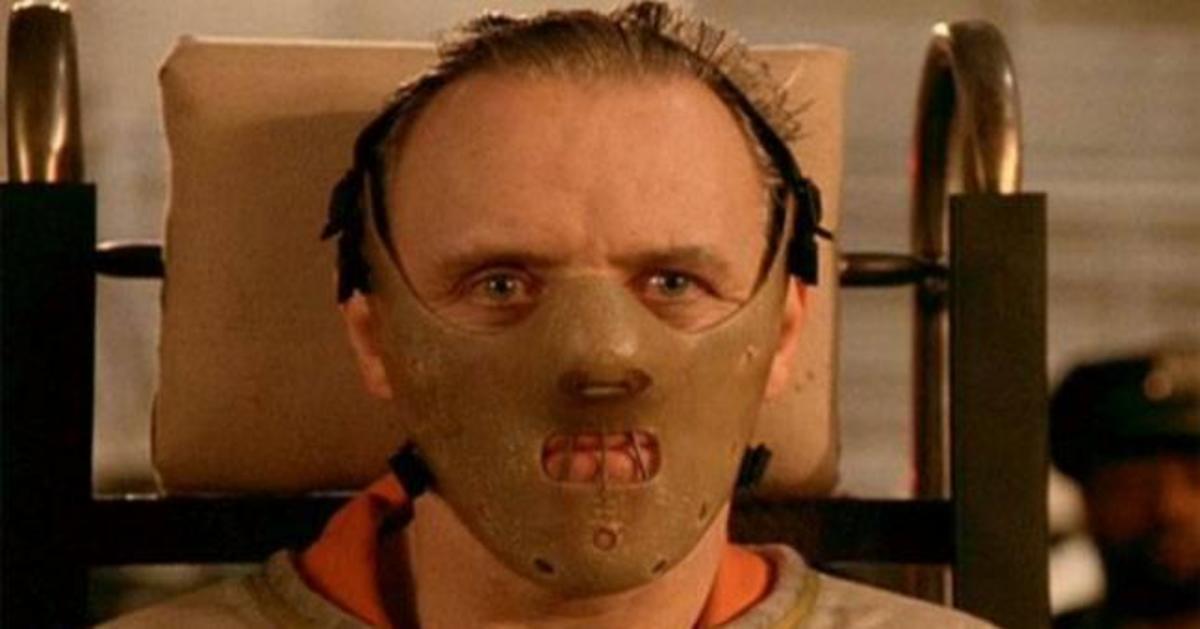
Of course it helps that Hannibal Lecter is portrayed in a performance of magnetic, career-defining brilliance by Hopkins. Hopkins modestly claimed playing Lecter was easy once you mastered the voice and the physicality – but that’s to downplay the extraordinary skill mastering those aspects concern, and the bravura brilliance with which Hopkins plays to the camera but never tips into absurdism. It’s an arch, knowing, winking performance that also carries with it an intense, psychotic menace, a delirious capacity for violence (as we find out). Demme introduces the character sublimely – after the build-up, his ram-rod stillness, polite manner and refined behaviour are somehow even more unsettling. Sure Brian Cox in Manhunter may be more conventionally chilling, but Hopkins is like an elemental demon playing with our childhood bogeyman fears, a guy who seems even more dangerous as he playfully chats one minute, then beats you to death with a truncheon the next.

The scenes between these two characters dominate the film (even if they take up no more than ten minutes of its runtime), and their relationship (beautifully shot as a game of one cagey upmanship that turns into semi-flirting, that turns into something in between) defines the movie and its legacy. Lecter’s magnetism was such that in later movies he would increasingly become an anti-hero of sorts, a lord of misrule rather than a brutal and indiscriminate killer, but here he’s terrifying and satanic, just as Starling is courageous and noble as the lady on a quest.

And that quest targets Buffalo Bill – a deeply unsettling performance of psychological unease and self-loathing by Ted Levine. The film was controversial at the time for its killer being both a transsexual and gay (although the film makes clear it’s a desire to be anyone apart from who he is that drives all these feelings), especially as at the time these groups were barely represented positively in the movies. But it also makes for singularly unsettling character, living in a subterranean cave-like basement, surrounded by moths, his voice slurred childishly while carrying no sense of shame or regret for his actions.

The hunt for Bill is the film’s story, and Demme uses the devices of cinema to make this as tense and unsettling an experience as needed. The camera prowls terrifyingly around Bill’s domains. Howard Shore’s score makes a deeply unnerving use of mournful refrains. Frequently scenes – such as the post-mortem inspection of a victim’s body – are often silently scored, making the mechanical noises of the investigator’s trade (such as the loudly clicking and whirring camera) deeply jarring. The film is grim, but relies more on reaction rather than bathing us in horrors, and implication brings the greatest terror. Every sequence of the film is perfectly assembled to leave us struggling to breathe – not least as events place Starling in more and more peril.

With its playful sense of black comedy, mixed with genuine terror and thrills, The Silence of the Lambs genuinely feels like the film Hitchcock was born to make. Everything in the film is perfectly assembled to serve the film’s aims – there is not a foot wrong in its assembly, and it’s sad that Demme never hit these sort of heights again. But the film is like a twisted companion piece to Psycho (only better), and in Hopkins and Foster produced two landmark performances. While the film engrosses us in Starling’s struggles in a man’s world, it also overwhelms us with Hopkins’ devilish magnetism and dark mystery. And what to make of the relationship between Starling and Lecter? It’s a mystery so enigmatic that it continues to grip today and it’s the secret behind the success of this compelling masterpiece.

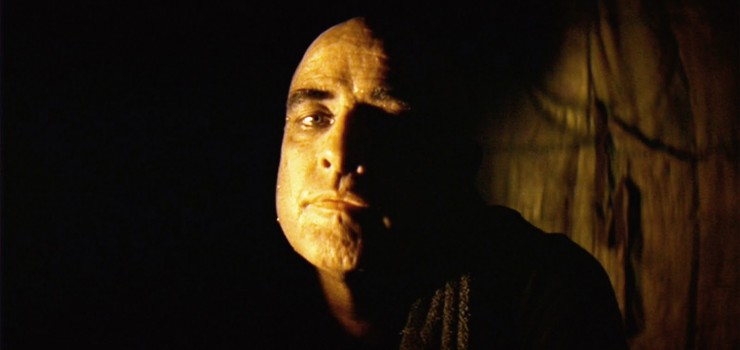
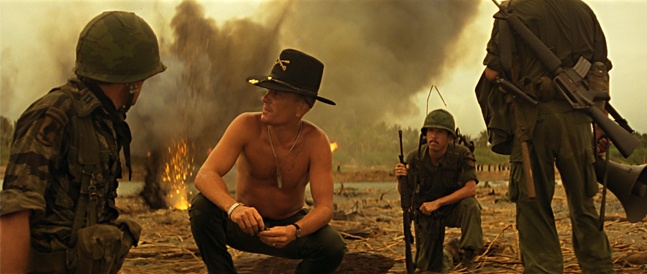
Apocalypse Now (1979)

Martin Sheen heads into insanity in Coppola’s epic pretentious masterpiece Apocalypse Now

Director: Francis Ford Coppola

Cast: Martin Sheen (Captain Willard), Marlon Brando (Colonel Kurtz), Robert Duvall (Lt Col Kilgore), Frederic Forrest (Chef), Albert Hall (Chief), Sam Bottoms (Lance), Laurence Fishburne (Mr Clean), Dennis Hopper (Photojournalist), GD Spradlin (Lt General Corman), Harrison Ford (Colonel Lucas), Scott Glenn (Captain Colby), Christian Marquand (Hubert de Marais), Aurore Clément (Roxanna Sarrault), Jerry Ziesmer (Mysterious Man)

During the 1970s, the director was king in Hollywood. Get a reputation as a visionary director, and Tinseltown fell at your feet. You could spare no expense to put together ambitious, thought-provoking, epic films. If you wanted to shoot on location at huge cost, or reconstruct elaborate sets for single shots, for a huge runtime that catered as much to your ideas of being an artist as it did to crowd-pleasing narrative, then Hollywood would give you keys. It didn’t last: several massive bombs (combined with the huge box office take of Star Wars) shattered the mystique of the director as an ego-mad, flawless genius who had to be indulged, and persuaded Hollywood the future was in big-budget, mass-produced action films (welcome to the 1980s, Hollywood’s nadir).

Apocalypse Now wasn’t one of those flops, like (most infamously) Heaven’s Gate. But, by golly gosh, it really could have been. In fact, in many ways it should have been. It has all the hallmarks: a huge runtime, filmed over a colossal period of time in a difficult location, a plot that mixes action, war and thrills with impenetrably pretentious musings on mankind’s dark soul. A maverick director throwing his own very personal vision at the screen, and damn the consequences. It’s a miracle Apocalypse Now wasn’t a career apocalypse for everyone. It escaped because, despite everything, it more or less gets the balance right between plot and character and pretention and faux-philosophy.

The film is famously a transposing of Joseph Conrad’s Heart of Darkness into Vietnam. Captain Willard (Martin Sheen) is ordered to head down the river to “terminate with extreme prejudice” rogue Special Forces Colonel Kurtz (Marlon Brando), who is conducting his own vigilante war. On the boat trip down the river, Willard encounters a host of increasingly bizarre and surreal scenes, from war-mad Colonel Kilgore (Robert Duvall) to a seemingly leaderless battle over a bridge, a playboy bunny show and a compound of ex-French colonials. And that’s before he even arrives at Kurtz’s compound and things get really strange.

Apocalypse Now is almost impossible to separate from the bizarre, tortuous route it took to get to the screen. Originally scheduled for a few months, the film took over a year to complete. A typhoon destroyed all the sets in the first two months. Original star Harvey Keitel was dismissed after a week (as his performance wasn’t right): his replacement, Martin Sheen, had a near-fatal heart-attack partway through filming. Marlon Brando not only turned up the size of a buffalo but refused to learn (or even speak) his lines. A year into production, the film had no ending. Coppola put his entire fortune up as collateral to complete the film. It was a nightmare.

But yet somehow what emerged has a sort of force-of-nature quality to it. Even though parts are basically pretentious rubbish, despite the fact I have twice fallen asleep in this film, despite the fact it is far from being a film that trades in complex ideas and offers profound insights, it still has a hypnotic quality about it. It’s done with a real force of commitment, a genuine labour of love, a film that doesn’t leave anything in the locker room but throws it all at the screen. The quality of what lands may sometimes be questionable, but the commitment with which it is thrown is beyond doubt.

And in a world of cookie-cutter films, it’s hard to have anything but respect and regard for a film that is so defiantly its own animal, that tells its story in its unique way. It’s perhaps one of the first “experience” films: no film could of course communicate what it was like to serve in Vietnam, but this film perhaps gets close to the surreal, drug-fuelled madness in that conflict.

Because Apocalypse Now is a very surreal film. Its plot is extremely thin, and each section of its (mammoth) runtime is all about experiencing another element of the American experience. In the commentary, Coppola talks about the river trip being partly a journey from the present into the past, a journey back not only into the history of the conflict (and its different stages) but also the regressing of mankind itself into a more primitive, malleable, basic state. It’s a big lump for a film to bite off – and I’m not sure if the idea really comes across without you knowing it. The real impression you get is of rules of society being left further and further behind.

The arrival at Kurtz’s compound is the fufillment of this increasingly unnerving story. We’ve seen the madness on the journey, the pointlessness, and the bemused, carefree confusion of the crew. But at the camp we get the overblown, decadent lunacy of Kurtz. Brando dominates the final 30 minutes of the film, although his monologues are meaningless drivel, the sort of intellectual point-scoring you could hear in a sixth form debating society. To be honest, iconic as Brando’s appearance is, his performance of mumbling battiness is actually a little awful (like one big practical joke from the actor) and the film’s momentum grinds to a halt while he babbles on. 

In fact, so self-indulgent is Brando that in a way it’s a sort of tribute to Coppola’s mastery of cinema that he makes this pompous character make any sense at all – or that he makes this sort of nonsense even remotely watchable. But again it’s the hypnotic pull of the film: Coppola builds towards a chilling, haunting final sequence of Willard and Kurtz’s final confrontation intercut with The Doors’ The End and the real-life slaughtering of an ox by a crowd of real-life villagers (they were going to kill the animal anyway but offered to do it for the camera). Coppola somehow turns all this into iconic cinema, even though, viewed objectively, it’s overblown, indulgent, pretentious rubbish.

The whole film is a testament to hewing compelling filmmaking out of breathtaking insanity. After the film departs in the boat, most of reason, sense and conventional story-telling depart with it. Information only gets conveyed through rambling monologues from Willard. The crew of the boat get into scraps that reflect heightened versions of the American experience in Vietnam – from a war crime as the crew shoot-up what turns out to be an innocent boat, to an attack from unseen tribesmen with spears from the mists of the shore. Sam Bottoms, as surfer-turned-GI Lance, is our guide of a sort here – as he gets more stoned, so narrative logic departs with his senses. 

What keeps the film going throughout is the masterful film-making. Coppola shoots the bizarreness with brilliant, visionary imagination. As a social theorist he’s pretty basic – man is, by the way, a savage animal and the Americans didn’t know what they were getting themselves into in ‘Nam – but as a film-maker he’s one of the best. Who else could have made three hours of episodic boat journeys so strangely compelling? The film is crammed full of great scenes and moments which rarely feel like they tie together – in fact, they could almost be watched in any order – and there is barely a character in there, but the film feels like its throwing you into the madness of Vietnam. 

Even the sequence with a bit more narrative is still laced with absurdity. Kilgore’s helicopter assault on a village – and its use of Wagner blaring from helicopters to scare the Vietcong – is justly famous. This is a bravura film-making – and as much a tribute to the astoundingly amazing editing and sound work of Walter Murch as it is the photography of Coppola. Like most of the rest of the film it is visually outstanding, but it also has the film’s best writing (in the quotable but also strangely subtle characterisation of Kilgore) and also the film’s most iconic performance in Robert Duvall. Duvall is terrific as the war-loving, but strangely childish Kilgore, obsessed with surfing and with an ability to live totally in the moment. 

This sequence doesn’t hesitate in showing both the brutality of war – and also the insanity of our commanders. Kilgore is genuinely dreading the end of the war, and you can see why he would since he is clearly having a whale of a time bombing places. Kilgore is a lovable, quotable badass doing what needs to be done – but the film doesn’t forgot that he is also an insane soldier with no off-switch. And Apocalypse Now never really glamourises war, for all the excitement and beauty of watching those helicopters come over the horizon.

It’s the artistry in its film-making, and the genuine effort and work that helps make it a demented classic. Walter Murch’s sound design and editing is possibly flawless – this might be the best edited and sound designed movie ever – from the opening moment when the helicopter blade sounds transform into a hotel room fan you know you are seeing something special. Scenes such as Willard’s hotel-room breakdown hum with intensity as they feel genuinely real – that scene in particular feels like Martin Sheen exposing part of his tortured psyche at the time. Sheen is by the way perfect as Willard, a slightly unknowable killer with dead eyes and a dead soul, still aware of the vileness of his world.

Apocalypse Now is a sprawling batty film – and in many ways an intellectually empty one straining at a depth that ain’t there. But somehow, for all that, it still is a masterpiece. Which is in itself a bit of a miracle as it really should be a disaster. It’s pretentious. It’s overlong. It’s very full of its own importance as a work of art (the re-insertion of the long-winded political discussion at the French Plantation into the Redux version doesn’t help). Some of its performances are plain ridiculous, verging in Brando’s case on outright bad. But yet, it’s delivered with such force of conviction, it’s so wonderfully assembled, so hauntingly shot and edited, that it hammers itself into your brain. You literally can’t forget it, for all its many, many flaws. Despite yourself, you find yourself forgiving it an awful lot – a lot more than you might expect. A mess, but also a classic.

Vertical Limit (2000)


Chris O’Donnell and Scott Glenn head into high nonsense in Vertical Limit

Director: Martin Campbell

Cast: Chris O’Donnell (Peter Garrett), Bill Paxton (Elliot Vaughan), Robin Tunney (Anniez Garrett), Scott Glenn (Montgomery Wick), Izabella Scorupco (Monique Aubertine), Robert Taylor (Skip Taylor), Temuera Morrison (Major Rasul), Stuart Wilson (Royce Garrett), Nicholas Lea (Tom McClaren), Alexander Siddig (Kareem Nazir), David Hayman (Frank Williams), Ben Mendelsohn (Malcolm Bench), Steve Le Marquand (Cyril Bench), Roshan Seth (Colonel Amir Salim)

You know a film is in trouble when its heart-rendering death scene at the open is met with howls of laughter from the packed cinema. But Vertical Limit is that kind of film: totally ridiculous, mind-numbingly stupid and filmed in such a melodramatic, over-the-top way it’s impossible to take seriously. It’s a silly, contrived, stupid movie, but at least it’s good clean fun.

Peter (Chris O’Donnell) and Annie Garrett (Robin Tunney) are on a climbing trip with their father when an accident puts them all in danger. Their father sacrifices himself to save their lives, but afterwards the siblings drift apart. Three years later she’s part of mountaineering team taking arrogant millionaire Elliot Vaughan (Bill Paxton) up K2. When disaster strikes (of course!) and Annie, Elliot and wounded Tom McClaren (Nicholas Lea) are stranded up the mountain, Peter gets together a team to head up the mountain to save them. The best way of doing this? Why, carrying nitro-glycerine up the mountain! That’s right, this is a film where our heroes basically carry a series of bombs up a mountain: it’s The Wages of Fear meets Cliffhanger.

Oh lord where to begin? In the very first scene, I horribly misread the relationship between Annie and Peter – so it was a bit of shock, after what seemed like a fair amount of flirting, to have them revealed as brother and sister. But their weird obsession with each other hangs over the whole picture, and is used to justify the people killed in this film to save Peter’s sister. Peter certainly can’t get excited about his nominal love-interest (a bored looking Izabella Scorupco), although that might be partly due to Chris O’Donnell’s balsa-wood earnestness.

But then the whole film is wonkily acted. Bill Paxton is so obviously a wrong-un, he practically twirls his moustache through the whole film. Scott Glenn plays a mystic climber mourning the loss of his wife, like some sort of bizarre shaman. Robert Taylor is wooden as Skip. Alexander Siddig is wasted as a rent-a-Muslim (the film is so old the call to prayer even needs to be explained!). Among the smaller roles, Ben Mendelsohn plays a sort of climbing Crocodile Dundee. None of these actors bring their A-game to this rubbish.

And it is rubbish. Nothing in it is particularly exciting, despite the efforts of Campbell to throw a (literal) avalanche of events at the screen, with characters hanging over cliffs like no-one’s business. None of these action sequences is actually that exciting – some, like a prolonged helicopter drop-off, are frankly dull – and everything has a sort of inevitability about it. You can predict who will die and who won’t, and the film only talks about things that are going to happen: of course Montgomery Wick’s wife’s body will be revealed after one of several avalanches (another scene that provokes sniggers rather than gasps); of course Vaughan will try and kill his fellow survivors; of course Peter will have to come to terms with his dad ordering him to cut him loose at the start of the film.

Most of the mountain climbing effects are not convincing. The opening sequence is obviously filmed at ground level, the passes of K2 look like sound stages. At one point Wick drops the title by saying they are at the “Vertical Limit” where the body starts dying: O’Donnell responds like a forgetful child actor, suddenly remembering he’s supposed to be out of puff in this scene. The very idea of taking nitro-glycerine up the mountain like this is so completely irresponsible and stupid that the film can’t get over it. Needless to say many, many, many more people die on this rescue expedition than are actually rescued at the end. Not that it matters, as Annie and Peter reconcile to continue their odd flirtatious relationship once more!

Vertical Limit is a terrible film. No doubt about it. It’s good to laugh at, I’ll give it that. But it’s got literally nothing else going for it. Nothing. Martin Campbell: how did you deliver something this mundane and stupid?