
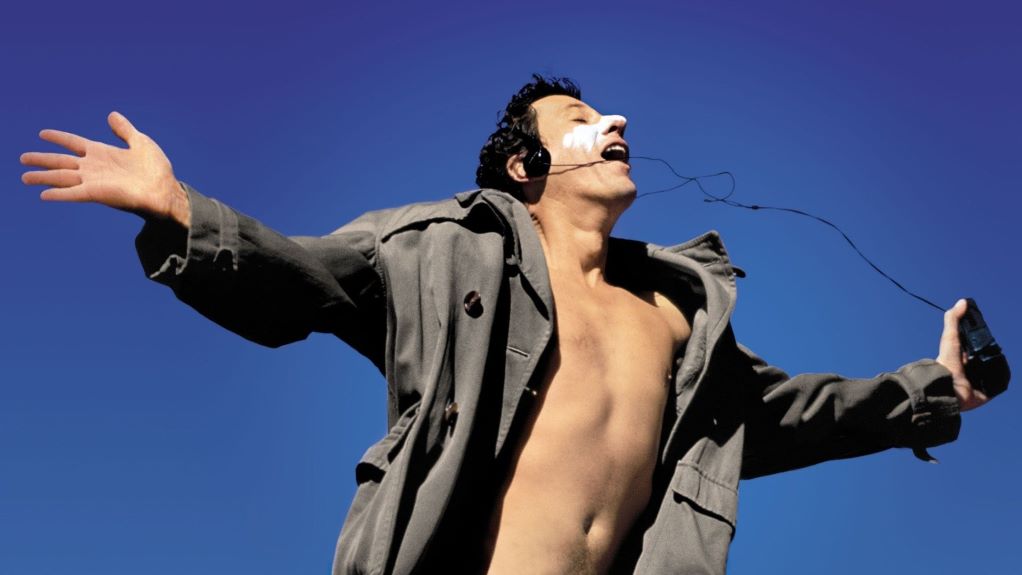
Middle-brow and safe biography that takes easy choices and makes reassuring points
Director: Scott Hicks
Cast: Geoffrey Rush (David Helfgott), Armin Mueller-Stahl (Peter Helfgott), Noah Taylor (Young David Helfgott), Lynn Redgrave (Gillian), Googie Withers (Katherine Susannah Prichard), John Gielgud (Sir Cecil Parkes), Sonia Todd (Sylvia), Nicholas Bell (Mr Rosen), Alex Rafalowicz (Child David Helfgott)

A hugely talented pianist, David Helfgott (played by Noah Taylor then Geoffrey Rush) trained at the Royal College of Music in the late 1960s but developed schizoaffective disorder, a condition that stalled any music career. What happened next is debated, but according to Shine years of mental institutes and sheltered housing eventually led to rediscovery and a life turned round by marriage to Gillian (Lynn Redgrave). This provided a happy home to Helfgott, who had grown up under the domineering hand of his father Peter (Armin Mueller-Stahl), a Polish-Australian who had narrowly escaped the Holocaust and disowned his son after he travelled, against his wishes, to Britain.
Shine repackages Helfgott’s life into a crowd-pleasing triumph-against-adversity biopic which plays fast and loose with facts. Shine makes no mention of Helfgott’s first marriage, it’s portrayal of his father as a misguided tyrant has been disputed by other members of Helfgott’s family and the level of estrangement Helfgott had from his family (his brother claimed David continued to live with the Helfgott family after his return) has been strongly disputed. Shine smooths off all rough edges and emphasises dramatic potential in others to create its stereotypical heart-warming tale.
What it also does is turn Helfgott’s life into a middle-of-the-road biopic, a highly convention film full of expected arcs (struggle, triumph, collapse, triumphant return) and directed with a middlebrow assurance by Hicks. It’s a film that flatters to deceive, offering only cursory insight into its subject and ends with a sentimental scene in which we are all-but-invited to join the characters in a standing ovation for a Helfgott comeback performance (which the film doesn’t even show us).
Shine has almost no interest in Helfgott’s illness, what bought it on, how it developed or what he and those around him did to help him function in society (his marriage to Gillian gets barely ten minutes of the film’s runtime). It has very little interest or insight into music – other than Rachmaninov being ‘very hard to play’ and some guff about finding the heart behind the notes which sounds full of import because anything said by John Gielgud sounds important. It takes a fascinatingly conflicted character like Peter Helfgott and bends over backwards to make him as two dimensional as possible, with only a brief throw-away line that leans into how quite possibly his views on the importance of family might just have been affected by the slaughter of the rest of his in the Holocaust. Everything is designed to make us feel that standing ovation is earned.
The film gets a much better performance than it deserves from Armin Mueller-Stahl as Peter Helfgott. Here is an actor with more compassion and insight into his role than either the film or the director has. On the surface everything Peter does is appalling; controlling what his son plays, demanding he wins competitions, blocking opportunities for progress, beating him in a rage twice and throwing him out of the house. But Mueller-Stahl plays the fragility and vulnerability under Peter exquisitely. This is a man so terrified about losing his family that he goes to extraordinarily damaging lengths to hold it together. So much so he destroys it.
And you understand that in every moment of Mueller-Stahl’s sensitive and immaculately judged performance. He looks at his son with tenderness and adoring love. His eyes dance with fear at the prospect of David going out alone into a world he thinks is dangerous. Its fear that leads him to react with violence – the terror of weakness pours from Mueller-Stahl. It’s a rich, layered, superb performance which seems almost smuggled into a film that does it’s very best to present Peter Helfgott as a controlling, destructive bully who (it believes) was the root cause of David’s illness.
The drama of the film – most of its first hour – revolves around the clash between this domineering father and the young Helfgott, played by Noah Taylor. It tells a very familiar story: the quiet, but talented son and the monster behind him, but does it solidly enough. Quiet, mumbling and shy – but with subtle traces of condition we know will seize him later in life, Taylor is marvellous. The training sequence at the Royal Academy, again familiarly reassuring for its pupil-mentor set-up, also allows a lovely showcase for an-almost-swansong role for Gielgud, sparkling, wry and charming.
It’s strange than that the Best Actor awards were poured onto Geoffrey Rush who only appears in two scenes before taking over the role at the 67-minute mark (of a 100-minute film). Rush, then unknown internationally, gives the sort of grand performance beloved of awards ceremonies. I admire Rush enormously: but Shine is all technique and no insight. Rush twitches, talks at a thousand miles a minute and plays the piano like a natural. Never once is he given the opportunity to really get inside what motivates Helfgott. He doesn’t even get the main dramatic meat of the film (he shares one brief scene with Mueller-Stahl). It’s ironically like a note-perfect but professionally smooth piano recital: the sort of role you feel Rush could actually have done standing on his head.
Shine even fudges moments of stand-up-and-cheer. Helfgott has been told he cannot play a piano because it affects his nerves. We frequently see him starring wistfully at a piano. The film opens with a rain-soaked Helfgott barging into a closed café hoping to be allowed to use the piano. The film is clearly building towards the moment when Helfgott plays the piano in that café, wowing the clientele with his virtuosity after a clumsy initial test playing of a few keys. We should have been wondering: does he still have it after all these years? We’re not because Hicks has thrown away Helfgott’s first playing of the piano in years five minutes early by having him hammer the keys with brilliance in a piano in his hostel (the instrument subsequently locked by his annoyed host). Why not have the piano locked from the start, sitting in his room, present but out of reach? Wouldn’t that have made it even more triumphant when Helfgott played like a master in that café one evening?
It’s cack-handed moments like that exposes the weakness in Shine, a film that flatters to deceive, offering only the most conventional and safe perspectives on a life. It boils things down to goodies and baddies and simplifies mental problems into being solved by just a little love and affection. It’s a film that wants us to applaud Helfgott – and, by extension, to feel better about ourselves. But Shine offers very little in the way of insight or understanding and boils all its events down into easily digestible narrative homilies. It’s middle-brow filmmaking of the middlest kind.
 Movie Musings