Tag: Sean Connery

The Untouchables (1987)

The Untouchables (1987)

Super stylish cops and robbers thriller, as Costner and Connery take on Capone

Director: Brian de Palma

Cast: Kevin Costner (Eliot Ness), Sean Connery (Jimmy Malone), Andy Garcia (George Stone), Robert De Niro (Al Capone), Charles Martin Smith (Oscar Wallace), Patricia Clarkson (Catherine Ness), Billy Drago (Frank Nitti), Richard Bradford (Chief Mike Dorsett), Jack Kehoe (Walter Payne)

“What are you prepared to do!”

It’s the motto of this electric law-enforcement film, one of those all-time classics that provides endlessly quotable lines and moments you can’t forget. It’s crammed with iconic moments, from its brilliantly quotable dialogue from David Mamet, via its wonderful music score, to its artful film literacy and iconic performances. If there is an untouchable film, this one is pretty close. I love it.

It’s 1930, prohibition is in full force and Chicago is ruled by gangland kingpin Al Capone (Robert De Niro). Young Federal Officer Elliot Ness (Kevin Costner) is thrown into Chicago to end Capone’s reign and stamp out the illegal liquor business. Not surprisingly, it’s hard to know who to trust in a town as stinking as this one, until a chance meeting with disillusioned beat cop Jimmy Malone (Sean Connery) helps him find a group of people he can trust – “Untouchables” who aren’t going to go on Capone’s payroll. But to bring Capone down he’s going to have to embrace the “Chicago way” and start to bend his strict moral code. 

Listening to Brian de Palma talk about the making of the movie, you can’t help but suspect he felt he was doing one for the suits rather than one from the heart. Well perhaps he should do that more often, because The Untouchables is a lean, mean, hugely entertaining action-adventure, that plays with genuine ideas and but also nails every single moment. Every scene is shot with a confident, compelling swagger – the sort of thing that reminds you what a conneseur of high-class pulp de Palma can be. The Untouchables plays out like a super-brainy graphic novel adaptation, and every scene sings. There is barely a duff moment in there.

A lot of this comes straight from David Mamet’s brilliant script. Really, with lines like this, moments as well-crafted as this, characters as clearly, brilliantly defined as the ones on show here, you can’t go wrong. Quotable lines fall from the actors’ lips like the gifts they are: “He brings a knife, you bring a gun. He sends one of yours to the hospital, you send one of his to the morgue. That’s the Chicago Way!” It’s dialogue like this that just has ageless appeal, the sort of stuff you find yourself trying to work into day-to-day conversation.

But Mamet’s script is also sharply clever. It swiftly lays out at the start Ness’ moral compass, his code – and then, as the film progresses, it cleverly shows the whys and wherefores for Ness compromising these. Needless to say, the man at the end of the film is totally different from the bright-eyed naïve agent we met at the start. Mamet also brilliantly works shades of grey into all our heroes, while scripting some compelling moments of grandstanding bastardy that an actor as marvellous as De Niro is just waiting to send to the back of the net.

De Niro was of course the inevitable choice as Capone. Bob Hoskins was contracted just in case De Niro said no (when told De Niro would be taking the job but he would get a $20k pay-out for his time, Hoskins told de Palma he’d be thrilled to hear about any other movies de Palma didn’t want him to be in), but it had to be Bobby. The film drops Capone in at key moments: the film opens with the swaggering bully delighted at holding court with English newspapers while being shaved (de Palma’s camera draws down from an overhead shot, like a spider descending from the ceiling, to reveal him in the barber’s chair) – a flash of danger emerges when the barber slips and cuts Capone’s face (de Niro’s flash of fury, followed by his decision to pardon – combined with the barber’s terror – is perfect). Later Capone rages at Ness, hosts a very messy dinner party with a baseball bat, and weeps at the theatre while a key character bleeds to death at his home (a brilliant example of de Palma’s mastery of B-movie cost cutting). He’s the perfect dark heart.

And opposite him you need a white knight – even if it a white knight who is set to be sullied. I’m not sure Kevin Costner ever topped his performance here, in the film that made him a superstar overnight. Looking like the perfect boy scout – his fresh faced earnestness is one of his finest qualities – Costner also has a WASPish hardness under the surface. The burning determination he has to destroy Capone, his disgust at the murder and chaos Capone deals in, is never in doubt – just as his initial naïveté about how to end Capone is all too clear. Costner masterfully shows how each event pushes Ness a step or two further in bending his rules, to fight Capone’s ruthlessness with ruthlessness of his own. “What are you prepared to do!” Malone asks him, and the film is about Ness working out how far his moral compass can stretch. I can’t think of many films that so completely and successfully have the lead character change as much as Costner does here without it feeling rushed or forced. It’s a wonderful performance.

But the film is stolen – and it’s no surprise, as he has the showiest part, most of the best lines, and of course the movie-star cool – by Connery. It’s easy to mock Connery’s blatantly Scottish Irish cop – he gives the accent a go for his first scene, but promptly drops it. What Connery’s performance is really all about is an old dog who never got a chance to do the right thing, finally being given the licence, the support and the inspiration from the younger man to clean up this filthy city. And Connery rages in the film, a force of nature, the perfect mentor, the cop who against all initial expectations is prepared to go through any and all risks to get Capone. He’s the samurai beat cop, and Connery (Oscar-winning) growls through Mamet’s dialogue with all the love of the seasoned pro letting rip. It’s an iconic performance – and led to a five year purple patch of great films and roles for Connery.

But the film works partly because of these great performances and the script, but also because of de Palma’s direction. The pacing is absolutely spot-on, the camera full of moments of flash and invention. Every action sequence has its own distinct tone, from the horse riding hi-jinks of a Canadian border interception of a booze truck, to the dark slaughter late at night of one of the film’s main characters (a masterful, Hitchcockian piece of genius by the way that uses the POV shot to exceptional effect). A late roof chase sizzles with a ruthless energy.

But the real highpoint of the action is of course that famous train-station shoot out. Allegedly the original plans on the day had to be ditched due to budgetary reasons – so cinephile de Palma pulled a sublime Battleship Potemkin homage out of his locker. Shot in near silence, save for gunshots, the bounce of a pram falling down the station stairs (baby on board) and a spare score from Morricone, the sequence is true bravura cinema, both hugely exciting and strangely endearing for all those who know anything about the history of cinema. 

De Palma and Mamet keep the story focused, clear and every scene has a clear purpose and goal. There isn’t a single superfluous character or moment. Everything is perfectly assembled to serve the overall impact of the film. It’s gripping, entertaining and compelling: the sort of film where if you catch it at the right age it has you for life. Ennio Morricone’s operatic score is perfect for the film, underlining and emphasising every moment and effectively sweeping you up. Costner and Connery are superb, De Niro is perfect, the film is a gift that has something new to give every time you see it.

The Man Who Would Be King (1975)

Caine and Connery together at last heading out to the sort of land perfect for The Man Who Would Be King

Director: John Huston

Cast: Sean Connery (Daniel Dravot), Michael Caine (Peachy Carnehan), Christopher Plummer (Rudyard Kipling), Saeed Jaffrey (Billy Fish), Shakira Caine (Roxanne), Doghmi Larbi (Oootah), Jack May (District Commissioner)

A glorious rip-roaring adventure, The Man Who Would Be King is exactly the sort of deeply enjoyable Sunday afternoon viewing you could expect to see playing out on a Bank Holiday weekend on the BBC. Which is enough to make you often overlook that this is quite a dark, even subversive film in amongst all the fun.

Adapted from Rudyard Kipling’s short story, the story follows Daniel Dravot (Sean Connery) and “Peachy” Carnahan (Michael Caine): cashiered NCOs from the British Empire, bumming their way round the Raj in the 1880s, picking pockets and scamming everyone from local rajahs to British commissioners. But their dream is to travel to the distant land of Kafiristan, a country almost unknown in the West, where they hope to help a ruler conquer the land, overthrow him, clean the country out and head back to the West. Arriving after a difficult journey, their plan goes well – but is put out of joint when Dravot is mistaken for a god…

Strange to think that John Huston had this project in development for so long that his original intended stars were Clark Gable and Humphrey Bogart. After the project faltered for so long that those two stars sadly died, Huston shopped it around to most actorly double bills around Hollywood. Finally he settled on his ideal choices for these very British scoundrels: Paul Newman and Robert Redford. Fortunately, Newman took one read of the script and essentially said “John they’ve got to be British”. Connery and Caine were suggested – the rest is history.

And just as well they were suggested, as the film’s principal delight is the gorgeous interplay between the two star actors, happily embracing the film as if they knew they’d never get to bounce off each other together on screen again. This is one of the warmest, most genuine feeling friendships between two characters captured on film, Dravot and Peachy are so clearly heterosexual life partners that they are willing (after much bickering) to forgive each other virtually anything. On top of which, the two actors play around with each other like old-school stage comedians, matching each subtle raise of an eyebrow with a wry half smile. 

Connery is of course perfect as the man succumbing to hubris, his Scots burr spot on for Dravot’s slightly pompous “front man”, while Caine excels as the more sly, fast-talking Peachy. The finest moments of the film feature these two interacting, from performing long cons, to hysterical laughter when death feels near on a snowswept mountain, to the final (emotionally stirring) moments of sacrifice and support.

Because yes, with the film opening with a decrepit Peachy recounting his story to Kipling (an engagingly plummy performance from Plummer – no pun intended) you just know this little boys’-own adventure in the East isn’t going to end well for our heroes. Huston, however, still manages to make the whole thing feel like an excellent jaunt, even though the devastation is clearly signposted from the start. 

Huston’s film is shot with a sweeping, low-key excellence – Huston was a master at putting the camera in place and then basically not getting in the way of the story. He totally identifies from the start that it’s the relationship between the two leads that is the real emotional and dramatic force of the film and never allows anything to obstruct that. He’s smart enough to also get a bit of social commentary in there, around imperialism and the entitlement that means these lower-class Brits feel that they should have their share of other people’s counties. But these themes never unbalance the picture. Instead they counterbalance it – however much we enjoy the leads cheek and charm, we can’t forget that in many ways they are immoral conmen, who represent some of the worst riches stealing excesses of the British Empire.

The slow spiralling of Dravot into the sort of man who wants to stay behind and build a dynasty in Kafiristan works extraordinarily well. Connery perfectly suggests the ego and love of attention that motivates many of the actions of this natural showman. From the first battle, when an arrow fails to kill him, we see him slowly realise and enjoy the implications of this fame. His rather touchingly childlike pleasure in dispensing justice (even if Peachy has to quietly correct his maths in the middle of one case) and spinning fantasies about sitting on equal terms of Queen Victoria don’t turn him into a monster or an egotist, but more of a kid who is running before he can walk. 

It’s the sense of fun that keeps you watching – and also what gives the final few moments their emotional force and power. It works because it never harps on the darker social commentary it contains, about the corruption of British rule, and the greed of these buccaneering adventurers. Superbly acted – as well as the leads, Saeed Jaffrey is very good as a Gurkha soldier who acts as translator for our two con-men – and extremely well filmed, with the sweep and grandeur of India coming across strongly in Huston’s careful camerawork, this is a hugely enjoyable film about friendship that has all the fun and vibrance of a con film wrapped in an epic adventure.

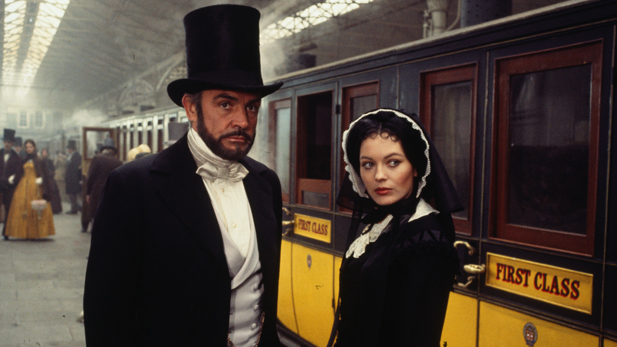
The First Great Train Robbery (1978)


Sean Connery and Lesley-Anne Down grab a train ride in The First Great Train Robbery

Director: Michael Crichton

Cast: Sean Connery (Edward Pierce), Donald Sutherland (Robert Agar), Lesley-Anne Down (Miriam) Alan Webb (Trent), Malcolm Terris (Henry Fowler), Robert Lang (Inspector Sharp), Michael Elphick (Burgess), Wayne Sleep (Clean Willy), Pamela Salem (Emily Trent), Gabrielle Lloyd (Elizabeth Trent), James Cossins (Harranby), André Morell (Judge)

When you think about Michael Crichton, it’s easy to forget he had many more strings to his bow than just writing airport plot boilers. He created ER, he wrote and directed a number of films (most famously WestWorld) – and one of his best books is actually a piece of semi-history, The Great Train Robbery. This book – a brilliantly researched and entertaining part history, part fictionalisation – covers the story of the Great Gold Robbery of 1855, a train-based gold heist. 

Crichton’s film of this book takes a slightly different tone – its realism is toned down slightly, its nose-thumbing anti-establishmentism shaved off, in favour of a lighter comic farce, a caper movie. It makes for an enjoyable movie – but it’s less interesting than the book’s documentary realism and its careful construction of the vast number of obstacles the criminals needed to ingeniously overcome.

Edward Pierce (Sean Connery) is a professional criminal who can pose as an upper-class gent. Having befriended a number of senior people from a leading city bank, he plans a daring heist on a train carrying gold from London to Dover – gold bound for the Crimean war. Pierce puts together a detailed plan – that involves gaining possession of copies of four keys essential for getting access to the safe on the train containing the gold – and recruits a team including expert locksmith and pickpocket Robert Agar (Donald Sutherland) and cunning courtesan Miriam (Lesley-Anne Down). 

The First Great Train Robbery is a caper – and it has all the structure and energy you would expect. From Jerry Goldsmith’s lyrical score to the framing device that constantly returns to Pierce’s key box getting fuller and fuller (like fingers flying up when recruiting The Magnificent Seven), the whole shebang is told with real lightness. Nothing is too serious – the criminals’ actions aren’t designed to hurt anyone (apart from one of their number who turns informant) – and the overall mood is a lark, with the criminals engaging in a boys’ own adventure.

This is helped by the excellent light-comedic playing from Sean Connery and Donald Sutherland as the two main architects of the crime. Connery uses his smoothness (hiding a chippy edge) extremely well – he’s the charming man you’d want to spend time with, and he wraps you up in his own sense of fun. Any obstacles are usually met with a wry smile – like some sort of period Danny Ocean, Pierce is always one-step ahead of the game. Sutherland – with an odd, half Irish accent – makes a very good put-upon wingman, grumbling but still enjoying the ride.

Most of the rest of the cast don’t make much of an impact. Lesley Anne-Down gets some comedic business – particularly a seduction that is designed to go wrong to gain possession of a key – but not a lot else to do. Malcolm Terris and Alan Webb bluster as arrogant dupes. Robert Lang growls as an angry cop. Wayne Sleep of all people pops up as an expert burglar.

The film sweeps from set-up to set-up, very competently filmed, with some decent design and photography (it was the last film of legendary photographer Geoffrey Unsworth). Crichton is a decent director, and if some moments look a bit dated or are a little too much (some make-up for Sutherland at one point looks rubbish) it’s still pretty good.

The real problem is that you lose the sense that, by-and-large, a lot of this actually happened – I mean, sure, it was probably with less banter and jokes, but people really did a lot of this stuff. The film doesn’t always dwell enough on the problems the thieves face, and doesn’t always explain why these obstacles are so vital to overcome. It misses a trick here with its eagerness to keep barrelling forward.

What this means is that film sometimes misses the sense of triumph and satisfaction of overcoming real hurdles – or the frisson of having it clear that a lot of these were real solutions that a real person came up with. The film also rushes its final conclusions. Historically we don’t know what happened to the gold and there was a trial of some of those involved – but the film never really makes that clear. Its conclusion zeroes in again on some hi-jinks, but it doesn’t really make clear the impact, the consequences or what happened to the Macguffin at its centre. You also don’t get the sense of hypocrisy the book mines so well, with the corruption of the upper classes being glossed over by society, but the thievery of the working classes being outright condemned. I missed that a lot from the film – fun as it is.

It’s an entertaining film but, to be honest, it’s not as good as the book – which is actually really worth a read. Crichton is a man with more talent than people give him credit for.

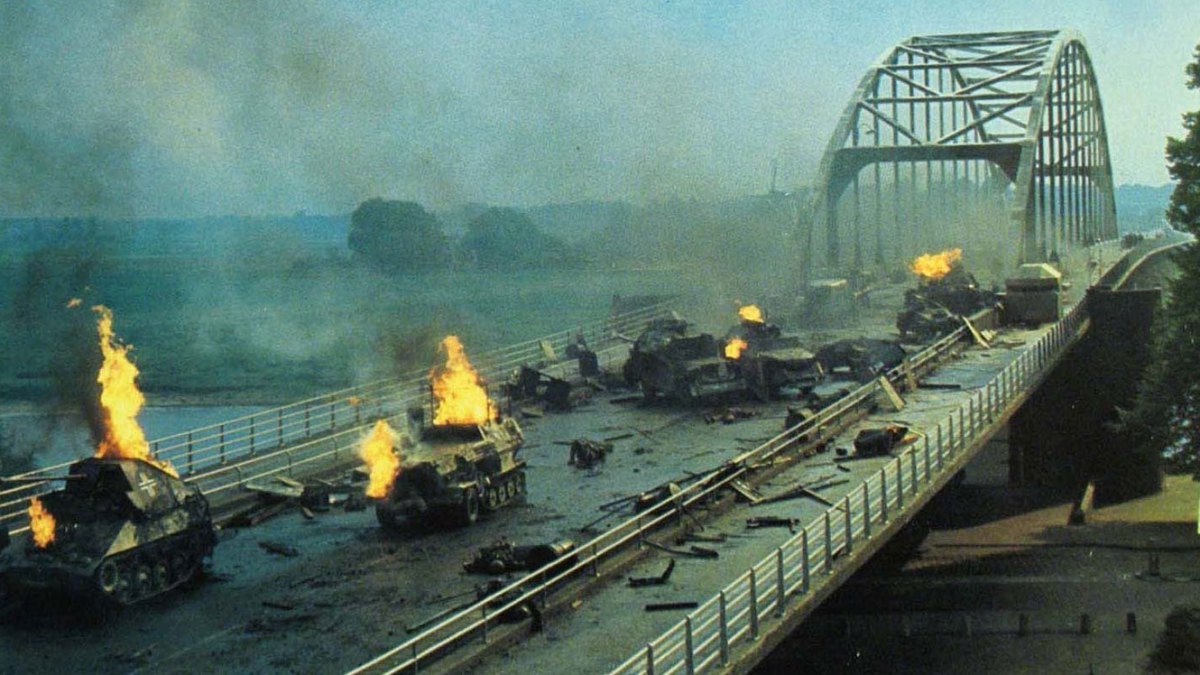
A Bridge Too Far (1977)


Dirk Bogarde, Sean Connery, Ryan O’Neal and Gene Hackman are among the Generals aiming to go A Bridge Too Far

Director: Richard Attenborough

Cast: Dirk Bogarde (Lt-Gen Frederick “Boy” Browning), James Caan (Staff Sgt Eddie Dohun), Michael Caine (Lt-Col J.O.E. Vandeleur), Sean Connery (Maj Gen Roy Urguhart), Edward Fox (Lt Gen Brian Horrocks), Elliot Gould (Col Robert Stout), Gene Hackman (Maj Gen Stanislaw Sosabowski), Anthony Hopkins (Lt Col John Frost), Hardy Krüger (SS Maj Gen Karl Ludwig), Laurence Olivier (Dr. Jan Spaander), Ryan O’Neal (Brig Gen James Gavin), Robert Redford (Major Julian Cook), Maximilian Schell (SS Gen Wilhelm Bittrich), Liv Ullman (Kate ter Horst), Michael Byrne (Lt Col Giles Vandeleur), Denholm Elliott (RAF Officer), Jeremy Kemp (Briefing Officer), Wolfgang Preiss (Feldmarchall Gerd von Rundstedt), Stephen Moore (Maj Robert Steele)

You’ve got to love a good war film. In fact, there are few things more cinematic than the old-school, star laden Hollywood war film. A Bridge Too Far is for me one of the finest examples of this genre, and it’s a film I come back to time and time again. Is it perfect? No of course it isn’t – in fact I probably love this film more than some of the people actually in it do. But it’s a damn fine piece of big-screen, big-budget film-making, and it’s got a cast of stars. And more than perhaps any other film of this genre, it’s a film about how overwhelmingly awful and gut-wrenching war is. This is a film about a defeat – and not the sort of triumphant defeat that Dunkirk feels like. It’s just a gut-punch. The Allies threw the dice big time, and they lost.

The Battle of Arnhem was one of those “end the war by Christmas” plans. The brainchild of British war-hero Field Marshall Montgomery (noticeably absent from the film), Operation Market Garden was a lightning strike into the heart of the Ruhr to capture Germany’s industrial capability. This involved a series of paratrooper drops into towns in the Netherlands, culminating in Arnhem, to cross the Rhine. While the paratroopers seized key bridges, British Tank Division XXX Corp would power through, cross the bridges and into Germany. It was bold, daring and radical. It was a disaster. Arnhem, far from being undefended, was being used as a rest place for a Waffen-SS Panzer division. The British paratroopers found themselves not seizing a lightly defended bridge, but fighting a tank division with machine guns and limited supplies. Meanwhile XXX Corp’s progress became bogged down in traffic jams and higher than expected German resistance. 

It’s quite something to make a war film about possibly the biggest military disaster on the Western Front during the Second World War. The entire plan is a misconceived tactical blunder, and the film never shies away from this, demonstrating time and again the numerous errors that led to it: from Generals ignoring reconnaissance that suggests this won’t be a cake walk, to paratroopers failing to seize bridges quickly, to tanks crawling down crowded roads, fighting every step of the way. Alongside all this, the film never loses track of the horrifying impact of war on both soldiers and civilians caught in the crossfire. It’s a huge budget, all-action, anti-war film.

Richard Attenborough is the perfect marshal for this film. He has the experience and understanding of scope to handle the action scenes. At the time, this film was possibly the most expensive film ever made. Not only that, it was independently funded – producer Joseph E. Levine thought the film was so important he pumped millions of pounds of his own money into it. The attention to detail is extraordinary – the film consulted nearly every single surviving commander from the battle on the script – and all the stops were pulled out creating the military features of the film. 

This is of course particularly striking now as we know everything in the film is real – no special effects in those days. If you see it in the film, then you know that it was really there. In the sequence showing the planes taking off to deliver the paratroopers to their destinations, there were so many planes in the air that Attenborough could literally claim to command the world’s seventh largest air force. Every military blow of the battle is carefully reconstructed. The tactics are carefully explained and followed. Attenborough can shoot compelling action.

But what makes the film so good (for me anyway) is the way the heart-breaking horror of war never gets lost. In all this action, we are always shown the cost. Attenborough will frequently cut back to the after-effects – several times we hear wounded soldiers whimpering on smoke-filled, body-littered battlefields. Many acts of courage (on both sides) by individual soldiers result only in pointless, gut-wrenching deaths. Arnhem isn’t just damaged by the battle, it’s flattened. The impact on the civilian population is terrible – in a powerful sequence, we see characters we were introduced to earlier mercilessly caught in the crossfire of the German tanks. We return continually to locations increasingly shredded by weapons fire. More and more soldiers are wounded – some horrifically.  Near the end, the remaining British paratroopers, encircled and surrendering, sing a deeply moving quiet rendition of Abide With Me. No one could come out of this wanting to go to war.

Attenborough’s humanity is key to the film’s success. It helps as well that he is a brilliant actor’s director. Want to dispel any doubt on the horrors of Arnhem –then train the camera on the Laurence Olivier’s tear-stained face as he drives through the destroyed streets. Want to understand the sacrifices and the courage? Well just let Anthony Hopkins – simply excellent as the commander of the only forces to reach the bridge at Arnhem – with calm, restrained Britishness request support and supplies late in the film as his men are butchered around him. It’s a film full of brilliant moments of acting like that, where Attenborough points the camera at them and lets them act. 

The sequences around Arnhem and the British paratroopers there are the heart of the film. Sean Connery is terrific as Major General Roy Urquhart, commander of the British paratroopers. His growing frustration as events spiral far out of his control is a great contrast with his initial professional confidence. Gene Hackman, as commander of the Polish forces (slightly odd casting but good once you tune up to it), gets the role of the “one man talking sense” who can smell disaster early on, but works harder than anyone to get the plan to work. A number of the regular soldiers in Arnhem are faces the film returns to again and again – giving us people to relate to as their numbers are increasingly decimated by the savage, desperate combat. John Addison’s score also helps a huge amount with building the emotion in these scenes.

The Arnhem sequences are so good that the other sequences around the American paratroopers feel like they come from a slightly different movie. It doesn’t help that the likes of Elliot Gould are playing slightly clichéd “Brooklyn Yankee” types, chomping cigars and ribbing the stiff-upper-lip Brits. Ryan O’Neal as General Gavin is slightly dull. The XXX Corp material is a little dry (essentially driving up a road or waiting), although Edward Fox is superb (and BAFTA-winning) as their charismatic commander Lt Gen Brian Horrocks. Attenborough puts together at least one terrific set-piece tank battle on the road – but it’s not quite enough.

The two biggest American stars are also given the feel-good, up-beat material. James Caan gets the best part in what is effectively a stand-alone story of a Staff Sergeant going to impossible lengths to save the life of his Captain (Caan had his choice of part and chose well). Robert Redford is a little too starry (bizarrely in a film full of stars!) as a Major tasked to seize the vital bridge at Nijmagen via a daylight river-crossing. This sequence feels like it’s been put in the film to (a) give us something to cheer and (b) to allow an American victory for the box office. Of course, we need the biggest star in the world at the time to play the most straight-forward heroic part!

The film does have a tendency to shuffle its characters into “good” and “bad”. So after Redford seizes the bridge, the character sent to tell him that XXX Corp won’t be rushing across to Arnhem after all isn’t Caine’s Vandeleur, but a nameless Colonel played by Polanski’s villainous Ross from Macbeth himself, John Stride. The most sympathetic generals and commanders are all (coincidentally) the people who served as military advisors on the film.

On the other hand, the film ends up laying most of the “blame” on Dirk Bogarde’s Lt Gen Browning. Browning’s widow, Daphne du Maurier, threatened to sue the film-makers for the portrayal of Browning here (she got an apology). Browning is portrayed as the ultimate “non-boat rocker” – over-confident and arrogant, he disregards intelligence suggesting the Arnhem plan is dangerous, seems shocked and clueless once the scale of the disaster is revealed, and by the end of the film seems to be most interested in positioning himself as always opposed to the plan in the first place. Bogarde (the only actor in the film who actually served in Market Garden) was similarly angry when he saw the film – and he has a point. It’s grossly unfair.

It’s a problem with this film and it does annoy me. The parts not set in Arnhem are not as memorable or compelling as the rest. But huge chunks of the film are brilliant, and never fail to move or (sometimes) excite me. Its anti-war stance is striking. The acting from the cast is very good across the board – say what you like, cast every part with a star and you never get confused about who is who. Attenborough also draws great performances from the non-stars – Stephen Moore is a particular stand-out as a signals man unwilling to voice his doubts about the equipment (and who pays a heavy price). 

I can watch A Bridge Too Far at any time. I always love it. It’s a film of great moments and performances. It carries real emotional weight. Attenborough is a very good director of actors, but also a skilled commander of scale. It’s a film that gets emotion in there. It’s a film that isn’t afraid to present a military disaster. It doesn’t demonise the Germans. Sure it plays goodies and baddies with the Allies, and parts of it to drag on a bit too much or deal with cliché. But at its best is the core of a great film. I love it. It’s a favourite. And always will be.

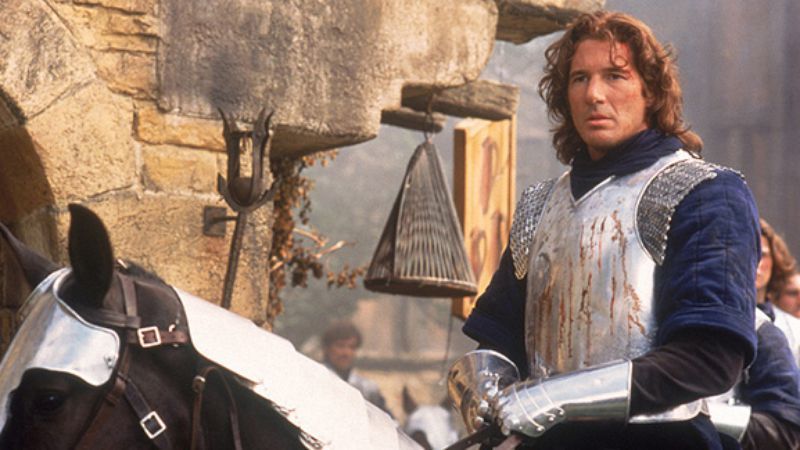
First Knight (1995)


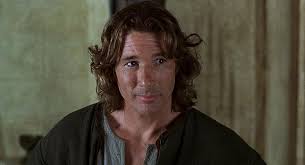
Casting choices only Hollywood producers could make #473: Richard Gere IS Lancelot du Lac

Director: Jerry Zucker

Cast: Sean Connery (King Arthur), Richard Gere (Lancelot), Julia Ormond (Guinevere), Ben Cross (Prince Malagant), John Gielgud (oswald), Liam Cunningham (Sir Agravaine), Christopher Villiers (Sir Kay), Valentine Pelka (Sir Patrise), Colin McCormack (Sir Mador), Alexis Denisof (Sir Gaheris), Ralph Ineson (Ralf), Stuart Bunce (Peter)

First Knight continues a proud tradition of Hollywood adaptations of British legends, with full-blown action and romance mixed with an anachronistic modern-ish vibe which clashes completely with the design of the rest of the film. Think anything from Ivanhoe to Robin Hood: Prince of Thieves. At heart these films are ridiculous, but to be a success they need to embrace this and create something with a bit of heart. First Knight is almost wholly absurd from start to finish – but it’s still remarkably good fun. Even when you laugh at the bizarre sequences that pepper the film, it’s still somehow entertaining. It doesn’t take itself seriously – so I feel people who lambast it are missing the point.

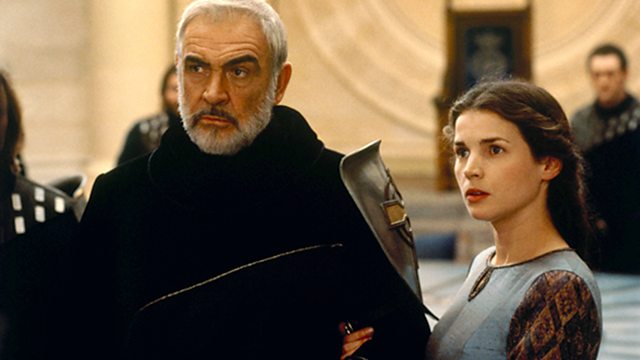
Anyway, it retreads the story of King Arthur (Sean Connery) with a modern mix. Here Arthur is an old man, marrying Guinevere (Julia Ormond) to seal a truce between Camelot and Guinevere’s home of Lyonesse. While being escorted to Camelot, an attempt is made by the villainous Malagant (Ben Cross) to kidnap Guinevere, but she is saved by charismatic chancer and expert swordsman Lancelot (Richard Gere). Returning to Camelot, she marries Arthur while Lancelot finds himself inducted into the Knights of Camelot. But their adventure together has led to a deep romantic bond between Lancelot and Guinevere – one that threatens to tear apart the harmony of Camelot.

Something stupid or horrendously anachronistic happens in every scene of First Knight. Many of these moments are thanks to Richard Gere. Gere is at his most smirky here as Lancelot, an American Gigolo in King Arthur’s Court. There are few more modern actors than Gere – so seeing him in armour and cod-medieval garb jumps straight out as completely incongruous. Rather like Costner in Robin Hood, he makes no concessions to period whatsoever, and behaves more or less as he does in Pretty Woman. Every event in the film is met with his trademarked smirk-cum-grin and a twinkle in his eye. And while he clearly spent a lot of time on his sword work for this film, you literally never forget you are watching Julia Robert’s sugar daddy pretend to be a knight.

But then why should be really have made an effort to adjust his manner, accent or style for this film? After all this is a film where Lancelot takes part in a Total Wipeout competition – and on the basis of his performance in it is basically offered a spot at the round table. As a travelling entertainer, Lancelot woos the crowd with the sort of patter not out of place on a New York street corner. Later, the baddies hook up a boat with a pulley system that turns it into a super-fast speedboat. The baddies are all armed with pistol sized cross bows. It’s the sort of film where the lead villain rides into Camelot and shouts “Nobody move! Or Arthur DIES!”. Anyone watching this expecting a faithful exploration of Thomas Mallory seriously needs to change the channel.

So instead embrace the film for what it is. And enjoy the production values! The music score is swellingly impressive (now hugely familiar to any fans of Sky’s Ryder Cup coverage). The Camelot location looks brilliant. The costumes are wonderful – even if the knight’s armour (basically little more than a shield on the shoulder) looks horrendously inefficient. There is a very effective night-time battle excitingly filmed. The photography looks luscious. It’s shot with an old school, chocolate box, romance that makes everything look like a grand renaissance painting. The final battle between Malagrant and Lancelot is terrific.

I’ve also got to say that it offers an actually fairly interesting role to Sean Connery as Arthur. Considering that four years after this film he made Entrapment, a film in which he boffed Catherine Zeta-Jones, in a way it’s fairly daring for him to make a film that puts so much prominence on his age making him an unsuitable lover for Guinevere. His age is prominent in every scene (especially when counter poised with the modern vibrance of Gere). Half the time he’s with Guinevere he reminds her that he knew her as a child (yuck). He takes no part in any of the action – it’s Lancelot who (twice) rescue Guinevere, while Arthur commands from the rear. His relationship with Guinevere is almost devoid of sex and passion (they share only one remotely passionate snog). He even plays the poor cuckold, the man unable to excite his wife. Has Connery ever played such an unflattering part?


Julia Ormond – an actress who achieved a certain run of prominent roles in the 1990s – plays Guinevere. Despite the fact she seems to frequently find herself in distress, Ormond does manage to make Guinevere not feel like a damsel in distress. She’s proactive, she saves others, she’s defiant and (by and large) she knows what she wants and tries to get it. She also is an effective leader of her people. Ormond is also a fine, generous actress – she manages to convey a lot of chemistry with both Gere and Connery, two actors very different in style.

The film remains charged through with silliness. Ben Cross’ snarling villain has big speeches about how he wishes to escape from “the tyranny of Arthur’s Law”. The LAW is a major theme throughout the film – the characters bang on about it with an earnest insistence. Arthur falls back on it to make sense of his life. Lancelot struggles to understand and embrace the values it brings. Guinevere is determined to match law and duty together. Sure there are some silly grandstanding speeches about it – and the film runs with gleeful pride of Camelot as some sort of Socialist Utopia – but I suppose there’s a kernel of an idea at the centre here about justice and its importance in the world. It might mean we get a scene where Camelot is left totally undefended while everyone gathers for an open trial of Guinevere (guess what happens!), but at least it’s got an idea.

Of course that doesn’t get in the way of the silliness, the high blown acting, the silly events and the overblown dialogue. The heroes are all clean cut, and chiselled of jaw with perfect teeth, the villains all dressed in black, forever scowling and rugged of shave. It never for one minute feels remotely like it is happening in a truly medieval world. Richard Gere is, frankly, completely wrong as a medieval knight. But he’s strangely completely right for a film that is a chocolate box entertainment, a soufflé of a romance with swords and passion, that provides a few stirring moments and an interestingly different part for Connery. Gere is a perfect measure for the film – it’s a silly entertainment for those with an affection for Mills and Boon not Henry V. And there’s nothing wrong with that – it knows what it is, and knows what it wants to be taken as. Enjoy it. After all Camelot Lives!

You Only Live Twice (1967)


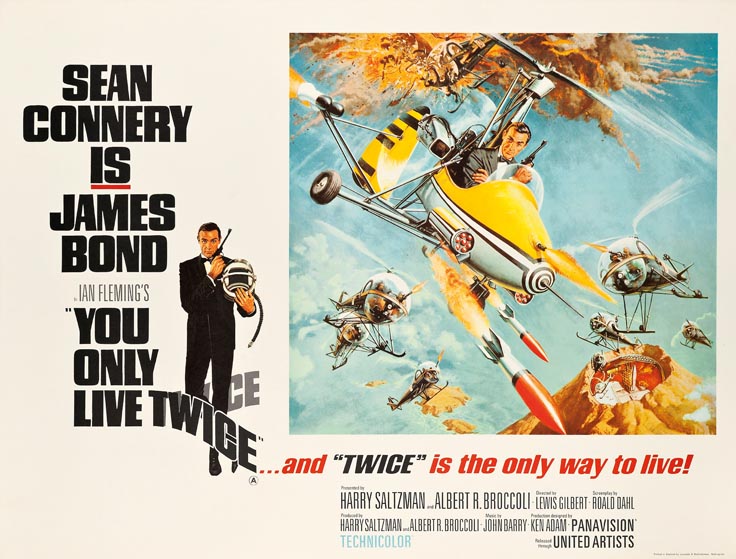
I feel Connery’s attitude to the film comes across well in this image…

Director: Lewis Gilbert

Cast: Sean Connery (James Bond), Akiko Wakabayashi (Aki), Mie Hama (Kissy Suzuki), Tetsurō Tamba (Tiger Tanaka), Teru Shimada (Mr. Osato), Karin Dor (Helga Brandt/No. 11), Donald Pleasence (Ernst Stavro Blofeld), Bernard Lee (M), Lois Maxwell (Miss Moneypenny), Desmond Llewelyn (Q), Charles Gray (Dikko Henderson)

James Bond films: always fun, even when not that good. You Only Live Twice is probably the prime example. For many, many reasons, it isn’t actually very good but still remains strangely enjoyable just because, well hell, it’s Bond. 

Anyway YOLT revolves around naughty super villains SPECTRE nabbing US and USSR space missions, hoping to provoke a nuclear war between the two superpowers. Apparently they will profit handsomely from this – but how they see that happening in a nuclear wasteland isn’t clear. Anyway, James Bond (Sean Connery) fakes his own death and heads to Japan to investigate. Events peddle around Japan for ages, giving filmgoers the chance for some vicarious sight-seeing, before culminating in an all-out attack by Bond and a gang of ninjas on the hollowed-out volcano base of SPECTRE chief Blofield (Donald Pleasance).

YOLT is the moment Bond started to head full tilt towards the Moore-era of overblown, fantasy silliness. The plot is total bobbins (despite being repeated in The Spy Who Loved Me, Moonraker etc.) with both Russians and the US naturally continuing to suspect each other, even when each side loses a spacecraft (though I did like the fact that the actual astronauts together in captivity are shown to have far more in common than not). There is no logical reason for them to behave like this, even at the heart of the Cold War.

There is plenty of other nonsense here. Bond’s death is faked early doors for no reason (only the hopeless SPECTRE is in any way fooled). Bond meanders around Japan with even less subtlety than usual, with a series of clashes, fights and chases that make little real narrative sense at all. Later, again for no reason, (and almost unbelievable to watch today) he disguises himself as a Japanese man (PC alert ahoy, as Bond cuts his hair with a bowl and tans his skin. At least he doesn’t tape his eyelids back…). He also finds a kindred spirit in Tiger Tanaka, both of them treating a host of female servants as a shopping list for rumpy-pumpy.

As per many Bond films, the franchise clambers on top of a current fashion to feel hip and cool (but actually manages to feel fusty and stuffy). This time it’s the samurai craze, as Bond joins a sword-swinging, ninja training school. Yes, you read that right. But of course Bond also needs to get married before the attack: again why? His wife is of course offed seconds later, and Connery just about manages to look put out at this coitus interruptus (more on Connery later…)

SPECTRE themselves are hilariously incompetent. They are hoodwinked like children by Bond’s ludicrous faked death. They practically signpost their location by bumping off anyone who gets within about five miles of the place. Later, poor Blofield not only carefully talks Bond through the self-destruct button for his rocket, he also lets Bond take back his clearly gadget-concealing smoking case, blows away two sidekicks (one right in front of Bond) rather than eliminate Bond himself, then caps it all with sending the base itself to kingdom come. SPECTRE’s agents are equally useless, with Brandt too attracted to Bond to finish him off (and then deciding to tie him up in a plane, detonate a grenade in it and then parachute out to leave the plane to crash with Bond in it – needless to say Bond lands the plane with ease).

The terrific volcano set

The volcano base, however, is a triumph of production design – it’s staggering to think that everything you see on screen was built for real. It’s huge and iconic – and the battle scene between the aforementioned ninjas and SPECTRE goons that fills the final act of the film is hugely exciting, despite almost every single thing making virtually no sense. Incidentally the final battle’s structure is lifted almost completely for a similar sequence in The Spy Who Loved Me.

The problem is that everything else leading up to this feels like all involved are going through the motions – as if there wasn’t really anything fresh left to do or say in the Bond-verse. Need a glamourous location. Never been to Japan have we? Need some scuffles – not sure we‘ve done a roof top fight in long shot, let’s chuck that in. How about we kill Bond off for a few seconds – yeah never done that before. A super gadget needed? Bring on suitcase-assembled helicopter, Little Nellie. The final reveal of Blofeld is fun, but when you come back to watching the film you realise he’s as bland and identikit as Largo or Dr No – a pompous windbag who fucks everything up.

Stumbling through all this is a clearly bored Sean Connery. By this time, Connery was sick of the part (“I’ve always hated that damned James Bond, I’d like to kill him” he was to later say), and money was the only thing tempting him back. Connery coasts through the whole movie with the air of a man who would rather be anywhere else. There is no sparkle at all, just a weary going through the paces. He can barely raise a smirk, let alone a glimmer of interest in the events around him.

Bond turns Japanese. No they really did do this.

It’s the atmosphere of the whole film. Roald Dahl (yes that Roald Dahl) did the script – but he felt the book was pretty awful (one of Fleming’s duller efforts) so spiced it up with some new content. Problem was the suits basically demanded a certain quota of set pieces and a certain number of Bond girls. Trying to deviate from this template too much was far too difficult a challenge. Lewis Gilbert’s direction is professional but pretty uninspired: it sums up the whole movie.

Most of the acting is pretty non-descript. Donald Pleasance at least deserves some credit for making Blofield’s appearance iconic and for doing a nice line of whispering menace. Charles Gray is pretty good fun as a camp British contact (“That’s stirred, not shaken. Is that right?”) – though SPECTRE (true to form) confirm all his suspicions by knocking him off after less than minute or two on screen. Everyone else blends into one.

So, anyway, YOLT is really nothing special – a tired entry into a tired franchise, with an all too obviously disillusioned star and action beats that largely feel like retreads of things we’ve seen before (done better) in the series. But yet, but yet… Somehow enough of the old Bond magic keeps you watching. Sure Connery is indifferent and the action more a travelogue than a thriller – but the final sequence is exciting, Blofeld (for all his ineptitude) makes a decent enough villain, and while no-one really gets het-up about it, the stakes do feel fairly high. Stretches of the film are dull – but others work very well. You may only watch twice, but it will be fun enough.

Time Bandits (1981)


Time travelling roguery in Time Bandits 

Director: Terry Gilliam

Cast: Craig Warnock (Kevin), David Rappaport (Randall), Kenny Baker (Fidgit), Malcolm Dixon (Strutter), Mike Edmonds (Og), Jack Purvis (Wally), Tiny Ross (Vermin), John Cleese (Robin Hood), Sean Connery (Agamemnon), Shelley Duvall (Pansy), Katherine Helmond (Mrs Ogre), Ian Holm (Napoleon), Michael Palin (Vincent), Ralph Richardson (Supreme Being), Peter Vaughan (Winston), David Warner (Evil), Jim Broadbent (Compere)

After leaving Monty Python, each Python went their own way. Terry Gilliam had been the slightly odd one, the eccentric animator who played the weirdos at the edge of the frame. Time Bandits would be pivotal in repositioning him as an ambitious, visionary director with a striking visual sense. It would also allow him (and co-writer Michael Palin) to create a fairytale fable with something for all ages, a film about a child’s view of the world which adults could embrace.

Kevin (Craig Warnock) is a dreamer, a young kid adrift in his parent’s materialistic world. Until one night a gang of dwarves calling themselves “Time Bandits” emerge out of his bedroom cupboard. They have a map that allows them to travel through time and use it to commit crimes and then escape to different centuries. Kevin joins them in their adventures, but none of them know they have attracted the attention of the Evil Genius (David Warner) who wants to use the map to escape his prison and recreate the world in his own image.

I still remember watching this film when I was younger and really enjoying (I must have watched it dozens of times). I have to say it holds up extremely well. Sure Craig Warnock isn’t the most inspired child actor of all time, but he has a wide eyed innocence and enthusiasm that anchors the film really well. Gilliam’s direction is brilliantly good – wild and inventive, like a punk-rock fairytale. The dwarfs make an inspired grouping, each embracing the once-in-a-lifetime chance of playing leading roles.

The main reason for the film’s success is Gilliam. His work is extraordinarily detailed and imaginative, while his visual sense makes shots that cost hundreds of pounds look like millions. Huge swathes of the film are shot with a low-angle lens that allows us to see everything from the perspective of our heroes, and also makes each of these larger-than-life events seem even more awe-inspiring. The design of the film is extraordinary, with striking images confronting you at every turn, either a recreation of events or the bizarre visuals of the “time of wonder”.

And those visuals are outstanding. Can you think of any other film where a knight on horseback bursts out of a bedroom cupboard, charges around the room in medium shot, and then gallops off through a field that has suddenly replaced the bedroom wall? How about an ogre who lives on a ship that is then revealed to be a hat for a giant who lives underwater? Evil’s Fortress is a swaggeringly brilliant triumph of production design, while his goat skulled, tall, hooded monsters must surely have been playing in JK Rowling’s mind when she came up with the Dementors.

The design also echoes the possibility that this is all a child’s fantasy. A careful look at Kevin’s bedroom shows pictures of everything we encounter. The final confrontation with Evil takes place on a set clearly inspired by the Lego bricks, chess board and toys that litter Kevin’s bedroom. 

The playful tone is also reflected in its lampooning of the “adult” world of technology for its dull materialism: Kevin’s parents watch a bullying gameshow (compered by a demonic Jim Broadbent) while sitting on armchairs still in their plastic wrapping. Evil’s obsessions all revolve around lasers and the microchip.

Away from all this, the film has a simple structure. It’s basically a series of really rather fun historical sketches, linked together by an engaging fantasy narrative. These scenes attracted guest star performers, all of whom excel (though it is odd to see them get top billing – Cleese is on screen for about three minutes, but gets top-billing!). 

The guest stars are terrific – Holm is hilarious as a chippy, height-obsessed Napoleon; Cleese very funny as a visiting-Royal-inspired Robin Hood, treating all around him with condescension; Ralph Richardson brings an absent-minded imperiousness and dry wit to his role as God; Connery sprinkles a touch of movie-star bravado as a kindly, gentle Agamemnon (the uncommented on joke being the movie’s ideal father figure is most famous for sacrificing his daughter…). 

If any performer high-jacks the film it’s David Warner as a dry-witted, viciously ego-maniacal Evil Being, getting most of the best lines. A sequence where he obliterates several underlings for minor transgressions hums with dark humour (and punchlines with the accidental obliteration of another minion off screen, met with a sheepish “Sorry”). On top of that, Warner brings just the right level of sinister child’s-nightmareish quality to the role, helped by a striking costume design that makes him look the love-child of a crocodile and a car engine.

The leads of the film (Kevin and the bandits) are extremely well drawn by Palin’s script, each of them with sharply distinctive personalities. David Rappaport (allegedly incredibly unpopular with the others due to his haughty disregard for them) is perfect as the arrogant self-appointed leader, but Jack Purvis is a stand-out as the warmly brave Wally. More than a few commentators have pointed out that the Bandits all serve as representatives of the members of the Monty Python troop, which adds another level of fun watching the film.

Time Bandits is electric good fun. I have no doubt I might find more to criticise without the memory of enjoying it so much when I was younger. Some of the sketches work less well than others – the scene with the ogre doesn’t quite work, and the ending, twistedly funny as it is, does feel slightly abrupt is. But the film never outstays its welcome, and it’s put together with such glee and accomplishment that there is always a line or an image that sticks with you. It’s a dark fairytale for children of all ages – and making something the whole family can enjoy is really quite a feat. Palin and Gilliam would have put together a sensational series of Doctor Who.

Dr. No (1962)


Bond sets out his stall in series opener Dr No.

Director: Terence Young

Cast:  Sean Connery (James Bond), Ursula Andress (Honey Ryder), Joseph Wiseman (Dr. No), Jack Lord (Felix Leiter), Bernard Lee (M), Anthony Dawson (Professor Dent), John Kitzmiller (Quarrel), Zena Marshall (Miss Taro), Eunice Grayson (Sylvia Trench), Lois Maxwell (Miss Moneypenny)

It’s hard to believe now, but there was a time when the launch of James Bond novel was nothing more than a little B-picture event – rather than the major cultural landmark it has now become. But James Bond started off as a slightly higher budget B-movie of a character largely unknown to those who don’t read spy fiction.

After the murder of a British agent in Jamaica, James Bond (Sean Connery) is sent to investigate. Arriving in Jamaica, Bond quickly finds himself the target of a series of increasingly outlandish attempts to take his life: from a fake embassy driver to a series of assassins pretending to be blind and a sinister geology professor. Eventually, Bond detects the hands (forgive the pun) of Dr No (Joseph Wiseman), who is experimenting with radioactivity on a nearby island. 

What is striking is how much of the Bond-movie formula is in place here right from the start – or rather, how much the style and tone established here fitted so naturally with the source material and character, meaning it would be used repeatedly throughout the rest of the series. Most striking of course are the music cues, all perfect and immediately cool. Is it any wonder that no-one has felt the need to change the James Bond Theme since? But it’s not just that: Bond’s flirtation with Moneypenny and cheeky-protégé exchanges with M? Check. Exotic locales, car chases, shoot ups and wise cracks over dead bodies? Check. The villain being a suavely charming wannabe upper-class type with a creepy deformity, a vague plan and a ridiculously overblown layer? Check. Wave after wave of heavies attempting to bump Bond off with overblown schemes? Check. The villain monologing rather than killing Bond? Check. It’s all there – the formula was in place, and would remain for the next 60 years.

Of course, it probably wouldn’t have worked without getting the casting of Bond himself right – which they certainly did with Connery. Not exactly a conventional choice for a character Fleming imagined as a mixture of Noel Coward, Cary Grant, David Niven and Christopher Lee, Connery brought to it the earthy violence, the roughness and sense of danger that made you believe he could not only merrily kill a room full of goons, but that he would hardly break a sweat doing it. The film’s writers downplayed the self-doubt, anxiety and fear that Fleming’s book-Bond often displayed, repositioning the character as a serenely cool and charismatic superspy, with Connery granting him an additional charm and sex appeal all rooted in his charisma as a performer. He’s magnetic here – whippet thin, dryly deadpan and ruthlessly violent. He established completely the template the character would follow through the next five actors.

What’s interesting watching this film is how close it is to being a one-man movie cum character study. Bond’s principle love interest, Honey Ryder, doesn’t appear until half way through the film and Dr No himself doesn’t pop up until the final act. Felix Leiter has just a few bare scenes. Instead, the focus is front and centre on Bond himself, and Connery’s perfect mix of suave sophisticate and brutal remorseless brawler. The character’s comfort with sex and violence (often close together) is in every scene – Bond sleeps with at least four women, flirts with a couple more, ruthlessly offs a wave of heavies sent by No, and cold bloodedly guns down defenceless doofus Professor Dent. Perhaps fitting for a film that promoted itself as “the FIRST James Bond film”, it wants us to understand (and above all, enjoy the company of) this guy, with the hope that we will sign up for multiple movies to come (which of course we did).

As a standalone film, Doctor No makes a pretty good fist of things. Its plot avoids a clumsy “Bond: Origins” story, instead throwing us straight into events (despite being the first Bond film, it could basically be watched in any order with Connery’s other Bonds – only his first discovery of SPECTRE has any bearing on the timeline). Its plot is certainly a lot more stodgy and wordy than later films would be – but the balance is Bond actually gets to do quite a bit of investigating. The pace is kept up, even if (as noted) most of the film’s principle characters don’t appear until late in the film.

The rather low budget is clear in the rather rudimentary car chases (back screen projection ahoy!) and fights, which rely heavily on sped-up film to get their impact across. I suspect most of the money went on the glamourous Jamaican location, but that does look fantastic under Ted Moore’s photography. 

The film does though have a certain mastery in its direction, not least in the introduction of its leading characters. The introduction of Bond himself (held off for the best part of 10 minutes) is a lovely example: a camera tracks into a casino, settling on a table before craning up to reveal the lady Bond is playing against. A medium shot of the same table: Bond’s hands can be seen but nothing else. The camera focuses on the lady again and tracks back over Bond’s shoulders – we see the outline of his neck. Several shots of his hands follow flipping over cards – finally he speaks (“I admire your courage Miss uh –“ being the character’s immortal first onscreen words). She retorts and then the camera finally jump cuts to Connery nonchantly lighting a cigarette with practised cool – while the Bond theme gently underplays, swelling throughout the rest of the scene. From here now we cut to Connery’s face every few seconds. It’s a masterful building of tension and aura. Similar skill is also of course shown in the later entrance of Ursula Andress’ Honey Ryder.

Dr No is an extremely enjoyable B-movie, which successfully sets up the tropes that would play out so well in future Bond movies. Ken Adams’ imposing set design for Dr No’s secret base set the tone for the sort of futuristic locations Bond would find himself in, and would only grow in imagination as the film series expanded. It’s not just the visuals – the tone of the series is pretty much there straight away, and if the plot is not always the most gripping and the action not always the most compelling, that would only develop as the series got more and more money pumped its way. Indeed the follow-up, From Russia with Love, would build perfectly on many of the concepts and ideas introduced in this film. Dr No is not in the top 10 best Bond films, but it continues to reward and entertain – and for starting such a huge ball rolling so confidently, it deserves plenty of praise.

The Russia House (1990)


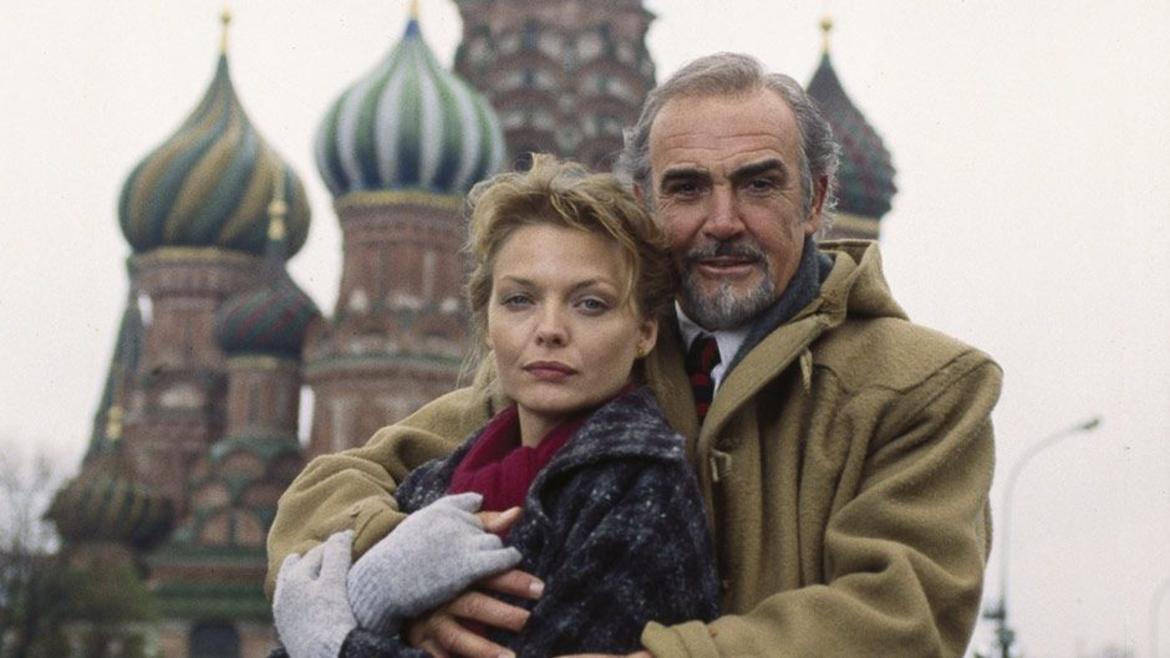
Connery and Pfeiffer go behind the Iron Curtain

Director: Fred Schepisi

Cast: Sean Connery (Bartholomew “Barley” Scott Blair), Michelle Pfeiffer (Katya Orlova), Klaus Maria Brandauer (Dante), Roy Scheider (Russell), James Fox (Ned), John Mahoney (Brady), Michael Kitchen (Clive), J. T. Walsh (Colonel Jackson Quinn), Ken Russell (Walter), David Threlfall (Wicklow)

Based on John Le Carré’s novel, The Russia House was one of the first espionage thriller films released after the fall of the Soviet Union, and therefore found itself exploring the curious impact of Glasnost on the games of one-upmanship that East and West played with each other.

Barley Blair (Sean Connery) is an over-the-hill publisher with connections in Russia, who is enlisted by MI6 to recruit the mysterious “Dante” (Klaus Maria Brandauer, a little too mannered for the film and under used), whose manuscript about Russian nuclear readiness has been intercepted en route to Blair by the intelligence services. Blair’s main contact is Dante’s former lover Katya (Michelle Pfeiffer), a woman trapped in political games.

Second-tier Le Carré is brought to the screen in a film that perfectly captures the authorial voice, but missing  narrative drive. Tom Stoppard’s adaptation masterfully captures the nuances and rhythms of Le Carré’s writing – the conversations of the CIA and MI6 operatives, their lingo and phraseology, are a perfect evocation of the author’s style, while Barley comes to the screen as almost the quintessential disillusioned middle-aged romantic: scruffy with a drink problem and a public school disdain for the prefects of the intelligence service.

The film’s other major positive is the central performance of Sean Connery. The former James Bond (then in the middle of a five-year purple patch of great roles which ran from The Name of the Rose to The Hunt for Red October) brilliantly plays against type as the dishevelled Barley, a man who feels like he has spent a lifetime circling failure and unreliability. Connery tones down his athletic physicality as an actor, playing Barley as a shuffling, hunched figure, often a step behind those around him. He’s also able to capture the romantic defiance behind Blair as well as a sadness and a self-loathing, his eyes showing years of shame at his own unreliability and the disappointments he has inflicted on people. It’s one of his least “Connery-like” performances, and a real demonstration of his willingness to stretch himself as an actor.

He’s well matched by some fine supporting performances. Pfeiffer is a very good actress who balances Katya’s vulnerability with a shrewd understanding of the compromises and dangers of the world she is in. Having said that, the chemistry between her and Connery doesn’t quite click into place during the course of the film. There are also good performances from James Fox and Roy Scheider as feuding intelligence boffins, and an eye-catching “love it or loath it” one from Ken Russell playing one of Le Carré’s quintessential campy, eccentric public-school intelligence operatives.

The film’s main weakness is that the actual story just isn’t quite interesting enough. The stakes never feel as high as they should be, and the unfolding of events seems unclear rather than carefully concealed from the audience. Despite the actors’ performances, Blair and Katya aren’t quite characters we can invest in enough and the momentum of the film too often gets bogged down in a reconstruction of intelligence agent squabbles. Schepisi films the Russian locations extremely well, but too often the camera lingers lovingly on a series of locations like a travelogue, slowing down the pace of the film as the film revels in its status as only the second Hollywood production allowed to film in Russia.

It’s an intelligent and faithful adaptation, but it doesn’t quite come to life. Stoppard’s script doesn’t carry enough narrative thrust and you simply don’t care enough about the fates of many of the characters. In many ways, a less faithful adaptation – such as the BBC’s recent production of The Night Manager – might well have made for a more compelling movie. As it is, although the film feels like an immersion into the author’s universe, it also feels like a dip into one of the less engaging and memorable offerings in his back catalogue. Along with the book’s strengths, it also carries across weaknesses. It’s satisfying enough and doesn’t outstay its welcome – but it also never really seizes the attention.