Tag: Sean Harris

Spencer (2021)

Kristen Stewart channels the People’s Princess in Spencer

Director: Pablo Larrain

Cast: Kristen Stewart (Diana, Princess of Wales), Timothy Spall (Major Alistair Gregory), Jack Farthing (Prince Charles), Sean Harris (Chef Darren McGrady), Sally Hawkins (Maggie), Jack Nielsen (Prince William), Freddie Spry (Prince Harry), Stella Gonet (Queen Elizabeth II), Amy Manson (Anne Boleyn)
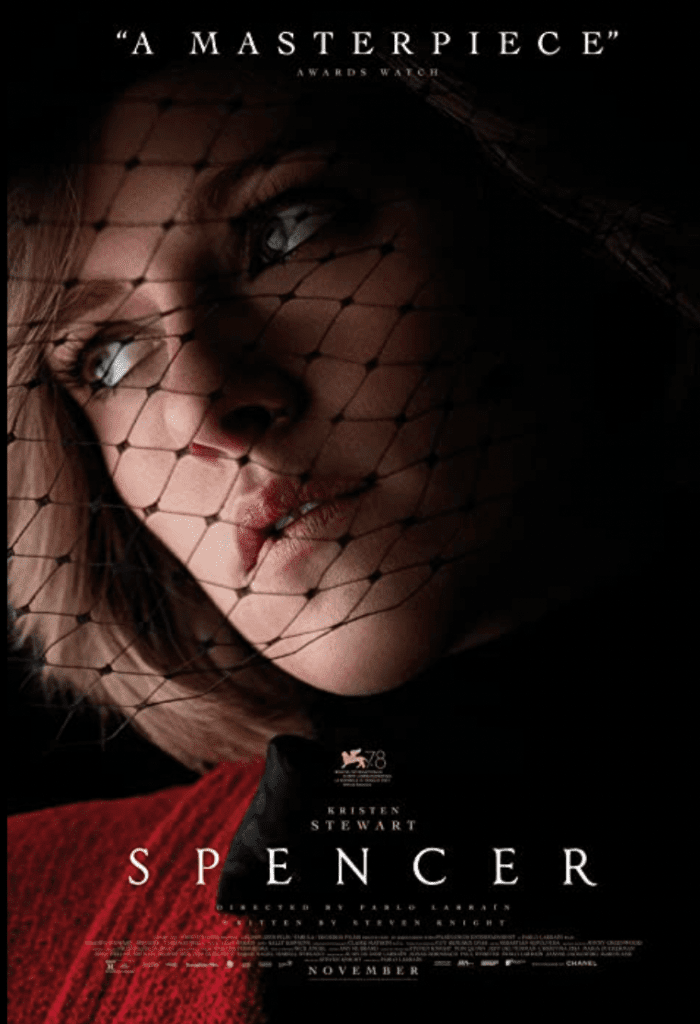
There is no more famous fairy-tale-gone-wrong in history than Prince Charles and Diana. It’s been explored in countless books, memoirs and films. It’s the meat of Netflix’s The Crown. Interest in it has been rekindled again after Prince Harry’s royal resignation. It’s a fable (also what this film claims to be, based, it claims, on “a true tragedy”) that will only become more of a legend. At its centre is Diana, a figure idealised and enshrined by a tragic early death, who had all the warmth, lovability and public humanity the more reserved Charles lacked. Diana’s romanticism has always helped her be remembered as the hero of this tragedy, with Charles the villain. You’ll see no difference in opinion here. Spencer is a fantastia on Diana that feels like it has been squeezed out of the pages of a host of sentimental pro-Diana memoirs from the likes of Paul Burrell.

Set over a three-day Christmas holiday at Sandringham, around 1991, the film follows a disastrous holiday of psychological depression, despair and isolated crisis for Diana (Kristen Stewart) as her marriage to Charles (Jack Farthing) finally, irretrievably, collapses. Over those days, Diana hides in her room, throws up meals, is treated with stony silence from the Royal family and quietly bullied by Sandringham equerry Major Gregory (Timothy Spall). Her only friends are besotted loyal dresser Maggie (Sally Hawkins) and avuncular chef Darren (Sean Harris) and her only moments of happiness are with her two young sons, giving her the only taste she has of a normal life.

If there is one thing Spencer does very well, it is giving an insight into how overbearing and crushing depression can be. Diana is erratic, frequently tearful, prone to fantasies and suffers through prolonged periods of self-loathing, exhibiting as chronic vomiting after every meal and possible self-harm. Stress makes her sharp and waspish with those she doesn’t trust and almost overwhelmingly needy with those she does. Larrain visualises this with muted pallets and drained colours, showing this world in the same oppressive, depressing light as Diana see it, while Johnny Greenwood’s excellent score makes superb use of a series of unsettling chords to constantly put us ill at ease.

The downside is, the film so completely consumes the Diana-side only, that it feels like being crushed to death by a collapsing mountain of “People’s Princess” bargain-bucket memoirs. Diana is always the victim and never at fault. The film takes an idealised view of her as “one-of-us” chewed up and spat out by an uncaring system, with the Windsors as monstrous gargoyles. (A bit rich considering she’s the daughter of an Earl). Charles is cast firmly as a cold-fish and villain, heartlessly openly carrying on an affair, gifting the same pearls to Camilla as he does Diana. Where Diana is warm and playful with the children, Charles is cold and authoritative, angrily tutting at William’s failures at shooting. Where she has a natural touch with people, Charles is cold and dictatorial.

It is, basically a one-sided vision of this story. That would be fine if the film had suggested that what we are seeing is Diana’s depression-filtered perception of the world – her perception told her surroundings were like, cold, cruel and oppressive. But there is no suggestion that we are seeing this, no extenuating circumstances or slight doubts raised to suggest that there may be different interpretations of these events or that there were two people in this marriage, both in different ways at fault.

It’s something The Crown has carefully – and skilfully – done, by demonstrating these are two people never in love with each other in the first place, with no common interests and outlooks. Spencer could have delved more into helping us understand how this situation came about. It isn’t interested in doing this: as far as the film is concerned, Charles is an unfaithful bastard (Jack Farthing’s channels his Warleggen from Poldark, playing every scene with a razor-blade growl) intent on gaslighting his wife. It doesn’t seem fair.

And lord knows, I’m sorry for Diana who should never have agreed to marry a man she was unsuited to and in love with another woman from day one. There is a film to be made (eventually) about Diana which explores the fascinating puzzles in her identity. The woman who loathed the press but also was an expert manipulator of public opinion, who yearned for privacy but loved public and private devotion. Spencer doesn’t explore any of this, instead presenting a simplified, romantic vision of a woman exactly as you would expect to see from a cliched TV movie. At heart, in fact, that’s what Spencer is – a slushy made-for-TV-movie shot like an arthouse film.

That’s perhaps why its full of such ridiculous flourishes. We’ve obviously talked about the stone-cold Royals. We get cod psychology – “Where the fuck am I?” are Diana’s opening lines, hammering home for us (in case we are about to miss it) that her tortured psychology is the heart of the film. As the Royal Court arrives at Sandringham, their cars drive over the dead body of a pheasant – symbolism you see! Diana reads a book about Anne Boleyn – and sure enough she is soon literally communing with a ghost of the beheaded Queen, both of them claiming themselves as victims of a cruel king who loved someone else. Everything in the film is heavy-handed and designed to push Diana as the faultless victim and the Royals as scowling monsters.

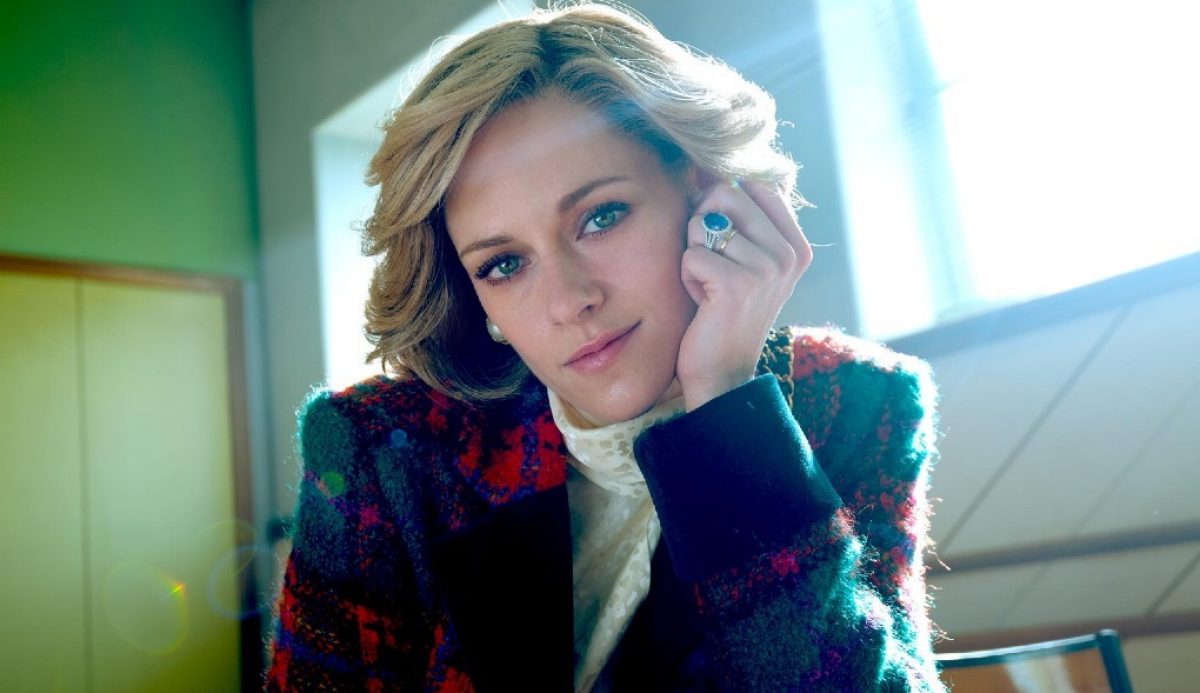
Kirsten Stewart gives a decent impersonation of Diana – vocally she’s spot-on – but for me she struggles in the shadow of Emma Corrin’s extraordinarily transformative work in The Crown – a show that also gained a lot more emotional insight into this story than the film even begins to achieve. It’s shot with a real arthouse style, but at heart it’s a silly and shallow film that never tries to understand either Diana’s inner life or how her marriage became what it was.
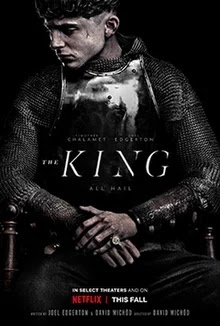
The King (2019)

Timothée Chalamet is the war like Henry V in the confused The King

Director: David Michôd

Cast: Timothée Chalamet (King Henry V), Joel Edgerton (Sir John Falstaff), Robert Pattinson (The Dauphin), Sean Harris (William Gascoigne), Thomasin McKenzie (Queen Phillippa), Ben Mendelsohn (Henry IV), Tom Glynn-Carney (Henry “Hotspur” Percy), Lily-Rose Depp (Princess Catherine), Dean-Charles Chapman (Thomas, Duke of Clarence), Thibault de Montalembert (King Charles VI), Tara Fitzgerald (Hooper), Andrew Havill (Archbishop of Canterbury)

This is a story that is pretty familiar to most people now – after all, Shakespeare’s play has probably been being played somewhere in the world for most of the last 500 years. Edgerton and Michôd collaborated on the story and script of this restaging, or reimagining, of Shakespeare’s epic of the wayward fun-loving prince turned hardened warrior king. Despite being handsomely filmed, and impressively shot, this makes for an odd and unusual film which falls between the two stools, as it is faithful to neither history nor the Shakespeare original.

The rough concept remains the same. Prince Hal (Timothée Chalamet) is not just a young man who has fun in the taverns of London, he’s also quite forward looking in his attitudes, and just can’t understand why he should be made to carry on the rivalries of his father, the fearsome Henry IV (a broodingly miffed Ben Mendelsohn) or why he should continue the wars that the council pressures him into. When he becomes king, however, Henry is persuaded by his counsellor William Gascoigne (Sean Harris), that the path to peace for the realm – and safety for his subjects – can only be through unifying the kingdom by war with France. Appointing the only man he trusts – his old drinking companion and famed soldier Sir John Falstaff (Joel Edgerton) – as the Marshal of his armies, Henry heads to France where destiny awaits.

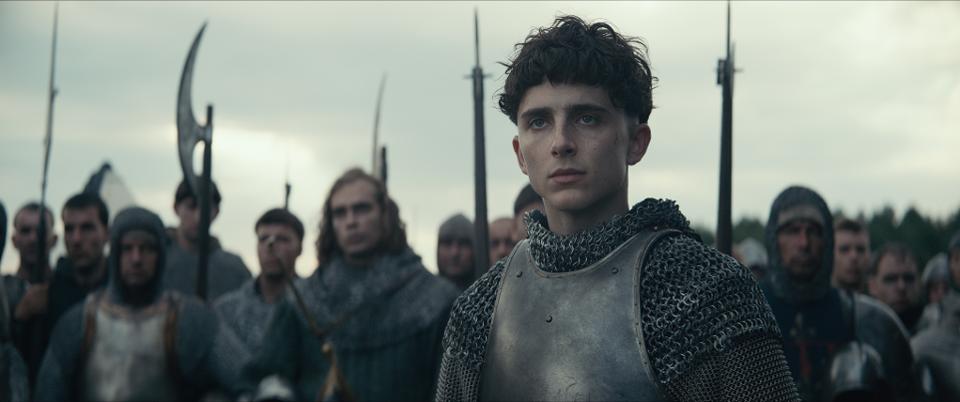
Michôd’s film is at its strongest when it focuses on the visuals and the aesthetic of its age. It’s beautifully shot, with several striking images, from execution courtyards to the battle of Agincourt itself, which takes place in an increasingly grimy field. The battle itself ends up feeling more than a little reminiscent of ideas from Game of Thrones – in fact a few core images are straight rip-offs from the famous “Battle of the Bastards” episode – but it at least looks good, even if there are few things new in it. The costumes and production design don’t feel like they strike a wrong note either with the grimy, lived-in feel.

More of the issues come around the script. The film’s concept of Henry initially as this rather woke modern king – he just wants peace and to give up these tiresome obsessive conflicts of his father – who slowly becomes more colder and ruthless as the film progresses does at least make thematic sense in the film, but it still rings a little untrue. Much as I would like, it’s hard to believe that any prince like this could ever have existed at the time, and so cool and calculating is Chalamet’s performance from the first that he never feels like a genuine, young, naïve princeling whom we can sympathise with early on. 

It makes the film’s arc rather cold, and Hal an even more unknowable character than the film perhaps even intends. There is very little warmth or genuine friendship between Hal and Falstaff, and Hal moves so quickly to the imagining (and enacting) of war crimes during his time in France that his descent towards potential tyrant feels far too sharp to carry impact. Even in the early days of his reign he’s swift to have potential destablisers in his court executed with no mercy. Where is the fall, if he is such a cold fish to start with? And with Chalamet at his most restrained (like the royal baggage and the accent are a straight-jacket around him), how can an audience invest in him? 

And what are we supposed to be making of this anyway, since the film is at equal pains to suggest that the king may be the subject of manipulation and lies that force his hand into war? This Henry, we learn, values truth and honesty highest – but this doesn’t stop him getting pissed when met with counter-arguments from his advisers (even Falstaff) or reacting with cold fury and disavowal when things don’t go his way. It’s a confusing attempt to add an ill-fitting modern morality to a king who essentially in real life spent most of his life at war, and was to die on campaign in France still trying to cement his rights at a young age.

Edgerton and Michôd’s script fails to really square this circle, and all the attempts to have its cake and eat it (the peace loving king still manages to kick arse, including killing Hotspur in single combat thus averting the Battle of Shrewsbury from ever happening) don’t quite pan out. Edgerton writes himself a decent role as Sir John Falstaff, here reimagined as a million miles from the drunken, cowardly knight into a courageous and hardened soldier who has no time for the compromises and deceit of court (in contrast to Henry’s other advisor, the Machiavellian Gascoigne played with a playful archness by Sean Harris). Making Falstaff a respected figure like this rather flies in the face of the logic of why Henry IV is so annoyed about his son spending time with him, but never mind.

It’s not really Shakespeare and it’s not really history. It sticks closest perhaps to Shakespeare in its portrayal of the French as arrogant fops – led by Robert Pattinson going delightfully OTT as the Dauphin – but it never really quite works out what it wants to be. With its Game of Thrones look and feel, and prince who is both great warrior and reluctant warlord, peace-lover and ruthless executor of his enemies, it feels scattergun and confused rather than coherent and whole.

Mission: Impossible – Rogue Nation (2015)


Tom Cruise is the Living Manifestation of Destiny in Mission: Impossible Rogue Nation

Director: Christopher McQuarrie

Cast: Tom Cruise (Ethan Hunt), Jeremy Renner (William Brandt), Simon Pegg (Benji Dunn), Rebecca Ferguson (Ilsa Faust), Ving Rhames (Luther Stickell), Sean Harris (Solomon Lane), Alec Baldwin (Alan Hunley), Simon McBurney (Atlee), Tom Hollander (Prime Minister)

Tom Cruise may be getting on a bit now, but he still does his own stunts with reckless disregard for his own safety: part of the franchise’s appeal is seeing the latest insane thing the Crusier will do. In M:I RN he gets this out of the way early (pre-credits) with a madcap stunt involving holding onto a plane while it takes off. A clever little tease, if for no other reason that no-one can complain about it being a spoiler when said stunt was placed on the poster and all the trailers, when it’s literally the first thing he does in the film.

Anyway, the mission accepted this time is Ethan Hunt (Tom Cruise) going toe-to-toe with a shadowy organisation known as The Syndicate (a sort of evil IMF), run by the serenely sinister Solomon Lane (Sean Harris). Things are made more difficult by IMF being disbanded (again!) by CIA director Alan Hunley (Alec Baldwin). However, help is at hand from old friends Benji (Simon Pegg), Brandt (Jeremy Renner) and Luther (Ving Rhames) – and possibly from mysterious double (or is it triple?) agent Ilsa Faust (Rebecca Ferguson) who may or may not be playing for the angels.

This continues the rich vein of form for this series. It’s light, fast-paced and huge amounts of fun that bombs along with plenty of cool stuff happening all the time. Once again, the stunts are pretty stunning and the set-pieces feel like they offer fresh alternatives. In fact Mission: Impossible – Rogue Nation might be one of the most fun entries in what’s already a hugely enjoyable franchise.

It’s still very much the Cruise franchise though. There’s a fascinating documentary on the DVD. It’s called “Cruise Control”, which is a revealing pun while you watch Tom constantly stand over the shoulder of Chris McQuarrie during shooting. He sets the camera, he storyboards the scenes, he talks to the actors, he edits the film. To all intents and purposes, he’s at lease the co-director. Perhaps this is why Cruise is so overwhelmingly the focus of the film. He spends a good 15 minutes displaying his chiselled body topless. Alec Baldwin even has a ludicrous speech where he calls Hunt “the living manifestation of destiny”. Fun as the film is, make no mistake it’s a showpiece for Cruise.

Here’s Tom hanging off a plane. Say what you like the guy is committed. Or should be committed.

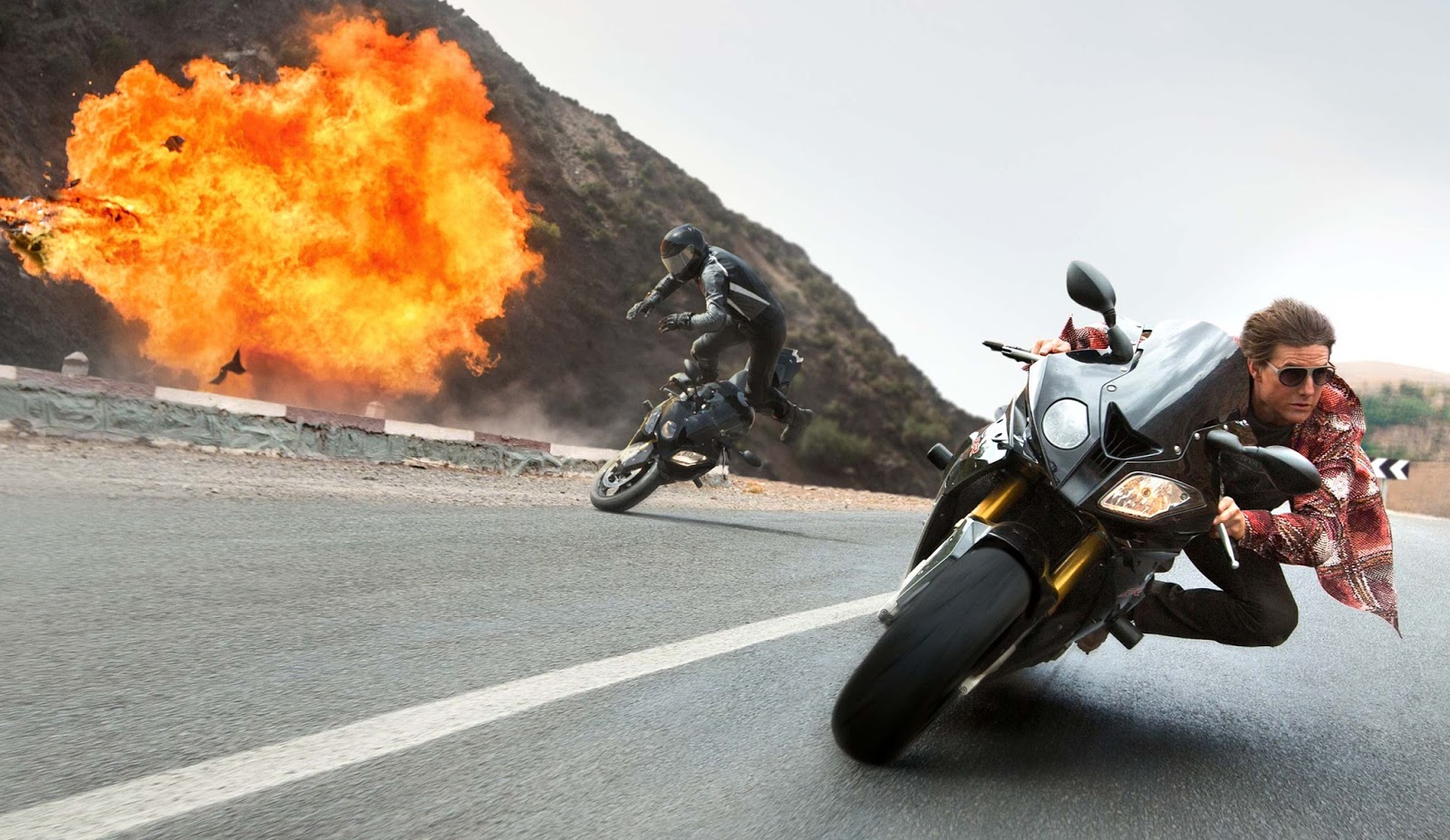
Not that there is much wrong with that if the end result is such good fun. Simon Pegg does a good job of puncturing the pretentions. Every 15 minutes we also get some sort of gripping action set-piece: Tom fighting in the Vienna Opera House, Tom holding his breath in an underwater computer bank for an unfeasibly long period of time, Tom driving a car then a motorbike (no helmet!) through a series of crazily risky chases… Even when escaping from captivity early from the film, he springs his escape with a nifty upside-down acrobatic jump-climb from a pole. Sure it’s all Tom, but he does it all so well that you can’t not be entertained.

But away from Tom, there is actually a nice sense of family that keeps the story bubbling over. Benji and Hunt increasingly feel like heterosexual life partners (in a really nice touch, it’s Benji who fills the damsel in distress role at the end of the film). The other returning characters, Brandt and Luther, don’t have masses to do but immediately settle into the bickering dynamic that keeps the family ticking over. Ilsa Faust is thrown into this boys-only club partly as a femme fatale, partly as some sort of a potential surrogate stepmum, who the kids are working out whether to trust.

Ilsa Faust could be the best thing about the film, a sort of super-efficient female version of Ethan, bests him a couple of times, and can do all the running, punching, shooting and driving that Tom does almost as well. Sure the camera can’t quite resist a few tracking shots up her body in a nice dress or motorcycle gear, but all-in-all she’s pretty well presented. There is a curious semi-flirtatious, semi-siblingy relationship between Faust and Hunt, with the film eventually settling as a kinda sweet dance of “what might have been”. Ferguson is terrific in the role, not only matching Tom’s athleticism, but also giving Faust a sort of arch mysteriousness. Goodness only knows what Hunt really makes of the first female interest he’s had in the series who can match him.

McQuarrie may, I suspect, be as much Cruise’s collaborator as the director, but he does craft an exciting and confident piece of film making. The Syndicate plot line is suitably twisty and turny – and helped by Sean Harris’ softly spoken, arrogant menace as Lane. You’ll be kept guessing as to the true agenda of nearly everyone involved. Simon McBurney offers good smarm as a shady MI6 head (called, bizarrely, Chief Attlee at every turn hardly the title you’d expect). A spycraft action sequence at the Vienna Opera House is a brilliantly entertaining routine of misdirection, which feels close in tone to the original Mission: Impossible film in its old-school smarts behind new-school flash.

Rogue Nation is, quite simply, a damn entertaining thrill ride – and it doesn’t really have pretensions to be more than that. McQuarrie and Cruise keep the action churning along nicely, each of the thrilling set pieces is exactly that, and the core characters on this rollercoaster are engaging and interesting. McQuarrie is a skilled enough writer to rope together some memorable scenes among the mayhem. It’s charming and hugely entertaining – any doubt that this franchise isn’t here for the long term can be firmly dispelled.