Tag: Seiji Miyaguchi

Kwaidan (1964)

Kwaidan (1964)

Unsettling dread abounds in this beautiful, terrifying collection of ghost stories

Director: Masaki Kobayashi

Cast: The Black Hair – Rentarō Mikuni (Samurai), Michiyo Aratama (First wife), Misako Watanabe (Second wife); The Woman of the Snow – Tatsuya Nakadai (Minokichi), Keiko Kishi (Yuki-Onna); Hoichi the Earless – Katsuo Nakamura (Hoichi), Tetsurō Tamba (Warrior), Takashi Shimura (Head priest); In a Cup of Tea – Osamu Takizawa (Author), Noboru Nakaya (Shikibu Heinai), Seiji Miyaguchi (Sekinai)
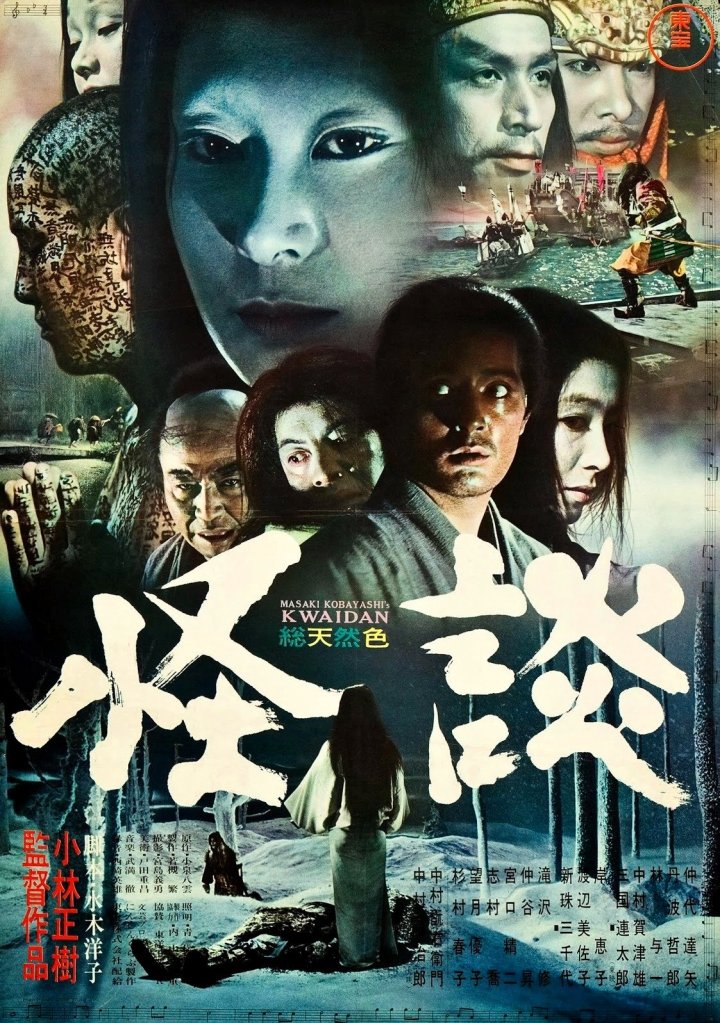
What is horror? For many people, it’s guts and gore. But I’ve always found far more unsettling the creeping terror of the unnatural, the unsettling dread of the unknown. The best ghost stories do this: the horror of encountering something that, by all logic, shouldn’t be there. The paralysing fear of coming face-to-face with something that surely cannot be real. The MR James style of ghost stories, where supernatural powers are unknowable and unrelenting. Kwaidan, Kobayaski’s collection of Lafcidio Hearn’s Japanese ghost stories, trades brilliantly in this – each of the stories contains moments of real spine-tingling dread that sent goosebumps racing over my body.

Kwaidan is built around four short stories, each separate but thematically linked. In The Black Hair, a samurai (Rentarō Mikuni) leaves his faithful first wife (Michiyo Aratama) for a loveless marriage with the daughter of a rich man. Realising his mistake, he finally returns to her but he stumbles into a haven that becomes a nightmare. In The Woman of the Snow, woodcutter Minokichi (Tatsuya Nakadai) encounters a terrible spirit (Keiko Kishi) in the forest who swears him to secrecy on pain of death – can he keep his silence from Yuki (Kishi again), the woman he marries? In Hoichi the Earless, Hoichi (Katsuo Nakamura) a blind ballad singer, is unwittingly hired by the spirits of a dead warlord. And in In a Cup of Tea, a samurai (Seiji Miyaguchi) is horrified when he sees a reflection that is not his own in a cup of tea.

Simple concepts – and in many cases you can see where this might be going just from the description – but the unnerving sense of dread and the uncontrollable inevitability of the supernatural horrors are what makes this truly terrifying. Kobayashi’s film is slow, careful, precise, and it is this very quality that contributes most effectively to its terror. As the camera moves slowly through unnaturally still and quiet locations, with a soundtrack made of a mix of silence and deeply unsettling, jarring chords and discordant sound from Toru Takemitsu, you actually feel like you want nothing more than to turn and run. Whatever Kobayashi’s camera is slowly edging towards showing us, we know it can’t be anything good. The expectation is a large part of the terror.

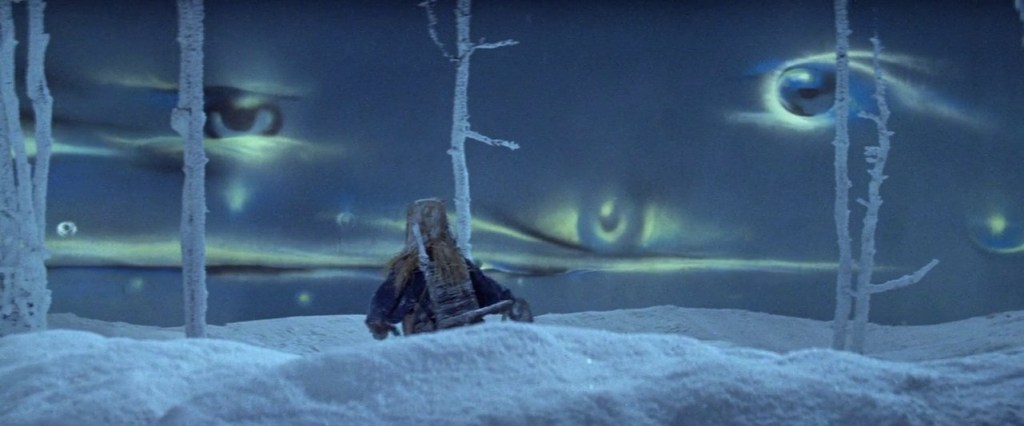
The unsettling world of Kwaidan is magnified by Kobayashi’s desire to control every element of the world he constructed. Bar a few shots of wave-lashed coasts and a Samurai riding competition (presumably too difficult to recreate inside), every scene was filmed inside a massive air-hanger studio. No attempt is made to disguise this. Instead, this exquisitely beautiful film makes a virtue of this to add to the unnerving sense of unreality. Skylines and backdrops are swirling whirlpools of paint and colour, never once trying to suggest a reality. Buildings, fields and even lakes subconsciously feel hemmed in by massive walls of painted unreality. It adds a terrifying fable quality – a nightmareish unreality – to the entire film.
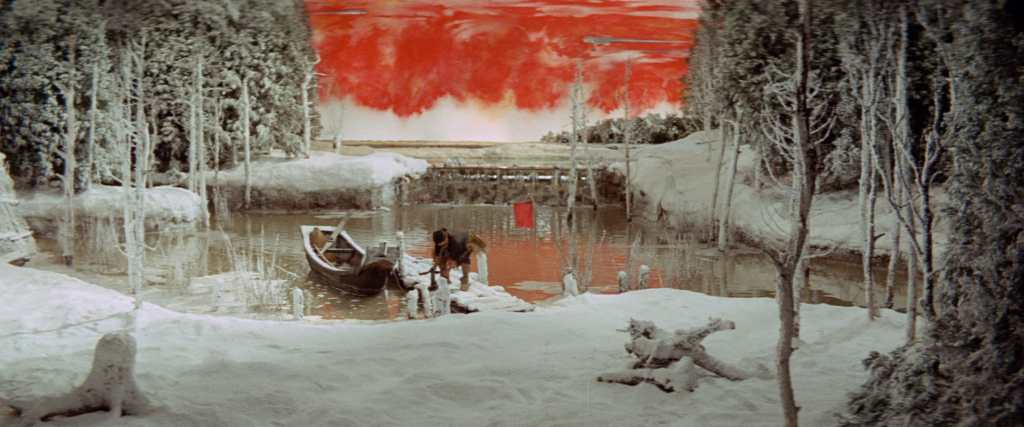
It also makes Kwaidan a uniquely beautiful film. Not since Jack Cardiff’s work with Powell and Pressburger have scenery and backdrops looked as beautiful as this. Kwaidan is an explosion of gorgeous colours, used vividly and imaginatively to suggest mood, themes and threats. In The Woman of the Snow, the spirit seems to suck everything but blues and whites out of the palette – something we notice even more from the orangey skies that surround the woodcutter at every other point. The faded, paler colours in The Black Hair when the samurai returns to his first wife clue us in that all is surely not well. Splashes of red throughout spell danger – a coat, the lining of a pair of sandals, a torn flag, the lining of a cup, all of which the characters ignore.

They ignore these dangers at their peril. One of most dreadful things about the unsettling terrors of Kwaidan is that we can see the outcomes of their mistakes long before the characters do. The stomach-churning dread is waiting for it to happen. It’s executed to perfect effect in The Black Hair. The pompous samurai (a fine performance by Mikuni) is naturally due to be punished for abandoning his wife – and the faded home but unchanged wife he visits after years warn us well before him that horrors will follow. But Mikuni’s horrified shriek when confronted with the truth – and the staggering, nightmare-like, lack of control he seems to have over his body when he realises it (like a dream where you need to run but can’t) – makes this short chapter honestly one of the most unsettling things I’ve ever seen, a true Japanese MR James classic.

Equally fine is the second story The Woman of the Snow. It’s the most lusciously filmed of the four – its painted backdrops are Van Goghian works of art and the colour contrast between the warm summer and terrifying, pale blue winter is extraordinary. Its story is slight, but its spirit – Kishi moving with, again, a nightmarish precision that is deeply unnatural – is terrifyingly relentless. It offers no plot shocks, but the terror of inevitability, to excellent effect.
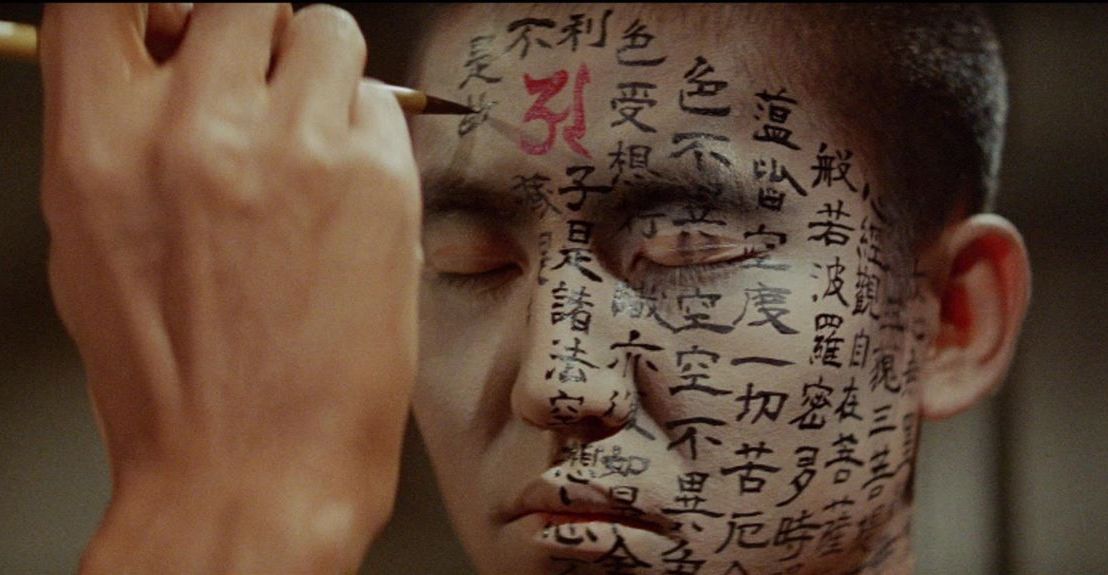
Kwaidan’s two final stories are less satisfying than these two masterpieces. Hoshi the Earless is very long – almost half the run time alone – and the story most dependent on an understanding of Japanese history. It recreates with a deliberately artificial beauty an ancient Japanese naval battle – clearly taking place in a water tank before a painted backdrop, but dreamlike in its execution, like a half-remembered vision, crammed with striking colours and images. The actual story of Hoshi is the least haunting, but provides Kwaidan’s most lingering cultural image, of a body covered (almost) from head to toe in writing to ward off spirits. Kwaidan concludes with a curiosity In a Cup of Toe a deliberately un-finished story – although the reason it remains unfinished provides Kwaidan with its final burst of shocking horror and another striking, unforgettable image of nightmarish dread.

Images of nightmarish dread abound in a film constructed intricately and deliberately artificially to heighten its sense of horror. The inevitability of many of the outcomes in its story detracts not one jot from the terror – if anything they add to it. Kobayashi’s direction is detailed, controlled, perfectly paced and wrings every last drop of unease from the audience. It’s a film that is long and slow, because the best terror often comes from the lingering slow-build – and its world of disjointed noises and sounds works perfectly to never allow the audience to relax. Kwaidan is an essential and masterful horror film, a collection of the sort of ghost stories that would make you run from the campfire.

Seven Samurai (1954)

Seven Samurai (1954)

Superb, archetypal action-adventure men-on-a-mission film: Kurosawa’s masterpiece, brave, bold and thrilling film-making

Director: Akira Kurosawa

Cast: Toshiro Mifune (Kikuchiyo), Takashi Shimura (Kambei Shimada), Daisuke Katō (Shichirōji), Isao Kimura (Katsushirō Okamoto), Minoru Chiaki (Heihachi Hayashida), Seiji Miyaguchi (Kyūzō), Yoshio Inaba (Gorōbei Katayama), Yoshio Tsuchiya (Rikichi), Bokuzen Hidari (Yohei), Yukiko Shimazaki (Rikichi’s wife), Kamatari Fujiwara (Manzō), Keiko Tsushima (Shino), Kokuten Kōdō (Gisaku)

I’ve often been a Kurosawa sceptic. But it’s hard to stay critical, when he made a masterpiece as near perfect as Seven Samurai. It’s one of those films that is long (the favoured cut is nearly three and a half hours) but never once drags. Kurosawa directs with such intelligence, skill and pace, you can’t help but be swept up in it. It’s one of the finest action epics ever made, but also has a rich vein of sadness and melancholy. After all, the samurai may fight the good fight, but they always lose.

In the sixteenth century, a farming village is under-threat from a bandits, rogue samurai turned ronin, who plan to steal the harvest. To protect themselves, the village elder (Kokuten Kōdō) declares they need samurai of their own (and since the farmers have little to offer, they better “hire hungry samurai”). They recruit a team of seven, led by experienced Kambei (Takashi Shimura), who accepts out of nobility. Among the team is wild-card peasant-turned-wannabe-Samurai Kikuchiyo (Toshiro Mifune). The seven arrive in the village and prepare for battle: but, even when working together, no one ever completely forgets the rigid societal boundaries of Japanese culture.

Seven Samurai is a wonderful character study, a sublime action film and complex and engaging exploration of Japanese history and society. It also has a perfect three act structure, it’s run time expertly divided into the samurai’s recruitment, preparation and defence of the village. This careful construction counters that epic run time – each act tells an almost self-contained story, meaning the film’s momentum never slackens.

It’s bought together by a director making a perfect fusion between Japanese cinema and his American and European influences. Kurosawa had never been shy about his admiration for directors like Ford and Hawks. You see elements of cowboy flicks throughout: from the set-up of the villagers as homesteaders, the samurai as the cavalry and the rogue ronin as the Indians, down to sweeping camera shots and vistas straight from Ford (the kinetic energy of Stagecoach is surely an influence). His Western influences always made Kurosawa more digestible than (for example) Ozu.

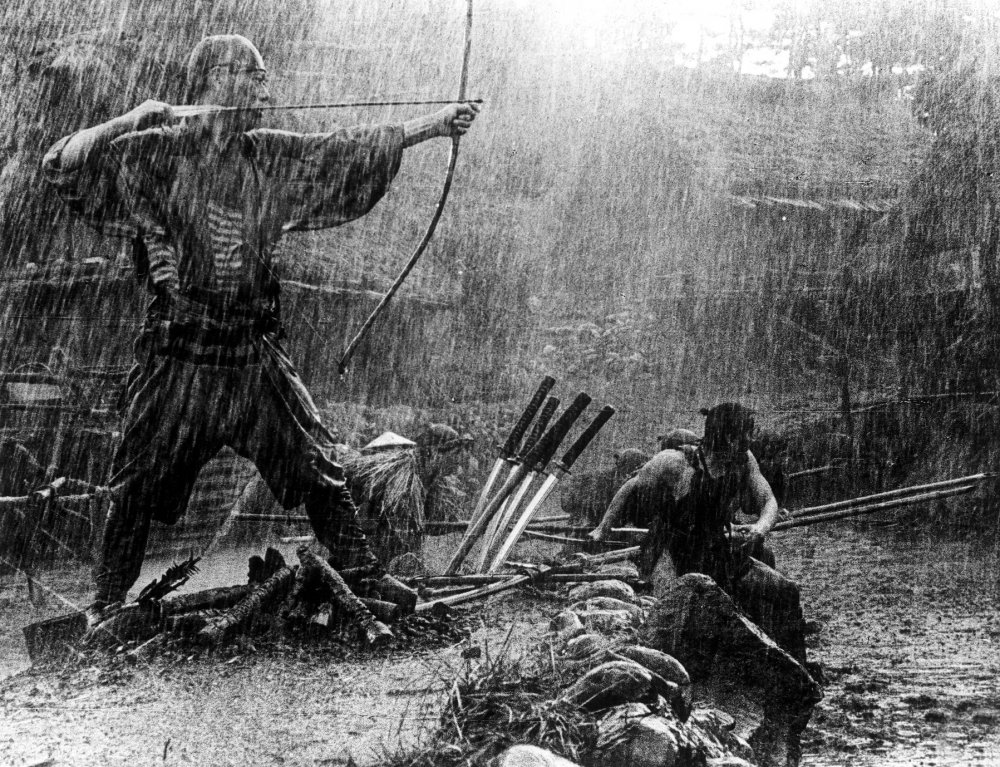
Seven Samurai is an also electric employment of Eisenstein style techniques of skilful editing, dissolves, fast cutting and an embracing of the language of cinema. Kurosawa accentuates action with slow motion: when Kambei dispatches a bandit (in his superb introduction scene), the body falls seemingly forever, death building in impact. Zoom cuts introduce locations, bringing us closer and closer to events. Kurosawa shot the battles with three cameras (a master and two roving cameras) allowing him to capture the kinetic action of his rain-soaked finale. Brilliant montages introduce concepts, characters and themes. It’s a masterclass.

It’s also masterful at quickly sketching character. We know from his first introduction – a brilliant cold-open fifteen minutes or so into the film – that Kambei is a man of both shrewd tactical awareness and puts duty before superficial pride, by his willingness to shave his hair so he can pass as a monk to rescue a child. (The gasps of those watching say it all at this willing acceptance of a cultural mark of shame). Kyūzō is introduced duelling with wooden swords. Why don’t we swop to real blades says his opponent: because you’ll die, Kyūzō matter-of-factly describes, his matter-of-fact bluntness and lack of bragging backed up by his immense skill when the chap dies seconds later. Gorōbei’s shrewdness is shown by the ease he dodges Kambei’s ambush test, just as Kikuchiyo’s rawness is when he blunders straight into it (and promptly loses his temper). Little moments like this abound, in a film stuffed with clever character beats.

The film presents a Japanese culture where concepts of honour and self-sacrifice sit awkwardly alongside regimented hierarchical and societal rules. The samurai can’t help but look down on the peasants – even while they see it as their duty to protect the weak. The villagers, in turn, look at the samurai as barely-to-be-trusted potential oppressors or dangerous parasites who steal their land and daughters (or both). Much of the film’s second act, as the samurai train the villagers to resist the attack, is about these two communities learning to respect each other. But it’s a tenuous alliance, held together by circumstance: when the dust settles, the surviving samurai are no longer welcome.

The samurai are a dying breed. Kambei knows the future belongs to people who provide industry and food. Samurai principles of honour and duty, pride in their skill, is also increasingly irrelevant in a world where the gun decides conflict. The ronin have three rifles and these deadly weapons are no respecter of skill or honour (none of the seven are bested in conflict, but all who fall do so to a bullet). Perhaps this is why the samurai cling to their principles and their honour. They know the world they knew is dying away and that there may be no place for them in the new.

This conflict is given a human shape by Kikuchiyo. Played with an electric, charismatic wildness by Toshiro Mifune (allowed to let rip, he’s a breath-taking explosion of jagged movements, eccentric line deliveries and unbound energy), Kikuchiyo is neither peasant nor samurai. Bought up from working stock – carrying stolen papers of nobility to try and pass himself off as samurai – he’s also rejected by his farmer peers for his warrior status. This makes him a character who can expose hypocrisies on both sides: denouncing the farmers pleading for help but cowering from the samurai; then angrily arguing samurai selfishness and pride have left the peasants with little choice but to horde food and riches to survive.

Not that Kurosawa is shy of admiration for the samurai. Yes, the flaws of their class are exposed – and we see more than enough their potential for arrogance, pride and violence. But the seven also contain a collection of their best traits. Takashi Shimura is brilliant as Kambei: selfless and honourable who takes on the task to honour the peasant’s offering all they can (however little that be). Heihachi (played by an ebullient Minoru Chiaki) represents generosity and warmth. Kyūzō (an enigmatic Seiji Miyaguchi) is awash with self-effacing warrior skill, shrugging off his feats with simple matter-of-fact statements. Shichirōji and Gorōbei are loyal and thoughtful warriors, Katsushirō (a charming Isao Kimura) a decent man eager to prove his worth. These are the best of their class.

They’ll need to be to win in this desperate action. Their preparation carefully outlines the obstacles facing to defence of this village – and to corral the villagers to defend their property. Houses outside the village walls are abandoned (Kambei seeing down a near rebellion on this, with threats of immediate justice), a raid on the ronin’s base aims to reduce their numerical advantage, the difficulty of turning the terrain against superior numbers repeatedly made plain. Kurosawa’s visual storytelling means the action when it comes is not only captivating, but completely understandable.

And what action. Seven Samurai can take its place on any list of the greatest war films ever made. The final hour features attack-after-attack on the village, interspersed with raids, skirmishes and derring-do. Both Kyūzō and Kikuchiyo take solo missions out of the village, though Kikuchiyo’s hunt for glory, even while he captures a rifle, leaves part of the wall undefended and leads to tragedy (Kambei is furious at this failure in discipline). It culminates in a rain-soaked final stand, shot with an all-absorbing power and engrossing kinetic energy.

The samurai sacrifice much for the village. But for what thanks? A peasant disguises his daughter as a boy, because he assumes, if discovered, the samurai will instinctively rape her. When the ronin don’t arrive as expected, the peasants grumble that the samurai are eating more than their fair share. As the samurai fall, their deaths are marked with a decreasing lack of notice (the final deaths don’t even gain on-screen funerals). With victory assured, the peasants return to their crop and don’t even lift a hand to wave the samurai goodbye.

It seems like poor reward for people who have sacrificed so much. But then that’s part of the point Kurosawa is making. Some samurai chose honour. Some choose the opposite. But they are always relics of a feudal system that is being left behind by events and the modern world. Its not just guns that will take them eventually. It’s a sadness that adds an even richer vein to this gripping, superb action drama. Kurosawa’s films may have flaws – but he doesn’t put a foot wrong in Seven Samurai.