
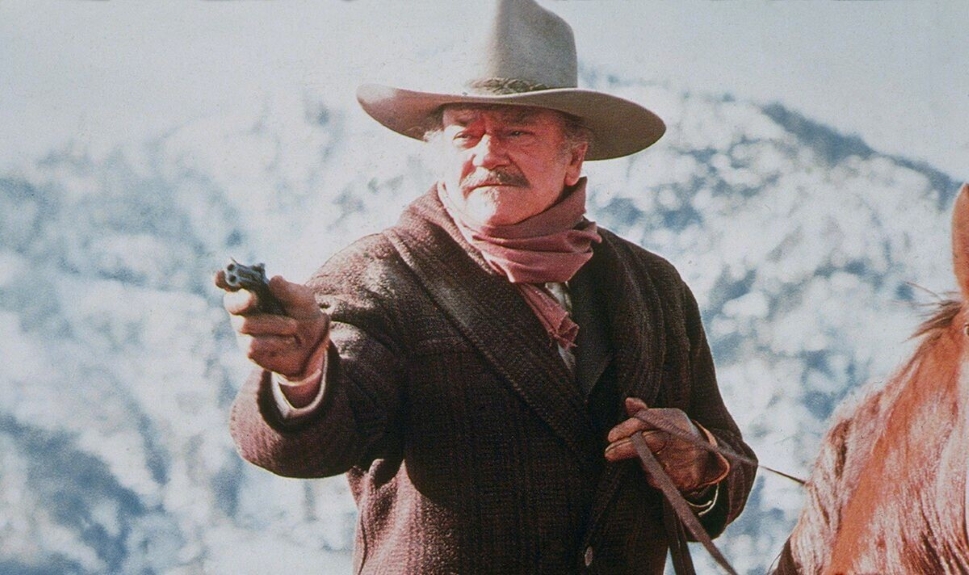
Tag: Sheree North

The Shootist (1976)

The Shootist (1976)

Wayne’s final elegiac Western as a dying gunslinger tries to go out on his own terms

Director: Don Siegel

Cast: John Wayne (JB Brooks), Lauren Bacall (Bond Rogers), Ron Howard (Gillom Rogers), James Stewart (Dr Hostetier), Richard Boone (Sweeney), John Carradine (Beckum), Scatman Crothers (Moses), Richard Lenz (Dobkins), Harry Morgan (Marshall Thibido), Sheree North (Serepta), Hugh O’Brian (Pulford)
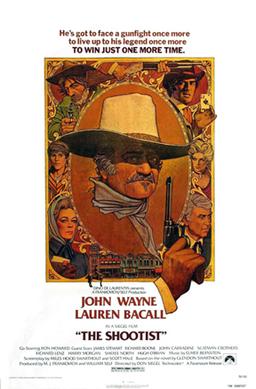
It’s 22nd January 1901 and Queen Victoria has passed. Automobiles are starting to chug down roads, towns filled with electricity, telegraphs and trams, no longer look like the beat-up, dust-bowls the likes of Wyatt Earp policed. It’s a new age and the end of the Wild West. Which also means it’s the end of the gun-toting cowboys, like JB Brooks (John Wayne), who rode freely and grabbed their six-shooters faster than anyone else. Brooks rides into Carson City, his cancer terminal, his life lonely and full of enemies, wanting to live (and die) in his final week on his own terms.

You don’t need to be a psychologist to see more than a few parallels between Brooks and the man playing him, Hollywood legend John Wayne. Wayne himself was struggling with a cancer that claimed his life three years later and you could argue he too had outlived his time. The glory days of the Westerns were gone along with men like John Ford who built it. The Shootist draws huge piles of its elegiac emotion from this – with even more retrospectively added when it turned out to be the star’s swan song.

It’s strange to think Wayne wasn’t even first choice for the role (the producers were worried his health might not last), because he is so perfect for it that the line between Wayne and Brooks seems paper thin. Wayne still has the spark under the weakness of a sickly one who downs laudanum and relies on a cushion to sit comfortably. He’s a vulnerable man, raging quietly against the dying of the light. Lonely, devoid of friends whose entire life’s possessions are wrapped up in a saddle bag. But he’s also dangerous who can still be extraordinarily ruthless. He kills without hesitation when called on and resorts to violent threats (backed with a gun) when he needs to. But he needs to believe there is more to him than this.

Brooks is a man ‘scared of the dark’, quietly terrified about how he will be remembered. He sees himself as a ‘shootist’, a prowling man’s-man who shot when he needed to. What he doesn’t want to be seen as is a ruthless blood-soaked assassin dealing death left-right-and-centre. He humiliates a journalist (the weasily Richard Lenz) who wants a blood-and-guts killer’s story, sending him packing with a gun in his mouth. He turns away a funeral director (John Carradine, a lovely cameo) who offers a free funeral so he can sell tickets to see the dead killer. He’s desperate for some sort of positive legacy.

This overlaps with Wayne who, if he didn’t know this was his final film, surely knew it was probably his final Western. Siegel opens with a montage from Wayne films past (including Red River, Hondo and Rio Bravo) before crashing into a wide-screen, Fordian landscape that sees Wayne swiftly get the better of a would-be robber. Wayne’s performance is, whatever you think of him, undeniably heart-felt. His drawling pain-wracked face, full of fear and frustration, when told his fatal diagnosis by an old friend (an almost equally emotional cameo from that other drawling icon of the Western, James Stewart) is very moving.

You can see Brooks regrets when an old flame (Sheree North) arrives to suggest they marry – and the hurt when it becomes clear she only wants marriage so she can sell his story. The closest thing he has to a friend – Stewart’s doctor – he hasn’t seen for fifteen years (coincidentally the exact length of time since the two actors shot The Man Who Shot Liberty Valance). In fact it becomes clear the people in his life are enemies and rivals. From Richard Boone’s weasily rancher who blames Brooks for his brother’s death to Hugh O’Brian’s suave gambler who wants the chance to take down a legend. Even that’s better than Harry Morgan’s nervous Marshal, who bursts into relieved laughter when he hears cancer is going to take care of Brooks so he doesn’t have to.

In his final week, Brooks finds some sort of connection not based on fear, envy or greed with Lauren Bacall’s (yet another golden-voiced legend) Bond Rogers, a widow with a tearaway son Gillom (Ron Howard), whose initial suspicion of Brooks soften. Bacall is excellent, full of humanity and sharp no-nonsense sincerity that hides a warmth you feel she’s had to crush down over years of holding hearth-and-home together. Brooks and Mrs Rogers form a quiet friendship, based on mutual loneliness, both actors playing beautifully in a series of quiet, sombre but gentle scenes, with Bacall drawing even more humanity from Wayne.

Mrs Rogers’ son, Gillom, becomes the embodiment of Brooks battle for a legacy. Ron Howard makes Gillom a cocky, immature dreamer, exactly the sort of guy who’d lap up the sort of blood-and-guts stories Brooks is worried his life will be turned into. He’s wowed when Brooks – alerted by his pain-ridden body keeping him awake – takes down two would-be assassins. But his mother is terrified that he could lead the wrong sort of life. And, eventually, Brooks himself starts to worry that all he’s doing spending time with him is leading Gillom towards an end like his: lonely and dying in a guest house, surrounded by strangers. It becomes the thematic struggle of the film, which is handled (like the rest) with an unlaboured patience.

It’s all building of course to Brooks deciding to go down on his own terms, clutching a gun not a laudanum bottle. The Shootist ends with a blood-soaked shoot-out that we all suspect its heading to, expertly assembled by Siegel. Siegel’s direction throughout is faultlessly smooth, avoiding all temptation to layer on sentimentality but instead let the sad tiredness of Wayne carry the emotion without loading the deck. It’s a beautifully done, quiet, restrained and perfectly elegiac picture that makes for a perfect final role for John Wayne. A sad, touching film about a strong-willed man fighting a last battle he can’t win, it’s a compelling watch.

Charley Varrick (1973)

Walter Matthau schemes a caper in crime thriller Charley Varrick

Director: Don Siegel

Cast: Walter Matthau (Charley Varrick), Joe Don Baker (Molly), Andy Robinson (Harman Sullivan), John Vernon (Maynard Boyle), Sheree North (Jewell Everettt), Felicia Farr (Sybil Fort), Norman Fell (Garfinkle), Woodrow Parfrey (Harold Young), William Schallert (Sheriff Horton), Jacqueline Scott (Nadine), Tom Tully (Tom), Benson Fong (Honest John)

Don Siegel was perhaps the ultimate professional director, who took on any scripts that came his way, producing polished, professional films. In the later part of his career, he finally received some of the freedom to start shooting his quality B-movies on A-movie style budgets. Charley Varrick was the first film he made after his box-office smash Dirty Harry, and Siegel received more time and space to deliver a film that mixed action and drama with an elaborate, almost meditative, mystery.

Charley Varrick (Walter Matthau) is a former stunt pilot, whose small crop-dusting business is a front for carrying out small-scale robberies. A bank robbery in Tres Cruces, New Mexico goes horribly wrong – Varrick’s wife Nadine (Jacqueline Scott) is killed and he and his partner Harman Sullivan (Andy Robinson) find the small job they had anticipated is actually holding a huge amount of mafia money. Varrick knows the mafia won’t rest until they get the money back – and he is right, as bank president Maynard Boyle (John Vernon) has no choice but to call in ruthless hitman Molly (Joe Don Baker) to get the money back and kill those who stole it.

Charley Varrickwas also known by Don Siegel as The Last of the Independents – and that kinda fits its tone. Varrick is a small-scale operator who has chosen crime because he’s been squeezed out of the crop-dusting business by the corporations. He’s operating a crime gang that follows a series of carefully planned robberies, aimed at stealing humble amounts: enough to be a nuisance rather than cause a genuine scandal. He’s a small-time operator, proud of who is, who doesn’t want to hit the big time but to excel as the big fish in the small pond.

The whole film reflects this personality: the film is deliberately set in a quiet American town in the mid-West – the opening credits are played over everyday scenes of small-town life. Every location is slightly run-down and unimpressive. Those wrapped up in the crime are regular Joes – on both sides of the law – and the values and principles are those of mid-west America. Even Molly the hitman – while clearly ruthless and capable of extreme violence and full of disdain of those he meets – has a drawling, cowboy quality to him. 

Part of Siegel’s point is that into all this explodes a story of crime, murder and violence that all spins out of money (doesn’t it always?). The mystery element is the audience wondering how Varrick is going to get out of this with both cash and life intact. What Siegel does really well is effectively make Varrick an unreliable narrator. Despite the fact we follow him around in the film, we are never really told what he is thinking or why he does things. Only at the end of the film are all the threads of the actions he has carried out pulled together – a real lightbulb “ah ha!” moment – and the real purpose of what he has been doing is revealed.

To make a character who plays their cards so close to their chest work, you need an actor who is effortlessly charming. The film gets this in Walter Matthau. Matthau, with his hang-dog Droopy-face is hardly anyone’s first idea of a ruthless bank robber (surely part of the film’s point!) but his winning charm and kindly-Uncle quality, as well as the eye of assured cool that Matthau gives him, really make you root for him. In fact it works so well that you actually forget how ruthless Varrick in this film: from moving on swiftly from his wife’s death, to ruthlessly sacrificing several people in his quest for self-preservation. In other hands, Varrick wouldn’t half come across as a copper-bottomed shit. 

Instead, his plan of misdirection, clues pointing towards the wrong thing, and carefully juggled parallel attempts to escape (his unrevealed real plan, and the clumsy surface plan that the audience knows must be a bluff) really works to keep you engaged and entertained. Siegel is purposefully pulling the wool over your eyes in virtually every scene – and he has Varrick basically tell us he’s doing this – but there are few things that audiences like more than a magic trick. We want Varrick to pull a rabbit out of the hat at the end – to surprise us all with how clever he’s been (and to reward those who have worked out part of what he is doing).

Siegel mixes this with a surprising number of quiet, even soulful moments that mix the thoughtful with some black comedy. From Varrick’s tender kissing of his dead wife – right before he professionally carries on with their plan to burn the get-away car they escaped in (this time with his wife’s body inside it) – to a secret meeting/interrogation/intimidation of timid bank manager Harold Young (a twitchy Woodrow Parfey) by smooth big-city bank manager Boyle (a superbly cold John Vernon, nowhere near as assured and secure as he thinks he is) in a cow-filled field, these scenes are about character as much as they are about plot.

Siegel mixes this with moments of pure action and drama. The opening bank robbery is surprisingly violent, considering the gentle introduction to the film – and our “heroes” are amazingly ruthless towards those that stand in their way. Joe Don Baker’s chillingly amoral Molly hands out beatings as easily as he does slightly goofy Western smirks (a beat down of Harman is particularly brutal). Varrick is quietly ruthless and the film ends with a dynamic chase scene in a scrapyard, quite unlike anything you have ever seen.

Charley Varrick epitomises the sort of 1970s film that studios and Hollywood looked down on at the time, but inspired the filmmakers today far more than some of the Oscar winning gumph that got praised. Parts of it are dated – women in the film are either love interests or whores, and both Molly and Charley (Walter Matthau is no one’s idea of a lothario) bed compliant, impressed women in the film with an off-hand carelessness. But the core and heart of the film is in its cool, calculated confidence mixed with a sense of Western soul. With a terrific performance by Matthau, this is a fine example of independent film-making.