Tag: Sissy Spacek

Badlands (1973)

Martin Sheen and Sissy Spacek are killers on the run in Terrence Malick’s masterpiece Badlands

Director: Terrence Malick

Cast: Martin Sheen (Kit Carruthers), Sissy Spacek (Holly), Warren Oates (Father), Ramon Bieri (Cato), Alan Vint (Deputy), Gary Littlejohn (Sheriff), John Carter (Rich man)
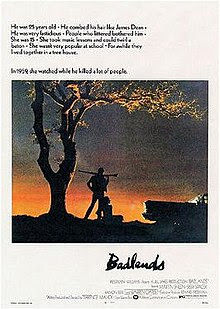
If American cinema has a poet, it’s Terrence Malick. His career is the most elliptical of any major American filmmaker. Shunning interviews or any discussion of his work, his mystique is built upon Kubrickian isolation (he took a 20-year gap between his second and third films) and the powerful mystique of his first film – and still his masterpiece – Badlands. A luscious, beautifully filmed, profound piece of film-making, perfectly paced and told with a poetic sensibility, it’s  powerful and brilliant. Nothing Malick has done since has reached the same beautiful balance between story, profundity, poetry and realism.

Kit Carruthers (Martin Sheen) is an aimless young man, recently fired from his job as a garbage collector in South Dakota. His imagination is captured by a teenage girl, Holly (Sissy Spacek), freshly arrived from Texas. He romances the young girl – who is naively swept up in the possibility of Kit’s poetic soul – but her father (Warren Oates) disapproves. So, in a casual confrontation at their home, Kit kills the father, burns down the house and he and Holly head out on the run. Travelling across the country, Kit kills with a casual lack of maliciousness, all the time building in his head his self-image as a James Dean-like hero in his own movie, a poet turned outlaw. Holly narrates the film, her guileless, innocent and often unreliable narrative revealing her own naivety. Sheen is outstanding as Kit, idealistic but empty, while Spacek gives Holly a sublime blankness that makes us never sure how much she understands the situation she is in.

Malick based the film on the killing spree of Charles Starkweather, who carried out a murderous journey across several states in the mid-West with his underage girlfriend in the late 50s. But what Malick found in this story was a fascinating insight into how people can become absorbed by the romanticism of the American pioneer spirit, to try and turn their own lives into something with meaning and depth. So, Kit can be little more than a not particularly bright casual killer, but he builds his own self-image as something part-way between movie star and philosopher poet.

What the film does quite brilliantly is balance the ruthlessness of Kit with this dreamlike poeticism. Much as you shouldn’t, you end up caring a little for Kit and Holly, while deploring their brutality. Perhaps it’s because both of them feel so young. After the murder of her father, they build a cabin in the woods and live off the land, with all the enthusiasm of kids. There is something very vulnerable about both of them, their abilities to really understand the situations they are in and the moral implications of their actions non-existent. In a way they are playing – but with real guns.

Their life has been so filtered through the Hollywood celebrity culture growing around them, that they see their actions like part of a film. Death is as unreal and without impact as it is in Hollywood. Kit twice, early in the film, prods dead animals with nerveless curiosity – the same blankness and lack of reaction that he will later treat dead people with. Holly is briefly shocked by the death of her father, but then builds all Kit’s actions into a narrative of romantic drama.
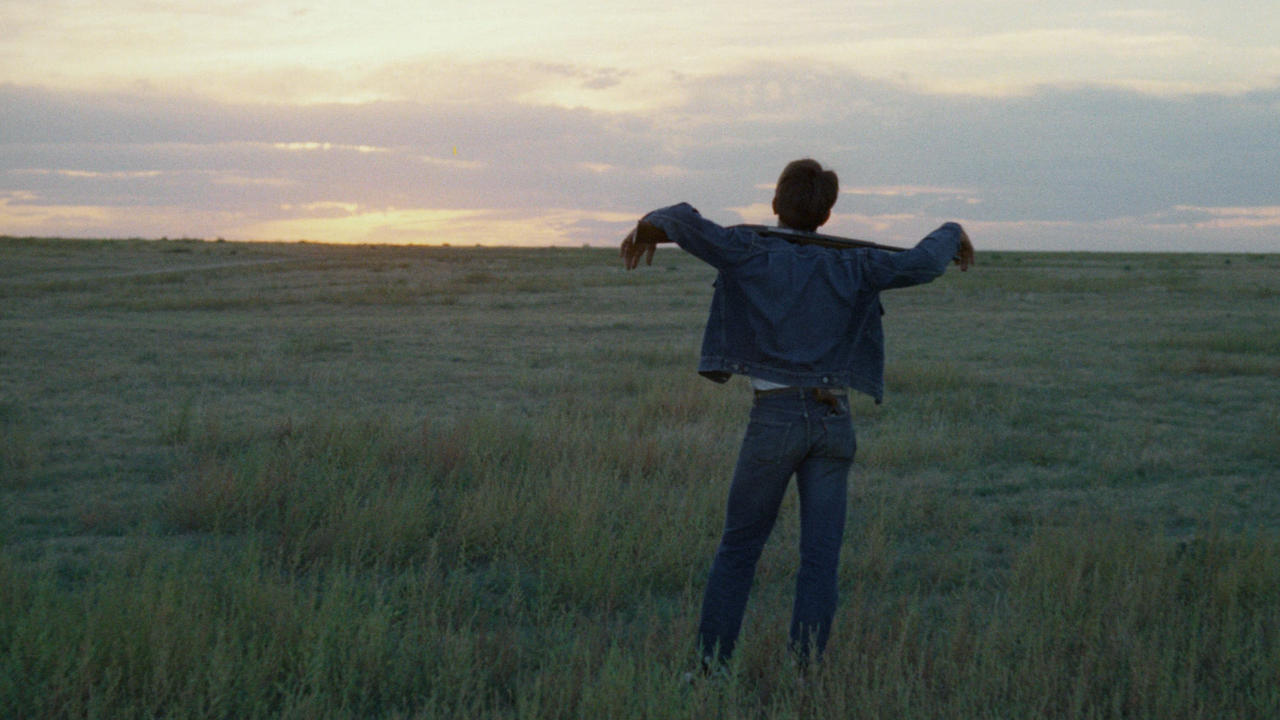
Kit and Holly build their own narrative the whole time – but with a shallow emptiness that reveals their own pretensions. Both of them are collectors of odds-and-ends – Kit picks up mementos and strange souvenirs from where they have been, treating these as near religious icons that future generations will use to mark his presence. Objects from lamps to paintings to rocks are invested with artistic value by the pair. Kit’s shallowness is clear: early in the film he picks up a large rock from under the tree where they first made love, determined to keep it forever as a memento. After walking a few metres, he drops it and decides to take a lighter rock. Later, when Kit is finally cornered by the police, his main concern is to build a small cairn to mark the location where he was caught.

Kit wants to be more than he is. He is delighted when his physical resemblance to James Dean is noted by the police (his appearance is carefully studied to cultivate this). At a rich man’s house, he decides to record messages for posterity – words so bland, predictable and lacking in depth they reveal the total lack of imagination and original thought in Kit. He is polite, generally kind to his victims (before killing them) and thinks of himself as a sort of poet of the wilderness. Neither he nor Holly understands the horrific finality of death. The couple have a fatally corrupted innocence, a childlike, romantic understanding of the world that becomes a sort of fairy-tale. And you can totally see why a naïve young girl like Holly might see Kit as a romantic figure who can set her free.

Malick’s film wraps this up in a film of dreamlike beauty. In later films, Malick became so obsessed with beautiful images, and increasingly pretentious in his themes, that they became self-important artefacts. But Badlands balances these instincts beautifully with a fascinating and revealing story.

The shooting of the film offers up one beautiful image after another, reflecting the poetic longings of the couple at its heart, while underpinning sharply their blandness. Malick captures the awesome grandness of the Badlands themselves, a dusty stretch of emptiness that goes on forever. Malick shoots moments, like the house-fire, with such grace and perfection that they take on deep psychological meaning (what else is that house fire but the death of Holly’s early life?). Shots of nature – the sort of wildlife photography that would go too far in later films – place the couple in exactly the sort of tranquil independence, free from the burdens of the real world, that they long for. It’s an American dream, the celebration of the pioneer spirit deeply and darkly inverted.

The film is an enigma that avoids ever casting easy judgements on its characters. Their actions may be awful, but how much have they been bent and twisted by the world around them? The film’s eclectic musical choices – Carl Orff to Nat King Cole – bring the film a sense of magic, again a dreamlike mysticism. It’s fitting for a young couple who are living in a dream, with no consequences and no morals. This impressionistic masterpiece, which mixes in moments of shocking realism and casual violence, reflects the inner life of its leads, both yearning to be more than they are, and directing these longings into disastrous ends. Badlands is one of the greatest debut films in history, and still the perfect fusing of Malick’s poetic leanings with narrative film-making.
JFK (1991)

Kevin Costner goes on a quest for the truth in Oliver Stone’s crazy but brilliant JFK

Director: Oliver Stone

Cast: Kevin Costner (Jim Garrison), Sissy Spacek (Liz Garrison), Kevin Bacon (Willie O’Keefe), Tommy Lee Jones (Clay Shaw), Jack Lemmon (Jack Martin), Walter Matthau (Senator Russell B Long), Gary Oldman (Lee Harvey Oswald), Joe Pesci (David Ferrie), Donald Sutherland (Colonel X), Laurie Metcalf (Susie Cox), Michael Rooker (Bill Broussard), Jay O. Sanders (Lou Ivan), Edward Asner (Guy Banister), Brian Doyle-Murray (Guy Banister), John Candy (Dean Andrews), Sally Kirkland (Rose Cheramie), Wayne Knight (Numa Bertel), Priutt Taylor Vince (Lee Bowers), Tony Plana (Carlos Bringuier)

When great events happen, it’s hard for us to accept they might take place for random reasons. Rather than freak occurrences or boring individuals, we’d rather see them taking place due to an impenetrable web of shadowy figures. There is something in us that rejects randomness and embraces order. Conspiracy theories are the (ironic) result of these, with their exponents often the most passionate believers in the all-pervading genius of big government. Events like the death of President Kennedy can’t be because some nobody shot him. Instead it must be part of a wider junta of baddies, with every man you see merely a front for a cabal of the wicked. It’s hard not to be swept up by the lure of the conspiracy theories (they invariably have the best stories after all) – and Oliver Stone’s JFK is perhaps the definitive mainstream conspiracy theory essay.

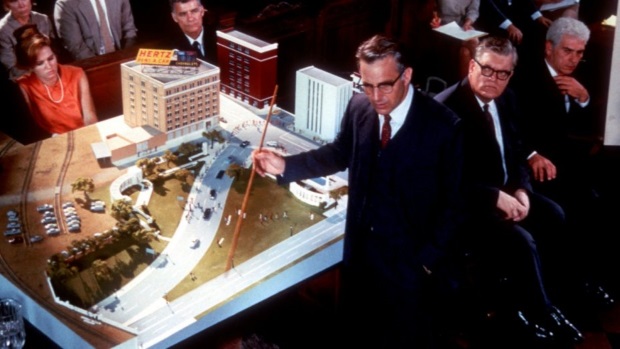
Taking the campaign of Louisiana DA Jim Garrison (Kevin Costner) to find out the “truth” about the murder of President Kennedy, Stone’s film is part a fascinating presentation of half-truths and “might-have-beens” and part a sprawling mess of irresponsible nonsense. Either way it’s assembled with astonishing panache, a level of filmic skill that makes it (literally) almost impossible to tell whether what you are seeing is true and what is invention. Stone’s film superbly interweaves a variety of film stocks and effects to seamlessly splice together newsreel footage, Zapruder film and his own reconstructions so brilliantly it frequently becomes hard to tell which is which.

The same logic also applies to the script. JFK is frequently engaging and fascinating. But you have to remember that it is the equivalent of meeting the most literate and articulate street corner “End-of-the-Worlder”. Such is Stone’s skill he could, I am sure, have created an equally compelling film which would have you questioning the Moon Landings or the shape of the Earth. JFK throws an army of questions, objections and theories at the screen. And while it rarely provides much in the way of answers, only points that it wants you to think about, these theories frequently fascinate. Imagine JFK as a sort of video essay, linked together with dramatic scenes, with its points delivered by authoritative and trusted actors like Donald Sutherland, Jack Lemmon and Walter Matthau.

There is absolutely no doubting the technique of Stone here, or his mastery of the language of cinema. The work of Robert Richardson’s photography, with its myriad styles, and of Joe Hutshing and Pietro Scalia’s editing, pulling together a host of images, snapshots and flash cuts into an insidiously convincing whole, is breathtaking. Light in particular is superbly used, casting some characters in shadow, flaring up to (literally) blind others – light frequently plays across Garrison’s glasses, a visual metaphor for his own struggle to see the light. The speeches he writes for his characters are superbly done, and make their points with great skill – Sutherland (superb) has a hugely convincing story of military black ops action (and inaction) before and after the assassination that fills almost 20 minutes of screentime.

There are compelling arguments made about the ability of Oswald to fire the shots, the triangulation of fire, the spurning of an easier shot before the fateful turn, Oswald’s seemingly illogical movements after the shooting etc. etc. There is decent reasoning behind all of this, and the points are marshalled very well. But, like all extremist theories, suddenly it will turn into something just a little batshit (Lyndon B Johnson ordering the hit or some sort of cabal of Cubans, CIA, FBI and Secret Service working together to conduct a coup).

Much of Stone’s passion for finding the truth (the film’s mantra) is rooted in his own romantic view of Kennedy, as some sort of lost “Prince Who Was Promised”. To Stone, Kennedy would have withdrawn us from Vietnam (news I am sure to the President who started and escalated America’s involvement in it), ended the military industrial complex (contrary to his platform when elected of a stronger US military), bought the Cold War to an end (again, running against his sustained opposition to the Soviet Union) and introduced full Civil Rights (a cause he was lukewarm on at best – unlike his brother or his successor Johnson).

But Kennedy was a romantic figure who had the ability to invite people to invest him with whatever qualities they wanted (both good and bad), a magic cemented forever by his untimely murder. In reality there is no indication that JFK would do (or want to do) any of the things JFK argues he was assassinated for. But that’s all part of the magic of the conspiracy. Facts and events can be marshalled into whatever you want them to be. (Tellingly the only member of Garrison’s investigative team who questions these theories is shown to be a creep in the pay of the conspirators.)

So Kennedy can be a saint, and the film can outline (with no evidence at all beyond a series of coincidences and unlikely or random events) a grand vision of master schemers reshaping America over the body of a dead President. Does it really stand up? Well no of course not. But I will say it is compelling viewing – even if it is essential to keep an open mind about it. Stone later wished he had made clearer that much of the work here was pure fiction (and speculative at best). Certainly it’s a point to keep in mind.

Perhaps Stone should also have looked again at some of the other beats in the film. The film’s version of Jim Garrison as a kind of saintly campaigner for justice flies in the face of many (then and later) who believed the Louisiana DA a shameless self-promoter – an argument made easier to believe by the real Garrison’s cheeky cameo in the film as his ‘nemesis’ Earl Warren. No mention is made in the film that the case he brings against Clay Shaw was dismissed by the jury after less than an hour, and the film avoids explicitly showing his lack of evidence. Costner delivers the final speech, with its famous “back and to the left” commentary on what seems like Kennedy’s unnatural movement after being hit by a bullet and breakdown of the “magic bullet” (both theories now largely discredited), with aplomb, but the film puts a halo on Garrison which doesn’t really stand up.

But again at least it’s entertaining. Other parts of the film don’t even manage that: the baseline narrative that links up the various compelling conspiracy lectures is frequently dull, insipid and lamely written. Sissy Spacek has perhaps the most thankless role in film history as Garrison’s wife whose nearly every line is a variation on “Honey please stop reading the Warren Report and come to bed”. Even that though pales against the exploration of the 1960s gay scene in Louisiana (which Clay Shaw and his “fellow conspirators” were leading members of) which has an unpleasant stink of homophobia, playing into a host of deeply unpleasant (and false) stereotypes of gay people as perverted, promiscuous and preying on the straight. One suspects there was more than a little truth in the idea that Garrison’s fury at Shaw was at least partly motivated by homophobia.

These sequences work considerably less well today – and frequently go on far too long – but when the film focuses on its Kennedy theories it is at least compelling, even if it’s all rubbish. The film made it mainstream to believe Kennedy was killed by a conspiracy in which Oswald was, if he was involved at all, only a patsy. How different would the world have been if Oswald had lived and been made to explain why and how he killed Kennedy? But then chances are, being such an average an unremarkable man, people wouldn’t have believed him anyway.

Stone’s film is a triumph of agenda-led fantasy. Stuffed with faults it makes you at least ask questions – even if you wisely use those questions to affirm many of its points are questionable at best. But any film buff will love the skill it’s told with and the beauty of its technical assembly. Costner was perhaps a little too bland to drive the thing along (although the film uses his innate morality very well), but there are several good performances not least from Gary Oldman who is brilliant as put-upon, used but unknowable Oswald. Nuts, crazy and packed with compelling nonsense, it at least always encourages you to find out more about the actual history.

Missing (1982)

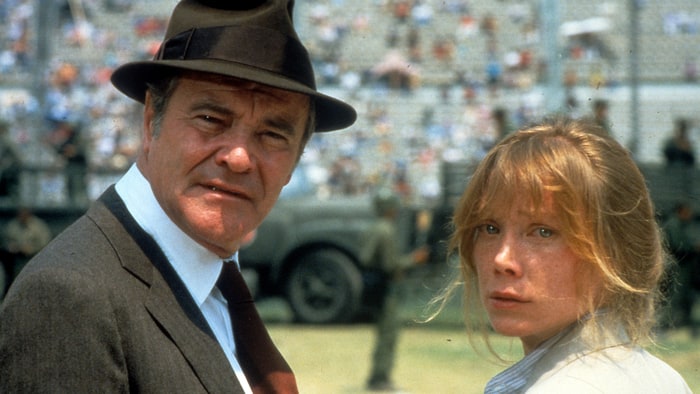
Jack Lemmon and Sissy Spacek are on a quest for the Missing

Director: Costa-Gravas

Cast: Jack Lemmon (Edmund Horman), Sissy Spacey (Beth Horman), John Shea (Charles Horman), Melanie Mayron (Terry Simon), Charles Cioffi (Captain Ray Tower), David Clennon (Consul Phil Putnam), Richard Venture (US Ambassador), Jerry Hardin (Colonel Sean Patrick), Janice Rule (Kate Newman), Richard Bradford (Andrew Babcock)

Politically motivated American films are few and far between, especially ones that take such a starkly critical view of American foreign policy. So it’s a testament to the respect given to Greek director Costa-Gravas that his first American film is an angry denunciation of America’s attitude towards Latin and South America and a criticism of the cosy assumption of so many of its citizens that the very fact of their being American will open all doors and make them invulnerable to harm. 

Set in the immediate aftermath of Pinochet’s military coup in Chile in 1973 (although for various legal reasons Chile itself is never named), young American journalist and filmmaker Charles Horman (John Shea) goes missing. His wife Beth (Sissy Spacek) is left alone in the increasingly dangerous city, while his father Ed Horman (Jack Lemmon) flies into the country. Ed assumes his government will swiftly work with him to solve the mystery, and that his son must have been wrapped up in some dodgy dealings to have gone missing. He is to be brutally disabused of both notions with a painful swiftness, as he finds he and his son are insignificant factors in America’s geopolitical interests.

Costa-Gravas’ film wisely avoids focusing too much on the details of Chilean politics, or the causes of the coup, or even really concentrating on the left-wing politics of many of the American citizens wrapped up in the coup. Instead it zeroes in on the human impact of loss and pain, and by focusing less on the politics of a coup but on the impact of it, it places the audience attention instead on the atrocities that military revolutions bring. Alongside this, Costa-Gravas places front-and-centre of the story not a firebrand liberal, or a left-wing polemicist, but a character who could not be more of a strait-laced conservative, a quintessential American who firmly believes his country is the greatest in the world and heads into a foreign land anticipating doors will be opened for him and his government is here to help. 

It’s vital for the film’s success that it’s the experience of Ed Horman that drives the film narrative. First appearing 25 minutes into the film, the rest of the narrative charts Ed’s growing shocked realisation that his government doesn’t give a damn about his son and, even worse, is more than happy to lie to his face about the level of their involvement. While Ed believes America to be the font of all goodness in the world, he is horrified to discover that it is at the centre of a far more shady world of realpolitik. And that his own complacent belief in the country, and unquestioning assumption that it can do no wrong, is part of what empowers its representatives to back murderous regimes. “If you hadn’t been personally involved in this unfortunate incident, you’d be sitting at home complacent and more or less oblivious to all of this” the Ambassador haughtily tells Ed, after the frantic father has angrily denounced America’s policies. And, from what we saw of Ed at the start, he’s right.

It’s a superb role of growing disillusionment and a stunned realisation that his own home-grown principles and believe in truth, justice and the American Way turn out to be just words. And Jack Lemmon is just about the perfect actor for it. This might be Lemmon’s finest performance, superb from start to finish, a perfect emobodiment of All-American principles that disintegrates into someone angry, bitter and disillusioned. But at its heart as well – and the films – is the very real grief of a father who has lost his son. Worse, a father who only feels he grows close to – and understanding of – his son after losing him. Lemmon’s performances mines every ounce of empathetic sympathy from the role, in a series of heartbreaking moments as Ed begins to realise just how much he has lost in a son he begins to feel he never gave a chance.

This very personal story is at the centre of the film, but Costa-Gravas never for one moment allows us to forget – or avert our eyes – from the horrors coups like this bring. By not naming Chile, it manages to make this the face of all brutal revolutions. As characters move through the streets, or squares, in controlled, carefully framed long-shots and takes we see all around, uncommented on by the camera, unfocused on by the director, the signs of brutality. Throughout the film the background action sees casual arrests, violence, assaults, book burnings, bodies being left in the street or thrown into trucks… All around ordinary people keep their heads down or run for terror. Curfews leave people trapped outside – Sissy Spacek (very impressive) as Beth is caught out and is forced to spend a night hiding in the porch of a hotel, while gun shots ring out around the city (a regular soundtrack for every scene).

The investigation into Charles’ disappearance is pushed forward not the embassy – which presents a series of acceptable faces of the new regime and a smiling reassurance that every thing is being done – but by harried and scared survivors and asylum seekers in European embassies, who tell snippets of the events they have seen, the deaths they have seen glimpses off, the horrors of detention centres. It’s finally dragged home to Ed and Beth as they are taken to an office block with every room containing executed corpses, some identified some not, the bodies piled on every floor of the building. 

In all this America – and shady military and industrial interests – are complicit, and the executions and deaths of citizens of this country (and a few Americans who unwisely mixed themselves up in it) are seen as acceptable collateral damage, the price of doing business to protect American financial interests. The Government is happy bed fellows with murderers and crooked officials, and the idea that the death of one American citizen is going to matter at all is nonsense. Costa-Gravas’ film has a firm point to make – but it makes it within the context of a very human and personal story. “They can’t hurt us, we’re Americans!” are Charlie’s final (on-screen) words: in this attitude he’s as naïve as his father, and he clearly believes just as much in the divine goodness and special status of his homeland. America has no special or outstanding moral character: it’s as mired in dirty world realities as anyone else. This rude awakening will cost the son his life and cause untold grief to his father as well as shattering all his cosy greatest generation idealism.