

Original and (perhaps) best version of the pioneering cynical journalism story
Director: Lewis Milestone
Cast: Adolphe Menjou (Walter Burns), Pat O’Brien (Hildy Johnson), Mary Brian (Peggy Grant), Edward Everett Horton (Roy Bensinger), Walter Catlett (Jimmy Murphy), George E. Stone (Earl Williams), Mae Clarke (Molly Malloy), Slim Summerville (Irving Pincus), Matt Moore (Ernie Kruger), Frank McHugh (McCue), Clarence Wilson (Sheriff Pinky Hartman), Fred Howard (Schwartz)
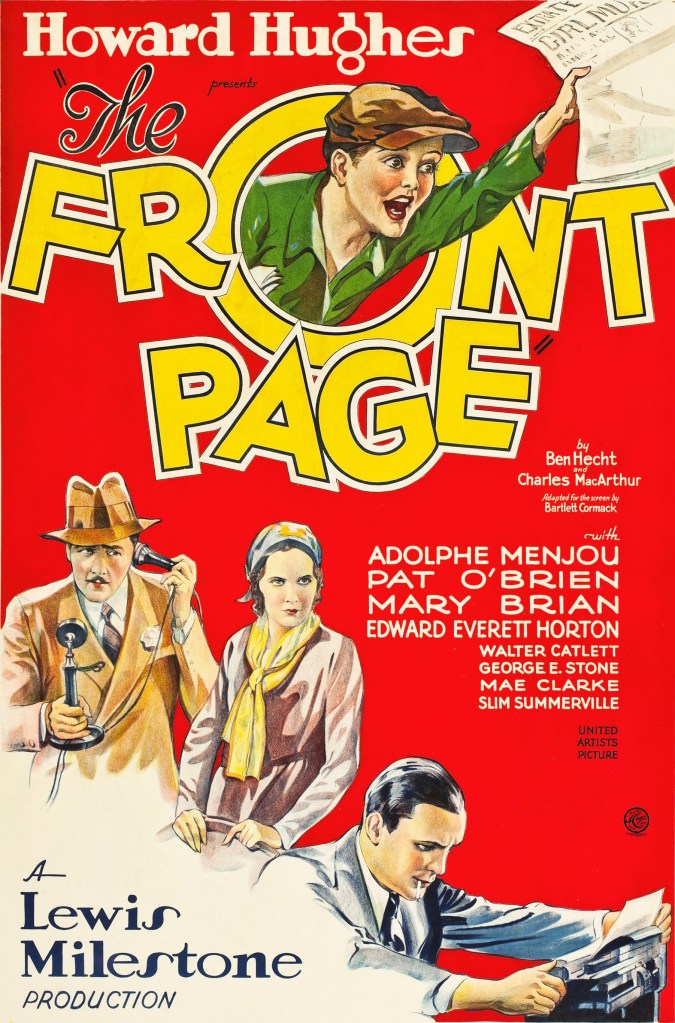
Unscrupulous newspaper men fling fast-paced banter at each other, caring less about the truth and far more about how the copy sells. In many ways the deeply cynical The Front Page hasn’t really aged at all. Probably why it keeps coming back round again-and-again, in different forms for different eras (most famously of course, spiced up with a gender-swopped Hildy as the screwball romance His Girl Friday). I’ll make a confession – not a surprise for those who know my heretical views on His Girl Friday – it’s never been my favourite play and I’ve never found it as funny as others. But, despite my doubts, it’s hard to deny the flair and energy of Milestone’s early talkie.
Star-reported “Hildy” Johnson (Pat O’Brien) has decided the time is right to give up the newsprint game and find happiness with sweetheart Peggy Grant (Mary Brian). But his ruthless editor Walter Burns (Adolphe Menjou) doesn’t want to hear it from his star reporter. Burns is determined to drag Hildy back into the game, and the press-stopping story of an anarchist who escapes hours before his scheduled execution is just the thing to tempt Hildy away from those wedding bells.
And so we get the ultimate cynical press story, adapted from a play that practically invented the image of the newspaper man as a heartless adrenalin junkie more interested in the scoop than the truth. The Front Page is all about the process of collecting the news, and how easily and casually this can be spun into what an audience wants. If the truth does out eventually, it barely happens as a result of the journalists. In fact, our heroes largely end up pushing it because it will get them out of a tight spot and shift a hell of a lot of copies tomorrow morning.
Milestone’s film for years existed as only a bastardised version of the international print: made up of Milestone’s third choice takes and angles with re-edited lines. Restored into his original vision, it’s striking how dynamic and cinematic The Front Page is. While His Girl Friday has it beat on pace (giving us the same story and almost the same amount of dialogue in twelve fewer minutes), arguably Milestone’s film has the edge on cinematic technique. Milestone uses dynamic camera angles and set-ups to inject pace, from the long tracking shot of Burns prowling his newsprint rooms to the rotating camera that roves around the film’s primary location, the courthouse press-room.
It uses fast-cuts and zooms to great effect: the opening shot of a sack of flour, crash zooms out to reveal it’s being used to test a gallows; the ‘yo-yo’ effect as the camera bounces rapidly up-and-down to take us from one reporter’s face to another during a harried reporting scene. Milestone makes large chunks of otherwise single-location farce, come to life through witty angles and blocking, knowing when and when-not to include an actor in the frame to make a joke work. It’s fast-cutting gives it an early screwball style that further accelerates its sense of momentum. It’s a very astutely, very skilfully directed movie that feels several years ahead of its time, and certainly a whole other level above some of the stilted play adaptations Hollywood was churning out.
Even though the script has never been my favourite, it also picks up a lot of screwball dynamism (and healthy dose of pre-Wilder cynicism) in its bones. It’s chorus of newspapermen, all corrupted to various degrees, are finely delineated, each with their own clear characteristics. From Frank McHugh’s shallow cough to Fred Howard’s banjo, via Edward Everett Horton’s prissy germaphobia and half-hearted attempts at woeful poetry, they each have complementary personalities that helps the comedy spark even more. That’s even without their utter disinterest in the personal lives and tragedies of those they are reporting on, or their shameless gilding of the facts of every story (a lovely audio montage sees them all reporting wildly different versions of an arrest).
The Front Page has a strong performance from Adolphe Menjou as the debonair Burns, here embodied by Menjou as a heartlessly ambitious Mephistopheles-type, constantly throwing titbits of temptation in the way of Hildy. Milestone even films him with a Devilish-Murnau strength, popping up seemingly everywhere he needs to be at any moment in time. Add in Menjou’s suave delight in some ruthlessly amoral lines and you have a genuinely spot-on piece of casting. This is less of the case for Pat O’Brien, the sort of actor more familiar as the best friend to a real star, here showing he doesn’t quite have the charisma to carry a dynamic part like Hildy (in fact, O’Brien would have been perfect casting for the male-version of Peggy: dependable, sturdy, dull).
Nevertheless, he and Menjou bounce off each other well in a film that has more than a little homoerotic energy in it (surely the idea for the gender reverse spun from this!) Even Peggy points out Hildy seems as least as excited as the thought of inconveniencing Burns as he does in marrying her (“you’re going to marry me to spite Mr Burns?”). Hildy isn’t just a man fighting against his urge to report on any events happening around him (a potential fire sees him bemoaning he doesn’t have a camera to hand). There is a life and energy to him when riffing ideas with Burns, that he just doesn’t have with anyone else. The two of them burst into life like naughty kids in each other’s company, in a way they just don’t with anyone else.
Hildy may end the film heading into the sunset, but you suspect Burns’ scheme to bring him back (a witty typewriter ping covers a sensor banned piece of naughty language as Burns calls Hildy an SOB on the phone to an underling) is going to succeed with very little hinderance. Because these guys are made for each other and, just like the rest of the cast, they need the buzz of being in the room where it happens far more than the dull dependency of a job in advertising for Peggy’s Dad’s firm.
That The Front Page does very well and while I’m still not an admirer of a play I found overly cynical and glib, Milestone’s dynamically staged version of it may (ironically) be the best of many committed to the screen.


 Movie Musings