
Tag: Sofia Coppola

The Godfather Part III (1990)

The Godfather Part III (1990)

The third film in the series is a decent effort – but pales in comparison to the others

Director: Francis Ford Coppola

Cast: Al Pacino (Michael Corleone), Diane Keaton (Kay Adams-Corleone), Talia Shire (Connie Corleone), Andy Garcia (Vincent Corleone), Eli Wallach (Don Altobello), Joe Mantegna (Joey Zasa), George Hamilton (BJ Harrison), Bridget Fonda (Grace Hamilton), Sofia Coppola (Mary Corleone), Raf Vallone (Cardinal Lamberto), Franc D’Ambrosio (Anthony Corleone), Donal Donnelly (Archbishop Gilday), Richard Bright (Al Neri), Al Martino (Johnny Fontane), John Savage (Father Andrew Hagen), Helmut Berger (Frederick Keinszig), Don Novello (Dominic Abbandando), Franco Citti (Calo)
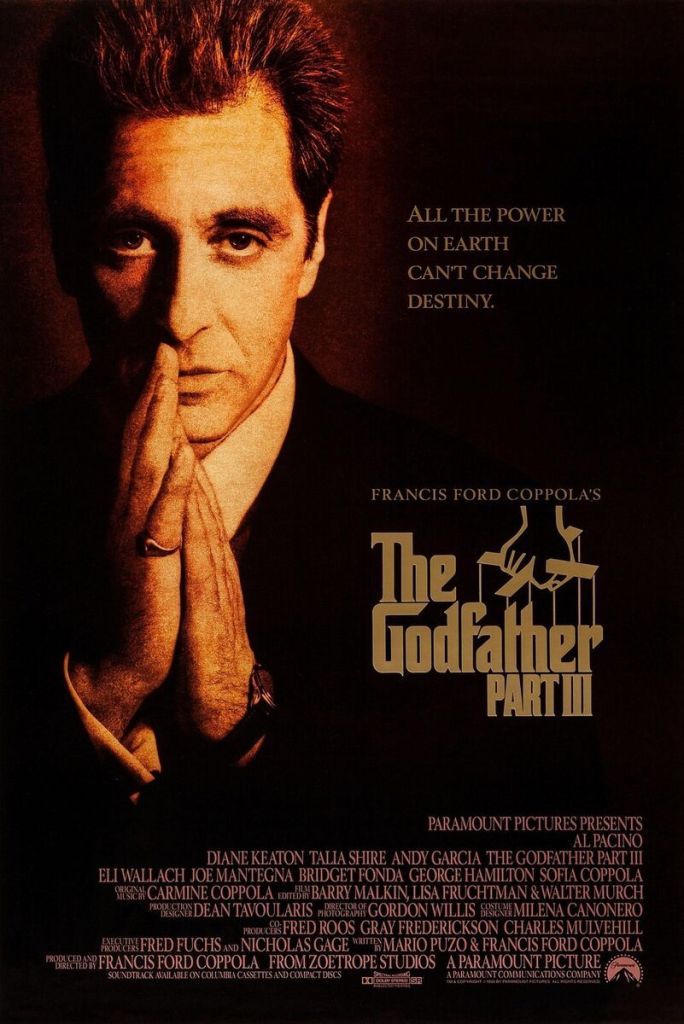
Coppola wanted to call it The Godfather Coda: The Death of Michael Corleone. He got his wish decades later with a belated re-edit release. But at the time, the studio wasn’t having it: this would be a full-blown Third Part to The Godfather. Problem is, those are some very big shoes to step into and The Godfather Part III wasn’t the genre-defining masterpiece its predecessors was. Instead, it’s a decent, melancholic gangster film with touches of King Lear. However, when you are following the sublime being “pretty good” winds up looking like “pretty awful”. The Godfather Part III became the infamous “fuhgeddaboutit” chapter in the saga, the one for completists and those who watch out of duty. On its own merits its fine, but perhaps it was a doomed venture from the start.

It’s 1979 and Michael Corleone (Al Pacino) has aged and mellowed. All his life he’s talked about getting out, and now it seems he finally has. He’s set up a charitable foundation, he’s been honoured by the Vatican and is rebuilding relationships with his children: daughter Mary (Sofia Coppola), now head of his foundation and son Anthony (Franc D’Ambrosio), an opera singer. Even Kay (Diane Keaton) is speaking to him again. Michael is grooming Vincent (Andy Garcia), illegitimate son of his brother Sonny, to take over the reins of the crime family. But then, they drag him back in. Bailing out the Vatican Bank, Michael finds is double-crossed by a collection of Euro-banking crooks, corrupt Church leaders and rival Mafiosi. Will he survive the dangers a return to Sicily will bring?

The unspoken secret of The Godfather is that everyone was always there for the money: they just also had something to prove the first two times and the fire in their bellies to turn gangster grist into cinematic beauty. Fast forward 15 years later, and there hangs an air of “give the studio what it wants” about Part III, coupled with a willingness to rest on laurels. Coppola agreed to do it because his last few films were bombs and he needed the money. Pacino demanded – and got – a massive sum. Keaton coined it. Robert Duvall asked for $1.5 million, didn’t get it and walked. Coppola agreed to turn the script around in lightening time to rush the film to the screen for the inevitable box-office and awards bonanza. No one involved really did the film for either love or passion.

Coppola’s script, written to a deadline, is torn awkwardly between two plots, neither completely satisfactory. His interest lies with the question of whether absolution (of any sort) for Michael is possible. This is the film Coppola wanted to make, but it keeps losing ground though to the other, a complex conspiracy thriller, riffing on real-life events in the Vatican. This conspiracy is frequently dense, difficult to follow and (frankly) not particularly interesting as it trudges through Papal politics and investment banking, seeming existing to provide faces for the inevitable violent montage of inventive hits.

A Part III that zeroed in on Michael himself, his guilts and shame, would have been both distinctive and unique. But The Godfather Part III fudges this. Crucially, the Michael we see here – for all he would have mellowed with age – feels very different from the cold, buttoned-down, calculating figure from the first two. Pacino – perhaps remembering the pressure of Part II that left him exhausted – invests it with more “hoo-hah”. This twinkly Michael, smiles to hide his regrets – when you feel, in reality, years of pressure would have turned him into even more of a murderous Scrooge. I also can’t believe he would be this close to his now adult children. Pacino embraces the moments of raw pain when they come, but this character just doesn’t quite mesh with his previous performances (and his hair looks just plain wrong).
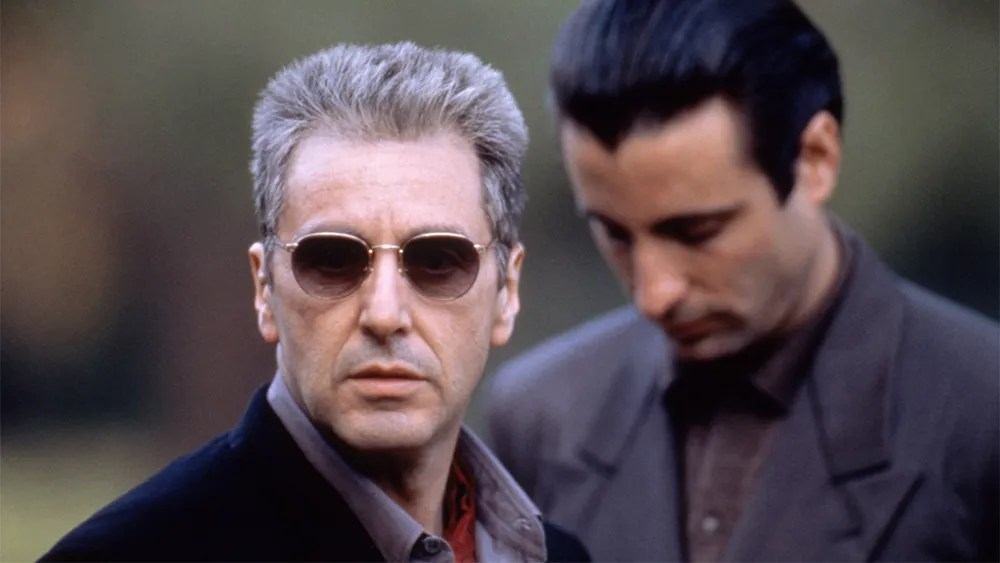
The rushed production further fatally holed this personal plot below the water-line. Duvall was originally intended to serve as the film’s ‘antagonist’, the film planned as a very personal battle between the last two ‘brothers’. Duvall’s departure ripped the heart out of this script, his role redistributed between George Hamilton’s anonymous lawyer, Talia Shire’s Connie (now turned inexplicable consigliere) and Eli Wallach’s treacherous Don Altobello. None of these make any real impact. Rushed production also meant Winona Ryder dropped out of the crucial role of Michael’s daughter, Coppola taking the (disastrous) last-minute decision to cast his daughter Sofia instead.

Sofia Coppola has suffered more than enough from lacerating reviews of her performance (the level of vitriol poured on her is shocking to read today). Let’s just say, while a great director, she is no actor. But then, neither really is Franc D’Ambrosio playing her brother. Both children never become either interesting or dynamic presences. Since their relationship – and the flowering of it – with Michael is crucial to the film’s emotional impact, it’s a fatal flaw. No matter how hard Pacino works, these scenes just don’t ring true. There is no sense of decades of anger and resentment. The drama seeps out of the family scenes and Mary becomes such a flat and two-dimensional character that her impact on the other principle characters never engages.

Sofia Coppola similarly struggles in her romantic scenes with Andy Garcia, again despite his best efforts. Garcia is the best thing in the film, full of cocksure confidence and instinctive cunning, channelling the best elements of Sonny and Michael into a character we’d dearly like to see more of. His facing down of two murderous home-invading hoods is the film’s most memorable moment while Garcia also does excellent work charting Vincent’s slow acceptance of the tragic sacrifices – the killing of parts of your nature – that being ‘the Godfather’ demands. Diane Keaton is also excellent as a far more seasoned and stronger Kay than we’ve seen before.

The Godfather Part III has several fine moments, even if it never coalesces into anything more than a decent film. Coppola restages with assurance and poise versions of previous scenes from the saga – a Little Italy festival assassination, Sicilian countryside violence, an assassin surreptitiously moving through a quiet building, Kay closing a door by choice, the montage of killings – mixed with large scale moments (a helicopter attack on a crime boss meeting is the film’s most ‘action moment’). He works really hard to channel a sense of melancholy: Michael is crippled with diabetes, plagued with guilt for his brother’s death, running to stand still and do the right thing. Pacino’s strongest moments are these moments of rawer emotion: his cloister confession to the future Pope is a masterclass in letting simmering pain suddenly rush to the surface.

But The Godfather Part III always feels like a perfunctory re-heat of key moments, not quite mixed successfully with a redemption (or lack of) tale. This film needed to be a more sombre, focused story about an army of chickens coming home to roost. It needed a stronger sense of Michael desperately scrambling to bring back together the family he was so desperate to protect that he destroyed it. Instead, it’s torn between recapturing old glories and being hampered by fudged attempts to provide emotional depth, linked to a poor structure, unfortunate casting choices and lack of focus. It’s not a bad film – but it is not a great one. And for the third in the greatest series of all time, that wasn’t good enough.

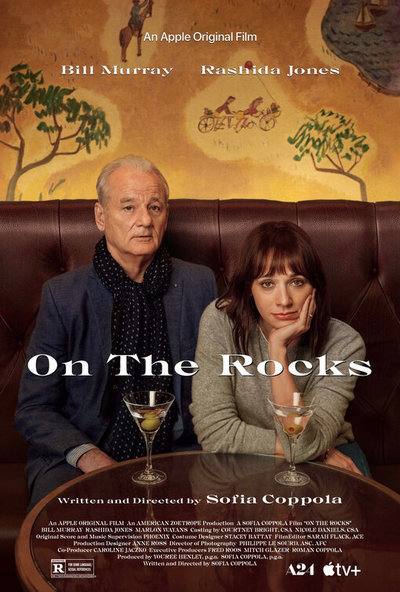
On the Rocks (2020)

Rashida Jones and Bill Murray deal with family problems in On the Rocks

Director: Sofia Coppola

Cast: Rashida Jones (Laura), Bill Murray (Felix), Marlon Wayans (Dean), Jessica Henwick (Fiona), Jenny Slate (Vanessa), Barbara Bain (Gran)

There is often a special bond between fathers and daughters. And it’s one that can be challenged if the father is “replaced” by a husband. After all, nobody wants to go from being the main man to second best. But how complex can this become when the father himself has a track record of selfishness and philandering? And is that the best person for the daughter to turn to when she starts to have doubts about her own husband? In Sofia Coppola’s gentle, light-weight film, Laura (Rashida Jones) reconnects with her roguish millionaire father Felix (Bill Murray), a successful retired art dealer, as she becomes increasingly worried that her husband Dean (Marlon Wayans) is having an affair with his attractive younger colleague Fiona (Jessica Henwick).

Coppola’s new film is an entertaining, low-key family and relationship drama that’s as light as a puff of air. Recycling many familiar ideas from her previous films – in particular the idea of women who seemingly “have it all” but are feeling discontented and trapped in their lives – it spins off into a fairly gentle parable of how doubts and insecurities can take over our lives, which mainly serves as a lovely little showpiece for two very engaging actors to entertainingly do their thing.

Rashida Jones balances the trickier part as a woman who’s half endearingly fond of her fun-loving dad, half infuriated and damaged by the way he wrecked his marriage to her mother and ruined her childhood (it seems her sister and mother are no longer on speaking terms with him). At the same time, she’s keen to hold onto her successful writing career and family life – while also facing an existential crisis as she feels herself becoming more and more stuck in a rut. There are distant echoes of the lack of focus Scarlett Johansson’s character felt in Lost in Translation, the many lonely women running the house in The Beguiled, or the rich girls cut adrift in The Bling Ring or Marie Antoinette.

Into all this drops the bombshell of her husband’s possible infidelity. Coppola gently uses this as a subtle investigation of human nature. Is infidelity and betrayal something all people have as common possibilities? Or does a history of infidelity in our families make us more ready to see it everywhere? Gentle is the word, as the film doesn’t really labour any of these points – perhaps worried that to do so would take it into deeper waters than it has the nerves to handle – and prefers to keep the mood light and frothy. This does mean that when – eventually – emotional moments come, they come rather from nothing, and a braver film would have balanced better the lightness of father and daughter chasing after a (possibly) cheating husband, with tension between that same father and daughter over his appalling past behaviour.

But then, the film perhaps falls rather in love with Bill Murray – and genuinely it’s pretty hard not to. Sofia Coppola again provides Murray with a part designed to match all his strengths. A charming performer, it’s very hard (near impossible) not to like Murray and as he coasts through the film with relaxed cool, arching an eyebrow there, a touch of glib lightness here, investing certain lines with a saggy sadness, others with a playful childishness, you’ll enjoy every moment. Murray makes perfect sense as the ageing rouéand cad, who has lived his life entirely for his own pleasure, and now is conducted by chauffeur from hotel to hotel, flirting with any woman who crosses his path.

It’s a delightful performance, with several scene stealing moments – not least when Felix is pulled over by the cops and charms his way out of a ticket with confidence, a bottomless contact book and charm. The cops even push-start his showy old sports car. Of course it’s the ultimate display of white privilege: I’m interested if Dean would have had similar success if it was him. The film shies away from any commentary on race at all, which feels like a missed opportunity. Does Dean put so many hours into work because he needs to prove himself in the ways people like Felix never had to? A different film might have wondered if sub-consciously Felix was even more jealous and concerned about losing his daughter to a black man. But these are areas the film chooses not to go into.

Instead it largely settles for being a charming meander, centred around Murray’s character, that doesn’t want you to look to closely and realise what a selfish cad he really is. Of course the film is really about Felix’s regrets about not having the relationship he would like to have with his children (and Murray more than gets this across with his skilful suggestion of sadness behind the eyes), but even this is a beat the film very lightly taps. What you end up with is a very light, almost whimsical film that moves through a series of events that wind up feeling rather inconsequential. A puff of air you feel would blow the film apart.

The Beguiled (2017)

Nicole Kidman struggles to resist the charms of Colin Farrell in The Beguiled

Director: Sofia Coppola

Cast: Nicole Kidman (Miss Martha), Kirsten Dunst (Edwina), Elle Fanning (Alicia), Colin Farrell (Corporal McBurney), Oona Laurence (Amy), Angourie Rice (Jane), Addison Riecke (Marie), Emma Howard (Emily)

A remake of Don Siegel’s adaptation of the original novel, The Beguiled throws a feminist slant on a story of a confederate soldier, Corporal McBurney (Colin Farrell) who, in the later years of the Civil War, is found injured in the grounds of a girl’s school, where the women have continued to run the operation while the menfolk are consumed with (and by) the war. The school is run by the distant Miss Martha (Nicole Kidman), with the lead teacher Edwina (Kirsten Dunst) and five students of varying ages. All of the girls and women find themselves entranced (beguiled!) with the deceptively gentlemanly McBurney, whose true aims may be darker than assumed.

Sofia Coppola’s version of the story shifts the attention onto the women of the piece, and their plight and emotional journeys. This is a perfectly legitimate stance to take – and showing effectively a colony of girls and women in the 1860s living some sort of structured commune life is interesting and different – but Coppola’s film has a coolness and distance to it that ironically makes it far less than beguiling than it should be.

Beautifully filmed as the film is, it’s slow pace and meditative tone – as well as the rather obvious points it seems determined to make about male and female relations – actually serve to make the film less engaging than it should be. Wonderfully framed and painterly in its execution, with an effective mix of classical and 1970s style, it still never quite sparks into life.

The cast also struggle to bring a heartbeat to their characters. Nicole Kidman brings her customary reserve and elegance to a woman who has hints of a mysterious past that troubles her to this day, but the role remains distant and difficult to read – more than the film really requires. A clash or seduction between her and Colin Farrell’s corporal keeps promising dynamite but the explosions never really seem to come. Farrell laces his role with charm and a gruff masculinity, but the role misses a sense of his own darkness or manipulative nature until quite late, with the final act revelations making him appear more angry and bitter than the role really requires. It all kind of sums up the film that gets lost in its artifice and fails to uncover its heart.

The film, you could argue, does its best to beguile the audience with McBurney as the film’s character are. We are shown at every angle his vulnerability and tender politeness, and hidden from us for too long are his more manipulative elements. Coppola’s film becomes an intense study instead of sexual feelings and relations within a confined space. From sensual hand washes from Miss Martha, to intense declarations with lonely teacher Edwina, to not-so-innocent flirtations with the pupils, there is more than enough evidence that McBurney’s desire to stay may well be as much linked to seeing the school as having the potential to be his own private harem. The film’s failure in this intense sexual politics is that, while it captures moments of the simmer of attraction, it fails to really establish the danger that McBurney could suggest, as a violent man of action with complete control over a group of women.

Indeed the final moments of the film even suggest that the school itself may be a sort of siren’s bay – although lord knows McBurney is no Odysseys – which I found a rather confusing beat. Effective as the final images, or the film’s last supper betrayals, may be, they don’t carry quite enough wait because the film never quite nails the sexual tension it is aiming for, or the sensual danger it is trying to establish as a theme within the film. 

Other changes make less sense as well. Coppola deliberately changes the race of Edwina, from a mixed-race young woman to someone white enough to be played by Kirsten Dunst. While Dunst’s performance is fine, many of the themes of Edwina’s lack of confidence, her self-loathing, her feeling of having no place outside of the school, of being somehow less than other women are left in place. These themes of course make perfect sense for a mixed race woman in the 1860s who has landed a job through the connections of her father, but they make less sense for an attractive young schoolteacher with a privileged background. Coppola made the change because she felt that she could not do the theme justice, but she misses the fact that the very appearance of the character is the context needed for her to make sense.

The Beguiled is beautiful to observe and has its moments, but it never really comes to light the way it should. Thoughtful and poetic a director as Coppola is, she has created a film here that feels all artifice and no depth, that wants to paint a picture of the life of women in the civil war but never really has the energy and fire to make this come to life in a way to make the audience as engaged as they should be.